Dr.Alan Bruce
Universal Learning Systems - Dublin
 Rationale
 Dimensions of difference - disability
 Impact
 Globalization and change in learning
 Context
 International and European
 Opportunities
 Approaching best practice
 Disability is and always has been an issue of
access and rights
 Common humanity/common reactions
 Impact of value systems and religious belief
 Role of war and migration
 Continuing impact of institutionalization,
charity and control
 Impact of learning solutions and ICT
 Disability: fear, loathing, guilt and shame
 Historic impact of segregation and exclusion
 Sense of impossibility – no alternatives
offered to this population
 Systemic exclusion in all European countries
 From Foucault to Laing – analysis of the
systems, structures and methods that
oppress
 Medical and social models
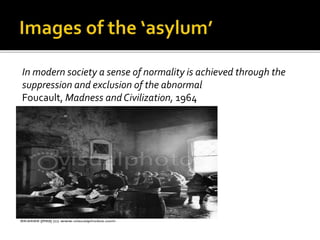
In modern society a sense of normality is achieved through the
suppression and exclusion of the abnormal
Foucault, Madness andCivilization, 1964
 Foundational and critical document
 Published byWHO
 State of the art analysis and review
 Overall aims of Report:
 To provide governments and civil society with a
comprehensive description of the importance of
disability and an analysis of the responses provided,
based on the best available scientific information.
 Based on this analysis, to make recommendations for
action at national and international levels.
 Impact of vocational rehabilitation since 1947
 War and effects of war
 Independent Living movement (1967)
 Progressive legislation – ADA 1990.
 Europe – from mainstreaming to inclusion
 Assistive technologiesAAATE and RESNA
 Research and comparative analysis
 Universal Design principles
 Innovation and adaptation in education
 Historic pattern – vicious circle of low
expectations
 Institutionalization and ‘special’ needs
 Embedded pervasive imagery of dependence
 Family, support and care
 Medicalization of discourse
 Legacies of charity
 The vocational imperative – where to now?
 Teaching – and learning – around difference
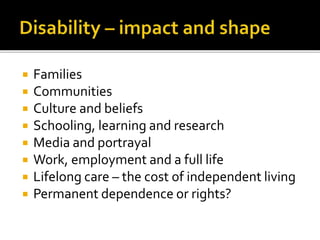
 Families
 Communities
 Culture and beliefs
 Schooling, learning and research
 Media and portrayal
 Work, employment and a full life
 Lifelong care – the cost of independent living
 Permanent dependence or rights?
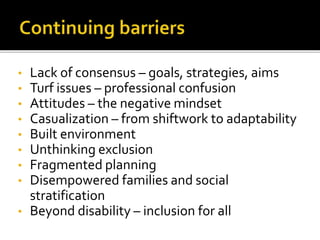
• Lack of consensus – goals, strategies, aims
• Turf issues – professional confusion
• Attitudes – the negative mindset
• Casualization – from shiftwork to adaptability
• Built environment
• Unthinking exclusion
• Fragmented planning
• Disempowered families and social
stratification
• Beyond disability – inclusion for all
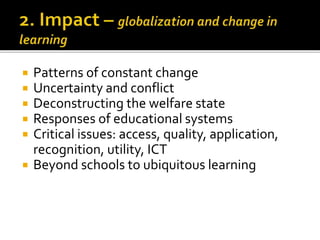
 Patterns of constant change
 Uncertainty and conflict
 Deconstructing the welfare state
 Responses of educational systems
 Critical issues: access, quality, application,
recognition, utility, ICT
 Beyond schools to ubiquitous learning
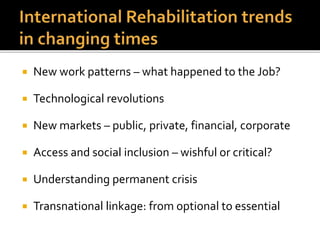
 New work patterns – what happened to the Job?
 Technological revolutions
 New markets – public, private, financial, corporate
 Access and social inclusion – wishful or critical?
 Understanding permanent crisis
 Transnational linkage: from optional to essential
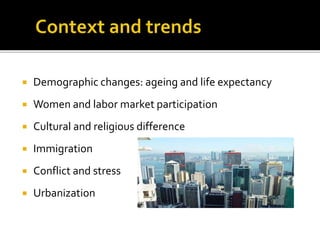
 Demographic changes: ageing and life expectancy
 Women and labor market participation
 Cultural and religious difference
 Immigration
 Conflict and stress
 Urbanization
 Patterns of constant change
 Permanent migration mobility
 Outsourcing
 Flexible structures and modalities
 End of job norms
 Knowledge economy
 Structural inequalities
 Exponential increase in information
 Critical reflection vs. need to know: where
does e-learning sit?
 Peer-to-peer learning economy: social media
 Free speech and autonomous expression
 Developing critical thinking skills
 Autonomous problem solving
 Diversity embedded
 Historic impact low expectations
 Institutionalization and ‘special’ needs
 Medicalization of service models
 Legacy of charity
 The transformation of work
 Learning and difference
 Diminishing public space
 Linking disability to other social justice
models
The emergence of a true global economy
dictates a new role in international activities to
promote the well being of persons with
disabilities through access to jobs, better
technology and social supports...
Source: NIDRR Long Range Plan 1999-2004
 Ubiquity and access
 Innovation – the new imperative
 Professionals, Customers, Communities
 Quality, standards and assessment
 Curriculum or competence: institutional crisis
of international educational systems
 Freedom, openness and creativity in the
digital economy
 Lisbon Declaration
 Inclusive education as principle
 Significant national variations
 Separation between health, social services
and education functions and responsibilities
 Poor multidisciplinary developement
 Family exclusion
 Focus on educational, health and social needs
 Universal Design for Learning is a set of principles
for curriculum development that gives all individuals
equal opportunities to learn.
 UDL provides a blueprint for creating instructional
goals, methods, materials and assessments that
work for everyone - not a single, one-size-fits-all
solution but rather flexible approaches that can be
customized and adjusted for individual needs.
 Universal Design for Learning (UDL) is a framework that
addresses the primary barrier to fostering expert
learners within instructional environments: inflexible,
“one-size-fits-all” curricula.
 Inflexible curricula raise unintentional barriers to
learning.
 In learning environments individual variability is the
norm, not the exception
 UDL addresses learner variability by suggesting flexible
goals, methods, materials and assessments that
empower educators to meet these varied needs.
 The purpose of UDL curricula is not simply to help
students master a specific body of knowledge or set
of skills, but to help them master learning itself— to
become expert learners.
 Expert learners have 3 broad characteristics:
1. strategic, skillful and goal directed
2. knowledgeable
3. purposeful and motivated to learn more
 CAST (Center for Applied SpecialTechnology)
established 1984
 First Federal grant from NSF 1994
 UDL defined. CAST invents “Bobby” 1995
 CAST Advisory Council established 2005
 National UDLTaskforce established 2006
 First Statutory definition of UDL 2008
 National Center for Universal Design established
2009
 University of North Carolina academic expertise
 Impact of universal schooling
 The university revolution – from distance
learning to MOOCs
 Impact of legislation and policy
 Technological revolution only starting
 From psychology to engineering – the altered
environment
 Shaping the mind – struggles with attitudes
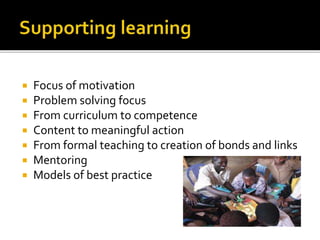
 Focus of motivation
 Problem solving focus
 From curriculum to competence
 Content to meaningful action
 From formal teaching to creation of bonds and links
 Mentoring
 Models of best practice
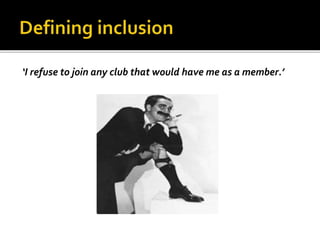
‘I refuse to join any club that would have me as a member.’
 Modeling
 Empathic analysis in transition support
 Social analytics for multidisciplinary work
 Roles and responsibility
 Advanced digital competence/assistive
technologies
 Comparative research methods
 Independent living/rights based models
 Universal Design
 Defining needs
 Defining required supports
 Developing teams: communication
 Avoiding traps – the standardized label
 Critical and reflective thinking and practice
 Empathy
 Sensitivity and clarity – goal setting
 Evaluative review
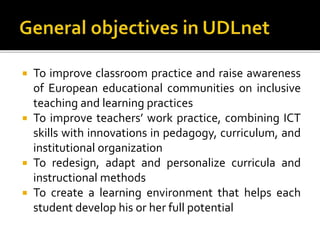
 To improve classroom practice and raise awareness
of European educational communities on inclusive
teaching and learning practices
 To improve teachers’ work practice, combining ICT
skills with innovations in pedagogy, curriculum, and
institutional organization
 To redesign, adapt and personalize curricula and
instructional methods
 To create a learning environment that helps each
student develop his or her full potential
 Rights and advocacy
 Quality circles (Netherlands)
 Collaborative research
 Culture of innovation
 Highly qualified staff
 Equality frameworks and enforceable standards
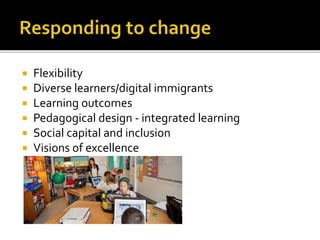
 Flexibility
 Diverse learners/digital immigrants
 Learning outcomes
 Pedagogical design - integrated learning
 Social capital and inclusion
 Visions of excellence
Dr. Alan Bruce
Universal Learning Systems
Dublin, Ireland
abruce@ulsystems.com
Tel: +353-87-249-8791

Inclusion: the final frontier - Universal Design for Learning

  • 1.
  • 2.
     Rationale  Dimensionsof difference - disability  Impact  Globalization and change in learning  Context  International and European  Opportunities  Approaching best practice
  • 3.
     Disability isand always has been an issue of access and rights  Common humanity/common reactions  Impact of value systems and religious belief  Role of war and migration  Continuing impact of institutionalization, charity and control  Impact of learning solutions and ICT
  • 4.
     Disability: fear,loathing, guilt and shame  Historic impact of segregation and exclusion  Sense of impossibility – no alternatives offered to this population  Systemic exclusion in all European countries  From Foucault to Laing – analysis of the systems, structures and methods that oppress  Medical and social models
  • 5.
    In modern societya sense of normality is achieved through the suppression and exclusion of the abnormal Foucault, Madness andCivilization, 1964
  • 6.
     Foundational andcritical document  Published byWHO  State of the art analysis and review  Overall aims of Report:  To provide governments and civil society with a comprehensive description of the importance of disability and an analysis of the responses provided, based on the best available scientific information.  Based on this analysis, to make recommendations for action at national and international levels.
  • 7.
     Impact ofvocational rehabilitation since 1947  War and effects of war  Independent Living movement (1967)  Progressive legislation – ADA 1990.  Europe – from mainstreaming to inclusion  Assistive technologiesAAATE and RESNA  Research and comparative analysis  Universal Design principles  Innovation and adaptation in education
  • 8.
     Historic pattern– vicious circle of low expectations  Institutionalization and ‘special’ needs  Embedded pervasive imagery of dependence  Family, support and care  Medicalization of discourse  Legacies of charity  The vocational imperative – where to now?  Teaching – and learning – around difference
  • 9.
     Families  Communities Culture and beliefs  Schooling, learning and research  Media and portrayal  Work, employment and a full life  Lifelong care – the cost of independent living  Permanent dependence or rights?
  • 10.
    • Lack ofconsensus – goals, strategies, aims • Turf issues – professional confusion • Attitudes – the negative mindset • Casualization – from shiftwork to adaptability • Built environment • Unthinking exclusion • Fragmented planning • Disempowered families and social stratification • Beyond disability – inclusion for all
  • 11.
     Patterns ofconstant change  Uncertainty and conflict  Deconstructing the welfare state  Responses of educational systems  Critical issues: access, quality, application, recognition, utility, ICT  Beyond schools to ubiquitous learning
  • 12.
     New workpatterns – what happened to the Job?  Technological revolutions  New markets – public, private, financial, corporate  Access and social inclusion – wishful or critical?  Understanding permanent crisis  Transnational linkage: from optional to essential
  • 13.
     Demographic changes:ageing and life expectancy  Women and labor market participation  Cultural and religious difference  Immigration  Conflict and stress  Urbanization
  • 14.
     Patterns ofconstant change  Permanent migration mobility  Outsourcing  Flexible structures and modalities  End of job norms  Knowledge economy  Structural inequalities
  • 15.
     Exponential increasein information  Critical reflection vs. need to know: where does e-learning sit?  Peer-to-peer learning economy: social media  Free speech and autonomous expression  Developing critical thinking skills  Autonomous problem solving  Diversity embedded
  • 16.
     Historic impactlow expectations  Institutionalization and ‘special’ needs  Medicalization of service models  Legacy of charity  The transformation of work  Learning and difference  Diminishing public space  Linking disability to other social justice models
  • 17.
    The emergence ofa true global economy dictates a new role in international activities to promote the well being of persons with disabilities through access to jobs, better technology and social supports... Source: NIDRR Long Range Plan 1999-2004
  • 18.
     Ubiquity andaccess  Innovation – the new imperative  Professionals, Customers, Communities  Quality, standards and assessment  Curriculum or competence: institutional crisis of international educational systems  Freedom, openness and creativity in the digital economy
  • 19.
     Lisbon Declaration Inclusive education as principle  Significant national variations  Separation between health, social services and education functions and responsibilities  Poor multidisciplinary developement  Family exclusion  Focus on educational, health and social needs
  • 20.
     Universal Designfor Learning is a set of principles for curriculum development that gives all individuals equal opportunities to learn.  UDL provides a blueprint for creating instructional goals, methods, materials and assessments that work for everyone - not a single, one-size-fits-all solution but rather flexible approaches that can be customized and adjusted for individual needs.
  • 21.
     Universal Designfor Learning (UDL) is a framework that addresses the primary barrier to fostering expert learners within instructional environments: inflexible, “one-size-fits-all” curricula.  Inflexible curricula raise unintentional barriers to learning.  In learning environments individual variability is the norm, not the exception  UDL addresses learner variability by suggesting flexible goals, methods, materials and assessments that empower educators to meet these varied needs.
  • 22.
     The purposeof UDL curricula is not simply to help students master a specific body of knowledge or set of skills, but to help them master learning itself— to become expert learners.  Expert learners have 3 broad characteristics: 1. strategic, skillful and goal directed 2. knowledgeable 3. purposeful and motivated to learn more
  • 23.
     CAST (Centerfor Applied SpecialTechnology) established 1984  First Federal grant from NSF 1994  UDL defined. CAST invents “Bobby” 1995  CAST Advisory Council established 2005  National UDLTaskforce established 2006  First Statutory definition of UDL 2008  National Center for Universal Design established 2009  University of North Carolina academic expertise
  • 24.
     Impact ofuniversal schooling  The university revolution – from distance learning to MOOCs  Impact of legislation and policy  Technological revolution only starting  From psychology to engineering – the altered environment  Shaping the mind – struggles with attitudes
  • 25.
     Focus ofmotivation  Problem solving focus  From curriculum to competence  Content to meaningful action  From formal teaching to creation of bonds and links  Mentoring  Models of best practice
  • 26.
    ‘I refuse tojoin any club that would have me as a member.’
  • 27.
     Modeling  Empathicanalysis in transition support  Social analytics for multidisciplinary work  Roles and responsibility  Advanced digital competence/assistive technologies  Comparative research methods  Independent living/rights based models  Universal Design
  • 28.
     Defining needs Defining required supports  Developing teams: communication  Avoiding traps – the standardized label  Critical and reflective thinking and practice  Empathy  Sensitivity and clarity – goal setting  Evaluative review
  • 29.
     To improveclassroom practice and raise awareness of European educational communities on inclusive teaching and learning practices  To improve teachers’ work practice, combining ICT skills with innovations in pedagogy, curriculum, and institutional organization  To redesign, adapt and personalize curricula and instructional methods  To create a learning environment that helps each student develop his or her full potential
  • 30.
     Rights andadvocacy  Quality circles (Netherlands)  Collaborative research  Culture of innovation  Highly qualified staff  Equality frameworks and enforceable standards
  • 31.
     Flexibility  Diverselearners/digital immigrants  Learning outcomes  Pedagogical design - integrated learning  Social capital and inclusion  Visions of excellence
  • 32.
    Dr. Alan Bruce UniversalLearning Systems Dublin, Ireland abruce@ulsystems.com Tel: +353-87-249-8791