From Open to Inclusive:
asserting rights based approaches in globalized learning
Dr. Alan Bruce ULS Dublin
LINQ 2015 Brussels, Belgium 12 May 2015
Globalization
 Trends: economic, social, commercial, cultural
 Communications on unprecedented scale
 Planetary scale is at least potentially possible
 Glitz disguises realities of continuing disequilibrium
 Comparative possibilities
 Alternatives are possible: Assimilation is expected
Global benefit?
 Levels of imbalance are actually increasing
 Major disparities in power and access to resources
 Severe disruptions in terms of acceptance and stability
 Crisis in terms of resources and access
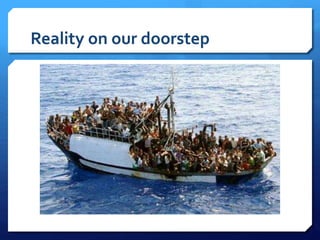
 Hunger and rage – the migrant flood
 Urbanized nightmares of hopelessness
 Equality: myth or possibility?
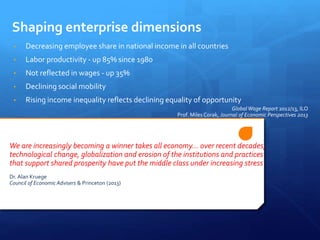
Shaping enterprise dimensions
• Decreasing employee share in national income in all countries
• Labor productivity - up 85% since 1980
• Not reflected in wages - up 35%
• Declining social mobility
• Rising income inequality reflects declining equality of opportunity
Global Wage Report 2012/13, ILO
Prof. Miles Corak, Journal of Economic Perspectives 2013
We are increasingly becoming a winner takes all economy… over recent decades,
technological change, globalization and erosion of the institutions and practices
that support shared prosperity have put the middle class under increasing stress
Dr. Alan Kruege
Council of Economic Advisers & Princeton (2013)
Reality on our doorstep
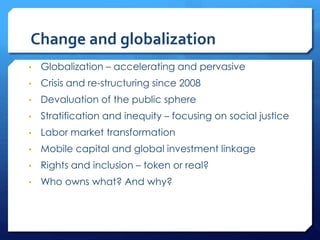
Change and globalization
• Globalization – accelerating and pervasive
• Crisis and re-structuring since 2008
• Devaluation of the public sphere
• Stratification and inequity – focusing on social justice
• Labor market transformation
• Mobile capital and global investment linkage
• Rights and inclusion – token or real?
• Who owns what? And why?
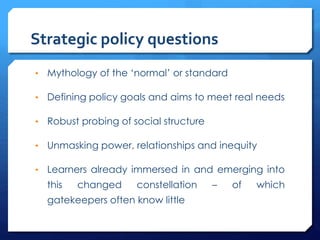
Strategic policy questions
• Mythology of the ‘normal’ or standard
• Defining policy goals and aims to meet real needs
• Robust probing of social structure
• Unmasking power, relationships and inequity
• Learners already immersed in and emerging into
this changed constellation – of which
gatekeepers often know little
ICT and re-imagined access
 Contradictory and paradoxical process
 Never greater potential - side by side with increasing
disparities of access
 What we think:
 Citizens
 Shared knowledge
 Participative engagement
 What we have:
 Consumers
 Increasing exclusion
 Significant problems with equitable access
Cohen and Kennedy (2000): 6 issues around globalization
that impact directly on education:
 Changing concepts of space and time
 An increasing number of cultural interactions
 Common problems facing the world’s inhabitants
 Growing interconnections and interdependence
 Networks of increasingly powerful transnational
actors and organization
 Synchronization of all dimensions involved in
globalization.
Fragments of a globalized future…
 Planetary urbanization
 New diversities
 Equality, access and inclusive design
 Understanding crisis – living with crisis
 Globalization: obliteration of borders… but creation of
connectivity
 New markets
 Constant upskilling
Crisis and imbalance
 Education as both structure and process
 Education systems mirror world and society of
which they are part
 Education systems as constraining as liberating
 Forum for ideas or market for products? Or
both….?
 Commodification of knowledge
 Impact on education systems (Freire, Illich, Field)
 Impact on work (Braverman, Haraszti, Davis)
 Impact on community
Purposive learning in an age of
uncertainty
 End of linear models of learning
 Cognitive dissonance: what is needed is not being
provided
 Alienation and anomie in a changing world
 Labor market flux and the loss of autonomy
 Adaptability and innovation as norm, not exception
 Globalized paradigms and fractured community
 Elephants in the room: power and ownership
Further issues
Quantum increase in data:
 Information as a marketable resource
 Massification at all levels
 Ownership and control
 The Surveillance State
Participation and openness
 Using a system or being used?
 Active use…to active participation
 At what point is meaning and value added?
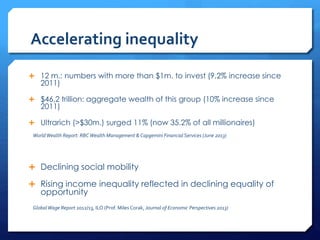
Accelerating inequality
 12 m.: numbers with more than $1m. to invest (9,2% increase since
2011)
 $46,2 trillion: aggregate wealth of this group (10% increase since
2011)
 Ultrarich (>$30m.) surged 11% (now 35,2% of all millionaires)
WorldWealth Report: RBCWealth Management & Capgemini Financial Services (June 2013)
 Declining social mobility
 Rising income inequality reflected in declining equality of
opportunity
GlobalWage Report 2012/13, ILO (Prof. Miles Corak, Journal of Economic Perspectives 2013)
Inclusion - five key issues in Europe
1. Measures to reduce early school leaving
2. Priority education measures in relation to
disadvantaged pupils and groups
3. Inclusive education measures in relation to
pupils with special needs
4. Safe education measures in relation on the
reduction of bullying and harassment
5. Teacher support measures.
Trajectories of inclusion
 Youth and mass unemployment
 Demographics: ageing and life expectancy
 Women and labor market participation
 Immigration, cultural and religious difference
 Disability
 Conflict, stress, anomie
 Urbanization, dissent and democratic deficits
Meaningful inclusion
 Inclusion changes both sides – the act of mainstreaming is
to change the mainstream not the ‘excluded’
 From objects to subjects
 Narratives of adaptation and discovery
 From target group to citizen
 Critical role of teachers
 Inclusion and the dialectic of rights
Excluding systems
 Legacies of segregated schooling
 Gender
 Disability
 Religion
 Ability
 Language
 Class
 Unequal school systems mirror unequal society
 Schooling is not separate from wider socio-political
environment
Key points
 Schooling and education at a crossroads: both structure and
process
 Labor market and education increasingly connected
 Planetary focus is on mobility, skills and innovation
 Huge impact of increasing inequality of access and of
resources
 Crisis as the norm
 Addressing assessment
 Performance, standards, quality, reproducibility and added
value at the heart of competence
 ICT embedded in contexts of vision and values
Thank you
Dr. Alan Bruce
ULS Dublin
abruce@ulsystems.com
Associate Offices: BARCELONA - HELSINKI - SÃO PAULO - CHICAGO

From Open to Inclusive: asserting rights based approaches in globalized learning

  • 1.
    From Open toInclusive: asserting rights based approaches in globalized learning Dr. Alan Bruce ULS Dublin LINQ 2015 Brussels, Belgium 12 May 2015
  • 2.
    Globalization  Trends: economic,social, commercial, cultural  Communications on unprecedented scale  Planetary scale is at least potentially possible  Glitz disguises realities of continuing disequilibrium  Comparative possibilities  Alternatives are possible: Assimilation is expected
  • 3.
    Global benefit?  Levelsof imbalance are actually increasing  Major disparities in power and access to resources  Severe disruptions in terms of acceptance and stability  Crisis in terms of resources and access  Hunger and rage – the migrant flood  Urbanized nightmares of hopelessness  Equality: myth or possibility?
  • 4.
    Shaping enterprise dimensions •Decreasing employee share in national income in all countries • Labor productivity - up 85% since 1980 • Not reflected in wages - up 35% • Declining social mobility • Rising income inequality reflects declining equality of opportunity Global Wage Report 2012/13, ILO Prof. Miles Corak, Journal of Economic Perspectives 2013 We are increasingly becoming a winner takes all economy… over recent decades, technological change, globalization and erosion of the institutions and practices that support shared prosperity have put the middle class under increasing stress Dr. Alan Kruege Council of Economic Advisers & Princeton (2013)
  • 5.
  • 6.
    Change and globalization •Globalization – accelerating and pervasive • Crisis and re-structuring since 2008 • Devaluation of the public sphere • Stratification and inequity – focusing on social justice • Labor market transformation • Mobile capital and global investment linkage • Rights and inclusion – token or real? • Who owns what? And why?
  • 7.
    Strategic policy questions •Mythology of the ‘normal’ or standard • Defining policy goals and aims to meet real needs • Robust probing of social structure • Unmasking power, relationships and inequity • Learners already immersed in and emerging into this changed constellation – of which gatekeepers often know little
  • 8.
    ICT and re-imaginedaccess  Contradictory and paradoxical process  Never greater potential - side by side with increasing disparities of access  What we think:  Citizens  Shared knowledge  Participative engagement  What we have:  Consumers  Increasing exclusion  Significant problems with equitable access
  • 9.
    Cohen and Kennedy(2000): 6 issues around globalization that impact directly on education:  Changing concepts of space and time  An increasing number of cultural interactions  Common problems facing the world’s inhabitants  Growing interconnections and interdependence  Networks of increasingly powerful transnational actors and organization  Synchronization of all dimensions involved in globalization.
  • 10.
    Fragments of aglobalized future…  Planetary urbanization  New diversities  Equality, access and inclusive design  Understanding crisis – living with crisis  Globalization: obliteration of borders… but creation of connectivity  New markets  Constant upskilling
  • 11.
    Crisis and imbalance Education as both structure and process  Education systems mirror world and society of which they are part  Education systems as constraining as liberating  Forum for ideas or market for products? Or both….?  Commodification of knowledge  Impact on education systems (Freire, Illich, Field)  Impact on work (Braverman, Haraszti, Davis)  Impact on community
  • 12.
    Purposive learning inan age of uncertainty  End of linear models of learning  Cognitive dissonance: what is needed is not being provided  Alienation and anomie in a changing world  Labor market flux and the loss of autonomy  Adaptability and innovation as norm, not exception  Globalized paradigms and fractured community  Elephants in the room: power and ownership
  • 13.
    Further issues Quantum increasein data:  Information as a marketable resource  Massification at all levels  Ownership and control  The Surveillance State Participation and openness  Using a system or being used?  Active use…to active participation  At what point is meaning and value added?
  • 14.
    Accelerating inequality  12m.: numbers with more than $1m. to invest (9,2% increase since 2011)  $46,2 trillion: aggregate wealth of this group (10% increase since 2011)  Ultrarich (>$30m.) surged 11% (now 35,2% of all millionaires) WorldWealth Report: RBCWealth Management & Capgemini Financial Services (June 2013)  Declining social mobility  Rising income inequality reflected in declining equality of opportunity GlobalWage Report 2012/13, ILO (Prof. Miles Corak, Journal of Economic Perspectives 2013)
  • 15.
    Inclusion - fivekey issues in Europe 1. Measures to reduce early school leaving 2. Priority education measures in relation to disadvantaged pupils and groups 3. Inclusive education measures in relation to pupils with special needs 4. Safe education measures in relation on the reduction of bullying and harassment 5. Teacher support measures.
  • 16.
    Trajectories of inclusion Youth and mass unemployment  Demographics: ageing and life expectancy  Women and labor market participation  Immigration, cultural and religious difference  Disability  Conflict, stress, anomie  Urbanization, dissent and democratic deficits
  • 17.
    Meaningful inclusion  Inclusionchanges both sides – the act of mainstreaming is to change the mainstream not the ‘excluded’  From objects to subjects  Narratives of adaptation and discovery  From target group to citizen  Critical role of teachers  Inclusion and the dialectic of rights
  • 18.
    Excluding systems  Legaciesof segregated schooling  Gender  Disability  Religion  Ability  Language  Class  Unequal school systems mirror unequal society  Schooling is not separate from wider socio-political environment
  • 19.
    Key points  Schoolingand education at a crossroads: both structure and process  Labor market and education increasingly connected  Planetary focus is on mobility, skills and innovation  Huge impact of increasing inequality of access and of resources  Crisis as the norm  Addressing assessment  Performance, standards, quality, reproducibility and added value at the heart of competence  ICT embedded in contexts of vision and values
  • 20.
    Thank you Dr. AlanBruce ULS Dublin abruce@ulsystems.com Associate Offices: BARCELONA - HELSINKI - SÃO PAULO - CHICAGO