
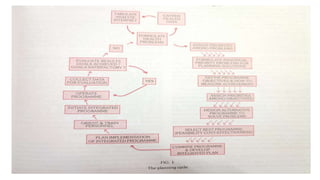
Planning Cycle
Dr Akshay Minhas
Planning
• Process of analyzing a system, or defining a problem, assessing the
extent to which the problem exists as a need , formulating goals and
objectives to alleviate or ameliorate those identified needs, examining
and choosing from among alternative intervention strategies, initiating
the necessary action for its implementation and monitoring the system
to ensure proper implementation of the plan and evaluating the results
of intervention in the light of stated objectives.
Preplanning
• Existing policies, legislation, health structure, institutes, political
commitments etc. are considered, assessed .
• Place, time, population and disease condition.
1 Analyzing, Identifying & setting the
priorities of the health problem
• It involves the collection , assessment and interpretation of reliable information.
• Minimum data:
• A) The population, its age and sex structure.
• B) Statistics of morbidity and mortality
• C) The epidemiology and geographical distribution of different diseases.
• D) Medical care facilities such as hospitals, health centers, and other health agencies-both
public and private.
• E) The technical manpower of various categories
• F) Training facilities available
• G) Attitudes and beliefs of the population towards disease, its cure and prevention.
• Community Diagnosis
2. Establishment of objectives and goals
• Objective and goals are needed to guide efforts.
• Goal is what to be attained, to what extent to be attained and when to
attain so its ultimate result towards which all resources are diverted.
• Objectives are broken down goal.
• From upper(General) to lower level(more specific).
• Short term to long term.
• Objectives guide to action and also a yard stick to measure work after
it is done.
• Cost benefit analysis and input-output used for defining goals ,
objectives and targets .
3. Assessment of resources
• Manpower, money, materials, skills, knowledge and techniques
4. Fixing priorities
• Financial constraints, mortality and morbidity , diseases wtc
• Alternative plans.
5. Write-up of formulated plan
• Preparation of the detailed plan or plans.
• Input and output.
• Built in system for evaluation.
6. Programming and implementation
• Once the plan is improved , implementation are begun.
• Organizational structure.
• Main considerations at the implementation stage include:
• A) definition of roles and tasks
• B) the selection, training, motivation and supervision of the manpower
involved
• C) organization and communication
• D) the efficiency of individual institutions such as hospitals or health
centers.
7. Monitoring
• Day-to-day follow up of activities as per scheduled.
• Its continuous process of observing, recording and reporting on various indicators.
• Specify what to be monitored , who will be monitor and how it will be monitored and
how frequently.
• Monitoring consists of keeping track of the course of activities and identifying deviations
and taking corrective action if excessive deviation occur.
8. Evaluation
• Purpose is to assess the achievement of stated objectives of
programme, its adequacy , its efficiency and its acceptance by all
parties involved.
• Mainly final outcomes are evaluated and as per WHO evaluation
measures the degree to which objectives and targets are fulfilled and
the quality of the results obtained.
Replanning
• 1 Where are all we now? Situational analysis
• 2 Where do we want to reach? Goal, Objective, priorties
• 3 How will we get there ? Strategies, operational and implementation
plan
• 4 How well we have done? Monitoring and evaluation
• 5 What are new problems and how we can tackle them? Replanning.
• Planning cycle includes:
a.) analysis of situation
b.) Evaluation
c.) Resource assessment
d.) All
• Thank You

Planning Cycle

  • 1.
  • 2.
    Planning • Process ofanalyzing a system, or defining a problem, assessing the extent to which the problem exists as a need , formulating goals and objectives to alleviate or ameliorate those identified needs, examining and choosing from among alternative intervention strategies, initiating the necessary action for its implementation and monitoring the system to ensure proper implementation of the plan and evaluating the results of intervention in the light of stated objectives.
  • 3.
    Preplanning • Existing policies,legislation, health structure, institutes, political commitments etc. are considered, assessed . • Place, time, population and disease condition.
  • 5.
    1 Analyzing, Identifying& setting the priorities of the health problem • It involves the collection , assessment and interpretation of reliable information. • Minimum data: • A) The population, its age and sex structure. • B) Statistics of morbidity and mortality • C) The epidemiology and geographical distribution of different diseases. • D) Medical care facilities such as hospitals, health centers, and other health agencies-both public and private. • E) The technical manpower of various categories • F) Training facilities available • G) Attitudes and beliefs of the population towards disease, its cure and prevention. • Community Diagnosis
  • 6.
    2. Establishment ofobjectives and goals • Objective and goals are needed to guide efforts. • Goal is what to be attained, to what extent to be attained and when to attain so its ultimate result towards which all resources are diverted. • Objectives are broken down goal. • From upper(General) to lower level(more specific). • Short term to long term. • Objectives guide to action and also a yard stick to measure work after it is done. • Cost benefit analysis and input-output used for defining goals , objectives and targets .
  • 7.
    3. Assessment ofresources • Manpower, money, materials, skills, knowledge and techniques
  • 8.
    4. Fixing priorities •Financial constraints, mortality and morbidity , diseases wtc • Alternative plans.
  • 9.
    5. Write-up offormulated plan • Preparation of the detailed plan or plans. • Input and output. • Built in system for evaluation.
  • 10.
    6. Programming andimplementation • Once the plan is improved , implementation are begun. • Organizational structure. • Main considerations at the implementation stage include: • A) definition of roles and tasks • B) the selection, training, motivation and supervision of the manpower involved • C) organization and communication • D) the efficiency of individual institutions such as hospitals or health centers.
  • 11.
    7. Monitoring • Day-to-dayfollow up of activities as per scheduled. • Its continuous process of observing, recording and reporting on various indicators. • Specify what to be monitored , who will be monitor and how it will be monitored and how frequently. • Monitoring consists of keeping track of the course of activities and identifying deviations and taking corrective action if excessive deviation occur.
  • 12.
    8. Evaluation • Purposeis to assess the achievement of stated objectives of programme, its adequacy , its efficiency and its acceptance by all parties involved. • Mainly final outcomes are evaluated and as per WHO evaluation measures the degree to which objectives and targets are fulfilled and the quality of the results obtained.
  • 13.
    Replanning • 1 Whereare all we now? Situational analysis • 2 Where do we want to reach? Goal, Objective, priorties • 3 How will we get there ? Strategies, operational and implementation plan • 4 How well we have done? Monitoring and evaluation • 5 What are new problems and how we can tackle them? Replanning.
  • 14.
    • Planning cycleincludes: a.) analysis of situation b.) Evaluation c.) Resource assessment d.) All
  • 15.