
Downloaded 136 times



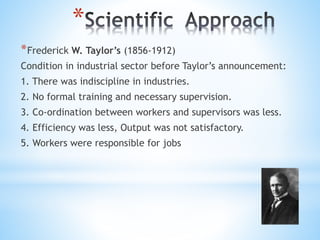


Frederick Taylor is considered the father of scientific management. His theories in the late 19th/early 20th century focused on applying scientific principles to management to improve efficiency and productivity. He emphasized standardized work methods, incentives for higher output, and harmony between managers and workers. Henry Gantt and the Gilbreths further developed motion and time studies that analyzed workflows. Henri Fayol made important contributions to general management functions and principles. The Hawthorne Studies in the 1920s-30s found that social and psychological factors like group dynamics and morale significantly impact productivity over physical factors alone.


