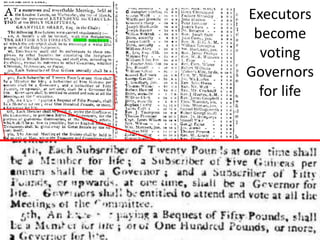

Effective promotion of legacy giving: A presentation of new research findings and theoryPresentation at Legacy Promotion Ireland, Dublin, Ireland, 26 July, 2010Russell James III, J.D., Ph.D.Associate ProfessorDirector of Graduate Studies in Charitable PlanningTexas Tech UniversityRussell.James@ttu.edu
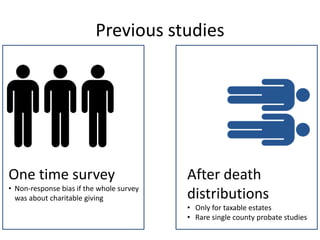
Previous studiesOne time surveyNon-response bias if the whole survey was about charitable givingAfter death distributionsOnly for taxable estates
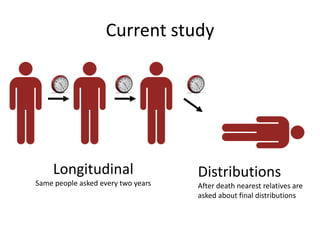
Rare single county probate studiesCurrent studyLongitudinalSame people asked every two yearsDistributionsAfter death nearest relatives are asked about final distributions
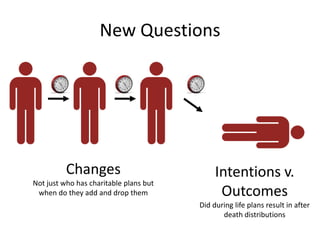
New QuestionsChangesNot just who has charitable plans but when do they add and drop themIntentions v. OutcomesDid during life plans result in after death distributions
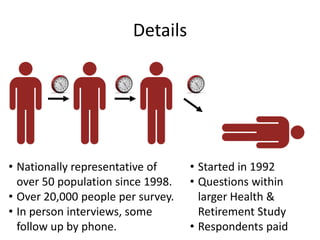
DetailsNationally representative of over 50 population since 1998.
Over 20,000 people per survey.
In person interviews, some follow up by phone.
Started in 1992
Questions within larger Health & Retirement Study
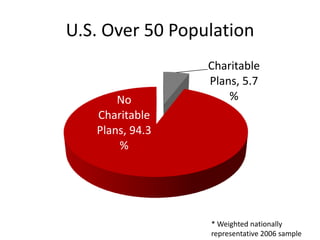
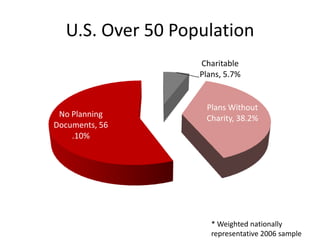
Respondents paidWhat share of people over 50 in the U.S. have “made provisions for any charities in [their] will or trust?”
U.S. Over 50 Population* Weighted nationally representative 2006 sample
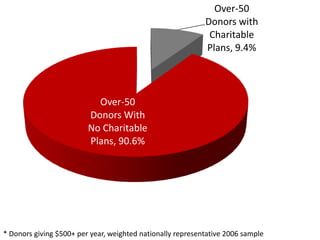
What share of over-50 charitable donors  giving over $500 per year indicate that they have a charitable estate plan?
* Donors giving $500+ per year, weighted nationally representative 2006 sample
Can that be right?Maybe a lot of donors will eventually get around to making a charitable plan?Will donors ever get around to making a charitable plan?
Projecting based on age, gender and mortality or tracking actual post-death distributions 88%-90% of donors ($500+/year) over age 50 will die with no charitable estate plan.
You mean 90% of our donors will die without leaving a gift?You mean we could generate 9 times more estate gifts from our current donors?
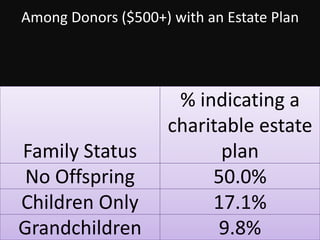
Among donors ($500+) over 50 with an estate plan, what is the single most significant factor associated with having a charitable estate plan?Age? Education? Wealth? Income?
Among Donors ($500+) with an Estate Plan
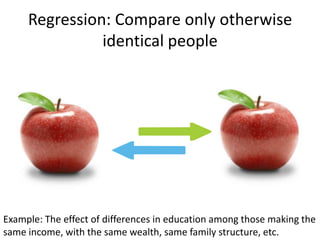
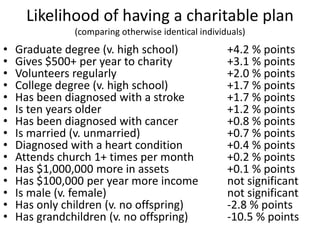
Regression: Compare only otherwise identical people Example: The effect of differences in education among those making the same income, with the same wealth, same family structure, etc.
Likelihood of having a charitable plan(comparing otherwise identical individuals)Graduate degree (v. high school)		+4.2 % pointsGives $500+ per year to charity		+3.1 % pointsVolunteers regularly				+2.0 % pointsCollege degree (v. high school)		+1.7 % pointsHas been diagnosed with a stroke		+1.7 % pointsIs ten years older				+1.2 % pointsHas been diagnosed with cancer		+0.8 % pointsIs married (v. unmarried)			+0.7 % pointsDiagnosed with a heart condition		+0.4 % pointsAttends church 1+ times per month		+0.2 % pointsHas $1,000,000 more in assets		+0.1 % pointsHas $100,000 per year more income	not significantIs male (v. female)				not significantHas only children (v. no offspring)		-2.8 % pointsHas grandchildren (v. no offspring)		-10.5 % points
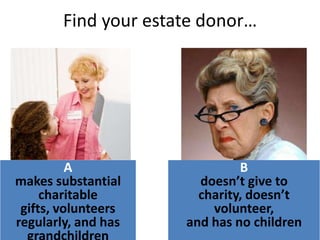
Find your estate donor…
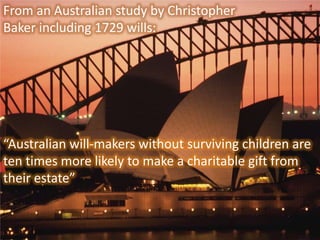
From an Australian study by Christopher Baker including 1729 wills:“Australian will-makers without surviving children are ten times more likely to make a charitable gift from their estate”
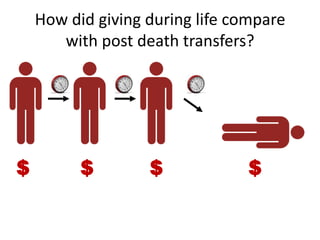
How did giving during life compare with post death transfers? $$$$
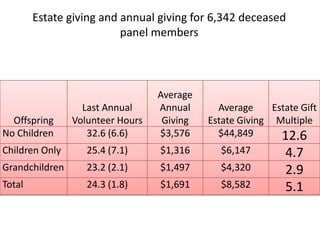
Estate giving and annual giving for 6,342 deceased panel members
When did people drop charitable plans?
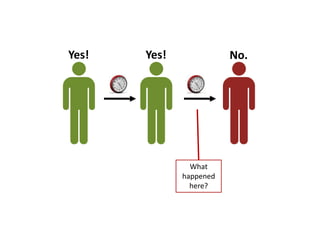
Yes!Yes!No.What happened here?
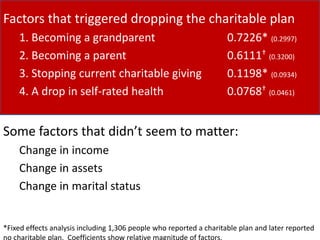
Factors that triggered dropping the charitable plan1. Becoming a grandparent 			0.7226* (0.2997)2. Becoming a parent 				0.6111†(0.3200)3. Stopping current charitable giving 	0.1198* (0.0934)4. A drop in self-rated health  		0.0768†(0.0461)Some factors that didn’t seem to matter: Change in income Change in assets Change in marital status*Fixed effects analysis including 1,306 people who reported a charitable plan and later reported no charitable plan.  Coefficients show relative magnitude of factors.
When did people add charitable plans?
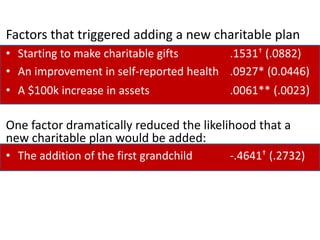
Factors that triggered adding a new charitable planStarting to make charitable gifts  		.1531† (.0882)An improvement in self-reported health 	.0927* (0.0446)A $100k increase in assets 			.0061** (.0023)One factor dramatically reduced the likelihood that a new charitable plan would be added:The addition of the first grandchild 		-.4641† (.2732)
Do the estates of people who make charitable estate plans grow differently than the general population?
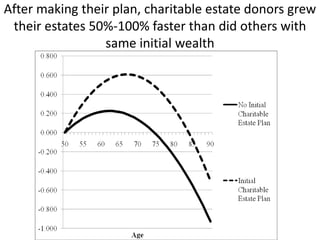
After making their plan, charitable estate donors grew their estates 50%-100% faster than did others with same initial wealth
Demographics and future projections
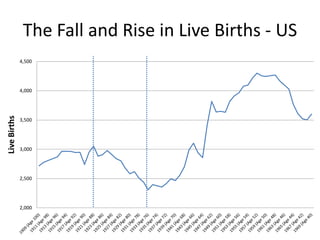
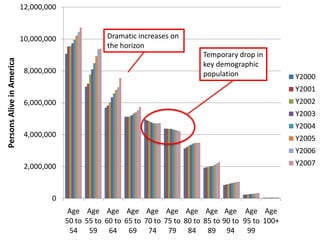
The Fall and Rise in Live Births - US
Dramatic increases on the horizonTemporary drop in key demographic population
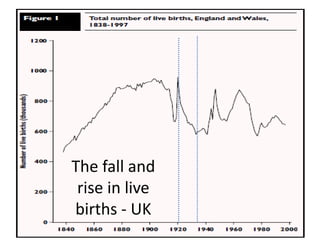
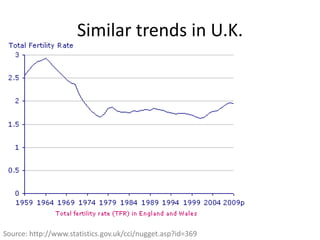
The fall and rise in live births - UK
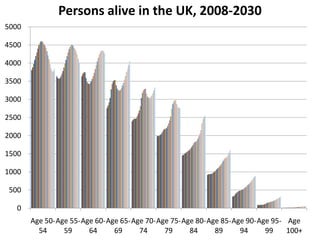
Persons alive in the UK, 2008-2030
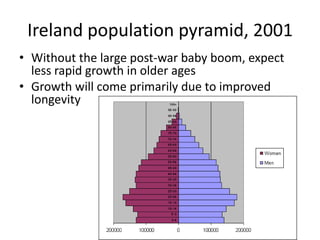
Ireland population pyramid, 2001Without the large post-war baby boom, expect less rapid growth in older agesGrowth will come primarily due to improved longevity
Projecting future bequest givingFrequency of future bequest gifts Change in populationChange in tendency to make bequest gifts
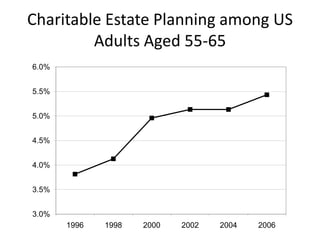
Charitable Estate Planning among US Adults Aged 55-65
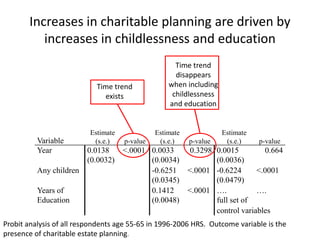
Increases in charitable planning are driven by increases in childlessness and educationTime trend disappears when including childlessness and educationTime trend existsProbit analysis of all respondents age 55-65 in 1996-2006 HRS.  Outcome variable is the presence of charitable estate planning.
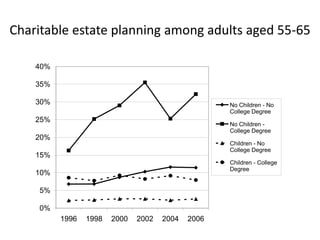
Charitable estate planning among adults aged 55-65
Basic relationshipThis suggests that the overall trend of increased charitable estate planning may have been driven, in large part, by changes in childlessness and education.Such a relationship has important implications for predicting charitable estate planning levels in the future.
Upcoming cohorts and childlessnessChildlessness among women who will be entering the 55-65 age group over the next decade will be substantially higher than those in the 55-65 age group during 2006 (the year of the latest HRS survey).
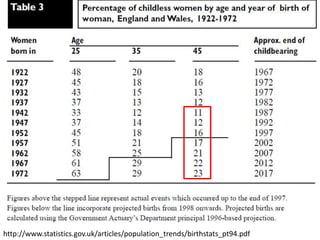
Women in the 56-61 age group during 2006 reported a childlessness rate of 16.0% in 1990 when they were aged 40-44 (Dye, 2005).  In comparison, women in the 40-44 age range in 2004 (i.e., those who will begin entering the 55-65 near retirement age group in 2015) reported a childlessness rate of 19.3% (Dye, 2005).  Similar trends in U.K.Source: http://www.statistics.gov.uk/cci/nugget.asp?id=369
http://www.statistics.gov.uk/articles/population_trends/birthstats_pt94.pdf
Upcoming cohorts and educationSimilarly, a college education is much more common among the upcoming cohorts of individuals nearing retirement age than among the current 55-65 group (Stoops, 2004).
In 1996, less than 27% of those in the 35-54 age group had at least a bachelor’s degree.
By 2007, over 31% of those in the 35-54 age group had at least a bachelor’s degree (Current Population Survey, 2007).
Thus, one can expect the upcoming cohorts of individuals nearing retirement to be more educated than individuals currently in the 55-65 age group.Big take-awaysDon’t just recruit estate givers by giving level, also know your donors without childrenAfter making their intention, charitable estate donors grew their estates 50%-100% faster than did others.Future demographics are generally positive based on population, childlessness, and education
New Ideas for legacy promotion from a theoretical frameworkApplying “The Generosity Code”
Why theory instead of just a list of techniques?Limitations of “war stories” researchSo called best practices may just be practicesTheory based strategies are more flexibleNew techniques can emerge as circumstances changeGuides practice even where, as in bequest giving, interim measurement is difficult.
What does a fundraiser do?Bring in money?This description is “true”, but not very informative.  Applies to essentially all private sector jobs.What does a Lawyer do? Makes money.  What does a grocer do? Makes money. What does an artist do? Makes money. You could bring money to your organization from government contracts, operation of a charitable business, or other means, but it wouldn’t be as a fundraiser.
What does a fundraiser do?A fundraiser …
What does a fundraiser do?A fundraiser …Encourages Generosity
Encouraging generosityAn issue of fundamental human significanceAn independently valuable mission separate from (although complementary to) your organization’s mission
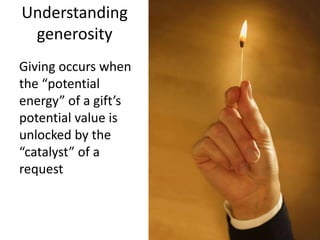
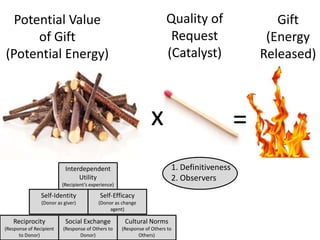
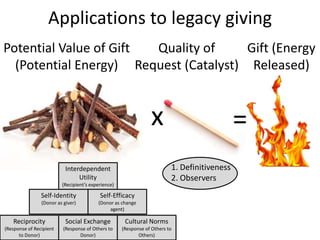
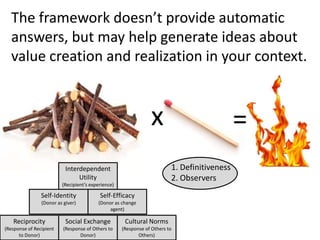
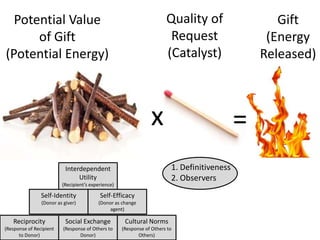
Understanding generosityGiving occurs when the “potential energy” of a gift’s potential value is unlocked by the “catalyst” of a request
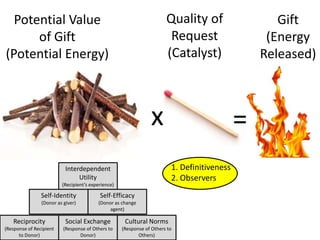
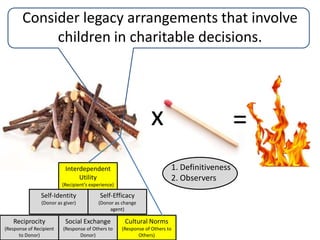
Quality of Request(Catalyst)Potential Value of Gift(Potential Energy)Gift(Energy Released)x=1. Definitiveness2. ObserversInterdependent Utility(Recipient’s experience)Self-Identity(Donor as giver)Self-Efficacy(Donor as change agent)Reciprocity(Response of Recipient to Donor)Social Exchange (Response of Others to Donor)Cultural Norms (Response of Others to Others)
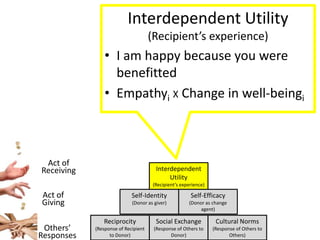
Interdependent Utility(Recipient’s experience)I am happy because you were benefittedEmpathyiX Change in well-beingiAct of ReceivingInterdependent Utility(Recipient’s experience)Act of GivingSelf-Identity(Donor as giver)Self-Efficacy(Donor as change agent)Others’ ResponsesReciprocity(Response of Recipient to Donor)Social Exchange (Response of Others to Donor)Cultural Norms (Response of Others to Others)
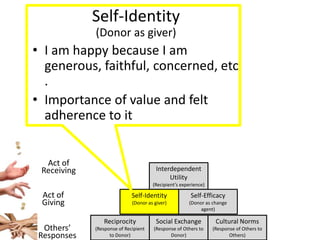
Self-Identity(Donor as giver)I am happy because I am generous, faithful, concerned, etc.
Importance of value and felt adherence to itAct of ReceivingInterdependent Utility(Recipient’s experience)Act of GivingSelf-Identity(Donor as giver)Self-Efficacy(Donor as change agent)Others’ ResponsesReciprocity(Response of Recipient to Donor)Social Exchange (Response of Others to Donor)Cultural Norms (Response of Others to Others)
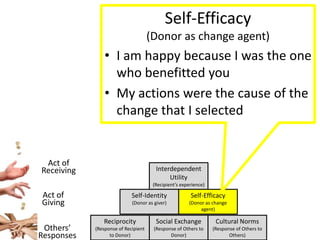
Self-Efficacy(Donor as change agent)I am happy because I was the one who benefitted youMy actions were the cause of the change that I selectedAct of ReceivingInterdependent Utility(Recipient’s experience)Act of GivingSelf-Identity(Donor as giver)Self-Efficacy(Donor as change agent)Others’ ResponsesReciprocity(Response of Recipient to Donor)Social Exchange (Response of Others to Donor)Cultural Norms (Response of Others to Others)
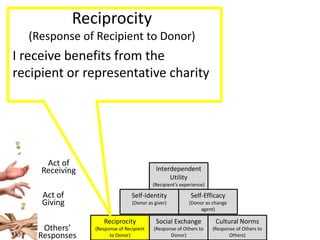
Reciprocity(Response of Recipient to Donor)I receive benefits from the recipient or representative charityAct of ReceivingInterdependent Utility(Recipient’s experience)Act of GivingSelf-Identity(Donor as giver)Self-Efficacy(Donor as change agent)Others’ ResponsesReciprocity(Response of Recipient to Donor)Social Exchange (Response of Others to Donor)Cultural Norms (Response of Others to Others)
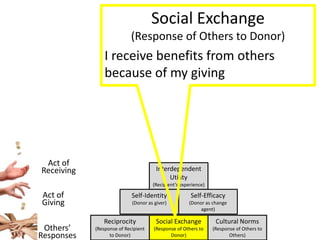
Social Exchange(Response of Others to Donor)I receive benefits from others because of my givingAct of ReceivingInterdependent Utility(Recipient’s experience)Act of GivingSelf-Identity(Donor as giver)Self-Efficacy(Donor as change agent)Others’ ResponsesReciprocity(Response of Recipient to Donor)Social Exchange (Response of Others to Donor)Cultural Norms (Response of Others to Others)
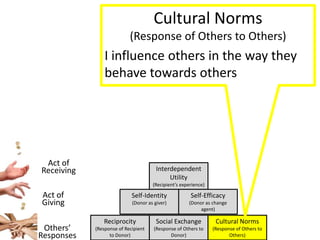
Cultural Norms(Response of Others to Others)I influence others in the way they behave towards othersAct of ReceivingInterdependent Utility(Recipient’s experience)Act of GivingSelf-Identity(Donor as giver)Self-Efficacy(Donor as change agent)Others’ ResponsesReciprocity(Response of Recipient to Donor)Social Exchange (Response of Others to Donor)Cultural Norms (Response of Others to Others)
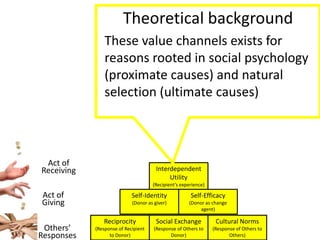
Theoretical backgroundThese value channels exists for reasons rooted in social psychology (proximate causes) and natural selection (ultimate causes)Act of ReceivingInterdependent Utility(Recipient’s experience)Act of GivingSelf-Identity(Donor as giver)Self-Efficacy(Donor as change agent)Others’ ResponsesReciprocity(Response of Recipient to Donor)Social Exchange (Response of Others to Donor)Cultural Norms (Response of Others to Others)
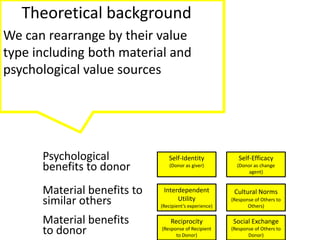
Theoretical backgroundWe can rearrange by their value type including both material and psychological value sourcesPsychological benefits to donorMaterial benefits to similar othersSelf-Identity(Donor as giver)Self-Efficacy(Donor as change agent)Material benefits to donorInterdependent Utility(Recipient’s experience)Cultural Norms(Response of Others to Others)Reciprocity(Response of Recipient to Donor)Social Exchange (Response of Others to Donor)
Understanding generosityGiving occurs when the “potential energy” of a gift’s potential value is unlocked by the “catalyst” of a request
Quality of Request(Catalyst)Potential Value of Gift(Potential Energy)Gift(Energy Released)x=1. Definitiveness2. ObserversInterdependent Utility(Recipient’s experience)Self-Identity(Donor as giver)Self-Efficacy(Donor as change agent)Reciprocity(Response of Recipient to Donor)Social Exchange (Response of Others to Donor)Cultural Norms (Response of Others to Others)
DefinitivenessHow clearly is a decision required?ObserversWho observes the decision?Quality of request
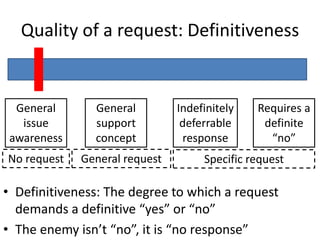
Quality of a request: DefinitivenessRequires a definite “no”Indefinitely deferrableresponseGeneral support concept General issue awarenessGeneral requestNo requestSpecific requestDefinitiveness: The degree to which a request demands a definitive “yes” or “no”The enemy isn’t “no”, it is “no response”
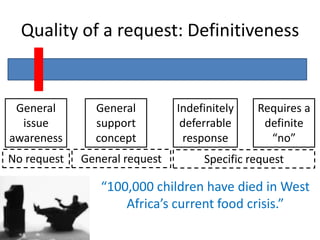
Quality of a request: DefinitivenessRequires a definite “no”Indefinitely deferrableresponseGeneral support concept General issue awarenessGeneral requestNo requestSpecific request“100,000 children have died in West Africa’s current food crisis.”
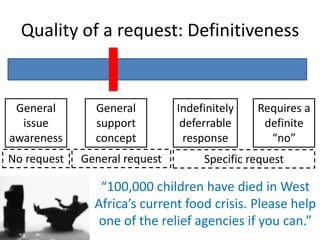
Quality of a request: DefinitivenessRequires a definite “no”Indefinitely deferrableresponseGeneral support concept General issue awarenessGeneral requestNo requestSpecific request“100,000 children have died in West Africa’s current food crisis. Please help one of the relief agencies if you can.”
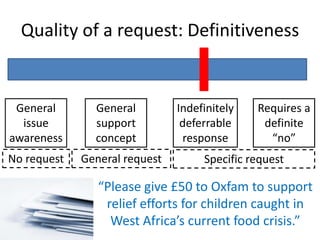
Quality of a request: DefinitivenessRequires a definite “no”Indefinitely deferrableresponseGeneral support concept General issue awarenessGeneral requestNo requestSpecific request“Please give £50 to Oxfam to support relief efforts for children caught in West Africa’s current food crisis.”
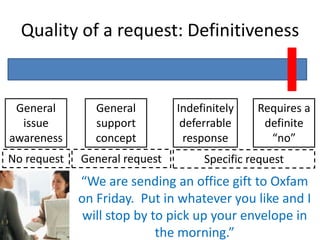
Quality of a request: DefinitivenessRequires a definite “no”Indefinitely deferrableresponseGeneral support concept General issue awarenessGeneral requestNo requestSpecific request“We are sending an office gift to Oxfam on Friday.  Put in whatever you like and I will stop by to pick up your envelope in the morning.”
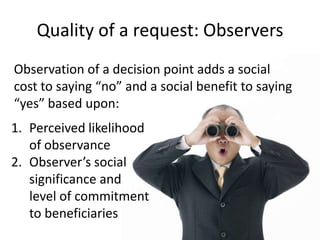
Quality of a request: ObserversObservation of a decision point adds a social cost to saying “no” and a social benefit to saying “yes” based upon:Perceived likelihood of observanceObserver’s social significance and level of commitment to beneficiaries
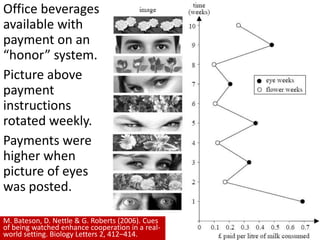
Office beverages available with payment on an “honor” system.Picture above payment instructions rotated weekly.Payments were higher when picture of eyes was posted.M. Bateson, D. Nettle & G. Roberts (2006). Cues of being watched enhance cooperation in a real-world setting. Biology Letters 2, 412–414.
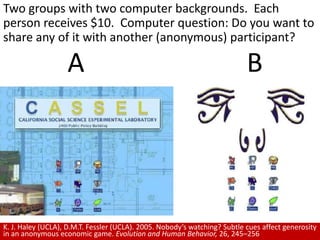
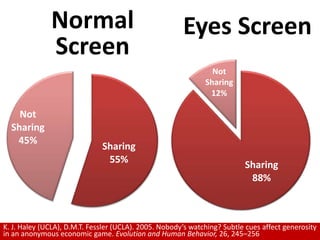
Two groups with two computer backgrounds.  Each person receives $10.  Computer question: Do you want to share any of it with another (anonymous) participant?ABK. J. Haley (UCLA), D.M.T. Fessler (UCLA). 2005. Nobody’s watching? Subtle cues affect generosity in an anonymous economic game. Evolution and Human Behavior, 26, 245–256
K. J. Haley (UCLA), D.M.T. Fessler (UCLA). 2005. Nobody’s watching? Subtle cues affect generosity in an anonymous economic game. Evolution and Human Behavior, 26, 245–256
Applications to legacy givingPotential Value of Gift(Potential Energy)Quality of Request (Catalyst)Gift (Energy Released)x=1. Definitiveness2. ObserversInterdependent Utility(Recipient’s experience)Self-Identity(Donor as giver)Self-Efficacy(Donor as change agent)Reciprocity(Response of Recipient to Donor)Social Exchange (Response of Others to Donor)Cultural Norms (Response of Others to Others)
Unfortunate reality of legacy giving“74% of the UK population support charities and when asked, 35% of people say they'd happily leave a gift in their will once family and friends had been provided for. The problem is only 7% actually do.”From www.rememberacharity.org
* Donors giving $500+ per year, weighted nationally representative 2006 sample
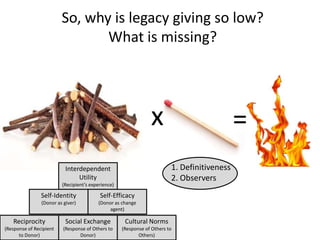
So, why is legacy giving so low?What is missing?x=1. Definitiveness2. ObserversInterdependent Utility(Recipient’s experience)Self-Identity(Donor as giver)Self-Efficacy(Donor as change agent)Reciprocity(Response of Recipient to Donor)Social Exchange (Response of Others to Donor)Cultural Norms (Response of Others to Others)
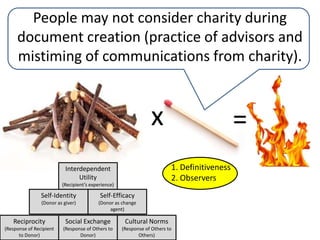
People may not consider charity during document creation (practice of advisors and mistiming of communications from charity).x=1. Definitiveness2. ObserversInterdependent Utility(Recipient’s experience)Self-Identity(Donor as giver)Self-Efficacy(Donor as change agent)Reciprocity(Response of Recipient to Donor)Social Exchange (Response of Others to Donor)Cultural Norms (Response of Others to Others)
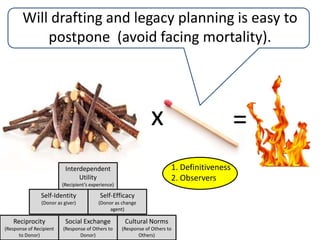
Will drafting and legacy planning is easy to postpone  (avoid facing mortality).x=1. Definitiveness2. ObserversInterdependent Utility(Recipient’s experience)Self-Identity(Donor as giver)Self-Efficacy(Donor as change agent)Reciprocity(Response of Recipient to Donor)Social Exchange (Response of Others to Donor)Cultural Norms (Response of Others to Others)
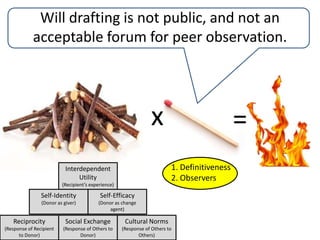
Will drafting is not public, and not an acceptable forum for peer observation.x=1. Definitiveness2. ObserversInterdependent Utility(Recipient’s experience)Self-Identity(Donor as giver)Self-Efficacy(Donor as change agent)Reciprocity(Response of Recipient to Donor)Social Exchange (Response of Others to Donor)Cultural Norms (Response of Others to Others)
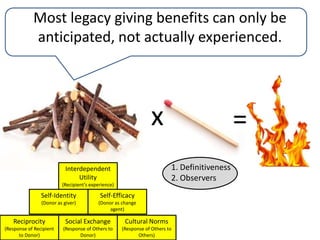
Most legacy giving benefits can only be anticipated, not actually experienced.x=1. Definitiveness2. ObserversInterdependent Utility(Recipient’s experience)Self-Identity(Donor as giver)Self-Efficacy(Donor as change agent)Reciprocity(Response of Recipient to Donor)Social Exchange (Response of Others to Donor)Cultural Norms (Response of Others to Others)
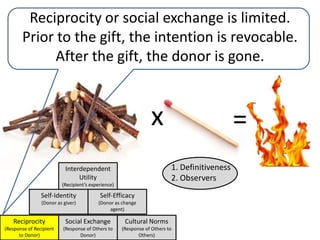
Reciprocity or social exchange is limited.  Prior to the gift, the intention is revocable.  After the gift, the donor is gone.x=1. Definitiveness2. ObserversInterdependent Utility(Recipient’s experience)Self-Identity(Donor as giver)Self-Efficacy(Donor as change agent)Reciprocity(Response of Recipient to Donor)Social Exchange (Response of Others to Donor)Cultural Norms (Response of Others to Others)
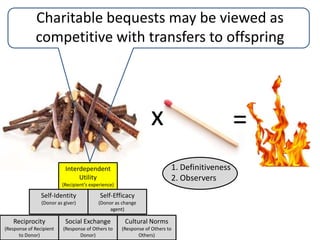
Charitable bequests may be viewed as competitive with transfers to offspringx=1. Definitiveness2. ObserversInterdependent Utility(Recipient’s experience)Self-Identity(Donor as giver)Self-Efficacy(Donor as change agent)Reciprocity(Response of Recipient to Donor)Social Exchange (Response of Others to Donor)Cultural Norms (Response of Others to Others)
What strategies within this framework might improve participation in charitable bequest making?
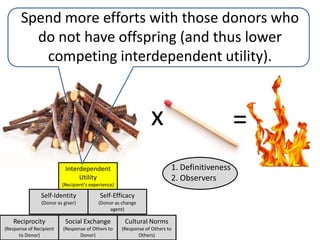
Spend more efforts with those donors who do not have offspring (and thus lower competing interdependent utility).x=1. Definitiveness2. ObserversInterdependent Utility(Recipient’s experience)Self-Identity(Donor as giver)Self-Efficacy(Donor as change agent)Reciprocity(Response of Recipient to Donor)Social Exchange (Response of Others to Donor)Cultural Norms (Response of Others to Others)
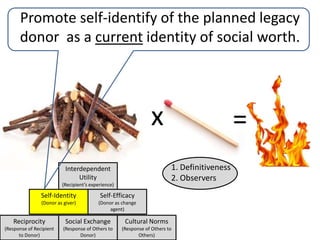
Promote self-identify of the planned legacy donor  as a current identity of social worth.x=1. Definitiveness2. ObserversInterdependent Utility(Recipient’s experience)Self-Identity(Donor as giver)Self-Efficacy(Donor as change agent)Reciprocity(Response of Recipient to Donor)Social Exchange (Response of Others to Donor)Cultural Norms (Response of Others to Others)
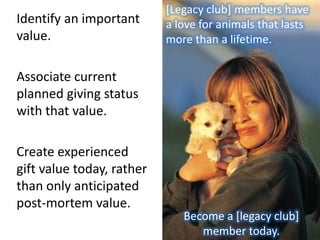
[Legacy club] members have a love for animals that lasts more than a lifetime.Identify an important value.Associate current planned giving status with that value.Create experienced gift value today, rather than only anticipated post-mortem value.Become a [legacy club] member today.
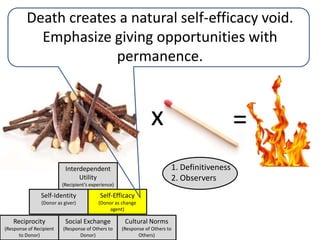
Death creates a natural self-efficacy void.  Emphasize giving opportunities with permanence.x=1. Definitiveness2. ObserversInterdependent Utility(Recipient’s experience)Self-Identity(Donor as giver)Self-Efficacy(Donor as change agent)Reciprocity(Response of Recipient to Donor)Social Exchange (Response of Others to Donor)Cultural Norms (Response of Others to Others)
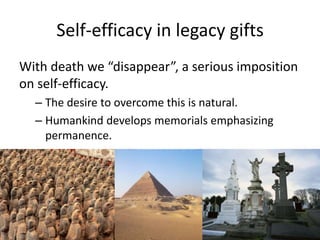
Self-efficacy in legacy giftsWith death we “disappear”, a serious imposition on self-efficacy.The desire to overcome this is natural.Humankind develops memorials emphasizing permanence.
Self-efficacy in legacy giftsLegacy giving can also help fulfill the desire for permanence. But may depend on how the charity will use the gift.Logo from http://www.rememberacharity.org.uk
Self-efficacy in legacy giftsIt is easier for the wealthy to imagine charitable gifts with permanent impact.Buildings, large charitable foundations, parks, artConsider developing permanent giving opportunities for mid-level donors.Named giving opportunities limited to legacy donors (so as not to pull from current giving)
Permanent memorial trusts for legacy donors onlyScholarships, lectureships, sponsor a child, sponsor a rescued pet, annual performances, etc.
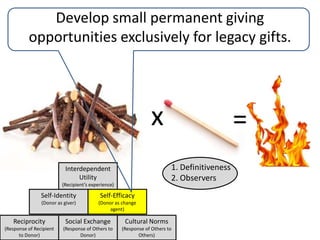
Develop small permanent giving opportunities exclusively for legacy gifts.x=1. Definitiveness2. ObserversInterdependent Utility(Recipient’s experience)Self-Identity(Donor as giver)Self-Efficacy(Donor as change agent)Reciprocity(Response of Recipient to Donor)Social Exchange (Response of Others to Donor)Cultural Norms (Response of Others to Others)
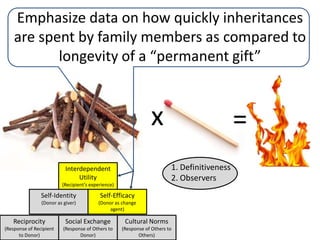
Emphasize data on how quickly inheritances are spent by family members as compared to longevity of a “permanent gift”x=1. Definitiveness2. ObserversInterdependent Utility(Recipient’s experience)Self-Identity(Donor as giver)Self-Efficacy(Donor as change agent)Reciprocity(Response of Recipient to Donor)Social Exchange (Response of Others to Donor)Cultural Norms (Response of Others to Others)
Legacy societies to publicly recognize planned donors and create functioning donor communities through social events.x=1. Definitiveness2. ObserversInterdependent Utility(Recipient’s experience)Self-Identity(Donor as giver)Self-Efficacy(Donor as change agent)Reciprocity(Response of Recipient to Donor)Social Exchange (Response of Others to Donor)Cultural Norms (Response of Others to Others)
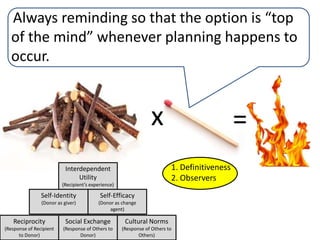
Always reminding so that the option is “top of the mind” whenever planning happens to occur.x=1. Definitiveness2. ObserversInterdependent Utility(Recipient’s experience)Self-Identity(Donor as giver)Self-Efficacy(Donor as change agent)Reciprocity(Response of Recipient to Donor)Social Exchange (Response of Others to Donor)Cultural Norms (Response of Others to Others)
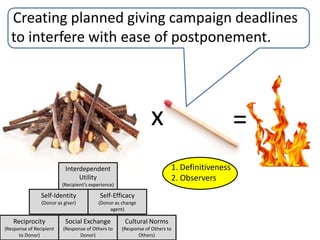
Creating planned giving campaign deadlines to interfere with ease of postponement.x=1. Definitiveness2. ObserversInterdependent Utility(Recipient’s experience)Self-Identity(Donor as giver)Self-Efficacy(Donor as change agent)Reciprocity(Response of Recipient to Donor)Social Exchange (Response of Others to Donor)Cultural Norms (Response of Others to Others)
A small organization’s two-year campaign to reach 100 planned legacieshttp://www.fcs.uga.edu/alumni/legacies.html
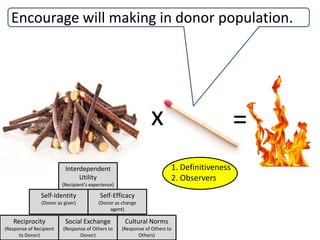
Encourage will making in donor population.x=1. Definitiveness2. ObserversInterdependent Utility(Recipient’s experience)Self-Identity(Donor as giver)Self-Efficacy(Donor as change agent)Reciprocity(Response of Recipient to Donor)Social Exchange (Response of Others to Donor)Cultural Norms (Response of Others to Others)
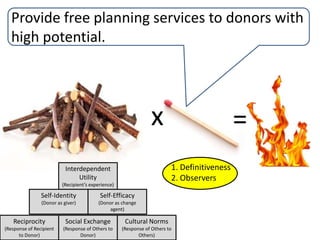
Provide free planning services to donors with high potential.x=1. Definitiveness2. ObserversInterdependent Utility(Recipient’s experience)Self-Identity(Donor as giver)Self-Efficacy(Donor as change agent)Reciprocity(Response of Recipient to Donor)Social Exchange (Response of Others to Donor)Cultural Norms (Response of Others to Others)
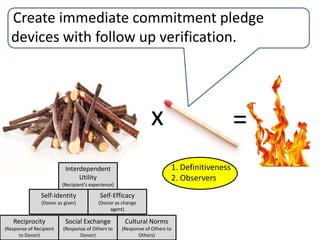
Create immediate commitment pledge devices with follow up verification.x=1. Definitiveness2. ObserversInterdependent Utility(Recipient’s experience)Self-Identity(Donor as giver)Self-Efficacy(Donor as change agent)Reciprocity(Response of Recipient to Donor)Social Exchange (Response of Others to Donor)Cultural Norms (Response of Others to Others)
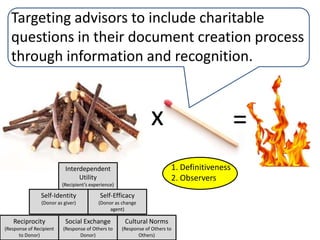
Targeting advisors to include charitable questions in their document creation process through information and recognition.x=1. Definitiveness2. ObserversInterdependent Utility(Recipient’s experience)Self-Identity(Donor as giver)Self-Efficacy(Donor as change agent)Reciprocity(Response of Recipient to Donor)Social Exchange (Response of Others to Donor)Cultural Norms (Response of Others to Others)
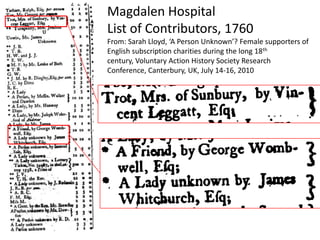
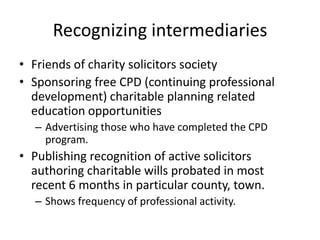
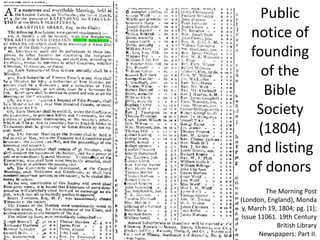
Why not recognize the intermediaries?Intermediaries, such as a will drafting lawyer, are essential to the process.Often the simple act of specifically asking about a gift to charity by an advisor is key.A “new” idea?

Dublin Legacy Presentation

  • 1.
    Effective promotion oflegacy giving: A presentation of new research findings and theoryPresentation at Legacy Promotion Ireland, Dublin, Ireland, 26 July, 2010Russell James III, J.D., Ph.D.Associate ProfessorDirector of Graduate Studies in Charitable PlanningTexas Tech UniversityRussell.James@ttu.edu
  • 2.
    Previous studiesOne timesurveyNon-response bias if the whole survey was about charitable givingAfter death distributionsOnly for taxable estates
  • 3.
    Rare single countyprobate studiesCurrent studyLongitudinalSame people asked every two yearsDistributionsAfter death nearest relatives are asked about final distributions
  • 4.
    New QuestionsChangesNot justwho has charitable plans but when do they add and drop themIntentions v. OutcomesDid during life plans result in after death distributions
  • 5.
    DetailsNationally representative ofover 50 population since 1998.
  • 6.
  • 7.
    In person interviews,some follow up by phone.
  • 8.
  • 9.
    Questions within largerHealth & Retirement Study
  • 10.
    Respondents paidWhat shareof people over 50 in the U.S. have “made provisions for any charities in [their] will or trust?”
  • 11.
    U.S. Over 50Population* Weighted nationally representative 2006 sample
  • 12.
    U.S. Over 50Population* Weighted nationally representative 2006 sample
  • 13.
    What share ofover-50 charitable donors giving over $500 per year indicate that they have a charitable estate plan?
  • 14.
    * Donors giving$500+ per year, weighted nationally representative 2006 sample
  • 15.
    Can that beright?Maybe a lot of donors will eventually get around to making a charitable plan?Will donors ever get around to making a charitable plan?
  • 16.
    Projecting based onage, gender and mortality or tracking actual post-death distributions 88%-90% of donors ($500+/year) over age 50 will die with no charitable estate plan.
  • 17.
    You mean 90%of our donors will die without leaving a gift?You mean we could generate 9 times more estate gifts from our current donors?
  • 18.
    Among donors ($500+)over 50 with an estate plan, what is the single most significant factor associated with having a charitable estate plan?Age? Education? Wealth? Income?
  • 19.
    Among Donors ($500+)with an Estate Plan
  • 20.
    Regression: Compare onlyotherwise identical people Example: The effect of differences in education among those making the same income, with the same wealth, same family structure, etc.
  • 21.
    Likelihood of havinga charitable plan(comparing otherwise identical individuals)Graduate degree (v. high school) +4.2 % pointsGives $500+ per year to charity +3.1 % pointsVolunteers regularly +2.0 % pointsCollege degree (v. high school) +1.7 % pointsHas been diagnosed with a stroke +1.7 % pointsIs ten years older +1.2 % pointsHas been diagnosed with cancer +0.8 % pointsIs married (v. unmarried) +0.7 % pointsDiagnosed with a heart condition +0.4 % pointsAttends church 1+ times per month +0.2 % pointsHas $1,000,000 more in assets +0.1 % pointsHas $100,000 per year more income not significantIs male (v. female) not significantHas only children (v. no offspring) -2.8 % pointsHas grandchildren (v. no offspring) -10.5 % points
  • 22.
  • 23.
    From an Australianstudy by Christopher Baker including 1729 wills:“Australian will-makers without surviving children are ten times more likely to make a charitable gift from their estate”
  • 24.
    How did givingduring life compare with post death transfers? $$$$
  • 25.
    Estate giving andannual giving for 6,342 deceased panel members
  • 26.
    When did peopledrop charitable plans?
  • 27.
  • 28.
    Factors that triggereddropping the charitable plan1. Becoming a grandparent 0.7226* (0.2997)2. Becoming a parent 0.6111†(0.3200)3. Stopping current charitable giving 0.1198* (0.0934)4. A drop in self-rated health 0.0768†(0.0461)Some factors that didn’t seem to matter: Change in income Change in assets Change in marital status*Fixed effects analysis including 1,306 people who reported a charitable plan and later reported no charitable plan. Coefficients show relative magnitude of factors.
  • 29.
    When did peopleadd charitable plans?
  • 30.
    Factors that triggeredadding a new charitable planStarting to make charitable gifts .1531† (.0882)An improvement in self-reported health .0927* (0.0446)A $100k increase in assets .0061** (.0023)One factor dramatically reduced the likelihood that a new charitable plan would be added:The addition of the first grandchild -.4641† (.2732)
  • 31.
    Do the estatesof people who make charitable estate plans grow differently than the general population?
  • 32.
    After making theirplan, charitable estate donors grew their estates 50%-100% faster than did others with same initial wealth
  • 33.
  • 34.
    The Fall andRise in Live Births - US
  • 35.
    Dramatic increases onthe horizonTemporary drop in key demographic population
  • 36.
    The fall andrise in live births - UK
  • 37.
    Persons alive inthe UK, 2008-2030
  • 38.
    Ireland population pyramid,2001Without the large post-war baby boom, expect less rapid growth in older agesGrowth will come primarily due to improved longevity
  • 39.
    Projecting future bequestgivingFrequency of future bequest gifts Change in populationChange in tendency to make bequest gifts
  • 40.
    Charitable Estate Planningamong US Adults Aged 55-65
  • 41.
    Increases in charitableplanning are driven by increases in childlessness and educationTime trend disappears when including childlessness and educationTime trend existsProbit analysis of all respondents age 55-65 in 1996-2006 HRS. Outcome variable is the presence of charitable estate planning.
  • 42.
    Charitable estate planningamong adults aged 55-65
  • 43.
    Basic relationshipThis suggeststhat the overall trend of increased charitable estate planning may have been driven, in large part, by changes in childlessness and education.Such a relationship has important implications for predicting charitable estate planning levels in the future.
  • 44.
    Upcoming cohorts andchildlessnessChildlessness among women who will be entering the 55-65 age group over the next decade will be substantially higher than those in the 55-65 age group during 2006 (the year of the latest HRS survey).
  • 45.
    Women in the56-61 age group during 2006 reported a childlessness rate of 16.0% in 1990 when they were aged 40-44 (Dye, 2005). In comparison, women in the 40-44 age range in 2004 (i.e., those who will begin entering the 55-65 near retirement age group in 2015) reported a childlessness rate of 19.3% (Dye, 2005). Similar trends in U.K.Source: http://www.statistics.gov.uk/cci/nugget.asp?id=369
  • 46.
  • 47.
    Upcoming cohorts andeducationSimilarly, a college education is much more common among the upcoming cohorts of individuals nearing retirement age than among the current 55-65 group (Stoops, 2004).
  • 48.
    In 1996, lessthan 27% of those in the 35-54 age group had at least a bachelor’s degree.
  • 49.
    By 2007, over31% of those in the 35-54 age group had at least a bachelor’s degree (Current Population Survey, 2007).
  • 50.
    Thus, one canexpect the upcoming cohorts of individuals nearing retirement to be more educated than individuals currently in the 55-65 age group.Big take-awaysDon’t just recruit estate givers by giving level, also know your donors without childrenAfter making their intention, charitable estate donors grew their estates 50%-100% faster than did others.Future demographics are generally positive based on population, childlessness, and education
  • 51.
    New Ideas forlegacy promotion from a theoretical frameworkApplying “The Generosity Code”
  • 52.
    Why theory insteadof just a list of techniques?Limitations of “war stories” researchSo called best practices may just be practicesTheory based strategies are more flexibleNew techniques can emerge as circumstances changeGuides practice even where, as in bequest giving, interim measurement is difficult.
  • 53.
    What does afundraiser do?Bring in money?This description is “true”, but not very informative. Applies to essentially all private sector jobs.What does a Lawyer do? Makes money. What does a grocer do? Makes money. What does an artist do? Makes money. You could bring money to your organization from government contracts, operation of a charitable business, or other means, but it wouldn’t be as a fundraiser.
  • 54.
    What does afundraiser do?A fundraiser …
  • 55.
    What does afundraiser do?A fundraiser …Encourages Generosity
  • 56.
    Encouraging generosityAn issueof fundamental human significanceAn independently valuable mission separate from (although complementary to) your organization’s mission
  • 57.
    Understanding generosityGiving occurswhen the “potential energy” of a gift’s potential value is unlocked by the “catalyst” of a request
  • 58.
    Quality of Request(Catalyst)PotentialValue of Gift(Potential Energy)Gift(Energy Released)x=1. Definitiveness2. ObserversInterdependent Utility(Recipient’s experience)Self-Identity(Donor as giver)Self-Efficacy(Donor as change agent)Reciprocity(Response of Recipient to Donor)Social Exchange (Response of Others to Donor)Cultural Norms (Response of Others to Others)
  • 59.
    Interdependent Utility(Recipient’s experience)Iam happy because you were benefittedEmpathyiX Change in well-beingiAct of ReceivingInterdependent Utility(Recipient’s experience)Act of GivingSelf-Identity(Donor as giver)Self-Efficacy(Donor as change agent)Others’ ResponsesReciprocity(Response of Recipient to Donor)Social Exchange (Response of Others to Donor)Cultural Norms (Response of Others to Others)
  • 60.
    Self-Identity(Donor as giver)Iam happy because I am generous, faithful, concerned, etc.
  • 61.
    Importance of valueand felt adherence to itAct of ReceivingInterdependent Utility(Recipient’s experience)Act of GivingSelf-Identity(Donor as giver)Self-Efficacy(Donor as change agent)Others’ ResponsesReciprocity(Response of Recipient to Donor)Social Exchange (Response of Others to Donor)Cultural Norms (Response of Others to Others)
  • 62.
    Self-Efficacy(Donor as changeagent)I am happy because I was the one who benefitted youMy actions were the cause of the change that I selectedAct of ReceivingInterdependent Utility(Recipient’s experience)Act of GivingSelf-Identity(Donor as giver)Self-Efficacy(Donor as change agent)Others’ ResponsesReciprocity(Response of Recipient to Donor)Social Exchange (Response of Others to Donor)Cultural Norms (Response of Others to Others)
  • 63.
    Reciprocity(Response of Recipientto Donor)I receive benefits from the recipient or representative charityAct of ReceivingInterdependent Utility(Recipient’s experience)Act of GivingSelf-Identity(Donor as giver)Self-Efficacy(Donor as change agent)Others’ ResponsesReciprocity(Response of Recipient to Donor)Social Exchange (Response of Others to Donor)Cultural Norms (Response of Others to Others)
  • 64.
    Social Exchange(Response ofOthers to Donor)I receive benefits from others because of my givingAct of ReceivingInterdependent Utility(Recipient’s experience)Act of GivingSelf-Identity(Donor as giver)Self-Efficacy(Donor as change agent)Others’ ResponsesReciprocity(Response of Recipient to Donor)Social Exchange (Response of Others to Donor)Cultural Norms (Response of Others to Others)
  • 65.
    Cultural Norms(Response ofOthers to Others)I influence others in the way they behave towards othersAct of ReceivingInterdependent Utility(Recipient’s experience)Act of GivingSelf-Identity(Donor as giver)Self-Efficacy(Donor as change agent)Others’ ResponsesReciprocity(Response of Recipient to Donor)Social Exchange (Response of Others to Donor)Cultural Norms (Response of Others to Others)
  • 66.
    Theoretical backgroundThese valuechannels exists for reasons rooted in social psychology (proximate causes) and natural selection (ultimate causes)Act of ReceivingInterdependent Utility(Recipient’s experience)Act of GivingSelf-Identity(Donor as giver)Self-Efficacy(Donor as change agent)Others’ ResponsesReciprocity(Response of Recipient to Donor)Social Exchange (Response of Others to Donor)Cultural Norms (Response of Others to Others)
  • 67.
    Theoretical backgroundWe canrearrange by their value type including both material and psychological value sourcesPsychological benefits to donorMaterial benefits to similar othersSelf-Identity(Donor as giver)Self-Efficacy(Donor as change agent)Material benefits to donorInterdependent Utility(Recipient’s experience)Cultural Norms(Response of Others to Others)Reciprocity(Response of Recipient to Donor)Social Exchange (Response of Others to Donor)
  • 68.
    Understanding generosityGiving occurswhen the “potential energy” of a gift’s potential value is unlocked by the “catalyst” of a request
  • 69.
    Quality of Request(Catalyst)PotentialValue of Gift(Potential Energy)Gift(Energy Released)x=1. Definitiveness2. ObserversInterdependent Utility(Recipient’s experience)Self-Identity(Donor as giver)Self-Efficacy(Donor as change agent)Reciprocity(Response of Recipient to Donor)Social Exchange (Response of Others to Donor)Cultural Norms (Response of Others to Others)
  • 70.
    DefinitivenessHow clearly isa decision required?ObserversWho observes the decision?Quality of request
  • 71.
    Quality of arequest: DefinitivenessRequires a definite “no”Indefinitely deferrableresponseGeneral support concept General issue awarenessGeneral requestNo requestSpecific requestDefinitiveness: The degree to which a request demands a definitive “yes” or “no”The enemy isn’t “no”, it is “no response”
  • 72.
    Quality of arequest: DefinitivenessRequires a definite “no”Indefinitely deferrableresponseGeneral support concept General issue awarenessGeneral requestNo requestSpecific request“100,000 children have died in West Africa’s current food crisis.”
  • 73.
    Quality of arequest: DefinitivenessRequires a definite “no”Indefinitely deferrableresponseGeneral support concept General issue awarenessGeneral requestNo requestSpecific request“100,000 children have died in West Africa’s current food crisis. Please help one of the relief agencies if you can.”
  • 74.
    Quality of arequest: DefinitivenessRequires a definite “no”Indefinitely deferrableresponseGeneral support concept General issue awarenessGeneral requestNo requestSpecific request“Please give £50 to Oxfam to support relief efforts for children caught in West Africa’s current food crisis.”
  • 75.
    Quality of arequest: DefinitivenessRequires a definite “no”Indefinitely deferrableresponseGeneral support concept General issue awarenessGeneral requestNo requestSpecific request“We are sending an office gift to Oxfam on Friday. Put in whatever you like and I will stop by to pick up your envelope in the morning.”
  • 76.
    Quality of arequest: ObserversObservation of a decision point adds a social cost to saying “no” and a social benefit to saying “yes” based upon:Perceived likelihood of observanceObserver’s social significance and level of commitment to beneficiaries
  • 77.
    Office beverages availablewith payment on an “honor” system.Picture above payment instructions rotated weekly.Payments were higher when picture of eyes was posted.M. Bateson, D. Nettle & G. Roberts (2006). Cues of being watched enhance cooperation in a real-world setting. Biology Letters 2, 412–414.
  • 78.
    Two groups withtwo computer backgrounds. Each person receives $10. Computer question: Do you want to share any of it with another (anonymous) participant?ABK. J. Haley (UCLA), D.M.T. Fessler (UCLA). 2005. Nobody’s watching? Subtle cues affect generosity in an anonymous economic game. Evolution and Human Behavior, 26, 245–256
  • 79.
    K. J. Haley(UCLA), D.M.T. Fessler (UCLA). 2005. Nobody’s watching? Subtle cues affect generosity in an anonymous economic game. Evolution and Human Behavior, 26, 245–256
  • 80.
    Applications to legacygivingPotential Value of Gift(Potential Energy)Quality of Request (Catalyst)Gift (Energy Released)x=1. Definitiveness2. ObserversInterdependent Utility(Recipient’s experience)Self-Identity(Donor as giver)Self-Efficacy(Donor as change agent)Reciprocity(Response of Recipient to Donor)Social Exchange (Response of Others to Donor)Cultural Norms (Response of Others to Others)
  • 81.
    Unfortunate reality oflegacy giving“74% of the UK population support charities and when asked, 35% of people say they'd happily leave a gift in their will once family and friends had been provided for. The problem is only 7% actually do.”From www.rememberacharity.org
  • 82.
    * Donors giving$500+ per year, weighted nationally representative 2006 sample
  • 83.
    So, why islegacy giving so low?What is missing?x=1. Definitiveness2. ObserversInterdependent Utility(Recipient’s experience)Self-Identity(Donor as giver)Self-Efficacy(Donor as change agent)Reciprocity(Response of Recipient to Donor)Social Exchange (Response of Others to Donor)Cultural Norms (Response of Others to Others)
  • 84.
    People may notconsider charity during document creation (practice of advisors and mistiming of communications from charity).x=1. Definitiveness2. ObserversInterdependent Utility(Recipient’s experience)Self-Identity(Donor as giver)Self-Efficacy(Donor as change agent)Reciprocity(Response of Recipient to Donor)Social Exchange (Response of Others to Donor)Cultural Norms (Response of Others to Others)
  • 85.
    Will drafting andlegacy planning is easy to postpone (avoid facing mortality).x=1. Definitiveness2. ObserversInterdependent Utility(Recipient’s experience)Self-Identity(Donor as giver)Self-Efficacy(Donor as change agent)Reciprocity(Response of Recipient to Donor)Social Exchange (Response of Others to Donor)Cultural Norms (Response of Others to Others)
  • 86.
    Will drafting isnot public, and not an acceptable forum for peer observation.x=1. Definitiveness2. ObserversInterdependent Utility(Recipient’s experience)Self-Identity(Donor as giver)Self-Efficacy(Donor as change agent)Reciprocity(Response of Recipient to Donor)Social Exchange (Response of Others to Donor)Cultural Norms (Response of Others to Others)
  • 87.
    Most legacy givingbenefits can only be anticipated, not actually experienced.x=1. Definitiveness2. ObserversInterdependent Utility(Recipient’s experience)Self-Identity(Donor as giver)Self-Efficacy(Donor as change agent)Reciprocity(Response of Recipient to Donor)Social Exchange (Response of Others to Donor)Cultural Norms (Response of Others to Others)
  • 88.
    Reciprocity or socialexchange is limited. Prior to the gift, the intention is revocable. After the gift, the donor is gone.x=1. Definitiveness2. ObserversInterdependent Utility(Recipient’s experience)Self-Identity(Donor as giver)Self-Efficacy(Donor as change agent)Reciprocity(Response of Recipient to Donor)Social Exchange (Response of Others to Donor)Cultural Norms (Response of Others to Others)
  • 89.
    Charitable bequests maybe viewed as competitive with transfers to offspringx=1. Definitiveness2. ObserversInterdependent Utility(Recipient’s experience)Self-Identity(Donor as giver)Self-Efficacy(Donor as change agent)Reciprocity(Response of Recipient to Donor)Social Exchange (Response of Others to Donor)Cultural Norms (Response of Others to Others)
  • 90.
    What strategies withinthis framework might improve participation in charitable bequest making?
  • 91.
    Spend more effortswith those donors who do not have offspring (and thus lower competing interdependent utility).x=1. Definitiveness2. ObserversInterdependent Utility(Recipient’s experience)Self-Identity(Donor as giver)Self-Efficacy(Donor as change agent)Reciprocity(Response of Recipient to Donor)Social Exchange (Response of Others to Donor)Cultural Norms (Response of Others to Others)
  • 92.
    Promote self-identify ofthe planned legacy donor as a current identity of social worth.x=1. Definitiveness2. ObserversInterdependent Utility(Recipient’s experience)Self-Identity(Donor as giver)Self-Efficacy(Donor as change agent)Reciprocity(Response of Recipient to Donor)Social Exchange (Response of Others to Donor)Cultural Norms (Response of Others to Others)
  • 93.
    [Legacy club] membershave a love for animals that lasts more than a lifetime.Identify an important value.Associate current planned giving status with that value.Create experienced gift value today, rather than only anticipated post-mortem value.Become a [legacy club] member today.
  • 94.
    Death creates anatural self-efficacy void. Emphasize giving opportunities with permanence.x=1. Definitiveness2. ObserversInterdependent Utility(Recipient’s experience)Self-Identity(Donor as giver)Self-Efficacy(Donor as change agent)Reciprocity(Response of Recipient to Donor)Social Exchange (Response of Others to Donor)Cultural Norms (Response of Others to Others)
  • 95.
    Self-efficacy in legacygiftsWith death we “disappear”, a serious imposition on self-efficacy.The desire to overcome this is natural.Humankind develops memorials emphasizing permanence.
  • 96.
    Self-efficacy in legacygiftsLegacy giving can also help fulfill the desire for permanence. But may depend on how the charity will use the gift.Logo from http://www.rememberacharity.org.uk
  • 97.
    Self-efficacy in legacygiftsIt is easier for the wealthy to imagine charitable gifts with permanent impact.Buildings, large charitable foundations, parks, artConsider developing permanent giving opportunities for mid-level donors.Named giving opportunities limited to legacy donors (so as not to pull from current giving)
  • 98.
    Permanent memorial trustsfor legacy donors onlyScholarships, lectureships, sponsor a child, sponsor a rescued pet, annual performances, etc.
  • 99.
    Develop small permanentgiving opportunities exclusively for legacy gifts.x=1. Definitiveness2. ObserversInterdependent Utility(Recipient’s experience)Self-Identity(Donor as giver)Self-Efficacy(Donor as change agent)Reciprocity(Response of Recipient to Donor)Social Exchange (Response of Others to Donor)Cultural Norms (Response of Others to Others)
  • 100.
    Emphasize data onhow quickly inheritances are spent by family members as compared to longevity of a “permanent gift”x=1. Definitiveness2. ObserversInterdependent Utility(Recipient’s experience)Self-Identity(Donor as giver)Self-Efficacy(Donor as change agent)Reciprocity(Response of Recipient to Donor)Social Exchange (Response of Others to Donor)Cultural Norms (Response of Others to Others)
  • 101.
    Legacy societies topublicly recognize planned donors and create functioning donor communities through social events.x=1. Definitiveness2. ObserversInterdependent Utility(Recipient’s experience)Self-Identity(Donor as giver)Self-Efficacy(Donor as change agent)Reciprocity(Response of Recipient to Donor)Social Exchange (Response of Others to Donor)Cultural Norms (Response of Others to Others)
  • 102.
    Always reminding sothat the option is “top of the mind” whenever planning happens to occur.x=1. Definitiveness2. ObserversInterdependent Utility(Recipient’s experience)Self-Identity(Donor as giver)Self-Efficacy(Donor as change agent)Reciprocity(Response of Recipient to Donor)Social Exchange (Response of Others to Donor)Cultural Norms (Response of Others to Others)
  • 103.
    Creating planned givingcampaign deadlines to interfere with ease of postponement.x=1. Definitiveness2. ObserversInterdependent Utility(Recipient’s experience)Self-Identity(Donor as giver)Self-Efficacy(Donor as change agent)Reciprocity(Response of Recipient to Donor)Social Exchange (Response of Others to Donor)Cultural Norms (Response of Others to Others)
  • 104.
    A small organization’stwo-year campaign to reach 100 planned legacieshttp://www.fcs.uga.edu/alumni/legacies.html
  • 105.
    Encourage will makingin donor population.x=1. Definitiveness2. ObserversInterdependent Utility(Recipient’s experience)Self-Identity(Donor as giver)Self-Efficacy(Donor as change agent)Reciprocity(Response of Recipient to Donor)Social Exchange (Response of Others to Donor)Cultural Norms (Response of Others to Others)
  • 106.
    Provide free planningservices to donors with high potential.x=1. Definitiveness2. ObserversInterdependent Utility(Recipient’s experience)Self-Identity(Donor as giver)Self-Efficacy(Donor as change agent)Reciprocity(Response of Recipient to Donor)Social Exchange (Response of Others to Donor)Cultural Norms (Response of Others to Others)
  • 107.
    Create immediate commitmentpledge devices with follow up verification.x=1. Definitiveness2. ObserversInterdependent Utility(Recipient’s experience)Self-Identity(Donor as giver)Self-Efficacy(Donor as change agent)Reciprocity(Response of Recipient to Donor)Social Exchange (Response of Others to Donor)Cultural Norms (Response of Others to Others)
  • 108.
    Targeting advisors toinclude charitable questions in their document creation process through information and recognition.x=1. Definitiveness2. ObserversInterdependent Utility(Recipient’s experience)Self-Identity(Donor as giver)Self-Efficacy(Donor as change agent)Reciprocity(Response of Recipient to Donor)Social Exchange (Response of Others to Donor)Cultural Norms (Response of Others to Others)
  • 109.
    Why not recognizethe intermediaries?Intermediaries, such as a will drafting lawyer, are essential to the process.Often the simple act of specifically asking about a gift to charity by an advisor is key.A “new” idea?

Editor's Notes

  • #33 http://www.statistics.gov.uk/CCI/article.asp?ID=618&Pos=3&ColRank=2&Rank=176
  • #34 http://www.statistics.gov.uk/downloads/theme_population/NPP2008/NatPopProj2008.pdf