Fundraising 101: Major Gifts Who, What, Why and How Carlos F. Camargo, Ph.D. Arête Management Consulting For GWLN Stakeholder Training
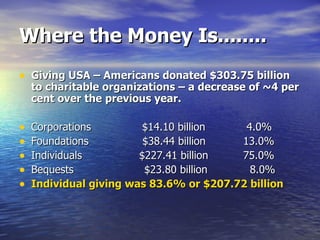
Where the Money Is........ Giving USA – Americans donated $303.75 billion to charitable organizations – a decrease of ~4 per cent over the previous year. Corporations   $14.10 billion  4.0% Foundations  $38.44 billion 13.0% Individuals  $227.41 billion 75.0% Bequests  $23.80 billion   8.0% Individual giving was 83.6% or $207.72 billion
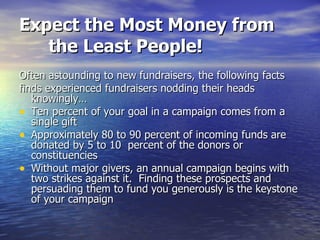
Expect the Most Money from the Least People! Often astounding to new fundraisers, the following facts finds experienced fundraisers nodding their heads knowingly… Ten percent of your goal in a campaign comes from a single gift Approximately 80 to 90 percent of incoming funds are donated by 5 to 10  percent of the donors or constituencies Without major givers, an annual campaign begins with two strikes against it.  Finding these prospects and persuading them to fund you generously is the keystone of your campaign
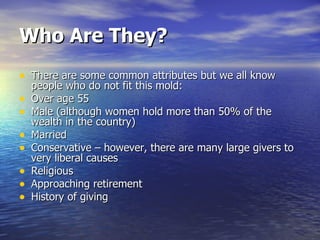
Who Are They? There are some common attributes but we all know people who do not fit this mold: Over age 55 Male (although women hold more than 50% of the wealth in the country) Married Conservative – however, there are many large givers to very liberal causes Religious Approaching retirement History of giving
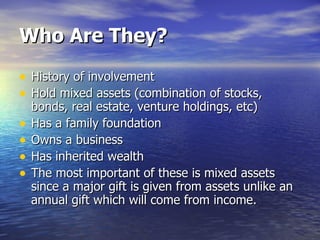
Who Are They? History of involvement Hold mixed assets (combination of stocks, bonds, real estate, venture holdings, etc) Has a family foundation Owns a business Has inherited wealth The most important of these is mixed assets since a major gift is given from assets unlike an annual gift which will come from income.
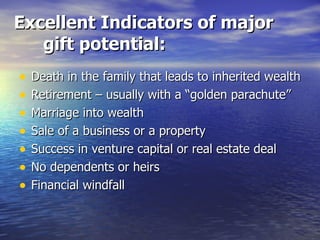
Excellent Indicators of major gift potential: Death in the family that leads to inherited wealth Retirement – usually with a “golden parachute” Marriage into wealth Sale of a business or a property Success in venture capital or real estate deal No dependents or heirs Financial windfall
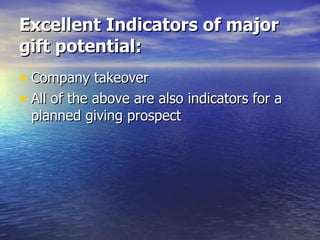
Excellent Indicators of major gift potential: Company takeover All of the above are also indicators for a planned giving prospect
Why You Need Them A major donor is significant because his or her gift is large enough to make a real difference . In every development plan there should be a major gift plan since it is the most successful and cost-effective way to seek private funds Their gifts can support current programs, new programs which are not in the current budget, and capital needs.
Major Gifts come from Someone who knows you Major gifts come from someone who has an extraordinary commitment to your organization  They usually come from insiders – board members and other close friends They are generally motivated but many times have not been recognized as potential givers
Why People Give Figuring out what will motivate a donor to give is one of the most important aspects of major gifts fundraising.  The definition of motivation might be:  those factors within a person combined with external forces that move him or her to make a donation.  If we consider Maslow’s Hierarchy of Needs for fundraising, we must accept his theory that a person does not move up on the scale of needs until all the needs in a lower category are met.
Why People Give An individual is not likely to become a major prospect until he or she has completely satisfied needs at the safety and physiological levels.  But once a person starts looking for connections and acceptance, relating to a nonprofit is a natural outlet.
Why People Give Paul H. Schneiter in  The Art of Asking  points to seven reasons: Religious Beliefs Guilt Recognition Self preservation and fear Tax Benefits Obligation Pressure
Four Prerequisites for Success Every organization must have a clearly stated and well-recognized mission in place.  The following are essential to that mission – they are basic and simple – but often overlooked: Cause  – the socially desirable result you hope to achieve.  It must be significant, have a direct impact on society, and a sense of immediacy.
Requisites for Success Case  – statement of how an organization is going to achieve the result.  It shows why funds are needed and the specific funding priorities related to these needs.  Gives prospect clear reasons why they should support you and clearly outlines what makes your activities better or different from those of others
Requisites for Success Organizational   Identity  – your organization must be recognized for the issues on which you work.  There should be an immediate linkage in the public’s mind the case of the organization’s programs to the cause being addressed People  – the internal and external constituencies of the organization must all be drawn into the fundraising process for it to be successful
Where Are They? The purpose of the research process is to estimate the maximum gift a prospect could make if properly motivated by the organization.  Finding out facts about prospects helps you decide which activities will affect gift motivations.  The ultimate aim is to find the  right person  to ask the  right prospect  for the  right amount  in the  right way  for the  right amount  at the  right time .
How do you find them? Prospect research is an essential component – it must be ongoing and continuous Changes in a prospect’s financial holdings or family situation can obviously have a dramatic impact on his or her potential What are the best sources for information on a prospect: In-house records Computer information you can access Newspapers, business journals
How do you find them? Personal contacts with volunteers, other prospects Prior donors People who have shown an interest in your organization Vendors Past and present Board Members People with historical or family ties to the organization Employees Neighbors People with interest in similar causes
How do you find them? Prospect Research Traditional Resources The Social Register Who’s Who in America Standard and Poor’s Register of Corporations Dun and Bradstreet America’s Wealthiest People Who’s Who (various professions) Quantus (stock holdings for top executives)
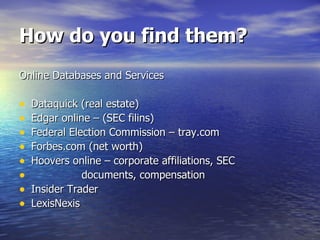
How do you find them? Online Databases and Services Dataquick (real estate) Edgar online – (SEC filins) Federal Election Commission – tray.com Forbes.com (net worth) Hoovers online – corporate affiliations, SEC  documents, compensation Insider Trader  LexisNexis
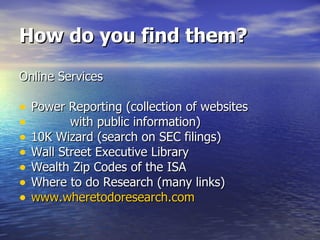
How do you find them? Online Services Power Reporting (collection of websites with public information) 10K Wizard (search on SEC filings) Wall Street Executive Library Wealth Zip Codes of the ISA Where to do Research (many links) www.wheretodoresearch.com
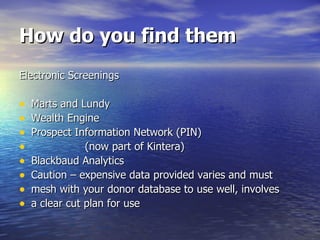
How do you find them Electronic Screenings Marts and Lundy Wealth Engine Prospect Information Network (PIN) (now part of Kintera) Blackbaud Analytics Caution – expensive data provided varies and must mesh with your donor database to use well, involves  a clear cut plan for use
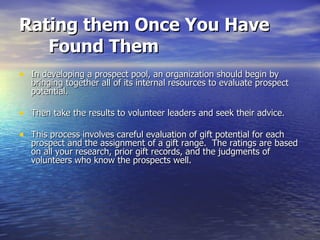
Rating them Once You Have Found Them   In developing a prospect pool, an organization should begin by bringing together all of its internal resources to evaluate prospect potential.  Then take the results to volunteer leaders and seek their advice.  This process involves careful evaluation of gift potential for each prospect and the assignment of a gift range.  The ratings are based on all your research, prior gift records, and the judgments of volunteers who know the prospects well.
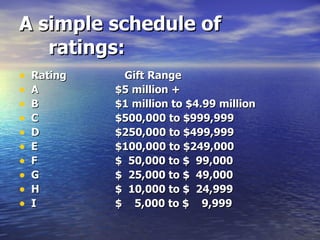
A simple schedule of ratings: Rating   Gift Range A $5 million + B $1 million to $4.99 million C $500,000 to $999,999 D $250,000 to $499,999 E $100,000 to $249,000 F $  50,000 to $  99,000 G $  25,000 to $  49,000 H $  10,000 to $  24,999 I $  5,000 to $  9,999
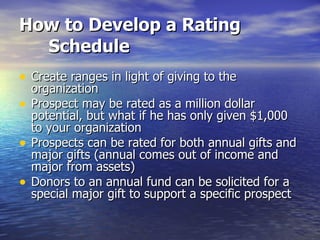
How to Develop a Rating Schedule Create ranges in light of giving to the organization Prospect may be rated as a million dollar potential, but what if he has only given $1,000 to your organization Prospects can be rated for both annual gifts and major gifts (annual comes out of income and major from assets) Donors to an annual fund can be solicited for a special major gift to support a specific prospect
For ratings keep two factors in mind:  Ability to Give Inclination to Give
Rating Sessions Raising major gifts requires that you segment the prospect pool, emphasizing those who are worth the most effort. The aim of researching and rating prospects is to define the top 10 percent of the organization’s constituency – the people who can make the real difference.  Prospects at lower levels will also be identified through this process
Rating Sessions Seek ability ratings only – ask volunteers to rate prospects on their ability to give if properly motivated First level is a broad screening process where volunteers identify everyone with potential Second level is where you seek peer-level ratings from those who know the prospects well Process is confidential and well organized
Cultivation or Getting to Know You In development terminology, the word “cultivation” means educating potential donors about an organization’s mission and needs before they are asked for a gift Usually the larger the gift, the more preparatory steps have to be taken. Cultivation takes place slowly over a period of time
Cultivation or Getting to Know You Cultivation should not be aimed at getting only one gift – it should focus on establishing a habit of giving with significant gifts coming at key points Your most important cultivation targets should be prior donors
Establishing your moves management program Cultivation occurs in three ways: Mass impersonal events Smaller-directed events One-on-One personal interaction However, with some major prospects, you might jump over the first two, and focus on personal interaction.
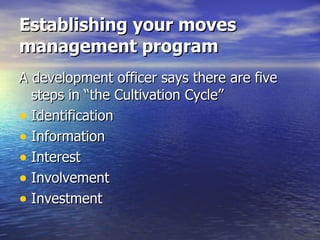
Establishing your moves management program A development officer says there are five steps in “the Cultivation Cycle” Identification Information Interest Involvement Investment
There is a process as well as an art in cultivation The key to success with major gifts relates to thinking about a potential donor more as a “person” rather than as a “prospect”.  The aim is to involve wealthy people intimately and genuinely with your organization In order to accomplish this, you must create a formal process called “moves management” which allows you to bring the potential donor closer to the organization.
Art of Cultivation  Each donor is assigned to a volunteer or staff for cultivation and needs to have a certain number of interactions per year – the higher the prospect scores on ability and propensity – the more “moves” that person will have per year
Asking the Big Question  - who should do the asking? If the correct cultivation has taken place, the ask can really be a rewarding experience – both for the asker and the donor Soliciting a major gift almost always requires a personal visit The asker should be of equal or superior status to the prospect – they can be a prominent volunteer, chief administrative officer, artistic director, or key members of either the development or the administrative staff.
How Should they Ask? There are three stages in the solicitation process: Preparation for the face-to-face meeting The meeting Follow-up
The Ask The solicitor – who has made his or her own generous commitment to the organization – engages the potential donor in meaningful conversation – and it is amazing how much information can be gathered Always use open-ended questions such as….In your opinion, what are the most important projects that need attention?  Some people say…..what do you think of that?
What are the questions the potential donor is thinking? Is it the best? Will it perform the way they say it will? Will it have a lasting impact? How will I be paid back for my investment? Think carefully how you can answer these questions throughout your conversations
What is the most important part of the meeting? You will have to do more listening than talking – and that is not easy Listening is a selective process – a good listener hears all, but chooses to respond only to his/her speaker’s most important points.  Respond only to those topics germane to your solicitation
Listening …… Good listeners are alert – they listen with a purpose and ask questions that will get them the information they want Good listeners are empathetic – attempt to understand what the speaker is saying.  Good listeners are not defensive – many times we spend our listening time formulating responses and counter-arguments.  When you do this – you are not listening
Learn to summarize Another very effective method of winning over your prospect is to summarize what you have heard …. I hear you saying that…… or Let me be sure I understand what you have said.  These summaries are effective for a number of reasons:
Summarize… Give evidence that you have listened Encourage your prospect to listen to you Suggest areas of common ground Help avoid hostility Encourage your prospect to respect you as a reasonable and empathetic person
Objections…… An objection actually gives you a wonderful opportunity to clarify any issues.  An effective method of dealing with objections is to remember three little words –  Feel, Felt, Found. I know how you  feel Others have  felt  the same way And upon further study, what we have  found  is that this is one of the most effective ways of reducing violence in the middle school among nine-year olds…..
Setting their sights The prospect may not be initially thinking of a gift at the level you will ask them to consider – you may need to consider doing the following: Share with the prospect some of the other lead gifts Discuss the value of leadership gifts to the campaign
Setting their sights Explain the importance of their participation in the campaign to securing other major gifts  Discuss the tax advantages If working with a key volunteer, have him or her discuss their own stretch gift to the campaign because of the importance of the need
Asking for a thoughtful and proportionate commitment Although decisions regarding the magnitude of the investment rests with the prospect alone, you will need to ask for a contribution that is based on their ability to give, their understanding of the organization, and their interest in the projects In order to secure gifts at this level – you must ask for them!
Other Important Points to Consider   What if your prospect’s considered pledge is far below evaluation? Negotiate – you do not have to accept the first offer Thank them for considering a pledge, but tell them you would like them to think further before making a decision – this project is so important to the organization “ If you do not consider a gift at the ___level given your degree of interest and ability, who else might we ask for such an investment”
Asking….. Remember – we are asking for an investment in a major community asset
Keep in Mind Remember this advice from John D. Rockefeller, Jr. one of the earliest major philanthropists and fundraisers: “ Never think you need to apologize for asking someone to give to a worthy cause, any more than as though you were giving him an opportunity to participate in a high grade investment”
Keep in Mind The role of a solicitor is to  guide  and  gauge  the prospect’s increasing interest, to  determine  the highest possible level of support the prospect can consider and finally to  ask  for that support.
The Follow-Up Always thank the prospect in writing for seeing you.  Use the letter to share even more information about the cause. If a pledge was given or a gift made, thank the donor yourself but also have the Board president and CEO send their letter. If no commitment was made, thank them for their time and send any appropriate information

Gwln Major Gifts

  • 1.
    Fundraising 101: MajorGifts Who, What, Why and How Carlos F. Camargo, Ph.D. Arête Management Consulting For GWLN Stakeholder Training
  • 2.
    Where the MoneyIs........ Giving USA – Americans donated $303.75 billion to charitable organizations – a decrease of ~4 per cent over the previous year. Corporations $14.10 billion 4.0% Foundations $38.44 billion 13.0% Individuals $227.41 billion 75.0% Bequests $23.80 billion 8.0% Individual giving was 83.6% or $207.72 billion
  • 3.
    Expect the MostMoney from the Least People! Often astounding to new fundraisers, the following facts finds experienced fundraisers nodding their heads knowingly… Ten percent of your goal in a campaign comes from a single gift Approximately 80 to 90 percent of incoming funds are donated by 5 to 10 percent of the donors or constituencies Without major givers, an annual campaign begins with two strikes against it. Finding these prospects and persuading them to fund you generously is the keystone of your campaign
  • 4.
    Who Are They?There are some common attributes but we all know people who do not fit this mold: Over age 55 Male (although women hold more than 50% of the wealth in the country) Married Conservative – however, there are many large givers to very liberal causes Religious Approaching retirement History of giving
  • 5.
    Who Are They?History of involvement Hold mixed assets (combination of stocks, bonds, real estate, venture holdings, etc) Has a family foundation Owns a business Has inherited wealth The most important of these is mixed assets since a major gift is given from assets unlike an annual gift which will come from income.
  • 6.
    Excellent Indicators ofmajor gift potential: Death in the family that leads to inherited wealth Retirement – usually with a “golden parachute” Marriage into wealth Sale of a business or a property Success in venture capital or real estate deal No dependents or heirs Financial windfall
  • 7.
    Excellent Indicators ofmajor gift potential: Company takeover All of the above are also indicators for a planned giving prospect
  • 8.
    Why You NeedThem A major donor is significant because his or her gift is large enough to make a real difference . In every development plan there should be a major gift plan since it is the most successful and cost-effective way to seek private funds Their gifts can support current programs, new programs which are not in the current budget, and capital needs.
  • 9.
    Major Gifts comefrom Someone who knows you Major gifts come from someone who has an extraordinary commitment to your organization They usually come from insiders – board members and other close friends They are generally motivated but many times have not been recognized as potential givers
  • 10.
    Why People GiveFiguring out what will motivate a donor to give is one of the most important aspects of major gifts fundraising. The definition of motivation might be: those factors within a person combined with external forces that move him or her to make a donation. If we consider Maslow’s Hierarchy of Needs for fundraising, we must accept his theory that a person does not move up on the scale of needs until all the needs in a lower category are met.
  • 11.
    Why People GiveAn individual is not likely to become a major prospect until he or she has completely satisfied needs at the safety and physiological levels. But once a person starts looking for connections and acceptance, relating to a nonprofit is a natural outlet.
  • 12.
    Why People GivePaul H. Schneiter in The Art of Asking points to seven reasons: Religious Beliefs Guilt Recognition Self preservation and fear Tax Benefits Obligation Pressure
  • 13.
    Four Prerequisites forSuccess Every organization must have a clearly stated and well-recognized mission in place. The following are essential to that mission – they are basic and simple – but often overlooked: Cause – the socially desirable result you hope to achieve. It must be significant, have a direct impact on society, and a sense of immediacy.
  • 14.
    Requisites for SuccessCase – statement of how an organization is going to achieve the result. It shows why funds are needed and the specific funding priorities related to these needs. Gives prospect clear reasons why they should support you and clearly outlines what makes your activities better or different from those of others
  • 15.
    Requisites for SuccessOrganizational Identity – your organization must be recognized for the issues on which you work. There should be an immediate linkage in the public’s mind the case of the organization’s programs to the cause being addressed People – the internal and external constituencies of the organization must all be drawn into the fundraising process for it to be successful
  • 16.
    Where Are They?The purpose of the research process is to estimate the maximum gift a prospect could make if properly motivated by the organization. Finding out facts about prospects helps you decide which activities will affect gift motivations. The ultimate aim is to find the right person to ask the right prospect for the right amount in the right way for the right amount at the right time .
  • 17.
    How do youfind them? Prospect research is an essential component – it must be ongoing and continuous Changes in a prospect’s financial holdings or family situation can obviously have a dramatic impact on his or her potential What are the best sources for information on a prospect: In-house records Computer information you can access Newspapers, business journals
  • 18.
    How do youfind them? Personal contacts with volunteers, other prospects Prior donors People who have shown an interest in your organization Vendors Past and present Board Members People with historical or family ties to the organization Employees Neighbors People with interest in similar causes
  • 19.
    How do youfind them? Prospect Research Traditional Resources The Social Register Who’s Who in America Standard and Poor’s Register of Corporations Dun and Bradstreet America’s Wealthiest People Who’s Who (various professions) Quantus (stock holdings for top executives)
  • 20.
    How do youfind them? Online Databases and Services Dataquick (real estate) Edgar online – (SEC filins) Federal Election Commission – tray.com Forbes.com (net worth) Hoovers online – corporate affiliations, SEC documents, compensation Insider Trader LexisNexis
  • 21.
    How do youfind them? Online Services Power Reporting (collection of websites with public information) 10K Wizard (search on SEC filings) Wall Street Executive Library Wealth Zip Codes of the ISA Where to do Research (many links) www.wheretodoresearch.com
  • 22.
    How do youfind them Electronic Screenings Marts and Lundy Wealth Engine Prospect Information Network (PIN) (now part of Kintera) Blackbaud Analytics Caution – expensive data provided varies and must mesh with your donor database to use well, involves a clear cut plan for use
  • 23.
    Rating them OnceYou Have Found Them In developing a prospect pool, an organization should begin by bringing together all of its internal resources to evaluate prospect potential. Then take the results to volunteer leaders and seek their advice. This process involves careful evaluation of gift potential for each prospect and the assignment of a gift range. The ratings are based on all your research, prior gift records, and the judgments of volunteers who know the prospects well.
  • 24.
    A simple scheduleof ratings: Rating Gift Range A $5 million + B $1 million to $4.99 million C $500,000 to $999,999 D $250,000 to $499,999 E $100,000 to $249,000 F $ 50,000 to $ 99,000 G $ 25,000 to $ 49,000 H $ 10,000 to $ 24,999 I $ 5,000 to $ 9,999
  • 25.
    How to Developa Rating Schedule Create ranges in light of giving to the organization Prospect may be rated as a million dollar potential, but what if he has only given $1,000 to your organization Prospects can be rated for both annual gifts and major gifts (annual comes out of income and major from assets) Donors to an annual fund can be solicited for a special major gift to support a specific prospect
  • 26.
    For ratings keeptwo factors in mind: Ability to Give Inclination to Give
  • 27.
    Rating Sessions Raisingmajor gifts requires that you segment the prospect pool, emphasizing those who are worth the most effort. The aim of researching and rating prospects is to define the top 10 percent of the organization’s constituency – the people who can make the real difference. Prospects at lower levels will also be identified through this process
  • 28.
    Rating Sessions Seekability ratings only – ask volunteers to rate prospects on their ability to give if properly motivated First level is a broad screening process where volunteers identify everyone with potential Second level is where you seek peer-level ratings from those who know the prospects well Process is confidential and well organized
  • 29.
    Cultivation or Gettingto Know You In development terminology, the word “cultivation” means educating potential donors about an organization’s mission and needs before they are asked for a gift Usually the larger the gift, the more preparatory steps have to be taken. Cultivation takes place slowly over a period of time
  • 30.
    Cultivation or Gettingto Know You Cultivation should not be aimed at getting only one gift – it should focus on establishing a habit of giving with significant gifts coming at key points Your most important cultivation targets should be prior donors
  • 31.
    Establishing your movesmanagement program Cultivation occurs in three ways: Mass impersonal events Smaller-directed events One-on-One personal interaction However, with some major prospects, you might jump over the first two, and focus on personal interaction.
  • 32.
    Establishing your movesmanagement program A development officer says there are five steps in “the Cultivation Cycle” Identification Information Interest Involvement Investment
  • 33.
    There is aprocess as well as an art in cultivation The key to success with major gifts relates to thinking about a potential donor more as a “person” rather than as a “prospect”. The aim is to involve wealthy people intimately and genuinely with your organization In order to accomplish this, you must create a formal process called “moves management” which allows you to bring the potential donor closer to the organization.
  • 34.
    Art of Cultivation Each donor is assigned to a volunteer or staff for cultivation and needs to have a certain number of interactions per year – the higher the prospect scores on ability and propensity – the more “moves” that person will have per year
  • 35.
    Asking the BigQuestion - who should do the asking? If the correct cultivation has taken place, the ask can really be a rewarding experience – both for the asker and the donor Soliciting a major gift almost always requires a personal visit The asker should be of equal or superior status to the prospect – they can be a prominent volunteer, chief administrative officer, artistic director, or key members of either the development or the administrative staff.
  • 36.
    How Should theyAsk? There are three stages in the solicitation process: Preparation for the face-to-face meeting The meeting Follow-up
  • 37.
    The Ask Thesolicitor – who has made his or her own generous commitment to the organization – engages the potential donor in meaningful conversation – and it is amazing how much information can be gathered Always use open-ended questions such as….In your opinion, what are the most important projects that need attention? Some people say…..what do you think of that?
  • 38.
    What are thequestions the potential donor is thinking? Is it the best? Will it perform the way they say it will? Will it have a lasting impact? How will I be paid back for my investment? Think carefully how you can answer these questions throughout your conversations
  • 39.
    What is themost important part of the meeting? You will have to do more listening than talking – and that is not easy Listening is a selective process – a good listener hears all, but chooses to respond only to his/her speaker’s most important points. Respond only to those topics germane to your solicitation
  • 40.
    Listening …… Goodlisteners are alert – they listen with a purpose and ask questions that will get them the information they want Good listeners are empathetic – attempt to understand what the speaker is saying. Good listeners are not defensive – many times we spend our listening time formulating responses and counter-arguments. When you do this – you are not listening
  • 41.
    Learn to summarizeAnother very effective method of winning over your prospect is to summarize what you have heard …. I hear you saying that…… or Let me be sure I understand what you have said. These summaries are effective for a number of reasons:
  • 42.
    Summarize… Give evidencethat you have listened Encourage your prospect to listen to you Suggest areas of common ground Help avoid hostility Encourage your prospect to respect you as a reasonable and empathetic person
  • 43.
    Objections…… An objectionactually gives you a wonderful opportunity to clarify any issues. An effective method of dealing with objections is to remember three little words – Feel, Felt, Found. I know how you feel Others have felt the same way And upon further study, what we have found is that this is one of the most effective ways of reducing violence in the middle school among nine-year olds…..
  • 44.
    Setting their sightsThe prospect may not be initially thinking of a gift at the level you will ask them to consider – you may need to consider doing the following: Share with the prospect some of the other lead gifts Discuss the value of leadership gifts to the campaign
  • 45.
    Setting their sightsExplain the importance of their participation in the campaign to securing other major gifts Discuss the tax advantages If working with a key volunteer, have him or her discuss their own stretch gift to the campaign because of the importance of the need
  • 46.
    Asking for athoughtful and proportionate commitment Although decisions regarding the magnitude of the investment rests with the prospect alone, you will need to ask for a contribution that is based on their ability to give, their understanding of the organization, and their interest in the projects In order to secure gifts at this level – you must ask for them!
  • 47.
    Other Important Pointsto Consider What if your prospect’s considered pledge is far below evaluation? Negotiate – you do not have to accept the first offer Thank them for considering a pledge, but tell them you would like them to think further before making a decision – this project is so important to the organization “ If you do not consider a gift at the ___level given your degree of interest and ability, who else might we ask for such an investment”
  • 48.
    Asking….. Remember –we are asking for an investment in a major community asset
  • 49.
    Keep in MindRemember this advice from John D. Rockefeller, Jr. one of the earliest major philanthropists and fundraisers: “ Never think you need to apologize for asking someone to give to a worthy cause, any more than as though you were giving him an opportunity to participate in a high grade investment”
  • 50.
    Keep in MindThe role of a solicitor is to guide and gauge the prospect’s increasing interest, to determine the highest possible level of support the prospect can consider and finally to ask for that support.
  • 51.
    The Follow-Up Alwaysthank the prospect in writing for seeing you. Use the letter to share even more information about the cause. If a pledge was given or a gift made, thank the donor yourself but also have the Board president and CEO send their letter. If no commitment was made, thank them for their time and send any appropriate information