Balance Of Support Learning Objectives Relationships are vital to the sustainability and growth of your organization Meeting your members needs  and performing the group’s mission will bring financial success Donors are waiting to be asked to invest in your mission!
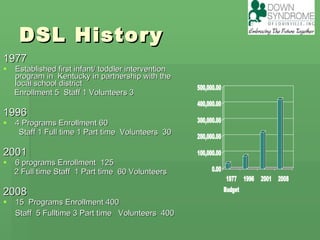
DSL History 1977   Established first infant/ toddler intervention program in  Kentucky in partnership with the local school district Enrollment 5  Staff 1 Volunteers 3 1996 4 Programs Enrollment 60  Staff 1 Full time 1 Part time  Volunteers  30 2001 6 programs Enrollment  125 2 Full time Staff  1 Part time  60 Volunteers 2008  15  Programs Enrollment 400 Staff  5 Fulltime 3 Part time  Volunteers  400
Life Long Learning Center New Family Outreach Program Infant  Developmental Intervention Toddler/Pre-School Developmental Playgroups  School Age Creative Enrichment Program/Summer Camp Sib-Shops Totally Tweeners Social Skills/Communication Development Dreams with Wings Teen Summer Camp Teen and Adult Life Style/ Social Program Steps to Independence Life Skills Programs Adult Literacy Individual tutoring and group classes Everyone Reads Program Behavior Intervention / Family Counseling Career Solutions  Job Placement Advocacy  for Education Health Community Access Family Networking Events
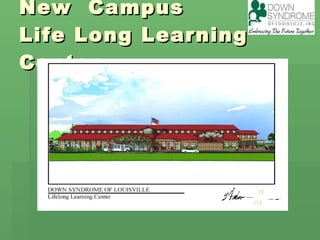
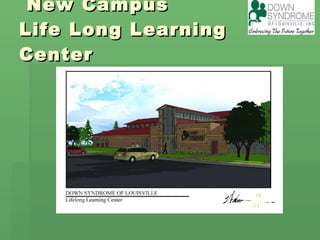
New  Campus Life Long Learning Center
New Campus Life Long Learning Center
Membership and Friends 1977  Membership  15  Friends  40 1996 Membership  84  Friends  350 2001   Membership  225  Friends  650 2008  Membership  720  Friends  14,000
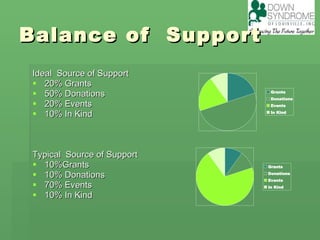
Balance of  Support  Ideal  Source of Support 20% Grants 50% Donations 20% Events 10% In Kind Typical  Source of Support  10%Grants  10% Donations 70% Events 10% In Kind
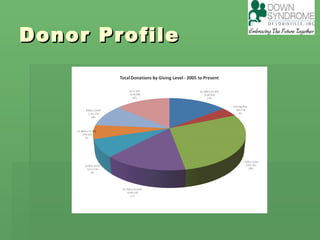
Donor Profile
Building Your Infrastructure  Board Structure : Recruit  parents, extended family, volunteers and community professionals  Percentage of board members of community professionals goal to be at least 40% Establish policies for attendance and participation in fundraising activities and campaigns Establish a Development Committee  Include a Development goal in your board’s strategic plan
Building Your Infrastructure Members Recruitment & Retention Establish policies and practices to ensure a welcoming environment for all. Inclusive of age, complexity of diagnosis, race, religion, ethnic, economic, or sexual orientation Establish an effective referral network with community partners Develop an effective First Call program including a system for maintaining contact with new parents Host regular networking events appropriate for various age groups When creating programs survey membership for relevancy for their needs
Building Your Infrastructure Friend Recruitment and Retention Encourage participation of extended family to attend member networking events and volunteer Contact local civic and business groups to book speaking engagements and encourage members to volunteer or attend events  Invite Friends to events and programs that showcases your organization Seek advice from Friends/Supporters within their area of expertise  Invite Friends/Supporter to serve on special projects or committees  Treasure your volunteers and seek input from experienced volunteers in future planning
Building Your Infrastructure Data Base Implement a consistent method of collecting  member/friend contact information.  Create a data base system to record  member’s/friend detailed contact information including donations, volunteer history, career and charitable interests. Allocate volunteer/staff to record and update information
Building Your  Infrastructure  Communications  and Public Relations Include a communication/public relations goal in your strategic plan Send all Friends/Supporters your general newsletter Develop an electronic system communication that is informative but not annoying Establish relationships with local TV, Radio and Print media  Send press releases in regard to programming events and accomplishments not just fund raising events Portray a Positive  Community Presence
Grant Basics Must be a 501c3 Non-Profit Organization  Competitive /Graded on specific criteria Rate of Success Average 20% Equipment and educational materials are funded at a higher rates than salaries  Grantors accept proposals during a specific time frame
Grant Basics Identify staff, volunteer or professional grant writer to complete the grant Seek grant writing training Allocate time to identify Grantors who’s guidelines match your needs Create a written descriptive narrative and budget for the request for funds Develop a relationship with grantor’s director
Grant Basics Allocate time for reports that Grantors require usually outcome measurements of your program Grantors typically do not fund the same need year after year. Grantors will fund new programs if well designed and the pilot program demonstrates positive outcomes
Annual Campaigns/Donations Establish an Annual Fund instead of Membership Membership dues typically sets the bar to low Membership may imply a time commitment Yearly Donations set a habit with the donors that can last a life time  Donors will contribute to both an annual campaign and the Buddy Walk An Annual campaign does not need to be in December
Annual Campaigns/Donations Create a case of support Detail why you need the funds Illustrate  your service in relation to a suggested donation  Example  $100.00 will purchase 3 new parent welcome baskets Demonstrate how the donor’s funds will impact a person with Down syndrome Use a personal story or ask a family to write a letter to donors describing how the organization met their needs. Document that your organization is reliable, responsible and good stewards of donated funds
Annual Campaigns/Donations Organize Your Campaign Recruit/appoint Chair/Co Chair Set a Goal and a start and ending date for the campaign  Recruit committee members including all board members Train Committee on techniques for asking for donations Analyze your list of members/friends and project donors that  are likely to donate and estimate an average donation Set a Budget include printing ,mailing cost and event expenses
Annual Campaigns/Donations A Personal Call Makes a Difference Mailing a brochure is not an annual campaign Typical return on just mailing is 1-5% Select from your data base Supporters that warrant a personal call or visit  DO NOT MAIL Check with your committee to see who may have a connection with donors that will receive a call/visit Use the power of e-mail but selectively The personal touch raised over  $10,000  with 105 donors 1/3 of our goal
Annual Campaign/Donations The  Dreaded Ask: The Donor is Waiting for the Opportunity To Give! Learn more about the “friend” and why he is a supporter of your cause Understand his giving history both dollars and talent  Call or e-mail for a short appointment Bring on the appointment a recent newsletter or materials that illustrate the growth of the group Share with the donor either your personal story or another member that benefited from their support. Thank him/her for his prior contributions
Annual Campaigns/Donations Share with the donor the objectives of the campaign and the goal Ask for his advise or comments on the plan Invite her to invest in the vision and join the campaign Ask the donor to complete the pledge sheet Thank the donor for his time and invite him to an upcoming event
Annual Campaign/Donations Show us the Money Set up convenient ways for people to give Arrange with bank to accept all credit cards Arrange with bank  for auto debit on a monthly basis Allow for  pledges with quarterly payment schedule especially for larger donations Design your brochure for an easy return envelope
Donations Celebrate and Honor List in every newsletter the opportunity to donate to honor any life event or a memorial  List the opportunity to donate on the web site Create donation envelopes with lines to honor a loved one Insert a donation envelope in each newsletter Distribute donation envelopes to area Funeral Homes
THANK The DONOR Thank the donor in a formal letter that is suitable for tax purposes Thank the donor within 7 days Thank the donor with a phone call for first time gifts or extraordinary gifts ( not necessarily  based on size of gift) Designate giving levels and list donors in those levels Thank the donor next time you see them Thank the donor in your newsletter  Ask your members to thank the Donor Consider an event to thank donors and volunteers  THANK THANK THANK the DONOR!
Fundraisers By Friends Developing Relationships with Community Organizations Identify  service organizations that raise dollars for charities Join and attend your local chamber of commerce and business association Identify labor unions or employee associations that raise dollars for charities Inquire with members  whose employers  sponsor Charity days Identify restaurants that fundraise for charities
Fundraising Events 3 Essential Elemental Questions What will it cost to produce?  What is the minimum dollars it will raise? What  is the cost of human resources?
Fundraising Events Answers or More Questions The  ideal cost  range to produce 0- 30% Is the minimum dollars raised less than the projection cost???  If  Yes STOP! Will staff or volunteer comprise core services to prepare and staff event???
Fundraising Events Will this event showcase your mission? Will this event afford opportunities for individuals with Down syndrome to participate? Will this event introduce new “Friends” to your organization? Will this event be unique and fun? Will you be competing with established events?
Fundraising Events Get Organized Recruit chair/co chair  Set  Fundraising Goal and Budget Book Venue  Solicit businesses for Sponsorship Solicit volunteers Solicit vendors for favorable discounts Solicit guests /participants Advertise Set up Clean up
Questions?? Contact Diana Merzweiler [email_address] 502-495-5088

D S Louisville Fundraising

  • 1.
    Balance Of SupportLearning Objectives Relationships are vital to the sustainability and growth of your organization Meeting your members needs and performing the group’s mission will bring financial success Donors are waiting to be asked to invest in your mission!
  • 2.
    DSL History 1977 Established first infant/ toddler intervention program in Kentucky in partnership with the local school district Enrollment 5 Staff 1 Volunteers 3 1996 4 Programs Enrollment 60 Staff 1 Full time 1 Part time Volunteers 30 2001 6 programs Enrollment 125 2 Full time Staff 1 Part time 60 Volunteers 2008 15 Programs Enrollment 400 Staff 5 Fulltime 3 Part time Volunteers 400
  • 3.
    Life Long LearningCenter New Family Outreach Program Infant Developmental Intervention Toddler/Pre-School Developmental Playgroups School Age Creative Enrichment Program/Summer Camp Sib-Shops Totally Tweeners Social Skills/Communication Development Dreams with Wings Teen Summer Camp Teen and Adult Life Style/ Social Program Steps to Independence Life Skills Programs Adult Literacy Individual tutoring and group classes Everyone Reads Program Behavior Intervention / Family Counseling Career Solutions Job Placement Advocacy for Education Health Community Access Family Networking Events
  • 4.
    New CampusLife Long Learning Center
  • 5.
    New Campus LifeLong Learning Center
  • 6.
    Membership and Friends1977 Membership 15 Friends 40 1996 Membership 84 Friends 350 2001 Membership 225 Friends 650 2008 Membership 720 Friends 14,000
  • 7.
    Balance of Support Ideal Source of Support 20% Grants 50% Donations 20% Events 10% In Kind Typical Source of Support 10%Grants 10% Donations 70% Events 10% In Kind
  • 8.
  • 9.
    Building Your Infrastructure Board Structure : Recruit parents, extended family, volunteers and community professionals Percentage of board members of community professionals goal to be at least 40% Establish policies for attendance and participation in fundraising activities and campaigns Establish a Development Committee Include a Development goal in your board’s strategic plan
  • 10.
    Building Your InfrastructureMembers Recruitment & Retention Establish policies and practices to ensure a welcoming environment for all. Inclusive of age, complexity of diagnosis, race, religion, ethnic, economic, or sexual orientation Establish an effective referral network with community partners Develop an effective First Call program including a system for maintaining contact with new parents Host regular networking events appropriate for various age groups When creating programs survey membership for relevancy for their needs
  • 11.
    Building Your InfrastructureFriend Recruitment and Retention Encourage participation of extended family to attend member networking events and volunteer Contact local civic and business groups to book speaking engagements and encourage members to volunteer or attend events Invite Friends to events and programs that showcases your organization Seek advice from Friends/Supporters within their area of expertise Invite Friends/Supporter to serve on special projects or committees Treasure your volunteers and seek input from experienced volunteers in future planning
  • 12.
    Building Your InfrastructureData Base Implement a consistent method of collecting member/friend contact information. Create a data base system to record member’s/friend detailed contact information including donations, volunteer history, career and charitable interests. Allocate volunteer/staff to record and update information
  • 13.
    Building Your Infrastructure Communications and Public Relations Include a communication/public relations goal in your strategic plan Send all Friends/Supporters your general newsletter Develop an electronic system communication that is informative but not annoying Establish relationships with local TV, Radio and Print media Send press releases in regard to programming events and accomplishments not just fund raising events Portray a Positive Community Presence
  • 14.
    Grant Basics Mustbe a 501c3 Non-Profit Organization Competitive /Graded on specific criteria Rate of Success Average 20% Equipment and educational materials are funded at a higher rates than salaries Grantors accept proposals during a specific time frame
  • 15.
    Grant Basics Identifystaff, volunteer or professional grant writer to complete the grant Seek grant writing training Allocate time to identify Grantors who’s guidelines match your needs Create a written descriptive narrative and budget for the request for funds Develop a relationship with grantor’s director
  • 16.
    Grant Basics Allocatetime for reports that Grantors require usually outcome measurements of your program Grantors typically do not fund the same need year after year. Grantors will fund new programs if well designed and the pilot program demonstrates positive outcomes
  • 17.
    Annual Campaigns/Donations Establishan Annual Fund instead of Membership Membership dues typically sets the bar to low Membership may imply a time commitment Yearly Donations set a habit with the donors that can last a life time Donors will contribute to both an annual campaign and the Buddy Walk An Annual campaign does not need to be in December
  • 18.
    Annual Campaigns/Donations Createa case of support Detail why you need the funds Illustrate your service in relation to a suggested donation Example $100.00 will purchase 3 new parent welcome baskets Demonstrate how the donor’s funds will impact a person with Down syndrome Use a personal story or ask a family to write a letter to donors describing how the organization met their needs. Document that your organization is reliable, responsible and good stewards of donated funds
  • 19.
    Annual Campaigns/Donations OrganizeYour Campaign Recruit/appoint Chair/Co Chair Set a Goal and a start and ending date for the campaign Recruit committee members including all board members Train Committee on techniques for asking for donations Analyze your list of members/friends and project donors that are likely to donate and estimate an average donation Set a Budget include printing ,mailing cost and event expenses
  • 20.
    Annual Campaigns/Donations APersonal Call Makes a Difference Mailing a brochure is not an annual campaign Typical return on just mailing is 1-5% Select from your data base Supporters that warrant a personal call or visit DO NOT MAIL Check with your committee to see who may have a connection with donors that will receive a call/visit Use the power of e-mail but selectively The personal touch raised over $10,000 with 105 donors 1/3 of our goal
  • 21.
    Annual Campaign/Donations The Dreaded Ask: The Donor is Waiting for the Opportunity To Give! Learn more about the “friend” and why he is a supporter of your cause Understand his giving history both dollars and talent Call or e-mail for a short appointment Bring on the appointment a recent newsletter or materials that illustrate the growth of the group Share with the donor either your personal story or another member that benefited from their support. Thank him/her for his prior contributions
  • 22.
    Annual Campaigns/Donations Sharewith the donor the objectives of the campaign and the goal Ask for his advise or comments on the plan Invite her to invest in the vision and join the campaign Ask the donor to complete the pledge sheet Thank the donor for his time and invite him to an upcoming event
  • 23.
    Annual Campaign/Donations Showus the Money Set up convenient ways for people to give Arrange with bank to accept all credit cards Arrange with bank for auto debit on a monthly basis Allow for pledges with quarterly payment schedule especially for larger donations Design your brochure for an easy return envelope
  • 24.
    Donations Celebrate andHonor List in every newsletter the opportunity to donate to honor any life event or a memorial List the opportunity to donate on the web site Create donation envelopes with lines to honor a loved one Insert a donation envelope in each newsletter Distribute donation envelopes to area Funeral Homes
  • 25.
    THANK The DONORThank the donor in a formal letter that is suitable for tax purposes Thank the donor within 7 days Thank the donor with a phone call for first time gifts or extraordinary gifts ( not necessarily based on size of gift) Designate giving levels and list donors in those levels Thank the donor next time you see them Thank the donor in your newsletter Ask your members to thank the Donor Consider an event to thank donors and volunteers THANK THANK THANK the DONOR!
  • 26.
    Fundraisers By FriendsDeveloping Relationships with Community Organizations Identify service organizations that raise dollars for charities Join and attend your local chamber of commerce and business association Identify labor unions or employee associations that raise dollars for charities Inquire with members whose employers sponsor Charity days Identify restaurants that fundraise for charities
  • 27.
    Fundraising Events 3Essential Elemental Questions What will it cost to produce? What is the minimum dollars it will raise? What is the cost of human resources?
  • 28.
    Fundraising Events Answersor More Questions The ideal cost range to produce 0- 30% Is the minimum dollars raised less than the projection cost??? If Yes STOP! Will staff or volunteer comprise core services to prepare and staff event???
  • 29.
    Fundraising Events Willthis event showcase your mission? Will this event afford opportunities for individuals with Down syndrome to participate? Will this event introduce new “Friends” to your organization? Will this event be unique and fun? Will you be competing with established events?
  • 30.
    Fundraising Events GetOrganized Recruit chair/co chair Set Fundraising Goal and Budget Book Venue Solicit businesses for Sponsorship Solicit volunteers Solicit vendors for favorable discounts Solicit guests /participants Advertise Set up Clean up
  • 31.
    Questions?? Contact DianaMerzweiler [email_address] 502-495-5088