A Planned Giving Program  in One Hour per Week April 6, 2011 Wells Fargo Private Bank provides financial services and products through Wells Fargo Bank, N.A. and its affiliates. Wells Fargo & Company cannot provide tax advice. Please consult your professional tax advisor to  determine how this information may apply to your own situation. Dan Harris Senior Vice President, Regional Manager Wells Fargo Philanthropic Services 720-947-6775 [email_address]
Introductions Presentation Objective: To encourage you to start or jump-start  your PG program today! Presentation Focus: Smaller organizations Newer organizations With few staff members, who wear many hats PG doesn’t have to be  complicated or  time-consuming.
Intro to Planned Giving The PG “Industry” has done a disservice:  To start a PG program, a nonprofit must: Evaluate “Institutional Readiness” Adopt / modify policies Understand all the PG vehicles  Buy marketing collateral, have seminars, website, etc. Industry Focus : big orgs with a PG specialist Consequence : Belief that PG is only for big orgs FACT : Nonprofits of all sizes / types have set up  successful PG programs
Intro to Planned Giving Planned Giving can become an important source of funding for almost any nonprofit organization If you remember one thing… Planned Giving is mostly  Bequests , and you don’t have to be an expert
What is Planned Giving? Planned Giving   is the process of making a charitable gift of  estate assets  to charitable organizations. Gift Planning   is the process of cultivating, designing, facilitating, and stewarding gifts to charitable organizations.  (Partnership for Philanthropic Planning)
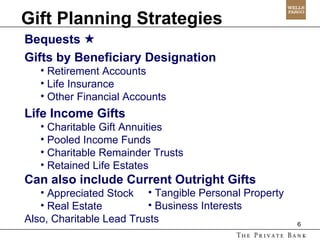
Gift Planning Strategies Bequests     Gifts by Beneficiary Designation Retirement Accounts Life Insurance Other Financial Accounts Life Income Gifts Charitable Gift Annuities Pooled Income Funds Charitable Remainder Trusts Retained Life Estates Can also include Current Outright Gifts Appreciated Stock Real Estate Also, Charitable Lead Trusts Tangible Personal Property Business Interests
Gift Planning Program 1. The active solicitation of planned gifts. 2. Any efforts undertaken in the process of  marketing, cultivating,  designing,  facilitating, and  stewarding gifts to charitable  organizations.
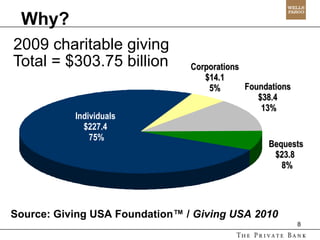
2009 charitable giving  Total = $303.75 billion   Source: Giving USA Foundation ™  /  Giving USA 2010 Why? Individuals $227.4  75% Foundations $38.4  13% Bequests $23.8   8% Corporations $14.1 5%
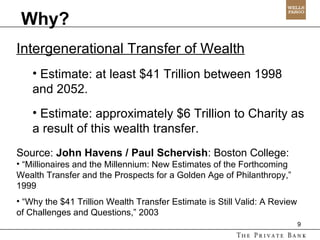
Intergenerational Transfer of Wealth Estimate: at least $41 Trillion between 1998 and 2052.  Estimate: approximately $6 Trillion to Charity as a result of this wealth transfer. Source:  John Havens / Paul Schervish : Boston College: “ Millionaires and the Millennium: New Estimates of the Forthcoming Wealth Transfer and the Prospects for a Golden Age of Philanthropy,” 1999 “ Why the $41 Trillion Wealth Transfer Estimate is Still Valid: A Review of Challenges and Questions,” 2003 Why?
WHY? Bequests  and  Beneficiary Designations   provide options for donors: Make a   larger gift  than donor thought possible Leave a legacy  for future generations
WHY? Gift Planning can be used: to  assist your donors  to fulfill their  philanthropic objectives to  assist your org to fulfill its   mission to  diversify   your   funding sources to  further your career  in philanthropy
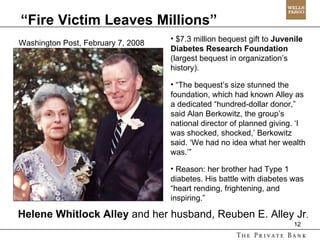
Helene Whitlock Alley  and her husband, Reuben E. Alley Jr . “ Fire Victim Leaves Millions” Washington Post, February 7, 2008 $7.3 million bequest gift to  Juvenile Diabetes Research Foundation  (largest bequest in organization’s history). “ The bequest’s size stunned the foundation, which had known Alley as a dedicated “hundred-dollar donor,” said Alan Berkowitz, the group’s national director of planned giving. ‘I was shocked, shocked,’ Berkowitz said. ‘We had no idea what her wealth was.’” Reason: her brother had Type 1 diabetes. His battle with diabetes was “heart rending, frightening, and inspiring.”
“ Big Donation Saved Bit by Bit” Grand Junction, Colorado The Daily Sentinel, February 10, 2008 Lena Sammons Read   died at the age of 96 on Feb. 19, 2007, preceded in death by her husband Clarence. “ She lived very frugally in a small trailer in Crawford, about 12 by 5 feet, which she and her husband bought,” [the estate executor] said. “She lived there for 40 years or more, close to the school, and most of the time she walked.”  She left $565,000 in  scholarships  to help Crawford students pay for higher education for the next 50 years. Also left  bequests  for Crawford’s  ambulance service ,  library ,  fire department ,  Methodist church , and  cemetery district . Crawford, Colorado.  Delta County. Population 366 in 2000 census.
Why Planned Giving? Five Studies:  NCPG  / NFO Research, Inc .: “Planned Giving in the United States  2001 .”  (Survey) (Partnership for Philanthropic Planning) Bank of America Study   of High Net-Worth Philanthropy,  2006 and 2008  Campbell & Company   / The Center on Philanthropy at Indiana University, “Bequest Donors: Demographics and Motivations of Potential and Actual Donors,”  2007  (Survey) Iceberg Philanthropy ,  Green / McDonald / Van Herpt.  2007  (Survey of Direct Mail Donors) Larry Stelter / J. Ann Selzer ,   “Discovering the Secret Giver: Groundbreaking Research on the Behavior of Bequest Givers in America,”  2008  (Study)
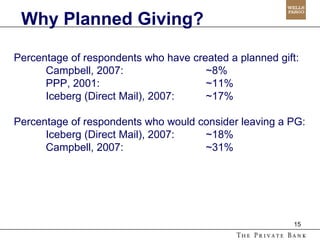
Percentage of respondents who have created a planned gift: Campbell, 2007:  ~8% PPP, 2001:  ~11% Iceberg (Direct Mail), 2007:  ~17% Percentage of respondents who would consider leaving a PG:  Iceberg (Direct Mail), 2007:  ~18% Campbell, 2007:  ~31% Why Planned Giving?
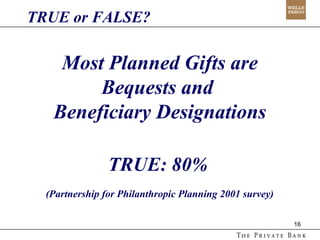
TRUE or FALSE? Most Planned Gifts are Bequests and  Beneficiary Designations TRUE: 80%   (Partnership for Philanthropic Planning 2001 survey)
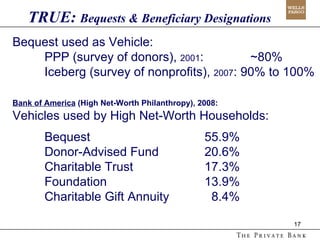
Bequest used as Vehicle:  PPP (survey of donors),  2001 :    ~80% Iceberg (survey of nonprofits),  2007 : 90% to 100% Bank of America  (High Net-Worth Philanthropy), 2008: Vehicles used by High Net-Worth Households: Bequest 55.9% Donor-Advised Fund 20.6% Charitable Trust 17.3% Foundation 13.9% Charitable Gift Annuity     8.4% TRUE:  Bequests & Beneficiary Designations
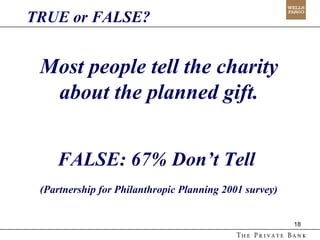
TRUE or FALSE? Most people tell the charity about the planned gift. FALSE: 67% Don’t Tell  (Partnership for Philanthropic Planning 2001 survey)
Percentage who have informed charity:   Iceberg (Direct Mail), 2007:    ~8% PPP, 2001:     ~33% Stelter/Selzer (age 40+), 2008:  ~36% Myth: Most People will Tell You
Charitable Bequests are made mostly by WEALTHY people FALSE:  At time of bequest commitment, 58% of bequest donors had income of less than $75,000. (Partnership for Philanthropic Planning 2001 survey) TRUE or FALSE?
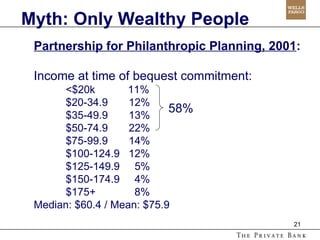
Partnership for Philanthropic Planning, 2001 : Income at time of bequest commitment: <$20k  11% $20-34.9  12% $35-49.9  13% $50-74.9  22% $75-99.9  14% $100-124.9  12% $125-149.9  5% $150-174.9  4% $175+  8% Median: $60.4 / Mean: $75.9 Myth: Only Wealthy People 58%
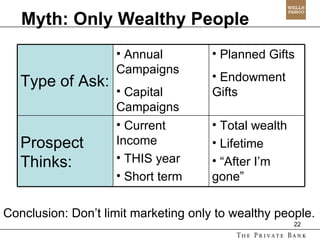
Myth: Only Wealthy People Conclusion: Don’t limit marketing only to wealthy people. Type of Ask: Annual  Campaigns Capital Campaigns Planned Gifts Endowment Gifts Prospect Thinks: Current Income THIS year Short term Total wealth Lifetime  “ After I’m gone”
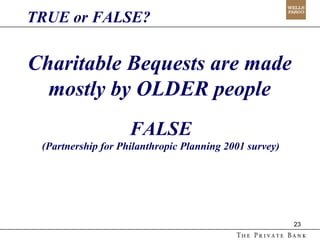
Charitable Bequests are made mostly by OLDER people FALSE (Partnership for Philanthropic Planning 2001 survey) TRUE or FALSE?
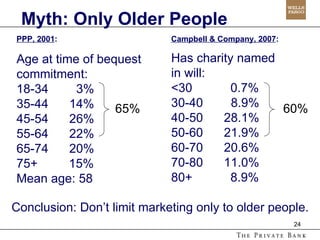
PPP, 2001 : Age at time of bequest commitment: 18-34  3% 35-44  14% 45-54  26% 55-64  22% 65-74  20% 75+  15% Mean age: 58 Myth: Only Older People Campbell & Company, 2007 : Has charity named  in will: <30  0.7% 30-40  8.9% 40-50  28.1% 50-60  21.9% 60-70  20.6% 70-80  11.0% 80+  8.9% 65% 60% Conclusion: Don’t limit marketing only to older people.
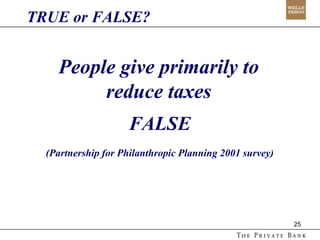
People give primarily to reduce taxes FALSE (Partnership for Philanthropic Planning 2001 survey) TRUE or FALSE?
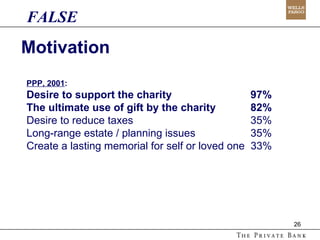
Motivation PPP, 2001 : Desire to support the charity  97% The ultimate use of gift by the charity  82% Desire to reduce taxes  35% Long-range estate / planning issues  35% Create a lasting memorial for self or loved one  33% FALSE
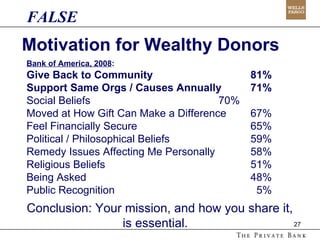
Motivation for Wealthy Donors Bank of America, 2008 : Give Back to Community 81% Support Same Orgs / Causes Annually 71% Social Beliefs 70% Moved at How Gift Can Make a Difference 67% Feel Financially Secure  65% Political / Philosophical Beliefs 59% Remedy Issues Affecting Me Personally 58% Religious Beliefs 51% Being Asked 48% Public Recognition   5% Conclusion: Your mission, and how you share it, is essential. FALSE
Leaving money to charity in your  estate plan requires hiring an attorney  FALSE: Beneficiary Designations  do not require an attorney. TRUE or FALSE?
The Best indicator that a person is likely to leave a bequest is their WEALTH   FALSE: The best predictor is LOYALTY Source:  Samuel D. Caldwell , President, The Planned Giving Company. “The Old Gray Mare Ain’t What She Used to Be: The Revolution in Planned Giving Marketing.” 2007, 2008 TRUE or FALSE?
Loyalty The best predictor of willingness to make a planned gift:  long-term loyalty   to your institution or cause . Fact: over 90% of planned giving donors exhibit loyal patterns of giving. Source:  Samuel D. Caldwell , President, The Planned Giving Company. “The Old Gray Mare Ain’t What She Used to Be: The Revolution in Planned Giving Marketing.” 2007, 2008 © 2007 The Planned Giving Company LLC  (used with permission)
Which Donors are the best planned giving prospects?   Answer:  those who are loyal. Next Question:  How do you measure loyalty? Loyalty
The PRIMARY way that donors hear about gift planning options is at a  Face-to-Face Meeting  with a representative of the charity  FALSE TRUE or FALSE?
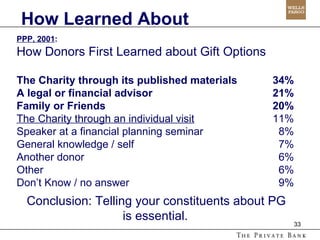
How Learned About PPP, 2001 : How Donors First Learned about Gift Options The Charity through its published materials  34% A legal or financial advisor 21% Family or Friends  20% The Charity through an individual visit   11% Speaker at a financial planning seminar    8% General knowledge / self   7% Another donor   6% Other   6% Don’t Know / no answer   9% Conclusion: Telling your constituents about PG is essential.
For the INITIAL contact to discuss estate gifts to a charity,  Most People Prefer to schedule a  Face-to-Face Meeting   with someone from the charity  TRUE or FALSE?
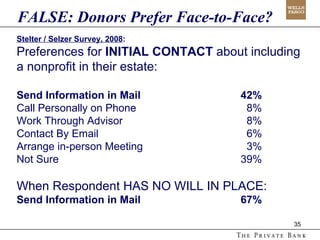
Stelter / Selzer Survey, 2008 : Preferences for  INITIAL CONTACT  about including a nonprofit in their estate:  Send Information in Mail  42% Call Personally on Phone   8% Work Through Advisor    8% Contact By Email    6% Arrange in-person Meeting    3% Not Sure 39% When Respondent HAS NO WILL IN PLACE:  Send Information in Mail  67% FALSE: Donors Prefer Face-to-Face?
Strategies: What You Need to Know Most PGs are  Bequests  and  Beneficiary Designations The planned giving community (MNPGC) is very supportive: reach out when you have a question:  Call or email other fundraisers
PG: Getting Started “ Bequest Program Fact Sheet for Board Members” “ Planned Giving” versus “Bequests” 80% of Planned Gifts are Bequests 67% of Donors will Never Tell 2009 Bequests: $23.8 Billion Intergenerational Wealth Transfer Loyalty Reasons Our Plans How board members can help Myths
Planned Giving “Stuff” Evaluate “institutional readiness (staff, board, budget, etc.)  Understand all planned giving vehicles Adopt / modify gift acceptance policies Adopt planned giving policies Create / implement recognition program Purchase gift planning software Create / implement marketing plan (collateral, website, direct mail, newsletters, events, face-to-face meetings, etc.) Create case for endowment  This “Stuff” can cripple a small nonprofit
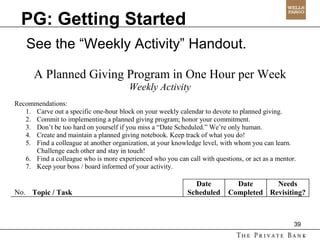
See the “Weekly Activity” Handout. PG: Getting Started
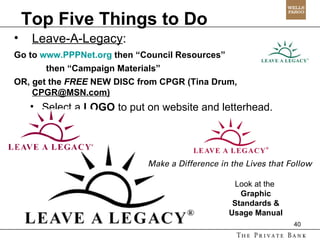
Top Five Things to Do Leave-A-Legacy :  Go to  www.PPPNet.org  then “Council Resources”  then “Campaign Materials” OR, get the  FREE  NEW DISC from CPGR (Tina Drum,  CPGR@MSN.com) Select a  LOGO  to put on website and letterhead. Look at the  Graphic Standards & Usage Manual
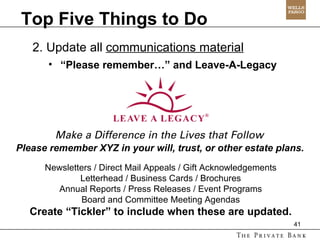
2. Update all  communications material “ Please remember…” and Leave-A-Legacy Please remember XYZ in your will, trust, or other estate plans. Newsletters / Direct Mail Appeals / Gift Acknowledgements Letterhead / Business Cards / Brochures Annual Reports / Press Releases / Event Programs Board and Committee Meeting Agendas Create “Tickler” to include when these are updated. Top Five Things to Do
3. Review “ Fact Sheet for Donors ” template; update with your org data. Print copies. 4. Review the “ Ways to Give ” template; modify. Print copies.  5. Update your  Website  to include reference to PG: “ Please remember us…”  “ Leave-A-Legacy” logo “ Fact Sheet for Donors” “ Ways to Give” Top Five Things to Do
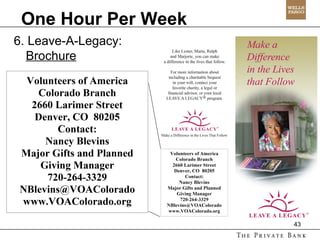
One Hour Per Week 6. Leave-A-Legacy: Brochure
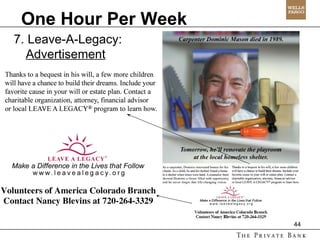
One Hour Per Week 7. Leave-A-Legacy: Advertisement
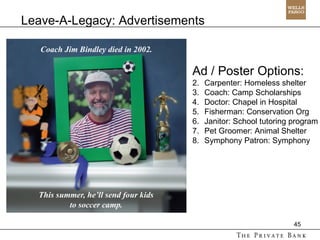
Leave-A-Legacy: Advertisements Ad / Poster Options: Carpenter: Homeless shelter Coach: Camp Scholarships Doctor: Chapel in Hospital Fisherman: Conservation Org Janitor: School tutoring program Pet Groomer: Animal Shelter Symphony Patron: Symphony
One Hour Per Week 8. List donors who have given in each of last three years (or more), or otherwise are  loyal donors . ●  Make a schedule to call them ●  Send LAL brochure with next communication 9. Make a list your senior or most  loyal volunteers . Send a thank you letter with LAL brochure.
One Hour Per Week 10. Write an  article  for your newsletter or website.  Discuss your org’s need for long-term funding. Include:  “ Have you ever considered an  estate gift  to (your org)? A charitable bequest provides an opportunity to give something back to your community, helping our programs and services long into the future. We would be honored by your support. Please feel free to contact (name and contact info) with any questions. Thank you for your confidence in our efforts.”
PG Additional Notes Family comes first   (for most people) Small gifts add up Revocable vs. Irrevocable Directing your gift Beneficiary Designations on IRAs Board support is essential
Planned Giving Training Minnesota Planned Giving Council www.MNPGC.org
Communicating With Donors Create Loyal Donors Transparency Clear Messaging: Vision, Mission, Case Statements Penelope Burk’s Donor-Centered Fundraising Ideas Endowment Clear Messaging: Purpose, Long-Term Need Bequests / Beneficiary Designations Passive: “Please Remember Us With a Bequest” Limited Mailing to Loyal Donors Personal Ask Recognition, Testimonials Down the Road: “Legacy Society,” Events
Dan Harris Senior Vice President, Regional Manager Wells Fargo Philanthropic Services 720-947-6775 [email_address] Questions? Please Email or Call With Additional Questions! See accompanying paper for list of resources.

WEBINAR: Planned Giving on One Hour Per Week

  • 1.
    A Planned GivingProgram in One Hour per Week April 6, 2011 Wells Fargo Private Bank provides financial services and products through Wells Fargo Bank, N.A. and its affiliates. Wells Fargo & Company cannot provide tax advice. Please consult your professional tax advisor to determine how this information may apply to your own situation. Dan Harris Senior Vice President, Regional Manager Wells Fargo Philanthropic Services 720-947-6775 [email_address]
  • 2.
    Introductions Presentation Objective:To encourage you to start or jump-start your PG program today! Presentation Focus: Smaller organizations Newer organizations With few staff members, who wear many hats PG doesn’t have to be complicated or time-consuming.
  • 3.
    Intro to PlannedGiving The PG “Industry” has done a disservice: To start a PG program, a nonprofit must: Evaluate “Institutional Readiness” Adopt / modify policies Understand all the PG vehicles Buy marketing collateral, have seminars, website, etc. Industry Focus : big orgs with a PG specialist Consequence : Belief that PG is only for big orgs FACT : Nonprofits of all sizes / types have set up successful PG programs
  • 4.
    Intro to PlannedGiving Planned Giving can become an important source of funding for almost any nonprofit organization If you remember one thing… Planned Giving is mostly Bequests , and you don’t have to be an expert
  • 5.
    What is PlannedGiving? Planned Giving is the process of making a charitable gift of estate assets to charitable organizations. Gift Planning is the process of cultivating, designing, facilitating, and stewarding gifts to charitable organizations. (Partnership for Philanthropic Planning)
  • 6.
    Gift Planning StrategiesBequests  Gifts by Beneficiary Designation Retirement Accounts Life Insurance Other Financial Accounts Life Income Gifts Charitable Gift Annuities Pooled Income Funds Charitable Remainder Trusts Retained Life Estates Can also include Current Outright Gifts Appreciated Stock Real Estate Also, Charitable Lead Trusts Tangible Personal Property Business Interests
  • 7.
    Gift Planning Program1. The active solicitation of planned gifts. 2. Any efforts undertaken in the process of marketing, cultivating, designing, facilitating, and stewarding gifts to charitable organizations.
  • 8.
    2009 charitable giving Total = $303.75 billion Source: Giving USA Foundation ™ / Giving USA 2010 Why? Individuals $227.4 75% Foundations $38.4 13% Bequests $23.8 8% Corporations $14.1 5%
  • 9.
    Intergenerational Transfer ofWealth Estimate: at least $41 Trillion between 1998 and 2052. Estimate: approximately $6 Trillion to Charity as a result of this wealth transfer. Source: John Havens / Paul Schervish : Boston College: “ Millionaires and the Millennium: New Estimates of the Forthcoming Wealth Transfer and the Prospects for a Golden Age of Philanthropy,” 1999 “ Why the $41 Trillion Wealth Transfer Estimate is Still Valid: A Review of Challenges and Questions,” 2003 Why?
  • 10.
    WHY? Bequests and Beneficiary Designations provide options for donors: Make a larger gift than donor thought possible Leave a legacy for future generations
  • 11.
    WHY? Gift Planningcan be used: to assist your donors to fulfill their philanthropic objectives to assist your org to fulfill its mission to diversify your funding sources to further your career in philanthropy
  • 12.
    Helene Whitlock Alley and her husband, Reuben E. Alley Jr . “ Fire Victim Leaves Millions” Washington Post, February 7, 2008 $7.3 million bequest gift to Juvenile Diabetes Research Foundation (largest bequest in organization’s history). “ The bequest’s size stunned the foundation, which had known Alley as a dedicated “hundred-dollar donor,” said Alan Berkowitz, the group’s national director of planned giving. ‘I was shocked, shocked,’ Berkowitz said. ‘We had no idea what her wealth was.’” Reason: her brother had Type 1 diabetes. His battle with diabetes was “heart rending, frightening, and inspiring.”
  • 13.
    “ Big DonationSaved Bit by Bit” Grand Junction, Colorado The Daily Sentinel, February 10, 2008 Lena Sammons Read died at the age of 96 on Feb. 19, 2007, preceded in death by her husband Clarence. “ She lived very frugally in a small trailer in Crawford, about 12 by 5 feet, which she and her husband bought,” [the estate executor] said. “She lived there for 40 years or more, close to the school, and most of the time she walked.” She left $565,000 in scholarships to help Crawford students pay for higher education for the next 50 years. Also left bequests for Crawford’s ambulance service , library , fire department , Methodist church , and cemetery district . Crawford, Colorado. Delta County. Population 366 in 2000 census.
  • 14.
    Why Planned Giving?Five Studies: NCPG / NFO Research, Inc .: “Planned Giving in the United States 2001 .” (Survey) (Partnership for Philanthropic Planning) Bank of America Study of High Net-Worth Philanthropy, 2006 and 2008 Campbell & Company / The Center on Philanthropy at Indiana University, “Bequest Donors: Demographics and Motivations of Potential and Actual Donors,” 2007 (Survey) Iceberg Philanthropy , Green / McDonald / Van Herpt. 2007 (Survey of Direct Mail Donors) Larry Stelter / J. Ann Selzer , “Discovering the Secret Giver: Groundbreaking Research on the Behavior of Bequest Givers in America,” 2008 (Study)
  • 15.
    Percentage of respondentswho have created a planned gift: Campbell, 2007: ~8% PPP, 2001: ~11% Iceberg (Direct Mail), 2007: ~17% Percentage of respondents who would consider leaving a PG: Iceberg (Direct Mail), 2007: ~18% Campbell, 2007: ~31% Why Planned Giving?
  • 16.
    TRUE or FALSE?Most Planned Gifts are Bequests and Beneficiary Designations TRUE: 80% (Partnership for Philanthropic Planning 2001 survey)
  • 17.
    Bequest used asVehicle: PPP (survey of donors), 2001 : ~80% Iceberg (survey of nonprofits), 2007 : 90% to 100% Bank of America (High Net-Worth Philanthropy), 2008: Vehicles used by High Net-Worth Households: Bequest 55.9% Donor-Advised Fund 20.6% Charitable Trust 17.3% Foundation 13.9% Charitable Gift Annuity 8.4% TRUE: Bequests & Beneficiary Designations
  • 18.
    TRUE or FALSE?Most people tell the charity about the planned gift. FALSE: 67% Don’t Tell (Partnership for Philanthropic Planning 2001 survey)
  • 19.
    Percentage who haveinformed charity: Iceberg (Direct Mail), 2007: ~8% PPP, 2001: ~33% Stelter/Selzer (age 40+), 2008: ~36% Myth: Most People will Tell You
  • 20.
    Charitable Bequests aremade mostly by WEALTHY people FALSE: At time of bequest commitment, 58% of bequest donors had income of less than $75,000. (Partnership for Philanthropic Planning 2001 survey) TRUE or FALSE?
  • 21.
    Partnership for PhilanthropicPlanning, 2001 : Income at time of bequest commitment: <$20k 11% $20-34.9 12% $35-49.9 13% $50-74.9 22% $75-99.9 14% $100-124.9 12% $125-149.9 5% $150-174.9 4% $175+ 8% Median: $60.4 / Mean: $75.9 Myth: Only Wealthy People 58%
  • 22.
    Myth: Only WealthyPeople Conclusion: Don’t limit marketing only to wealthy people. Type of Ask: Annual Campaigns Capital Campaigns Planned Gifts Endowment Gifts Prospect Thinks: Current Income THIS year Short term Total wealth Lifetime “ After I’m gone”
  • 23.
    Charitable Bequests aremade mostly by OLDER people FALSE (Partnership for Philanthropic Planning 2001 survey) TRUE or FALSE?
  • 24.
    PPP, 2001 :Age at time of bequest commitment: 18-34 3% 35-44 14% 45-54 26% 55-64 22% 65-74 20% 75+ 15% Mean age: 58 Myth: Only Older People Campbell & Company, 2007 : Has charity named in will: <30 0.7% 30-40 8.9% 40-50 28.1% 50-60 21.9% 60-70 20.6% 70-80 11.0% 80+ 8.9% 65% 60% Conclusion: Don’t limit marketing only to older people.
  • 25.
    People give primarilyto reduce taxes FALSE (Partnership for Philanthropic Planning 2001 survey) TRUE or FALSE?
  • 26.
    Motivation PPP, 2001: Desire to support the charity 97% The ultimate use of gift by the charity 82% Desire to reduce taxes 35% Long-range estate / planning issues 35% Create a lasting memorial for self or loved one 33% FALSE
  • 27.
    Motivation for WealthyDonors Bank of America, 2008 : Give Back to Community 81% Support Same Orgs / Causes Annually 71% Social Beliefs 70% Moved at How Gift Can Make a Difference 67% Feel Financially Secure 65% Political / Philosophical Beliefs 59% Remedy Issues Affecting Me Personally 58% Religious Beliefs 51% Being Asked 48% Public Recognition 5% Conclusion: Your mission, and how you share it, is essential. FALSE
  • 28.
    Leaving money tocharity in your estate plan requires hiring an attorney FALSE: Beneficiary Designations do not require an attorney. TRUE or FALSE?
  • 29.
    The Best indicatorthat a person is likely to leave a bequest is their WEALTH FALSE: The best predictor is LOYALTY Source: Samuel D. Caldwell , President, The Planned Giving Company. “The Old Gray Mare Ain’t What She Used to Be: The Revolution in Planned Giving Marketing.” 2007, 2008 TRUE or FALSE?
  • 30.
    Loyalty The bestpredictor of willingness to make a planned gift: long-term loyalty to your institution or cause . Fact: over 90% of planned giving donors exhibit loyal patterns of giving. Source: Samuel D. Caldwell , President, The Planned Giving Company. “The Old Gray Mare Ain’t What She Used to Be: The Revolution in Planned Giving Marketing.” 2007, 2008 © 2007 The Planned Giving Company LLC (used with permission)
  • 31.
    Which Donors arethe best planned giving prospects? Answer: those who are loyal. Next Question: How do you measure loyalty? Loyalty
  • 32.
    The PRIMARY waythat donors hear about gift planning options is at a Face-to-Face Meeting with a representative of the charity FALSE TRUE or FALSE?
  • 33.
    How Learned AboutPPP, 2001 : How Donors First Learned about Gift Options The Charity through its published materials 34% A legal or financial advisor 21% Family or Friends 20% The Charity through an individual visit 11% Speaker at a financial planning seminar 8% General knowledge / self 7% Another donor 6% Other 6% Don’t Know / no answer 9% Conclusion: Telling your constituents about PG is essential.
  • 34.
    For the INITIALcontact to discuss estate gifts to a charity, Most People Prefer to schedule a Face-to-Face Meeting with someone from the charity TRUE or FALSE?
  • 35.
    Stelter / SelzerSurvey, 2008 : Preferences for INITIAL CONTACT about including a nonprofit in their estate: Send Information in Mail 42% Call Personally on Phone 8% Work Through Advisor 8% Contact By Email 6% Arrange in-person Meeting 3% Not Sure 39% When Respondent HAS NO WILL IN PLACE: Send Information in Mail 67% FALSE: Donors Prefer Face-to-Face?
  • 36.
    Strategies: What YouNeed to Know Most PGs are Bequests and Beneficiary Designations The planned giving community (MNPGC) is very supportive: reach out when you have a question: Call or email other fundraisers
  • 37.
    PG: Getting Started“ Bequest Program Fact Sheet for Board Members” “ Planned Giving” versus “Bequests” 80% of Planned Gifts are Bequests 67% of Donors will Never Tell 2009 Bequests: $23.8 Billion Intergenerational Wealth Transfer Loyalty Reasons Our Plans How board members can help Myths
  • 38.
    Planned Giving “Stuff”Evaluate “institutional readiness (staff, board, budget, etc.) Understand all planned giving vehicles Adopt / modify gift acceptance policies Adopt planned giving policies Create / implement recognition program Purchase gift planning software Create / implement marketing plan (collateral, website, direct mail, newsletters, events, face-to-face meetings, etc.) Create case for endowment This “Stuff” can cripple a small nonprofit
  • 39.
    See the “WeeklyActivity” Handout. PG: Getting Started
  • 40.
    Top Five Thingsto Do Leave-A-Legacy : Go to www.PPPNet.org then “Council Resources” then “Campaign Materials” OR, get the FREE NEW DISC from CPGR (Tina Drum, CPGR@MSN.com) Select a LOGO to put on website and letterhead. Look at the Graphic Standards & Usage Manual
  • 41.
    2. Update all communications material “ Please remember…” and Leave-A-Legacy Please remember XYZ in your will, trust, or other estate plans. Newsletters / Direct Mail Appeals / Gift Acknowledgements Letterhead / Business Cards / Brochures Annual Reports / Press Releases / Event Programs Board and Committee Meeting Agendas Create “Tickler” to include when these are updated. Top Five Things to Do
  • 42.
    3. Review “Fact Sheet for Donors ” template; update with your org data. Print copies. 4. Review the “ Ways to Give ” template; modify. Print copies. 5. Update your Website to include reference to PG: “ Please remember us…” “ Leave-A-Legacy” logo “ Fact Sheet for Donors” “ Ways to Give” Top Five Things to Do
  • 43.
    One Hour PerWeek 6. Leave-A-Legacy: Brochure
  • 44.
    One Hour PerWeek 7. Leave-A-Legacy: Advertisement
  • 45.
    Leave-A-Legacy: Advertisements Ad/ Poster Options: Carpenter: Homeless shelter Coach: Camp Scholarships Doctor: Chapel in Hospital Fisherman: Conservation Org Janitor: School tutoring program Pet Groomer: Animal Shelter Symphony Patron: Symphony
  • 46.
    One Hour PerWeek 8. List donors who have given in each of last three years (or more), or otherwise are loyal donors . ● Make a schedule to call them ● Send LAL brochure with next communication 9. Make a list your senior or most loyal volunteers . Send a thank you letter with LAL brochure.
  • 47.
    One Hour PerWeek 10. Write an article for your newsletter or website. Discuss your org’s need for long-term funding. Include: “ Have you ever considered an estate gift to (your org)? A charitable bequest provides an opportunity to give something back to your community, helping our programs and services long into the future. We would be honored by your support. Please feel free to contact (name and contact info) with any questions. Thank you for your confidence in our efforts.”
  • 48.
    PG Additional NotesFamily comes first (for most people) Small gifts add up Revocable vs. Irrevocable Directing your gift Beneficiary Designations on IRAs Board support is essential
  • 49.
    Planned Giving TrainingMinnesota Planned Giving Council www.MNPGC.org
  • 50.
    Communicating With DonorsCreate Loyal Donors Transparency Clear Messaging: Vision, Mission, Case Statements Penelope Burk’s Donor-Centered Fundraising Ideas Endowment Clear Messaging: Purpose, Long-Term Need Bequests / Beneficiary Designations Passive: “Please Remember Us With a Bequest” Limited Mailing to Loyal Donors Personal Ask Recognition, Testimonials Down the Road: “Legacy Society,” Events
  • 51.
    Dan Harris SeniorVice President, Regional Manager Wells Fargo Philanthropic Services 720-947-6775 [email_address] Questions? Please Email or Call With Additional Questions! See accompanying paper for list of resources.

Editor's Notes