Southeast CAH Collaborative
Norton, VA
Brock Slabach, MPH, FACHE
Sr. Vice-President
National Rural Health Association
Leawood, KS
Rural Overview
 62 million patients rely on rural providers.
 Population challenges
 Geographic challenges
 Cultural challenges
 Rural providers face health care delivery challenges like no other
provider.
 Workforce shortages
 Fiscal constraints
 Rural providers and patients are disproportionately dependent on
Federal Government.
 Medicare, Medicaid
 Appropriations
 Regulatory Process
 Now, rural providers face unprecedented challenges from
Washington, D.C.
2
Rural disparities/challenges
• War on Poverty in the 60’s
• Rural Health Clinics –just turned 36 (1978), >4,500 RHC’s
nationwide
• Community Health Centers, created in the War on Poverty
• Advent of PPS 1983: 400 hospital closures
• Policy Response: SORH, Flex, MDH, CAH and LVH
• Rural serves more challenging populations:
• “Rural Americans are older, poorer and sicker than their urban
counterparts… Rural areas have higher rates of poverty, chronic
disease, and uninsured and underinsured, and millions of rural
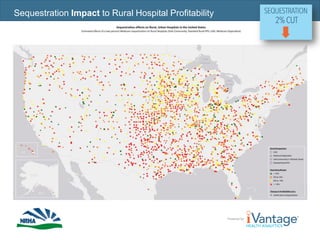
Americans have limited access to a primary care provider.” (HHS, 2011)
• Disparities are compounded if you are a senior or minority in rural
America.
Problems still exist…
• Health equates to wealth according to Univ. of Washington
Study, July 2013
• Key Finding:
• The study found that people who live in wealthy
areas like San Francisco, Colorado, or the suburbs
of Washington, D.C. are likely to be as healthy as
their counterparts in Switzerland or Japan, but those
who live in Appalachia or the rural South are likely to
be as unhealthy as people in Algeria or Bangladesh.
Medicare Cuts Enacted
• ACA Hospital Reductions: $159B
• Sequestration cuts – 2% for nine years
• Bad debt reimbursement cuts
• Documentation & coding cuts
• Readmission cuts
• Multiple therapy procedure cuts
• ESRD reimbursement cuts
• Outpatient hold harmless payments (TOPS) –
expired
• 508 reclassifications – expired
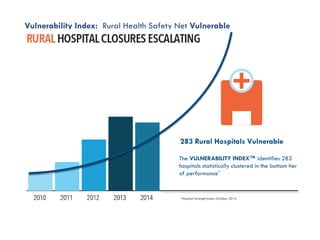
Vulnerability Index: Rural Health Safety Net Vulnerable
283 Rural Hospitals Vulnerable
The VULNERABILITY INDEX™ identifies 283
hospitals statistically clustered in the bottom tier
of performance*
* Hospital Strength Index October 2014
6
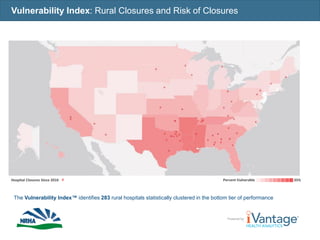
Vulnerability Index: Rural Closures and Risk of Closures
The Vulnerability Index™ identifies 283 rural hospitals statistically clustered in the bottom tier of performance
35%Percent VulnerableXHospital Closures Since 2010
7
Sequestration Impact to Rural Hospital Profitability
8
9
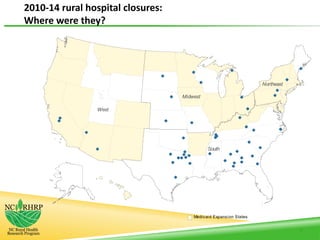
2010-14 rural hospital closures:
Where were they?
Northeast
South
Midwest
West
.
Medicaid Expansion States
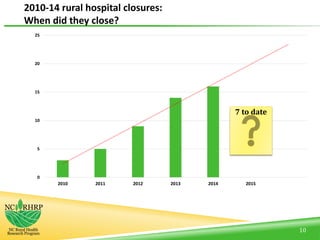
2010-14 rural hospital closures:
When did they close?
10
0
5
10
15
20
25
2010 2011 2012 2013 2014 2015
7 to date
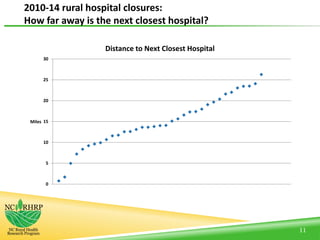
2010-14 rural hospital closures:
How far away is the next closest hospital?
11
0
5
10
15
20
25
30
Miles
Distance to Next Closest Hospital
12
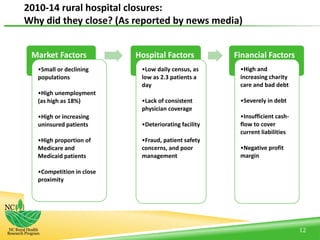
Market Factors
•Small or declining
populations
•High unemployment
(as high as 18%)
•High or increasing
uninsured patients
•High proportion of
Medicare and
Medicaid patients
•Competition in close
proximity
Hospital Factors
•Low daily census, as
low as 2.3 patients a
day
•Lack of consistent
physician coverage
•Deteriorating facility
•Fraud, patient safety
concerns, and poor
management
Financial Factors
•High and
increasing charity
care and bad debt
•Severely in debt
•Insufficient cash-
flow to cover
current liabilities
•Negative profit
margin
2010-14 rural hospital closures:
Why did they close? (As reported by news media)
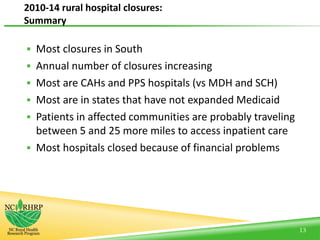
 Most closures in South
 Annual number of closures increasing
 Most are CAHs and PPS hospitals (vs MDH and SCH)
 Most are in states that have not expanded Medicaid
 Patients in affected communities are probably traveling
between 5 and 25 more miles to access inpatient care
 Most hospitals closed because of financial problems
13
2010-14 rural hospital closures:
Summary
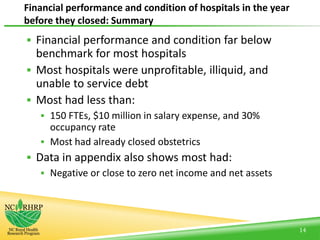
Financial performance and condition of hospitals in the year
before they closed: Summary
14
 Financial performance and condition far below
benchmark for most hospitals
 Most hospitals were unprofitable, illiquid, and
unable to service debt
 Most had less than:
 150 FTEs, $10 million in salary expense, and 30%
occupancy rate
 Most had already closed obstetrics
 Data in appendix also shows most had:
 Negative or close to zero net income and net assets
A general process of financial distress
15
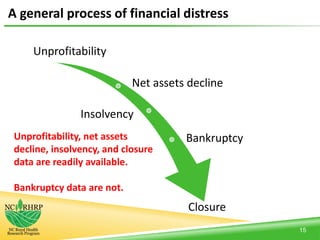
Unprofitability
Net assets decline
Insolvency
Bankruptcy
Closure
Unprofitability, net assets
decline, insolvency, and closure
data are readily available.
Bankruptcy data are not.
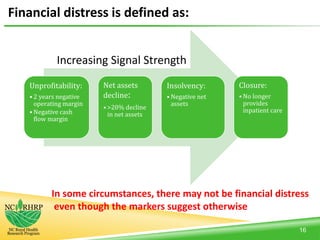
Financial distress is defined as:
Unprofitability:
• 2 years negative
operating margin
• Negative cash
flow margin
Net assets
decline:
• >20% decline
in net assets
Insolvency:
• Negative net
assets
Closure:
• No longer
provides
inpatient care
16
Increasing Signal Strength
In some circumstances, there may not be financial distress
even though the markers suggest otherwise
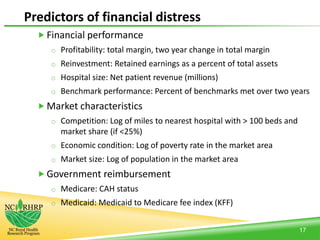
Predictors of financial distress
 Financial performance
o Profitability: total margin, two year change in total margin
o Reinvestment: Retained earnings as a percent of total assets
o Hospital size: Net patient revenue (millions)
o Benchmark performance: Percent of benchmarks met over two years
 Market characteristics
o Competition: Log of miles to nearest hospital with > 100 beds and
market share (if <25%)
o Economic condition: Log of poverty rate in the market area
o Market size: Log of population in the market area
 Government reimbursement
o Medicare: CAH status
o Medicaid: Medicaid to Medicare fee index (KFF)
17
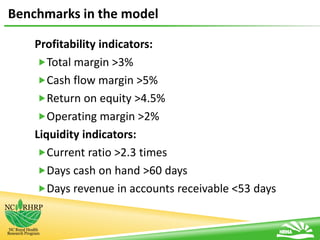
Benchmarks in the model
Profitability indicators:
Total margin >3%
Cash flow margin >5%
Return on equity >4.5%
Operating margin >2%
Liquidity indicators:
Current ratio >2.3 times
Days cash on hand >60 days
Days revenue in accounts receivable <53 days
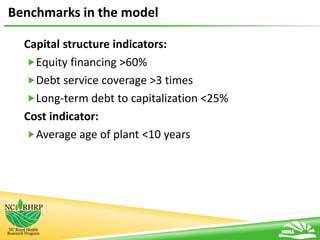
Benchmarks in the model
Capital structure indicators:
Equity financing >60%
Debt service coverage >3 times
Long-term debt to capitalization <25%
Cost indicator:
Average age of plant <10 years
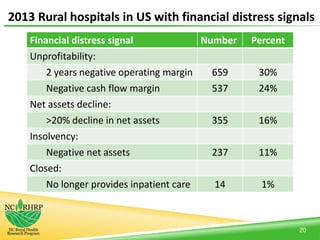
2013 Rural hospitals in US with financial distress signals
20
Financial distress signal Number Percent
Unprofitability:
2 years negative operating margin 659 30%
Negative cash flow margin 537 24%
Net assets decline:
>20% decline in net assets 355 16%
Insolvency:
Negative net assets 237 11%
Closed:
No longer provides inpatient care 14 1%
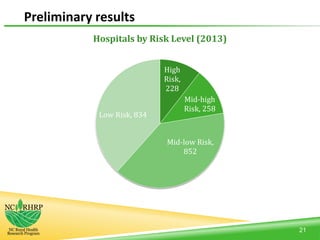
Preliminary results
21
High
Risk,
228
Mid-high
Risk, 258
Mid-low Risk,
852
Low Risk, 834
Hospitals by Risk Level (2013)
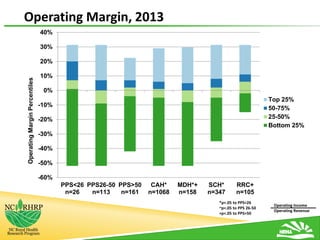
Operating Margin, 2013
22
Operating Income
Operating Revenue
*p<.05 to PPS<26
~p<.05 to PPS 26-50
+p<.05 to PPS>50
-60%
-50%
-40%
-30%
-20%
-10%
0%
10%
20%
30%
40%
PPS<26
n=26
PPS26-50
n=113
PPS>50
n=161
CAH*
n=1068
MDH*+
n=158
SCH*
n=347
RRC+
n=105
OperatingMarginPercentiles
Top 25%
50-75%
25-50%
Bottom 25%
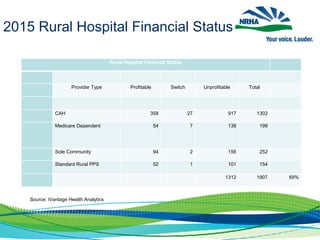
2015 Rural Hospital Financial Status
Rural Hospital Financial Status
Provider Type Profitable Switch Unprofitable Total
CAH 358 27 917 1302
Medicare Dependent 54 7 138 199
Sole Community 94 2 156 252
Standard Rural PPS 52 1 101 154
1312 1907 69%
Source: iVantage Health Analytics
Mergers and Acquisitions
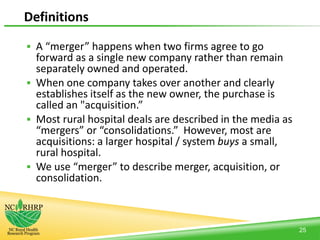
Definitions
 A “merger” happens when two firms agree to go
forward as a single new company rather than remain
separately owned and operated.
 When one company takes over another and clearly
establishes itself as the new owner, the purchase is
called an "acquisition.”
 Most rural hospital deals are described in the media as
“mergers” or “consolidations.” However, most are
acquisitions: a larger hospital / system buys a small,
rural hospital.
 We use “merger” to describe merger, acquisition, or
consolidation.
25
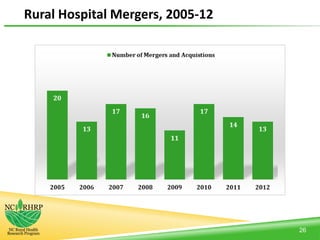
Rural Hospital Mergers, 2005-12
26
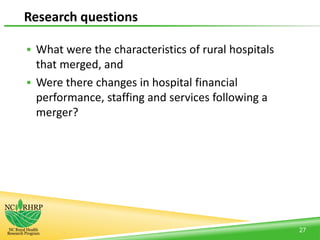
Research questions
 What were the characteristics of rural hospitals
that merged, and
 Were there changes in hospital financial
performance, staffing and services following a
merger?
27
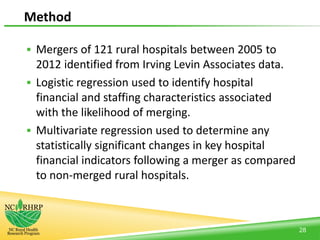
Method
 Mergers of 121 rural hospitals between 2005 to
2012 identified from Irving Levin Associates data.
 Logistic regression used to identify hospital
financial and staffing characteristics associated
with the likelihood of merging.
 Multivariate regression used to determine any
statistically significant changes in key hospital
financial indicators following a merger as compared
to non-merged rural hospitals.
28
Method
 Hospital fixed effects included to adjust for
systematic differences between hospitals that did
or did not engage in a merger.
 CAH status, acute average daily census, region, and
number of discharges were included to control for
hospital characteristics.
29
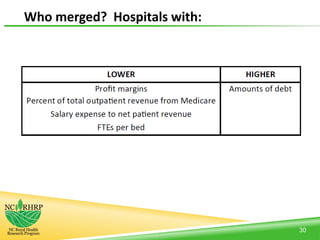
Who merged? Hospitals with:
30
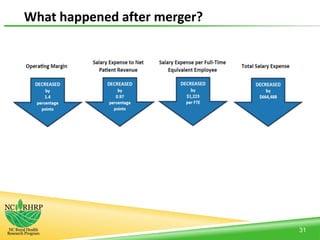
What happened after merger?
31
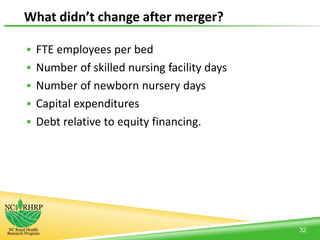
What didn’t change after merger?
 FTE employees per bed
 Number of skilled nursing facility days
 Number of newborn nursery days
 Capital expenditures
 Debt relative to equity financing.
32
Conclusion
 If small rural hospitals merge because they expect an
influx of capital, a relief of debt burden, or an
improvement in profitability, there was no evidence to
support this expectation.
 Some evidence of changes in staff mix as well as
reductions in average compensation and total salaries
 However, merger may be the only way for some rural
hospitals to survive.
 Mergers are financial and legal events that have many
non-financial consequences (quality?, access?,
employment?, local economy?)
33
Two-Step Process:
1. Stop the bleeding. Halt additional proposed cuts to rural
hospitals from the Administration and Congress immediately.
Support pro-rural provisions such as Medicaid expansion,
elimination of the 2% sequestration cuts and 101%
reimbursement for CAHs to stabilize the rural safety net.
2. Build bridge to the future. Promote new provider payment
models to create a new rural reality.
@SaveRural…Fighting Back
The Save Rural Hospitals Act
Rural hospital stabilization (Stop the bleeding)
• Elimination of Medicare Sequestration for rural hospitals;
• Reversal of all “bad debt” reimbursement cuts (Middle Class Tax Relief and Job Creation
Act of 2012);
• Permanent extension of current Low-Volume and Medicare Dependent Hospital payment
levels;
• Reinstatement of Sole Community Hospital “Hold Harmless” payments;
• Extension of Medicaid primary care payments;
• Elimination of Medicare and Medicaid DSH payment reductions; and
• Establishment of Meaningful Use support payments for rural facilities struggling.
• Permanent extension of the rural ambulance and super-rural ambulance payment.
Rural Medicare beneficiary equity. Eliminate higher out-of pocket charges for rural
patients (total charges vs. allowed Medicare charges.)
Regulatory Relief
• Elimination of the CAH 96-Hour Condition of Payment (See Critical Access Hospital Relief
Act of 2014);
• Rebase of supervision requirements for outpatient therapy services at CAHs and rural PPS
See PARTS Act);
• Modification to 2-Midnight Rule and RAC audit and appeals process.
Future of rural health care (Bridge to the Future)
I Innovation model for rural hospitals who continue to struggle.
Grassley Proposal
Title: Rural Emergency Acute Care Hospital Act
(REACH)
Features:
• Creates a new provider type: Rural Emergency
Hospital (REH)
The Save Rural Hospitals Act
HR 3225: Sponsored by Sam Graves (R) MO and Dan Loebsack, (D) IA
Title 1: Rural hospital stabilization (Stop the bleeding)
Title 2: Rural Medicare beneficiary equity.
Title 3: Regulatory Relief (Stop the bleeding)
Title 4: Future of rural health care (Bridge to the Future)
Save Rural Hospitals Act
Title I: Rural Provider Stabilization
• Eliminating Medicare sequestration for rural hospitals
• Reversing cuts to reimbursement of bad debt for CAHs and
Rural PPS Hospitals
• Extending payment levels for low-volume hospitals (LVH) and
Medicare Dependent Hospitals (MDH)
• Reinstating revised DRG payments for MDHs and SCHs
• Reinstating hold-harmless for hospital outpatient services for
SCHs
Save Rural Hospitals Act
Title I: Rural Provider Stabilization
• Delays application of penalties for failure to be a meaningful
EHR user
• Eliminating rural Medicare and Medicaid DSH payment
reductions
Subtitle B—Other Rural Providers
• Making permanent increase Medicare payments for ground
ambulance services in rural areas
• Extending Medicare primary care payments
Save Rural Hospitals Act
Title II: Rural Medicare Beneficiary Equity
• Equalizing beneficiary copayments for services furnished by a
CAH
Save Rural Hospitals Act
Title III: Regulatory Relief
• Eliminating 96-hour physician certification requirement with
respect to inpatient CAH services
• Rebasing physician supervision requirements
• Reforming practices of RACs under Medicare
Save Rural Hospitals Act
Title IV: Future of Rural Healthcare
• Community Outpatient Hospital (COH) Program
• Grant funding to assist rural hospitals
• CMMI demonstration of shared savings in rural hospitals
RECESS!
• Members in district
• Meet in district office
• Invite them to your facility
• Show and Tell
• Staff in DC
• Message:
• Rural Hospital Closure Crisis -
Save Rural Hospitals Act
• Appropriations – support for rural programs
SGR Fix
For Rural Doctors: 27-32% PFS Cuts
• Permanent SGR Repeal ($276 billion permanent fix)
• GPCI Extension ($500M)—Extends until Jan. 1, 2018
For Rural Hospitals:
• MDH ($100M)—Extends until Oct. 1, 2017
• 10-12% loss of Medicare revenue; need to make up 19% from private insurer.
• LVH ($450M)—Extends until Oct. 1, 2017
• approx. $500,000 per hospital and can mean well-over $1 million.
• Medicare Home Health Rural Add-On (extends 3% add-on until Jan. 1, 2018)
• Extension of therapy cap exceptions process (extends until Jan. 1, 2018)
OIG Attacks on CAHs
Another Misleading OIG Report
Health Affairs Report:
• Conclusion: Minimum-Distance Requirements
Could Harm High-Performing Critical-Access
Hospitals And Rural Communities
• President’s Budget continues to include eliminating
CAH designation if < 10 miles
• This idea has NOT gained any traction on the hill
• “We conclude that establishing a minimum-distance
requirement would generate modest cost savings for
Medicare but would likely be disruptive to the
communities that depend on these hospitals for their
health care.”
OIG Swing Bed Report
Medicare beneficiaries are eligible for up to 100
days of skilled nursing services following a
minimum 3-day acute inpatient hospitalization.
These services are provided in freestanding
skilled nursing facilities, hospital-based skilled
nursing facilities, and hospital swing beds
(Title 42 U.S. Code, 2011).
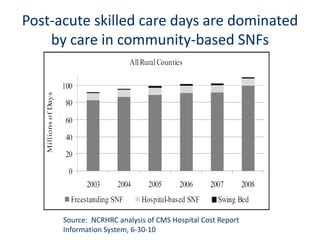
Post-acute skilled care days are dominated
by care in community-based SNFs
Source: NCRHRC analysis of CMS Hospital Cost Report
Information System, 6-30-10
UNC Sheps Center Conclusion:
• We believe the OIG has made methodological
choices that resulted in errors, and therefore,
the conclusions and policy recommendations
are suspect.
• A video that explains fixed cost transfers is available
at: https://www.youtube.com/watch?v=Ym75Tkka-xI
Conclusion on OIG
• No interest in Congress on Necessary Provider
exclusions
• No interest in Congress on Swing Bed
reimbursement changes
• However, NRHA is vigilant to make sure it stays that
way
• NRHA is working to fix beneficiary co-insurance
inequity for CAH patients
SGR Fix
For Rural Ambulance Providers ($100M) - Jan. 1, 2018
• 22.6% reductions
Two Year Extension:
Community Health Centers (CHC)
National Health Service Corps Fund (NHSC)
Teaching Health Centers
Converging Forces
• Price Reduction threats and volume
reduction pressures
• Expanding insurance coverage but narrower
networks
• Increasing quality of care measures and
accountabilities
• Widespread provider and payer affiliations
SGR Repeal and the Rest of
The Story…..
• Replaces it with a physician payment
system based on “quality, value and
accountability”
• Five year period of 0.5% annual FFS
updates in transition to “new system”
SGR Repeal and……
• Improves existing FFS through value over volume and
ensuring payment accuracy
• Consolidates the existing 3 physician quality programs into
a streamlined program that rewards providers who meet
performance thresholds
• Implements a process of payment accuracy
• Incentivizes care coordination efforts for patients with
chronic conditions
• Introduces “physician-developed” clinical care guidelines to
reduce inappropriate care
• Requires development of quality measures and provides
for reporting alignment across different payment programs
SGR Repeal and….
Incentivizes movement to alternative payment
models (APM)
• Minimal FFS yearly increase next 10 years of 0.5%,
then 0%
• Merit-based payment system (eventually -9% to
+27% adjustment)—Based on quality, resource use
and clinical practice improvement activities
• APMs (up to 5% bonus) based on APM level of
participation—25% revenue year one (2018-19)
• 41% payment difference between highest and
lowest performing physicians
SGR Fix Implications
Bottom line:
• Current plan leaves $141B between 2015 and 2025
unpaid for or in other words, added to the deficit
• Physicians pushed along to APMs and a value-
based system, impact on hospitals and volume?
• RHC cost-based reimbursement are exempt
• Physician alignment a key reality
Sec. Burwell’s Medicare Goals
• 30% of Medicare provider payments in APMs by 2016
• 50% of Medicare provider payments in APMs by 2018
• 85% of Medicare fee-for-service payments to be tied to
quality and value by 2016
• 90% of Medicare fee-for-service payments to be tied to
quality and value by 2018
CMS Payment Goals
Alternative Payment Models (APM)
• Shared Savings Models
• Bundled Payments
• Patient Centered Medical Homes
Remaining Fee For Service Linked to Value/Quality
Aggressive Timeline
• Favors: Large Systems, population health
management experience and deep pockets
Will Accelerate Provider Affiliations
So What?
• FFS/CBR payment  Value Payment
• Primary care physicians become revenue centers
• High cost procedures, specialists and hospitals
become cost centers
• Insurance Strategies
• Reference Pricing and Narrow Networks
• Consumer Driven Healthcare
• High Deductibles and price transparency
• These fundamental healthcare changes will impact
our hospital’s financial viability and survival
Follow the Money
• How we deliver care is how we are paid for
care
• Healthcare reform is changing BOTH
payment and delivery
• Bottom line: reform involves transfer of risk
from payers to providers
The Pop Health Review
• Preparing for the “new health care”
• Population Health
• Transition From Volume to Value
• Market Trends
• DSR and Reimbursement Models
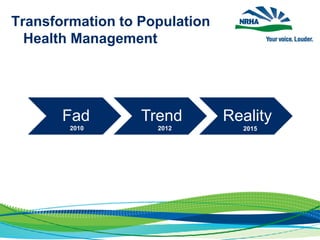
Transformation to Population
Health Management
Fad Trend Reality
2010 2012 2015
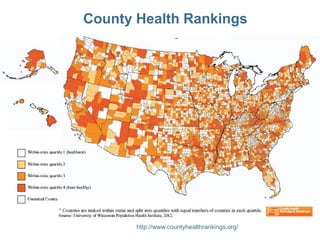
http://www.countyhealthrankings.org/
County Health Rankings
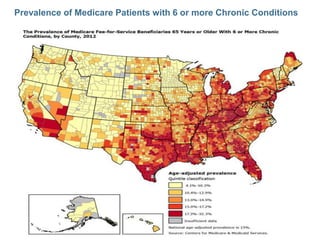
Prevalence of Medicare Patients with 6 or more Chronic Conditions
Federal
Employee/Commercial
State
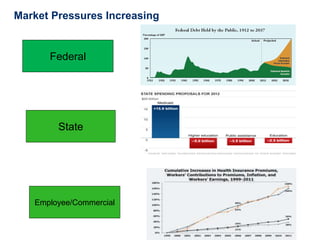
Market Pressures Increasing
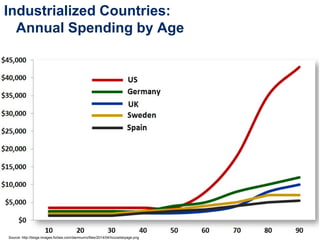
Industrialized Countries:
Annual Spending by Age
Source: http://blogs-images.forbes.com/danmunro/files/2014/04/hccostsbyage.png
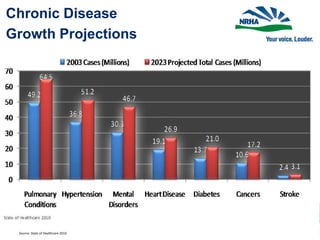
Chronic Disease
Growth Projections
Source: State of Healthcare 2010
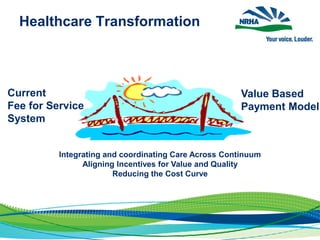
Healthcare Transformation
Current
Fee for Service
System
Value Based
Payment Model
Integrating and coordinating Care Across Continuum
Aligning Incentives for Value and Quality
Reducing the Cost Curve
ACOs Accelerating
Nationwide
• Nearly 700 public and private ACOs in every state and 7.8M
Medicare lives under a MSSP
• Medicare specific ACOs:
• 32 CMMI “Pioneer” participants, program began 1/1/2012—
9 dropped out with 7 converting to MSSP 1/1/2013—4
dropped in 2014 with 2 converting to MSSP
• Medicare Shared Savings Plan
• 4/1/2012 27 ACOs Added
• 7/1/2012 89 ACOs Added
• 1/1/2013 106 ACOs Added
• 1/1/2014 123 ACOs Added
• 1/1/2015 89 ACOs Added
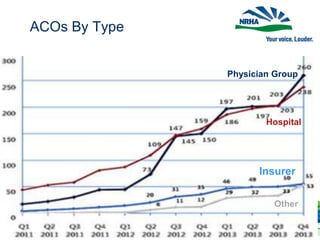
ACOs By Type
Physician Group
Hospital
Insurer
Other
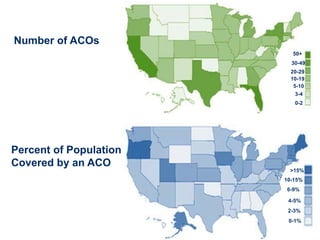
Number of ACOs
Percent of Population
Covered by an ACO
50+
30-49
20-29
10-19
5-10
3-4
0-2
>15%
10-15%
6-9%
4-5%
2-3%
0-1%
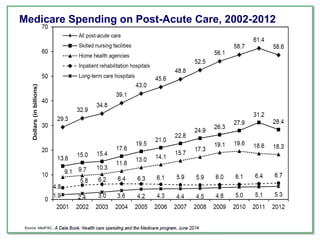
Medicare Spending on Post-Acute Care, 2002-2012
Source: MedPAC,
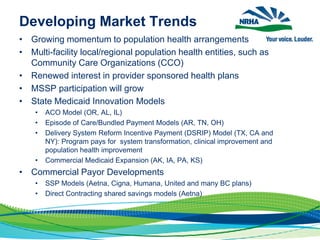
Developing Market Trends
• Growing momentum to population health arrangements
• Multi-facility local/regional population health entities, such as
Community Care Organizations (CCO)
• Renewed interest in provider sponsored health plans
• MSSP participation will grow
• State Medicaid Innovation Models
• ACO Model (OR, AL, IL)
• Episode of Care/Bundled Payment Models (AR, TN, OH)
• Delivery System Reform Incentive Payment (DSRIP) Model (TX, CA and
NY): Program pays for system transformation, clinical improvement and
population health improvement
• Commercial Medicaid Expansion (AK, IA, PA, KS)
• Commercial Payor Developments
• SSP Models (Aetna, Cigna, Humana, United and many BC plans)
• Direct Contracting shared savings models (Aetna)
Market is Responding
• Continued growth in Consumer Driven Health Plans and
commercial shared savings agreements (2nd wave)
• Medicaid waivers will increase to implement ACO principles for
State Medicaid plans
• MSSPs will increase this year and next (89 new starts 1/1/2015)
• Declining hospital inpatient admissions due to these programs
(for example, 6% decrease in Chicago market last 48 months)
• Growth in Patient Centered Medical Homes (PCMH) 30,000
primary care physicians participating to date nationwide
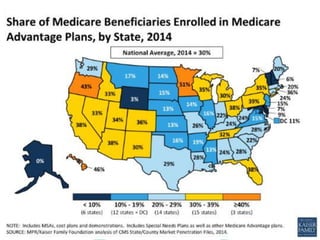
• 10 Million newly insured (uninsured rate dropped from 17.5% to
12.4% since 2014)
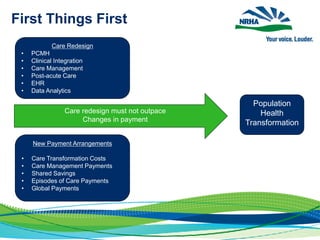
First Things First
Care Redesign
• PCMH
• Clinical Integration
• Care Management
• Post-acute Care
• EHR
• Data Analytics
Care redesign must not outpace
Changes in payment
New Payment Arrangements
• Care Transformation Costs
• Care Management Payments
• Shared Savings
• Episodes of Care Payments
• Global Payments
Population
Health
Transformation
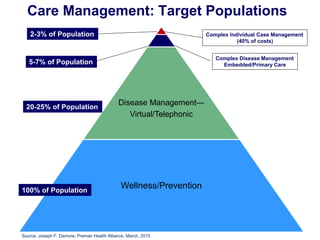
Care Management: Target Populations
Disease Management—
Virtual/Telephonic
Wellness/Prevention100% of Population
20-25% of Population
5-7% of Population
2-3% of Population Complex Individual Case Management
(40% of costs)
Complex Disease Management
Embedded/Primary Care
Source: Joseph F. Damore, Premier Health Alliance, March, 2015
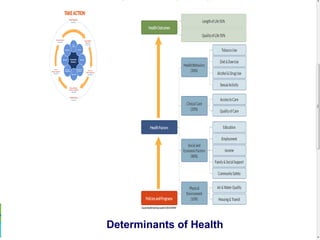
Determinants of Health
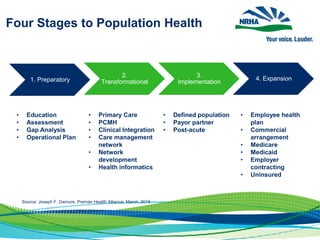
1. Preparatory
2.
Transformational
3.
Implementation
4. Expansion
Four Stages to Population Health
• Education
• Assessment
• Gap Analysis
• Operational Plan
• Primary Care
• PCMH
• Clinical Integration
• Care management
network
• Network
development
• Health informatics
• Defined population
• Payor partner
• Post-acute
• Employee health
plan
• Commercial
arrangement
• Medicare
• Medicaid
• Employer
contracting
• Uninsured
Source: Joseph F. Damore, Premier Health Alliance, March, 2015
Volume to Value: Specifically….
• How do we set a glide path to delivering
value when our revenue is primarily volume
driven?
• What changes can we implement now to be
successful in the future?
• Maybe a new set of tools?
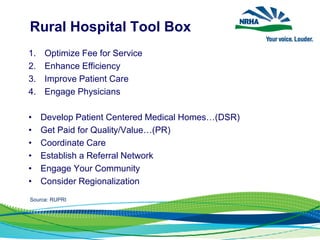
Rural Hospital Tool Box
1. Optimize Fee for Service
2. Enhance Efficiency
3. Improve Patient Care
4. Engage Physicians
• Develop Patient Centered Medical Homes…(DSR)
• Get Paid for Quality/Value…(PR)
• Coordinate Care
• Establish a Referral Network
• Engage Your Community
• Consider Regionalization
Source: RUPRI
APM Readiness Checklist
• Rural Health Value Project, part of RUPRI, checklist
for you to evaluate your readiness for APMs.
• Takes about 90 minutes for you and your team to
review and answer.
• Points out gaps in readiness and a foundation for
action.
• Webinar on Aug. 27, 2015 to formally introduce
• WHA will share an advance copy
1. Optimize Fee For Service
• Revenue Cycle Management
• Expense Management
• Market Share
• PQRS
• Payer and Purchasing Contracts (GPO)
• Inventory Management
• Appropriate Volume
2. Efficiency
• Lean
• Six Sigma
Speed plus Accuracy =
Satisfied Employees, Better Delivery,
Better Quality and Satisfied Customers
3. Improve Patient Care
• Clinical Quality, Patient Safety, and the Patient Experience
• Always is > than the mean, always improving
• Leadership priority
• Quality/Safety Performance
• Outpatient: 33 ACO Measures
• Inpatient: Hospital Compare
• Communicate to Improve
• Public Reporting (CAH Website)
• Every Meeting
• Charts
• Unbind the Data
• Direct Contracting for Care (cut out the middle and share savings)
• Your own employees (self-funded plan)
• Business and Industry (Boeing Announcement example)
4. Engage the Physicians
The Hospital CEO’s most important
job is developing and nurturing
good medical staff relationships
Journey to Value: A
Process not an Event
“We always overestimate the change
that will occur in the next two years and
underestimate the change that will
occur in the next ten.”
--Bill Gates, Jr.
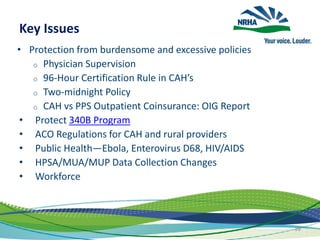
Key Issues
• Protection from burdensome and excessive policies
o Physician Supervision
o 96-Hour Certification Rule in CAH’s
o Two-midnight Policy
o CAH vs PPS Outpatient Coinsurance: OIG Report
• Protect 340B Program
• ACO Regulations for CAH and rural providers
• Public Health—Ebola, Enterovirus D68, HIV/AIDS
• HPSA/MUA/MUP Data Collection Changes
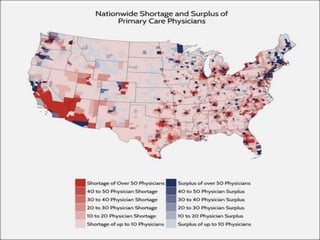
• Workforce
89
Source: http://americanactionforum.org/weekly-checkup/doc-shortage-or-maldistribution
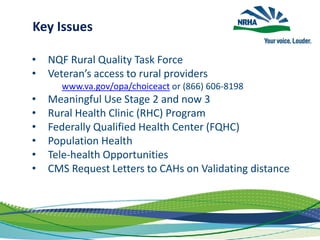
Key Issues
• NQF Rural Quality Task Force
• Veteran’s access to rural providers
www.va.gov/opa/choiceact or (866) 606-8198
• Meaningful Use Stage 2 and now 3
• Rural Health Clinic (RHC) Program
• Federally Qualified Health Center (FQHC)
• Population Health
• Tele-health Opportunities
• CMS Request Letters to CAHs on Validating distance
T H A N K Y O U
Questions?
Brock Slabach
Senior Vice President
National Rural Health Association
bslabach@nrharural.org

Decreasing Cost While Increasing Value

  • 1.
    Southeast CAH Collaborative Norton,VA Brock Slabach, MPH, FACHE Sr. Vice-President National Rural Health Association Leawood, KS
  • 2.
    Rural Overview  62million patients rely on rural providers.  Population challenges  Geographic challenges  Cultural challenges  Rural providers face health care delivery challenges like no other provider.  Workforce shortages  Fiscal constraints  Rural providers and patients are disproportionately dependent on Federal Government.  Medicare, Medicaid  Appropriations  Regulatory Process  Now, rural providers face unprecedented challenges from Washington, D.C. 2
  • 3.
    Rural disparities/challenges • Waron Poverty in the 60’s • Rural Health Clinics –just turned 36 (1978), >4,500 RHC’s nationwide • Community Health Centers, created in the War on Poverty • Advent of PPS 1983: 400 hospital closures • Policy Response: SORH, Flex, MDH, CAH and LVH • Rural serves more challenging populations: • “Rural Americans are older, poorer and sicker than their urban counterparts… Rural areas have higher rates of poverty, chronic disease, and uninsured and underinsured, and millions of rural Americans have limited access to a primary care provider.” (HHS, 2011) • Disparities are compounded if you are a senior or minority in rural America.
  • 4.
    Problems still exist… •Health equates to wealth according to Univ. of Washington Study, July 2013 • Key Finding: • The study found that people who live in wealthy areas like San Francisco, Colorado, or the suburbs of Washington, D.C. are likely to be as healthy as their counterparts in Switzerland or Japan, but those who live in Appalachia or the rural South are likely to be as unhealthy as people in Algeria or Bangladesh.
  • 5.
    Medicare Cuts Enacted •ACA Hospital Reductions: $159B • Sequestration cuts – 2% for nine years • Bad debt reimbursement cuts • Documentation & coding cuts • Readmission cuts • Multiple therapy procedure cuts • ESRD reimbursement cuts • Outpatient hold harmless payments (TOPS) – expired • 508 reclassifications – expired
  • 6.
    Vulnerability Index: RuralHealth Safety Net Vulnerable 283 Rural Hospitals Vulnerable The VULNERABILITY INDEX™ identifies 283 hospitals statistically clustered in the bottom tier of performance* * Hospital Strength Index October 2014 6
  • 7.
    Vulnerability Index: RuralClosures and Risk of Closures The Vulnerability Index™ identifies 283 rural hospitals statistically clustered in the bottom tier of performance 35%Percent VulnerableXHospital Closures Since 2010 7
  • 8.
    Sequestration Impact toRural Hospital Profitability 8
  • 9.
    9 2010-14 rural hospitalclosures: Where were they? Northeast South Midwest West . Medicaid Expansion States
  • 10.
    2010-14 rural hospitalclosures: When did they close? 10 0 5 10 15 20 25 2010 2011 2012 2013 2014 2015 7 to date
  • 11.
    2010-14 rural hospitalclosures: How far away is the next closest hospital? 11 0 5 10 15 20 25 30 Miles Distance to Next Closest Hospital
  • 12.
    12 Market Factors •Small ordeclining populations •High unemployment (as high as 18%) •High or increasing uninsured patients •High proportion of Medicare and Medicaid patients •Competition in close proximity Hospital Factors •Low daily census, as low as 2.3 patients a day •Lack of consistent physician coverage •Deteriorating facility •Fraud, patient safety concerns, and poor management Financial Factors •High and increasing charity care and bad debt •Severely in debt •Insufficient cash- flow to cover current liabilities •Negative profit margin 2010-14 rural hospital closures: Why did they close? (As reported by news media)
  • 13.
     Most closuresin South  Annual number of closures increasing  Most are CAHs and PPS hospitals (vs MDH and SCH)  Most are in states that have not expanded Medicaid  Patients in affected communities are probably traveling between 5 and 25 more miles to access inpatient care  Most hospitals closed because of financial problems 13 2010-14 rural hospital closures: Summary
  • 14.
    Financial performance andcondition of hospitals in the year before they closed: Summary 14  Financial performance and condition far below benchmark for most hospitals  Most hospitals were unprofitable, illiquid, and unable to service debt  Most had less than:  150 FTEs, $10 million in salary expense, and 30% occupancy rate  Most had already closed obstetrics  Data in appendix also shows most had:  Negative or close to zero net income and net assets
  • 15.
    A general processof financial distress 15 Unprofitability Net assets decline Insolvency Bankruptcy Closure Unprofitability, net assets decline, insolvency, and closure data are readily available. Bankruptcy data are not.
  • 16.
    Financial distress isdefined as: Unprofitability: • 2 years negative operating margin • Negative cash flow margin Net assets decline: • >20% decline in net assets Insolvency: • Negative net assets Closure: • No longer provides inpatient care 16 Increasing Signal Strength In some circumstances, there may not be financial distress even though the markers suggest otherwise
  • 17.
    Predictors of financialdistress  Financial performance o Profitability: total margin, two year change in total margin o Reinvestment: Retained earnings as a percent of total assets o Hospital size: Net patient revenue (millions) o Benchmark performance: Percent of benchmarks met over two years  Market characteristics o Competition: Log of miles to nearest hospital with > 100 beds and market share (if <25%) o Economic condition: Log of poverty rate in the market area o Market size: Log of population in the market area  Government reimbursement o Medicare: CAH status o Medicaid: Medicaid to Medicare fee index (KFF) 17
  • 18.
    Benchmarks in themodel Profitability indicators: Total margin >3% Cash flow margin >5% Return on equity >4.5% Operating margin >2% Liquidity indicators: Current ratio >2.3 times Days cash on hand >60 days Days revenue in accounts receivable <53 days
  • 19.
    Benchmarks in themodel Capital structure indicators: Equity financing >60% Debt service coverage >3 times Long-term debt to capitalization <25% Cost indicator: Average age of plant <10 years
  • 20.
    2013 Rural hospitalsin US with financial distress signals 20 Financial distress signal Number Percent Unprofitability: 2 years negative operating margin 659 30% Negative cash flow margin 537 24% Net assets decline: >20% decline in net assets 355 16% Insolvency: Negative net assets 237 11% Closed: No longer provides inpatient care 14 1%
  • 21.
    Preliminary results 21 High Risk, 228 Mid-high Risk, 258 Mid-lowRisk, 852 Low Risk, 834 Hospitals by Risk Level (2013)
  • 22.
    Operating Margin, 2013 22 OperatingIncome Operating Revenue *p<.05 to PPS<26 ~p<.05 to PPS 26-50 +p<.05 to PPS>50 -60% -50% -40% -30% -20% -10% 0% 10% 20% 30% 40% PPS<26 n=26 PPS26-50 n=113 PPS>50 n=161 CAH* n=1068 MDH*+ n=158 SCH* n=347 RRC+ n=105 OperatingMarginPercentiles Top 25% 50-75% 25-50% Bottom 25%
  • 23.
    2015 Rural HospitalFinancial Status Rural Hospital Financial Status Provider Type Profitable Switch Unprofitable Total CAH 358 27 917 1302 Medicare Dependent 54 7 138 199 Sole Community 94 2 156 252 Standard Rural PPS 52 1 101 154 1312 1907 69% Source: iVantage Health Analytics
  • 24.
  • 25.
    Definitions  A “merger”happens when two firms agree to go forward as a single new company rather than remain separately owned and operated.  When one company takes over another and clearly establishes itself as the new owner, the purchase is called an "acquisition.”  Most rural hospital deals are described in the media as “mergers” or “consolidations.” However, most are acquisitions: a larger hospital / system buys a small, rural hospital.  We use “merger” to describe merger, acquisition, or consolidation. 25
  • 26.
  • 27.
    Research questions  Whatwere the characteristics of rural hospitals that merged, and  Were there changes in hospital financial performance, staffing and services following a merger? 27
  • 28.
    Method  Mergers of121 rural hospitals between 2005 to 2012 identified from Irving Levin Associates data.  Logistic regression used to identify hospital financial and staffing characteristics associated with the likelihood of merging.  Multivariate regression used to determine any statistically significant changes in key hospital financial indicators following a merger as compared to non-merged rural hospitals. 28
  • 29.
    Method  Hospital fixedeffects included to adjust for systematic differences between hospitals that did or did not engage in a merger.  CAH status, acute average daily census, region, and number of discharges were included to control for hospital characteristics. 29
  • 30.
  • 31.
  • 32.
    What didn’t changeafter merger?  FTE employees per bed  Number of skilled nursing facility days  Number of newborn nursery days  Capital expenditures  Debt relative to equity financing. 32
  • 33.
    Conclusion  If smallrural hospitals merge because they expect an influx of capital, a relief of debt burden, or an improvement in profitability, there was no evidence to support this expectation.  Some evidence of changes in staff mix as well as reductions in average compensation and total salaries  However, merger may be the only way for some rural hospitals to survive.  Mergers are financial and legal events that have many non-financial consequences (quality?, access?, employment?, local economy?) 33
  • 34.
    Two-Step Process: 1. Stopthe bleeding. Halt additional proposed cuts to rural hospitals from the Administration and Congress immediately. Support pro-rural provisions such as Medicaid expansion, elimination of the 2% sequestration cuts and 101% reimbursement for CAHs to stabilize the rural safety net. 2. Build bridge to the future. Promote new provider payment models to create a new rural reality. @SaveRural…Fighting Back
  • 35.
    The Save RuralHospitals Act Rural hospital stabilization (Stop the bleeding) • Elimination of Medicare Sequestration for rural hospitals; • Reversal of all “bad debt” reimbursement cuts (Middle Class Tax Relief and Job Creation Act of 2012); • Permanent extension of current Low-Volume and Medicare Dependent Hospital payment levels; • Reinstatement of Sole Community Hospital “Hold Harmless” payments; • Extension of Medicaid primary care payments; • Elimination of Medicare and Medicaid DSH payment reductions; and • Establishment of Meaningful Use support payments for rural facilities struggling. • Permanent extension of the rural ambulance and super-rural ambulance payment. Rural Medicare beneficiary equity. Eliminate higher out-of pocket charges for rural patients (total charges vs. allowed Medicare charges.) Regulatory Relief • Elimination of the CAH 96-Hour Condition of Payment (See Critical Access Hospital Relief Act of 2014); • Rebase of supervision requirements for outpatient therapy services at CAHs and rural PPS See PARTS Act); • Modification to 2-Midnight Rule and RAC audit and appeals process. Future of rural health care (Bridge to the Future) I Innovation model for rural hospitals who continue to struggle.
  • 36.
    Grassley Proposal Title: RuralEmergency Acute Care Hospital Act (REACH) Features: • Creates a new provider type: Rural Emergency Hospital (REH)
  • 37.
    The Save RuralHospitals Act HR 3225: Sponsored by Sam Graves (R) MO and Dan Loebsack, (D) IA Title 1: Rural hospital stabilization (Stop the bleeding) Title 2: Rural Medicare beneficiary equity. Title 3: Regulatory Relief (Stop the bleeding) Title 4: Future of rural health care (Bridge to the Future)
  • 38.
    Save Rural HospitalsAct Title I: Rural Provider Stabilization • Eliminating Medicare sequestration for rural hospitals • Reversing cuts to reimbursement of bad debt for CAHs and Rural PPS Hospitals • Extending payment levels for low-volume hospitals (LVH) and Medicare Dependent Hospitals (MDH) • Reinstating revised DRG payments for MDHs and SCHs • Reinstating hold-harmless for hospital outpatient services for SCHs
  • 39.
    Save Rural HospitalsAct Title I: Rural Provider Stabilization • Delays application of penalties for failure to be a meaningful EHR user • Eliminating rural Medicare and Medicaid DSH payment reductions Subtitle B—Other Rural Providers • Making permanent increase Medicare payments for ground ambulance services in rural areas • Extending Medicare primary care payments
  • 40.
    Save Rural HospitalsAct Title II: Rural Medicare Beneficiary Equity • Equalizing beneficiary copayments for services furnished by a CAH
  • 41.
    Save Rural HospitalsAct Title III: Regulatory Relief • Eliminating 96-hour physician certification requirement with respect to inpatient CAH services • Rebasing physician supervision requirements • Reforming practices of RACs under Medicare
  • 42.
    Save Rural HospitalsAct Title IV: Future of Rural Healthcare • Community Outpatient Hospital (COH) Program • Grant funding to assist rural hospitals • CMMI demonstration of shared savings in rural hospitals
  • 43.
    RECESS! • Members indistrict • Meet in district office • Invite them to your facility • Show and Tell • Staff in DC • Message: • Rural Hospital Closure Crisis - Save Rural Hospitals Act • Appropriations – support for rural programs
  • 44.
    SGR Fix For RuralDoctors: 27-32% PFS Cuts • Permanent SGR Repeal ($276 billion permanent fix) • GPCI Extension ($500M)—Extends until Jan. 1, 2018 For Rural Hospitals: • MDH ($100M)—Extends until Oct. 1, 2017 • 10-12% loss of Medicare revenue; need to make up 19% from private insurer. • LVH ($450M)—Extends until Oct. 1, 2017 • approx. $500,000 per hospital and can mean well-over $1 million. • Medicare Home Health Rural Add-On (extends 3% add-on until Jan. 1, 2018) • Extension of therapy cap exceptions process (extends until Jan. 1, 2018)
  • 45.
    OIG Attacks onCAHs Another Misleading OIG Report
  • 46.
    Health Affairs Report: •Conclusion: Minimum-Distance Requirements Could Harm High-Performing Critical-Access Hospitals And Rural Communities • President’s Budget continues to include eliminating CAH designation if < 10 miles • This idea has NOT gained any traction on the hill • “We conclude that establishing a minimum-distance requirement would generate modest cost savings for Medicare but would likely be disruptive to the communities that depend on these hospitals for their health care.”
  • 47.
    OIG Swing BedReport Medicare beneficiaries are eligible for up to 100 days of skilled nursing services following a minimum 3-day acute inpatient hospitalization. These services are provided in freestanding skilled nursing facilities, hospital-based skilled nursing facilities, and hospital swing beds (Title 42 U.S. Code, 2011).
  • 48.
    Post-acute skilled caredays are dominated by care in community-based SNFs Source: NCRHRC analysis of CMS Hospital Cost Report Information System, 6-30-10
  • 49.
    UNC Sheps CenterConclusion: • We believe the OIG has made methodological choices that resulted in errors, and therefore, the conclusions and policy recommendations are suspect. • A video that explains fixed cost transfers is available at: https://www.youtube.com/watch?v=Ym75Tkka-xI
  • 50.
    Conclusion on OIG •No interest in Congress on Necessary Provider exclusions • No interest in Congress on Swing Bed reimbursement changes • However, NRHA is vigilant to make sure it stays that way • NRHA is working to fix beneficiary co-insurance inequity for CAH patients
  • 51.
    SGR Fix For RuralAmbulance Providers ($100M) - Jan. 1, 2018 • 22.6% reductions Two Year Extension: Community Health Centers (CHC) National Health Service Corps Fund (NHSC) Teaching Health Centers
  • 52.
    Converging Forces • PriceReduction threats and volume reduction pressures • Expanding insurance coverage but narrower networks • Increasing quality of care measures and accountabilities • Widespread provider and payer affiliations
  • 53.
    SGR Repeal andthe Rest of The Story….. • Replaces it with a physician payment system based on “quality, value and accountability” • Five year period of 0.5% annual FFS updates in transition to “new system”
  • 54.
    SGR Repeal and…… •Improves existing FFS through value over volume and ensuring payment accuracy • Consolidates the existing 3 physician quality programs into a streamlined program that rewards providers who meet performance thresholds • Implements a process of payment accuracy • Incentivizes care coordination efforts for patients with chronic conditions • Introduces “physician-developed” clinical care guidelines to reduce inappropriate care • Requires development of quality measures and provides for reporting alignment across different payment programs
  • 55.
    SGR Repeal and…. Incentivizesmovement to alternative payment models (APM) • Minimal FFS yearly increase next 10 years of 0.5%, then 0% • Merit-based payment system (eventually -9% to +27% adjustment)—Based on quality, resource use and clinical practice improvement activities • APMs (up to 5% bonus) based on APM level of participation—25% revenue year one (2018-19) • 41% payment difference between highest and lowest performing physicians
  • 56.
    SGR Fix Implications Bottomline: • Current plan leaves $141B between 2015 and 2025 unpaid for or in other words, added to the deficit • Physicians pushed along to APMs and a value- based system, impact on hospitals and volume? • RHC cost-based reimbursement are exempt • Physician alignment a key reality
  • 57.
    Sec. Burwell’s MedicareGoals • 30% of Medicare provider payments in APMs by 2016 • 50% of Medicare provider payments in APMs by 2018 • 85% of Medicare fee-for-service payments to be tied to quality and value by 2016 • 90% of Medicare fee-for-service payments to be tied to quality and value by 2018
  • 58.
    CMS Payment Goals AlternativePayment Models (APM) • Shared Savings Models • Bundled Payments • Patient Centered Medical Homes Remaining Fee For Service Linked to Value/Quality Aggressive Timeline • Favors: Large Systems, population health management experience and deep pockets Will Accelerate Provider Affiliations
  • 59.
    So What? • FFS/CBRpayment  Value Payment • Primary care physicians become revenue centers • High cost procedures, specialists and hospitals become cost centers • Insurance Strategies • Reference Pricing and Narrow Networks • Consumer Driven Healthcare • High Deductibles and price transparency • These fundamental healthcare changes will impact our hospital’s financial viability and survival
  • 60.
    Follow the Money •How we deliver care is how we are paid for care • Healthcare reform is changing BOTH payment and delivery • Bottom line: reform involves transfer of risk from payers to providers
  • 61.
    The Pop HealthReview • Preparing for the “new health care” • Population Health • Transition From Volume to Value • Market Trends • DSR and Reimbursement Models
  • 62.
    Transformation to Population HealthManagement Fad Trend Reality 2010 2012 2015
  • 63.
  • 64.
    Prevalence of MedicarePatients with 6 or more Chronic Conditions
  • 65.
  • 66.
    Industrialized Countries: Annual Spendingby Age Source: http://blogs-images.forbes.com/danmunro/files/2014/04/hccostsbyage.png
  • 67.
  • 70.
    Healthcare Transformation Current Fee forService System Value Based Payment Model Integrating and coordinating Care Across Continuum Aligning Incentives for Value and Quality Reducing the Cost Curve
  • 71.
    ACOs Accelerating Nationwide • Nearly700 public and private ACOs in every state and 7.8M Medicare lives under a MSSP • Medicare specific ACOs: • 32 CMMI “Pioneer” participants, program began 1/1/2012— 9 dropped out with 7 converting to MSSP 1/1/2013—4 dropped in 2014 with 2 converting to MSSP • Medicare Shared Savings Plan • 4/1/2012 27 ACOs Added • 7/1/2012 89 ACOs Added • 1/1/2013 106 ACOs Added • 1/1/2014 123 ACOs Added • 1/1/2015 89 ACOs Added
  • 72.
    ACOs By Type PhysicianGroup Hospital Insurer Other
  • 73.
    Number of ACOs Percentof Population Covered by an ACO 50+ 30-49 20-29 10-19 5-10 3-4 0-2 >15% 10-15% 6-9% 4-5% 2-3% 0-1%
  • 74.
    Medicare Spending onPost-Acute Care, 2002-2012 Source: MedPAC,
  • 75.
    Developing Market Trends •Growing momentum to population health arrangements • Multi-facility local/regional population health entities, such as Community Care Organizations (CCO) • Renewed interest in provider sponsored health plans • MSSP participation will grow • State Medicaid Innovation Models • ACO Model (OR, AL, IL) • Episode of Care/Bundled Payment Models (AR, TN, OH) • Delivery System Reform Incentive Payment (DSRIP) Model (TX, CA and NY): Program pays for system transformation, clinical improvement and population health improvement • Commercial Medicaid Expansion (AK, IA, PA, KS) • Commercial Payor Developments • SSP Models (Aetna, Cigna, Humana, United and many BC plans) • Direct Contracting shared savings models (Aetna)
  • 76.
    Market is Responding •Continued growth in Consumer Driven Health Plans and commercial shared savings agreements (2nd wave) • Medicaid waivers will increase to implement ACO principles for State Medicaid plans • MSSPs will increase this year and next (89 new starts 1/1/2015) • Declining hospital inpatient admissions due to these programs (for example, 6% decrease in Chicago market last 48 months) • Growth in Patient Centered Medical Homes (PCMH) 30,000 primary care physicians participating to date nationwide • 10 Million newly insured (uninsured rate dropped from 17.5% to 12.4% since 2014)
  • 77.
    First Things First CareRedesign • PCMH • Clinical Integration • Care Management • Post-acute Care • EHR • Data Analytics Care redesign must not outpace Changes in payment New Payment Arrangements • Care Transformation Costs • Care Management Payments • Shared Savings • Episodes of Care Payments • Global Payments Population Health Transformation
  • 78.
    Care Management: TargetPopulations Disease Management— Virtual/Telephonic Wellness/Prevention100% of Population 20-25% of Population 5-7% of Population 2-3% of Population Complex Individual Case Management (40% of costs) Complex Disease Management Embedded/Primary Care Source: Joseph F. Damore, Premier Health Alliance, March, 2015
  • 79.
  • 80.
    1. Preparatory 2. Transformational 3. Implementation 4. Expansion FourStages to Population Health • Education • Assessment • Gap Analysis • Operational Plan • Primary Care • PCMH • Clinical Integration • Care management network • Network development • Health informatics • Defined population • Payor partner • Post-acute • Employee health plan • Commercial arrangement • Medicare • Medicaid • Employer contracting • Uninsured Source: Joseph F. Damore, Premier Health Alliance, March, 2015
  • 81.
    Volume to Value:Specifically…. • How do we set a glide path to delivering value when our revenue is primarily volume driven? • What changes can we implement now to be successful in the future? • Maybe a new set of tools?
  • 82.
    Rural Hospital ToolBox 1. Optimize Fee for Service 2. Enhance Efficiency 3. Improve Patient Care 4. Engage Physicians • Develop Patient Centered Medical Homes…(DSR) • Get Paid for Quality/Value…(PR) • Coordinate Care • Establish a Referral Network • Engage Your Community • Consider Regionalization Source: RUPRI
  • 83.
    APM Readiness Checklist •Rural Health Value Project, part of RUPRI, checklist for you to evaluate your readiness for APMs. • Takes about 90 minutes for you and your team to review and answer. • Points out gaps in readiness and a foundation for action. • Webinar on Aug. 27, 2015 to formally introduce • WHA will share an advance copy
  • 84.
    1. Optimize FeeFor Service • Revenue Cycle Management • Expense Management • Market Share • PQRS • Payer and Purchasing Contracts (GPO) • Inventory Management • Appropriate Volume
  • 85.
    2. Efficiency • Lean •Six Sigma Speed plus Accuracy = Satisfied Employees, Better Delivery, Better Quality and Satisfied Customers
  • 86.
    3. Improve PatientCare • Clinical Quality, Patient Safety, and the Patient Experience • Always is > than the mean, always improving • Leadership priority • Quality/Safety Performance • Outpatient: 33 ACO Measures • Inpatient: Hospital Compare • Communicate to Improve • Public Reporting (CAH Website) • Every Meeting • Charts • Unbind the Data • Direct Contracting for Care (cut out the middle and share savings) • Your own employees (self-funded plan) • Business and Industry (Boeing Announcement example)
  • 87.
    4. Engage thePhysicians The Hospital CEO’s most important job is developing and nurturing good medical staff relationships
  • 88.
    Journey to Value:A Process not an Event “We always overestimate the change that will occur in the next two years and underestimate the change that will occur in the next ten.” --Bill Gates, Jr.
  • 89.
    Key Issues • Protectionfrom burdensome and excessive policies o Physician Supervision o 96-Hour Certification Rule in CAH’s o Two-midnight Policy o CAH vs PPS Outpatient Coinsurance: OIG Report • Protect 340B Program • ACO Regulations for CAH and rural providers • Public Health—Ebola, Enterovirus D68, HIV/AIDS • HPSA/MUA/MUP Data Collection Changes • Workforce 89
  • 90.
  • 91.
    Key Issues • NQFRural Quality Task Force • Veteran’s access to rural providers www.va.gov/opa/choiceact or (866) 606-8198 • Meaningful Use Stage 2 and now 3 • Rural Health Clinic (RHC) Program • Federally Qualified Health Center (FQHC) • Population Health • Tele-health Opportunities • CMS Request Letters to CAHs on Validating distance
  • 92.
    T H AN K Y O U Questions? Brock Slabach Senior Vice President National Rural Health Association bslabach@nrharural.org