Planets in the
Solar System
with Ma’am
Joyce
Welcome!
Are you excited for a fun
learning session?
Stand up and let’s
sing!
Arrange the jumbled
letters!
1. This means the spinning of the planet on its axis.(TAOOTNIR)
2. This is the movement of the planet around the sun.( VORETOINUL)
3. This refers to the equal day and night in the different places of the
world.(NOXESQUEI)
4. These are members of the solar system where some of which
have one or more satellites that revolve around the sun. (NEPASTL)
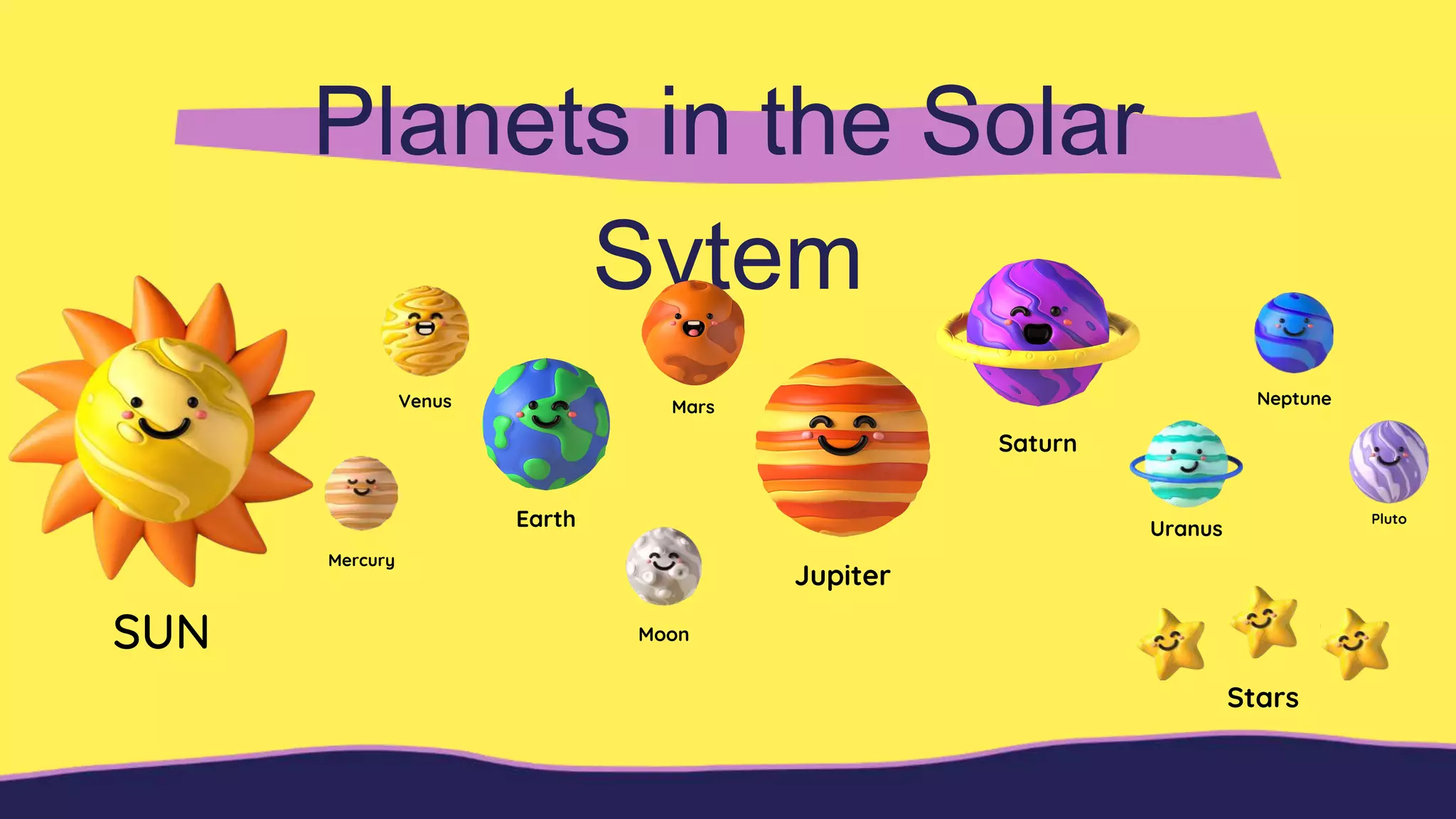
Planets in the Solar
Sytem
SUN
Mercury
Venus
Earth
Moon
Mars
Jupiter
Uranus
Saturn
Pluto
Neptune
Stars
Terrestrial Planets
Terrestrial or Earth-like planets are
made up of solid rocks. They are also
called inner planets because they are
the closest to the sun among all the
planets.
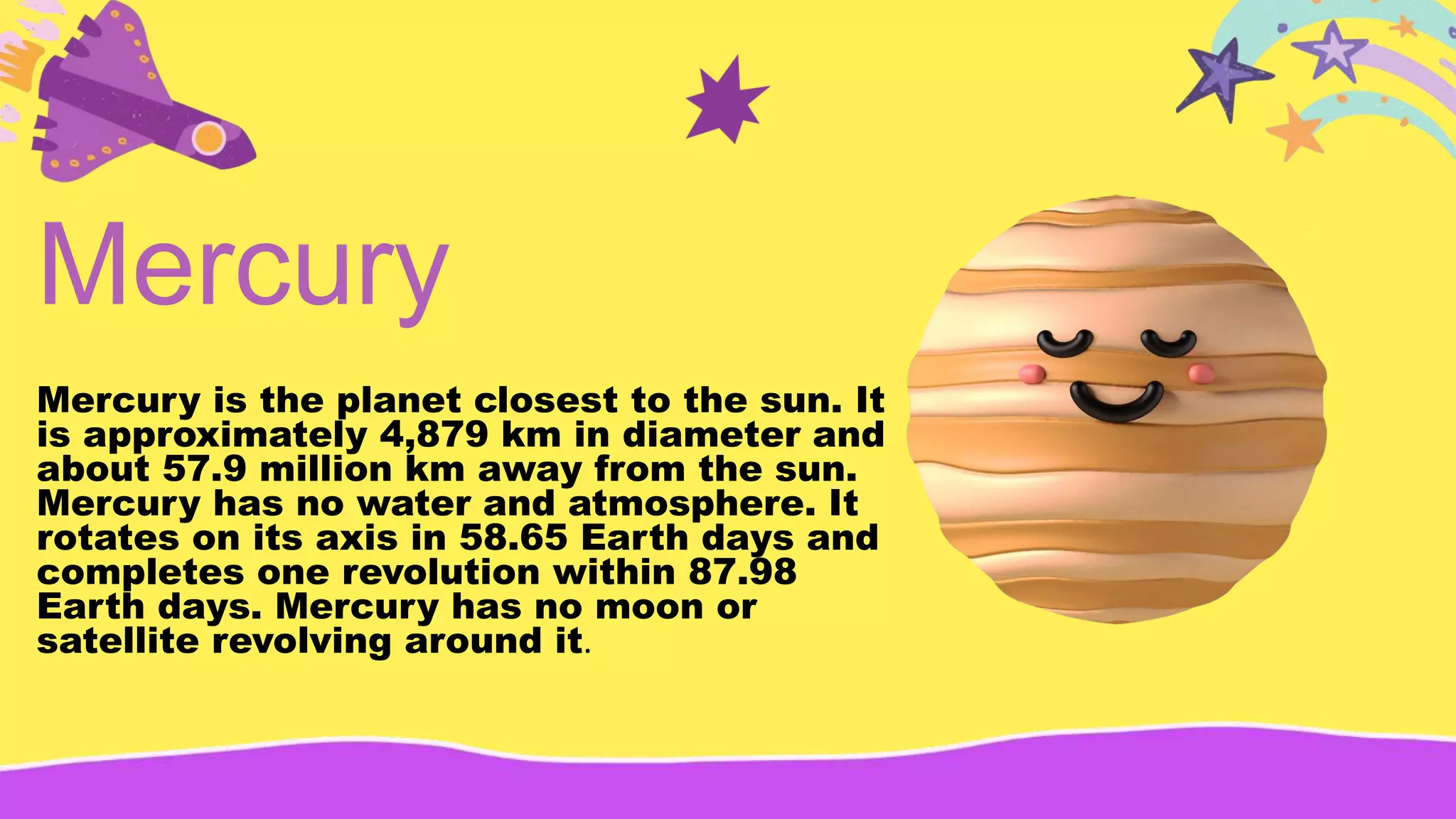
Mercury
Mercury is the planet closest to the sun. It
is approximately 4,879 km in diameter and
about 57.9 million km away from the sun.
Mercury has no water and atmosphere. It
rotates on its axis in 58.65 Earth days and
completes one revolution within 87.98
Earth days. Mercury has no moon or
satellite revolving around it.
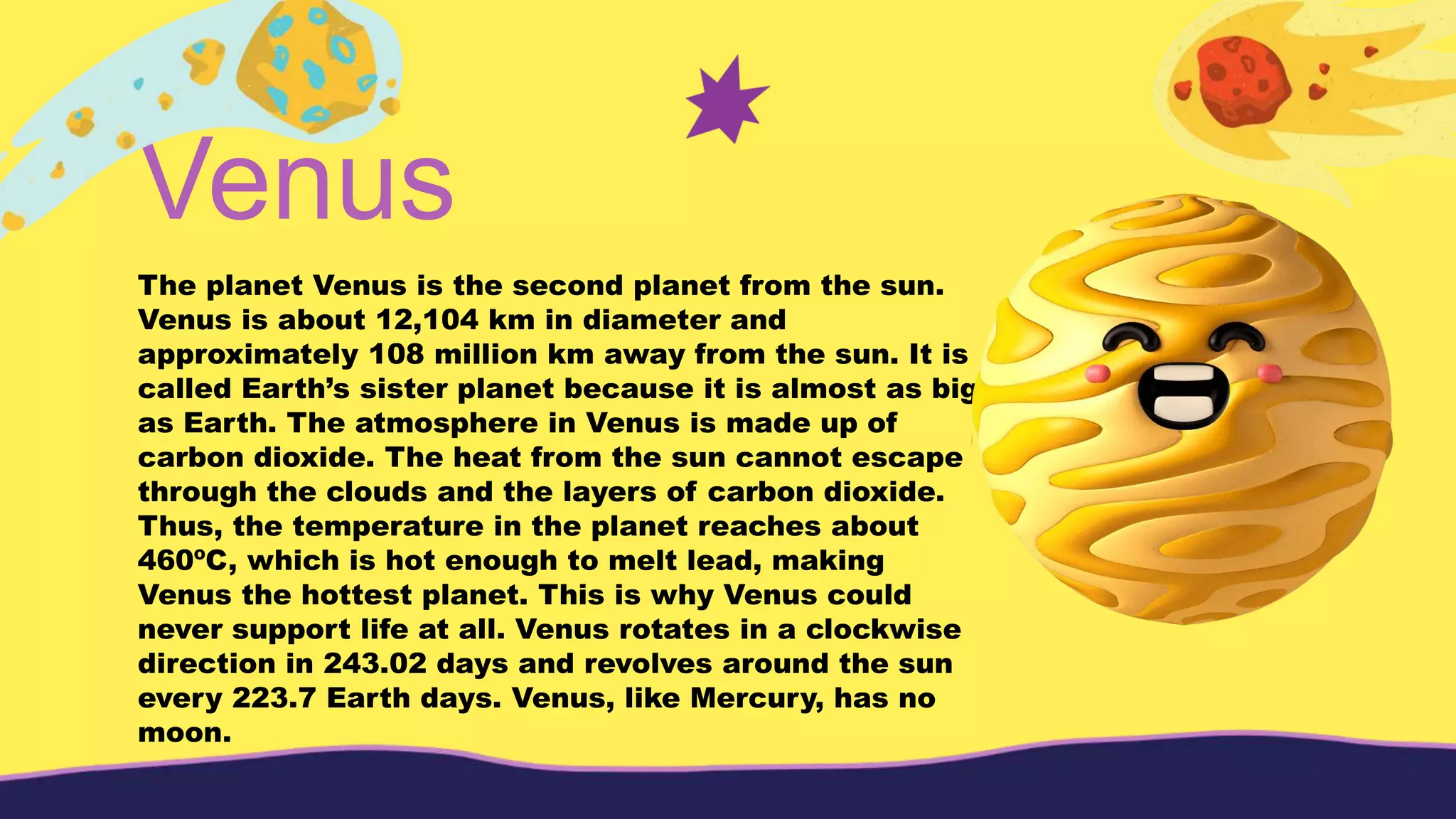
Venus
The planet Venus is the second planet from the sun.
Venus is about 12,104 km in diameter and
approximately 108 million km away from the sun. It is
called Earth’s sister planet because it is almost as big
as Earth. The atmosphere in Venus is made up of
carbon dioxide. The heat from the sun cannot escape
through the clouds and the layers of carbon dioxide.
Thus, the temperature in the planet reaches about
460ºC, which is hot enough to melt lead, making
Venus the hottest planet. This is why Venus could
never support life at all. Venus rotates in a clockwise
direction in 243.02 days and revolves around the sun
every 223.7 Earth days. Venus, like Mercury, has no
moon.
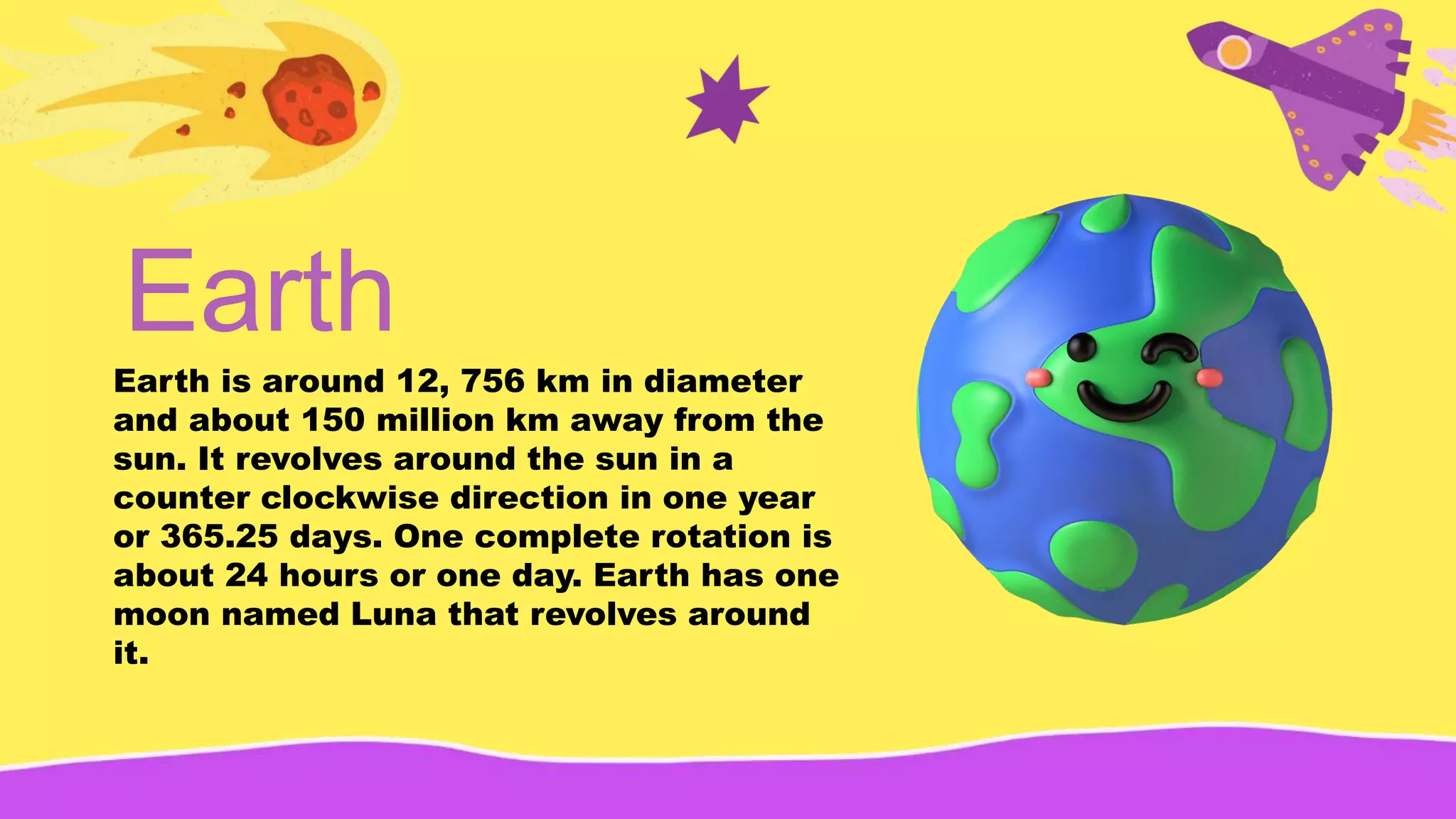
Earth
Earth is around 12, 756 km in diameter
and about 150 million km away from the
sun. It revolves around the sun in a
counter clockwise direction in one year
or 365.25 days. One complete rotation is
about 24 hours or one day. Earth has one
moon named Luna that revolves around
it.
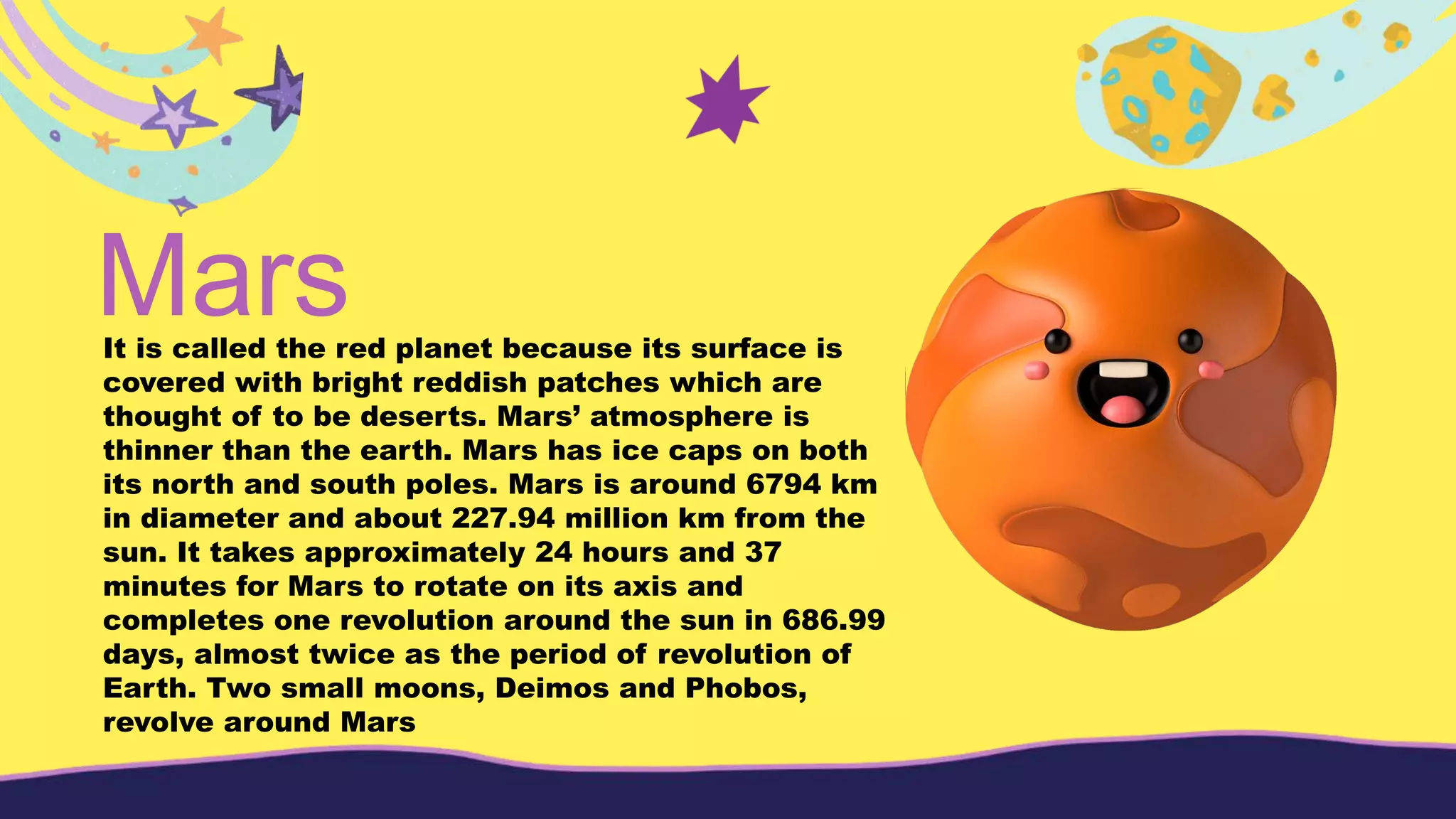
Mars
It is called the red planet because its surface is
covered with bright reddish patches which are
thought of to be deserts. Mars’ atmosphere is
thinner than the earth. Mars has ice caps on both
its north and south poles. Mars is around 6794 km
in diameter and about 227.94 million km from the
sun. It takes approximately 24 hours and 37
minutes for Mars to rotate on its axis and
completes one revolution around the sun in 686.99
days, almost twice as the period of revolution of
Earth. Two small moons, Deimos and Phobos,
revolve around Mars
Jovian Planets
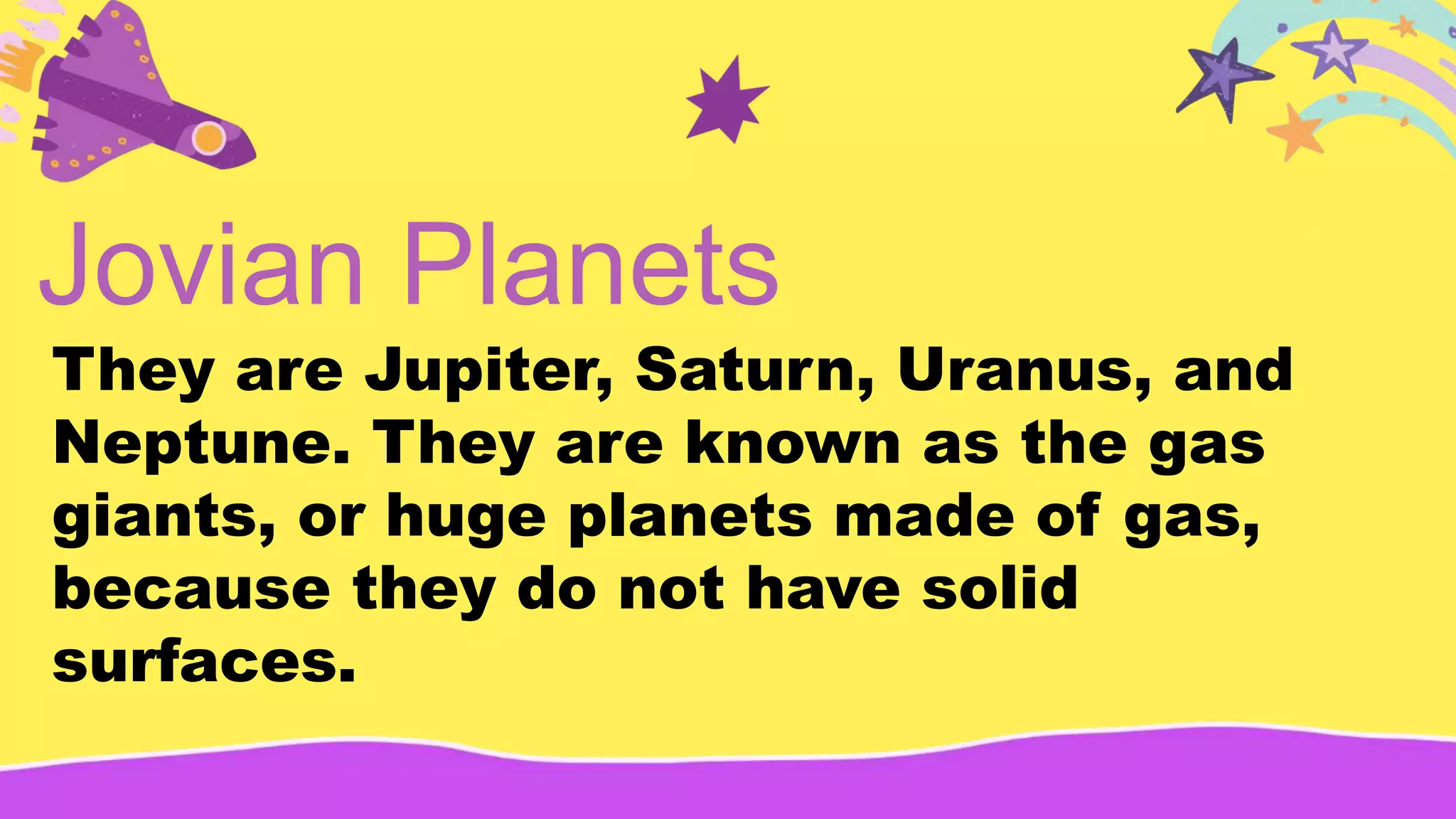
They are Jupiter, Saturn, Uranus, and
Neptune. They are known as the gas
giants, or huge planets made of gas,
because they do not have solid
surfaces.
Jupiter
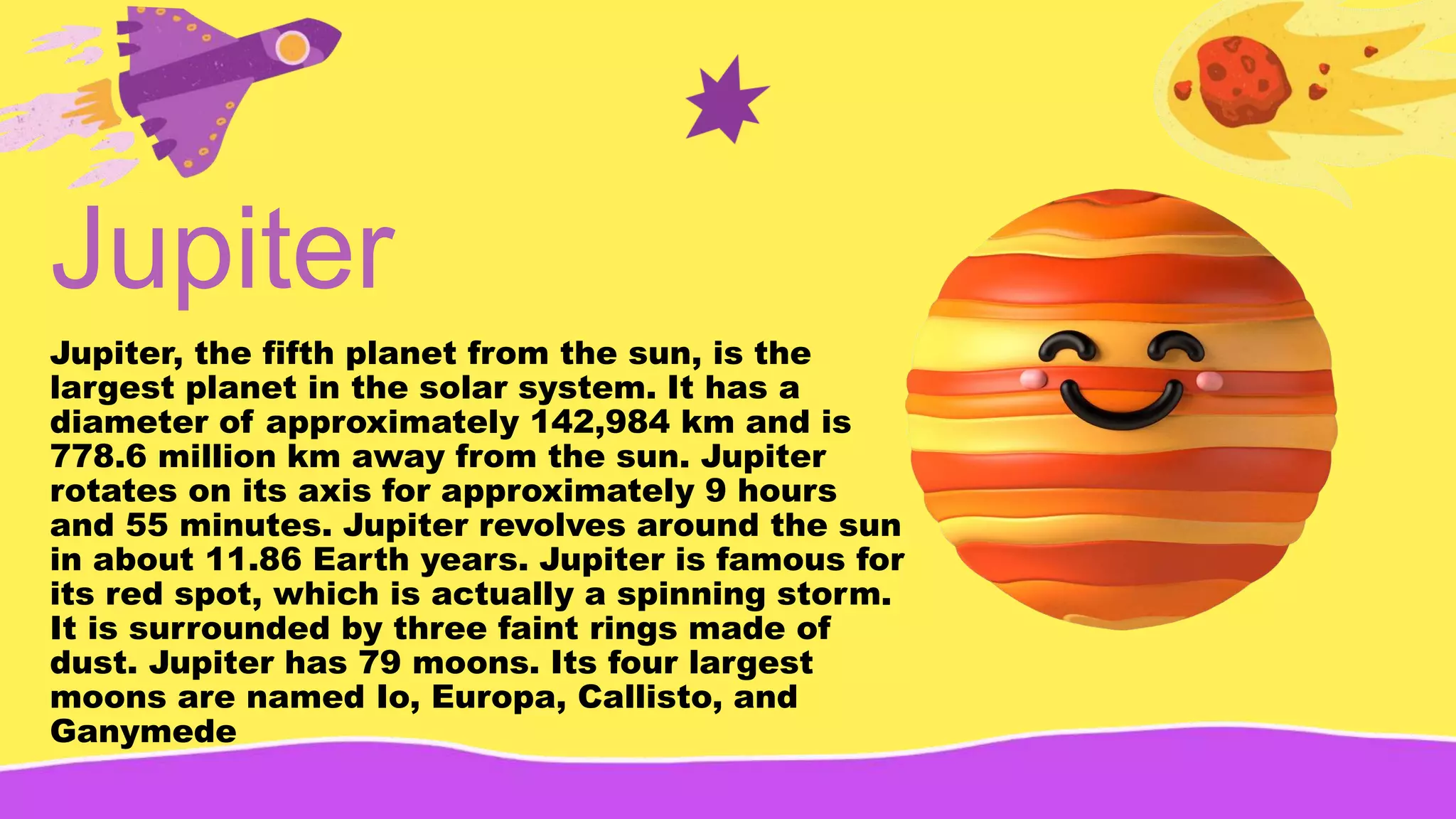
Jupiter, the fifth planet from the sun, is the
largest planet in the solar system. It has a

diameter of approximately 142,984 km and is
778.6 million km away from the sun. Jupiter
rotates on its axis for approximately 9 hours
and 55 minutes. Jupiter revolves around the sun
in about 11.86 Earth years. Jupiter is famous for
its red spot, which is actually a spinning storm.
It is surrounded by three faint rings made of
dust. Jupiter has 79 moons. Its four largest
moons are named Io, Europa, Callisto, and
Ganymede
Saturn
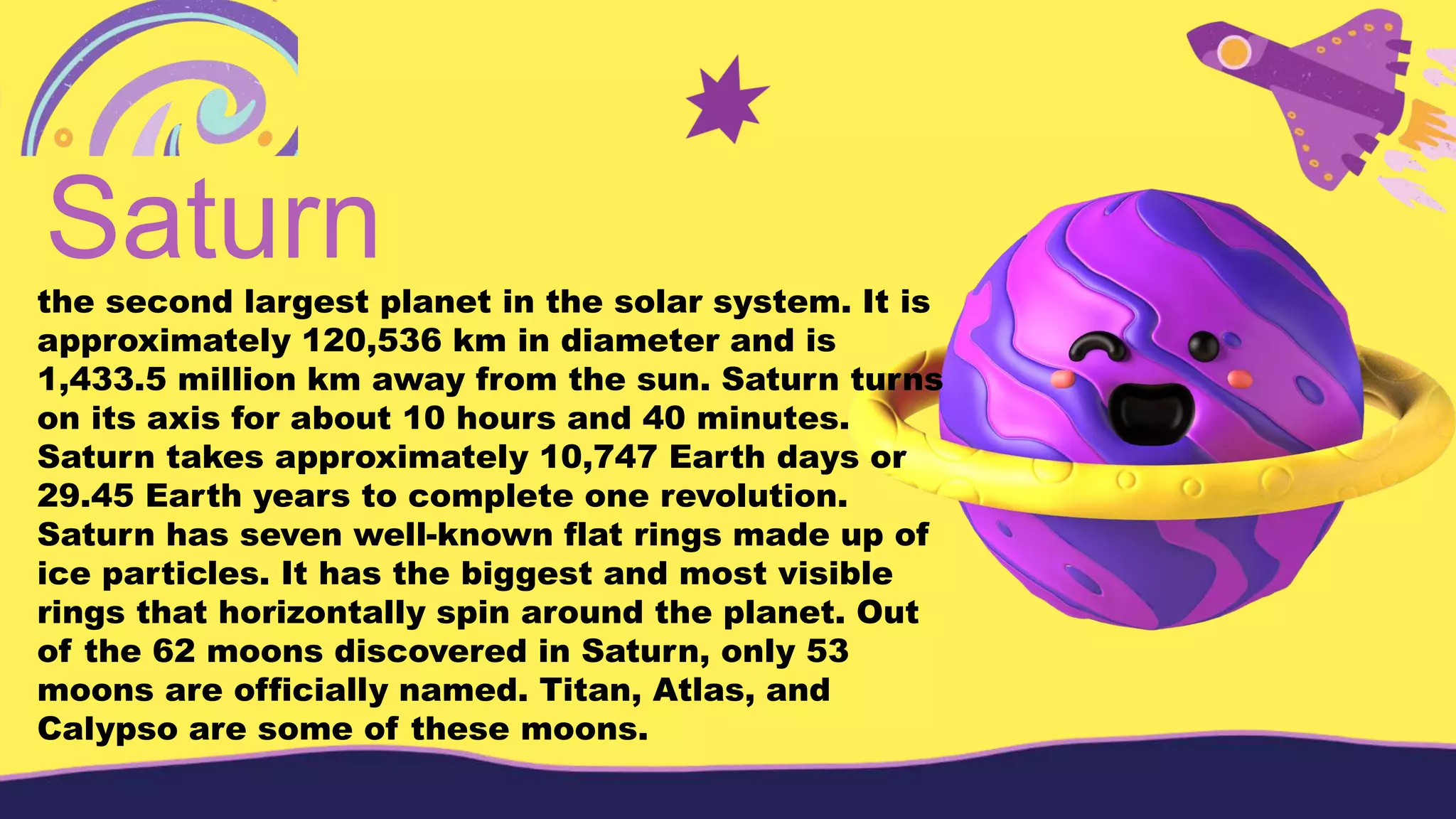
the second largest planet in the solar system. It is
approximately 120,536 km in diameter and is
1,433.5 million km away from the sun. Saturn turns
on its axis for about 10 hours and 40 minutes.
Saturn takes approximately 10,747 Earth days or
29.45 Earth years to complete one revolution.
Saturn has seven well-known flat rings made up of
ice particles. It has the biggest and most visible
rings that horizontally spin around the planet. Out
of the 62 moons discovered in Saturn, only 53
moons are officially named. Titan, Atlas, and
Calypso are some of these moons.
Uranus
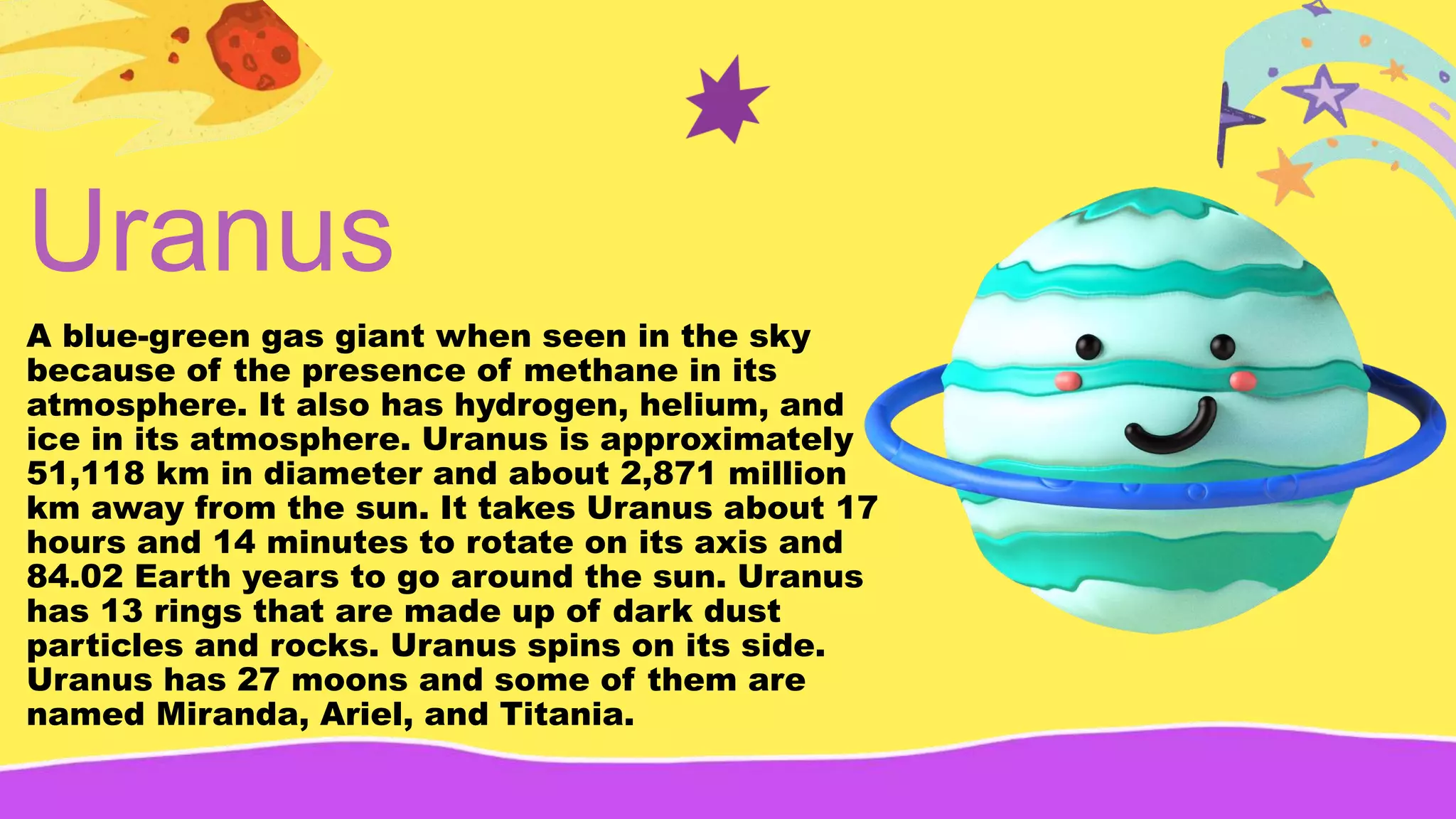
A blue-green gas giant when seen in the sky
because of the presence of methane in its
atmosphere. It also has hydrogen, helium, and
ice in its atmosphere. Uranus is approximately
51,118 km in diameter and about 2,871 million
km away from the sun. It takes Uranus about 17
hours and 14 minutes to rotate on its axis and
84.02 Earth years to go around the sun. Uranus
has 13 rings that are made up of dark dust
particles and rocks. Uranus spins on its side.
Uranus has 27 moons and some of them are
named Miranda, Ariel, and Titania.
Neptune
the farthest planet from the sun, is the smallest
of the gas giants. It is about 49,528 km in
diameter and is approximately 4,495.1 million km
away from the sun. It is bluish in color and has
six rings around it. Neptune turns on its axis in
around 19 hours and 17 minutes. It takes nearly
164.8 Earth years to revolve around the sun.
Neptune has 14 moons. Triton is its most
unusual moon because it orbits Neptune in the
opposite direction – from east to west
• How do planets move? In what direction do planets rotate?
• What about revolution?
• How are the planets arranged according to their distance from the sun?
• Which is the nearest? Farthest?
• What are the inner planets?
• Why are they called inner planets?
• What is the other term for inner planets? What are they made of?
• What are the outer planets? Why are they called outer planets?
• What is the other term for outer planets?
• What are they made of?
What will you do to keep our mother
Earth a better place to live in?
Activity Time
Direction: Read the statement
carefully. Choose the letter of
the correct answer.
Thank You
For
Attending!

Colorful Solar System Planets Kid's Science Presentation (1).pptx

  • 1.
    Planets in the SolarSystem with Ma’am Joyce
  • 2.
    Welcome! Are you excitedfor a fun learning session?
  • 3.
    Stand up andlet’s sing!
  • 4.
  • 5.
    1. This meansthe spinning of the planet on its axis.(TAOOTNIR) 2. This is the movement of the planet around the sun.( VORETOINUL) 3. This refers to the equal day and night in the different places of the world.(NOXESQUEI) 4. These are members of the solar system where some of which have one or more satellites that revolve around the sun. (NEPASTL)
  • 6.
    Planets in theSolar Sytem SUN Mercury Venus Earth Moon Mars Jupiter Uranus Saturn Pluto Neptune Stars
  • 7.
    Terrestrial Planets Terrestrial orEarth-like planets are made up of solid rocks. They are also called inner planets because they are the closest to the sun among all the planets.
  • 8.
    Mercury Mercury is theplanet closest to the sun. It is approximately 4,879 km in diameter and about 57.9 million km away from the sun. Mercury has no water and atmosphere. It rotates on its axis in 58.65 Earth days and completes one revolution within 87.98 Earth days. Mercury has no moon or satellite revolving around it.
  • 9.
    Venus The planet Venusis the second planet from the sun. Venus is about 12,104 km in diameter and approximately 108 million km away from the sun. It is called Earth’s sister planet because it is almost as big as Earth. The atmosphere in Venus is made up of carbon dioxide. The heat from the sun cannot escape through the clouds and the layers of carbon dioxide. Thus, the temperature in the planet reaches about 460ºC, which is hot enough to melt lead, making Venus the hottest planet. This is why Venus could never support life at all. Venus rotates in a clockwise direction in 243.02 days and revolves around the sun every 223.7 Earth days. Venus, like Mercury, has no moon.
  • 10.
    Earth Earth is around12, 756 km in diameter and about 150 million km away from the sun. It revolves around the sun in a counter clockwise direction in one year or 365.25 days. One complete rotation is about 24 hours or one day. Earth has one moon named Luna that revolves around it.
  • 11.
    Mars It is calledthe red planet because its surface is covered with bright reddish patches which are thought of to be deserts. Mars’ atmosphere is thinner than the earth. Mars has ice caps on both its north and south poles. Mars is around 6794 km in diameter and about 227.94 million km from the sun. It takes approximately 24 hours and 37 minutes for Mars to rotate on its axis and completes one revolution around the sun in 686.99 days, almost twice as the period of revolution of Earth. Two small moons, Deimos and Phobos, revolve around Mars
  • 12.
    Jovian Planets They areJupiter, Saturn, Uranus, and Neptune. They are known as the gas giants, or huge planets made of gas, because they do not have solid surfaces.
  • 13.
    Jupiter Jupiter, the fifthplanet from the sun, is the largest planet in the solar system. It has a diameter of approximately 142,984 km and is 778.6 million km away from the sun. Jupiter rotates on its axis for approximately 9 hours and 55 minutes. Jupiter revolves around the sun in about 11.86 Earth years. Jupiter is famous for its red spot, which is actually a spinning storm. It is surrounded by three faint rings made of dust. Jupiter has 79 moons. Its four largest moons are named Io, Europa, Callisto, and Ganymede
  • 14.
    Saturn the second largestplanet in the solar system. It is approximately 120,536 km in diameter and is 1,433.5 million km away from the sun. Saturn turns on its axis for about 10 hours and 40 minutes. Saturn takes approximately 10,747 Earth days or 29.45 Earth years to complete one revolution. Saturn has seven well-known flat rings made up of ice particles. It has the biggest and most visible rings that horizontally spin around the planet. Out of the 62 moons discovered in Saturn, only 53 moons are officially named. Titan, Atlas, and Calypso are some of these moons.
  • 15.
    Uranus A blue-green gasgiant when seen in the sky because of the presence of methane in its atmosphere. It also has hydrogen, helium, and ice in its atmosphere. Uranus is approximately 51,118 km in diameter and about 2,871 million km away from the sun. It takes Uranus about 17 hours and 14 minutes to rotate on its axis and 84.02 Earth years to go around the sun. Uranus has 13 rings that are made up of dark dust particles and rocks. Uranus spins on its side. Uranus has 27 moons and some of them are named Miranda, Ariel, and Titania.
  • 16.
    Neptune the farthest planetfrom the sun, is the smallest of the gas giants. It is about 49,528 km in diameter and is approximately 4,495.1 million km away from the sun. It is bluish in color and has six rings around it. Neptune turns on its axis in around 19 hours and 17 minutes. It takes nearly 164.8 Earth years to revolve around the sun. Neptune has 14 moons. Triton is its most unusual moon because it orbits Neptune in the opposite direction – from east to west
  • 17.
    • How doplanets move? In what direction do planets rotate? • What about revolution? • How are the planets arranged according to their distance from the sun? • Which is the nearest? Farthest? • What are the inner planets? • Why are they called inner planets? • What is the other term for inner planets? What are they made of? • What are the outer planets? Why are they called outer planets? • What is the other term for outer planets? • What are they made of?
  • 18.
    What will youdo to keep our mother Earth a better place to live in?
  • 19.
    Activity Time Direction: Readthe statement carefully. Choose the letter of the correct answer.
  • 20.