Let us discover the outer space!!

-planet discoveryFor Grade 5 Science
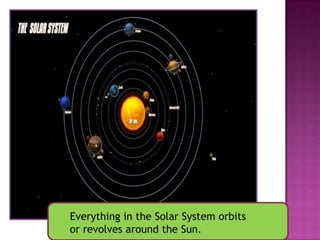
Everything in the Solar System orbits
or revolves around the Sun.
Our solar neighborhood is an
exciting place. The Solar System is
full of planets, moons, asteroids,
comets, minor planets, and many
other exciting objects. Learn about
Io, the explosive moon that orbits
the planet Jupiter, or explore the
gigantic canyons and deserts on
Mars.
The Sun or Sol, is the
star at the centre of our
solar system and is
responsible for the
Earth’s climate and
weather. The Sun is an
almost perfect sphere
with a difference of just
10km in diameter
between the poles and
the equator. The
average radius of the
Sun is 695,508 km
(109.2 x that of the
Earth) of which 20–25%
is the core.
Size comparison of the planets
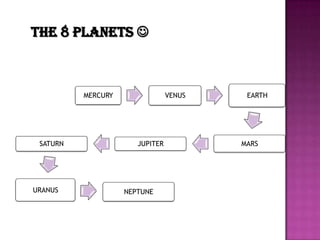
THE 8 PLANETS 

MERCURY

SATURN

URANUS

VENUS

JUPITER

NEPTUNE

EARTH

MARS
Mercury is the closest planet to
the Sun and due to its proximity it
is not easily seen except during
twilight. For every two orbits of
the Sun Mercury completes three
rotations about its axis and up
until 1965 it was thought that the
same side of Mercury constantly
faced the Sun. Thirteen times a
century Mercury can be observed
from Earth passing across the face
of the Sun in an event called a
transit, the next will occur on the
9th May 2016.
Venus is the second planet
from the Sun and is the second
brightest object in the night sky
after the Moon. Named after
the Roman goddess of love and
beauty, Venus is the second
largest terrestrial planet and is
sometimes referred to as the
Earth’s sister planet due the
their similar size and mass. The
surface of the planet is
obscured by an opaque layer of
clouds made up of sulfuric acid.
earth is the third planet from the
Sun and is the largest of the
terrestrial planets. Unlike the
other planets in the solar system
that are named after classic
deities the Earth’s name comes
from the Anglo-Saxon
worderda which means ground
or soil. The Earth was formed
approximately 4.54 billion years
ago and is the only known planet
to support life.
: -88 to 58°C
Mars is the fourth
planet from the Sun.
Named after the
Roman god of war, and
often described as the
“Red Planet” due to its
reddish appearance.
Mars is a terrestrial
planet with a thin
atmosphere composed
primarily of carbon
dioxide.
Jupiter is the fifth planet
from the Sun and is the
largest planet in the solar
system, like the other four
outer planets Jupiter is a
gas giant.
Saturn is the sixth planet
from the Sun and is named
after the not known to exist
until Galileo first observed
them in 1610. Roman god of
wealth. Saturn is the second
largest planet in the solar
system and is best known
for its fabulous rings. The
rings were
Uranus is the seventh planet
from the Sun and was the
first planet to be discovered
with the use of a telescope.
Uranus’ most unique feature
is that its axis sideways in
comparison to other planets
i.e. its north and south poles
are in line with where other
planets have their equators.
Uranus is named after the
Greek god of the sky.
Neptune is the eighth
planet from the Sun and
the smallest of the gas
giants. Neptune was the
first planet found by
mathematical prediction
after unexpected changes
in the orbit of Uranus
were observed. Neptune
is named after the Roman
god of the sea.
 PRESENTED

BY:

tifhany

Perez Lansangan

BEEd G3-2 day

discovering the outer space (THE PLANETS) :)

  • 1.
    Let us discoverthe outer space!! -planet discoveryFor Grade 5 Science
  • 2.
    Everything in theSolar System orbits or revolves around the Sun.
  • 3.
    Our solar neighborhoodis an exciting place. The Solar System is full of planets, moons, asteroids, comets, minor planets, and many other exciting objects. Learn about Io, the explosive moon that orbits the planet Jupiter, or explore the gigantic canyons and deserts on Mars.
  • 4.
    The Sun orSol, is the star at the centre of our solar system and is responsible for the Earth’s climate and weather. The Sun is an almost perfect sphere with a difference of just 10km in diameter between the poles and the equator. The average radius of the Sun is 695,508 km (109.2 x that of the Earth) of which 20–25% is the core.
  • 5.
    Size comparison ofthe planets
  • 6.
    THE 8 PLANETS MERCURY SATURN URANUS VENUS JUPITER NEPTUNE EARTH MARS
  • 7.
    Mercury is theclosest planet to the Sun and due to its proximity it is not easily seen except during twilight. For every two orbits of the Sun Mercury completes three rotations about its axis and up until 1965 it was thought that the same side of Mercury constantly faced the Sun. Thirteen times a century Mercury can be observed from Earth passing across the face of the Sun in an event called a transit, the next will occur on the 9th May 2016.
  • 8.
    Venus is thesecond planet from the Sun and is the second brightest object in the night sky after the Moon. Named after the Roman goddess of love and beauty, Venus is the second largest terrestrial planet and is sometimes referred to as the Earth’s sister planet due the their similar size and mass. The surface of the planet is obscured by an opaque layer of clouds made up of sulfuric acid.
  • 9.
    earth is thethird planet from the Sun and is the largest of the terrestrial planets. Unlike the other planets in the solar system that are named after classic deities the Earth’s name comes from the Anglo-Saxon worderda which means ground or soil. The Earth was formed approximately 4.54 billion years ago and is the only known planet to support life. : -88 to 58°C
  • 10.
    Mars is thefourth planet from the Sun. Named after the Roman god of war, and often described as the “Red Planet” due to its reddish appearance. Mars is a terrestrial planet with a thin atmosphere composed primarily of carbon dioxide.
  • 11.
    Jupiter is thefifth planet from the Sun and is the largest planet in the solar system, like the other four outer planets Jupiter is a gas giant.
  • 12.
    Saturn is thesixth planet from the Sun and is named after the not known to exist until Galileo first observed them in 1610. Roman god of wealth. Saturn is the second largest planet in the solar system and is best known for its fabulous rings. The rings were
  • 13.
    Uranus is theseventh planet from the Sun and was the first planet to be discovered with the use of a telescope. Uranus’ most unique feature is that its axis sideways in comparison to other planets i.e. its north and south poles are in line with where other planets have their equators. Uranus is named after the Greek god of the sky.
  • 14.
    Neptune is theeighth planet from the Sun and the smallest of the gas giants. Neptune was the first planet found by mathematical prediction after unexpected changes in the orbit of Uranus were observed. Neptune is named after the Roman god of the sea.
  • 15.