Discoveries in Planetary Science http://dps.aas.org/education/dpsdisc/
A Planet Orbiting Two Suns
• About 1000 planets have been
discovered outside our own solar
system
• But do planets form only around
single stars? About half of all stars
form in groups of two or more.
• NASA’s Kepler spacecraft has
detected a Saturn-sized planet
orbiting two stars - the first
discovery of a ‘circumbinary’ planet
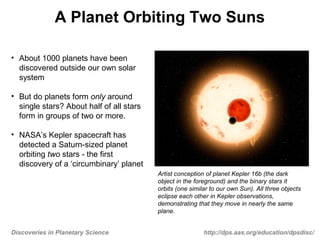
Artist conception of planet Kepler 16b (the dark
object in the foreground) and the binary stars it
orbits (one similar to our own Sun). All three objects
eclipse each other in Kepler observations,
demonstrating that they move in nearly the same
plane.
Discoveries in Planetary Science http://dps.aas.org/education/dpsdisc/
• Movies have imagined the view from cirumbinary planets. Are they realistic? Yes!
• The planet circles both stars, which circle their mutual center of mass
• Though unlikely, the planet may keep one face toward the Suns, with the other face
always dark
Two Suns would move back and forth in the sky for those on the correct side. In some
places one Sun could occasionally set.
• If the planet rotates faster it would have two sunrises & sunsets each day
Which Sun rose first could vary. The Suns would move at different and variable rates
through the sky. They would sometimes eclipse each other. There would still be night.
The View from ‘Tatooine’
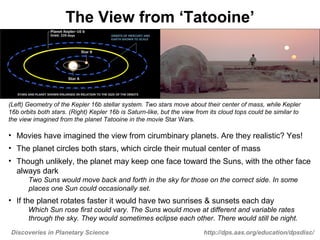
(Left) Geometry of the Kepler 16b stellar system. Two stars move about their center of mass, while Kepler
16b orbits both stars. (Right) Kepler 16b is Saturn-like, but the view from its cloud tops could be similar to
the view imagined from the planet Tatooine in the movie Star Wars.
Discoveries in Planetary Science http://dps.aas.org/education/dpsdisc/
The Big Picture
• Binary systems are quite common. If
Kepler 16b is ‘typical’ then there may
be many more planets in our galaxy
than previously estimated
• This planet and its Suns move in a
single plane, suggesting the planet
formed ‘in place’, rather than being
captured. But models of planet
formation have trouble making planets
as close to binary stars as Kepler 16b –
perhaps it migrated inward after
formation?
• Kepler 16b provides yet another
example of how science is catching up
with the imagination of science fiction
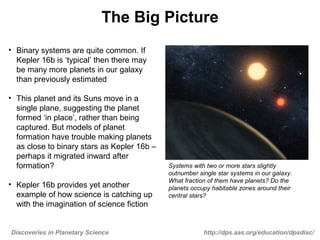
Systems with two or more stars slightly
outnumber single star systems in our galaxy.
What fraction of them have planets? Do the
planets occupy habitable zones around their
central stars?
Discoveries in Planetary Science http://dps.aas.org/education/dpsdisc/
For More Information…
Press
• Space.com – 09/15/11 – “Planet Like 'Star Wars' Tatooine Discovered Orbiting 2 Suns”
http://www.space.com/12963-tatooine-planet-2-suns-star-wars-kepler-16b.html
• Sky & Telescope – 09/15/11 - “A Planet Orbiting Two Suns”
http://www.skyandtelescope.com/community/skyblog/newsblog/129909203.html
• NASA – 09/15/11 - “NASA's Kepler Mission Discovers a World Orbiting Two Stars”
http://www.nasa.gov/mission_pages/kepler/news/kepler-16b.html
Images
• Slide 1 image courtesy NASA / JPL-Caltech, R. Hurt
http://www.nasa.gov/mission_pages/kepler/multimedia/images/Kepler-16_transit-art.html
• Slide 2 image courtesy space.com and Lucasfilm LTD
http://www.space.com/12964-alien-planet-star-wars-tatooine-kepler-16b-infographic.html
http://blogs.physicstoday.org/thedayside/2011/09/
• Slide 3 image courtesy NASA / JPL-Caltech, T. Pyle
http://www.nasa.gov/mission_pages/kepler/multimedia/images/Kepler-16_planet-pov-art.html
Source Articles (on-campus login may be required to access journals)
• Doyle et al., ‘Kepler-16: A Transiting Circumbinary Plant’, Science, 333,
doi:10.1126/science1210923, 2011.
http://www.sciencemag.org/content/333/6049/1602
Prepared for the Division for Planetary Sciences of the American Astronomical Society by David Brain and Nick Schneider
dpsdisc@aas.org - http://dps.aas.org/education/dpsdisc/ - Released 06 October, 2011

Planet orbitting two sun

  • 1.
    Discoveries in PlanetaryScience http://dps.aas.org/education/dpsdisc/ A Planet Orbiting Two Suns • About 1000 planets have been discovered outside our own solar system • But do planets form only around single stars? About half of all stars form in groups of two or more. • NASA’s Kepler spacecraft has detected a Saturn-sized planet orbiting two stars - the first discovery of a ‘circumbinary’ planet Artist conception of planet Kepler 16b (the dark object in the foreground) and the binary stars it orbits (one similar to our own Sun). All three objects eclipse each other in Kepler observations, demonstrating that they move in nearly the same plane.
  • 2.
    Discoveries in PlanetaryScience http://dps.aas.org/education/dpsdisc/ • Movies have imagined the view from cirumbinary planets. Are they realistic? Yes! • The planet circles both stars, which circle their mutual center of mass • Though unlikely, the planet may keep one face toward the Suns, with the other face always dark Two Suns would move back and forth in the sky for those on the correct side. In some places one Sun could occasionally set. • If the planet rotates faster it would have two sunrises & sunsets each day Which Sun rose first could vary. The Suns would move at different and variable rates through the sky. They would sometimes eclipse each other. There would still be night. The View from ‘Tatooine’ (Left) Geometry of the Kepler 16b stellar system. Two stars move about their center of mass, while Kepler 16b orbits both stars. (Right) Kepler 16b is Saturn-like, but the view from its cloud tops could be similar to the view imagined from the planet Tatooine in the movie Star Wars.
  • 3.
    Discoveries in PlanetaryScience http://dps.aas.org/education/dpsdisc/ The Big Picture • Binary systems are quite common. If Kepler 16b is ‘typical’ then there may be many more planets in our galaxy than previously estimated • This planet and its Suns move in a single plane, suggesting the planet formed ‘in place’, rather than being captured. But models of planet formation have trouble making planets as close to binary stars as Kepler 16b – perhaps it migrated inward after formation? • Kepler 16b provides yet another example of how science is catching up with the imagination of science fiction Systems with two or more stars slightly outnumber single star systems in our galaxy. What fraction of them have planets? Do the planets occupy habitable zones around their central stars?
  • 4.
    Discoveries in PlanetaryScience http://dps.aas.org/education/dpsdisc/ For More Information… Press • Space.com – 09/15/11 – “Planet Like 'Star Wars' Tatooine Discovered Orbiting 2 Suns” http://www.space.com/12963-tatooine-planet-2-suns-star-wars-kepler-16b.html • Sky & Telescope – 09/15/11 - “A Planet Orbiting Two Suns” http://www.skyandtelescope.com/community/skyblog/newsblog/129909203.html • NASA – 09/15/11 - “NASA's Kepler Mission Discovers a World Orbiting Two Stars” http://www.nasa.gov/mission_pages/kepler/news/kepler-16b.html Images • Slide 1 image courtesy NASA / JPL-Caltech, R. Hurt http://www.nasa.gov/mission_pages/kepler/multimedia/images/Kepler-16_transit-art.html • Slide 2 image courtesy space.com and Lucasfilm LTD http://www.space.com/12964-alien-planet-star-wars-tatooine-kepler-16b-infographic.html http://blogs.physicstoday.org/thedayside/2011/09/ • Slide 3 image courtesy NASA / JPL-Caltech, T. Pyle http://www.nasa.gov/mission_pages/kepler/multimedia/images/Kepler-16_planet-pov-art.html Source Articles (on-campus login may be required to access journals) • Doyle et al., ‘Kepler-16: A Transiting Circumbinary Plant’, Science, 333, doi:10.1126/science1210923, 2011. http://www.sciencemag.org/content/333/6049/1602 Prepared for the Division for Planetary Sciences of the American Astronomical Society by David Brain and Nick Schneider dpsdisc@aas.org - http://dps.aas.org/education/dpsdisc/ - Released 06 October, 2011