Mars the Red Planet
Known to Babylonians 3,600 years
ago as “Star that Wandered”
The Greeks referred to it as “Ares”
the god of War
Romans called it Mars
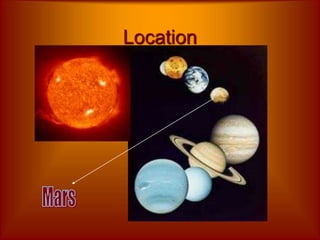
Location
Basic Facts
Distance from Sun ≈1.52 times as
far as Earth
Time to Orbit the Sun ~ 26 Earth
months
Atmosphere ~ Mostly carbon dioxide
Martian Day ~ 24.7 hours
Temperature on the planet’s surface
hardly rises above freezing point
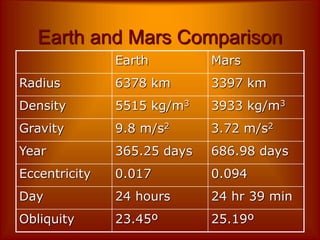
Earth and Mars Comparison
Earth Mars
Radius 6378 km 3397 km
Density 5515 kg/m3 3933 kg/m3
Gravity 9.8 m/s2 3.72 m/s2
Year 365.25 days 686.98 days
Eccentricity 0.017 0.094
Day 24 hours 24 hr 39 min
Obliquity 23.45º 25.19º
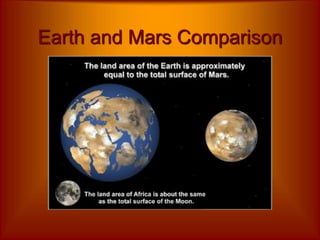
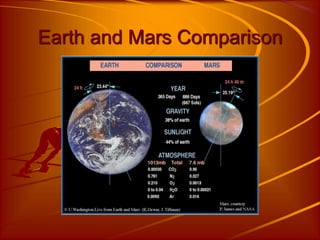
Earth and Mars Comparison
Mars Surface Features
Surface Color: “Red”
Features
– Impact Craters
– Largest volcano in the
solar system
(Olympus Mons)
– Largest Canyon in the
Solar System
(Valles Marineris)
– Ancient river channels
– Lava Rocks
– Dust: Reddish from
volcanic rock
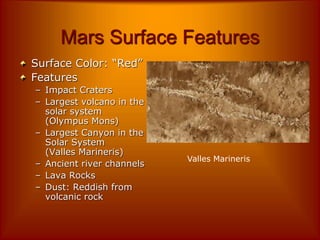
Valles Marineris
Mars Atmosphere
Unbreathable
Thin
Dusty, makes the sky pinkish, lots of
dust storms
Surface Pressure: 1/150th of Earth’s
(only 5.6 millibars)
Composition: 95% CO2, 3% N, 1.5%
Ar, 0.1% O2, 0.03% H2O
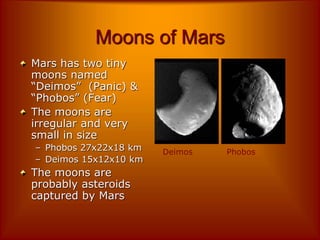
Moons of Mars
Mars has two tiny
moons named
“Deimos” (Panic) &
“Phobos” (Fear)
The moons are
irregular and very
small in size
– Phobos 27x22x18 km
– Deimos 15x12x10 km
The moons are
probably asteroids
captured by Mars
Deimos Phobos
Is there Water on Mars?
Water is the key to life as we know it
The north and south poles of Mars
are covered with thick ice or frost
Some astronomers about 100 years
ago thought there were canals on
Mars dug by intelligent civilization
Space probes to date have not found
any traces of canals on Mars
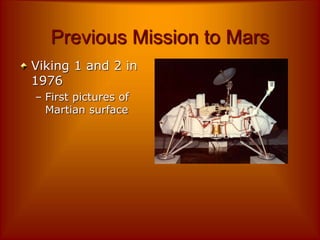
Previous Mission to Mars
Viking 1 and 2 in
1976
– First pictures of
Martian surface
Previous Mission to Mars
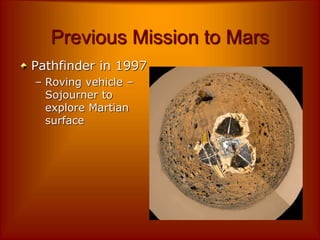
Pathfinder in 1997
– Roving vehicle –
Sojourner to
explore Martian
surface
Current Missions
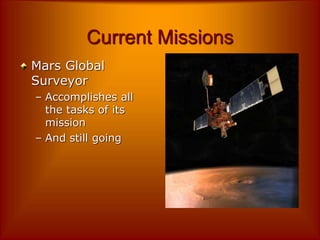
Mars Global
Surveyor
– Accomplishes all
the tasks of its
mission
– And still going
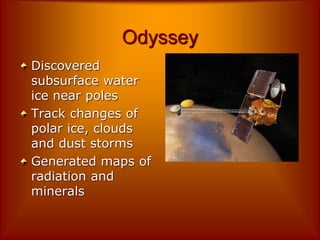
Odyssey
Discovered
subsurface water
ice near poles
Track changes of
polar ice, clouds
and dust storms
Generated maps of
radiation and
minerals
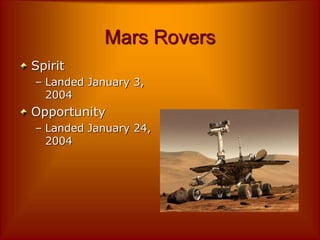
Mars Rovers
Spirit
– Landed January 3,
2004
Opportunity
– Landed January 24,
2004
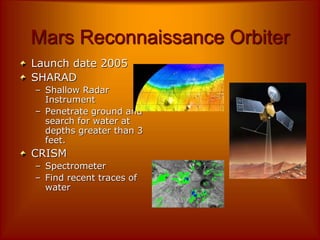
Mars Reconnaissance Orbiter
Launch date 2005
SHARAD
– Shallow Radar
Instrument
– Penetrate ground and
search for water at
depths greater than 3
feet.
CRISM
– Spectrometer
– Find recent traces of
water
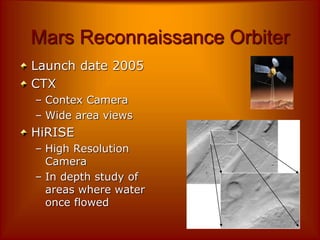
Mars Reconnaissance Orbiter
Launch date 2005
CTX
– Contex Camera
– Wide area views
HiRISE
– High Resolution
Camera
– In depth study of
areas where water
once flowed
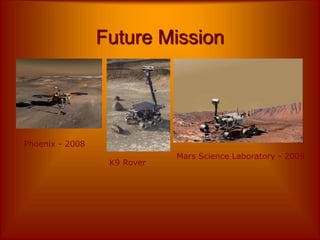
Future Mission
Phoenix - 2008
K9 Rover
Mars Science Laboratory - 2009
Mars Websites
http://mars.jpl.nasa.gov/classroom
http://mars.jpl.nasa.gov
http://marsed.asu.edu
http://msip.asu.edu
http://marsbound.asu.edu

Mars the red_planet

Editor's Notes

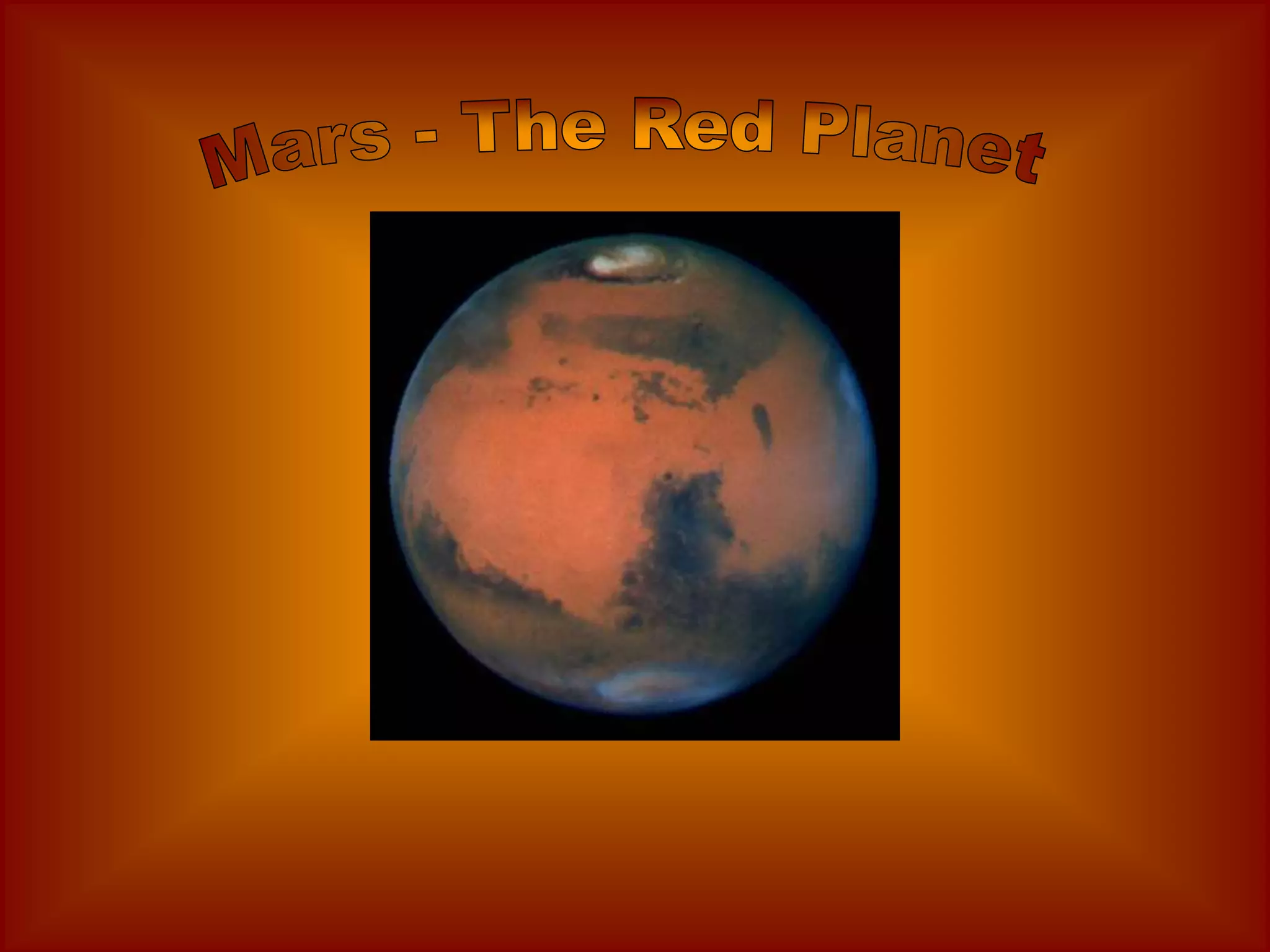
  • #3 Named after the Roman god of war, Mars, it is often described as the "Red Planet" as the iron oxide prevalent on its surface gives it a reddish appearance. Mars is a terrestrial planet with a thin atmosphere, having surface features reminiscent both of the impact craters of the Moon and the volcanoes, valleys, deserts, and polar ice caps of Earth. The rotational period and seasonal cycles of Mars are likewise similar to those of Earth, as is the tilt that produces the seasons. Mars is the site of Olympus Mons, the highest known mountain within the Solar System, and of Valles Marineris, the largest canyon.
  • #4 Mars is about 36 to 250 million miles from Earth and the fourth planet from the Sun. I'll try to find out how far away it is from the Sun. mars is about 36 to 250 million miles from Earth and the fourth planet from the Sun. Mars is the fourth planet from the Sun and is 1.52 AU from the Sun
  • #5 Scientists describe Mars as the ‘Red Planet’ as they observe its brilliance through their telescopes. It is similar to Venus as shines in the night sky. They are rediscovering all the facts that ancient philosophers, theorists, astronomers and other thinkers knew. Thinkers such as Aristotle used their knowledge of the planets and the universe to organise their society. Experts will likely continue to make new discoveries in their quest to learn what they can about Mars, Earth and our solar system.
  • #6 MARS, the outermost of the four terrestrial planets (Mercury, Venus, Earth, and Mars), is the second closest to Earth after Venus. It is slightly more than half the size of Earth and almost twice the size of the Moon. The atmosphere is very thin, less than one one- hundredth that of Earth, and composed primarily of carbon dioxide. Temperatures are cold, the mean annual surface temperature being approximately 50¡C at the equator and close to 130 degrees C at the poles. Because of the thin atmosphere, the diurnal temperature range is large, greater than 100 degrees C at the equator. Summer temperatures rise above 0 degrees C at midday despite the low diurnal mean.
  • #9 THE SURFACE OF MARS  The southern hemisphere of Mars is quite heavily cratered and resembles the surface of our Moon. The surface is old and has been relatively unchanged for some time. The northern hemisphere is quite different. It has few craters and these appear far less eroded indicating they are much younger than those of the southern hemisphere. The northern hemisphere shows much geologic activity. The surface has been smoothed by repeated lava flows indicating a great deal of volcanic activity. There is also a lot of deformed uplifted crustal sections along with collapsed depressions.
  • #10 The atmosphere of Mars is relatively thin and is composed mostly of carbon dioxide (95.32%). There has been interest in studying its composition since the detection of trace amounts of methane, which may indicate the presence of life on Mars, but may also be produced by a geochemical process, volcanic or hydrothermal activity. The atmospheric pressure on the surface of Mars varies from around 30 Pascal (0.0044 psi) on Olympus Mons's peak to over 1,155 Pascal (0.1675 psi) in the depths of Hellas Planitia, with a mean surface level pressure of 600 Pascal (0.087 psi), compared to Earth's sea level average of 101.3 kilopascals (14.69 psi), and a total mass of 25 teratonnes, compared to Earth's 5148 teratonnes. However, the scale height of the atmosphere is about 11 kilometres (6.8 mi), somewhat higher than Earth's 7 kilometres (4.3 mi). The atmosphere on Mars consists of 95% carbon dioxide, 3% nitrogen, 1.6% argon, and contains traces of oxygen, water, and methane, for a mean molar mass of 43.34 g/mol. The atmosphere is quite dusty, giving the Martian sky a light brown or orange colour when seen from the surface; data from the Mars exploration Rovers indicate that suspended dust particles within the atmosphere are roughly 1.5 micrometres across.
  • #11 Mars has two small moons, Phobos and Deimos, which are thought to be captured asteroids. Both satellites were discovered in 1877 by Asaph Hall, and are named after the characters Phobos (panic/fear) and Deimos (terror/dread) who, in Greek mythology, accompanied their father Ares, god of war, into battle. Ares was known as Mars to the Romans.
  • #12 Water on Mars is much less abundant than it is on Earth, at least in its liquid and gaseous states of matter. Most of the water known is locked in the cryosphere (permafrost and polar caps), and there are no bodies of liquid water which could create a hydrosphere. Only a small amount of water vapour is present in the atmosphere. Current conditions on the planet surface do not support the long-term existence of liquid water. The average atmospheric pressure and temperature are far too low, leading to immediate freezing and resulting sublimation. Despite this, research suggests that in the past there was liquid water flowing on the surface, creating large areas similar to Earth's oceans
  • #13 NASA's Viking Mission to Mars was composed of two spacecraft, Viking 1 and Viking 2, each consisting of an orbiter and a lander. The primary mission objectives were to obtain high resolution images of the Martian surface, characterize the structure and composition of the atmosphere and surface, and search for evidence of life. Viking 1 was launched on August 20, 1975 and arrived at Mars on June 19, 1976. The first month of orbit was devoted to imaging the surface to find appropriate landing sites for the Viking Landers. On July 20, 1976 the Viking 1 Lander separated from the Orbiter and touched down at Chryse Planitia (22.48° N, 49.97° W planetographic, 1.5 km below the datum (6.1 mbar) elevation). Viking 2 was launched September 9, 1975 and entered Mars orbit on August 7, 1976. The Viking 2 Lander touched down at Utopia Planitia (47.97° N, 225.74° W, 3 km below the datum elevation) on September 3, 1976. The Orbiters imaged the entire surface of Mars at a resolution of 150 to 300 meters, and selected areas at 8 meters. The lowest periapsis altitude for both Orbiters was 300 km. The Viking 2 Orbiter was powered down on July 25, 1978 after 706 orbits, and the Viking 1 Orbiter on August 17, 1980, after over 1400 orbits. The Orbiter images are available from NSSDC on CD-ROM and as photographic products. These images have been converted to digital image mosaics and maps , and these are also available from NSSDC on CD-ROM. An index giving the latitude and longitude of each Viking Orbiter image is available at the Viking FTP site. The Viking Landers transmitted images of the surface, took surface samples and analyzed them for composition and signs of life, studied atmospheric composition and meteorology, and deployed seismometers. The Viking 2 Lander ended communications on April 11, 1980, and the Viking 1 Lander on November 13, 1982, after transmitting over 1400 images of the two sites. Many of these images are also available from NSSDC online and as photographic products.
  • #14 Launched on December 4, 1996 by NASA aboard a Delta II booster a month after the Mars Global Surveyor was launched, it landed on July 4, 1997 on Mars' Ares Vallis, in a region called Chryse Planitia in the Oxia Palus quadrangle. The lander then opened, exposing the rover which conducted many experiments on the Martian surface. The mission carried a series of scientific instruments to analyze the Martian atmosphere, climate, geology and the composition of its rocks and soil. It was the second project from NASA's Discovery Program, which promotes the use of low-cost spacecraft and frequent launches under the motto "cheaper, faster and better" promoted by the then administrator, Daniel Goldin. The mission was directed by the Jet Propulsion Laboratory (JPL), a division of the California Institute of Technology, responsible for NASA's Mars Exploration Program. The project manager was JPL's Tony Spear.
  • #15 The Mars Global Surveyor (MGS) was a US spacecraft developed by NASA's Jet Propulsion Laboratory and launched November 1996. It began the United States return to Mars after a 10-year absence. It completed its primary mission in January 2001 and was in its third extended mission phase when, on 2 November 2006, the spacecraft failed to respond to messages and commands. A faint signal was detected three days later which indicated that the craft had gone into safe mode. All attempts to re contact the Mars Global Surveyor and resolve the problem failed. In January 2007 NASA officially ended the mission. The Surveyor spacecraft, fabricated at the Lockheed Martin Astronautics plant in Denver, is a rectangular-shaped box with wing-like projections (solar panels) extending from opposite sides. When fully loaded with propellant at the time of launch, the spacecraft weighed 1,060 kg (2,337 lb). Most of Surveyor's mass lies in the box-shaped module occupying the centre portion of the spacecraft. This centre module is made of two smaller rectangular modules stacked on top of each other, one of which is called the equipment module and holds the spacecraft's electronics, science instruments, and the 1750A mission computer. The other module, called the propulsion module, houses Surveyor's rocket engines and propellant tanks.
  • #16 2001 Mars Odyssey is a robotic spacecraft orbiting the planet Mars. The project was developed by NASA, and contracted out to Lockheed Martin, with an expected cost for the entire mission of US$297 million. Its mission is to use spectrometers and electronic imagers to hunt for evidence of past or present water and volcanic activity on Mars. It is hoped that the data Odyssey obtains will help answer the question of whether life has ever existed on Mars. It also acts as a relay for communications between the Mars Exploration Rovers and the Phoenix lander to Earth. The mission was named as a tribute to Arthur C. Clarke, evoking the name of 2001: A Space Odyssey.
  • #20 Phoenix was a robotic spacecraft on a space exploration mission on Mars under the Mars Scout Program. The Phoenix lander descended on Mars on May 25, 2008. Mission scientists used instruments aboard the lander to search for environments suitable for microbial life on Mars, and to research the history of water there. Phoenix is NASA's sixth successful landing out of seven attempts and is the most recent spacecraft to land successfully on Mars as well as the first successful landing in a Martian polar region. The lander completed its mission in August 2008, and made a last brief communication with Earth on November 2 as available solar power dropped with the Martian winter. The mission was declared concluded on November 10, 2008, after engineers were unable to re-contact the craft