IBM Research - Ireland
© 2012 IBM Corporation
Future Life and Services
Shake up your City
Pól Mac Aonghusa,
IBM Research – Ireland
IBM Research - Ireland
© 2012 IBM Corporation
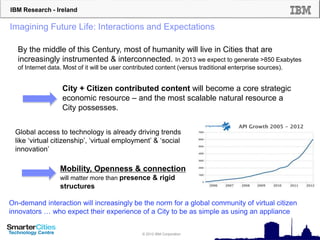
By the middle of this Century, most of humanity will live in Cities that are
increasingly instrumented & interconnected. In 2013 we expect to generate >850 Exabytes
of Internet data. Most of it will be user contributed content (versus traditional enterprise sources).
Global access to technology is already driving trends
like ‘virtual citizenship’, ‘virtual employment’ & ‘social
innovation’
City + Citizen contributed content will become a core strategic
economic resource – and the most scalable natural resource a
City possesses.
Mobility, Openness & connection
will matter more than presence & rigid
structures
Imagining Future Life: Interactions and Expectations
On-demand interaction will increasingly be the norm for a global community of virtual citizen
innovators … who expect their experience of a City to be as simple as using an appliance
IBM Research - Ireland
© 2012 IBM Corporation
Imagining Future Services: Interdependency and Complexity
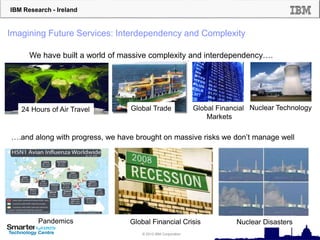
We have built a world of massive complexity and interdependency….
….and along with progress, we have brought on massive risks we don’t manage well
24 Hours of Air Travel Global Trade Global Financial
Markets
Nuclear Technology
Pandemics Global Financial Crisis Nuclear Disasters
IBM Research - Ireland
© 2012 IBM Corporation
Some Good News:
The future is already here -- it’s just not very evenly distributed*
• Linz, Austria
• Solar City, an entire district exclusively using solar power for energy.
• Milan, Italy, Southampton, UK, Salzburg, Austria
• Unified smart card access across services, i.e., bus, library, museum, bikes, and EV rental.
• Stockholm, Sweden
• Congestion charging and real-time information from taxi and lorry GPS, traffic and pollution sensors, transit
systems, and weather
• 20% reduction in city traffic, and halving the average travel time
• 40% reduction in GHG, such as CO2
• Barcelona
• EV innovation: >250 charge points, all with real-time status, free city parking and charging, 3% of parking spaces
reserved for EVs.
• Madrid
• Fully integrated its emergency management systems (fire, police, ambulance) with responsiveness increased by
25% (>8 minutes)
• Amsterdam
• Public/private platform to collaborate on aggressive goals:
• Municipal organizations climate-impact neutral before 2015
• 20% renewable energy by 2025,
• 40% reduction in CO2 emissions by 2025
*William Gibson
IBM Research - Ireland
© 2012 IBM Corporation
Three urgent challenges on the Future Cities roadmap
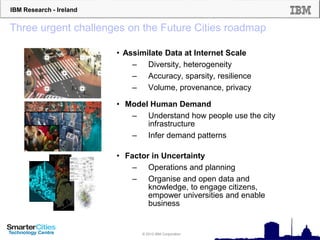
• Assimilate Data at Internet Scale
– Diversity, heterogeneity
– Accuracy, sparsity, resilience
– Volume, provenance, privacy
• Model Human Demand
– Understand how people use the city
infrastructure
– Infer demand patterns
• Factor in Uncertainty
– Operations and planning
– Organise and open data and
knowledge, to engage citizens,
empower universities and enable
business
IBM Research - Ireland
© 2012 IBM Corporation
ReasonableCity: Learning Systems to Help Diagnose the City
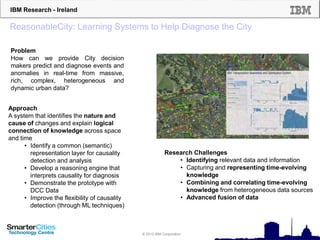
Problem
How can we provide City decision
makers predict and diagnose events and
anomalies in real-time from massive,
rich, complex, heterogeneous and
dynamic urban data?
Research Challenges
• Identifying relevant data and information
• Capturing and representing time-evolving
knowledge
• Combining and correlating time-evolving
knowledge from heterogeneous data sources
• Advanced fusion of data
Approach
A system that identifies the nature and
cause of changes and explain logical
connection of knowledge across space
and time
• Identify a common (semantic)
representation layer for causality
detection and analysis
• Develop a reasoning engine that
interprets causality for diagnosis
• Demonstrate the prototype with
DCC Data
• Improve the flexibility of causality
detection (through ML techniques)
IBM Research - Ireland
© 2012 IBM Corporation
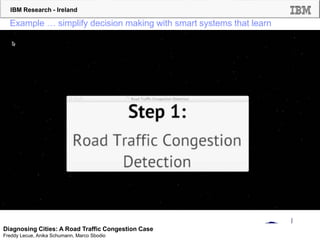
Diagnosing Cities: A Road Traffic Congestion Case
Freddy Lecue, Anika Schumann, Marco Sbodio
Example … simplify decision making with smart systems that learn
IBM Research - Ireland
© 2012 IBM Corporation
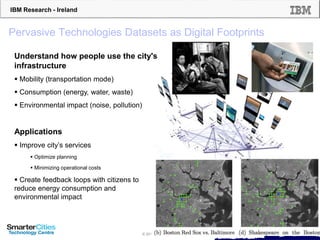
Pervasive Technologies Datasets as Digital Footprints
Understand how people use the city's
infrastructure
 Mobility (transportation mode)
 Consumption (energy, water, waste)
 Environmental impact (noise, pollution)
Applications
 Improve city’s services
 Optimize planning
 Minimizing operational costs
 Create feedback loops with citizens to
reduce energy consumption and
environmental impact
IBM Research - Ireland
© 2012 IBM Corporation
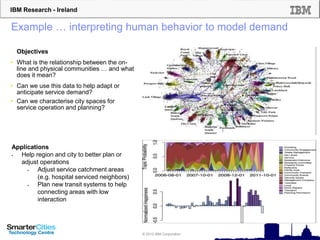
• Objectives
• What is the relationship between the on-
line and physical communities … and what
does it mean?
• Can we use this data to help adapt or
anticipate service demand?
• Can we characterise city spaces for
service operation and planning?
Example … interpreting human behavior to model demand
Applications
 Help region and city to better plan or
adjust operations
 Adjust service catchment areas
(e.g. hospital serviced neighbors)
 Plan new transit systems to help
connecting areas with low
interaction
IBM Research - Ireland
© 2012 IBM Corporation
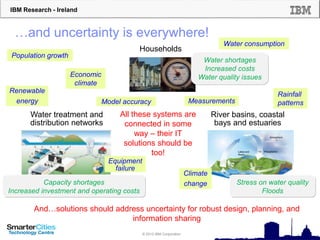
…and uncertainty is everywhere!
River basins, coastal
bays and estuaries
Households
Water treatment and
distribution networks
Water shortages
Increased costs
Water quality issues
Stress on water quality
Floods
Capacity shortages
Increased investment and operating costs
Population growth
Climate
change
Renewable
energy
Water consumption
Rainfall
patterns
Model accuracy Measurements
Economic
climate
All these systems are
connected in some
way – their IT
solutions should be
too!
Equipment
failure
And…solutions should address uncertainty for robust design, planning, and
information sharing
IBM Research - Ireland
© 2012 IBM Corporation
Valve Placement
ve Placement
Active and Robust Water Distribution Network Management
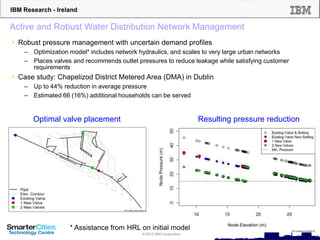
• Robust pressure management with uncertain demand profiles
– Optimization model* includes network hydraulics, and scales to very large urban networks
– Places valves and recommends outlet pressures to reduce leakage while satisfying customer
requirements
• Case study: Chapelizod District Metered Area (DMA) in Dublin
– Up to 44% reduction in average pressure
– Estimated 66 (16%) additional households can be served
Optimal valve placement Resulting pressure reduction
* Assistance from HRL on initial model
IBM Research - Ireland
© 2012 IBM Corporation
What could you do if you had access to all the public data of a city? Could you make the city run better,
faster, cheaper? What new economic opportunities would emerge? (Dublin City Manager, 2011)
Challenge
How can we make a ‘Future City’ as
consumable and accessible as email?
Observation
“After the telephone was introduced
more than a century ago, Kurzweil
says, it took 50 years for a quarter
of the American population to get
one. After the cell phone was
introduced, it took only seven
years.”
…. ‘Future Cities’ in < 7 years
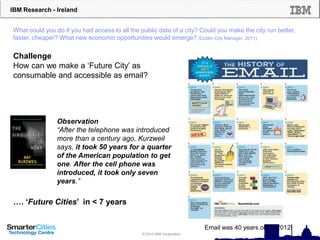
Email was 40 years old in 2012!
IBM Research - Ireland
© 2012 IBM Corporation
Working harder is not sustainable
Cities require innovative approaches
Join Us: http://www.ibm.com/ie/research

Future Cities Conference´13 / Pól Mac Aonghusa - "Future Life and Services"

  • 1.
    IBM Research -Ireland © 2012 IBM Corporation Future Life and Services Shake up your City Pól Mac Aonghusa, IBM Research – Ireland
  • 2.
    IBM Research -Ireland © 2012 IBM Corporation By the middle of this Century, most of humanity will live in Cities that are increasingly instrumented & interconnected. In 2013 we expect to generate >850 Exabytes of Internet data. Most of it will be user contributed content (versus traditional enterprise sources). Global access to technology is already driving trends like ‘virtual citizenship’, ‘virtual employment’ & ‘social innovation’ City + Citizen contributed content will become a core strategic economic resource – and the most scalable natural resource a City possesses. Mobility, Openness & connection will matter more than presence & rigid structures Imagining Future Life: Interactions and Expectations On-demand interaction will increasingly be the norm for a global community of virtual citizen innovators … who expect their experience of a City to be as simple as using an appliance
  • 3.
    IBM Research -Ireland © 2012 IBM Corporation Imagining Future Services: Interdependency and Complexity We have built a world of massive complexity and interdependency…. ….and along with progress, we have brought on massive risks we don’t manage well 24 Hours of Air Travel Global Trade Global Financial Markets Nuclear Technology Pandemics Global Financial Crisis Nuclear Disasters
  • 4.
    IBM Research -Ireland © 2012 IBM Corporation Some Good News: The future is already here -- it’s just not very evenly distributed* • Linz, Austria • Solar City, an entire district exclusively using solar power for energy. • Milan, Italy, Southampton, UK, Salzburg, Austria • Unified smart card access across services, i.e., bus, library, museum, bikes, and EV rental. • Stockholm, Sweden • Congestion charging and real-time information from taxi and lorry GPS, traffic and pollution sensors, transit systems, and weather • 20% reduction in city traffic, and halving the average travel time • 40% reduction in GHG, such as CO2 • Barcelona • EV innovation: >250 charge points, all with real-time status, free city parking and charging, 3% of parking spaces reserved for EVs. • Madrid • Fully integrated its emergency management systems (fire, police, ambulance) with responsiveness increased by 25% (>8 minutes) • Amsterdam • Public/private platform to collaborate on aggressive goals: • Municipal organizations climate-impact neutral before 2015 • 20% renewable energy by 2025, • 40% reduction in CO2 emissions by 2025 *William Gibson
  • 5.
    IBM Research -Ireland © 2012 IBM Corporation Three urgent challenges on the Future Cities roadmap • Assimilate Data at Internet Scale – Diversity, heterogeneity – Accuracy, sparsity, resilience – Volume, provenance, privacy • Model Human Demand – Understand how people use the city infrastructure – Infer demand patterns • Factor in Uncertainty – Operations and planning – Organise and open data and knowledge, to engage citizens, empower universities and enable business
  • 6.
    IBM Research -Ireland © 2012 IBM Corporation ReasonableCity: Learning Systems to Help Diagnose the City Problem How can we provide City decision makers predict and diagnose events and anomalies in real-time from massive, rich, complex, heterogeneous and dynamic urban data? Research Challenges • Identifying relevant data and information • Capturing and representing time-evolving knowledge • Combining and correlating time-evolving knowledge from heterogeneous data sources • Advanced fusion of data Approach A system that identifies the nature and cause of changes and explain logical connection of knowledge across space and time • Identify a common (semantic) representation layer for causality detection and analysis • Develop a reasoning engine that interprets causality for diagnosis • Demonstrate the prototype with DCC Data • Improve the flexibility of causality detection (through ML techniques)
  • 7.
    IBM Research -Ireland © 2012 IBM Corporation Diagnosing Cities: A Road Traffic Congestion Case Freddy Lecue, Anika Schumann, Marco Sbodio Example … simplify decision making with smart systems that learn
  • 8.
    IBM Research -Ireland © 2012 IBM Corporation Pervasive Technologies Datasets as Digital Footprints Understand how people use the city's infrastructure  Mobility (transportation mode)  Consumption (energy, water, waste)  Environmental impact (noise, pollution) Applications  Improve city’s services  Optimize planning  Minimizing operational costs  Create feedback loops with citizens to reduce energy consumption and environmental impact
  • 9.
    IBM Research -Ireland © 2012 IBM Corporation • Objectives • What is the relationship between the on- line and physical communities … and what does it mean? • Can we use this data to help adapt or anticipate service demand? • Can we characterise city spaces for service operation and planning? Example … interpreting human behavior to model demand Applications  Help region and city to better plan or adjust operations  Adjust service catchment areas (e.g. hospital serviced neighbors)  Plan new transit systems to help connecting areas with low interaction
  • 10.
    IBM Research -Ireland © 2012 IBM Corporation …and uncertainty is everywhere! River basins, coastal bays and estuaries Households Water treatment and distribution networks Water shortages Increased costs Water quality issues Stress on water quality Floods Capacity shortages Increased investment and operating costs Population growth Climate change Renewable energy Water consumption Rainfall patterns Model accuracy Measurements Economic climate All these systems are connected in some way – their IT solutions should be too! Equipment failure And…solutions should address uncertainty for robust design, planning, and information sharing
  • 11.
    IBM Research -Ireland © 2012 IBM Corporation Valve Placement ve Placement Active and Robust Water Distribution Network Management • Robust pressure management with uncertain demand profiles – Optimization model* includes network hydraulics, and scales to very large urban networks – Places valves and recommends outlet pressures to reduce leakage while satisfying customer requirements • Case study: Chapelizod District Metered Area (DMA) in Dublin – Up to 44% reduction in average pressure – Estimated 66 (16%) additional households can be served Optimal valve placement Resulting pressure reduction * Assistance from HRL on initial model
  • 12.
    IBM Research -Ireland © 2012 IBM Corporation What could you do if you had access to all the public data of a city? Could you make the city run better, faster, cheaper? What new economic opportunities would emerge? (Dublin City Manager, 2011) Challenge How can we make a ‘Future City’ as consumable and accessible as email? Observation “After the telephone was introduced more than a century ago, Kurzweil says, it took 50 years for a quarter of the American population to get one. After the cell phone was introduced, it took only seven years.” …. ‘Future Cities’ in < 7 years Email was 40 years old in 2012!
  • 13.
    IBM Research -Ireland © 2012 IBM Corporation Working harder is not sustainable Cities require innovative approaches Join Us: http://www.ibm.com/ie/research