Sensing time
Nick Tyler
Universal Composition Laboratory
UCL
What does one minute feel like to you?
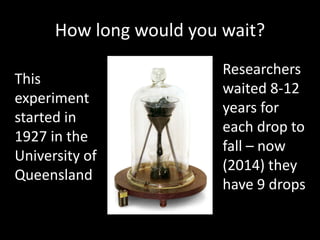
How long would you wait?
This
experiment
started in
1927 in the
University of
Queensland
Researchers
waited 8-12
years for
each drop to
fall – now
(2014) they
have 9 drops
For about a decade, time passed very slowly
Then, for a minute, time
passed extremely quickly
Looking back, the decades seemed very fast
But those final minutes
seem to be very long
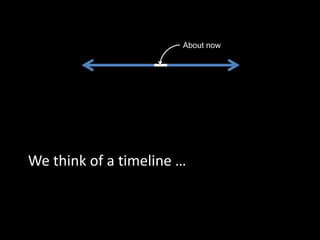
We think of a timeline …
About now
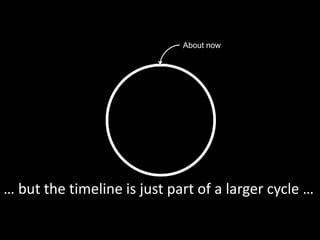
… but the timeline is just part of a larger cycle …
About now
Long term
Short term cycle
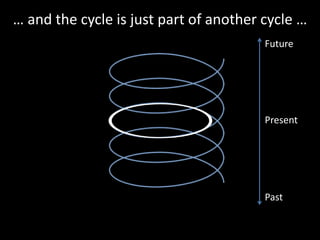
Past
Future
Present
… and the cycle is just part of another cycle …
Does time pass more quickly in the past
or in the future?
… past events happened more recently
and more slowly than they did
… future events will happen sooner
and more slowly than they will
Typically, people think that …
… but some people think the reverse …
… and events in the future seem further away
in time and faster than they will be
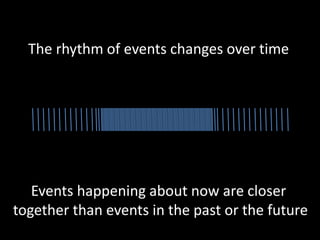
The rhythm of events changes over time
Events happening about now are closer
together than events in the past or the future
Long term
Short term cycle
Past
Future
Present
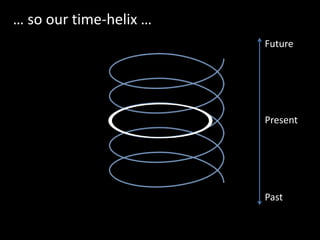
… so our time-helix …
Past
Future
Present
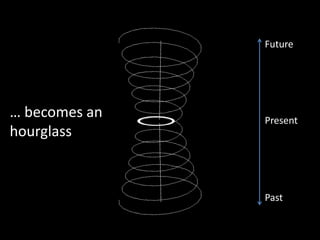
… becomes an
hourglass
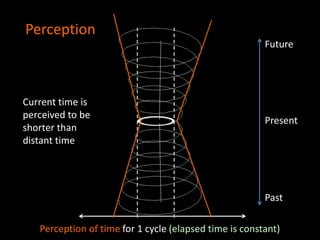
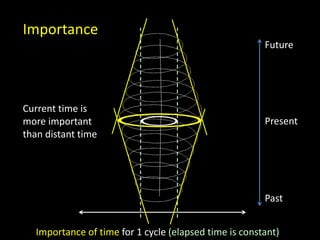
But time is an illusion
How do we perceive it?
What is its importance?
Past
Future
Present
Perception of time for 1 cycle (elapsed time is constant)
Perception
Current time is
perceived to be
shorter than
distant time
Past
Future
Present
Importance of time for 1 cycle (elapsed time is constant)
Importance
Current time is
more important
than distant time
We are doing something exciting
and important
We are going to do something else
exciting and important
In between, we have to wait for a
bus
“... waiting now is a chore …”
“the bus is not going to
come any time soon”
… so …
“… waiting is a waste of my time …”
“… so using the bus is a real waste of my
time …”
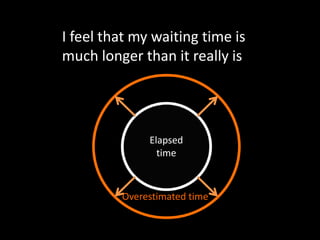
I feel that my waiting time is
much longer than it really is
Overestimated time
Elapsed
time
Real-time bus arrival information
hopes to reduce this overestimate
to equal the actual passage of time
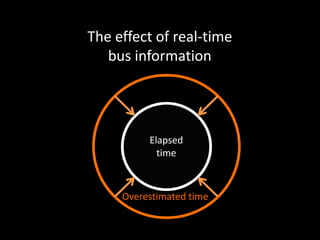
The effect of real-time
bus information
Overestimated time
Elapsed
time
However,
people routinely underestimate
the time they have spent
doing something they enjoy
“time just flew by while I was …”
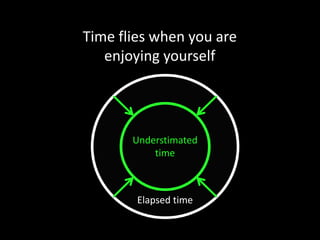
Time flies when you are
enjoying yourself
Elapsed time
Understimated
time
We need to change the perception of
time spent waiting …
… to be something that we can enjoy …
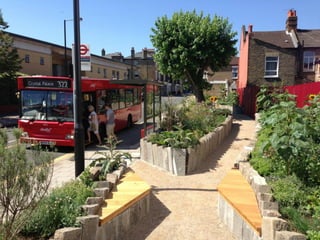
… so we design the bus stop …
… to be fun, useful, pleasant, enjoyable to use
This is Universal Composition …
Multisensorial design in space and time
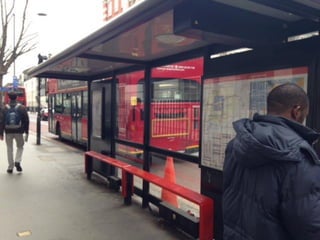
The bus stop becomes something you
look forward to using …
… and you look back on as being
a good experience
… and want to do again
How do you sense time?
What will five minutes in the future
feel like to you?
Nick Tyler & Sara Adhitya
Universal Composition Laboratory
University College London
ucl-squared@ucl.ac.uk
www.cege.ucl.ac.uk/arg/ucl-squared

Workshop on Human Living in Future Cities - Nick Tyler (UCL), "Sensing Time"

  • 1.
    Sensing time Nick Tyler UniversalComposition Laboratory UCL
  • 2.
    What does oneminute feel like to you?
  • 3.
    How long wouldyou wait? This experiment started in 1927 in the University of Queensland Researchers waited 8-12 years for each drop to fall – now (2014) they have 9 drops
  • 4.
    For about adecade, time passed very slowly Then, for a minute, time passed extremely quickly
  • 5.
    Looking back, thedecades seemed very fast But those final minutes seem to be very long
  • 6.
    We think ofa timeline … About now
  • 7.
    … but thetimeline is just part of a larger cycle … About now
  • 8.
    Long term Short termcycle Past Future Present … and the cycle is just part of another cycle …
  • 9.
    Does time passmore quickly in the past or in the future?
  • 10.
    … past eventshappened more recently and more slowly than they did … future events will happen sooner and more slowly than they will Typically, people think that …
  • 11.
    … but somepeople think the reverse … … and events in the future seem further away in time and faster than they will be
  • 12.
    The rhythm ofevents changes over time Events happening about now are closer together than events in the past or the future
  • 13.
    Long term Short termcycle Past Future Present … so our time-helix …
  • 14.
  • 15.
    But time isan illusion How do we perceive it? What is its importance?
  • 16.
    Past Future Present Perception of timefor 1 cycle (elapsed time is constant) Perception Current time is perceived to be shorter than distant time
  • 17.
    Past Future Present Importance of timefor 1 cycle (elapsed time is constant) Importance Current time is more important than distant time
  • 18.
    We are doingsomething exciting and important We are going to do something else exciting and important In between, we have to wait for a bus
  • 19.
    “... waiting nowis a chore …” “the bus is not going to come any time soon” … so … “… waiting is a waste of my time …”
  • 20.
    “… so usingthe bus is a real waste of my time …”
  • 21.
    I feel thatmy waiting time is much longer than it really is Overestimated time Elapsed time
  • 22.
    Real-time bus arrivalinformation hopes to reduce this overestimate to equal the actual passage of time
  • 23.
    The effect ofreal-time bus information Overestimated time Elapsed time
  • 24.
    However, people routinely underestimate thetime they have spent doing something they enjoy “time just flew by while I was …”
  • 25.
    Time flies whenyou are enjoying yourself Elapsed time Understimated time
  • 26.
    We need tochange the perception of time spent waiting … … to be something that we can enjoy …
  • 27.
    … so wedesign the bus stop … … to be fun, useful, pleasant, enjoyable to use
  • 28.
    This is UniversalComposition … Multisensorial design in space and time
  • 29.
    The bus stopbecomes something you look forward to using … … and you look back on as being a good experience
  • 30.
    … and wantto do again
  • 34.
    How do yousense time? What will five minutes in the future feel like to you?
  • 35.
    Nick Tyler &Sara Adhitya Universal Composition Laboratory University College London ucl-squared@ucl.ac.uk www.cege.ucl.ac.uk/arg/ucl-squared