Corporate Memory &
Personal Knowledge
Management

28 November 2013

Stephen Dale @stephendale
Unless otherwise noted, this work is licensed under a Creative Commons
Attribution-NonCommercial-ShareAlike 3.0 Unported License.
What does ‘Corporate’ look like?
Pre-industrial
Age

Industrial Age

Collabor8now Ltd

Post-industrial
Age
What does ‘Corporate’ look like?
Pre-industrial
Age

Industrial Age

•Skills important
•Shared knowledge

(Worshipful Companies)
•Individualism
•Close to the customer
•Personalised products
•Agile processes
•Small is beautiful (but
difficult to scale)
•Transparency

Collabor8now Ltd

Post-industrial
Age
What does ‘Corporate’ look like?
Pre-industrial
Age
•Skills important
•Shared knowledge

(Worshipful Companies)
•Individualism
•Close to the customer
•Personalised products
•Agile processes
•Small is beautiful (but
difficult to scale)
•Transparency

Industrial Age
•Mass production trumps

skills
•Knowledge hoarding
(knowledge is power)
•De-individualism
•Remote from customer
•One size fits all
•Hard-wired processes
•Big is beautiful (mega
organisations)
•Command and control
•Hierarchies (regimented)
•Opaqueness

Collabor8now Ltd

Post-industrial
Age
What does ‘Corporate’ look like?
Pre-industrial
Age
•Skills important
•Shared knowledge

(Worshipful Companies)
•Individualism
•Close to the customer
•Personalised products
•Agile processes
•Small is beautiful (but
difficult to scale)
•Transparency

Industrial Age
•Mass production trumps

skills
•Knowledge hoarding
(knowledge is power)
•De-individualism
•Remote from customer
•One size fits all
•Hard-wired processes
•Big is beautiful (mega
organisations)
•Command and control
•Hierarchies (regimented)
•Opaqueness

Collabor8now Ltd

Post-industrial
Age
•Skills important - but

routine work is automated
•Shared knowledge (social/
learning networks)
•Individualism
•Close to customer (Social
Business)
•Personalised products
•Agile processes
•Small is beautiful (but can
scale)
•Democratisation of
workplace
•Flat structures
•Transparency
What does ‘Corporate’ look like?
Pre-industrial
Age
•Skills important
•Shared knowledge

(Worshipful Companies)
•Individualism
•Close to the customer
•Personalised products
•Agile processes
•Small is beautiful (but
difficult to scale)
•Transparency

Industrial Age
•Mass production trumps

skills
•Knowledge hoarding
(knowledge is power)
•De-individualism
•Remote from customer
•One size fits all
•Hard-wired processes
•Big is beautiful (mega
organisations)
•Command and control
•Hierarchies (regimented)
•Opaqueness

Similar?

Collabor8now Ltd

Post-industrial
Age
•Skills important - but

routine work is automated
•Shared knowledge (social/
learning networks)
•Individualism
•Close to customer (Social
Business)
•Personalised products
•Agile processes
•Small is beautiful (but can
scale)
•Democratisation of
workplace
•Flat structures
•Transparency
Is BIG Always Better?

Collabor8now Ltd
Voted the most important issue by
delegates at the Online Information
Conference 19/20 November 2013

Source: Online Information Show : http://www.online-information.co.uk/
Voted the most important issue by
delegates at the Online Information
Conference 19/20 November 2013

How can knowledge/
information professionals
demonstrate value to their
organisation?

Source: Online Information Show : http://www.online-information.co.uk/
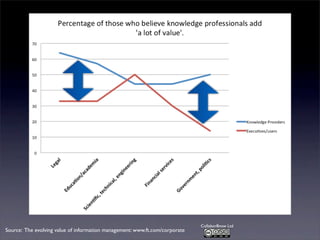
Source: The evolving value of information management: www.ft.com/corporate

Collabor8now Ltd
Source: The evolving value of information management: www.ft.com/corporate

Collabor8now Ltd
The credibility gap

Source: The evolving value of information management: www.ft.com/corporate

Collabor8now Ltd
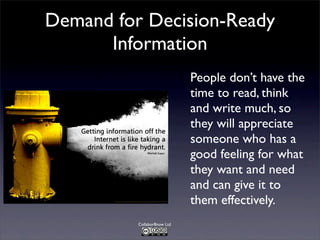
Demand for Decision-Ready
Information
People don’t have the
time to read, think
and write much, so
they will appreciate
someone who has a
good feeling for what
they want and need
and can give it to
them effectively.
Collabor8now Ltd
What Is Personal
Knowledge Management?

Collabor8now Ltd
What Is Personal
Knowledge Management?
It is a response to the idea
that knowledge workers
increasingly need to be
responsible for their own
growth and learning.

Collabor8now Ltd
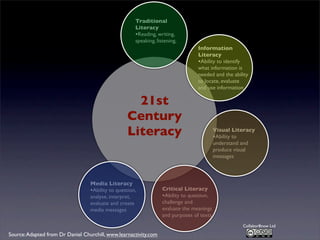
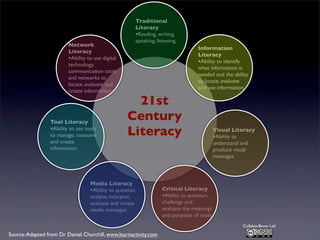
21st
Century
Literacy

Collabor8now Ltd

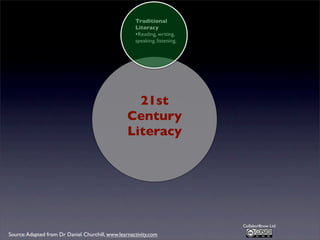
Source: Adapted from Dr Daniel Churchill, www.learnactivity.com
Traditional
Literacy
•Reading, writing,
speaking, listening,

21st
Century
Literacy

Collabor8now Ltd

Source: Adapted from Dr Daniel Churchill, www.learnactivity.com
Traditional
Literacy
•Reading, writing,
speaking, listening,
Information
Literacy
•Ability to identify
what information is
needed and the ability
to locate, evaluate
and use information

21st
Century
Literacy

Collabor8now Ltd

Source: Adapted from Dr Daniel Churchill, www.learnactivity.com
Traditional
Literacy
•Reading, writing,
speaking, listening,
Information
Literacy
•Ability to identify
what information is
needed and the ability
to locate, evaluate
and use information

21st
Century
Literacy

Visual Literacy
•Ability to
understand and
produce visual
messages

Collabor8now Ltd

Source: Adapted from Dr Daniel Churchill, www.learnactivity.com
Traditional
Literacy
•Reading, writing,
speaking, listening,
Information
Literacy
•Ability to identify
what information is
needed and the ability
to locate, evaluate
and use information

21st
Century
Literacy

Visual Literacy
•Ability to
understand and
produce visual
messages

Critical Literacy
•Ability to question,
challenge and
evaluate the meanings
and purposes of texts
Collabor8now Ltd

Source: Adapted from Dr Daniel Churchill, www.learnactivity.com
Traditional
Literacy
•Reading, writing,
speaking, listening,
Information
Literacy
•Ability to identify
what information is
needed and the ability
to locate, evaluate
and use information

21st
Century
Literacy

Media Literacy
•Ability to question,
analyse, interpret,
evaluate and create
media messages

Visual Literacy
•Ability to
understand and
produce visual
messages

Critical Literacy
•Ability to question,
challenge and
evaluate the meanings
and purposes of texts
Collabor8now Ltd

Source: Adapted from Dr Daniel Churchill, www.learnactivity.com
Traditional
Literacy
•Reading, writing,
speaking, listening,
Information
Literacy
•Ability to identify
what information is
needed and the ability
to locate, evaluate
and use information

Tool Literacy
•Ability to use tools
to manage, consume
and create
information

21st
Century
Literacy

Media Literacy
•Ability to question,
analyse, interpret,
evaluate and create
media messages

Visual Literacy
•Ability to
understand and
produce visual
messages

Critical Literacy
•Ability to question,
challenge and
evaluate the meanings
and purposes of texts
Collabor8now Ltd

Source: Adapted from Dr Daniel Churchill, www.learnactivity.com
Network
Literacy
•Ability to use digital
technology,
communication tools
and networks to
locate, evaluate and
create information

Tool Literacy
•Ability to use tools
to manage, consume
and create
information

Traditional
Literacy
•Reading, writing,
speaking, listening,
Information
Literacy
•Ability to identify
what information is
needed and the ability
to locate, evaluate
and use information

21st
Century
Literacy

Media Literacy
•Ability to question,
analyse, interpret,
evaluate and create
media messages

Visual Literacy
•Ability to
understand and
produce visual
messages

Critical Literacy
•Ability to question,
challenge and
evaluate the meanings
and purposes of texts
Collabor8now Ltd

Source: Adapted from Dr Daniel Churchill, www.learnactivity.com
Network
Literacy
•Ability to use digital
technology,
communication tools
and networks to
locate, evaluate and
create information
Tool Literacy
•Ability to use tools
to manage, consume
and create
information

Traditional
Literacy
•Reading, writing,
speaking, listening,
Information
Literacy
•Ability to identify
what information is
needed and the ability
to locate, evaluate
and use information

21st
Century
Literacy

Media Literacy
•Ability to question,
analyse, interpret,
evaluate and create
media messages

Visual Literacy
•Ability to
understand and
produce visual
messages

Critical Literacy
•Ability to question,
challenge and
evaluate the meanings
and purposes of texts
Collabor8now Ltd

Source: Adapted from Dr Daniel Churchill, www.learnactivity.com
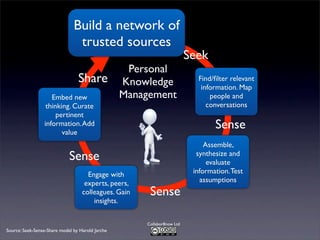
Build a network of
trusted sources

Share
Embed new
thinking. Curate
pertinent
information. Add
value

Personal
Knowledge
Management

Sense
Collabor8now Ltd

Source: Seek-Sense-Share model by Harold Jarche

Find/filter relevant
information. Map
people and
conversations

Sense

Sense
Engage with
experts, peers,
colleagues. Gain
insights.

Seek

Assemble,
synthesize and
evaluate
information. Test
assumptions
Build a network of
trusted sources
Share
Embed new
thinking. Curate
pertinent
information. Add
value

Personal
Knowledge
Management

Sense
Collabor8now Ltd

Source: Seek-Sense-Share model by Harold Jarche

Find/filter relevant
information. Map
people and
conversations

Sense

Sense
Engage with
experts, peers,
colleagues. Gain
insights.

Seek

Assemble,
synthesize and
evaluate
information. Test
assumptions
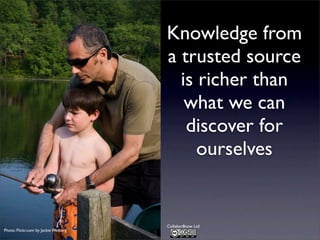
Knowledge from
a trusted source
is richer than
what we can
discover for
ourselves

Photo: Flickr.com by Jackie Welberg

Collabor8now Ltd
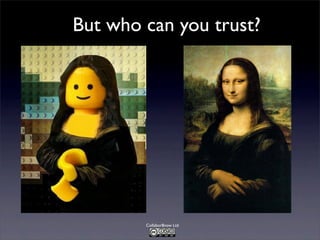
But who can you trust?

Collabor8now Ltd
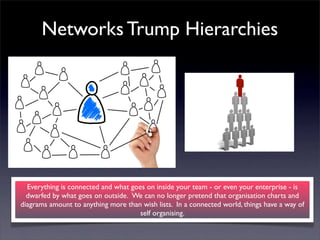
Networks Trump Hierarchies

Everything is connected and what goes on inside your team - or even your enterprise - is
dwarfed by what goes on outside.  We can no longer pretend that organisation charts and
diagrams amount to anything more than wish lists.  In a connected world, things have a way of
self organising.
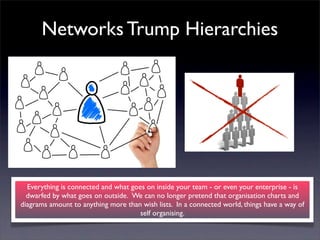
Networks Trump Hierarchies

Everything is connected and what goes on inside your team - or even your enterprise - is
dwarfed by what goes on outside.  We can no longer pretend that organisation charts and
diagrams amount to anything more than wish lists.  In a connected world, things have a way of
self organising.
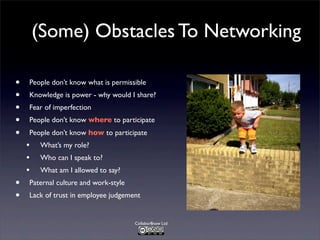
(Some) Obstacles To Networking
•
•
•
•
•

•
•

People don’t know what is permissible
Knowledge is power - why would I share?
Fear of imperfection
People don’t know where to participate
People don’t know how to participate

•
•
•

What’s my role?
Who can I speak to?
What am I allowed to say?

Paternal culture and work-style
Lack of trust in employee judgement

Collabor8now Ltd
Learning and
knowledge
acquisition is a
lifelong activity and
a far more
personalised
experience.

Collabor8now Ltd
Who owns the
knowledge?
Who owns the knowledge?
I felt that my network,
my trusted network which I
worked hard to maintain, cultivate,
I look at the culture of
nurture, trust and grow was going to be
the organisation. If there is a
exploited by other individuals within the
genuine, authentic opportunity to
organisation who saw me as their
share and learn and be respectful of each
‘free ride’ to some quick
other’s networks then I have no problem. If
answers.
it is mandated, or if my networks are used,
misused or discounted, then I’d question
why I’m even working there.
For the time being, I will nurture
and maintain my networks but I will be
cautious in how mine are used within my
organisation and for what purpose. But I’m
the one who decides that.
Helen Blunden
Source: http://activatelearning.com.au/2013/11/reflections-of-exploring-personal-learning-networks-mooc/
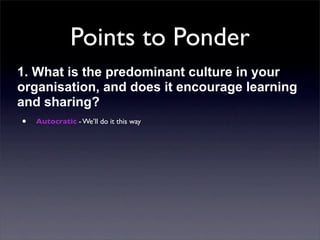
Points to Ponder
Points to Ponder
1. What is the predominant culture in your
organisation, and does it encourage learning
and sharing?
Points to Ponder
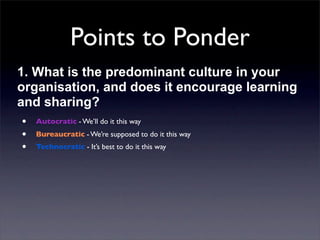
1. What is the predominant culture in your
organisation, and does it encourage learning
and sharing?
• Autocratic - We’ll do it this way
Points to Ponder
1. What is the predominant culture in your
organisation, and does it encourage learning
and sharing?
• Autocratic - We’ll do it this way
• Bureaucratic - We’re supposed to do it this way
Points to Ponder
1. What is the predominant culture in your
organisation, and does it encourage learning
and sharing?
• Autocratic - We’ll do it this way
• Bureaucratic - We’re supposed to do it this way
• Technocratic - It’s best to do it this way
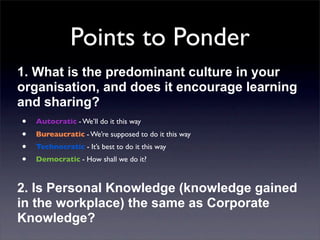
Points to Ponder
1. What is the predominant culture in your
organisation, and does it encourage learning
and sharing?
• Autocratic - We’ll do it this way
• Bureaucratic - We’re supposed to do it this way
• Technocratic - It’s best to do it this way
• Democratic - How shall we do it?
Points to Ponder
1. What is the predominant culture in your
organisation, and does it encourage learning
and sharing?
• Autocratic - We’ll do it this way
• Bureaucratic - We’re supposed to do it this way
• Technocratic - It’s best to do it this way
• Democratic - How shall we do it?
2. Is Personal Knowledge (knowledge gained
in the workplace) the same as Corporate
Knowledge?
It’s all about thriving in networks
that are smarter and faster than you
are. It’s all about being utterly
screwed if you don’t know what I’m
talking about.
Hugh MacLeod

Steve Dale @stephendale
steve.dale@collabor8now.com

Unless otherwise noted, this work is licensed under a Creative Commons
Attribution-NonCommercial-ShareAlike 3.0 Unported License.

PKM and Corporate Memory - a dichotomy?

  • 1.
    Corporate Memory & PersonalKnowledge Management 28 November 2013 Stephen Dale @stephendale Unless otherwise noted, this work is licensed under a Creative Commons Attribution-NonCommercial-ShareAlike 3.0 Unported License.
  • 2.
    What does ‘Corporate’look like? Pre-industrial Age Industrial Age Collabor8now Ltd Post-industrial Age
  • 3.
    What does ‘Corporate’look like? Pre-industrial Age Industrial Age •Skills important •Shared knowledge (Worshipful Companies) •Individualism •Close to the customer •Personalised products •Agile processes •Small is beautiful (but difficult to scale) •Transparency Collabor8now Ltd Post-industrial Age
  • 4.
    What does ‘Corporate’look like? Pre-industrial Age •Skills important •Shared knowledge (Worshipful Companies) •Individualism •Close to the customer •Personalised products •Agile processes •Small is beautiful (but difficult to scale) •Transparency Industrial Age •Mass production trumps skills •Knowledge hoarding (knowledge is power) •De-individualism •Remote from customer •One size fits all •Hard-wired processes •Big is beautiful (mega organisations) •Command and control •Hierarchies (regimented) •Opaqueness Collabor8now Ltd Post-industrial Age
  • 5.
    What does ‘Corporate’look like? Pre-industrial Age •Skills important •Shared knowledge (Worshipful Companies) •Individualism •Close to the customer •Personalised products •Agile processes •Small is beautiful (but difficult to scale) •Transparency Industrial Age •Mass production trumps skills •Knowledge hoarding (knowledge is power) •De-individualism •Remote from customer •One size fits all •Hard-wired processes •Big is beautiful (mega organisations) •Command and control •Hierarchies (regimented) •Opaqueness Collabor8now Ltd Post-industrial Age •Skills important - but routine work is automated •Shared knowledge (social/ learning networks) •Individualism •Close to customer (Social Business) •Personalised products •Agile processes •Small is beautiful (but can scale) •Democratisation of workplace •Flat structures •Transparency
  • 6.
    What does ‘Corporate’look like? Pre-industrial Age •Skills important •Shared knowledge (Worshipful Companies) •Individualism •Close to the customer •Personalised products •Agile processes •Small is beautiful (but difficult to scale) •Transparency Industrial Age •Mass production trumps skills •Knowledge hoarding (knowledge is power) •De-individualism •Remote from customer •One size fits all •Hard-wired processes •Big is beautiful (mega organisations) •Command and control •Hierarchies (regimented) •Opaqueness Similar? Collabor8now Ltd Post-industrial Age •Skills important - but routine work is automated •Shared knowledge (social/ learning networks) •Individualism •Close to customer (Social Business) •Personalised products •Agile processes •Small is beautiful (but can scale) •Democratisation of workplace •Flat structures •Transparency
  • 7.
    Is BIG AlwaysBetter? Collabor8now Ltd
  • 8.
    Voted the mostimportant issue by delegates at the Online Information Conference 19/20 November 2013 Source: Online Information Show : http://www.online-information.co.uk/
  • 9.
    Voted the mostimportant issue by delegates at the Online Information Conference 19/20 November 2013 How can knowledge/ information professionals demonstrate value to their organisation? Source: Online Information Show : http://www.online-information.co.uk/
  • 10.
    Source: The evolvingvalue of information management: www.ft.com/corporate Collabor8now Ltd
  • 11.
    Source: The evolvingvalue of information management: www.ft.com/corporate Collabor8now Ltd
  • 12.
    The credibility gap Source:The evolving value of information management: www.ft.com/corporate Collabor8now Ltd
  • 13.
    Demand for Decision-Ready Information Peopledon’t have the time to read, think and write much, so they will appreciate someone who has a good feeling for what they want and need and can give it to them effectively. Collabor8now Ltd
  • 14.
    What Is Personal KnowledgeManagement? Collabor8now Ltd
  • 15.
    What Is Personal KnowledgeManagement? It is a response to the idea that knowledge workers increasingly need to be responsible for their own growth and learning. Collabor8now Ltd
  • 16.
    21st Century Literacy Collabor8now Ltd Source: Adaptedfrom Dr Daniel Churchill, www.learnactivity.com
  • 17.
    Traditional Literacy •Reading, writing, speaking, listening, 21st Century Literacy Collabor8nowLtd Source: Adapted from Dr Daniel Churchill, www.learnactivity.com
  • 18.
    Traditional Literacy •Reading, writing, speaking, listening, Information Literacy •Abilityto identify what information is needed and the ability to locate, evaluate and use information 21st Century Literacy Collabor8now Ltd Source: Adapted from Dr Daniel Churchill, www.learnactivity.com
  • 19.
    Traditional Literacy •Reading, writing, speaking, listening, Information Literacy •Abilityto identify what information is needed and the ability to locate, evaluate and use information 21st Century Literacy Visual Literacy •Ability to understand and produce visual messages Collabor8now Ltd Source: Adapted from Dr Daniel Churchill, www.learnactivity.com
  • 20.
    Traditional Literacy •Reading, writing, speaking, listening, Information Literacy •Abilityto identify what information is needed and the ability to locate, evaluate and use information 21st Century Literacy Visual Literacy •Ability to understand and produce visual messages Critical Literacy •Ability to question, challenge and evaluate the meanings and purposes of texts Collabor8now Ltd Source: Adapted from Dr Daniel Churchill, www.learnactivity.com
  • 21.
    Traditional Literacy •Reading, writing, speaking, listening, Information Literacy •Abilityto identify what information is needed and the ability to locate, evaluate and use information 21st Century Literacy Media Literacy •Ability to question, analyse, interpret, evaluate and create media messages Visual Literacy •Ability to understand and produce visual messages Critical Literacy •Ability to question, challenge and evaluate the meanings and purposes of texts Collabor8now Ltd Source: Adapted from Dr Daniel Churchill, www.learnactivity.com
  • 22.
    Traditional Literacy •Reading, writing, speaking, listening, Information Literacy •Abilityto identify what information is needed and the ability to locate, evaluate and use information Tool Literacy •Ability to use tools to manage, consume and create information 21st Century Literacy Media Literacy •Ability to question, analyse, interpret, evaluate and create media messages Visual Literacy •Ability to understand and produce visual messages Critical Literacy •Ability to question, challenge and evaluate the meanings and purposes of texts Collabor8now Ltd Source: Adapted from Dr Daniel Churchill, www.learnactivity.com
  • 23.
    Network Literacy •Ability to usedigital technology, communication tools and networks to locate, evaluate and create information Tool Literacy •Ability to use tools to manage, consume and create information Traditional Literacy •Reading, writing, speaking, listening, Information Literacy •Ability to identify what information is needed and the ability to locate, evaluate and use information 21st Century Literacy Media Literacy •Ability to question, analyse, interpret, evaluate and create media messages Visual Literacy •Ability to understand and produce visual messages Critical Literacy •Ability to question, challenge and evaluate the meanings and purposes of texts Collabor8now Ltd Source: Adapted from Dr Daniel Churchill, www.learnactivity.com
  • 24.
    Network Literacy •Ability to usedigital technology, communication tools and networks to locate, evaluate and create information Tool Literacy •Ability to use tools to manage, consume and create information Traditional Literacy •Reading, writing, speaking, listening, Information Literacy •Ability to identify what information is needed and the ability to locate, evaluate and use information 21st Century Literacy Media Literacy •Ability to question, analyse, interpret, evaluate and create media messages Visual Literacy •Ability to understand and produce visual messages Critical Literacy •Ability to question, challenge and evaluate the meanings and purposes of texts Collabor8now Ltd Source: Adapted from Dr Daniel Churchill, www.learnactivity.com
  • 25.
    Build a networkof trusted sources Share Embed new thinking. Curate pertinent information. Add value Personal Knowledge Management Sense Collabor8now Ltd Source: Seek-Sense-Share model by Harold Jarche Find/filter relevant information. Map people and conversations Sense Sense Engage with experts, peers, colleagues. Gain insights. Seek Assemble, synthesize and evaluate information. Test assumptions
  • 26.
    Build a networkof trusted sources Share Embed new thinking. Curate pertinent information. Add value Personal Knowledge Management Sense Collabor8now Ltd Source: Seek-Sense-Share model by Harold Jarche Find/filter relevant information. Map people and conversations Sense Sense Engage with experts, peers, colleagues. Gain insights. Seek Assemble, synthesize and evaluate information. Test assumptions
  • 27.
    Knowledge from a trustedsource is richer than what we can discover for ourselves Photo: Flickr.com by Jackie Welberg Collabor8now Ltd
  • 28.
    But who canyou trust? Collabor8now Ltd
  • 29.
    Networks Trump Hierarchies Everythingis connected and what goes on inside your team - or even your enterprise - is dwarfed by what goes on outside.  We can no longer pretend that organisation charts and diagrams amount to anything more than wish lists.  In a connected world, things have a way of self organising.
  • 30.
    Networks Trump Hierarchies Everythingis connected and what goes on inside your team - or even your enterprise - is dwarfed by what goes on outside.  We can no longer pretend that organisation charts and diagrams amount to anything more than wish lists.  In a connected world, things have a way of self organising.
  • 31.
    (Some) Obstacles ToNetworking • • • • • • • People don’t know what is permissible Knowledge is power - why would I share? Fear of imperfection People don’t know where to participate People don’t know how to participate • • • What’s my role? Who can I speak to? What am I allowed to say? Paternal culture and work-style Lack of trust in employee judgement Collabor8now Ltd
  • 32.
    Learning and knowledge acquisition isa lifelong activity and a far more personalised experience. Collabor8now Ltd
  • 33.
  • 34.
    Who owns theknowledge? I felt that my network, my trusted network which I worked hard to maintain, cultivate, I look at the culture of nurture, trust and grow was going to be the organisation. If there is a exploited by other individuals within the genuine, authentic opportunity to organisation who saw me as their share and learn and be respectful of each ‘free ride’ to some quick other’s networks then I have no problem. If answers. it is mandated, or if my networks are used, misused or discounted, then I’d question why I’m even working there. For the time being, I will nurture and maintain my networks but I will be cautious in how mine are used within my organisation and for what purpose. But I’m the one who decides that. Helen Blunden Source: http://activatelearning.com.au/2013/11/reflections-of-exploring-personal-learning-networks-mooc/
  • 35.
  • 36.
    Points to Ponder 1.What is the predominant culture in your organisation, and does it encourage learning and sharing?
  • 37.
    Points to Ponder 1.What is the predominant culture in your organisation, and does it encourage learning and sharing? • Autocratic - We’ll do it this way
  • 38.
    Points to Ponder 1.What is the predominant culture in your organisation, and does it encourage learning and sharing? • Autocratic - We’ll do it this way • Bureaucratic - We’re supposed to do it this way
  • 39.
    Points to Ponder 1.What is the predominant culture in your organisation, and does it encourage learning and sharing? • Autocratic - We’ll do it this way • Bureaucratic - We’re supposed to do it this way • Technocratic - It’s best to do it this way
  • 40.
    Points to Ponder 1.What is the predominant culture in your organisation, and does it encourage learning and sharing? • Autocratic - We’ll do it this way • Bureaucratic - We’re supposed to do it this way • Technocratic - It’s best to do it this way • Democratic - How shall we do it?
  • 41.
    Points to Ponder 1.What is the predominant culture in your organisation, and does it encourage learning and sharing? • Autocratic - We’ll do it this way • Bureaucratic - We’re supposed to do it this way • Technocratic - It’s best to do it this way • Democratic - How shall we do it? 2. Is Personal Knowledge (knowledge gained in the workplace) the same as Corporate Knowledge?
  • 42.
    It’s all aboutthriving in networks that are smarter and faster than you are. It’s all about being utterly screwed if you don’t know what I’m talking about. Hugh MacLeod Steve Dale @stephendale steve.dale@collabor8now.com Unless otherwise noted, this work is licensed under a Creative Commons Attribution-NonCommercial-ShareAlike 3.0 Unported License.