Learning Outcomes
After completingthis module, you will have skills to:
Define Information literacy skills
Define Information
Know the characteristics of an information literate
person
Identify the need for information
Search and retrieve relevant information
Evaluate Information Sources
Use information ethically
Disseminate the information
3.
INFORMATION LITERACY SKILLS
Theterm 'information literacy' was developed by Paul
Zurkowski in 1974.
The term information literacy, according to Humes (2002)
refers to information competency, which generally means
the ability to access, evaluate, organize, and use
information from a variety of sources.
In the UK, information literacy is defined by the Chartered
Institute of Library and Information Professionals as
follows:
"Information literacy is knowing when and why you
need information, where to find it, and how to evaluate,
use and communicate it in an ethical manner. "
4.
INFORMATION LITERACY SKILLS
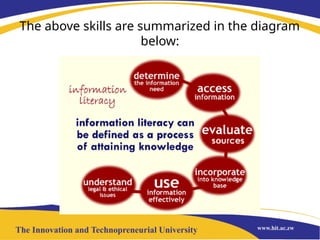
"Information literacy is an understanding
and set of abilities enabling individuals to
'recognise when information is needed
and have the capacity to locate, evaluate,
and use effectively the needed
information'."
(CAUL, 2004)
5.
INFORMATION LITERACY SKILLS
ILScomprises print and electronic, audio and
visual forms of information
ILS is common to all disciplines, all learning
environments and all levels of education
ILS enables learners to master content and
extend their investigations, become
independent learners
ILS equips current learners to deal with data
overload
6.
INFORMATION LITERACY SKILLS
Datasmog refers to an overwhelming amount of data
and information - often obtained through an Internet
search - whose volume serves more to confuse the
user than illuminate a topic
Data smog is a term coined from a book written by the
journalist David Shenk, which deals with the
influence of the information technology revolution
and how the vast amount of information available
online make it increasingly difficult to separate facts
from fiction
7.
Avoiding Information overload
Theincreasingly complex world in which we live
now contains an abundance of information
choices—print, electronic, image, spatial, sound,
visual, and numeric.
Too much information, in various formats and
not all of equal value.
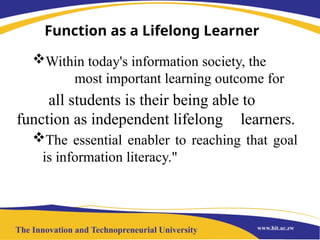
Function as aLifelong Learner
Within today's information society, the
most important learning outcome for
all students is their being able to
function as independent lifelong learners.
The essential enabler to reaching that goal
is information literacy."
10.
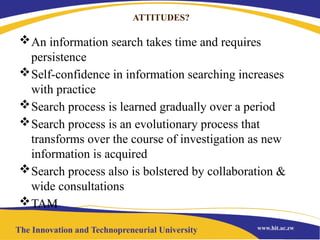
ATTITUDES?
An information searchtakes time and requires
persistence
Self-confidence in information searching increases
with practice
Search process is learned gradually over a period
Search process is an evolutionary process that
transforms over the course of investigation as new
information is acquired
Search process also is bolstered by collaboration &
wide consultations
TAM
11.
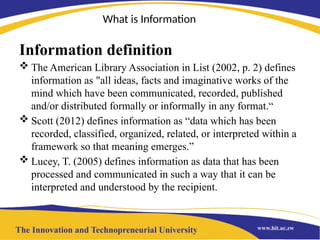
What is Information
Informationdefinition
The American Library Association in List (2002, p. 2) defines
information as "all ideas, facts and imaginative works of the
mind which have been communicated, recorded, published
and/or distributed formally or informally in any format.“
Scott (2012) defines information as “data which has been
recorded, classified, organized, related, or interpreted within a
framework so that meaning emerges.”
Lucey, T. (2005) defines information as data that has been
processed and communicated in such a way that it can be
interpreted and understood by the recipient.
12.
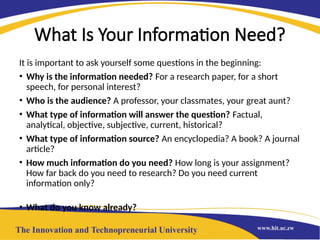
What Is YourInformation Need?
It is important to ask yourself some questions in the beginning:
• Why is the information needed? For a research paper, for a short
speech, for personal interest?
• Who is the audience? A professor, your classmates, your great aunt?
• What type of information will answer the question? Factual,
analytical, objective, subjective, current, historical?
• What type of information source? An encyclopedia? A book? A journal
article?
• How much information do you need? How long is your assignment?
How far back do you need to research? Do you need current
information only?
• What do you know already?
13.
How information isorganised
in the library:
LIBRARY OF CONGRESS
CLASSIFICATION
SCHEME
14.
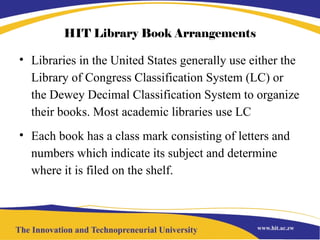
HIT Library BookArrangements
• Libraries in the United States generally use either the
Library of Congress Classification System (LC) or
the Dewey Decimal Classification System to organize
their books. Most academic libraries use LC
• Each book has a class mark consisting of letters and
numbers which indicate its subject and determine
where it is filed on the shelf.
15.
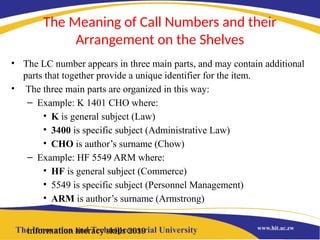
The Meaning ofCall Numbers and their
Arrangement on the Shelves
• The LC number appears in three main parts, and may contain additional
parts that together provide a unique identifier for the item.
• The three main parts are organized in this way:
– Example: K 1401 CHO where:
• K is general subject (Law)
• 3400 is specific subject (Administrative Law)
• CHO is author’s surname (Chow)
– Example: HF 5549 ARM where:
• HF is general subject (Commerce)
• 5549 is specific subject (Personnel Management)
• ARM is author’s surname (Armstrong)
information literacy skills 2019
16.
Have a collectionof materials ranging from
printed books and journals,
e-resource databases,
past exam papers,
Dissertation and thesis
What we have for you
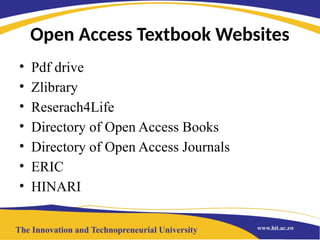
Open Access TextbookWebsites
• Pdf drive
• Zlibrary
• Reserach4Life
• Directory of Open Access Books
• Directory of Open Access Journals
• ERIC
• HINARI
19.
ON CAMPUS, OFFCAMPUS E-RESOURCES
ACCESS
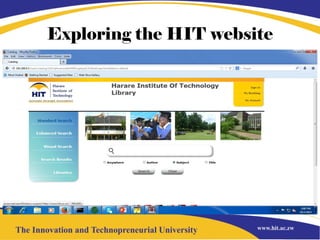
http:www.hit.ac.zw/library
OR
Log in to hit remoteXs and sign in
20.
Characteristics of aninformation literate person
Able to access information effectively and efficiently
Evaluate information critically, and creatively
Be an independent learner and pursue information related
to personal interest
Strive to excellence in information seeking.
Understand and reflect on the value of information literacy
Find your way around the library in order to find the
information you need
21.
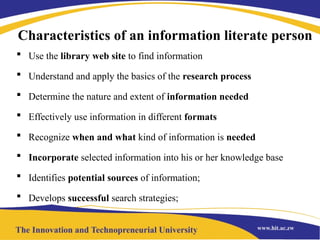
Characteristics of aninformation literate person
Use the library web site to find information
Understand and apply the basics of the research process
Determine the nature and extent of information needed
Effectively use information in different formats
Recognize when and what kind of information is needed
Incorporate selected information into his or her knowledge base
Identifies potential sources of information;
Develops successful search strategies;
22.
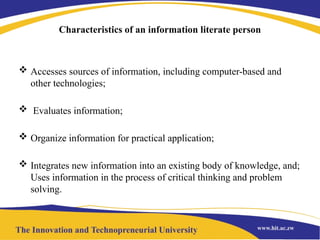
Characteristics of aninformation literate person
Accesses sources of information, including computer-based and
other technologies;
Evaluates information;
Organize information for practical application;
Integrates new information into an existing body of knowledge, and;
Uses information in the process of critical thinking and problem
solving.
23.
References
Dawes, M. etal (2005) “Sicily statement on evidence-based practice”, BMC Medical Education, 5
(1). [Online at http://www.biomedcentral.com/1472-6920/5/1]
SCONUL Information Skills Task Force (1999) Seven pillars of information literacy model,
Society of College, National & University Libraries . [Online at
http://www.sconul.ac.uk/groups/information_literacy/seven_pillars.html ]
Swansea University (2007) Information Literacy strategy, 2007-08. [Online at
http://www.swan.ac.uk/media/Media,19199,en.doc ]
University College London (UCL) CIBER Group (2008) Information behaviour of the researcher
of the future, UCL. [Online at
http://www.jisc.ac.uk/whatwedo/programmes/resourcediscovery/googlegen.aspx]
May, M. (2004) “Google is not enough” (cartoon), Wisconsin Association of Academic Librarians
newsletter, 21 (1) [Online at www.wla.lib.wi.us/WAAL/newsletter/211.html , accessed 19.5.09
![References
Dawes, M. et al (2005) “Sicily statement on evidence-based practice”, BMC Medical Education, 5
(1). [Online at http://www.biomedcentral.com/1472-6920/5/1]
SCONUL Information Skills Task Force (1999) Seven pillars of information literacy model,
Society of College, National & University Libraries . [Online at
http://www.sconul.ac.uk/groups/information_literacy/seven_pillars.html ]
Swansea University (2007) Information Literacy strategy, 2007-08. [Online at
http://www.swan.ac.uk/media/Media,19199,en.doc ]
University College London (UCL) CIBER Group (2008) Information behaviour of the researcher
of the future, UCL. [Online at
http://www.jisc.ac.uk/whatwedo/programmes/resourcediscovery/googlegen.aspx]
May, M. (2004) “Google is not enough” (cartoon), Wisconsin Association of Academic Librarians
newsletter, 21 (1) [Online at www.wla.lib.wi.us/WAAL/newsletter/211.html , accessed 19.5.09](https://image.slidesharecdn.com/module1introductiontoils-250806075444-b348b7c7/85/Module-1_Introduction-to-ILS-for-Science-23-320.jpg)


![Session 1 information literacy [Compatibility Mode].pdf](https://cdn.slidesharecdn.com/ss_thumbnails/session1informationliteracycompatibilitymode-250318203803-80f3327c-thumbnail.jpg?width=640&height=640&fit=bounds)


