www.themegallery.com 
Ahmed Rafea 
Computer Science and Engineering Department 
American University in Cairo
The emergence of Information and Communication Technologies (ICT) in 
the last decade has opened new avenues in knowledge management that 
could play important roles in meeting the prevailing challenges related to 
sharing, exchanging and disseminating knowledge and technologies. ICT 
allows capitalizing to a greater extent on the wealth of information and 
knowledge available for Agriculture Knowledge, Science and Technology 
(AKST). The ultimate objectives of AKST activities are to come up with 
results that can advance research more in certain areas, and engender 
technologies that AKST stakeholders can use to increase production, 
conserve the environment, etc. The following paragraphs will discuss the 
knowledge management challenges, explain how ICT could play a role in 
addressing them, and highlight an example of an institution in the 
Egyptian Agriculture Research Center whose main function is to conduct 
applied research . in ICT in Agriculture 
www.themegallery.com
The first challenge is the poor mechanisms and infrastructure for sharing and 
exchanging agriculture knowledge generated from research at national and 
regional levels. Many research activities are repeated due to the lack of such 
mechanisms and infrastructure at the national level. Researchers can find 
research papers published in international journals and conferences more 
easily than finding research papers published nationally in local journals, 
conferences, theses and technical reports. The second challenge is the 
inefficient mechanisms and infrastructure for transferring technologies 
produced as the result of research to growers either directly or through 
intermediaries (extension subsystem). Knowledge and technologies fostering 
agricultural production and environment conservation are examples. 
www.themegallery.com
Although many extension documents are produced by national agriculture 
research and extension systems to inform growers about the latest 
recommendations concerning different agricultural practices, these documents 
are not disseminated, updated or managed to respond to the needs of 
extension workers, advisers and farmers. This is also true for technical reports, 
books and research papers related to production. The third challenge is 
keeping the indigenous knowledge as a heritage for new generations. It is 
available through experienced growers and specialists in different commodities. 
These inherited agricultural practices are rarely documented, but they embody 
a wealth of knowledge that researchers need to examine thoroughly. The forth 
challenge is easily accessing and availing economic and social knowledge to 
different stakeholders at operational, management and decision-making levels, 
so that those responsible will be able to make appropriate decisions regarding 
the profit making of certain technologies and their effect on resource-poor 
farmers. 
www.themegallery.com
ICT Role in Agriculture 
Knowledge Management 
www.themegallery.com
Knowledge sharing, exchanging and dissemination are elements in a 
broader theme which is knowledge management. The central purpose of 
knowledge management is to transform information and intellectual 
assets into enduring value (Metcalfe, 2005). The basic idea is to 
strengthen, improve and propel the organization by using the wealth of 
information and knowledge that the organization and its members 
collectively possess (Milton, 2003). It has been pointed out that a large 
part of knowledge is not explicit but tacit (Schreiber et al., 1999). This is 
true for knowledge in agriculture where a lot of good practices are 
transferred without being well documented in books, papers or extension 
documents. To manage the knowledge properly, ICT is needed. In effect, 
there are many information technologies that can be used for knowledge 
management. The following paragraphs describe these technologies and 
emphasize their roles in agriculture knowledge management. 
www.themegallery.com
Content management system in its wider sense including data bases and 
multimedia, is the core technology of information and knowledge 
management. This technology can be used in different applications: 
Building a national agriculture research information system (NARIS) 
needs to include research outcomes, projects, institutions and 
researchers in every country, and a regional research information system 
that works as a portal for all the NARIS. An example NARIS has been 
developed at the agriculture research center in Egypt (ARC, 2007). 
www.themegallery.com
Content management system in its wider sense including data bases and 
multimedia, is the core technology of information and knowledge 
management. This technology can be used in different applications: 
Developing an information system of indigenous agricultural practices 
can enable researchers to examine this knowledge and decide on its 
usefulness for sustainable development. Such a system will also keep 
this knowledge for future generations before it disappears as a result of 
advanced technologies. 
Developing an information system recording matured technologies that 
on a trial basis have proven successful and success stories that have 
achieved economic growth will strengthen the interaction between 
inventors and innovators. This will lead to an innovation-driven economic 
growth paradigm. 
Storing and retrieving images, videotapes and audiotapes related to 
different agricultural activities. 
www.themegallery.com
Geographic information systems (GIS) are needed to store databases 
about natural resources with a graphical user interface that enables users 
to access these data easily using geographical maps. 
Decision support system techniques are needed in many applications: 
Simulating and modeling methods can be used to build computer 
systems that can model and simulate the effect of different agricultural 
production policies on the economy and the environment to help top 
management make decisions. 
Using expert systems technology to improve crop management and track 
its effect on conserving natural resources is elaborated in Rafea (1999). 
This technology may also be appropriate for keeping indigenous 
knowledge (Rafea, 1995, 1998, 2000). Expediting the expert systems 
development by generating agriculture specific tools to overcome the 
well known problem of knowledge acquisition is addresses in Abdul-Hadi 
et. al. (2006). Enhancing the explanation capabilities of expert systems 
developed for agriculture was also investigated by www.Said themegallery.et. al. com 
(2009)
Geographic information systems (GIS) are needed to store databases 
about natural resources with a graphical user interface that enables users 
to access these data easily using geographical maps. 
Modern ICT—Internet and Web technology—is needed to make these 
systems available regionally and globally. Accessing the Internet will 
bring a wealth of information to all agriculture stakeholders in rural and 
urban areas and will help in overcoming the digital divide. As most 
farmers in CWANA have no hands-on experience or access to digital 
networks, leaders of national agricultural research and extension 
systems should be encouraged to consider the ICT option. Training 
farmers and extension workers, including women, in ICT will help them 
access a lot of useful information if each country tries to develop 
contents in the language people are using. 
www.themegallery.com
Text Mining is being currently investigated in two applications in the 
Central Laboratory for Agricultural Expert System (CLAES) in Egypt: 
Developing an Intelligent focused search engine which aims at extracting 
the appropriate textual segments responding to a user query. In order to 
do that there is a need to develop ontology or extend an existing 
ontology. In agriculture there is the AGROVOC developed by FAO but we 
found many local concepts instances that need to be part of this 
ontology. Some work was done by Hazman et. al. (2009) to learn ontology 
from textual documents. 
www.themegallery.com
Text Mining is being currently investigated in two applications in the 
Central Laboratory for Agricultural Expert System (CLAES) in Egypt: 
It is also needed to segment document into passages that are 
semantically coherent. El-Shayeb et. al. (2006, 2007) worked on 
segmenting html and textual documents. Annotating these segments 
semantically using the ontology concepts is found necessarily (El-Beltagy 
et. al., 2007) 
Mining growers’ problems database which is part of the Virtual Extension 
and Research Communication Network (VERCON) (CLAES 2002; FAO, 
2003) to discover the best practices from the solutions provided by the 
human experts and find out whether there are any discrepancies in their 
recommendations. 
www.themegallery.com
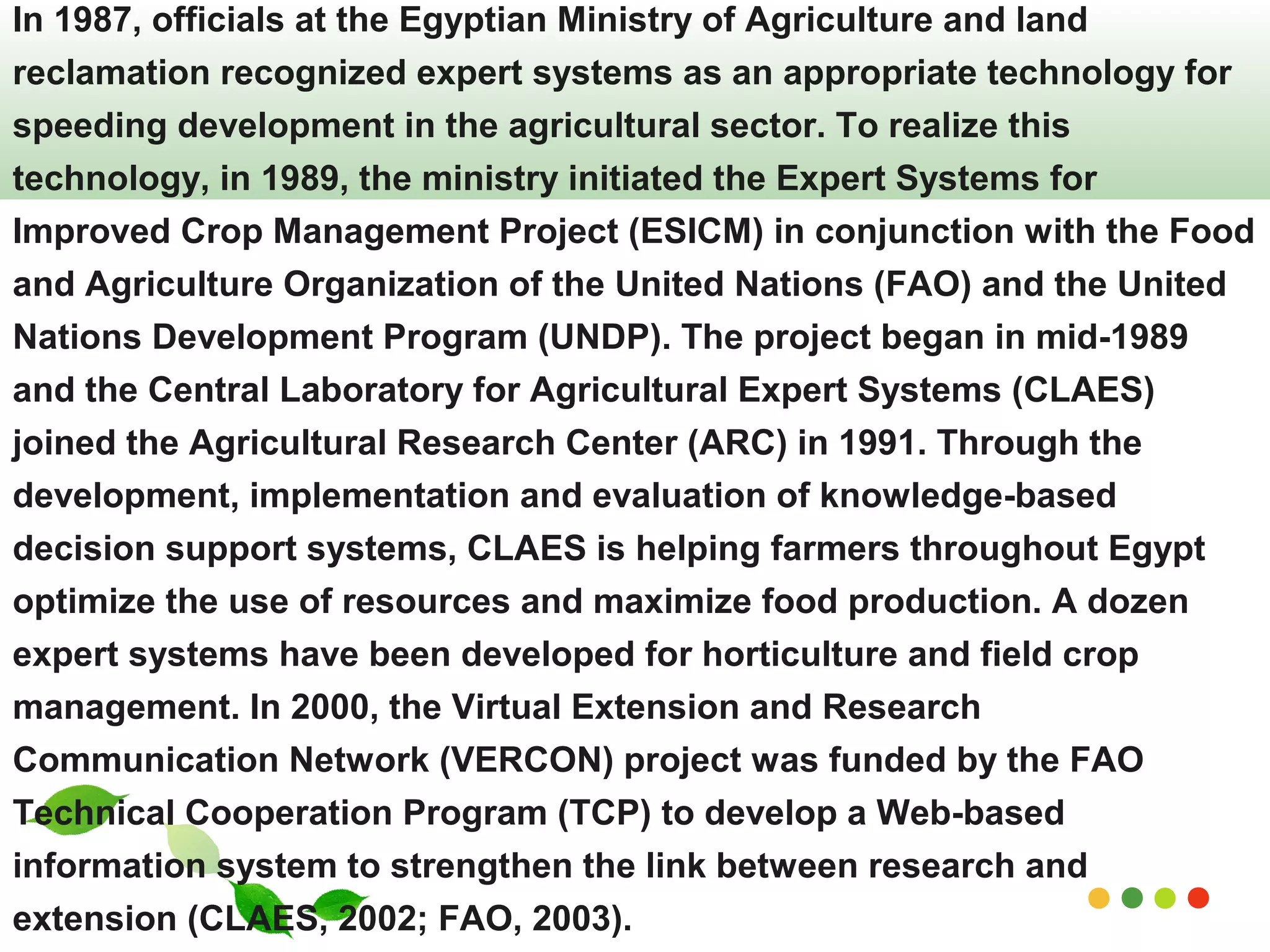
Using ICT in Agriculture in 
www.themegallery.com 
Egypt
In 1987, officials at the Egyptian Ministry of Agriculture and land 
reclamation recognized expert systems as an appropriate technology for 
speeding development in the agricultural sector. To realize this 
technology, in 1989, the ministry initiated the Expert Systems for 
Improved Crop Management Project (ESICM) in conjunction with the Food 
and Agriculture Organization of the United Nations (FAO) and the United 
Nations Development Program (UNDP). The project began in mid-1989 
and the Central Laboratory for Agricultural Expert Systems (CLAES) 
joined the Agricultural Research Center (ARC) in 1991. Through the 
development, implementation and evaluation of knowledge-based 
decision support systems, CLAES is helping farmers throughout Egypt 
optimize the use of resources and maximize food production. A dozen 
expert systems have been developed for horticulture and field crop 
management. In 2000, the Virtual Extension and Research 
Communication Network (VERCON) project was funded by the FAO 
Technical Cooperation Program (TCP) to develop a Web-based 
information system to strengthen the link between research and 
extension (CLAES, 2002; FAO, 2003). 
www.themegallery.com
This network has been extended to include other stakeholders, and other 
services through a project funded by Italian Debt Swap Program and 
executed by FAO in collaboration with CLAES (CLAES, 2008). Several 
expert systems have been made available on this network in addition to 
other modules. In collaboration with ICARDA, CLAES has developed 
three regional expert systems for wheat (CLAES, 2006c), faba (CLAES, 
2006d) and barley (ICARDA, 2006). CLAES also developed the National 
Agricultural Research Management Information System (NARIMS) 
through a project funded by FAO/TCP. This system has five modules: 
Institutes Information System, Researchers Information Systems, 
Projects Information Systems, Publication Information System, and 
National Research Program Information System (CLAES, 2007). 
www.themegallery.com

Managing agriculture knowledge: role of information and communication technology

  • 1.
    www.themegallery.com Ahmed Rafea Computer Science and Engineering Department American University in Cairo
  • 2.
    The emergence ofInformation and Communication Technologies (ICT) in the last decade has opened new avenues in knowledge management that could play important roles in meeting the prevailing challenges related to sharing, exchanging and disseminating knowledge and technologies. ICT allows capitalizing to a greater extent on the wealth of information and knowledge available for Agriculture Knowledge, Science and Technology (AKST). The ultimate objectives of AKST activities are to come up with results that can advance research more in certain areas, and engender technologies that AKST stakeholders can use to increase production, conserve the environment, etc. The following paragraphs will discuss the knowledge management challenges, explain how ICT could play a role in addressing them, and highlight an example of an institution in the Egyptian Agriculture Research Center whose main function is to conduct applied research . in ICT in Agriculture www.themegallery.com
  • 3.
  • 4.
    The first challengeis the poor mechanisms and infrastructure for sharing and exchanging agriculture knowledge generated from research at national and regional levels. Many research activities are repeated due to the lack of such mechanisms and infrastructure at the national level. Researchers can find research papers published in international journals and conferences more easily than finding research papers published nationally in local journals, conferences, theses and technical reports. The second challenge is the inefficient mechanisms and infrastructure for transferring technologies produced as the result of research to growers either directly or through intermediaries (extension subsystem). Knowledge and technologies fostering agricultural production and environment conservation are examples. www.themegallery.com
  • 5.
    Although many extensiondocuments are produced by national agriculture research and extension systems to inform growers about the latest recommendations concerning different agricultural practices, these documents are not disseminated, updated or managed to respond to the needs of extension workers, advisers and farmers. This is also true for technical reports, books and research papers related to production. The third challenge is keeping the indigenous knowledge as a heritage for new generations. It is available through experienced growers and specialists in different commodities. These inherited agricultural practices are rarely documented, but they embody a wealth of knowledge that researchers need to examine thoroughly. The forth challenge is easily accessing and availing economic and social knowledge to different stakeholders at operational, management and decision-making levels, so that those responsible will be able to make appropriate decisions regarding the profit making of certain technologies and their effect on resource-poor farmers. www.themegallery.com
  • 6.
    ICT Role inAgriculture Knowledge Management www.themegallery.com
  • 7.
    Knowledge sharing, exchangingand dissemination are elements in a broader theme which is knowledge management. The central purpose of knowledge management is to transform information and intellectual assets into enduring value (Metcalfe, 2005). The basic idea is to strengthen, improve and propel the organization by using the wealth of information and knowledge that the organization and its members collectively possess (Milton, 2003). It has been pointed out that a large part of knowledge is not explicit but tacit (Schreiber et al., 1999). This is true for knowledge in agriculture where a lot of good practices are transferred without being well documented in books, papers or extension documents. To manage the knowledge properly, ICT is needed. In effect, there are many information technologies that can be used for knowledge management. The following paragraphs describe these technologies and emphasize their roles in agriculture knowledge management. www.themegallery.com
  • 8.
    Content management systemin its wider sense including data bases and multimedia, is the core technology of information and knowledge management. This technology can be used in different applications: Building a national agriculture research information system (NARIS) needs to include research outcomes, projects, institutions and researchers in every country, and a regional research information system that works as a portal for all the NARIS. An example NARIS has been developed at the agriculture research center in Egypt (ARC, 2007). www.themegallery.com
  • 9.
    Content management systemin its wider sense including data bases and multimedia, is the core technology of information and knowledge management. This technology can be used in different applications: Developing an information system of indigenous agricultural practices can enable researchers to examine this knowledge and decide on its usefulness for sustainable development. Such a system will also keep this knowledge for future generations before it disappears as a result of advanced technologies. Developing an information system recording matured technologies that on a trial basis have proven successful and success stories that have achieved economic growth will strengthen the interaction between inventors and innovators. This will lead to an innovation-driven economic growth paradigm. Storing and retrieving images, videotapes and audiotapes related to different agricultural activities. www.themegallery.com
  • 10.
    Geographic information systems(GIS) are needed to store databases about natural resources with a graphical user interface that enables users to access these data easily using geographical maps. Decision support system techniques are needed in many applications: Simulating and modeling methods can be used to build computer systems that can model and simulate the effect of different agricultural production policies on the economy and the environment to help top management make decisions. Using expert systems technology to improve crop management and track its effect on conserving natural resources is elaborated in Rafea (1999). This technology may also be appropriate for keeping indigenous knowledge (Rafea, 1995, 1998, 2000). Expediting the expert systems development by generating agriculture specific tools to overcome the well known problem of knowledge acquisition is addresses in Abdul-Hadi et. al. (2006). Enhancing the explanation capabilities of expert systems developed for agriculture was also investigated by www.Said themegallery.et. al. com (2009)
  • 11.
    Geographic information systems(GIS) are needed to store databases about natural resources with a graphical user interface that enables users to access these data easily using geographical maps. Modern ICT—Internet and Web technology—is needed to make these systems available regionally and globally. Accessing the Internet will bring a wealth of information to all agriculture stakeholders in rural and urban areas and will help in overcoming the digital divide. As most farmers in CWANA have no hands-on experience or access to digital networks, leaders of national agricultural research and extension systems should be encouraged to consider the ICT option. Training farmers and extension workers, including women, in ICT will help them access a lot of useful information if each country tries to develop contents in the language people are using. www.themegallery.com
  • 12.
    Text Mining isbeing currently investigated in two applications in the Central Laboratory for Agricultural Expert System (CLAES) in Egypt: Developing an Intelligent focused search engine which aims at extracting the appropriate textual segments responding to a user query. In order to do that there is a need to develop ontology or extend an existing ontology. In agriculture there is the AGROVOC developed by FAO but we found many local concepts instances that need to be part of this ontology. Some work was done by Hazman et. al. (2009) to learn ontology from textual documents. www.themegallery.com
  • 13.
    Text Mining isbeing currently investigated in two applications in the Central Laboratory for Agricultural Expert System (CLAES) in Egypt: It is also needed to segment document into passages that are semantically coherent. El-Shayeb et. al. (2006, 2007) worked on segmenting html and textual documents. Annotating these segments semantically using the ontology concepts is found necessarily (El-Beltagy et. al., 2007) Mining growers’ problems database which is part of the Virtual Extension and Research Communication Network (VERCON) (CLAES 2002; FAO, 2003) to discover the best practices from the solutions provided by the human experts and find out whether there are any discrepancies in their recommendations. www.themegallery.com
  • 14.
    Using ICT inAgriculture in www.themegallery.com Egypt
  • 15.
    In 1987, officialsat the Egyptian Ministry of Agriculture and land reclamation recognized expert systems as an appropriate technology for speeding development in the agricultural sector. To realize this technology, in 1989, the ministry initiated the Expert Systems for Improved Crop Management Project (ESICM) in conjunction with the Food and Agriculture Organization of the United Nations (FAO) and the United Nations Development Program (UNDP). The project began in mid-1989 and the Central Laboratory for Agricultural Expert Systems (CLAES) joined the Agricultural Research Center (ARC) in 1991. Through the development, implementation and evaluation of knowledge-based decision support systems, CLAES is helping farmers throughout Egypt optimize the use of resources and maximize food production. A dozen expert systems have been developed for horticulture and field crop management. In 2000, the Virtual Extension and Research Communication Network (VERCON) project was funded by the FAO Technical Cooperation Program (TCP) to develop a Web-based information system to strengthen the link between research and extension (CLAES, 2002; FAO, 2003). www.themegallery.com
  • 16.
    This network hasbeen extended to include other stakeholders, and other services through a project funded by Italian Debt Swap Program and executed by FAO in collaboration with CLAES (CLAES, 2008). Several expert systems have been made available on this network in addition to other modules. In collaboration with ICARDA, CLAES has developed three regional expert systems for wheat (CLAES, 2006c), faba (CLAES, 2006d) and barley (ICARDA, 2006). CLAES also developed the National Agricultural Research Management Information System (NARIMS) through a project funded by FAO/TCP. This system has five modules: Institutes Information System, Researchers Information Systems, Projects Information Systems, Publication Information System, and National Research Program Information System (CLAES, 2007). www.themegallery.com
  • 17.