PITS AND PLASMODESMATA
3RD SEM UNIT-3
Functions of Plasmodesmata
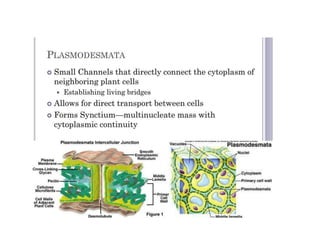
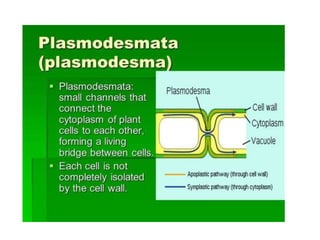
Plasmodesmata function in intercellular communication, i.e., they allow
molecules to pass directly from cell to cell.
It has been suggested that plasmodesmata mediate transport between adjacent
plant cells, much as gap junctions of animal...
Plasmodesmata have been shown to transport proteins (including transcription
factors), short interfering RNA, messenger...
Plasmodesmata are also used by cells in the phloem, and symplastic transport is
used to regulate the sieve-tube cells by...
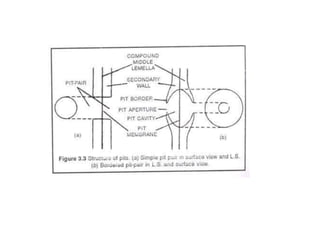
Pits are relatively thinner portions of the cell wall that
adjacent cells can communicate or exchange fluid through.
Pits are characteristic of cell walls with secondary layers. Generally each pit
has a complementary pit opposite of it in the neighboring cell. These
complementary pits are called "pit pairs".
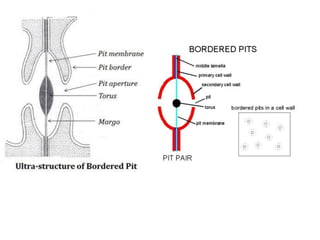
Pits are composed of three parts: the pit chamber, the pit aperture, and the pit
membrane. The pit chamber is the hollow area where the secondary layers of
the cell wall are absent. The pit aperture is the opening at either end of the pit
chamber. The pit membrane is the primary cell wall and middle lamella, or the
membrane between adjacent cell walls, at the middle of the pit chamber.
Types
• Though pits are usually simple and complementary, a few more pit
variations can be formed:
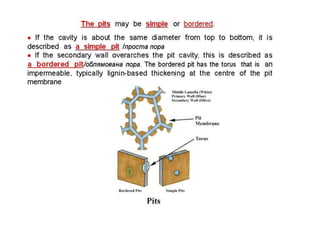
• Simple pits: A pit pair in which the diameter of the pit chamber and
the diameter of the pit aperture are equal.
• Bordered pits: A pit pair in which the pit chamber is over-arched by
the cell wall, creating a larger pit chamber and smaller pit aperture.
• Half bordered pits: A pit pair in which a bordered pit has a
complementary simple pit. Such a pit pair is called half bordered pit
pair.
• Blind pits: A pit pair in which a simple pit has no complementary
pit.
• Compound pits: A pit pair in which one cell wall has a large pit and
the adjacent cell wall has numerous, small pits.
THANK YOU………….

PITS AND PLASMODESMATA.pptx

  • 1.
  • 3.
    Functions of Plasmodesmata Plasmodesmatafunction in intercellular communication, i.e., they allow molecules to pass directly from cell to cell. It has been suggested that plasmodesmata mediate transport between adjacent plant cells, much as gap junctions of animal... Plasmodesmata have been shown to transport proteins (including transcription factors), short interfering RNA, messenger... Plasmodesmata are also used by cells in the phloem, and symplastic transport is used to regulate the sieve-tube cells by...
  • 5.
    Pits are relativelythinner portions of the cell wall that adjacent cells can communicate or exchange fluid through. Pits are characteristic of cell walls with secondary layers. Generally each pit has a complementary pit opposite of it in the neighboring cell. These complementary pits are called "pit pairs". Pits are composed of three parts: the pit chamber, the pit aperture, and the pit membrane. The pit chamber is the hollow area where the secondary layers of the cell wall are absent. The pit aperture is the opening at either end of the pit chamber. The pit membrane is the primary cell wall and middle lamella, or the membrane between adjacent cell walls, at the middle of the pit chamber.
  • 6.
    Types • Though pitsare usually simple and complementary, a few more pit variations can be formed: • Simple pits: A pit pair in which the diameter of the pit chamber and the diameter of the pit aperture are equal. • Bordered pits: A pit pair in which the pit chamber is over-arched by the cell wall, creating a larger pit chamber and smaller pit aperture. • Half bordered pits: A pit pair in which a bordered pit has a complementary simple pit. Such a pit pair is called half bordered pit pair. • Blind pits: A pit pair in which a simple pit has no complementary pit. • Compound pits: A pit pair in which one cell wall has a large pit and the adjacent cell wall has numerous, small pits.
  • 10.