Appendix A - Pipelining 1
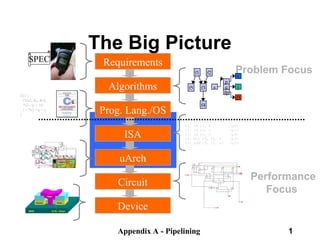
The Big Picture
Requirements
Algorithms
Prog. Lang./OS
ISA
uArch
Circuit
Device
Problem Focus
Performance
Focus
BOX
BOX Si fin - Body!
Drain
Source
Gate
Mult2
Mac2
Mult1 Mac1
S reg X reg
Add,
Sub,
Shift
Mult2
Mac2
Mult1 Mac1
S reg X reg
Add,
Sub,
Shift
f2() {
f3(s2, &j, &i);
*s2->p = 10;
i = *s2->q + i;
}
i1: ld r1, b <p1>
i2: ld r2, c <p1>
i3: ld r5, z <p3>
i4: mul r6, r5, 3 <p3>
i5: add r3, r1, r2 <p1>
f1 f2
f3
f4
f5 s q
p
j
i
fp
f3
SPEC
Appendix A - Pipelining 2
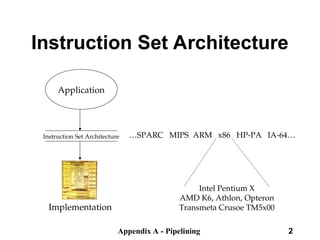
Instruction Set Architecture
Application
Instruction Set Architecture
Implementation
…SPARC MIPS ARM x86 HP-PA IA-64…
Intel Pentium X
AMD K6, Athlon, Opteron
Transmeta Crusoe TM5x00
Appendix A - Pipelining 3
Instruction Set Architecture
• Strong influence on cost/performance
• New ISAs are rare, but versions are
not
– 16-bit, 32-bit and 64-bit X86 versions
• Longevity is a strong function of
marketing prowess
Appendix A - Pipelining 4
• Strongly constrained by the number of
bits available to instruction encoding
• Opcodes/operands
• Registers/memory
• Addressing modes
• Orthogonality
• 0, 1, 2, 3 address machines
• Instruction formats
• Decoding uniformity
Traditional Issues
Appendix A - Pipelining 5
Introduction
A.1 What is Pipelining?
A.2 The Major Hurdle of Pipelining-Structural Hazards
– Data Hazards
– Control Hazards
A.3 How is Pipelining Implemented
A.4 What Makes Pipelining Hard to Implement?
A.5 Extending the MIPS Pipeline to Handle Multi-cycle Operations
Appendix A - Pipelining 6
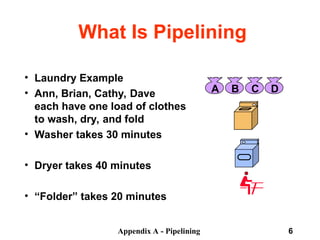
What Is Pipelining
• Laundry Example
• Ann, Brian, Cathy, Dave
each have one load of clothes
to wash, dry, and fold
• Washer takes 30 minutes
• Dryer takes 40 minutes
• “Folder” takes 20 minutes
A B C D
Appendix A - Pipelining 7
What Is Pipelining
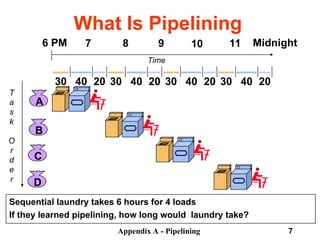
Sequential laundry takes 6 hours for 4 loads
If they learned pipelining, how long would laundry take?
A
B
C
D
30 40 20 30 40 20 30 40 20 30 40 20
6 PM 7 8 9 10 11 Midnight
T
a
s
k
O
r
d
e
r
Time
Appendix A - Pipelining 8
What Is Pipelining
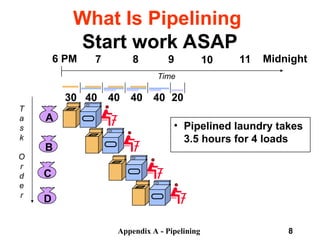
Start work ASAP
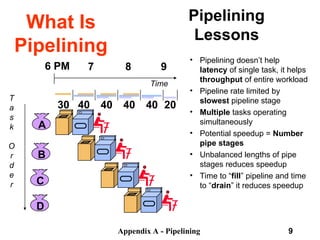
• Pipelined laundry takes
3.5 hours for 4 loads
A
B
C
D
6 PM 7 8 9 10 11 Midnight
T
a
s
k
O
r
d
e
r
Time
30 40 40 40 40 20
Appendix A - Pipelining 9
Pipelining
Lessons
• Pipelining doesn’t help
latency of single task, it helps
throughput of entire workload
• Pipeline rate limited by
slowest pipeline stage
• Multiple tasks operating
simultaneously
• Potential speedup = Number
pipe stages
• Unbalanced lengths of pipe
stages reduces speedup
• Time to “fill” pipeline and time
to “drain” it reduces speedup
A
B
C
D
6 PM 7 8 9
T
a
s
k
O
r
d
e
r
Time
30 40 40 40 40 20
What Is
Pipelining
Appendix A - Pipelining 10
MIPS Without
Pipelining
What Is
Pipelining
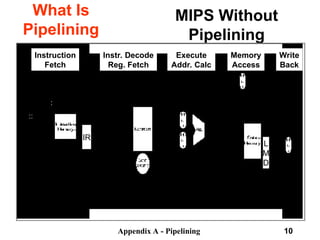
Memory
Access
Write
Back
Instruction
Fetch
Instr. Decode
Reg. Fetch
Execute
Addr. Calc
IR
L
M
D
Appendix A - Pipelining 11
MIPS Functions
What Is
Pipelining
Memory
Access
Write
Back
Instruction
Fetch
Instr. Decode
Reg. Fetch
Execute
Addr.
Calc
IR L
M
D
Instruction Fetch (IF):
Send out the PC and fetch the instruction from memory into the instruction
register (IR); increment the PC by 4 to address the next sequential
instruction.
IR holds the instruction that will be used in the next stage.
NPC holds the value of the next PC.
Passed To Next Stage
IR <- Mem[PC]
NPC <- PC + 4
Appendix A - Pipelining 12
MIPS Functions
What Is
Pipelining
Memory
Access
Write
Back
Instruction
Fetch
Instr. Decode
Reg. Fetch
Execute
Addr.
Calc
IR L
M
D
Instruction Decode/Register Fetch Cycle (ID):
Decode the instruction and access the register file to read the registers.
The outputs of the general purpose registers are read into two temporary
registers (A & B) for use in later clock cycles.
We extend the sign of the lower 16 bits of the Instruction Register.
Passed To Next Stage
A <- Regs[IR6..IR10];
B <- Regs[IR10..IR15];
Imm <- ((IR16) ##IR16-31
Appendix A - Pipelining 13
MIPS Functions
What Is
Pipelining
Memory
Access
Write
Back
Instruction
Fetch
Instr. Decode
Reg. Fetch
Execute
Addr.
Calc
IR L
M
D
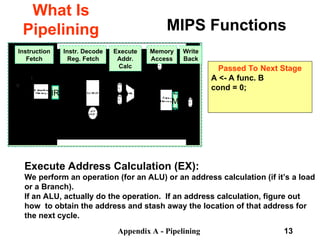
Passed To Next Stage
A <- A func. B
cond = 0;
Execute Address Calculation (EX):
We perform an operation (for an ALU) or an address calculation (if it’s a load
or a Branch).
If an ALU, actually do the operation. If an address calculation, figure out
how to obtain the address and stash away the location of that address for
the next cycle.
Appendix A - Pipelining 14
MIPS Functions
What Is
Pipelining
Memory
Access
Write
Back
Instruction
Fetch
Instr. Decode
Reg. Fetch
Execute
Addr.
Calc
IR L
M
D
Passed To Next Stage
A = Mem[prev. B]
or
Mem[prev. B] = A
MEMORY ACCESS (MEM):
If this is an ALU, do nothing.
If a load or store, then access memory.
Appendix A - Pipelining 15
MIPS Functions
What Is
Pipelining
Memory
Access
Write
Back
Instruction
Fetch
Instr. Decode
Reg. Fetch
Execute
Addr.
Calc
IR L
M
D
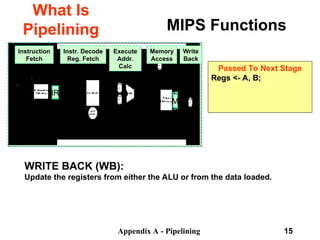
Passed To Next Stage
Regs <- A, B;
WRITE BACK (WB):
Update the registers from either the ALU or from the data loaded.
Appendix A - Pipelining 16
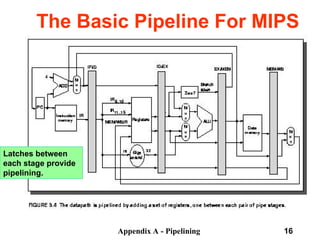
The Basic Pipeline For MIPS
Latches between
each stage provide
pipelining.
Appendix A - Pipelining 17
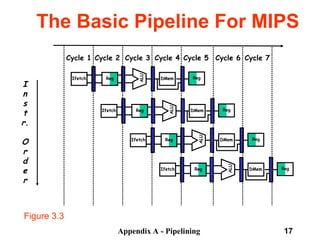
The Basic Pipeline For MIPS
Reg
ALU
DMem
Ifetch Reg
Reg
ALU
DMem
Ifetch Reg
Reg
ALU
DMem
Ifetch Reg
Reg
ALU
DMem
Ifetch Reg
Cycle 1 Cycle 2 Cycle 3 Cycle 4 Cycle 6 Cycle 7
Cycle 5
I
n
s
t
r.
O
r
d
e
r
Figure 3.3
Appendix A - Pipelining 18
Pipeline Hurdles
A.1 What is Pipelining?
A.2 The Major Hurdle of Pipelining-
Structural Hazards
-- Structural Hazards
– Data Hazards
– Control Hazards
A.3 How is Pipelining Implemented
A.4 What Makes Pipelining Hard to
Implement?
A.5 Extending the MIPS Pipeline to
Handle Multi-cycle Operations
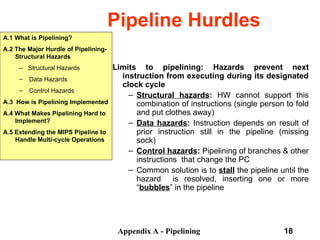
Limits to pipelining: Hazards prevent next
instruction from executing during its designated
clock cycle
– Structural hazards: HW cannot support this
combination of instructions (single person to fold
and put clothes away)
– Data hazards: Instruction depends on result of
prior instruction still in the pipeline (missing
sock)
– Control hazards: Pipelining of branches & other
instructions that change the PC
– Common solution is to stall the pipeline until the
hazard is resolved, inserting one or more
“bubbles” in the pipeline
Appendix A - Pipelining 19
Pipeline Hurdles
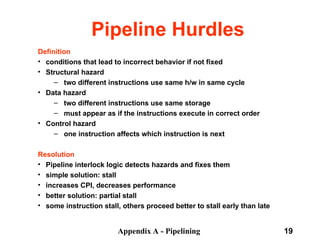
Definition
• conditions that lead to incorrect behavior if not fixed
• Structural hazard
– two different instructions use same h/w in same cycle
• Data hazard
– two different instructions use same storage
– must appear as if the instructions execute in correct order
• Control hazard
– one instruction affects which instruction is next
Resolution
• Pipeline interlock logic detects hazards and fixes them
• simple solution: stall ­
• increases CPI, decreases performance
• better solution: partial stall ­
• some instruction stall, others proceed better to stall early than late
Appendix A - Pipelining 20
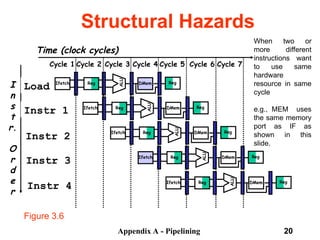
Structural Hazards
When two or
more different
instructions want
to use same
hardware
resource in same
cycle
e.g., MEM uses
the same memory
port as IF as
shown in this
slide.
I
n
s
t
r.
O
r
d
e
r
Time (clock cycles)
Load
Instr 1
Instr 2
Instr 3
Instr 4
Reg
ALU
DMem
Ifetch Reg
Reg
ALU
DMem
Ifetch Reg
Reg
ALU
DMem
Ifetch Reg
Reg
ALU
DMem
Ifetch Reg
Cycle 1 Cycle 2 Cycle 3 Cycle 4 Cycle 6 Cycle 7
Cycle 5
Reg
ALU
DMem
Ifetch Reg
Figure 3.6
Appendix A - Pipelining 21
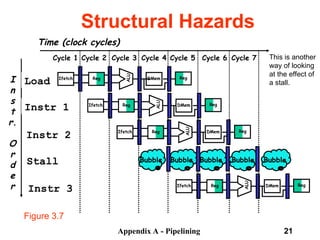
Structural Hazards
This is another
way of looking
at the effect of
a stall.
I
n
s
t
r.
O
r
d
e
r
Time (clock cycles)
Load
Instr 1
Instr 2
Stall
Instr 3
Reg
ALU
DMem
Ifetch Reg
Reg
ALU
DMem
Ifetch Reg
Reg
ALU
DMem
Ifetch Reg
Cycle 1 Cycle 2 Cycle 3 Cycle 4 Cycle 6 Cycle 7
Cycle 5
Reg
ALU
DMem
Ifetch Reg
Bubble Bubble Bubble Bubble
Bubble
Figure 3.7
Appendix A - Pipelining 22
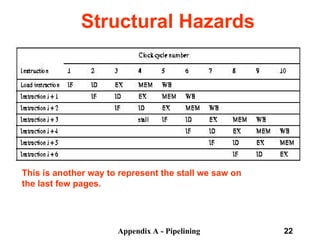
Structural Hazards
This is another way to represent the stall we saw on
the last few pages.
Appendix A - Pipelining 23
Structural Hazards
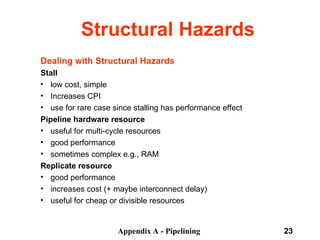
Dealing with Structural Hazards
Stall
• low cost, simple
• Increases CPI
• use for rare case since stalling has performance effect
Pipeline hardware resource
• useful for multi-cycle resources
• good performance
• sometimes complex e.g., RAM
Replicate resource
• good performance
• increases cost (+ maybe interconnect delay)
• useful for cheap or divisible resources
Appendix A - Pipelining 24
Structural Hazards
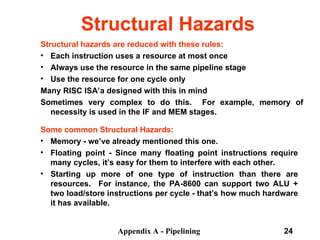
Structural hazards are reduced with these rules:
• Each instruction uses a resource at most once
• Always use the resource in the same pipeline stage
• Use the resource for one cycle only
Many RISC ISA’a designed with this in mind
Sometimes very complex to do this. For example, memory of
necessity is used in the IF and MEM stages.
Some common Structural Hazards:
• Memory - we’ve already mentioned this one.
• Floating point - Since many floating point instructions require
many cycles, it’s easy for them to interfere with each other.
• Starting up more of one type of instruction than there are
resources. For instance, the PA-8600 can support two ALU +
two load/store instructions per cycle - that’s how much hardware
it has available.
Appendix A - Pipelining 25
Structural Hazards
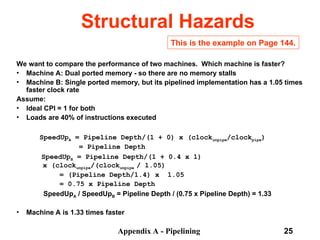
We want to compare the performance of two machines. Which machine is faster?
• Machine A: Dual ported memory - so there are no memory stalls
• Machine B: Single ported memory, but its pipelined implementation has a 1.05 times
faster clock rate
Assume:
• Ideal CPI = 1 for both
• Loads are 40% of instructions executed
SpeedUpA = Pipeline Depth/(1 + 0) x (clockunpipe/clockpipe)
= Pipeline Depth
SpeedUpB = Pipeline Depth/(1 + 0.4 x 1)
x (clockunpipe/(clockunpipe / 1.05)
= (Pipeline Depth/1.4) x 1.05
= 0.75 x Pipeline Depth
SpeedUpA / SpeedUpB = Pipeline Depth / (0.75 x Pipeline Depth) = 1.33
• Machine A is 1.33 times faster
This is the example on Page 144.
Appendix A - Pipelining 26
Data Hazards
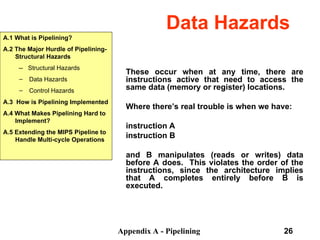
These occur when at any time, there are
instructions active that need to access the
same data (memory or register) locations.
Where there’s real trouble is when we have:
instruction A
instruction B
and B manipulates (reads or writes) data
before A does. This violates the order of the
instructions, since the architecture implies
that A completes entirely before B is
executed.
A.1 What is Pipelining?
A.2 The Major Hurdle of Pipelining-
Structural Hazards
-- Structural Hazards
– Data Hazards
– Control Hazards
A.3 How is Pipelining Implemented
A.4 What Makes Pipelining Hard to
Implement?
A.5 Extending the MIPS Pipeline to
Handle Multi-cycle Operations
Appendix A - Pipelining 27
Data Hazards
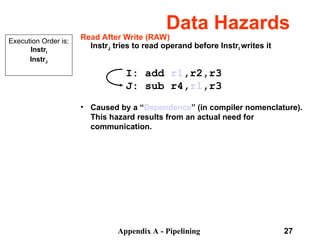
Read After Write (RAW)
InstrJ tries to read operand before InstrI writes it
• Caused by a “Dependence” (in compiler nomenclature).
This hazard results from an actual need for
communication.
Execution Order is:
InstrI
InstrJ
I: add r1,r2,r3
J: sub r4,r1,r3
Appendix A - Pipelining 28
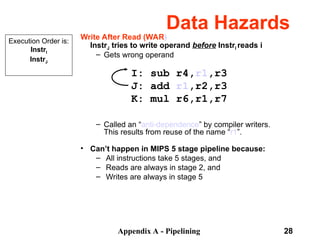
Data Hazards
Write After Read (WAR)
InstrJ tries to write operand before InstrI reads i
– Gets wrong operand
– Called an “anti-dependence” by compiler writers.
This results from reuse of the name “r1”.
• Can’t happen in MIPS 5 stage pipeline because:
– All instructions take 5 stages, and
– Reads are always in stage 2, and
– Writes are always in stage 5
Execution Order is:
InstrI
InstrJ
I: sub r4,r1,r3
J: add r1,r2,r3
K: mul r6,r1,r7
Appendix A - Pipelining 29
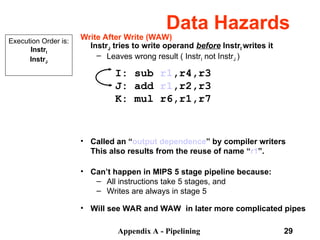
Data Hazards
Write After Write (WAW)
InstrJ tries to write operand before InstrI writes it
– Leaves wrong result ( InstrI not InstrJ )
• Called an “output dependence” by compiler writers
This also results from the reuse of name “r1”.
• Can’t happen in MIPS 5 stage pipeline because:
– All instructions take 5 stages, and
– Writes are always in stage 5
• Will see WAR and WAW in later more complicated pipes
Execution Order is:
InstrI
InstrJ
I: sub r1,r4,r3
J: add r1,r2,r3
K: mul r6,r1,r7
Appendix A - Pipelining 30
Data Hazards
Simple Solution to RAW
• Hardware detects RAW and stalls
• Assumes register written then read each cycle
+ low cost to implement, simple
-- reduces IPC
• Try to minimize stalls
Minimizing RAW stalls
• Bypass/forward/short­
circuit (We will use the word “forward”)
• Use data before it is in the register
+ reduces/avoids stalls
-- complex
• Crucial for common RAW hazards
Appendix A - Pipelining 31
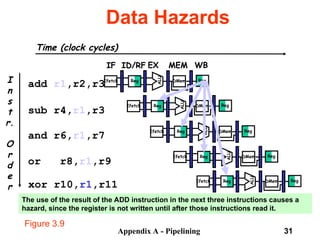
Data Hazards
The use of the result of the ADD instruction in the next three instructions causes a
hazard, since the register is not written until after those instructions read it.
I
n
s
t
r.
O
r
d
e
r
add r1,r2,r3
sub r4,r1,r3
and r6,r1,r7
or r8,r1,r9
xor r10,r1,r11
Reg
ALU
DMem
Ifetch Reg
Reg
ALU
DMem
Ifetch Reg
Reg
ALU
DMem
Ifetch Reg
Reg
ALU
DMem
Ifetch Reg
Reg
ALU
DMem
Ifetch Reg
Time (clock cycles)
IF ID/RF EX MEM WB
Figure 3.9
Appendix A - Pipelining 32
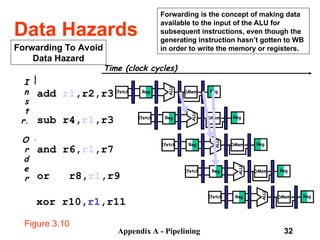
Data Hazards
Forwarding To Avoid
Data Hazard
Forwarding is the concept of making data
available to the input of the ALU for
subsequent instructions, even though the
generating instruction hasn’t gotten to WB
in order to write the memory or registers.
Figure 3.10
Time (clock cycles)
I
n
s
t
r.
O
r
d
e
r
add r1,r2,r3
sub r4,r1,r3
and r6,r1,r7
or r8,r1,r9
xor r10,r1,r11
Reg
ALU
DMem
Ifetch Reg
Reg
ALU
DMem
Ifetch Reg
Reg
ALU
DMem
Ifetch Reg
Reg
ALU
DMem
Ifetch Reg
Reg
ALU
DMem
Ifetch Reg
Appendix A - Pipelining 33
Data Hazards
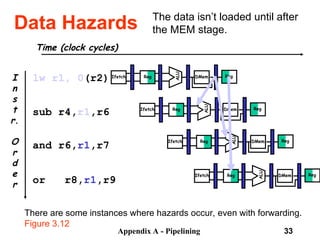
There are some instances where hazards occur, even with forwarding.
The data isn’t loaded until after
the MEM stage.
Time (clock cycles)
I
n
s
t
r.
O
r
d
e
r
lw r1, 0(r2)
sub r4,r1,r6
and r6,r1,r7
or r8,r1,r9
Reg
ALU
DMem
Ifetch Reg
Reg
ALU
DMem
Ifetch Reg
Reg
ALU
DMem
Ifetch Reg
Reg
ALU
DMem
Ifetch Reg
Figure 3.12
Appendix A - Pipelining 34
Data Hazards
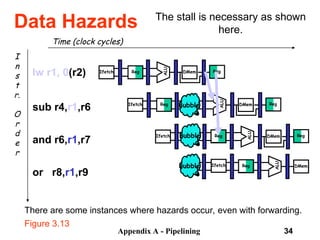
There are some instances where hazards occur, even with forwarding.
The stall is necessary as shown
here.
Figure 3.13
Time (clock cycles)
or r8,r1,r9
I
n
s
t
r.
O
r
d
e
r
lw r1, 0(r2)
sub r4,r1,r6
and r6,r1,r7
Reg
ALU
DMem
Ifetch Reg
Reg
Ifetch
ALU
DMem Reg
Bubble
Ifetch
ALU
DMem Reg
Bubble Reg
Ifetch
ALU
DMem
Bubble Reg
Appendix A - Pipelining 35
Data Hazards
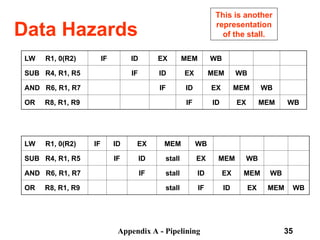
This is another
representation
of the stall.
LW R1, 0(R2) IF ID EX MEM WB
SUB R4, R1, R5 IF ID EX MEM WB
AND R6, R1, R7 IF ID EX MEM WB
OR R8, R1, R9 IF ID EX MEM WB
LW R1, 0(R2) IF ID EX MEM WB
SUB R4, R1, R5 IF ID stall EX MEM WB
AND R6, R1, R7 IF stall ID EX MEM WB
OR R8, R1, R9 stall IF ID EX MEM WB
Appendix A - Pipelining 36
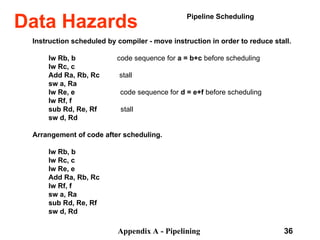
Data Hazards
Instruction scheduled by compiler - move instruction in order to reduce stall.
lw Rb, b ­
­code sequence for a = b+c before scheduling
lw Rc, c
Add Ra, Rb, Rc ­
­stall
sw a, Ra
lw Re, e ­
­code sequence for d = e+f before scheduling
lw Rf, f
sub Rd, Re, Rf ­
­stall
sw d, Rd
Arrangement of code after scheduling.
lw Rb, b
lw Rc, c
lw Re, e
Add Ra, Rb, Rc
lw Rf, f
sw a, Ra
sub Rd, Re, Rf
sw d, Rd
Pipeline Scheduling
Appendix A - Pipelining 37
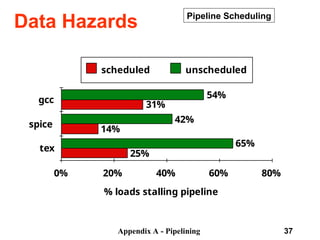
Data Hazards Pipeline Scheduling
% loads stalling pipeline
0% 20% 40% 60% 80%
tex
spice
gcc
25%
14%
31%
65%
42%
54%
scheduled unscheduled
Appendix A - Pipelining 38
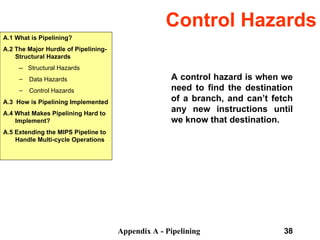
Control Hazards
A control hazard is when we
need to find the destination
of a branch, and can’t fetch
any new instructions until
we know that destination.
A.1 What is Pipelining?
A.2 The Major Hurdle of Pipelining-
Structural Hazards
-- Structural Hazards
– Data Hazards
– Control Hazards
A.3 How is Pipelining Implemented
A.4 What Makes Pipelining Hard to
Implement?
A.5 Extending the MIPS Pipeline to
Handle Multi-cycle Operations
Appendix A - Pipelining 39
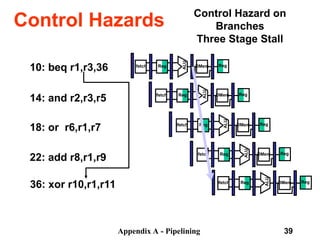
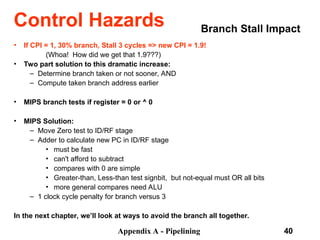
Control Hazard on
Branches
Three Stage Stall
Control Hazards
10: beq r1,r3,36
14: and r2,r3,r5
18: or r6,r1,r7
22: add r8,r1,r9
36: xor r10,r1,r11
Reg
ALU
DMem
Ifetch Reg
Reg
ALU
DMem
Ifetch Reg
Reg
ALU
DMem
Ifetch Reg
Reg
ALU
DMem
Ifetch Reg
Reg
ALU
DMem
Ifetch Reg
Appendix A - Pipelining 40
Branch Stall Impact
• If CPI = 1, 30% branch, Stall 3 cycles => new CPI = 1.9!
(Whoa! How did we get that 1.9???)
• Two part solution to this dramatic increase:
– Determine branch taken or not sooner, AND
– Compute taken branch address earlier
• MIPS branch tests if register = 0 or ^ 0
• MIPS Solution:
– Move Zero test to ID/RF stage
– Adder to calculate new PC in ID/RF stage
• must be fast
• can't afford to subtract
• compares with 0 are simple
• Greater-than, Less-than test sign­
bit, but not-equal must OR all bits
• more general compares need ALU
– 1 clock cycle penalty for branch versus 3
In the next chapter, we’ll look at ways to avoid the branch all together.
Control Hazards
Appendix A - Pipelining 41
Five Branch Hazard
Alternatives
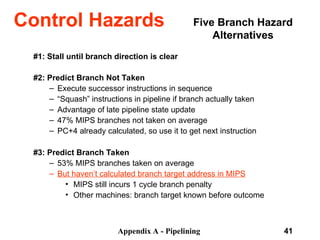
#1: Stall until branch direction is clear
#2: Predict Branch Not Taken
– Execute successor instructions in sequence
– “Squash” instructions in pipeline if branch actually taken
– Advantage of late pipeline state update
– 47% MIPS branches not taken on average
– PC+4 already calculated, so use it to get next instruction
#3: Predict Branch Taken
– 53% MIPS branches taken on average
– But haven’t calculated branch target address in MIPS
• MIPS still incurs 1 cycle branch penalty
• Other machines: branch target known before outcome
Control Hazards
Appendix A - Pipelining 42
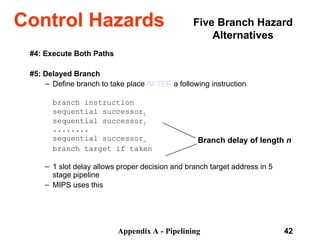
#4: Execute Both Paths
#5: Delayed Branch
– Define branch to take place AFTER a following instruction
branch instruction
sequential successor1
sequential successor2
........
sequential successorn
branch target if taken
– 1 slot delay allows proper decision and branch target address in 5
stage pipeline
– MIPS uses this
Branch delay of length n
Control Hazards Five Branch Hazard
Alternatives
Appendix A - Pipelining 43
Delayed Branch
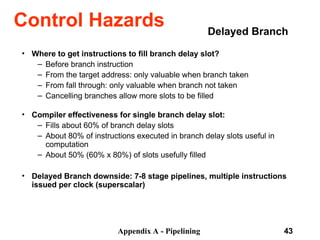
• Where to get instructions to fill branch delay slot?
– Before branch instruction
– From the target address: only valuable when branch taken
– From fall through: only valuable when branch not taken
– Cancelling branches allow more slots to be filled
• Compiler effectiveness for single branch delay slot:
– Fills about 60% of branch delay slots
– About 80% of instructions executed in branch delay slots useful in
computation
– About 50% (60% x 80%) of slots usefully filled
• Delayed Branch downside: 7-8 stage pipelines, multiple instructions
issued per clock (superscalar)
Control Hazards
Appendix A - Pipelining 44
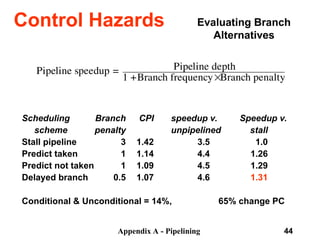
Evaluating Branch
Alternatives
Scheduling Branch CPI speedup v. Speedup v.
scheme penalty unpipelined stall
Stall pipeline 3 1.42 3.5 1.0
Predict taken 1 1.14 4.4 1.26
Predict not taken 1 1.09 4.5 1.29
Delayed branch 0.5 1.07 4.6 1.31
Conditional & Unconditional = 14%, 65% change PC
Control Hazards
Pipeline speedup = Pipeline depth
1 +Branch frequencyBranch penalty
Appendix A - Pipelining 45
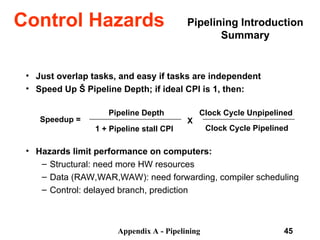
Pipelining Introduction
Summary
• Just overlap tasks, and easy if tasks are independent
• Speed Up Š Pipeline Depth; if ideal CPI is 1, then:
• Hazards limit performance on computers:
– Structural: need more HW resources
– Data (RAW,WAR,WAW): need forwarding, compiler scheduling
– Control: delayed branch, prediction
Speedup =
Pipeline Depth
1 + Pipeline stall CPI
X
Clock Cycle Unpipelined
Clock Cycle Pipelined
Control Hazards
Appendix A - Pipelining 46
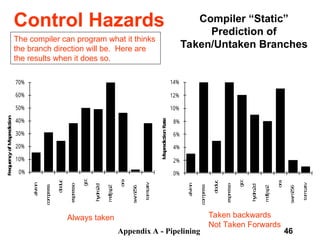
Compiler “Static”
Prediction of
Taken/Untaken Branches
F
r
e
q
u
e
n
c
y
o
f
M
isp
r
e
d
ic
tio
n
0%
10%
20%
30%
40%
50%
60%
70%
alvin
n
co
m
p
ress
d
o
d
u
c
esp
resso
g
cc
h
y
d
ro
2d
m
d
ljsp
2
o
ra
sw
m
256
to
m
catv
M
isp
red
ictio
n
Rate
0%
2%
4%
6%
8%
10%
12%
14%
alvinn
co
m
p
ress
d
od
u
c
esp
resso
g
cc
h
yd
ro2d
m
d
ljsp
2
ora
sw
m
256
to
m
catv
Always taken Taken backwards
Not Taken Forwards
Control Hazards
The compiler can program what it thinks
the branch direction will be. Here are
the results when it does so.
Appendix A - Pipelining 47
Compiler “Static”
Prediction of
Taken/Untaken Branches
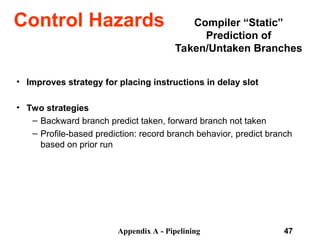
• Improves strategy for placing instructions in delay slot
• Two strategies
– Backward branch predict taken, forward branch not taken
– Profile-based prediction: record branch behavior, predict branch
based on prior run
Control Hazards
Appendix A - Pipelining 48
Evaluating Static
Branch Prediction
Strategies
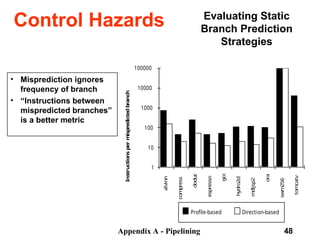
• Misprediction ignores
frequency of branch
• “Instructions between
mispredicted branches”
is a better metric
Instructions
per
mispredicted
branch
1
10
100
1000
10000
100000
alvinn
com
press
doduc
espresso
gcc
hydro2d
m
dljsp2
ora
swm
256
tom
catv
Profile-based Direction-based
Control Hazards
Appendix A - Pipelining 49
What Makes Pipelining Hard?
A.1 What is Pipelining?
A.2 The Major Hurdle of Pipelining-
Structural Hazards
– Data Hazards
– Control Hazards
A.3 How is Pipelining Implemented
A.4 What Makes Pipelining Hard to
Implement?
A.5 Extending the MIPS Pipeline to
Handle Multi-cycle Operations
Appendix A - Pipelining 50
What Makes
Pipelining Hard?
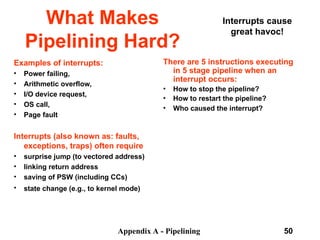
Examples of interrupts:
• Power failing,
• Arithmetic overflow,
• I/O device request,
• OS call,
• Page fault
Interrupts (also known as: faults,
exceptions, traps) often require
• surprise jump (to vectored address)
• linking return address
• saving of PSW (including CCs)
• state change (e.g., to kernel mode)
Interrupts cause
great havoc!
There are 5 instructions executing
in 5 stage pipeline when an
interrupt occurs:
• How to stop the pipeline?
• How to restart the pipeline?
• Who caused the interrupt?
Appendix A - Pipelining 51
What Makes
Pipelining Hard?
Interrupts cause
great havoc!
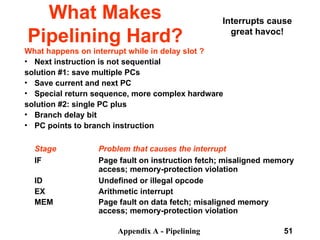
What happens on interrupt while in delay slot ?
• Next instruction is not sequential
solution #1: save multiple PCs
• Save current and next PC
• Special return sequence, more complex hardware
solution #2: single PC plus
• Branch delay bit
• PC points to branch instruction
Stage Problem that causes the interrupt
IF Page fault on instruction fetch; misaligned memory
access; memory-protection violation
ID Undefined or illegal opcode
EX Arithmetic interrupt
MEM Page fault on data fetch; misaligned memory
access; memory-protection violation
Appendix A - Pipelining 52
What Makes
Pipelining Hard?
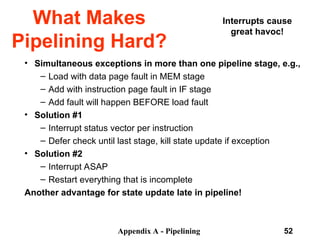
• Simultaneous exceptions in more than one pipeline stage, e.g.,
– Load with data page fault in MEM stage
– Add with instruction page fault in IF stage
– Add fault will happen BEFORE load fault
• Solution #1
– Interrupt status vector per instruction
– Defer check until last stage, kill state update if exception
• Solution #2
– Interrupt ASAP
– Restart everything that is incomplete
Another advantage for state update late in pipeline!
Interrupts cause
great havoc!
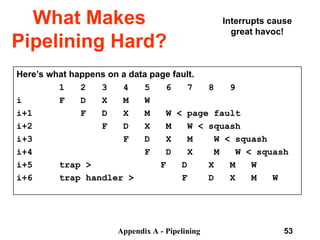
Appendix A - Pipelining 53
What Makes
Pipelining Hard?
Here’s what happens on a data page fault.
1 2 3 4 5 6 7 8 9
i F D X M W
i+1 F D X M W <­page fault
i+2 F D X M W <­squash
i+3 F D X M W <­squash
i+4 F D X M W <­squash
i+5 trap ­
> F D X M W
i+6 trap handler ­
> F D X M W
Interrupts cause
great havoc!
Appendix A - Pipelining 54
What Makes
Pipelining Hard?
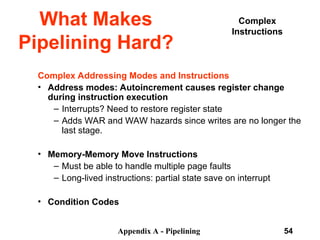
Complex Addressing Modes and Instructions
• Address modes: Autoincrement causes register change
during instruction execution
– Interrupts? Need to restore register state
– Adds WAR and WAW hazards since writes are no longer the
last stage.
• Memory-Memory Move Instructions
– Must be able to handle multiple page faults
– Long-lived instructions: partial state save on interrupt
• Condition Codes
Complex
Instructions
Appendix A - Pipelining 55
Handling Multi-cycle Operations
Multi-cycle instructions also
lead to pipeline complexity.
A very lengthy instruction
causes everything else in
the pipeline to wait for it.
A.1 What is Pipelining?
A.2 The Major Hurdle of Pipelining-
Structural Hazards
– Data Hazards
– Control Hazards
A.3 How is Pipelining Implemented
A.4 What Makes Pipelining Hard to
Implement?
A.5 Extending the MIPS Pipeline to
Handle Multi-cycle Operations
Appendix A - Pipelining 56
Multi-Cycle
Operations
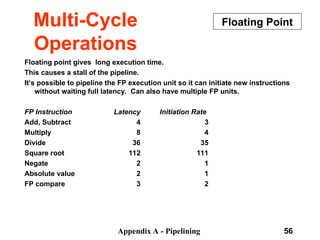
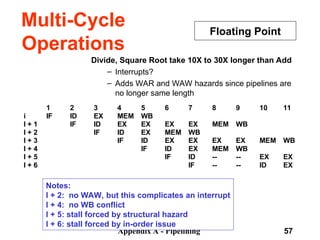
Floating point gives long execution time.
This causes a stall of the pipeline.
It’s possible to pipeline the FP execution unit so it can initiate new instructions
without waiting full latency. Can also have multiple FP units.
FP Instruction Latency Initiation Rate
Add, Subtract 4 3
Multiply 8 4
Divide 36 35
Square root 112 111
Negate 2 1
Absolute value 2 1
FP compare 3 2
Floating Point
Appendix A - Pipelining 57
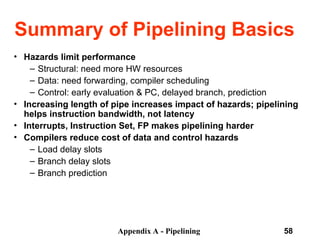
Divide, Square Root take ­
10X to ­
30X longer than Add
– Interrupts?
– Adds WAR and WAW hazards since pipelines are
no longer same length
Multi-Cycle
Operations
Floating Point
1 2 3 4 5 6 7 8 9 10 11
i IF ID EX MEM WB
I + 1 IF ID EX EX EX EX MEM WB
I + 2 IF ID EX MEM WB
I + 3 IF ID EX EX EX EX MEM WB
I + 4 IF ID EX MEM WB
I + 5 IF ID -- -- EX EX
I + 6 IF -- -- ID EX
Notes:
I + 2: no WAW, but this complicates an interrupt
I + 4: no WB conflict
I + 5: stall forced by structural hazard
I + 6: stall forced by in-order issue
Appendix A - Pipelining 58
Summary of Pipelining Basics
• Hazards limit performance
– Structural: need more HW resources
– Data: need forwarding, compiler scheduling
– Control: early evaluation & PC, delayed branch, prediction
• Increasing length of pipe increases impact of hazards; pipelining
helps instruction bandwidth, not latency
• Interrupts, Instruction Set, FP makes pipelining harder
• Compilers reduce cost of data and control hazards
– Load delay slots
– Branch delay slots
– Branch prediction
Appendix A - Pipelining 59
Credits
I have not written these notes by myself. There’s a great deal of fancy
artwork here that takes considerable time to prepare.
I have borrowed from:
Wen-mei & Patel: http://courses.ece.uiuc.edu/ece511/lectures/lecture3.ppt
Patterson: http://www.cs.berkeley.edu/~pattrsn/252S98/index.html
Rabaey: (He used lots of Patterson material):
http://bwrc.eecs.berkeley.edu/Classes/CS252/index.htm
Katz: (Again, he borrowed heavily from Patterson):
http://http.cs.berkeley.edu/~randy/Courses/CS252.F95/CS252.Intro.html
Mark Hill: (Follows text fairly well): http://www.cs.wisc.edu/~markhill/cs752/
Appendix A - Pipelining 60
Summary
A.1 What is Pipelining?
A.2 The Major Hurdle of Pipelining-Structural Hazards
– Data Hazards
– Control Hazards
A.3 How is Pipelining Implemented
A.4 What Makes Pipelining Hard to Implement?
A.5 Extending the MIPS Pipeline to Handle Multi-cycle Operations

Pipelining_Lecture computer Organisation .ppt

  • 1.
    Appendix A -Pipelining 1 The Big Picture Requirements Algorithms Prog. Lang./OS ISA uArch Circuit Device Problem Focus Performance Focus BOX BOX Si fin - Body! Drain Source Gate Mult2 Mac2 Mult1 Mac1 S reg X reg Add, Sub, Shift Mult2 Mac2 Mult1 Mac1 S reg X reg Add, Sub, Shift f2() { f3(s2, &j, &i); *s2->p = 10; i = *s2->q + i; } i1: ld r1, b <p1> i2: ld r2, c <p1> i3: ld r5, z <p3> i4: mul r6, r5, 3 <p3> i5: add r3, r1, r2 <p1> f1 f2 f3 f4 f5 s q p j i fp f3 SPEC
  • 2.
    Appendix A -Pipelining 2 Instruction Set Architecture Application Instruction Set Architecture Implementation …SPARC MIPS ARM x86 HP-PA IA-64… Intel Pentium X AMD K6, Athlon, Opteron Transmeta Crusoe TM5x00
  • 3.
    Appendix A -Pipelining 3 Instruction Set Architecture • Strong influence on cost/performance • New ISAs are rare, but versions are not – 16-bit, 32-bit and 64-bit X86 versions • Longevity is a strong function of marketing prowess
  • 4.
    Appendix A -Pipelining 4 • Strongly constrained by the number of bits available to instruction encoding • Opcodes/operands • Registers/memory • Addressing modes • Orthogonality • 0, 1, 2, 3 address machines • Instruction formats • Decoding uniformity Traditional Issues
  • 5.
    Appendix A -Pipelining 5 Introduction A.1 What is Pipelining? A.2 The Major Hurdle of Pipelining-Structural Hazards – Data Hazards – Control Hazards A.3 How is Pipelining Implemented A.4 What Makes Pipelining Hard to Implement? A.5 Extending the MIPS Pipeline to Handle Multi-cycle Operations
  • 6.
    Appendix A -Pipelining 6 What Is Pipelining • Laundry Example • Ann, Brian, Cathy, Dave each have one load of clothes to wash, dry, and fold • Washer takes 30 minutes • Dryer takes 40 minutes • “Folder” takes 20 minutes A B C D
  • 7.
    Appendix A -Pipelining 7 What Is Pipelining Sequential laundry takes 6 hours for 4 loads If they learned pipelining, how long would laundry take? A B C D 30 40 20 30 40 20 30 40 20 30 40 20 6 PM 7 8 9 10 11 Midnight T a s k O r d e r Time
  • 8.
    Appendix A -Pipelining 8 What Is Pipelining Start work ASAP • Pipelined laundry takes 3.5 hours for 4 loads A B C D 6 PM 7 8 9 10 11 Midnight T a s k O r d e r Time 30 40 40 40 40 20
  • 9.
    Appendix A -Pipelining 9 Pipelining Lessons • Pipelining doesn’t help latency of single task, it helps throughput of entire workload • Pipeline rate limited by slowest pipeline stage • Multiple tasks operating simultaneously • Potential speedup = Number pipe stages • Unbalanced lengths of pipe stages reduces speedup • Time to “fill” pipeline and time to “drain” it reduces speedup A B C D 6 PM 7 8 9 T a s k O r d e r Time 30 40 40 40 40 20 What Is Pipelining
  • 10.
    Appendix A -Pipelining 10 MIPS Without Pipelining What Is Pipelining Memory Access Write Back Instruction Fetch Instr. Decode Reg. Fetch Execute Addr. Calc IR L M D
  • 11.
    Appendix A -Pipelining 11 MIPS Functions What Is Pipelining Memory Access Write Back Instruction Fetch Instr. Decode Reg. Fetch Execute Addr. Calc IR L M D Instruction Fetch (IF): Send out the PC and fetch the instruction from memory into the instruction register (IR); increment the PC by 4 to address the next sequential instruction. IR holds the instruction that will be used in the next stage. NPC holds the value of the next PC. Passed To Next Stage IR <- Mem[PC] NPC <- PC + 4
  • 12.
    Appendix A -Pipelining 12 MIPS Functions What Is Pipelining Memory Access Write Back Instruction Fetch Instr. Decode Reg. Fetch Execute Addr. Calc IR L M D Instruction Decode/Register Fetch Cycle (ID): Decode the instruction and access the register file to read the registers. The outputs of the general purpose registers are read into two temporary registers (A & B) for use in later clock cycles. We extend the sign of the lower 16 bits of the Instruction Register. Passed To Next Stage A <- Regs[IR6..IR10]; B <- Regs[IR10..IR15]; Imm <- ((IR16) ##IR16-31
  • 13.
    Appendix A -Pipelining 13 MIPS Functions What Is Pipelining Memory Access Write Back Instruction Fetch Instr. Decode Reg. Fetch Execute Addr. Calc IR L M D Passed To Next Stage A <- A func. B cond = 0; Execute Address Calculation (EX): We perform an operation (for an ALU) or an address calculation (if it’s a load or a Branch). If an ALU, actually do the operation. If an address calculation, figure out how to obtain the address and stash away the location of that address for the next cycle.
  • 14.
    Appendix A -Pipelining 14 MIPS Functions What Is Pipelining Memory Access Write Back Instruction Fetch Instr. Decode Reg. Fetch Execute Addr. Calc IR L M D Passed To Next Stage A = Mem[prev. B] or Mem[prev. B] = A MEMORY ACCESS (MEM): If this is an ALU, do nothing. If a load or store, then access memory.
  • 15.
    Appendix A -Pipelining 15 MIPS Functions What Is Pipelining Memory Access Write Back Instruction Fetch Instr. Decode Reg. Fetch Execute Addr. Calc IR L M D Passed To Next Stage Regs <- A, B; WRITE BACK (WB): Update the registers from either the ALU or from the data loaded.
  • 16.
    Appendix A -Pipelining 16 The Basic Pipeline For MIPS Latches between each stage provide pipelining.
  • 17.
    Appendix A -Pipelining 17 The Basic Pipeline For MIPS Reg ALU DMem Ifetch Reg Reg ALU DMem Ifetch Reg Reg ALU DMem Ifetch Reg Reg ALU DMem Ifetch Reg Cycle 1 Cycle 2 Cycle 3 Cycle 4 Cycle 6 Cycle 7 Cycle 5 I n s t r. O r d e r Figure 3.3
  • 18.
    Appendix A -Pipelining 18 Pipeline Hurdles A.1 What is Pipelining? A.2 The Major Hurdle of Pipelining- Structural Hazards -- Structural Hazards – Data Hazards – Control Hazards A.3 How is Pipelining Implemented A.4 What Makes Pipelining Hard to Implement? A.5 Extending the MIPS Pipeline to Handle Multi-cycle Operations Limits to pipelining: Hazards prevent next instruction from executing during its designated clock cycle – Structural hazards: HW cannot support this combination of instructions (single person to fold and put clothes away) – Data hazards: Instruction depends on result of prior instruction still in the pipeline (missing sock) – Control hazards: Pipelining of branches & other instructions that change the PC – Common solution is to stall the pipeline until the hazard is resolved, inserting one or more “bubbles” in the pipeline
  • 19.
    Appendix A -Pipelining 19 Pipeline Hurdles Definition • conditions that lead to incorrect behavior if not fixed • Structural hazard – two different instructions use same h/w in same cycle • Data hazard – two different instructions use same storage – must appear as if the instructions execute in correct order • Control hazard – one instruction affects which instruction is next Resolution • Pipeline interlock logic detects hazards and fixes them • simple solution: stall ­ • increases CPI, decreases performance • better solution: partial stall ­ • some instruction stall, others proceed better to stall early than late
  • 20.
    Appendix A -Pipelining 20 Structural Hazards When two or more different instructions want to use same hardware resource in same cycle e.g., MEM uses the same memory port as IF as shown in this slide. I n s t r. O r d e r Time (clock cycles) Load Instr 1 Instr 2 Instr 3 Instr 4 Reg ALU DMem Ifetch Reg Reg ALU DMem Ifetch Reg Reg ALU DMem Ifetch Reg Reg ALU DMem Ifetch Reg Cycle 1 Cycle 2 Cycle 3 Cycle 4 Cycle 6 Cycle 7 Cycle 5 Reg ALU DMem Ifetch Reg Figure 3.6
  • 21.
    Appendix A -Pipelining 21 Structural Hazards This is another way of looking at the effect of a stall. I n s t r. O r d e r Time (clock cycles) Load Instr 1 Instr 2 Stall Instr 3 Reg ALU DMem Ifetch Reg Reg ALU DMem Ifetch Reg Reg ALU DMem Ifetch Reg Cycle 1 Cycle 2 Cycle 3 Cycle 4 Cycle 6 Cycle 7 Cycle 5 Reg ALU DMem Ifetch Reg Bubble Bubble Bubble Bubble Bubble Figure 3.7
  • 22.
    Appendix A -Pipelining 22 Structural Hazards This is another way to represent the stall we saw on the last few pages.
  • 23.
    Appendix A -Pipelining 23 Structural Hazards Dealing with Structural Hazards Stall • low cost, simple • Increases CPI • use for rare case since stalling has performance effect Pipeline hardware resource • useful for multi-cycle resources • good performance • sometimes complex e.g., RAM Replicate resource • good performance • increases cost (+ maybe interconnect delay) • useful for cheap or divisible resources
  • 24.
    Appendix A -Pipelining 24 Structural Hazards Structural hazards are reduced with these rules: • Each instruction uses a resource at most once • Always use the resource in the same pipeline stage • Use the resource for one cycle only Many RISC ISA’a designed with this in mind Sometimes very complex to do this. For example, memory of necessity is used in the IF and MEM stages. Some common Structural Hazards: • Memory - we’ve already mentioned this one. • Floating point - Since many floating point instructions require many cycles, it’s easy for them to interfere with each other. • Starting up more of one type of instruction than there are resources. For instance, the PA-8600 can support two ALU + two load/store instructions per cycle - that’s how much hardware it has available.
  • 25.
    Appendix A -Pipelining 25 Structural Hazards We want to compare the performance of two machines. Which machine is faster? • Machine A: Dual ported memory - so there are no memory stalls • Machine B: Single ported memory, but its pipelined implementation has a 1.05 times faster clock rate Assume: • Ideal CPI = 1 for both • Loads are 40% of instructions executed SpeedUpA = Pipeline Depth/(1 + 0) x (clockunpipe/clockpipe) = Pipeline Depth SpeedUpB = Pipeline Depth/(1 + 0.4 x 1) x (clockunpipe/(clockunpipe / 1.05) = (Pipeline Depth/1.4) x 1.05 = 0.75 x Pipeline Depth SpeedUpA / SpeedUpB = Pipeline Depth / (0.75 x Pipeline Depth) = 1.33 • Machine A is 1.33 times faster This is the example on Page 144.
  • 26.
    Appendix A -Pipelining 26 Data Hazards These occur when at any time, there are instructions active that need to access the same data (memory or register) locations. Where there’s real trouble is when we have: instruction A instruction B and B manipulates (reads or writes) data before A does. This violates the order of the instructions, since the architecture implies that A completes entirely before B is executed. A.1 What is Pipelining? A.2 The Major Hurdle of Pipelining- Structural Hazards -- Structural Hazards – Data Hazards – Control Hazards A.3 How is Pipelining Implemented A.4 What Makes Pipelining Hard to Implement? A.5 Extending the MIPS Pipeline to Handle Multi-cycle Operations
  • 27.
    Appendix A -Pipelining 27 Data Hazards Read After Write (RAW) InstrJ tries to read operand before InstrI writes it • Caused by a “Dependence” (in compiler nomenclature). This hazard results from an actual need for communication. Execution Order is: InstrI InstrJ I: add r1,r2,r3 J: sub r4,r1,r3
  • 28.
    Appendix A -Pipelining 28 Data Hazards Write After Read (WAR) InstrJ tries to write operand before InstrI reads i – Gets wrong operand – Called an “anti-dependence” by compiler writers. This results from reuse of the name “r1”. • Can’t happen in MIPS 5 stage pipeline because: – All instructions take 5 stages, and – Reads are always in stage 2, and – Writes are always in stage 5 Execution Order is: InstrI InstrJ I: sub r4,r1,r3 J: add r1,r2,r3 K: mul r6,r1,r7
  • 29.
    Appendix A -Pipelining 29 Data Hazards Write After Write (WAW) InstrJ tries to write operand before InstrI writes it – Leaves wrong result ( InstrI not InstrJ ) • Called an “output dependence” by compiler writers This also results from the reuse of name “r1”. • Can’t happen in MIPS 5 stage pipeline because: – All instructions take 5 stages, and – Writes are always in stage 5 • Will see WAR and WAW in later more complicated pipes Execution Order is: InstrI InstrJ I: sub r1,r4,r3 J: add r1,r2,r3 K: mul r6,r1,r7
  • 30.
    Appendix A -Pipelining 30 Data Hazards Simple Solution to RAW • Hardware detects RAW and stalls • Assumes register written then read each cycle + low cost to implement, simple -- reduces IPC • Try to minimize stalls Minimizing RAW stalls • Bypass/forward/short­ circuit (We will use the word “forward”) • Use data before it is in the register + reduces/avoids stalls -- complex • Crucial for common RAW hazards
  • 31.
    Appendix A -Pipelining 31 Data Hazards The use of the result of the ADD instruction in the next three instructions causes a hazard, since the register is not written until after those instructions read it. I n s t r. O r d e r add r1,r2,r3 sub r4,r1,r3 and r6,r1,r7 or r8,r1,r9 xor r10,r1,r11 Reg ALU DMem Ifetch Reg Reg ALU DMem Ifetch Reg Reg ALU DMem Ifetch Reg Reg ALU DMem Ifetch Reg Reg ALU DMem Ifetch Reg Time (clock cycles) IF ID/RF EX MEM WB Figure 3.9
  • 32.
    Appendix A -Pipelining 32 Data Hazards Forwarding To Avoid Data Hazard Forwarding is the concept of making data available to the input of the ALU for subsequent instructions, even though the generating instruction hasn’t gotten to WB in order to write the memory or registers. Figure 3.10 Time (clock cycles) I n s t r. O r d e r add r1,r2,r3 sub r4,r1,r3 and r6,r1,r7 or r8,r1,r9 xor r10,r1,r11 Reg ALU DMem Ifetch Reg Reg ALU DMem Ifetch Reg Reg ALU DMem Ifetch Reg Reg ALU DMem Ifetch Reg Reg ALU DMem Ifetch Reg
  • 33.
    Appendix A -Pipelining 33 Data Hazards There are some instances where hazards occur, even with forwarding. The data isn’t loaded until after the MEM stage. Time (clock cycles) I n s t r. O r d e r lw r1, 0(r2) sub r4,r1,r6 and r6,r1,r7 or r8,r1,r9 Reg ALU DMem Ifetch Reg Reg ALU DMem Ifetch Reg Reg ALU DMem Ifetch Reg Reg ALU DMem Ifetch Reg Figure 3.12
  • 34.
    Appendix A -Pipelining 34 Data Hazards There are some instances where hazards occur, even with forwarding. The stall is necessary as shown here. Figure 3.13 Time (clock cycles) or r8,r1,r9 I n s t r. O r d e r lw r1, 0(r2) sub r4,r1,r6 and r6,r1,r7 Reg ALU DMem Ifetch Reg Reg Ifetch ALU DMem Reg Bubble Ifetch ALU DMem Reg Bubble Reg Ifetch ALU DMem Bubble Reg
  • 35.
    Appendix A -Pipelining 35 Data Hazards This is another representation of the stall. LW R1, 0(R2) IF ID EX MEM WB SUB R4, R1, R5 IF ID EX MEM WB AND R6, R1, R7 IF ID EX MEM WB OR R8, R1, R9 IF ID EX MEM WB LW R1, 0(R2) IF ID EX MEM WB SUB R4, R1, R5 IF ID stall EX MEM WB AND R6, R1, R7 IF stall ID EX MEM WB OR R8, R1, R9 stall IF ID EX MEM WB
  • 36.
    Appendix A -Pipelining 36 Data Hazards Instruction scheduled by compiler - move instruction in order to reduce stall. lw Rb, b ­ ­code sequence for a = b+c before scheduling lw Rc, c Add Ra, Rb, Rc ­ ­stall sw a, Ra lw Re, e ­ ­code sequence for d = e+f before scheduling lw Rf, f sub Rd, Re, Rf ­ ­stall sw d, Rd Arrangement of code after scheduling. lw Rb, b lw Rc, c lw Re, e Add Ra, Rb, Rc lw Rf, f sw a, Ra sub Rd, Re, Rf sw d, Rd Pipeline Scheduling
  • 37.
    Appendix A -Pipelining 37 Data Hazards Pipeline Scheduling % loads stalling pipeline 0% 20% 40% 60% 80% tex spice gcc 25% 14% 31% 65% 42% 54% scheduled unscheduled
  • 38.
    Appendix A -Pipelining 38 Control Hazards A control hazard is when we need to find the destination of a branch, and can’t fetch any new instructions until we know that destination. A.1 What is Pipelining? A.2 The Major Hurdle of Pipelining- Structural Hazards -- Structural Hazards – Data Hazards – Control Hazards A.3 How is Pipelining Implemented A.4 What Makes Pipelining Hard to Implement? A.5 Extending the MIPS Pipeline to Handle Multi-cycle Operations
  • 39.
    Appendix A -Pipelining 39 Control Hazard on Branches Three Stage Stall Control Hazards 10: beq r1,r3,36 14: and r2,r3,r5 18: or r6,r1,r7 22: add r8,r1,r9 36: xor r10,r1,r11 Reg ALU DMem Ifetch Reg Reg ALU DMem Ifetch Reg Reg ALU DMem Ifetch Reg Reg ALU DMem Ifetch Reg Reg ALU DMem Ifetch Reg
  • 40.
    Appendix A -Pipelining 40 Branch Stall Impact • If CPI = 1, 30% branch, Stall 3 cycles => new CPI = 1.9! (Whoa! How did we get that 1.9???) • Two part solution to this dramatic increase: – Determine branch taken or not sooner, AND – Compute taken branch address earlier • MIPS branch tests if register = 0 or ^ 0 • MIPS Solution: – Move Zero test to ID/RF stage – Adder to calculate new PC in ID/RF stage • must be fast • can't afford to subtract • compares with 0 are simple • Greater-than, Less-than test sign­ bit, but not-equal must OR all bits • more general compares need ALU – 1 clock cycle penalty for branch versus 3 In the next chapter, we’ll look at ways to avoid the branch all together. Control Hazards
  • 41.
    Appendix A -Pipelining 41 Five Branch Hazard Alternatives #1: Stall until branch direction is clear #2: Predict Branch Not Taken – Execute successor instructions in sequence – “Squash” instructions in pipeline if branch actually taken – Advantage of late pipeline state update – 47% MIPS branches not taken on average – PC+4 already calculated, so use it to get next instruction #3: Predict Branch Taken – 53% MIPS branches taken on average – But haven’t calculated branch target address in MIPS • MIPS still incurs 1 cycle branch penalty • Other machines: branch target known before outcome Control Hazards
  • 42.
    Appendix A -Pipelining 42 #4: Execute Both Paths #5: Delayed Branch – Define branch to take place AFTER a following instruction branch instruction sequential successor1 sequential successor2 ........ sequential successorn branch target if taken – 1 slot delay allows proper decision and branch target address in 5 stage pipeline – MIPS uses this Branch delay of length n Control Hazards Five Branch Hazard Alternatives
  • 43.
    Appendix A -Pipelining 43 Delayed Branch • Where to get instructions to fill branch delay slot? – Before branch instruction – From the target address: only valuable when branch taken – From fall through: only valuable when branch not taken – Cancelling branches allow more slots to be filled • Compiler effectiveness for single branch delay slot: – Fills about 60% of branch delay slots – About 80% of instructions executed in branch delay slots useful in computation – About 50% (60% x 80%) of slots usefully filled • Delayed Branch downside: 7-8 stage pipelines, multiple instructions issued per clock (superscalar) Control Hazards
  • 44.
    Appendix A -Pipelining 44 Evaluating Branch Alternatives Scheduling Branch CPI speedup v. Speedup v. scheme penalty unpipelined stall Stall pipeline 3 1.42 3.5 1.0 Predict taken 1 1.14 4.4 1.26 Predict not taken 1 1.09 4.5 1.29 Delayed branch 0.5 1.07 4.6 1.31 Conditional & Unconditional = 14%, 65% change PC Control Hazards Pipeline speedup = Pipeline depth 1 +Branch frequencyBranch penalty
  • 45.
    Appendix A -Pipelining 45 Pipelining Introduction Summary • Just overlap tasks, and easy if tasks are independent • Speed Up Š Pipeline Depth; if ideal CPI is 1, then: • Hazards limit performance on computers: – Structural: need more HW resources – Data (RAW,WAR,WAW): need forwarding, compiler scheduling – Control: delayed branch, prediction Speedup = Pipeline Depth 1 + Pipeline stall CPI X Clock Cycle Unpipelined Clock Cycle Pipelined Control Hazards
  • 46.
    Appendix A -Pipelining 46 Compiler “Static” Prediction of Taken/Untaken Branches F r e q u e n c y o f M isp r e d ic tio n 0% 10% 20% 30% 40% 50% 60% 70% alvin n co m p ress d o d u c esp resso g cc h y d ro 2d m d ljsp 2 o ra sw m 256 to m catv M isp red ictio n Rate 0% 2% 4% 6% 8% 10% 12% 14% alvinn co m p ress d od u c esp resso g cc h yd ro2d m d ljsp 2 ora sw m 256 to m catv Always taken Taken backwards Not Taken Forwards Control Hazards The compiler can program what it thinks the branch direction will be. Here are the results when it does so.
  • 47.
    Appendix A -Pipelining 47 Compiler “Static” Prediction of Taken/Untaken Branches • Improves strategy for placing instructions in delay slot • Two strategies – Backward branch predict taken, forward branch not taken – Profile-based prediction: record branch behavior, predict branch based on prior run Control Hazards
  • 48.
    Appendix A -Pipelining 48 Evaluating Static Branch Prediction Strategies • Misprediction ignores frequency of branch • “Instructions between mispredicted branches” is a better metric Instructions per mispredicted branch 1 10 100 1000 10000 100000 alvinn com press doduc espresso gcc hydro2d m dljsp2 ora swm 256 tom catv Profile-based Direction-based Control Hazards
  • 49.
    Appendix A -Pipelining 49 What Makes Pipelining Hard? A.1 What is Pipelining? A.2 The Major Hurdle of Pipelining- Structural Hazards – Data Hazards – Control Hazards A.3 How is Pipelining Implemented A.4 What Makes Pipelining Hard to Implement? A.5 Extending the MIPS Pipeline to Handle Multi-cycle Operations
  • 50.
    Appendix A -Pipelining 50 What Makes Pipelining Hard? Examples of interrupts: • Power failing, • Arithmetic overflow, • I/O device request, • OS call, • Page fault Interrupts (also known as: faults, exceptions, traps) often require • surprise jump (to vectored address) • linking return address • saving of PSW (including CCs) • state change (e.g., to kernel mode) Interrupts cause great havoc! There are 5 instructions executing in 5 stage pipeline when an interrupt occurs: • How to stop the pipeline? • How to restart the pipeline? • Who caused the interrupt?
  • 51.
    Appendix A -Pipelining 51 What Makes Pipelining Hard? Interrupts cause great havoc! What happens on interrupt while in delay slot ? • Next instruction is not sequential solution #1: save multiple PCs • Save current and next PC • Special return sequence, more complex hardware solution #2: single PC plus • Branch delay bit • PC points to branch instruction Stage Problem that causes the interrupt IF Page fault on instruction fetch; misaligned memory access; memory-protection violation ID Undefined or illegal opcode EX Arithmetic interrupt MEM Page fault on data fetch; misaligned memory access; memory-protection violation
  • 52.
    Appendix A -Pipelining 52 What Makes Pipelining Hard? • Simultaneous exceptions in more than one pipeline stage, e.g., – Load with data page fault in MEM stage – Add with instruction page fault in IF stage – Add fault will happen BEFORE load fault • Solution #1 – Interrupt status vector per instruction – Defer check until last stage, kill state update if exception • Solution #2 – Interrupt ASAP – Restart everything that is incomplete Another advantage for state update late in pipeline! Interrupts cause great havoc!
  • 53.
    Appendix A -Pipelining 53 What Makes Pipelining Hard? Here’s what happens on a data page fault. 1 2 3 4 5 6 7 8 9 i F D X M W i+1 F D X M W <­page fault i+2 F D X M W <­squash i+3 F D X M W <­squash i+4 F D X M W <­squash i+5 trap ­ > F D X M W i+6 trap handler ­ > F D X M W Interrupts cause great havoc!
  • 54.
    Appendix A -Pipelining 54 What Makes Pipelining Hard? Complex Addressing Modes and Instructions • Address modes: Autoincrement causes register change during instruction execution – Interrupts? Need to restore register state – Adds WAR and WAW hazards since writes are no longer the last stage. • Memory-Memory Move Instructions – Must be able to handle multiple page faults – Long-lived instructions: partial state save on interrupt • Condition Codes Complex Instructions
  • 55.
    Appendix A -Pipelining 55 Handling Multi-cycle Operations Multi-cycle instructions also lead to pipeline complexity. A very lengthy instruction causes everything else in the pipeline to wait for it. A.1 What is Pipelining? A.2 The Major Hurdle of Pipelining- Structural Hazards – Data Hazards – Control Hazards A.3 How is Pipelining Implemented A.4 What Makes Pipelining Hard to Implement? A.5 Extending the MIPS Pipeline to Handle Multi-cycle Operations
  • 56.
    Appendix A -Pipelining 56 Multi-Cycle Operations Floating point gives long execution time. This causes a stall of the pipeline. It’s possible to pipeline the FP execution unit so it can initiate new instructions without waiting full latency. Can also have multiple FP units. FP Instruction Latency Initiation Rate Add, Subtract 4 3 Multiply 8 4 Divide 36 35 Square root 112 111 Negate 2 1 Absolute value 2 1 FP compare 3 2 Floating Point
  • 57.
    Appendix A -Pipelining 57 Divide, Square Root take ­ 10X to ­ 30X longer than Add – Interrupts? – Adds WAR and WAW hazards since pipelines are no longer same length Multi-Cycle Operations Floating Point 1 2 3 4 5 6 7 8 9 10 11 i IF ID EX MEM WB I + 1 IF ID EX EX EX EX MEM WB I + 2 IF ID EX MEM WB I + 3 IF ID EX EX EX EX MEM WB I + 4 IF ID EX MEM WB I + 5 IF ID -- -- EX EX I + 6 IF -- -- ID EX Notes: I + 2: no WAW, but this complicates an interrupt I + 4: no WB conflict I + 5: stall forced by structural hazard I + 6: stall forced by in-order issue
  • 58.
    Appendix A -Pipelining 58 Summary of Pipelining Basics • Hazards limit performance – Structural: need more HW resources – Data: need forwarding, compiler scheduling – Control: early evaluation & PC, delayed branch, prediction • Increasing length of pipe increases impact of hazards; pipelining helps instruction bandwidth, not latency • Interrupts, Instruction Set, FP makes pipelining harder • Compilers reduce cost of data and control hazards – Load delay slots – Branch delay slots – Branch prediction
  • 59.
    Appendix A -Pipelining 59 Credits I have not written these notes by myself. There’s a great deal of fancy artwork here that takes considerable time to prepare. I have borrowed from: Wen-mei & Patel: http://courses.ece.uiuc.edu/ece511/lectures/lecture3.ppt Patterson: http://www.cs.berkeley.edu/~pattrsn/252S98/index.html Rabaey: (He used lots of Patterson material): http://bwrc.eecs.berkeley.edu/Classes/CS252/index.htm Katz: (Again, he borrowed heavily from Patterson): http://http.cs.berkeley.edu/~randy/Courses/CS252.F95/CS252.Intro.html Mark Hill: (Follows text fairly well): http://www.cs.wisc.edu/~markhill/cs752/
  • 60.
    Appendix A -Pipelining 60 Summary A.1 What is Pipelining? A.2 The Major Hurdle of Pipelining-Structural Hazards – Data Hazards – Control Hazards A.3 How is Pipelining Implemented A.4 What Makes Pipelining Hard to Implement? A.5 Extending the MIPS Pipeline to Handle Multi-cycle Operations

Editor's Notes

  • #1 The big picture. Talk about the levels of abstraction. Talk about the fact that this is where all programs get ushered into hardware execution. Circuits are increasing providing both opportunities (resources, bandwidth) and challenges (noise, power). Circuits are locally designed; software is globally intertwined Software is increasingly over designed for portability and productivity. The path between the two domains is increasingly stressed and inadequate due to this mismatch. The focus of the thrust is to provide a very strong path from the productivity oriented software domain into the performance oriented hardware domain. Translate device/circuit level innovations into visible benefit at the application/software level!