FLOW CONTROL
Reliable Transmission
• CRC is used to detect errors.
• Some error codes are strong enough to correct errors.
• The overhead is typically too high.
• Corrupt frames must be discarded.
• A link-level protocol that wants to deliver frames reliably must
recover from these discarded frames.
• This is accomplished using a combination of two fundamental
mechanisms
• Acknowledgements and Timeouts
Protocols used in Flow control
• Stop and wait protocol
• Sliding window protocol
Stop and Wait Protocol
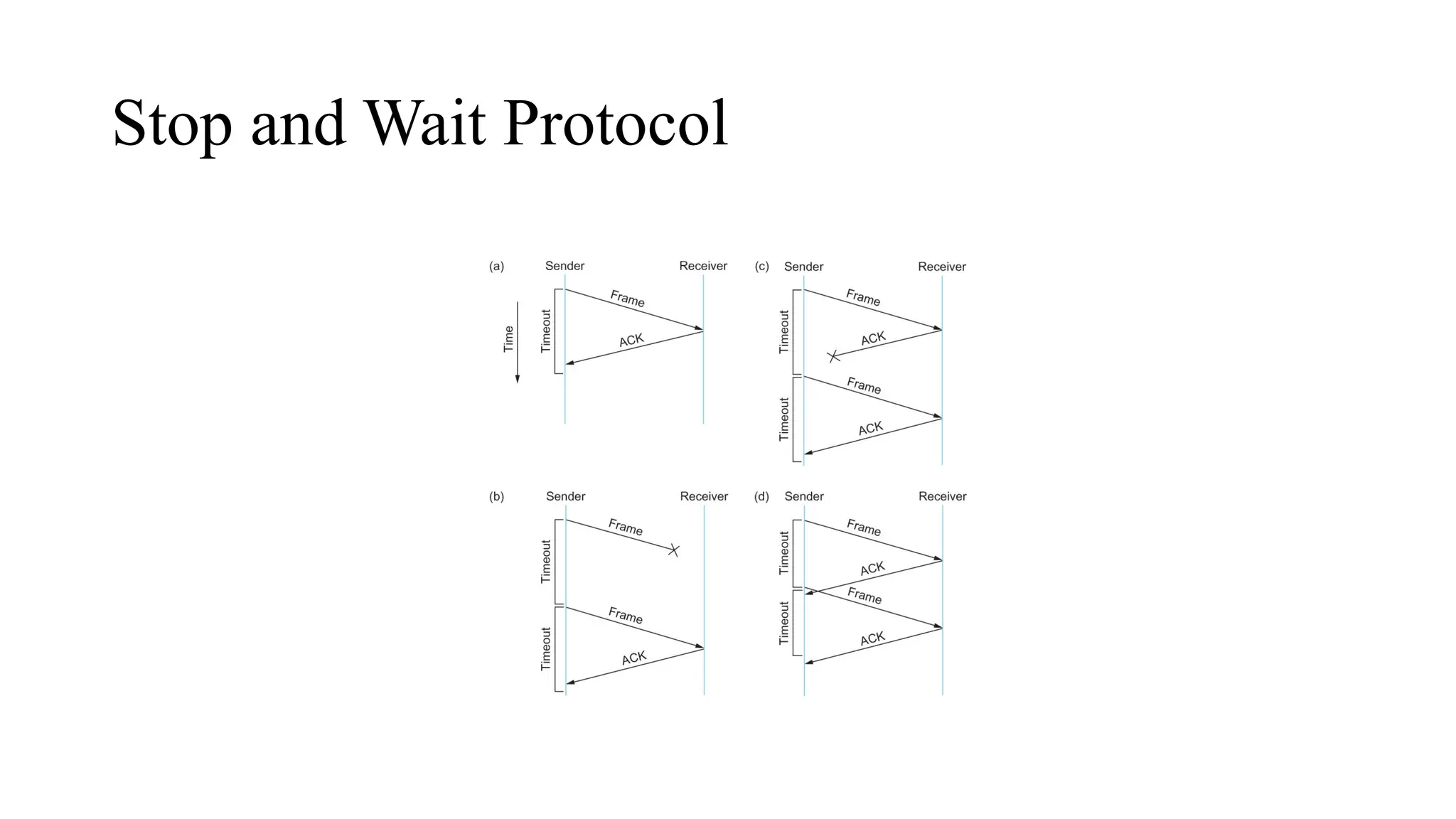
• Idea of stop-and-wait protocol is straightforward
• After transmitting one frame, the sender waits for an acknowledgement before
transmitting the next frame.
• If the acknowledgement does not arrive after a certain period of time, the
sender times out and retransmits the original frame
Stop and Wait Protocol
Problems with Stop and wait Protocol
• Problems due to lost packet
• Problems due to lost ack
• Problems due to delayed Ack
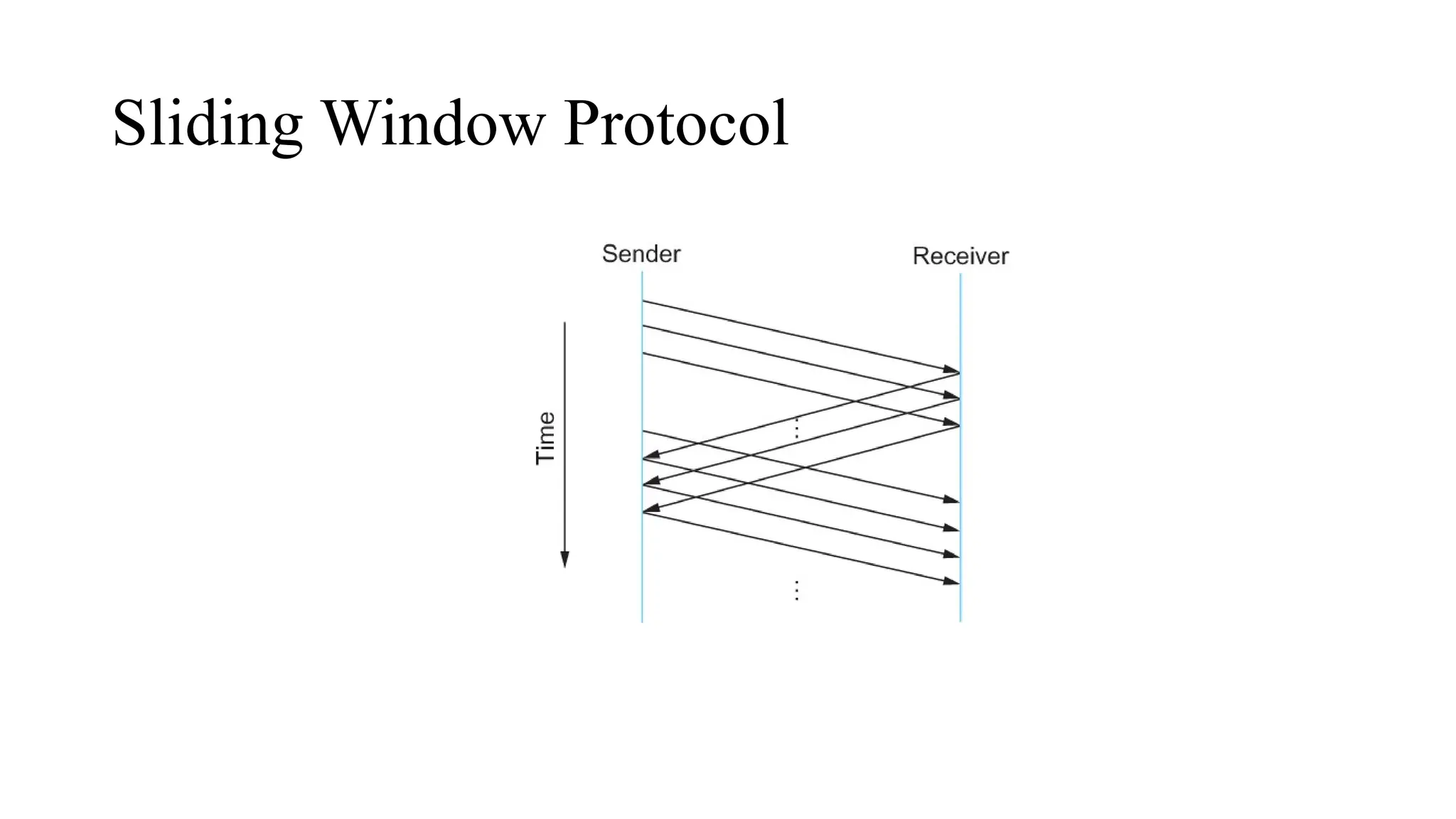
Sliding Window Protocol
• Sender assigns a sequence number denoted as SeqNum to each frame.
• Assume it can grow infinitely large
• Sender maintains three variables
• Sending Window Size (SWS)
• Upper bound on the number of outstanding (unacknowledged) frames that the sender can transmit
• Last Acknowledgement Received (LAR)
• Sequence number of the last acknowledgement received
• Last Frame Sent (LFS)
• Sequence number of the last frame sent
Media Access Control
• Data Link layer has two sub layers
• Logical Link Layer Sublayer
• Media Access Control Sublayer
Media Access Control Sublayer
• Implemented on the hardware layer
• To responsibility of the sublayer
• Data encapsulation
• Media Access Layer
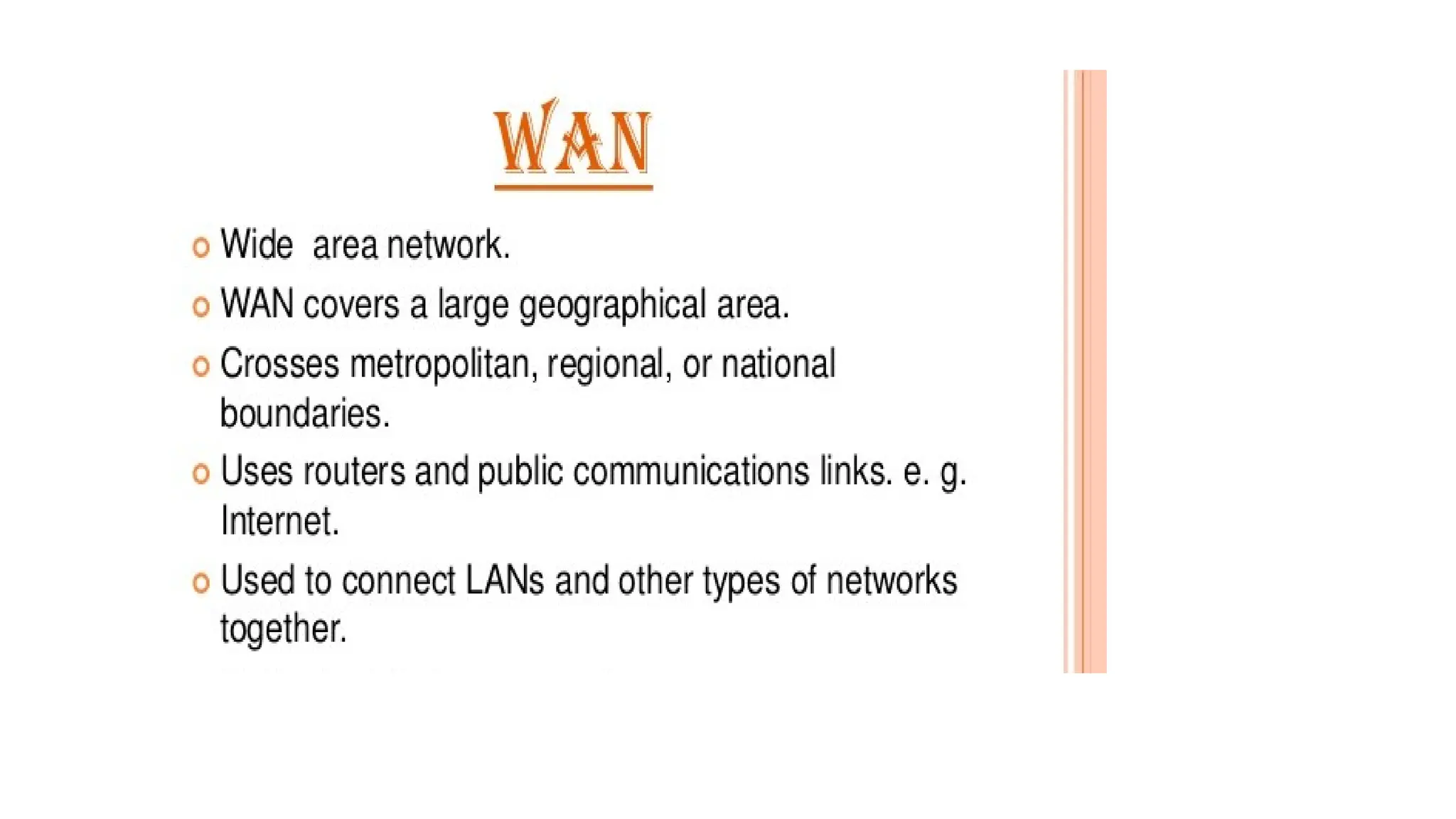
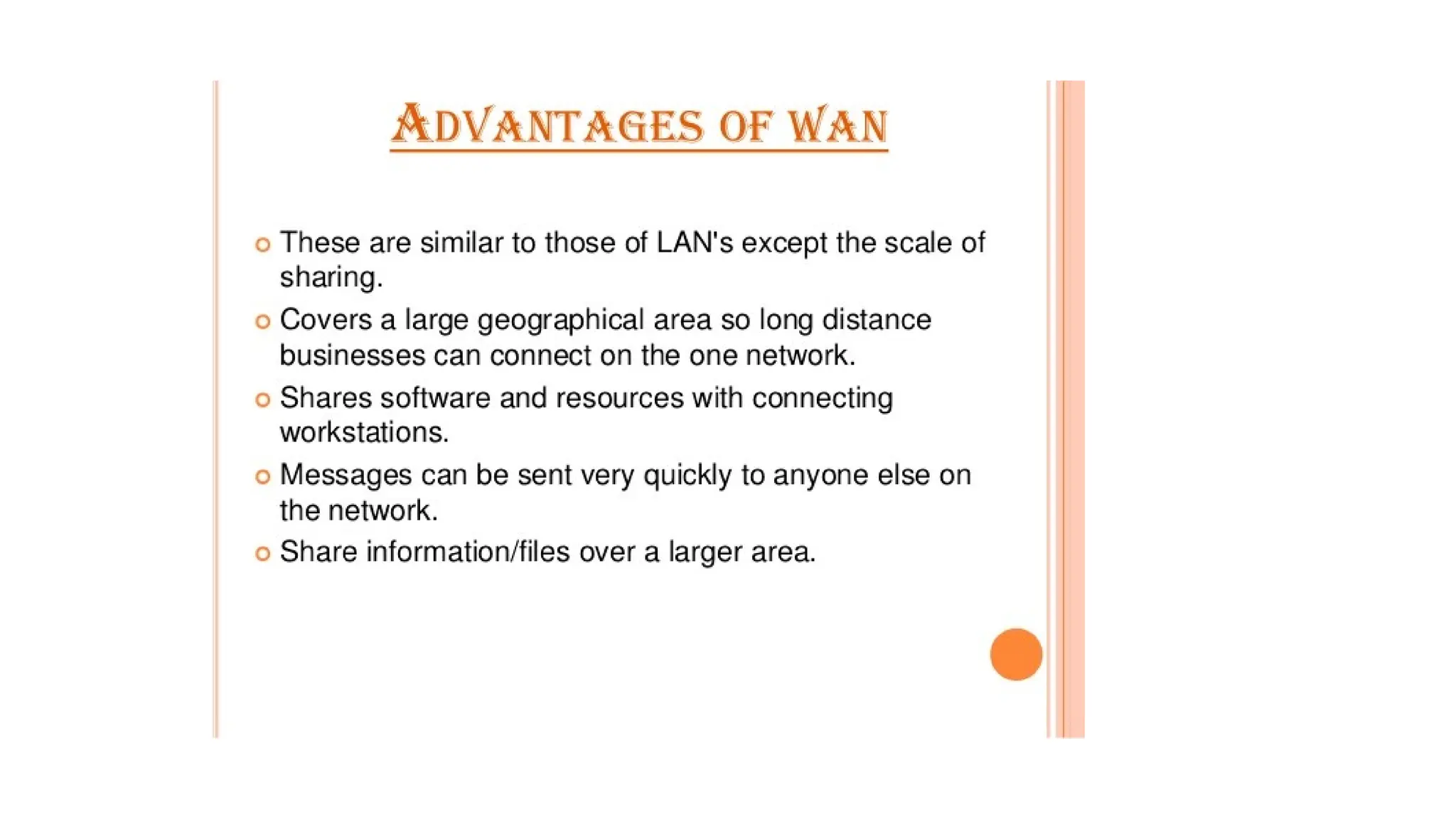
LAN
• A LAN is a network that is used for communicating among computer
devices, usually within an office building or home
• LAN’s enable the sharing of resources such as files or hardware
devices that may be needed by multiple users
• Is limited in size, typically spanning a few hundred meters, and no
more than a mile
• Is very fast, with speeds from 10 Mbps to 10 Gbps
• Requires very little wiring, typically a single cable connecting to each
device
• Has lower cost compared to MAN’s or WAN’s
Unit ii networks ; Medium Access Control .pptx

Unit ii networks ; Medium Access Control .pptx

  • 1.
  • 2.
    Reliable Transmission • CRCis used to detect errors. • Some error codes are strong enough to correct errors. • The overhead is typically too high. • Corrupt frames must be discarded. • A link-level protocol that wants to deliver frames reliably must recover from these discarded frames. • This is accomplished using a combination of two fundamental mechanisms • Acknowledgements and Timeouts
  • 3.
    Protocols used inFlow control • Stop and wait protocol • Sliding window protocol
  • 4.
    Stop and WaitProtocol • Idea of stop-and-wait protocol is straightforward • After transmitting one frame, the sender waits for an acknowledgement before transmitting the next frame. • If the acknowledgement does not arrive after a certain period of time, the sender times out and retransmits the original frame
  • 5.
    Stop and WaitProtocol
  • 6.
    Problems with Stopand wait Protocol • Problems due to lost packet • Problems due to lost ack • Problems due to delayed Ack
  • 7.
  • 8.
    Sliding Window Protocol •Sender assigns a sequence number denoted as SeqNum to each frame. • Assume it can grow infinitely large • Sender maintains three variables • Sending Window Size (SWS) • Upper bound on the number of outstanding (unacknowledged) frames that the sender can transmit • Last Acknowledgement Received (LAR) • Sequence number of the last acknowledgement received • Last Frame Sent (LFS) • Sequence number of the last frame sent
  • 9.
  • 10.
    • Data Linklayer has two sub layers • Logical Link Layer Sublayer • Media Access Control Sublayer Media Access Control Sublayer • Implemented on the hardware layer • To responsibility of the sublayer • Data encapsulation • Media Access Layer
  • 11.
    LAN • A LANis a network that is used for communicating among computer devices, usually within an office building or home • LAN’s enable the sharing of resources such as files or hardware devices that may be needed by multiple users • Is limited in size, typically spanning a few hundred meters, and no more than a mile • Is very fast, with speeds from 10 Mbps to 10 Gbps • Requires very little wiring, typically a single cable connecting to each device • Has lower cost compared to MAN’s or WAN’s