PRESSURE TEST :-PRESSURE TEST :-
Introduction :Introduction :
ƒ Pressure Test is performed or conducted when
there are new or old operating equipment like
Boilers, Heat Exchangers, Pipe Connections and
other pressure vessels installed.
ƒ All pressure vessels must go through the pressure
test before they are permitted to operate.
ƒ In Malaysia, there are the regulation enforced by
Malaysian Authority under the Department of
Occupational Safety and Health (DOSH).
ƒ There are 2 pressure tests performed :-
Pressure Leak Test
Pressure Strength Test - commonly known
as Hydrostatic Test.
PRESSURE TEST cont :-PRESSURE TEST cont :-
Objectives :Objectives :
ƒ Fired and Unfired pressure vessels are under
government regulation, their objectives are to
prevent :-
accidents that could cause undue risk to
the personnel working at or near the plant
equipment,
accidents that could cause several severe
material damage and consequently
substantial economic losses,
accidents that could cause risk of pollution
to the environment,
downtime in plant production.
PRESSURE TEST cont :-PRESSURE TEST cont :-
Definition:Definition:
ƒ Design Pressure :
ƒ The pressure used in the design of a vessel.
It is manufacturer recommended design
pressure on each equipment. This design
pressure is higher than operating pressure
and it will satisfy the requirement of the
pressure of the fluid and other content of
the vessel standard.
ƒ Operating Pressure :
ƒ This is the pressure which pressure vessel
can work safely or operate normally.
PRESSURE TEST cont :-PRESSURE TEST cont :-
DefinitionDefinition contcont ::
ƒ Maximum Allowable Working Pressure (MAWP) :
ƒ It is the internal pressure at which the weakest element
of the vessel is loaded to the ultimate permissible point,
when the vessel is assumed to be :-
corroded condition
under the effect of a designed temperature
in normal operating condition
under the effect of other loading, like wind, external
pressure, etc.
ƒ This MAWP is higher than operating pressure.
ƒ Test Pressure :
ƒ This is manufacturer recommended hydrostatic pressure
test when the vessel or equipment is new as appeared on
the equipment name plate.
PRESSURE TEST cont :-PRESSURE TEST cont :-
1. Pressure Leak Test (1.10 x MAWP) :1. Pressure Leak Test (1.10 x MAWP) :
The purpose is to detect leaking paths through the
"pressure envelope" in either direction.
The methods used may be straightforward using water
or gas, like air or inner search gases.
Leakage detection may be visual or measurement of
pressure drop, pressure vacuum decay rate, trace gas
or water respond to detection instrument, audible or
ultrasonic devices, fluorescent dyes, etc.
The pressure applied in the case of trace gas techniques
should be of a very low order and for audible or visual
technique it should be equal to the working pressure of
the vessel with small multiplying factor but it should
not in any circumstances exceed 110% of the MAWP.
PRESSURE TEST cont :-PRESSURE TEST cont :-
2. Hydrostatic Test (1.50 x MAWP) :2. Hydrostatic Test (1.50 x MAWP) :
ƒ Is the statutory requirement of pressure vessel in
order to verify and demonstrate the continued
fitness for services.
ƒ The pressure applied may approach up to original
design pressure with a suitable correction factor
applied for the ambient design temperature
differential and deviation from the new and old
condition.
ƒ In practice, the standard hydrostatic pressure test is
equal to 150% of the MAWP.
ƒ Hydrostatic should also be applied when repairs
or modifications have been carried out which
affect the structural integrity of the pressure shell
and foundation.
PRESSURE TEST cont :-PRESSURE TEST cont :-
2. Hydrostatic Test (1.50 x MAWP) cont :2. Hydrostatic Test (1.50 x MAWP) cont :
ƒ Also hydrostatic test is conducted after all
fabrication work has been completed.
ƒ During the testing process temporary
gasket may be used
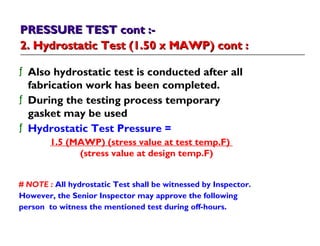
ƒ Hydrostatic Test Pressure =
1.5 (MAWP) (stress value at test temp.F)
(stress value at design temp.F)
# NOTE : All hydrostatic Test shall be witnessed by Inspector.
However, the Senior Inspector may approve the following
person to witness the mentioned test during off-hours.
PRESSURE TEST cont :-PRESSURE TEST cont :-
2. Hydrostatic Test (1.50 x MAWP) cont :2. Hydrostatic Test (1.50 x MAWP) cont :
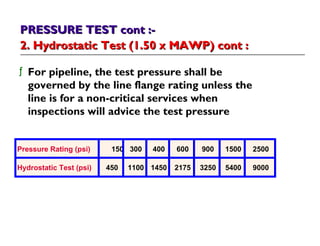
ƒ For pipeline, the test pressure shall be
governed by the line flange rating unless the
line is for a non-critical services when
inspections will advice the test pressure
Pressure Rating (psi) 150 300 400 600 900 1500 2500
Hydrostatic Test (psi) 450 1100 1450 2175 3250 5400 9000
PRESSURE TEST cont :-PRESSURE TEST cont :-
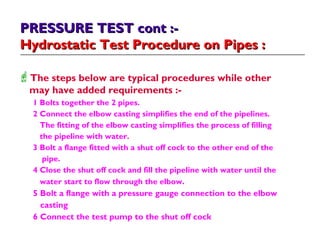
Hydrostatic Test Procedure on Pipes :Hydrostatic Test Procedure on Pipes :
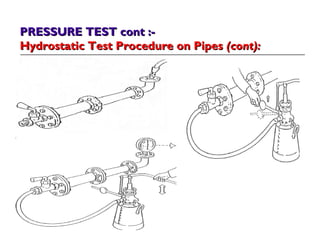
The steps below are typical procedures while other
may have added requirements :-
1 Bolts together the 2 pipes.
2 Connect the elbow casting simplifies the end of the pipelines.
The fitting of the elbow casting simplifies the process of filling
the pipeline with water.
3 Bolt a flange fitted with a shut off cock to the other end of the
pipe.
4 Close the shut off cock and fill the pipeline with water until the
water start to flow through the elbow.
5 Bolt a flange with a pressure gauge connection to the elbow
casting
6 Connect the test pump to the shut off cock
PRESSURE TEST cont :-PRESSURE TEST cont :-
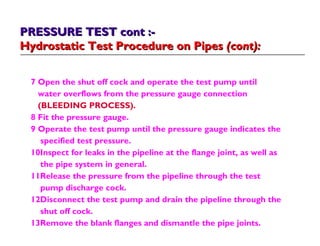
Hydrostatic Test Procedure on PipesHydrostatic Test Procedure on Pipes (cont):(cont):
7 Open the shut off cock and operate the test pump until
water overflows from the pressure gauge connection
(BLEEDING PROCESS).
8 Fit the pressure gauge.
9 Operate the test pump until the pressure gauge indicates the
specified test pressure.
10Inspect for leaks in the pipeline at the flange joint, as well as
the pipe system in general.
11Release the pressure from the pipeline through the test
pump discharge cock.
12Disconnect the test pump and drain the pipeline through the
shut off cock.
13Remove the blank flanges and dismantle the pipe joints.
PRESSURE TEST cont :-PRESSURE TEST cont :-
Hydrostatic Test Procedure on PipesHydrostatic Test Procedure on Pipes (cont):(cont):
PRESSURE TEST cont :-PRESSURE TEST cont :-
Safety Requirements :Safety Requirements :
ƒ Safety Requirements :-
1Depressurising the equipment after inspection
and the test has been approved must be done by
releasing the pressure slowly through the vent
and drain valves.
2The vent valve needs to be opened to release
pressure and yo admit air when draining to
prevent collapsing of the system by pulling a
vacuum.
3Never leave equipment an attended at any time
when it is under pressure.
4Always wear safety gear when conducting
hydrostatic test.
ƒ The record and inspection report are to be
kept properly according to the requirements of
inspection manual of pressure vessels. It is
necessary to keep a record of all inspection
result of each vessel from the initial inspection
to the latest inspection, so that comparison
and analysis can be made from these inspection
result.
ƒ Plan and report are to be submitted for
evaluation before issuance of inspection
certificate by Malaysian Authority (DOSH).
PRESSURE TEST cont :-PRESSURE TEST cont :-
Safety RequirementsSafety Requirements contcont ::

pipefitting pressure-test

  • 1.
    PRESSURE TEST :-PRESSURETEST :- Introduction :Introduction : ƒ Pressure Test is performed or conducted when there are new or old operating equipment like Boilers, Heat Exchangers, Pipe Connections and other pressure vessels installed. ƒ All pressure vessels must go through the pressure test before they are permitted to operate. ƒ In Malaysia, there are the regulation enforced by Malaysian Authority under the Department of Occupational Safety and Health (DOSH). ƒ There are 2 pressure tests performed :- Pressure Leak Test Pressure Strength Test - commonly known as Hydrostatic Test.
  • 2.
    PRESSURE TEST cont:-PRESSURE TEST cont :- Objectives :Objectives : ƒ Fired and Unfired pressure vessels are under government regulation, their objectives are to prevent :- accidents that could cause undue risk to the personnel working at or near the plant equipment, accidents that could cause several severe material damage and consequently substantial economic losses, accidents that could cause risk of pollution to the environment, downtime in plant production.
  • 3.
    PRESSURE TEST cont:-PRESSURE TEST cont :- Definition:Definition: ƒ Design Pressure : ƒ The pressure used in the design of a vessel. It is manufacturer recommended design pressure on each equipment. This design pressure is higher than operating pressure and it will satisfy the requirement of the pressure of the fluid and other content of the vessel standard. ƒ Operating Pressure : ƒ This is the pressure which pressure vessel can work safely or operate normally.
  • 4.
    PRESSURE TEST cont:-PRESSURE TEST cont :- DefinitionDefinition contcont :: ƒ Maximum Allowable Working Pressure (MAWP) : ƒ It is the internal pressure at which the weakest element of the vessel is loaded to the ultimate permissible point, when the vessel is assumed to be :- corroded condition under the effect of a designed temperature in normal operating condition under the effect of other loading, like wind, external pressure, etc. ƒ This MAWP is higher than operating pressure. ƒ Test Pressure : ƒ This is manufacturer recommended hydrostatic pressure test when the vessel or equipment is new as appeared on the equipment name plate.
  • 5.
    PRESSURE TEST cont:-PRESSURE TEST cont :- 1. Pressure Leak Test (1.10 x MAWP) :1. Pressure Leak Test (1.10 x MAWP) : The purpose is to detect leaking paths through the "pressure envelope" in either direction. The methods used may be straightforward using water or gas, like air or inner search gases. Leakage detection may be visual or measurement of pressure drop, pressure vacuum decay rate, trace gas or water respond to detection instrument, audible or ultrasonic devices, fluorescent dyes, etc. The pressure applied in the case of trace gas techniques should be of a very low order and for audible or visual technique it should be equal to the working pressure of the vessel with small multiplying factor but it should not in any circumstances exceed 110% of the MAWP.
  • 6.
    PRESSURE TEST cont:-PRESSURE TEST cont :- 2. Hydrostatic Test (1.50 x MAWP) :2. Hydrostatic Test (1.50 x MAWP) : ƒ Is the statutory requirement of pressure vessel in order to verify and demonstrate the continued fitness for services. ƒ The pressure applied may approach up to original design pressure with a suitable correction factor applied for the ambient design temperature differential and deviation from the new and old condition. ƒ In practice, the standard hydrostatic pressure test is equal to 150% of the MAWP. ƒ Hydrostatic should also be applied when repairs or modifications have been carried out which affect the structural integrity of the pressure shell and foundation.
  • 7.
    PRESSURE TEST cont:-PRESSURE TEST cont :- 2. Hydrostatic Test (1.50 x MAWP) cont :2. Hydrostatic Test (1.50 x MAWP) cont : ƒ Also hydrostatic test is conducted after all fabrication work has been completed. ƒ During the testing process temporary gasket may be used ƒ Hydrostatic Test Pressure = 1.5 (MAWP) (stress value at test temp.F) (stress value at design temp.F) # NOTE : All hydrostatic Test shall be witnessed by Inspector. However, the Senior Inspector may approve the following person to witness the mentioned test during off-hours.
  • 8.
    PRESSURE TEST cont:-PRESSURE TEST cont :- 2. Hydrostatic Test (1.50 x MAWP) cont :2. Hydrostatic Test (1.50 x MAWP) cont : ƒ For pipeline, the test pressure shall be governed by the line flange rating unless the line is for a non-critical services when inspections will advice the test pressure Pressure Rating (psi) 150 300 400 600 900 1500 2500 Hydrostatic Test (psi) 450 1100 1450 2175 3250 5400 9000
  • 9.
    PRESSURE TEST cont:-PRESSURE TEST cont :- Hydrostatic Test Procedure on Pipes :Hydrostatic Test Procedure on Pipes : The steps below are typical procedures while other may have added requirements :- 1 Bolts together the 2 pipes. 2 Connect the elbow casting simplifies the end of the pipelines. The fitting of the elbow casting simplifies the process of filling the pipeline with water. 3 Bolt a flange fitted with a shut off cock to the other end of the pipe. 4 Close the shut off cock and fill the pipeline with water until the water start to flow through the elbow. 5 Bolt a flange with a pressure gauge connection to the elbow casting 6 Connect the test pump to the shut off cock
  • 10.
    PRESSURE TEST cont:-PRESSURE TEST cont :- Hydrostatic Test Procedure on PipesHydrostatic Test Procedure on Pipes (cont):(cont): 7 Open the shut off cock and operate the test pump until water overflows from the pressure gauge connection (BLEEDING PROCESS). 8 Fit the pressure gauge. 9 Operate the test pump until the pressure gauge indicates the specified test pressure. 10Inspect for leaks in the pipeline at the flange joint, as well as the pipe system in general. 11Release the pressure from the pipeline through the test pump discharge cock. 12Disconnect the test pump and drain the pipeline through the shut off cock. 13Remove the blank flanges and dismantle the pipe joints.
  • 11.
    PRESSURE TEST cont:-PRESSURE TEST cont :- Hydrostatic Test Procedure on PipesHydrostatic Test Procedure on Pipes (cont):(cont):
  • 12.
    PRESSURE TEST cont:-PRESSURE TEST cont :- Safety Requirements :Safety Requirements : ƒ Safety Requirements :- 1Depressurising the equipment after inspection and the test has been approved must be done by releasing the pressure slowly through the vent and drain valves. 2The vent valve needs to be opened to release pressure and yo admit air when draining to prevent collapsing of the system by pulling a vacuum. 3Never leave equipment an attended at any time when it is under pressure. 4Always wear safety gear when conducting hydrostatic test.
  • 13.
    ƒ The recordand inspection report are to be kept properly according to the requirements of inspection manual of pressure vessels. It is necessary to keep a record of all inspection result of each vessel from the initial inspection to the latest inspection, so that comparison and analysis can be made from these inspection result. ƒ Plan and report are to be submitted for evaluation before issuance of inspection certificate by Malaysian Authority (DOSH). PRESSURE TEST cont :-PRESSURE TEST cont :- Safety RequirementsSafety Requirements contcont ::