Presented By:
MD. MONSUR RAHMAN
MPT (Musculoskeletal Disorders)
MM UNIVERSITY, MULLANA, AMBALA
 Pilates is a form of exercise which concentrates on strengthening the body
with an emphasis on core strength. This helps to improve general fitness
and overall well-being.
 Similar to Yoga, Pilates concentrates on posture, balance and flexibility. In
Pilates the chance of injury is much lower than with other more strenuous
forms of exercise.
 Pilates also focuses on the mind-body connection.
 Pilates is a system of exercises that promote the strengthening of the
body, often using specialized equipment.
 Pilates improves flexibility, builds strength, develops control and
endurance in the whole human body.
 Developed by Joseph Pilates in Germany where he was a carpenter and
gymnast to overcome childhood ailments of asthma, rickets, and rheumatic
fever.
 He invented Pilates as an exercise program for injured dancers and soldiers
while living in the UK. Joseph Pilates believed that physical and mental
health were closely connected.
 In the 1920's he immigrated to the US and opened a Pilates studio in New
York.
 In 1925, the German government asked Pilates to start training the
German army.
 Originally this form of exercise was called Contrology.
 The Pilates Method of Physical and Mental Conditioning in 1988 and in it
they outlined six “ principles of Pilates”
 The original six principles were:
 concentration
 control
 center
 flow
 precision and breathing
Concentration
 Pilates demands intense focus: “everyone have to concentrate on what they are
doing and all must concentrate on their entire body".
 This is not easy, but in Pilates the way that exercises are done is more important than
the exercises themselves.
 In 2006, at the Parkinson Center of the Oregon Health and Science University in
Portland, Oregon, the concentration factor of the Pilates method was being studied to
provide relief from the degenerative symptoms of Parkinson's disease.
Control
 "Contrology" was the term given by Joseph Pilates for his method and
it is based on the idea of muscle control.
 Nothing about the Pilates method is haphazard. The reason all need to
concentrate so thoroughly is so all can be in control of every aspect of
every moment
 All exercises are done with control with the muscles working to lift
against gravity and the resistance of the springs and thereby control
the movement of the body and the apparatus.
Center
 In order to attain control of body everyone must have a starting place, the
center.
 The center is the focal point of the Pilates method.
 Many Pilates teachers refer to the group of muscles in the center of the body –
encompassing the abdomen, lower and upper back, hips, buttocks and inner
thighs – the “powerhouse”
 All movement in Pilates should begin from the powerhouse and flow outward
to the limbs.
Flow or efficiency of movement
 Pilates aims for elegant sufficiency of movement, creating flow through the use of
appropriate transitions.
 Once precision has been achieved, the exercises are intended to flow within and
into each other in order to build strength and stamina.
 In other words, the Pilates technique asserts that physical energy exerted from the
center should coordinate movements of the extremities: Pilates is flowing movement
outward from a strong core.
Precision
 Precision is essential to correct pilates:"concentrate on the correct
movements each time everyone exercise. The focus is on doing one precise
and perfect movement.
 Pilates is here reflecting common physical culture wisdom: “one will gain
more strength from a few energetic, concentrated efforts than from a
thousand listless, sluggish movements".
 The goal is for this precision to eventually become second nature, and
carry over into everyday life as grace and economy of movement.
Breathing
 Breathing is important in the Pilates method.
 Proper full inhalation and complete exhalation are key.
The Pilates Fundamentals
 Pilates relies on postural alignment for effectiveness.
 The diaphragm is the top of the cylinder of core muscles; respiratory
control requires respiratory strength, as well as coordination and timing.
 Precise movement with few repetitions.
 Good posture - Pilates will teach how to gain and maintain good posture.
The exercises require that every body is always in alignment. This is
especially beneficial if anyone suffer from lower back pain.
 Muscle Tone - The exercises involve the use of muscles that everyone may
not use on a daily basis. This is especially good for older people and those
who are normally quite sedate in their daily life as muscle tone is usually
lost with age and inactivity.
 Flat abdominal muscles - Pilates focuses on strengthening core which
includes abdominal muscles, all will find that one of the benefits of Pilates
is that it will result in a flat stomach.
 Flexibility - As we age we tend to lose the flexibility we had when we
were young. Pilates will restore flexibility, gently at first of course. After a
while though, the body will become more flexible. This is especially
important for avoiding injuries from falls.
 Improves balance - Through the mind-body connection which is taught in
Pilates everyone will become much more aware of how their body moves
and performs. Therefore Pilates not only improves physical balance
through correct posture but will also restore mind-body balance.
 Reduces stress - When doing the exercises, everyone will be totally
engrossed and won't be able to think about all those responsibilities that
weigh you down on a day to day basis. All will be more focused on
breathing and on the moves that they are making with their body. This is
an excellent way to relieve stress.
 Gives a general sense of well-being - Pilates focuses on providing balance
between mind and body it gives an overall sense of well-being.
 PILATES EQUIPMENT
 Trapeze table
 Reformer
 Ladder barrel
 Combo chair
Pilates mat exercises are as
below
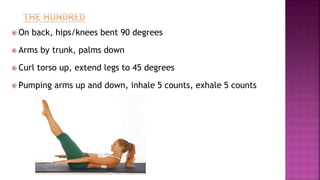
 On back, hips/knees bent 90 degrees
 Arms by trunk, palms down
 Curl torso up, extend legs to 45 degrees
 Pumping arms up and down, inhale 5 counts, exhale 5 counts
 On back, one leg straight facing up towards the ceiling
 Other leg extended on mat
 T base with arms
 Make small circle, inhale crossing midline, exhale outside
 Reverse, repeat with other leg
 From tuck position, arms wrapped
 Inhale, roll back onto shoulder blades
 Exhale, roll up
 Balance, finish exhalation
 On back, bring one knee to chest, clasping shin with hands, reach
other leg to 45 degree
 Switch legs
 Inhale for two, exhale for two
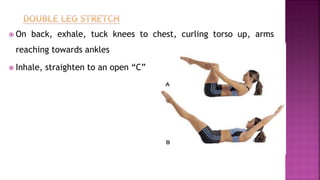
 On back, exhale, tuck knees to chest, curling torso up, arms
reaching towards ankles
 Inhale, straighten to an open “C”
 Prone position, legs slightly turned out
 Inhale, raise torso up 6-8 inches
 Exhale, lower torso, raise legs
 Prone position, propped on elbow
 Inhale, bend knee
 Exhale, extend leg to mat
 Repeat with other leg
 Prone position, arms behind, hands at lower back
 Inhale, bend knees, pulse twice
 Exhale, extend knees, raise torso, straighten arms
 Straddle, reach arms straight ahead
 Exhale, reach forward
 Inhale, hold the position
 Exhale, reach forward again
 Inhale, hold the position
 Exhale, return to position
 Pike position, balanced on buttocks
 Inhale, roll backward
 Exhale, return upright and balance
 On back, pike position, T base with arms
 Circle leg clockwise, exhale to start the circle, inhale to finish
 Reverse
 Straddle sit, arms out to side
 Inhale, rotate torso to one side
 Exhale, bend torso forward reaching toward foot with opposite hand
 Inhale, return to upright, still rotated
 Exhale, return to start
 Side lying, exhale, kick forward twice, inhale kick back
 With legs parallel, circle top leg at hip height
 Bottom up leg kicks
 Prone position
 Raise opposite arm and leg in swimming motion
 Change sides
 Inhale four, exhale four
 Supine during pregnancy.
 Legs over head or arms over head for cardiovascular conditions.
 Plantar fasciitis or foot injury with bar use on apparatus.
 SI joint dysfunction
 Unstable blood pressure.
 A herniated disk.
 Severe osteoporosis.
 A risk of blood clots.
 Poor stability
 Balance or vestibular issues
 Spinal stenosis
 Chronic neck and back pain.
 Hip or knee replacements
"Pilates – pronunciation of Pilates by Macmillan Dictionary" Retrieved 8 July 2012.
Mayo Clinic Staff (2012). "Pilates for Beginners: Explore the Core of Pilates". Mayo Clinic. Retrieved
2012-11-04.

pilates

  • 1.
    Presented By: MD. MONSURRAHMAN MPT (Musculoskeletal Disorders) MM UNIVERSITY, MULLANA, AMBALA
  • 2.
     Pilates isa form of exercise which concentrates on strengthening the body with an emphasis on core strength. This helps to improve general fitness and overall well-being.  Similar to Yoga, Pilates concentrates on posture, balance and flexibility. In Pilates the chance of injury is much lower than with other more strenuous forms of exercise.  Pilates also focuses on the mind-body connection.
  • 3.
     Pilates isa system of exercises that promote the strengthening of the body, often using specialized equipment.  Pilates improves flexibility, builds strength, develops control and endurance in the whole human body.
  • 4.
     Developed byJoseph Pilates in Germany where he was a carpenter and gymnast to overcome childhood ailments of asthma, rickets, and rheumatic fever.  He invented Pilates as an exercise program for injured dancers and soldiers while living in the UK. Joseph Pilates believed that physical and mental health were closely connected.
  • 5.
     In the1920's he immigrated to the US and opened a Pilates studio in New York.  In 1925, the German government asked Pilates to start training the German army.  Originally this form of exercise was called Contrology.
  • 7.
     The PilatesMethod of Physical and Mental Conditioning in 1988 and in it they outlined six “ principles of Pilates”  The original six principles were:  concentration  control  center  flow  precision and breathing
  • 8.
    Concentration  Pilates demandsintense focus: “everyone have to concentrate on what they are doing and all must concentrate on their entire body".  This is not easy, but in Pilates the way that exercises are done is more important than the exercises themselves.  In 2006, at the Parkinson Center of the Oregon Health and Science University in Portland, Oregon, the concentration factor of the Pilates method was being studied to provide relief from the degenerative symptoms of Parkinson's disease.
  • 9.
    Control  "Contrology" wasthe term given by Joseph Pilates for his method and it is based on the idea of muscle control.  Nothing about the Pilates method is haphazard. The reason all need to concentrate so thoroughly is so all can be in control of every aspect of every moment  All exercises are done with control with the muscles working to lift against gravity and the resistance of the springs and thereby control the movement of the body and the apparatus.
  • 10.
    Center  In orderto attain control of body everyone must have a starting place, the center.  The center is the focal point of the Pilates method.  Many Pilates teachers refer to the group of muscles in the center of the body – encompassing the abdomen, lower and upper back, hips, buttocks and inner thighs – the “powerhouse”  All movement in Pilates should begin from the powerhouse and flow outward to the limbs.
  • 11.
    Flow or efficiencyof movement  Pilates aims for elegant sufficiency of movement, creating flow through the use of appropriate transitions.  Once precision has been achieved, the exercises are intended to flow within and into each other in order to build strength and stamina.  In other words, the Pilates technique asserts that physical energy exerted from the center should coordinate movements of the extremities: Pilates is flowing movement outward from a strong core.
  • 12.
    Precision  Precision isessential to correct pilates:"concentrate on the correct movements each time everyone exercise. The focus is on doing one precise and perfect movement.  Pilates is here reflecting common physical culture wisdom: “one will gain more strength from a few energetic, concentrated efforts than from a thousand listless, sluggish movements".  The goal is for this precision to eventually become second nature, and carry over into everyday life as grace and economy of movement.
  • 13.
    Breathing  Breathing isimportant in the Pilates method.  Proper full inhalation and complete exhalation are key.
  • 14.
    The Pilates Fundamentals Pilates relies on postural alignment for effectiveness.  The diaphragm is the top of the cylinder of core muscles; respiratory control requires respiratory strength, as well as coordination and timing.  Precise movement with few repetitions.
  • 15.
     Good posture- Pilates will teach how to gain and maintain good posture. The exercises require that every body is always in alignment. This is especially beneficial if anyone suffer from lower back pain.  Muscle Tone - The exercises involve the use of muscles that everyone may not use on a daily basis. This is especially good for older people and those who are normally quite sedate in their daily life as muscle tone is usually lost with age and inactivity.
  • 16.
     Flat abdominalmuscles - Pilates focuses on strengthening core which includes abdominal muscles, all will find that one of the benefits of Pilates is that it will result in a flat stomach.  Flexibility - As we age we tend to lose the flexibility we had when we were young. Pilates will restore flexibility, gently at first of course. After a while though, the body will become more flexible. This is especially important for avoiding injuries from falls.
  • 17.
     Improves balance- Through the mind-body connection which is taught in Pilates everyone will become much more aware of how their body moves and performs. Therefore Pilates not only improves physical balance through correct posture but will also restore mind-body balance.  Reduces stress - When doing the exercises, everyone will be totally engrossed and won't be able to think about all those responsibilities that weigh you down on a day to day basis. All will be more focused on breathing and on the moves that they are making with their body. This is an excellent way to relieve stress.
  • 18.
     Gives ageneral sense of well-being - Pilates focuses on providing balance between mind and body it gives an overall sense of well-being.  PILATES EQUIPMENT  Trapeze table  Reformer  Ladder barrel  Combo chair
  • 23.
  • 24.
     On back,hips/knees bent 90 degrees  Arms by trunk, palms down  Curl torso up, extend legs to 45 degrees  Pumping arms up and down, inhale 5 counts, exhale 5 counts
  • 25.
     On back,one leg straight facing up towards the ceiling  Other leg extended on mat  T base with arms  Make small circle, inhale crossing midline, exhale outside  Reverse, repeat with other leg
  • 26.
     From tuckposition, arms wrapped  Inhale, roll back onto shoulder blades  Exhale, roll up  Balance, finish exhalation
  • 27.
     On back,bring one knee to chest, clasping shin with hands, reach other leg to 45 degree  Switch legs  Inhale for two, exhale for two
  • 28.
     On back,exhale, tuck knees to chest, curling torso up, arms reaching towards ankles  Inhale, straighten to an open “C”
  • 29.
     Prone position,legs slightly turned out  Inhale, raise torso up 6-8 inches  Exhale, lower torso, raise legs
  • 30.
     Prone position,propped on elbow  Inhale, bend knee  Exhale, extend leg to mat  Repeat with other leg
  • 31.
     Prone position,arms behind, hands at lower back  Inhale, bend knees, pulse twice  Exhale, extend knees, raise torso, straighten arms
  • 32.
     Straddle, reacharms straight ahead  Exhale, reach forward  Inhale, hold the position  Exhale, reach forward again  Inhale, hold the position  Exhale, return to position
  • 33.
     Pike position,balanced on buttocks  Inhale, roll backward  Exhale, return upright and balance
  • 34.
     On back,pike position, T base with arms  Circle leg clockwise, exhale to start the circle, inhale to finish  Reverse
  • 35.
     Straddle sit,arms out to side  Inhale, rotate torso to one side  Exhale, bend torso forward reaching toward foot with opposite hand  Inhale, return to upright, still rotated  Exhale, return to start
  • 36.
     Side lying,exhale, kick forward twice, inhale kick back  With legs parallel, circle top leg at hip height  Bottom up leg kicks
  • 37.
     Prone position Raise opposite arm and leg in swimming motion  Change sides  Inhale four, exhale four
  • 38.
     Supine duringpregnancy.  Legs over head or arms over head for cardiovascular conditions.  Plantar fasciitis or foot injury with bar use on apparatus.  SI joint dysfunction
  • 39.
     Unstable bloodpressure.  A herniated disk.  Severe osteoporosis.  A risk of blood clots.  Poor stability  Balance or vestibular issues  Spinal stenosis  Chronic neck and back pain.  Hip or knee replacements
  • 40.
    "Pilates – pronunciationof Pilates by Macmillan Dictionary" Retrieved 8 July 2012. Mayo Clinic Staff (2012). "Pilates for Beginners: Explore the Core of Pilates". Mayo Clinic. Retrieved 2012-11-04.