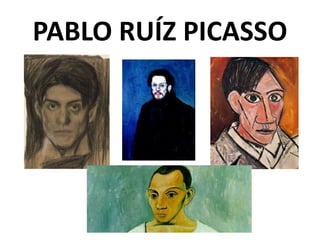
PABLO RUÍZ PICASSO
Born: October 25th, 1881 in Málaga
(Andalusia), Spain.
Died: April 8th, 1973 in Mougins, France.
Lived in: Spain (Málaga, La Coruña,
Barcelona) and France (Paris, Mougins).
Profession: Artist (painter) and sculptor. He
also worked on drawing, engraving,
illustration (books), ceramics, costume and
set design (theatre).
Painting styles: Many different ones; he kept
on trying out new things. Impressionism,
cubism, surrealism, expressionism,…
Children: Paolo, Maya, Claude and Paloma.
Hobby: Bullfighting.
Málaga
Mougins
PABLO RUÍZ PICASSO
PABLO RUÍZ PICASSO
IMPRESSIONISM
• The Blue period (1901- 1904).
• The Rose period (1904-1906).
CUBISM
• The African-influenced period, Primitive Cubism or the Green period
(1907-1909).
• Analytic Cubism (1909-1912).
• Synthetic Cubism (1912-1914).
CLASSICISM,
SURREALISM AND
EXPRESSIONISM.
• Classicism (1917-1927).
• Surrealism (1928-1932).
• Expressionism (1937-1945).
PERIODS
It’s called the Blue Period because of the colour of his paintings and
Picasso’s feelings (blue is a synonym of sad). He was influenced by
other artists like El Greco, Van Gogh or Gauguin.
Main work of art: Evocation, the burial of Casagemas.
Casagemas was a friend of Picasso who killed himself after he tried to
kill his girlfriend, a dancer of the Moulin Rouge.
In this period, Picasso felt very sad. He suffered the death of his
friend (Casagemas) and started to use the blue paint in his paintings.
He painted a world of skinny beggars and blind people.
PABLO RUÍZ PICASSO
IMPRESSIONISM: THE BLUE PERIOD
(1901-1904)
Evocation, the burial
of Casagemas (1901)
Prado Museum,
Madrid
Casagemas in his
coffin (1901)
Oil on canvas
The Old
Guitarrist (1903)
Child with a
dove (1901)
PABLO RUÍZ PICASSO
IMPRESSIONISM: THE ROSE PERIOD
(1904-1906)
It’s called the Rose Period because he started to use warm
and pastel colours and soft and delicate lines.
He used to paint the world of circus: saltimbanques (street
artists, clowns, harlequins, actors, acrobats…), troubadours,…
Main work of art: Family of Saltimbanques.
Family of Saltimbanques (1905)
National Gallery of Art,
Washington, D.C. (The U.S.A.)
Oil on canvas
PABLO RUÍZ PICASSO CUBISM: THE AFRICAN-INFLUENCED
PERIOD OR THE GREEN PERIOD
(1907-1909)
In this period, Picasso breaks with the Realism and starts to
paint using geometric shapes and chiaroscuro lines.
Main work of art: Les Demoiselles d’Avignon (The Young Ladies
of Avignon).
CUBISM
Objects and figures are dissected in geometric
forms and are shown simultaneously from several
different angles (from the front, from the back,
from the top).
Developed by Picasso and his friend Georges
Braque in around 1908.
Les Demoiselles d’Avignon (The Young Ladies of
Avignon) (1907)
Museum of Modern Art, New York City.
Oil on canvas
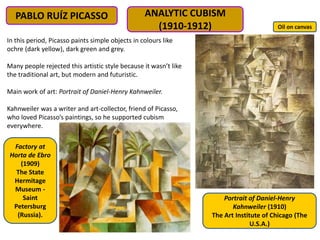
PABLO RUÍZ PICASSO ANALYTIC CUBISM
(1910-1912)
In this period, Picasso paints simple objects in colours like
ochre (dark yellow), dark green and grey.
Many people rejected this artistic style because it wasn’t like
the traditional art, but modern and futuristic.
Main work of art: Portrait of Daniel-Henry Kahnweiler.
Kahnweiler was a writer and art-collector, friend of Picasso,
who loved Picasso’s paintings, so he supported cubism
everywhere.
Portrait of Daniel-Henry
Kahnweiler (1910)
The Art Institute of Chicago (The
U.S.A.)
Oil on canvas
Factory at
Horta de Ebro
(1909)
The State
Hermitage
Museum -
Saint
Petersburg
(Russia).
PABLO RUÍZ PICASSO SYNTHETIC CUBISM
(1913-1914)
In this period, Picasso paints comparing with
metaphors, related to the African-influenced period.
It’s not that simple yet, It’s more abstract. So, the
observer has to think too much to understand the
meaning of the paintings. He breaks with all the
imitative process. He doesn’t like the European
tradition.
COLLAGE
It consists of sticking pieces of different
materials like paper (magazines,
newspapers,…), clothes,… on the painting.
Invented by Picasso and his friend Georges
Braque in 1912.
Still life with chair caning (1912)
Picasso Museum, Paris (France)
Oil on oil-cloth over
canvas edged with
rope
Woman with a shirt sitting in a chair (1913)
The Metropolitan Museum of Art, New York
Oil on canvas
PABLO RUÍZ PICASSO CLASSICISM
(1917-1927)
In this period, Picasso starts to be in contact with
people related to theatre and ballet. He friends with
high-class people and visits places where he can
study the most important works in the history of art
(classical antiquity). So, he returns to more
traditional patterns (classicist-realistic), but he keeps
on experimenting with synthetic cubism.
He draws curtains, sets and costumes for theatre.
Sketch of set for the “Parade” (1917)
Musee National Art Moderne, Paris
Paolo as harlequin (1924)
Picasso Museum, Paris
Oil on canvas
Picasso’s first son
PABLO RUÍZ PICASSO SURREALISM (1928-1932)
Crucifixion (1930)
Oil on wood
Bather opening a
cabin (1928)
Picasso Museum, Paris
Oil on canvas
Acrobat (1930)
Picasso Museum, Paris
Oil on canvas
In this period, Picasso goes beyond reality. Familiar
things are presented in way never seen before and
are linked to surprising and mysterious paintings in a
dreamlike manner.
Woman with a
flower (1932)
Oil on canvas
PABLO RUÍZ PICASSO EXPRESSIONISM (1937-1945)
In this period, Picasso expresses the experiences of
fear and insecurity through deformations. It reaches
its highest expression during the Spanish Civil War
(1936-1939).
Masterpiece: Guernica.
Guernica is a town in the North of Spain (País Vasco)
which was bombed by German and Italian
warplanes at the behest of the Spanish Nationalist
forces on the 26th of April of 1.937 during the
Spanish Civil War.
PABLO RUÍZ PICASSO EXPRESSIONISM (1937-1945)
Guernica (1937)
Reina Sofia Museum, Madrid
Oil on canvas
In this painting, Picasso gives up colours because of the sadness of the war and just paints using grey, black and white. It shows
suffering people, animals, and buildings wrenched by violence and chaos.
We can see 9 symbols: 6 humans and 3 animals.
The bull symbolizes darkness and brutality and it could be a self-portray of Picasso (He used to love bullfighting); the mother with
her dead son in her arms is under the bull, protected by the animal. She’s suffering and crying because her son is dead; the dove is
between the bull and the horse. It symbolizes peace but it is broken because the wing of the dove is broken and it’s screaming; the
dead warrior on the floor. We can only see his head and arms. One of them has got a broken sword and rose as a symbol of hope;
the light bulb symbolizes the bombs as well as the scientific and electronic advance that should mean a social advance (no war); the
horse symbolizes the innocent victims (people) of the war; the woman on her knees is suffering a haemorrhage stroke because she
has a cut on one of her legs; the woman with the candle is shocked. She’s like a ghost; the woman looking up the sky raising her
hands and begging the planes to stop bombing. It symbolizes the horror of the war. Her house is in flames (on fire) and she’s
shouting. The arrow under the horse symbolizes the rise of the spirit of the dead people.

Picasso

  • 1.
  • 2.
    Born: October 25th,1881 in Málaga (Andalusia), Spain. Died: April 8th, 1973 in Mougins, France. Lived in: Spain (Málaga, La Coruña, Barcelona) and France (Paris, Mougins). Profession: Artist (painter) and sculptor. He also worked on drawing, engraving, illustration (books), ceramics, costume and set design (theatre). Painting styles: Many different ones; he kept on trying out new things. Impressionism, cubism, surrealism, expressionism,… Children: Paolo, Maya, Claude and Paloma. Hobby: Bullfighting. Málaga Mougins PABLO RUÍZ PICASSO
  • 3.
    PABLO RUÍZ PICASSO IMPRESSIONISM •The Blue period (1901- 1904). • The Rose period (1904-1906). CUBISM • The African-influenced period, Primitive Cubism or the Green period (1907-1909). • Analytic Cubism (1909-1912). • Synthetic Cubism (1912-1914). CLASSICISM, SURREALISM AND EXPRESSIONISM. • Classicism (1917-1927). • Surrealism (1928-1932). • Expressionism (1937-1945). PERIODS
  • 4.
    It’s called theBlue Period because of the colour of his paintings and Picasso’s feelings (blue is a synonym of sad). He was influenced by other artists like El Greco, Van Gogh or Gauguin. Main work of art: Evocation, the burial of Casagemas. Casagemas was a friend of Picasso who killed himself after he tried to kill his girlfriend, a dancer of the Moulin Rouge. In this period, Picasso felt very sad. He suffered the death of his friend (Casagemas) and started to use the blue paint in his paintings. He painted a world of skinny beggars and blind people. PABLO RUÍZ PICASSO IMPRESSIONISM: THE BLUE PERIOD (1901-1904) Evocation, the burial of Casagemas (1901) Prado Museum, Madrid Casagemas in his coffin (1901) Oil on canvas The Old Guitarrist (1903) Child with a dove (1901)
  • 5.
    PABLO RUÍZ PICASSO IMPRESSIONISM:THE ROSE PERIOD (1904-1906) It’s called the Rose Period because he started to use warm and pastel colours and soft and delicate lines. He used to paint the world of circus: saltimbanques (street artists, clowns, harlequins, actors, acrobats…), troubadours,… Main work of art: Family of Saltimbanques. Family of Saltimbanques (1905) National Gallery of Art, Washington, D.C. (The U.S.A.) Oil on canvas
  • 6.
    PABLO RUÍZ PICASSOCUBISM: THE AFRICAN-INFLUENCED PERIOD OR THE GREEN PERIOD (1907-1909) In this period, Picasso breaks with the Realism and starts to paint using geometric shapes and chiaroscuro lines. Main work of art: Les Demoiselles d’Avignon (The Young Ladies of Avignon). CUBISM Objects and figures are dissected in geometric forms and are shown simultaneously from several different angles (from the front, from the back, from the top). Developed by Picasso and his friend Georges Braque in around 1908. Les Demoiselles d’Avignon (The Young Ladies of Avignon) (1907) Museum of Modern Art, New York City. Oil on canvas
  • 7.
    PABLO RUÍZ PICASSOANALYTIC CUBISM (1910-1912) In this period, Picasso paints simple objects in colours like ochre (dark yellow), dark green and grey. Many people rejected this artistic style because it wasn’t like the traditional art, but modern and futuristic. Main work of art: Portrait of Daniel-Henry Kahnweiler. Kahnweiler was a writer and art-collector, friend of Picasso, who loved Picasso’s paintings, so he supported cubism everywhere. Portrait of Daniel-Henry Kahnweiler (1910) The Art Institute of Chicago (The U.S.A.) Oil on canvas Factory at Horta de Ebro (1909) The State Hermitage Museum - Saint Petersburg (Russia).
  • 8.
    PABLO RUÍZ PICASSOSYNTHETIC CUBISM (1913-1914) In this period, Picasso paints comparing with metaphors, related to the African-influenced period. It’s not that simple yet, It’s more abstract. So, the observer has to think too much to understand the meaning of the paintings. He breaks with all the imitative process. He doesn’t like the European tradition. COLLAGE It consists of sticking pieces of different materials like paper (magazines, newspapers,…), clothes,… on the painting. Invented by Picasso and his friend Georges Braque in 1912. Still life with chair caning (1912) Picasso Museum, Paris (France) Oil on oil-cloth over canvas edged with rope Woman with a shirt sitting in a chair (1913) The Metropolitan Museum of Art, New York Oil on canvas
  • 9.
    PABLO RUÍZ PICASSOCLASSICISM (1917-1927) In this period, Picasso starts to be in contact with people related to theatre and ballet. He friends with high-class people and visits places where he can study the most important works in the history of art (classical antiquity). So, he returns to more traditional patterns (classicist-realistic), but he keeps on experimenting with synthetic cubism. He draws curtains, sets and costumes for theatre. Sketch of set for the “Parade” (1917) Musee National Art Moderne, Paris Paolo as harlequin (1924) Picasso Museum, Paris Oil on canvas Picasso’s first son
  • 10.
    PABLO RUÍZ PICASSOSURREALISM (1928-1932) Crucifixion (1930) Oil on wood Bather opening a cabin (1928) Picasso Museum, Paris Oil on canvas Acrobat (1930) Picasso Museum, Paris Oil on canvas In this period, Picasso goes beyond reality. Familiar things are presented in way never seen before and are linked to surprising and mysterious paintings in a dreamlike manner. Woman with a flower (1932) Oil on canvas
  • 11.
    PABLO RUÍZ PICASSOEXPRESSIONISM (1937-1945) In this period, Picasso expresses the experiences of fear and insecurity through deformations. It reaches its highest expression during the Spanish Civil War (1936-1939). Masterpiece: Guernica. Guernica is a town in the North of Spain (País Vasco) which was bombed by German and Italian warplanes at the behest of the Spanish Nationalist forces on the 26th of April of 1.937 during the Spanish Civil War.
  • 12.
    PABLO RUÍZ PICASSOEXPRESSIONISM (1937-1945) Guernica (1937) Reina Sofia Museum, Madrid Oil on canvas In this painting, Picasso gives up colours because of the sadness of the war and just paints using grey, black and white. It shows suffering people, animals, and buildings wrenched by violence and chaos. We can see 9 symbols: 6 humans and 3 animals. The bull symbolizes darkness and brutality and it could be a self-portray of Picasso (He used to love bullfighting); the mother with her dead son in her arms is under the bull, protected by the animal. She’s suffering and crying because her son is dead; the dove is between the bull and the horse. It symbolizes peace but it is broken because the wing of the dove is broken and it’s screaming; the dead warrior on the floor. We can only see his head and arms. One of them has got a broken sword and rose as a symbol of hope; the light bulb symbolizes the bombs as well as the scientific and electronic advance that should mean a social advance (no war); the horse symbolizes the innocent victims (people) of the war; the woman on her knees is suffering a haemorrhage stroke because she has a cut on one of her legs; the woman with the candle is shocked. She’s like a ghost; the woman looking up the sky raising her hands and begging the planes to stop bombing. It symbolizes the horror of the war. Her house is in flames (on fire) and she’s shouting. The arrow under the horse symbolizes the rise of the spirit of the dead people.