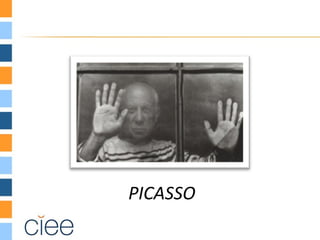
PICASSO
•   Was born in Málaga, Andalucía, Spain.

•   His father was a painter and art professor. Picasso received
    formal artistic training from his father in figure drawing and oil
    painting.

•   1891. His father saw him painting over his unfinished sketch of a
    pigeon. Picasso’s father felt that his 13 year old son had
    surpassed him.

•   1895 they moved to Barcelona, where his father took a position
    at its School of Fine Arts. He persuaded the officials at the
    academy to allow his son to take an entrance exam for the
    advanced class.


This process often took students a month, but Picasso completed it
      in a day, and the impressed jury admitted him; he was 13.
First known painting of Picasso:
       He was 8 years old
Plaster male torso
       1893
“Academical study” 1895
“The old fisherman” 1895
“The Quarries” 1895
“The first Communion” 1895
“Portrait of aunt Pepa”
•   Picasso’s father decided to send him to Madrid’s Royal Academy
    of San Fernando, the country's prime art school, he was 16.
”Head of a man in el
    Greco style”
•   Picasso made his first trip to Paris, the art capital of Europe at
    that time.

•   These were times of severe poverty, cold, and desperation. Much
    of his work was burned to keep his small room warm!
Blue Period 1901 - 1904


•Monochromatic paintings in shades of blue and
blue-green, only occasionally warmed by other
colors.

•Influenced by a journey through Spain and by the
suicide of his friend Carlos Casagemas, in 1901.
La Vie
The old guitarist
The tragedy
The blind
man’s meal
Rose Period 1904 - 1906

•Picasso's painting used cheerful orange and
pink colors in contrast to the cool, somber
tones of the previous Blue Period.

•Picasso was happy in his relationship with
Fernandine Olivier and she was one of the
reasons for him to change his style of
painting.

•The Rose Period has been considered French
influenced, while the Blue Period more
Spanish influenced.

•Picasso often painted clowns, harlequins
and circus performers.
Garçon a la Pipe, 1904

         On May 5, 2004 the painting was sold for US$ 104,168,000
at Sotheby's auction in New York City, breaking the record for the amount paid
                          for an auctioned painting.
Black Period 1907–1909
•African influenced period.

•African artifacts were being brought back to Paris museums in consequence of the
expansion of the French empire into Africa.

•In 1907, Picasso experienced a "revelation" while viewing African art at the
ethnographic museum in Paris.
CUBISM
•Objects are analyzed, broken up and reassembled in an abstracted form—
instead of depicting objects from one viewpoint, the artist depicts the subject
from a multitude of viewpoints to represent the subject in a greater context.

•In 1907 Picasso painted “The Ladies of Avignon” considered the origins of
Cubism
5 nude female
   prostitutes from
a brothel in Barcelona.


Influence of African art


    Abandonment of
 perspective in favor of a
        flat, two-
dimensional picture plane


First time in European
       art History
First use of collage in fine art
Classicism & Surrealism
•In the period following the disorder of World War I, Picasso produced work in
a neoclassical style.
“Classicism”
“Classicism”
“Classicism”
Surrealism
Surrealism
The Guernica
• Created in response to the bombing of Guernica by German and Italian warplanes during
the Spanish Civil War.

• The Spanish Republican government commissioned Picasso to create a large mural for
the Spanish display at the Paris International Exposition at the 1937 World's Fair in Paris.

• Shows the tragedies of war and the suffering it inflicts upon individuals, particularly
innocent civilians.

• It’s now an anti-war symbol.
The Guernica

• Grey, black and white, 3.5 metres (11 ft) tall
and 7.8 metres (25.6 ft) wide.

•The overall scene is within a room where, at an
open end on the left, a wide-eyed bull stands
over a woman grieving over a dead child in her
arms.
The Guernica


•The centre is occupied by a horse falling in
agony as it had just been run through by a spear
or javelin. The large gaping wound in the horse's
side is a major focus of the painting.
The Guernica

Under the horse is a dead,
apparently dismembered soldier;
his hand on a severed arm still
grasps a shattered sword from
which a flower grows.
The Guernica


•On the open palm of the dead soldier is a
stigma, a symbol of martyrdom derived from
the stigmata of Christ.
The Guernica

• A light bulb blazes in the
shape of an evil eye over the
suffering horse's head (the
bare bulb of the torturer's cell)
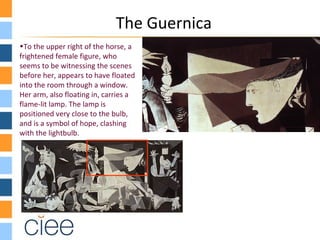
The Guernica
•To the upper right of the horse, a
frightened female figure, who
seems to be witnessing the scenes
before her, appears to have floated
into the room through a window.
Her arm, also floating in, carries a
flame-lit lamp. The lamp is
positioned very close to the bulb,
and is a symbol of hope, clashing
with the lightbulb.
The Guernica


•Daggers that suggest screaming
replace the tongues of the bull,
grieving woman, and horse.
The Guernica


•On the far right, a figure with arms
raised in terror is entrapped by fire
from above and below.
Guernica tapestry UN, New York
On 5 February 2003 a large blue curtain was placed to cover this work at the UN,
 so that it would not be visible in the background whenColin Powell and John
          Negroponte gave press conferences at the United Nations.

       Bush Administration pressured UN officials to cover the tapestry

Picasso y cubismo

  • 1.
  • 2.
    Was born in Málaga, Andalucía, Spain. • His father was a painter and art professor. Picasso received formal artistic training from his father in figure drawing and oil painting. • 1891. His father saw him painting over his unfinished sketch of a pigeon. Picasso’s father felt that his 13 year old son had surpassed him. • 1895 they moved to Barcelona, where his father took a position at its School of Fine Arts. He persuaded the officials at the academy to allow his son to take an entrance exam for the advanced class. This process often took students a month, but Picasso completed it in a day, and the impressed jury admitted him; he was 13.
  • 3.
    First known paintingof Picasso: He was 8 years old
  • 4.
  • 5.
  • 6.
  • 7.
  • 8.
  • 9.
  • 10.
    Picasso’s father decided to send him to Madrid’s Royal Academy of San Fernando, the country's prime art school, he was 16.
  • 12.
    ”Head of aman in el Greco style”
  • 13.
    Picasso made his first trip to Paris, the art capital of Europe at that time. • These were times of severe poverty, cold, and desperation. Much of his work was burned to keep his small room warm!
  • 14.
    Blue Period 1901- 1904 •Monochromatic paintings in shades of blue and blue-green, only occasionally warmed by other colors. •Influenced by a journey through Spain and by the suicide of his friend Carlos Casagemas, in 1901.
  • 20.
  • 21.
  • 22.
  • 23.
  • 24.
    Rose Period 1904- 1906 •Picasso's painting used cheerful orange and pink colors in contrast to the cool, somber tones of the previous Blue Period. •Picasso was happy in his relationship with Fernandine Olivier and she was one of the reasons for him to change his style of painting. •The Rose Period has been considered French influenced, while the Blue Period more Spanish influenced. •Picasso often painted clowns, harlequins and circus performers.
  • 29.
    Garçon a laPipe, 1904 On May 5, 2004 the painting was sold for US$ 104,168,000 at Sotheby's auction in New York City, breaking the record for the amount paid for an auctioned painting.
  • 30.
    Black Period 1907–1909 •Africaninfluenced period. •African artifacts were being brought back to Paris museums in consequence of the expansion of the French empire into Africa. •In 1907, Picasso experienced a "revelation" while viewing African art at the ethnographic museum in Paris.
  • 32.
    CUBISM •Objects are analyzed,broken up and reassembled in an abstracted form— instead of depicting objects from one viewpoint, the artist depicts the subject from a multitude of viewpoints to represent the subject in a greater context. •In 1907 Picasso painted “The Ladies of Avignon” considered the origins of Cubism
  • 33.
    5 nude female prostitutes from a brothel in Barcelona. Influence of African art Abandonment of perspective in favor of a flat, two- dimensional picture plane First time in European art History
  • 35.
    First use ofcollage in fine art
  • 36.
    Classicism & Surrealism •Inthe period following the disorder of World War I, Picasso produced work in a neoclassical style.
  • 37.
  • 38.
  • 39.
  • 40.
  • 41.
  • 42.
    The Guernica • Createdin response to the bombing of Guernica by German and Italian warplanes during the Spanish Civil War. • The Spanish Republican government commissioned Picasso to create a large mural for the Spanish display at the Paris International Exposition at the 1937 World's Fair in Paris. • Shows the tragedies of war and the suffering it inflicts upon individuals, particularly innocent civilians. • It’s now an anti-war symbol.
  • 43.
    The Guernica • Grey,black and white, 3.5 metres (11 ft) tall and 7.8 metres (25.6 ft) wide. •The overall scene is within a room where, at an open end on the left, a wide-eyed bull stands over a woman grieving over a dead child in her arms.
  • 44.
    The Guernica •The centreis occupied by a horse falling in agony as it had just been run through by a spear or javelin. The large gaping wound in the horse's side is a major focus of the painting.
  • 45.
    The Guernica Under thehorse is a dead, apparently dismembered soldier; his hand on a severed arm still grasps a shattered sword from which a flower grows.
  • 46.
    The Guernica •On theopen palm of the dead soldier is a stigma, a symbol of martyrdom derived from the stigmata of Christ.
  • 47.
    The Guernica • Alight bulb blazes in the shape of an evil eye over the suffering horse's head (the bare bulb of the torturer's cell)
  • 48.
    The Guernica •To theupper right of the horse, a frightened female figure, who seems to be witnessing the scenes before her, appears to have floated into the room through a window. Her arm, also floating in, carries a flame-lit lamp. The lamp is positioned very close to the bulb, and is a symbol of hope, clashing with the lightbulb.
  • 49.
    The Guernica •Daggers thatsuggest screaming replace the tongues of the bull, grieving woman, and horse.
  • 50.
    The Guernica •On thefar right, a figure with arms raised in terror is entrapped by fire from above and below.
  • 51.
    Guernica tapestry UN,New York On 5 February 2003 a large blue curtain was placed to cover this work at the UN, so that it would not be visible in the background whenColin Powell and John Negroponte gave press conferences at the United Nations. Bush Administration pressured UN officials to cover the tapestry