Louise Barwell loubar@ceh.ac.uk
WP3 Team: Beth Purse, Dan Chapman, Ana Perez-Sierra,
Beatrice Henricot, Mariella Marzano, Michael Dunn,
David Cooke, Sarah Green
Phytothreats:
WP 3 overview
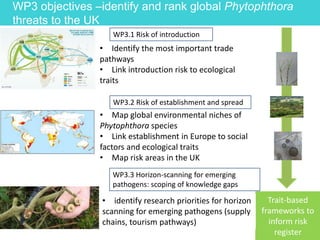
WP3 objectives –identify and rank global Phytophthora
threats to the UK
WP3.1 Risk of introduction
WP3.3 Horizon-scanning for emerging
pathogens: scoping of knowledge gaps
WP3.2 Risk of establishment and spread
Trait-based
frameworks to
inform risk
register
• Identify the most important trade
pathways
• Link introduction risk to ecological
traits
• Map global environmental niches of
Phytophthora species
• Link establishment in Europe to social
factors and ecological traits
• Map risk areas in the UK
• identify research priorities for horizon
scanning for emerging pathogens (supply
chains, tourism pathways)
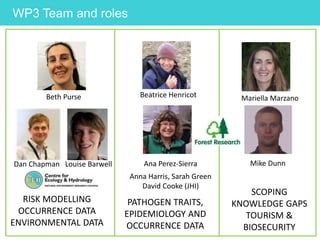
WP3 Team and roles
Beatrice Henricot
PATHOGEN TRAITS,
EPIDEMIOLOGY AND
OCCURRENCE DATA
Mariella Marzano
Mike Dunn
SCOPING
KNOWLEDGE GAPS
TOURISM &
BIOSECURITY
Beth Purse
Dan Chapman Louise Barwell
RISK MODELLING
OCCURRENCE DATA
ENVIRONMENTAL DATA
Ana Perez-Sierra
Anna Harris, Sarah Green
David Cooke (JHI)
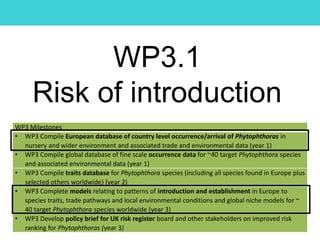
WP3.1
Risk of introduction
WP3 Milestones
• WP3 Compile European database of country level occurrence/arrival of Phytophthoras in
nursery and wider environment and associated trade and environmental data (year 1)
• WP3 Compile global database of fine scale occurrence data for ~40 target Phytophthora species
and associated environmental data (year 1)
• WP3 Compile traits database for Phytophthora species (including all species found in Europe plus
selected others worldwide) (year 2)
• WP3 Complete models relating to patterns of introduction and establishment in Europe to
species traits, trade pathways and local environmental conditions and global niche models for ~
40 target Phytophthora species worldwide (year 3)
• WP3 Develop policy brief for UK risk register board and other stakeholders on improved risk
ranking for Phytophthoras (year 3)
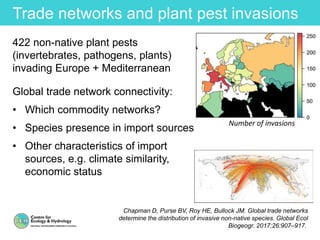
Trade networks and plant pest invasions
422 non-native plant pests
(invertebrates, pathogens, plants)
invading Europe + Mediterranean
Global trade network connectivity:
• Which commodity networks?
• Species presence in import sources
• Other characteristics of import
sources, e.g. climate similarity,
economic status
Chapman D, Purse BV, Roy HE, Bullock JM. Global trade networks
determine the distribution of invasive non-native species. Global Ecol
Biogeogr. 2017;26:907–917.
Number of invasions
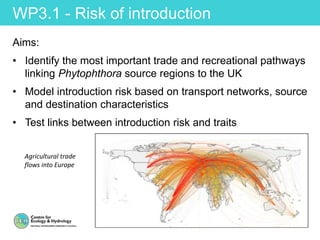
WP3.1 - Risk of introduction
Aims:
• Identify the most important trade and recreational pathways
linking Phytophthora source regions to the UK
• Model introduction risk based on transport networks, source
and destination characteristics
• Test links between introduction risk and traits
Agricultural trade
flows into Europe
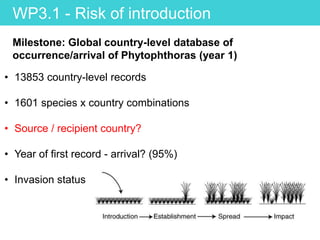
Milestone: Global country-level database of
occurrence/arrival of Phytophthoras (year 1)
• 13853 country-level records
• 1601 species x country combinations
• Source / recipient country?
• Year of first record - arrival? (95%)
• Invasion status
WP3.1 - Risk of introduction
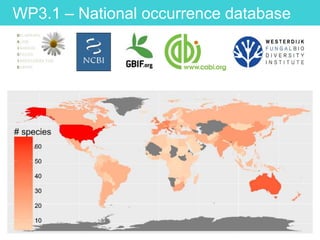
WP3.1 – National occurrence database
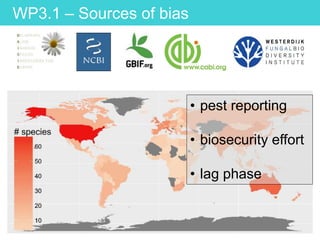
WP3.1 – Sources of bias
• pest reporting
• biosecurity effort
• lag phase
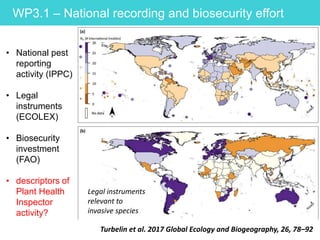
WP3.1 – National recording and biosecurity effort
• National pest
reporting
activity (IPPC)
• Legal
instruments
(ECOLEX)
• Biosecurity
investment
(FAO)
• descriptors of
Plant Health
Inspector
activity?
Turbelin et al. 2017 Global Ecology and Biogeography, 26, 78–92
Legal instruments
relevant to
invasive species
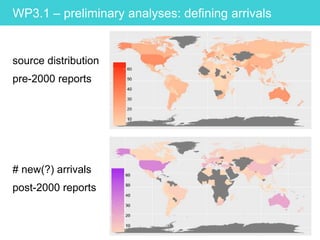
WP3.1 – preliminary analyses: defining arrivals
source distribution
pre-2000 reports
# new(?) arrivals
post-2000 reports
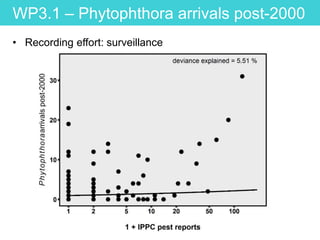
WP3.1 – preliminary analyses: first models
Response
# Phytophthora arrivals per country since 2000
Predictors
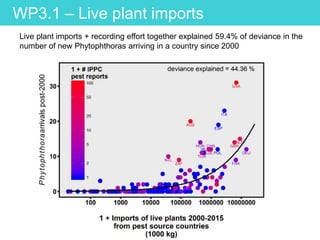
trade connectivity to pest source countries
(total imports of live plants)
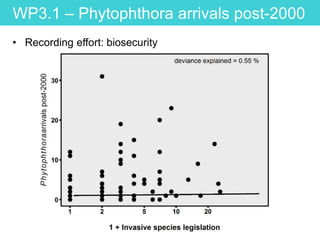
Biosecurity effort
(# pieces of invasive species legislation)
Surveillance effort
(# official pest reports - IPPC)
WP3.1 – Phytophthora arrivals post-2000
• Recording effort: surveillance
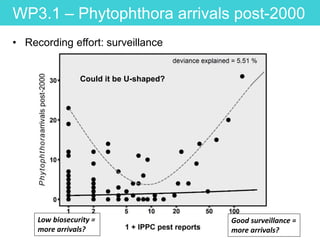
WP3.1 – Phytophthora arrivals post-2000
• Recording effort: surveillance
Low biosecurity =
more arrivals?
Good surveillance =
more arrivals?
Could it be U-shaped?
WP3.1 – Phytophthora arrivals post-2000
• Recording effort: biosecurity
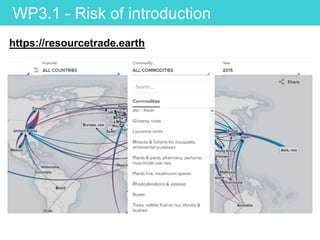
WP3.1 – Live plant imports
Live plant imports + recording effort together explained 59.4% of deviance in the
number of new Phytophthoras arriving in a country since 2000
https://resourcetrade.earth
WP3.1 - Risk of introduction
Plan for WP3.1 – Risk of introduction
Collate further (historical and projected?) trade-networks data
Arrivals at the species-level
Incorporate environmental suitability and species traits
Estimate arrival risk to the UK (different species and trade
scenarios)
WP3 Milestones
• WP3 Compile European database of country level occurrence/arrival of Phytophthoras in
nursery and wider environment and associated trade and environmental data (year 1)
• WP3 Compile global database of fine scale occurrence data for ~40 target Phytophthora species
and associated environmental data (year 1)
• WP3 Compile traits database for Phytophthora species (including all species found in Europe plus
selected others worldwide) (year 2)
• WP3 Complete models relating to patterns of introduction and establishment in Europe to
species traits, trade pathways and local environmental conditions and global niche models for ~
40 target Phytophthora species worldwide (year 3)
• WP3 Develop policy brief for UK risk register board and other stakeholders on improved risk
ranking for Phytophthoras (year 3)
WP3.2
Risk of establishment and
spread
WP3 Milestones
• WP3 Compile European database of country level occurrence/arrival of Phytophthoras in
nursery and wider environment and associated trade and environmental data (year 1)
• WP3 Compile global database of fine scale occurrence data for ~40 target Phytophthora species
and associated environmental data (year 1)
• WP3 Compile traits database for Phytophthora species (including all species found in Europe plus
selected others worldwide) (year 2)
• WP3 Complete models relating to patterns of introduction and establishment in Europe to
species traits, trade pathways and local environmental conditions and global niche models for ~
40 target Phytophthora species worldwide (year 3)
• WP3 Develop policy brief for UK risk register board and other stakeholders on improved risk
ranking for Phytophthoras (year 3)
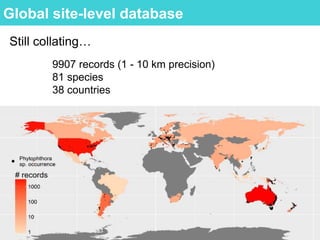
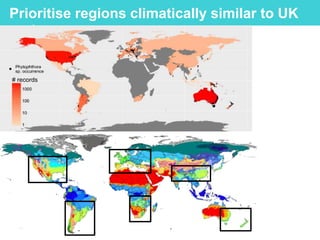
Global site-level database
Still collating…
9907 records (1 - 10 km precision)
81 species
38 countries
Prioritise regions climatically similar to UK
regions
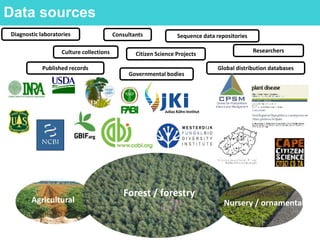
Culture collections Citizen Science Projects
Governmental bodies
Global distribution databases
Data sources
Published records
Diagnostic laboratories Sequence data repositoriesConsultants
Researchers
Agricultural
Forest / forestry
Nursery / ornamental
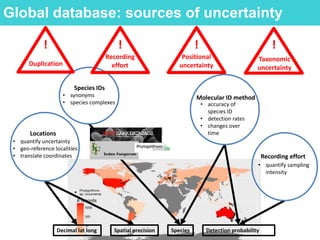
Decimal lat long Species Detection probabilitySpatial precision
• quantify uncertainty
• geo-reference localities
• translate coordinates
Locations
• synonyms
• species complexes
Species IDs
Molecular ID method
• accuracy of
species ID
• detection rates
• changes over
time
• quantify sampling
intensity
Recording effort
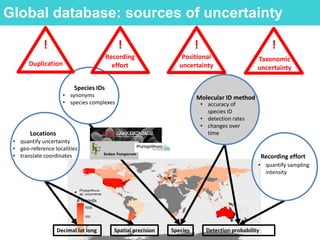
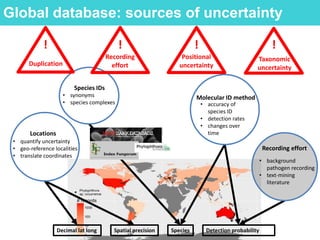
Global database: sources of uncertainty
Recording
effort
!
Taxonomic
uncertainty
!
Duplication
!
Positional
uncertainty
!
Decimal lat long Species Detection probabilitySpatial precision
• quantify uncertainty
• geo-reference localities
• translate coordinates
Locations
• synonyms
• species complexes
Species IDs
Molecular ID method
• accuracy of
species ID
• detection rates
• changes over
time
Global database: sources of uncertainty
Recording
effort
!
Taxonomic
uncertainty
!
Duplication
!
Positional
uncertainty
!
• quantify sampling
intensity
Recording effort
Decimal lat long Species Detection probabilitySpatial precision
• quantify uncertainty
• geo-reference localities
• translate coordinates
Locations
• synonyms
• species complexes
Species IDs
Molecular ID method
• accuracy of
species ID
• detection rates
• changes over
time
Global database: sources of uncertainty
Recording
effort
!
Taxonomic
uncertainty
!
Duplication
!
Positional
uncertainty
!
• background
pathogen recording
• text-mining
literature
Recording effort
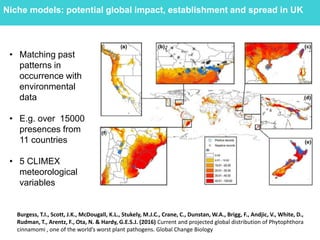
Niche models: potential global impact, establishment and spread in UK
Burgess, T.I., Scott, J.K., McDougall, K.L., Stukely, M.J.C., Crane, C., Dunstan, W.A., Brigg, F., Andjic, V., White, D.,
Rudman, T., Arentz, F., Ota, N. & Hardy, G.E.S.J. (2016) Current and projected global distribution of Phytophthora
cinnamomi , one of the world’s worst plant pathogens. Global Change Biology
• Matching past
patterns in
occurrence with
environmental
data
• E.g. over 15000
presences from
11 countries
• 5 CLIMEX
meteorological
variables
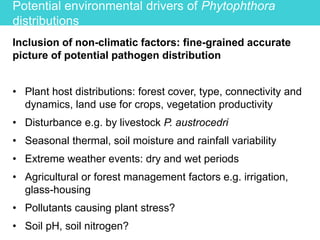
Potential environmental drivers of Phytophthora
distributions
Inclusion of non-climatic factors: fine-grained accurate
picture of potential pathogen distribution
• Plant host distributions: forest cover, type, connectivity and
dynamics, land use for crops, vegetation productivity
• Disturbance e.g. by livestock P. austrocedri
• Seasonal thermal, soil moisture and rainfall variability
• Extreme weather events: dry and wet periods
• Agricultural or forest management factors e.g. irrigation,
glass-housing
• Pollutants causing plant stress?
• Soil pH, soil nitrogen?
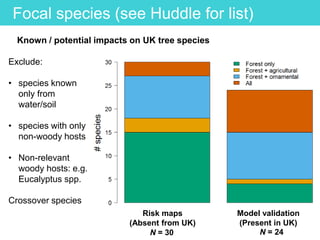
Focal species (see Huddle for list)
Known / potential impacts on UK tree species
Exclude:
• species known
only from
water/soil
• species with only
non-woody hosts
• Non-relevant
woody hosts: e.g.
Eucalyptus spp.
Crossover species
Risk maps
(Absent from UK)
Model validation
(Present in UK)
N = 24N = 30
WP3 Milestones
• WP3 Compile European database of country level occurrence/arrival of Phytophthoras in
nursery and wider environment and associated trade and environmental data (year 1)
• WP3 Compile global database of fine scale occurrence data for ~40 target Phytophthora species
and associated environmental data (year 1)
• WP3 Compile traits database for Phytophthora species (including all species found in Europe plus
selected others worldwide) (year 2)
• WP3 Complete models relating to patterns of introduction and establishment in Europe to
species traits, trade pathways and local environmental conditions and global niche models for ~
40 target Phytophthora species worldwide (year 3)
• WP3 Develop policy brief for UK risk register board and other stakeholders on improved risk
ranking for Phytophthoras (year 3)
Plan for WP3.2 – Risk of establishment and spread
Continue site-level data collation
Process environmental data
Develop preliminary global niche modelling methods (December 2017)
UK risk maps
WP3.1 & WP3.2
A global Phytophthora trait
database
WP3 Milestones
• WP3 Compile European database of country level occurrence/arrival of Phytophthoras in
nursery and wider environment and associated trade and environmental data (year 1)
• WP3 Compile global database of fine scale occurrence data for ~40 target Phytophthora species
and associated environmental data (year 1)
• WP3 Compile traits database for Phytophthora species (including all species found in Europe plus
selected others worldwide) (year 2)
• WP3 Complete models relating to patterns of introduction and establishment in Europe to
species traits, trade pathways and local environmental conditions and global niche models for ~
40 target Phytophthora species worldwide (year 3)
• WP3 Develop policy brief for UK risk register board and other stakeholders on improved risk
ranking for Phytophthoras (year 3)
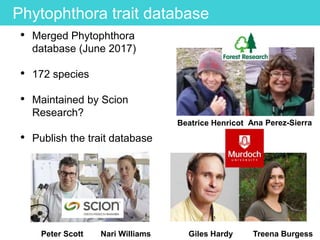
• Merged Phytophthora
database (June 2017)
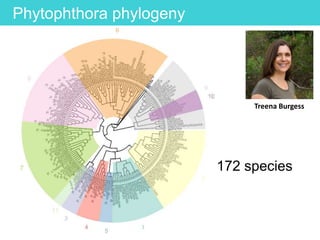
• 172 species
• Maintained by Scion
Research?
• Publish the trait database
Phytophthora trait database
Peter Scott Nari Williams Giles Hardy Treena Burgess
Ana Perez-SierraBeatrice Henricot
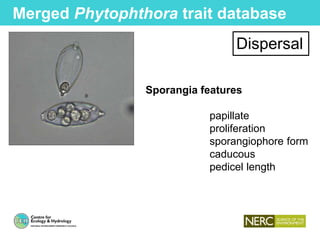
Merged Phytophthora trait database
Sporangia features
papillate
proliferation
sporangiophore form
caducous
pedicel length
Dispersal
Merged Phytophthora trait database
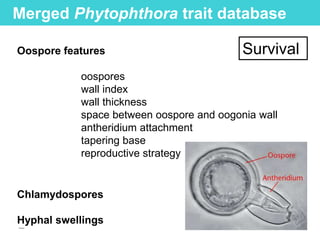
Oospore features
oospores
wall index
wall thickness
space between oospore and oogonia wall
antheridium attachment
tapering base
reproductive strategy
Survival
Chlamydospores
Hyphal swellings
Merged Phytophthora trait database
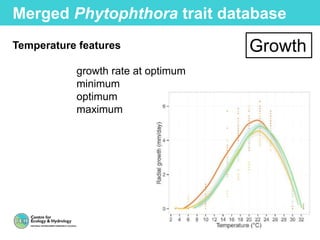
Temperature features
growth rate at optimum
minimum
optimum
maximum
Growth
Merged Phytophthora trait database
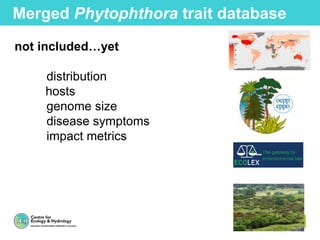
not included…yet
distribution
hosts
genome size
disease symptoms
impact metrics
Phytophthora trait database publication
Potential questions:
What is the value of trait data for
pathogens?
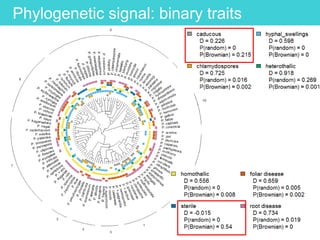
Is there a phylogenetic signal in
individual traits or groups of
traits?
Do hybrids share traits with parent taxa?
Phytophthora phylogeny
Treena Burgess
172 species
Phylogenetic signal: binary traits
Quantifying phylogenetic signal
• Need a null model of trait evolution
• Commonly a Brownian Motion model
• What is an appropriate model of trait
evolution for Phytophthora?
Global impact of Phytophthora
• Can species traits explain the global impact of Phytophthora
species?
- Phytophthora trait database (170 species)
- Global impact metrics
• Do Phytophthora trait syndromes outperform individual traits
as predictors of global impact?
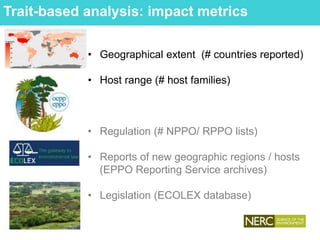
Trait-based analysis: impact metrics
• Geographical extent (# countries reported)
• Host range (# host families)
• Regulation (# NPPO/ RPPO lists)
• Reports of new geographic regions / hosts
(EPPO Reporting Service archives)
• Legislation (ECOLEX database)
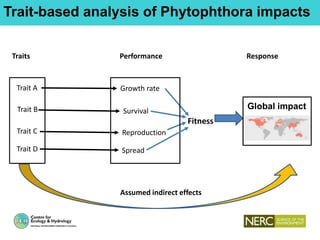
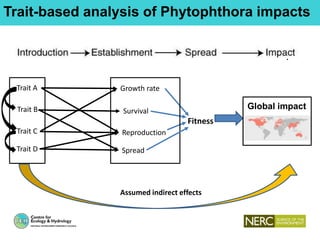
Trait-based analysis of Phytophthora impacts
Fitness
Trait A
Trait B
Trait C
Growth rate
Survival
Reproduction
Global impact
SpreadTrait D
Traits Performance Response
Assumed indirect effects
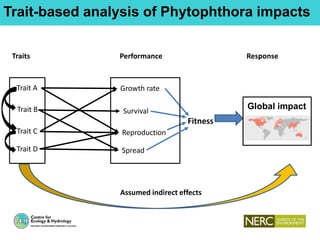
Trait-based analysis of Phytophthora impacts
Fitness
Trait A
Trait B
Trait C
Growth rate
Survival
Reproduction
Global impact
SpreadTrait D
Traits Performance Response
Assumed indirect effects
Trait-based analysis of Phytophthora impacts
Fitness
Trait A
Trait B
Trait C
Growth rate
Survival
Reproduction
Global impact
SpreadTrait D
Traits Invasion fi Performance Response
Assumed indirect effects
Global impact of Phytophthora
• Can species traits explain the global impact of Phytophthora
species?
- Phytophthora trait database (170 species)
- Global impact metrics
• Do Phytophthora trait syndromes outperform individual traits
as predictors of global impact?
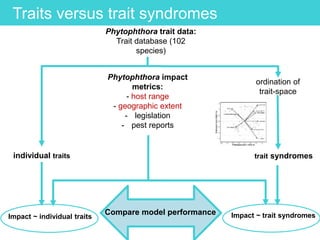
Traits versus trait syndromes
Phytophthora trait data:
Trait database (102
species)
ordination of
trait-space
trait syndromesindividual traits
Compare model performance
Impact ~ individual traits Impact ~ trait syndromes
Phytophthora impact
metrics:
- host range
- geographic extent
- legislation
- pest reports
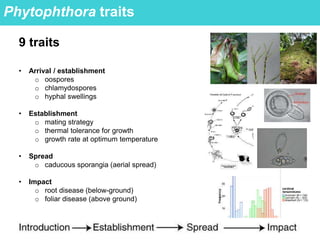
Phytophthora traits
9 traits
• Arrival / establishment
o oospores
o chlamydospores
o hyphal swellings
• Establishment
o mating strategy
o thermal tolerance for growth
o growth rate at optimum temperature
• Spread
o caducous sporangia (aerial spread)
• Impact
o root disease (below-ground)
o foliar disease (above ground)
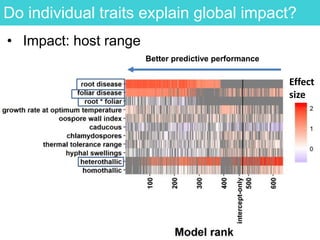
Do individual traits explain global impact?
• Impact: host range
Better predictive performance
Effect
size
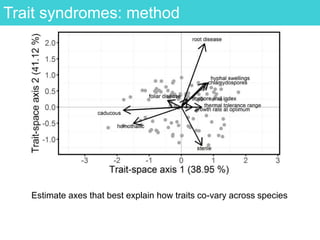
Trait syndromes: method
Estimate axes that best explain how traits co-vary across species
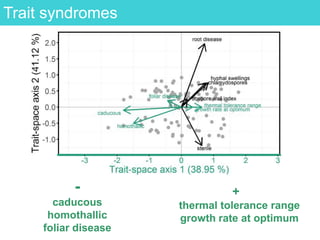
-
caducous
homothallic
foliar disease
+
thermal tolerance range
growth rate at optimum
Trait syndromes
-
sterile
+
root disease
heterothallic
Trait syndromes
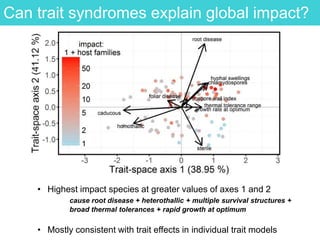
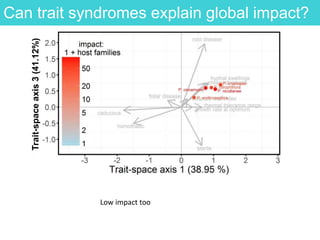
Can trait syndromes explain global impact?
• Highest impact species at greater values of axes 1 and 2
cause root disease + heterothallic + multiple survival structures +
broad thermal tolerances + rapid growth at optimum
• Mostly consistent with trait effects in individual trait models
Can trait syndromes explain global impact?
Trait-spaceaxis3(41.12%)
Low impact too
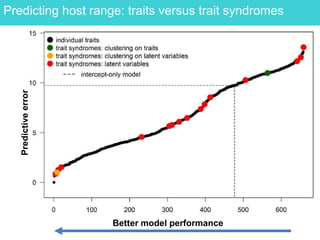
Predicting host range: traits versus trait syndromes
Better model performance
Predictiveerror
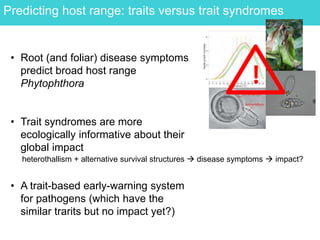
Predicting host range: traits versus trait syndromes
• Root (and foliar) disease symptoms
predict broad host range
Phytophthora
• Trait syndromes are more
ecologically informative about their
global impact
• A trait-based early-warning system
for pathogens (which have the
similar trarits but no impact yet?)
!
heterothallism + alternative survival structures  disease symptoms  impact?
Milestones: Plan for next 12 months
• Publish trait database and phylogenetic analyses
• Submit paper linking traits and global impact (November 2017)
• Global occurrence and environmental databases (ongoing)
• Fine-tune trade models and begin preliminary niche modelling
approaches (December 2017)
• Co-develop final model outputs with policy makers
WP3 Milestones
• WP3 Compile European database of country level occurrence/arrival of Phytophthoras in
nursery and wider environment and associated trade and environmental data (year 1)
• WP3 Compile global database of fine scale occurrence data for ~40 target Phytophthora species
and associated environmental data (year 1)
• WP3 Compile traits database for Phytophthora species (including all species found in Europe plus
selected others worldwide) (year 2)
• WP3 Complete models relating to patterns of introduction and establishment in Europe to
species traits, trade pathways and local environmental conditions and global niche models for ~
40 target Phytophthora species worldwide (year 3)
• WP3 Develop policy brief for UK risk register board and other stakeholders on improved risk
ranking for Phytophthoras (year 3)
A thank you to our funders
and all those who have kindly
shared their data
Acknowledgements

Phytothreats: WP 3 overview

  • 1.
    Louise Barwell loubar@ceh.ac.uk WP3Team: Beth Purse, Dan Chapman, Ana Perez-Sierra, Beatrice Henricot, Mariella Marzano, Michael Dunn, David Cooke, Sarah Green Phytothreats: WP 3 overview
  • 2.
    WP3 objectives –identifyand rank global Phytophthora threats to the UK WP3.1 Risk of introduction WP3.3 Horizon-scanning for emerging pathogens: scoping of knowledge gaps WP3.2 Risk of establishment and spread Trait-based frameworks to inform risk register • Identify the most important trade pathways • Link introduction risk to ecological traits • Map global environmental niches of Phytophthora species • Link establishment in Europe to social factors and ecological traits • Map risk areas in the UK • identify research priorities for horizon scanning for emerging pathogens (supply chains, tourism pathways)
  • 3.
    WP3 Team androles Beatrice Henricot PATHOGEN TRAITS, EPIDEMIOLOGY AND OCCURRENCE DATA Mariella Marzano Mike Dunn SCOPING KNOWLEDGE GAPS TOURISM & BIOSECURITY Beth Purse Dan Chapman Louise Barwell RISK MODELLING OCCURRENCE DATA ENVIRONMENTAL DATA Ana Perez-Sierra Anna Harris, Sarah Green David Cooke (JHI)
  • 4.
    WP3.1 Risk of introduction WP3Milestones • WP3 Compile European database of country level occurrence/arrival of Phytophthoras in nursery and wider environment and associated trade and environmental data (year 1) • WP3 Compile global database of fine scale occurrence data for ~40 target Phytophthora species and associated environmental data (year 1) • WP3 Compile traits database for Phytophthora species (including all species found in Europe plus selected others worldwide) (year 2) • WP3 Complete models relating to patterns of introduction and establishment in Europe to species traits, trade pathways and local environmental conditions and global niche models for ~ 40 target Phytophthora species worldwide (year 3) • WP3 Develop policy brief for UK risk register board and other stakeholders on improved risk ranking for Phytophthoras (year 3)
  • 5.
    Trade networks andplant pest invasions 422 non-native plant pests (invertebrates, pathogens, plants) invading Europe + Mediterranean Global trade network connectivity: • Which commodity networks? • Species presence in import sources • Other characteristics of import sources, e.g. climate similarity, economic status Chapman D, Purse BV, Roy HE, Bullock JM. Global trade networks determine the distribution of invasive non-native species. Global Ecol Biogeogr. 2017;26:907–917. Number of invasions
  • 6.
    WP3.1 - Riskof introduction Aims: • Identify the most important trade and recreational pathways linking Phytophthora source regions to the UK • Model introduction risk based on transport networks, source and destination characteristics • Test links between introduction risk and traits Agricultural trade flows into Europe
  • 7.
    Milestone: Global country-leveldatabase of occurrence/arrival of Phytophthoras (year 1) • 13853 country-level records • 1601 species x country combinations • Source / recipient country? • Year of first record - arrival? (95%) • Invasion status WP3.1 - Risk of introduction
  • 8.
    WP3.1 – Nationaloccurrence database
  • 9.
    WP3.1 – Sourcesof bias • pest reporting • biosecurity effort • lag phase
  • 10.
    WP3.1 – Nationalrecording and biosecurity effort • National pest reporting activity (IPPC) • Legal instruments (ECOLEX) • Biosecurity investment (FAO) • descriptors of Plant Health Inspector activity? Turbelin et al. 2017 Global Ecology and Biogeography, 26, 78–92 Legal instruments relevant to invasive species
  • 11.
    WP3.1 – preliminaryanalyses: defining arrivals source distribution pre-2000 reports # new(?) arrivals post-2000 reports
  • 12.
    WP3.1 – preliminaryanalyses: first models Response # Phytophthora arrivals per country since 2000 Predictors trade connectivity to pest source countries (total imports of live plants) Biosecurity effort (# pieces of invasive species legislation) Surveillance effort (# official pest reports - IPPC)
  • 13.
    WP3.1 – Phytophthoraarrivals post-2000 • Recording effort: surveillance
  • 14.
    WP3.1 – Phytophthoraarrivals post-2000 • Recording effort: surveillance Low biosecurity = more arrivals? Good surveillance = more arrivals? Could it be U-shaped?
  • 15.
    WP3.1 – Phytophthoraarrivals post-2000 • Recording effort: biosecurity
  • 16.
    WP3.1 – Liveplant imports Live plant imports + recording effort together explained 59.4% of deviance in the number of new Phytophthoras arriving in a country since 2000
  • 17.
  • 18.
    Plan for WP3.1– Risk of introduction Collate further (historical and projected?) trade-networks data Arrivals at the species-level Incorporate environmental suitability and species traits Estimate arrival risk to the UK (different species and trade scenarios) WP3 Milestones • WP3 Compile European database of country level occurrence/arrival of Phytophthoras in nursery and wider environment and associated trade and environmental data (year 1) • WP3 Compile global database of fine scale occurrence data for ~40 target Phytophthora species and associated environmental data (year 1) • WP3 Compile traits database for Phytophthora species (including all species found in Europe plus selected others worldwide) (year 2) • WP3 Complete models relating to patterns of introduction and establishment in Europe to species traits, trade pathways and local environmental conditions and global niche models for ~ 40 target Phytophthora species worldwide (year 3) • WP3 Develop policy brief for UK risk register board and other stakeholders on improved risk ranking for Phytophthoras (year 3)
  • 19.
    WP3.2 Risk of establishmentand spread WP3 Milestones • WP3 Compile European database of country level occurrence/arrival of Phytophthoras in nursery and wider environment and associated trade and environmental data (year 1) • WP3 Compile global database of fine scale occurrence data for ~40 target Phytophthora species and associated environmental data (year 1) • WP3 Compile traits database for Phytophthora species (including all species found in Europe plus selected others worldwide) (year 2) • WP3 Complete models relating to patterns of introduction and establishment in Europe to species traits, trade pathways and local environmental conditions and global niche models for ~ 40 target Phytophthora species worldwide (year 3) • WP3 Develop policy brief for UK risk register board and other stakeholders on improved risk ranking for Phytophthoras (year 3)
  • 20.
    Global site-level database Stillcollating… 9907 records (1 - 10 km precision) 81 species 38 countries
  • 21.
    Prioritise regions climaticallysimilar to UK regions
  • 22.
    Culture collections CitizenScience Projects Governmental bodies Global distribution databases Data sources Published records Diagnostic laboratories Sequence data repositoriesConsultants Researchers Agricultural Forest / forestry Nursery / ornamental
  • 23.
    Decimal lat longSpecies Detection probabilitySpatial precision • quantify uncertainty • geo-reference localities • translate coordinates Locations • synonyms • species complexes Species IDs Molecular ID method • accuracy of species ID • detection rates • changes over time • quantify sampling intensity Recording effort Global database: sources of uncertainty Recording effort ! Taxonomic uncertainty ! Duplication ! Positional uncertainty !
  • 24.
    Decimal lat longSpecies Detection probabilitySpatial precision • quantify uncertainty • geo-reference localities • translate coordinates Locations • synonyms • species complexes Species IDs Molecular ID method • accuracy of species ID • detection rates • changes over time Global database: sources of uncertainty Recording effort ! Taxonomic uncertainty ! Duplication ! Positional uncertainty ! • quantify sampling intensity Recording effort
  • 25.
    Decimal lat longSpecies Detection probabilitySpatial precision • quantify uncertainty • geo-reference localities • translate coordinates Locations • synonyms • species complexes Species IDs Molecular ID method • accuracy of species ID • detection rates • changes over time Global database: sources of uncertainty Recording effort ! Taxonomic uncertainty ! Duplication ! Positional uncertainty ! • background pathogen recording • text-mining literature Recording effort
  • 26.
    Niche models: potentialglobal impact, establishment and spread in UK Burgess, T.I., Scott, J.K., McDougall, K.L., Stukely, M.J.C., Crane, C., Dunstan, W.A., Brigg, F., Andjic, V., White, D., Rudman, T., Arentz, F., Ota, N. & Hardy, G.E.S.J. (2016) Current and projected global distribution of Phytophthora cinnamomi , one of the world’s worst plant pathogens. Global Change Biology • Matching past patterns in occurrence with environmental data • E.g. over 15000 presences from 11 countries • 5 CLIMEX meteorological variables
  • 27.
    Potential environmental driversof Phytophthora distributions Inclusion of non-climatic factors: fine-grained accurate picture of potential pathogen distribution • Plant host distributions: forest cover, type, connectivity and dynamics, land use for crops, vegetation productivity • Disturbance e.g. by livestock P. austrocedri • Seasonal thermal, soil moisture and rainfall variability • Extreme weather events: dry and wet periods • Agricultural or forest management factors e.g. irrigation, glass-housing • Pollutants causing plant stress? • Soil pH, soil nitrogen?
  • 28.
    Focal species (seeHuddle for list) Known / potential impacts on UK tree species Exclude: • species known only from water/soil • species with only non-woody hosts • Non-relevant woody hosts: e.g. Eucalyptus spp. Crossover species Risk maps (Absent from UK) Model validation (Present in UK) N = 24N = 30
  • 29.
    WP3 Milestones • WP3Compile European database of country level occurrence/arrival of Phytophthoras in nursery and wider environment and associated trade and environmental data (year 1) • WP3 Compile global database of fine scale occurrence data for ~40 target Phytophthora species and associated environmental data (year 1) • WP3 Compile traits database for Phytophthora species (including all species found in Europe plus selected others worldwide) (year 2) • WP3 Complete models relating to patterns of introduction and establishment in Europe to species traits, trade pathways and local environmental conditions and global niche models for ~ 40 target Phytophthora species worldwide (year 3) • WP3 Develop policy brief for UK risk register board and other stakeholders on improved risk ranking for Phytophthoras (year 3) Plan for WP3.2 – Risk of establishment and spread Continue site-level data collation Process environmental data Develop preliminary global niche modelling methods (December 2017) UK risk maps
  • 30.
    WP3.1 & WP3.2 Aglobal Phytophthora trait database WP3 Milestones • WP3 Compile European database of country level occurrence/arrival of Phytophthoras in nursery and wider environment and associated trade and environmental data (year 1) • WP3 Compile global database of fine scale occurrence data for ~40 target Phytophthora species and associated environmental data (year 1) • WP3 Compile traits database for Phytophthora species (including all species found in Europe plus selected others worldwide) (year 2) • WP3 Complete models relating to patterns of introduction and establishment in Europe to species traits, trade pathways and local environmental conditions and global niche models for ~ 40 target Phytophthora species worldwide (year 3) • WP3 Develop policy brief for UK risk register board and other stakeholders on improved risk ranking for Phytophthoras (year 3)
  • 31.
    • Merged Phytophthora database(June 2017) • 172 species • Maintained by Scion Research? • Publish the trait database Phytophthora trait database Peter Scott Nari Williams Giles Hardy Treena Burgess Ana Perez-SierraBeatrice Henricot
  • 32.
    Merged Phytophthora traitdatabase Sporangia features papillate proliferation sporangiophore form caducous pedicel length Dispersal
  • 33.
    Merged Phytophthora traitdatabase Oospore features oospores wall index wall thickness space between oospore and oogonia wall antheridium attachment tapering base reproductive strategy Survival Chlamydospores Hyphal swellings
  • 34.
    Merged Phytophthora traitdatabase Temperature features growth rate at optimum minimum optimum maximum Growth
  • 35.
    Merged Phytophthora traitdatabase not included…yet distribution hosts genome size disease symptoms impact metrics
  • 36.
    Phytophthora trait databasepublication Potential questions: What is the value of trait data for pathogens? Is there a phylogenetic signal in individual traits or groups of traits? Do hybrids share traits with parent taxa?
  • 37.
  • 38.
  • 39.
    Quantifying phylogenetic signal •Need a null model of trait evolution • Commonly a Brownian Motion model • What is an appropriate model of trait evolution for Phytophthora?
  • 40.
    Global impact ofPhytophthora • Can species traits explain the global impact of Phytophthora species? - Phytophthora trait database (170 species) - Global impact metrics • Do Phytophthora trait syndromes outperform individual traits as predictors of global impact?
  • 41.
    Trait-based analysis: impactmetrics • Geographical extent (# countries reported) • Host range (# host families) • Regulation (# NPPO/ RPPO lists) • Reports of new geographic regions / hosts (EPPO Reporting Service archives) • Legislation (ECOLEX database)
  • 42.
    Trait-based analysis ofPhytophthora impacts Fitness Trait A Trait B Trait C Growth rate Survival Reproduction Global impact SpreadTrait D Traits Performance Response Assumed indirect effects
  • 43.
    Trait-based analysis ofPhytophthora impacts Fitness Trait A Trait B Trait C Growth rate Survival Reproduction Global impact SpreadTrait D Traits Performance Response Assumed indirect effects
  • 44.
    Trait-based analysis ofPhytophthora impacts Fitness Trait A Trait B Trait C Growth rate Survival Reproduction Global impact SpreadTrait D Traits Invasion fi Performance Response Assumed indirect effects
  • 45.
    Global impact ofPhytophthora • Can species traits explain the global impact of Phytophthora species? - Phytophthora trait database (170 species) - Global impact metrics • Do Phytophthora trait syndromes outperform individual traits as predictors of global impact?
  • 46.
    Traits versus traitsyndromes Phytophthora trait data: Trait database (102 species) ordination of trait-space trait syndromesindividual traits Compare model performance Impact ~ individual traits Impact ~ trait syndromes Phytophthora impact metrics: - host range - geographic extent - legislation - pest reports
  • 47.
    Phytophthora traits 9 traits •Arrival / establishment o oospores o chlamydospores o hyphal swellings • Establishment o mating strategy o thermal tolerance for growth o growth rate at optimum temperature • Spread o caducous sporangia (aerial spread) • Impact o root disease (below-ground) o foliar disease (above ground)
  • 48.
    Do individual traitsexplain global impact? • Impact: host range Better predictive performance Effect size
  • 49.
    Trait syndromes: method Estimateaxes that best explain how traits co-vary across species
  • 50.
    - caducous homothallic foliar disease + thermal tolerancerange growth rate at optimum Trait syndromes
  • 51.
  • 52.
    Can trait syndromesexplain global impact? • Highest impact species at greater values of axes 1 and 2 cause root disease + heterothallic + multiple survival structures + broad thermal tolerances + rapid growth at optimum • Mostly consistent with trait effects in individual trait models
  • 53.
    Can trait syndromesexplain global impact? Trait-spaceaxis3(41.12%) Low impact too
  • 54.
    Predicting host range:traits versus trait syndromes Better model performance Predictiveerror
  • 55.
    Predicting host range:traits versus trait syndromes • Root (and foliar) disease symptoms predict broad host range Phytophthora • Trait syndromes are more ecologically informative about their global impact • A trait-based early-warning system for pathogens (which have the similar trarits but no impact yet?) ! heterothallism + alternative survival structures  disease symptoms  impact?
  • 56.
    Milestones: Plan fornext 12 months • Publish trait database and phylogenetic analyses • Submit paper linking traits and global impact (November 2017) • Global occurrence and environmental databases (ongoing) • Fine-tune trade models and begin preliminary niche modelling approaches (December 2017) • Co-develop final model outputs with policy makers WP3 Milestones • WP3 Compile European database of country level occurrence/arrival of Phytophthoras in nursery and wider environment and associated trade and environmental data (year 1) • WP3 Compile global database of fine scale occurrence data for ~40 target Phytophthora species and associated environmental data (year 1) • WP3 Compile traits database for Phytophthora species (including all species found in Europe plus selected others worldwide) (year 2) • WP3 Complete models relating to patterns of introduction and establishment in Europe to species traits, trade pathways and local environmental conditions and global niche models for ~ 40 target Phytophthora species worldwide (year 3) • WP3 Develop policy brief for UK risk register board and other stakeholders on improved risk ranking for Phytophthoras (year 3)
  • 57.
    A thank youto our funders and all those who have kindly shared their data Acknowledgements