WP1 ‐ Distribution, diversity and 
management of Phytophthora in 
UK plant nursery systems
Phyto‐threats project meeting – 04 May 2017
David Cooke, Leighton Pritchard, Peter Thorpe, Eva Randall & Beatrix Clark
Ana Perez, Sarah Green, Debbie Frederickson Matika ‐ Forest Research
Tim Pettit ‐ University of Worcester
Bethan Purse ‐ CEH
Jane Barbrook ‐ APHA
Alexandra Schlenzig ‐ SASA
Opening 2018 
V&A Museum of Design Dundee
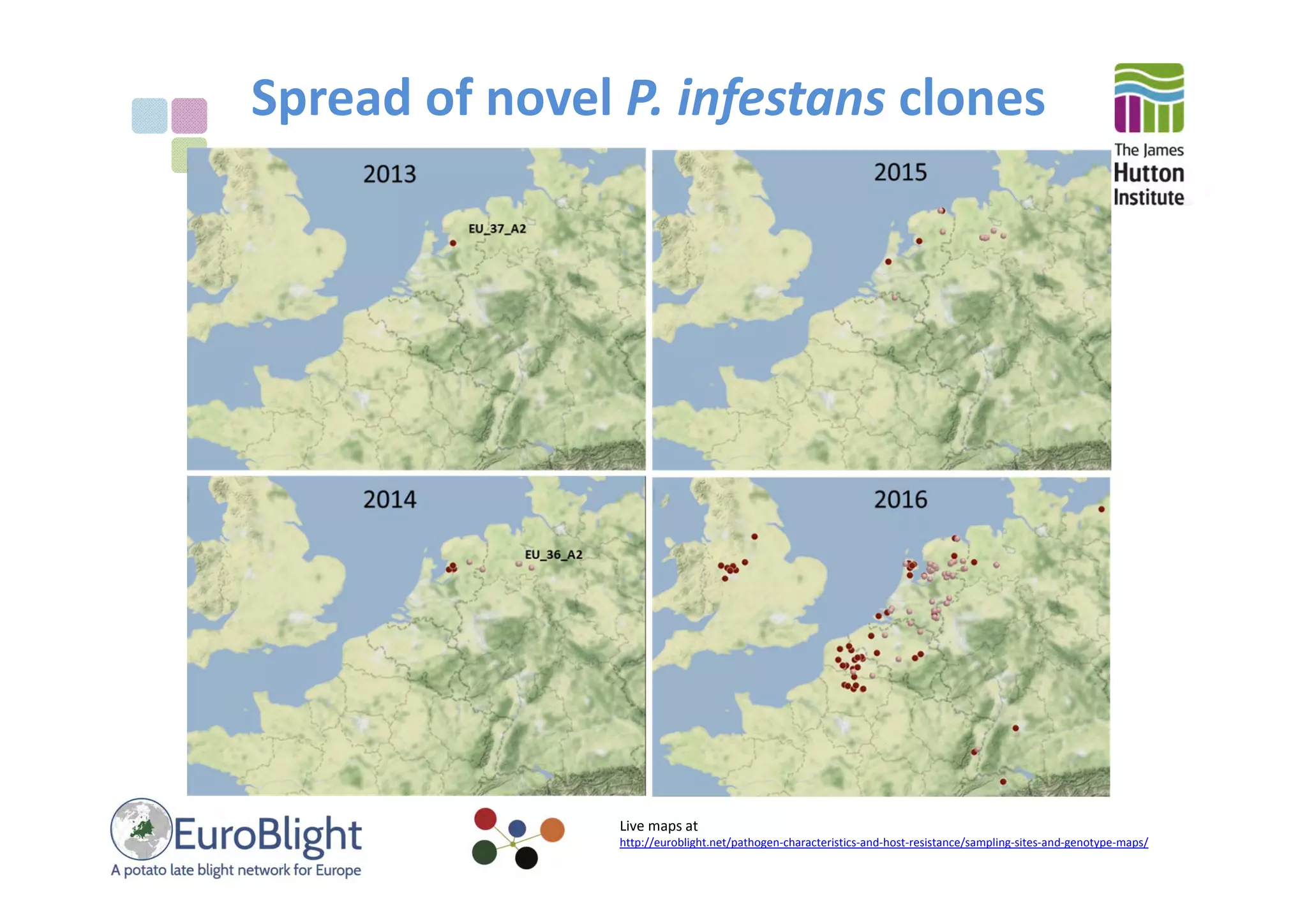
Spread of novel P. infestans clones
Live maps at 
http://euroblight.net/pathogen‐characteristics‐and‐host‐resistance/sampling‐sites‐and‐genotype‐maps/
Objectives
• WP1 objective I – Using metabarcoding to analyse 
community structure in nurseries and associated 
ecosystems 
– Providing a detailed insight into Phytophthora problems to improve 
disease management and advise ‘best practice’
• WP1 objective II – Phytophthora community 
modelling
– Seeking explanations for variation in Phytophthora community 
richness among nurseries – trade, management and ecology
Methods
• Questionnaire – simple (6 questions) to collect basic 
data on nursery practices
• Sampling
– Fine‐scale – testing nurseries by project staff for detailed 
breakdown of management problems and solutions
– Broad‐scale – sampling wider nursery selection alongside statutory 
plant health testing
– OPAL – engagement with community sampling
• Phytophthora detection and metabarcoding
• Computational biology to process large sequence 
datasets 
• Interpretation and provision of feedback to owners 
• Use of data for Community modelling 
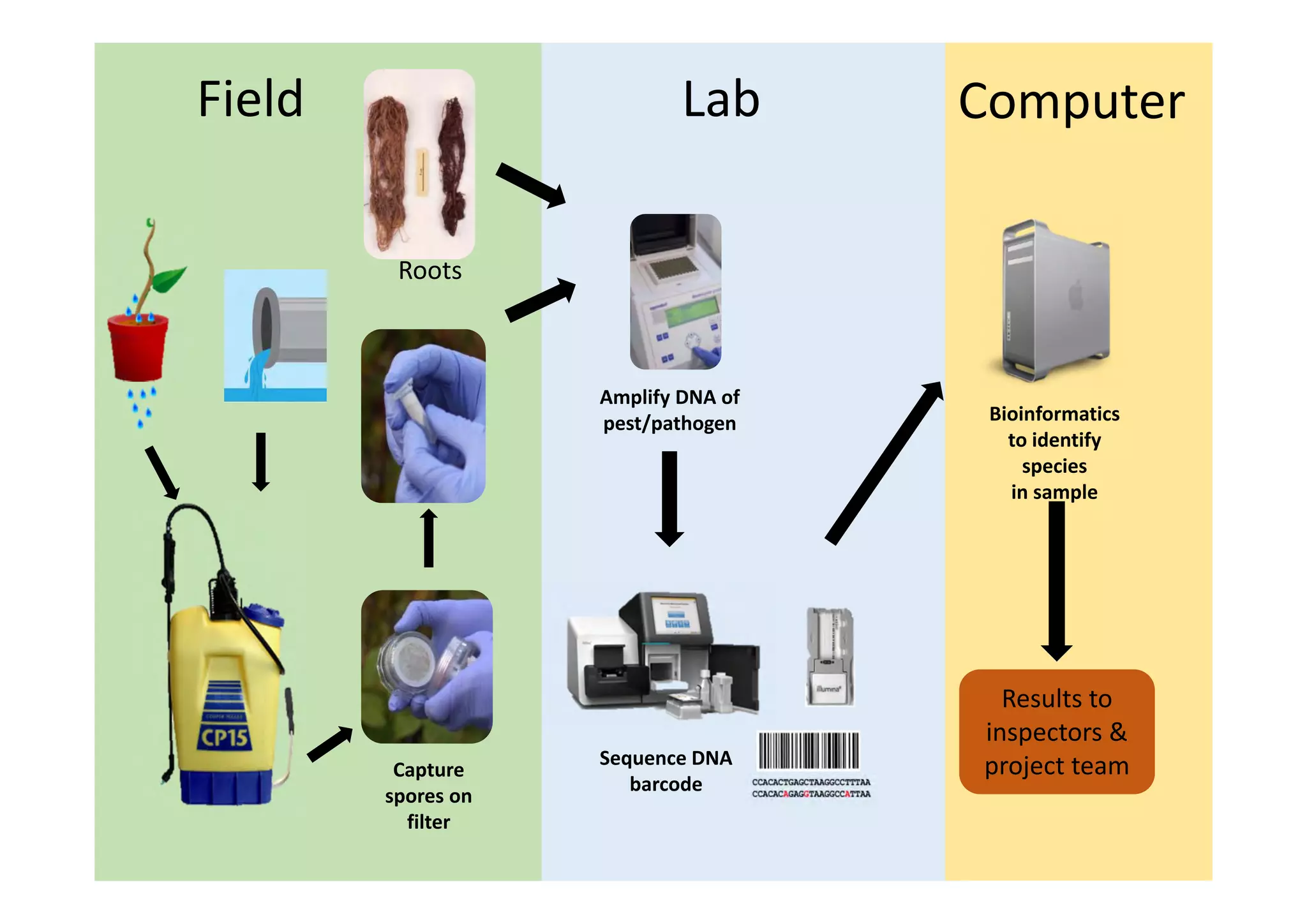
Field
Capture 
spores on 
filter
Amplify DNA of 
pest/pathogen
Sequence DNA 
barcode
Bioinformatics 
to identify 
species
in sample  
Results to 
inspectors & 
project team
Roots
Lab Computer
Sampling – practical issues
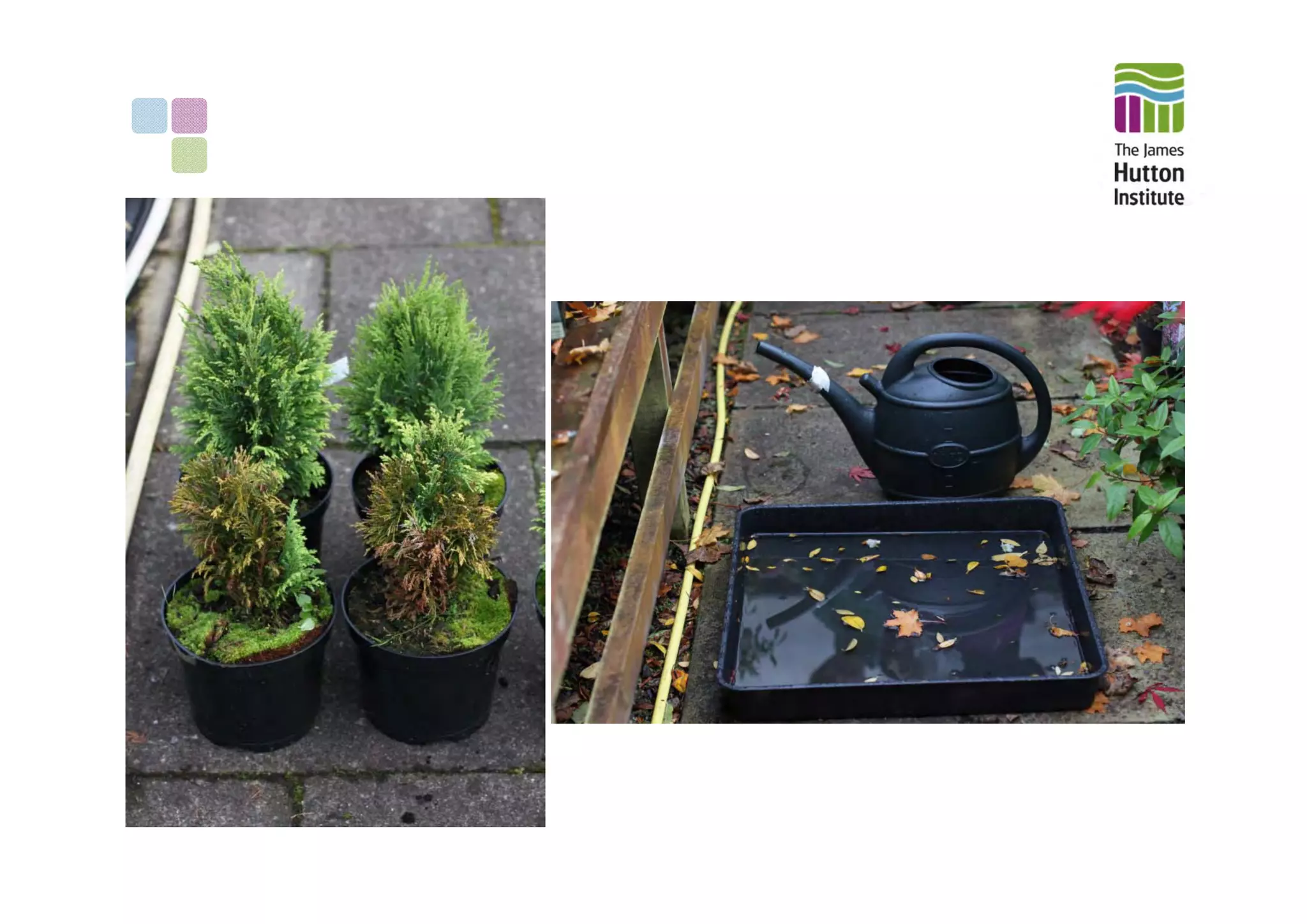
• Hosts – mix of known and unknown
• plant parts – mostly roots
• Water flowing through pots – yes 
but slow
• Symptomatic or asymptomatic? both
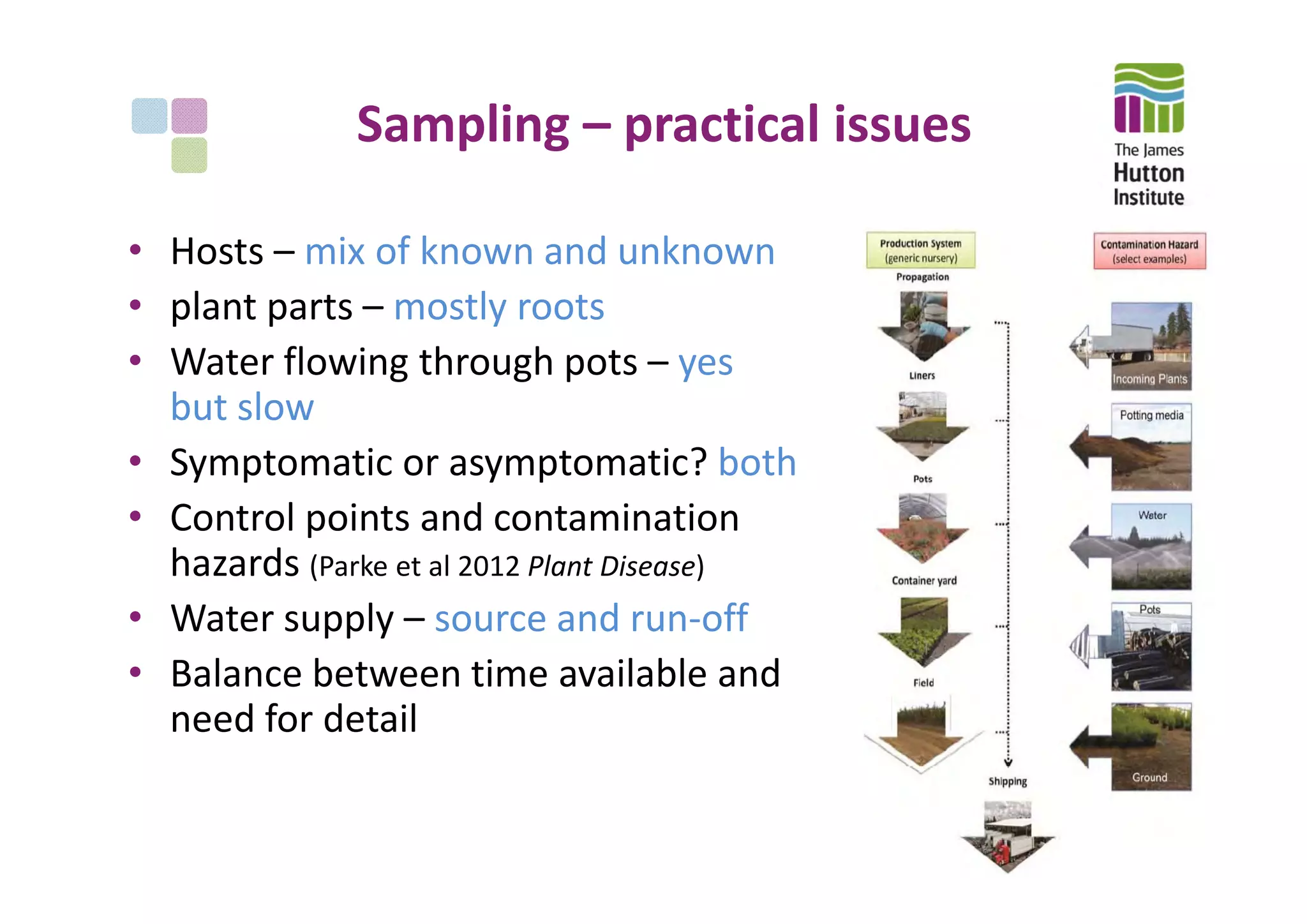
• Control points and contamination 
hazards (Parke et al 2012 Plant Disease) 
• Water supply – source and run‐off
• Balance between time available and 
need for detail
Work programme
• Nursery survey – questionnaires and leaflets
• Fine‐scale sampling of 10 ‘partner nurseries’
– Critical control points sampled over three years, feedback provided 
and the effect of mitigations examined
• Broad‐scale sampling as part of statutory testing by 
PMU and APHA
– Approx 200 samples from 50 nurseries/garden centres England & 
Wales and 25 in Scotland to be sampled twice
• OPAL project – co‐operation with David Slawson and 
staff associated with this project – community 
sampling and engagement in particular areas of 
recent planting/ regeneration
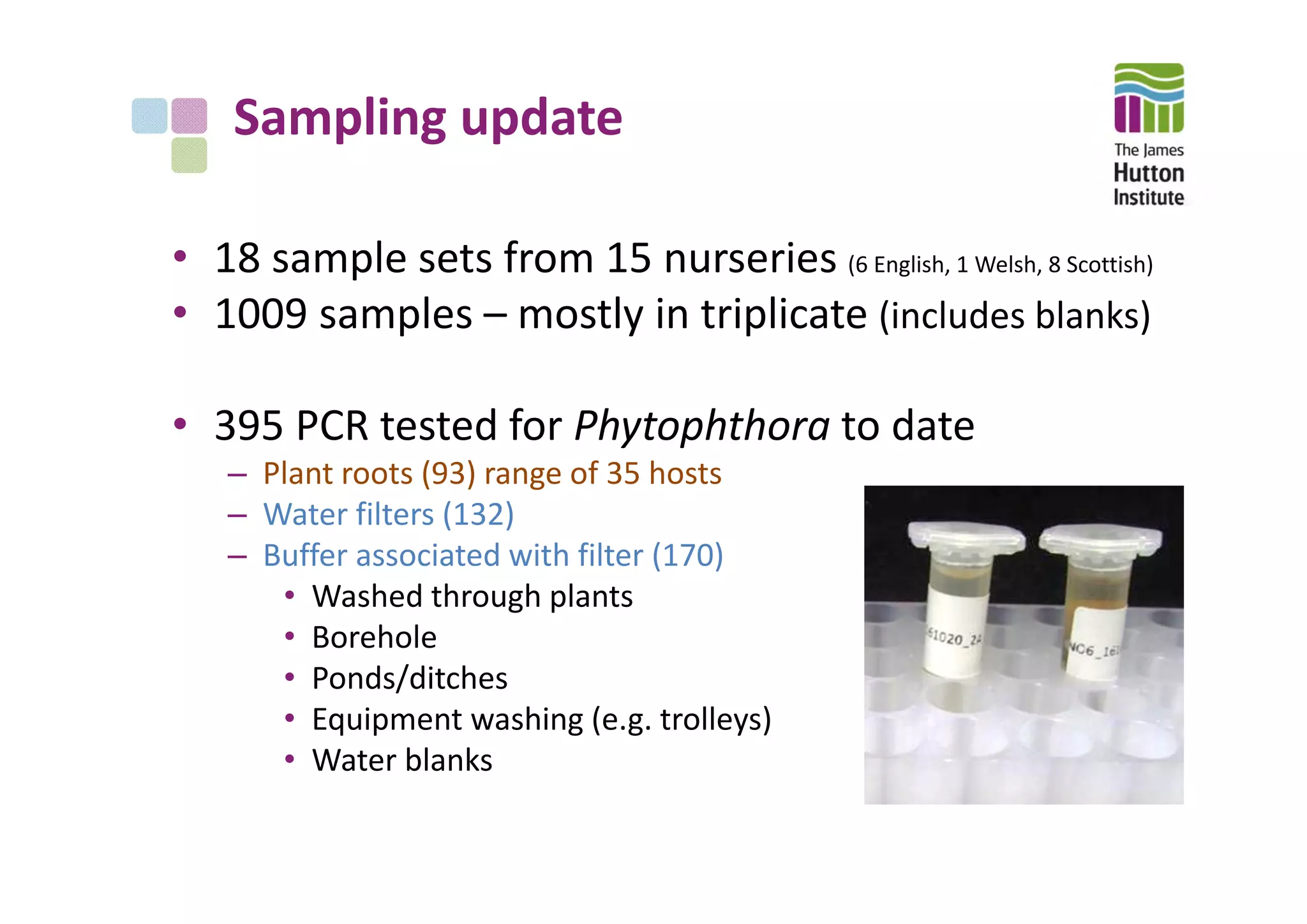
Sampling update
• 18 sample sets from 15 nurseries (6 English, 1 Welsh, 8 Scottish)
• 1009 samples – mostly in triplicate (includes blanks)
• 395 PCR tested for Phytophthora to date 
– Plant roots (93) range of 35 hosts
– Water filters (132)
– Buffer associated with filter (170)
• Washed through plants
• Borehole
• Ponds/ditches
• Equipment washing (e.g. trolleys)
• Water blanks
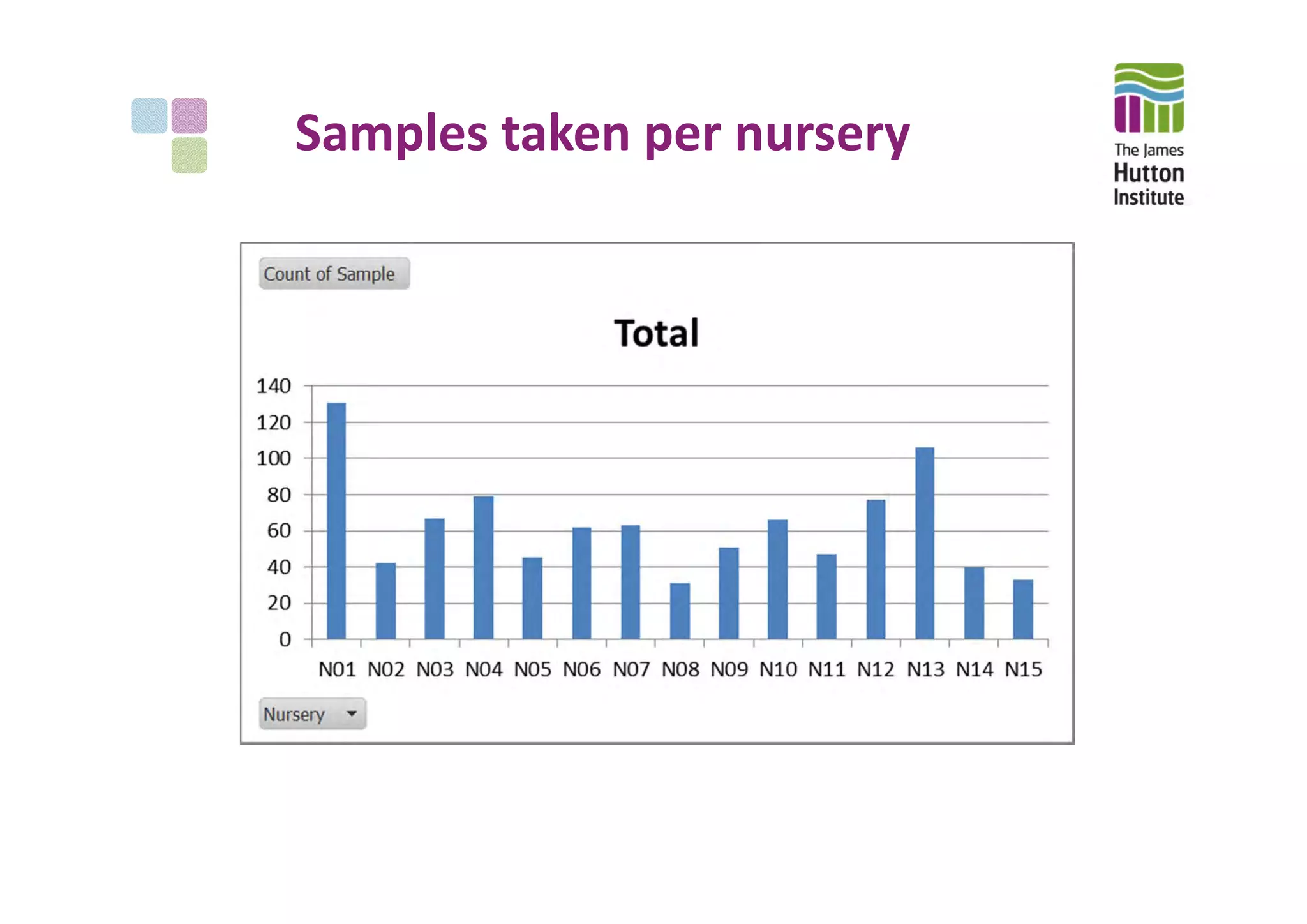
Samples taken per nursery
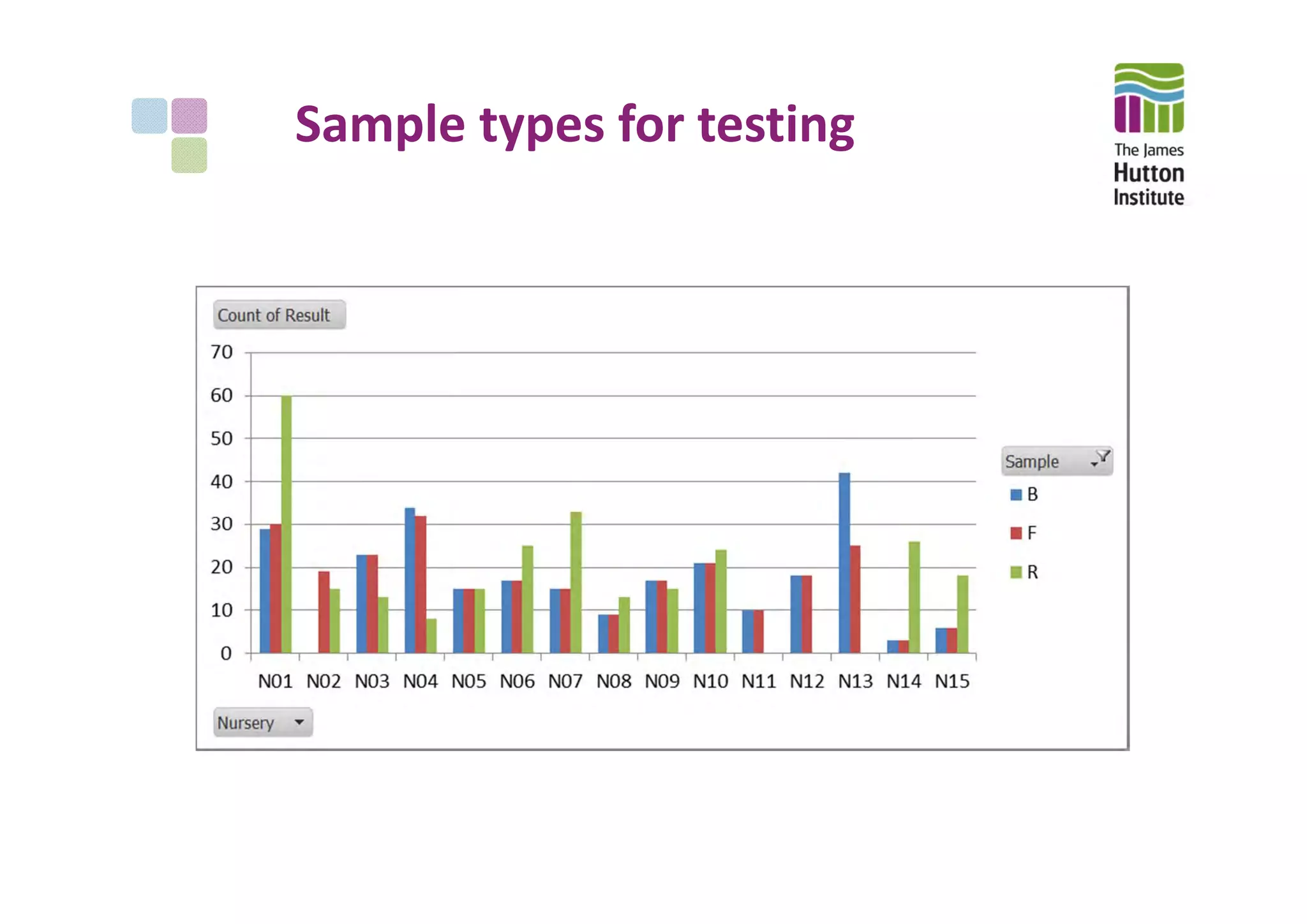
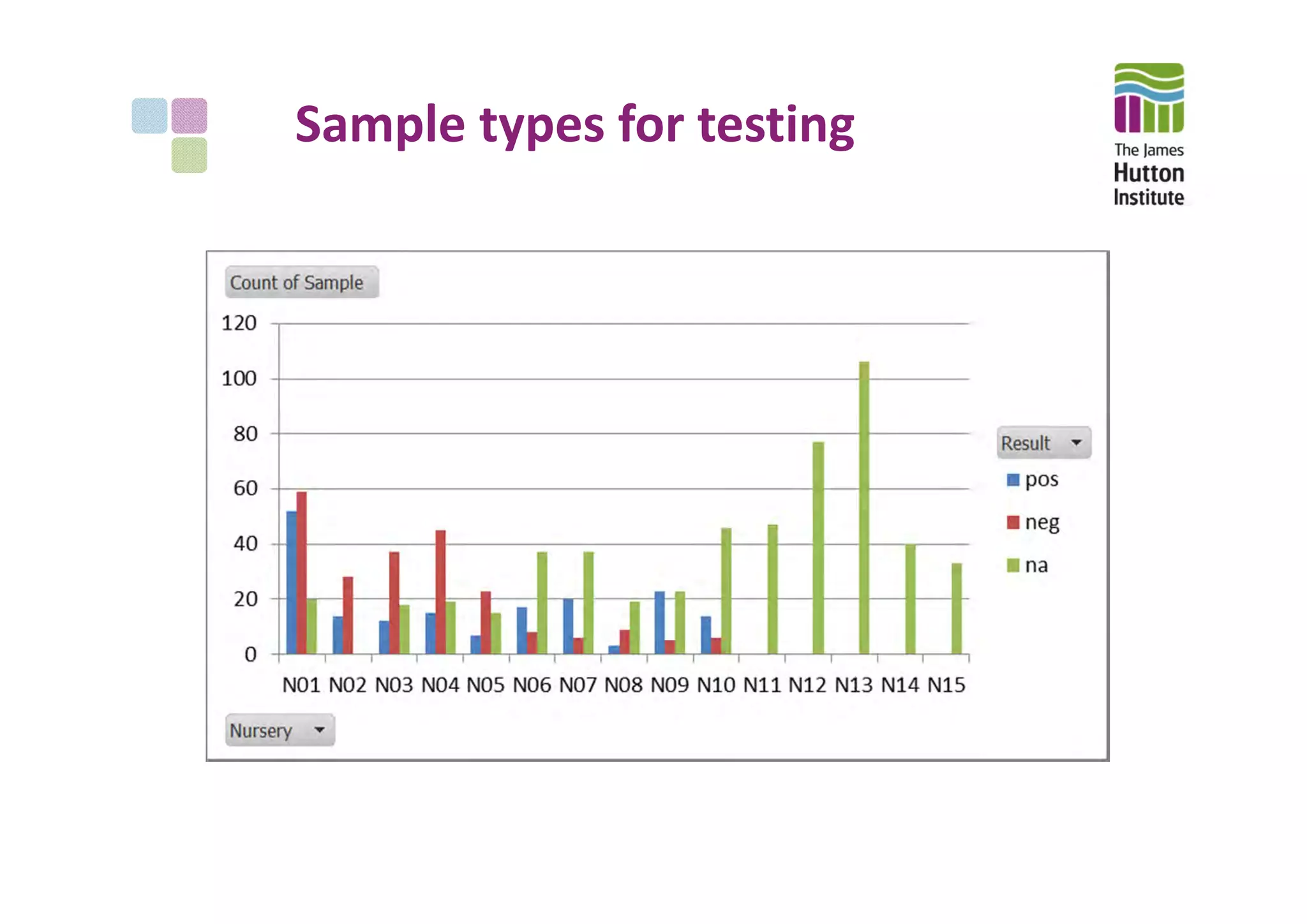
Sample types for testing
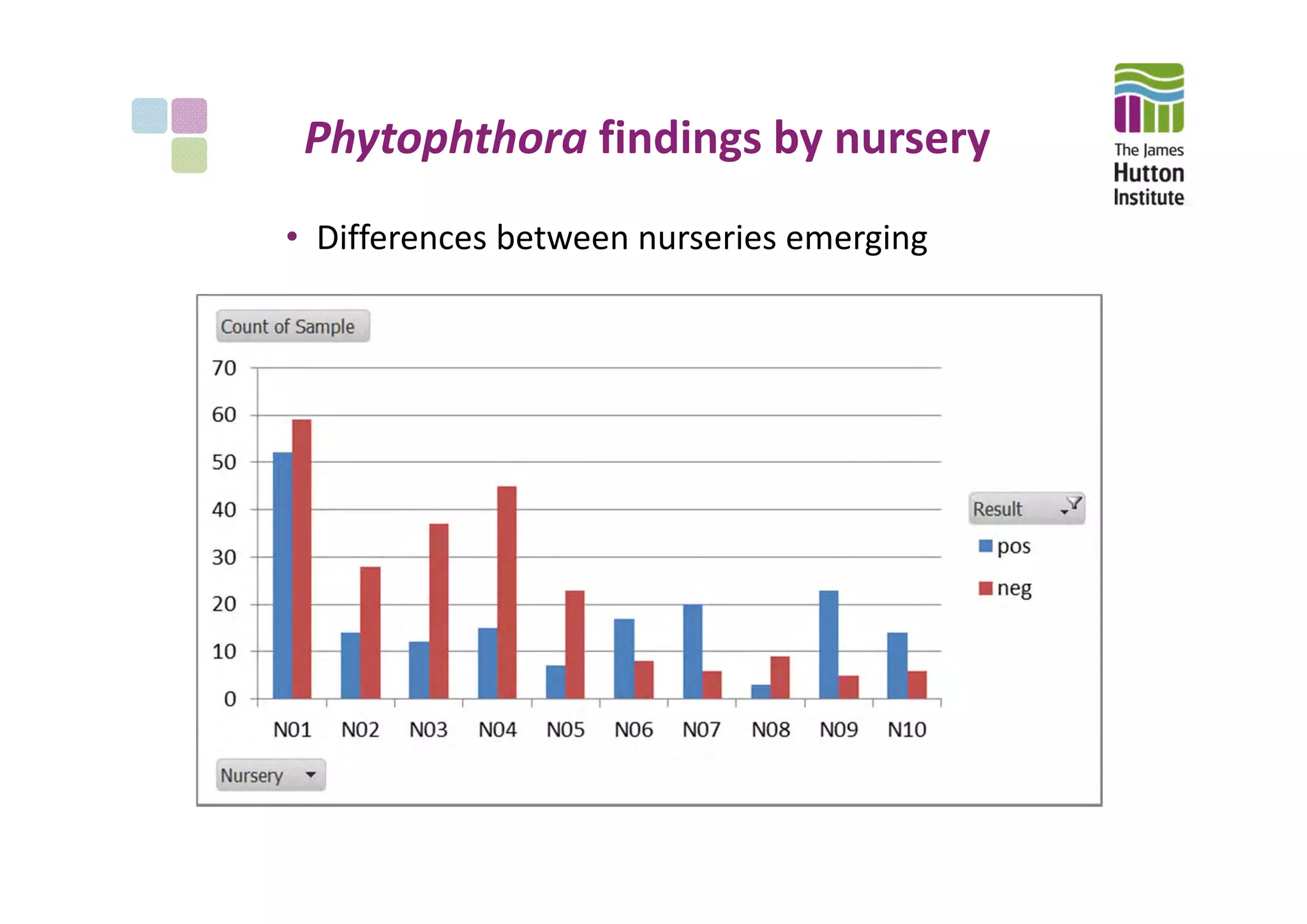
Phytophthora findings by nursery
• Differences between nurseries emerging
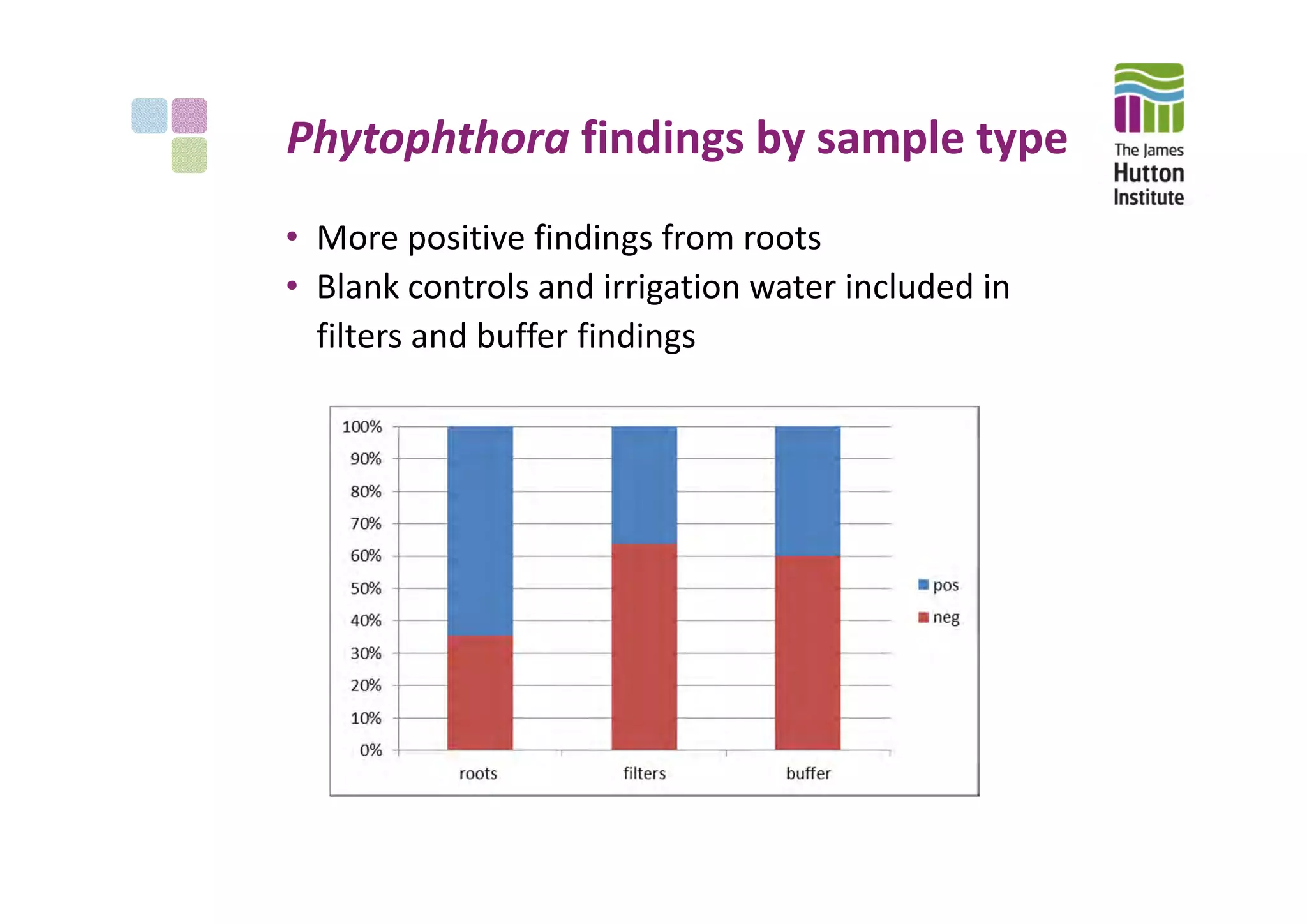
Phytophthora findings by sample type
• More positive findings from roots
• Blank controls and irrigation water included in 
filters and buffer findings
Types of nursery
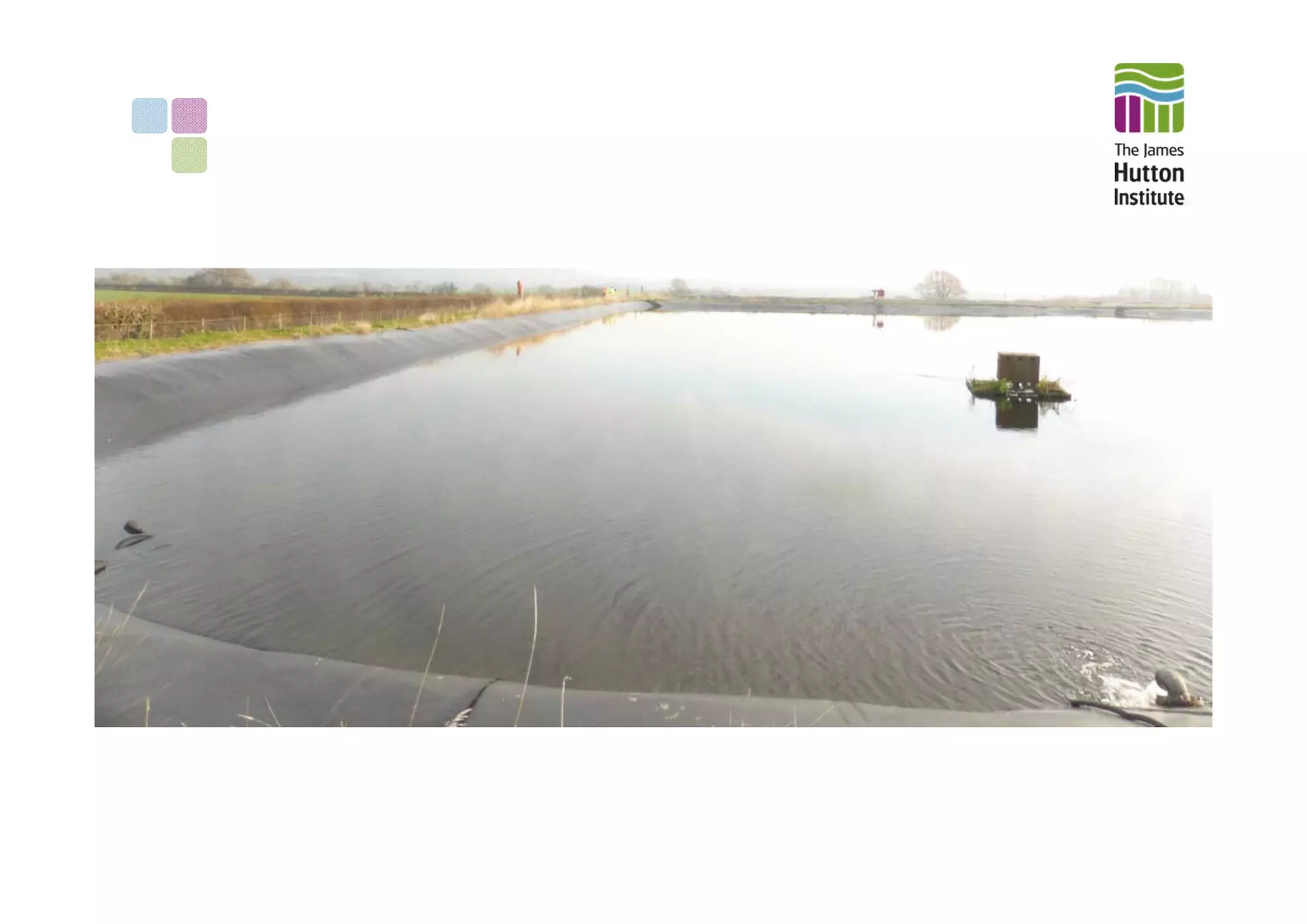
• Water – mostly borehole; some mains water (plus rainwater) 
or river water (‘filtered’)
• Plants all above‐ground in cells  ‐ to all on or in ground
• Production – From holding nurseries/wholesalers importing 
most stock to entire production of native plants on site 
• Garden centres/nurseries, trees only, mixed 
amenity/horticulture and hedgerow trees 
• Generally good awareness of plant health issues but fungicide 
use widespread
Next steps
Sampling
• Broad‐scale ‐ APHA and PMU – sample instructions 
and pack drafted for 2017 sampling
• OPAL – Co‐ordinating with David Slawson and 
Vanessa Barber ‐ samples to be collected with 
communities via contact points in Plymouth, 
Cardiff, North Wales and Glasgow 
• Resample fine‐scale nurseries once results known
Sample extraction 
• Extract all root samples
• Decision on buffer versus filter extraction
Next steps
Illumina run (May 2017)
• Selection of 176 positive findings for first Illumina 
run
• 250 base pair reads,  15M barcode reads = 156K 
reads per sample
• Synthetic control sequences generated to be 
included in Illumina run as a test of a) sequencing 
error rate, b) indexing error c) sensitivity range
• Pipeline …. Pete Thorpe
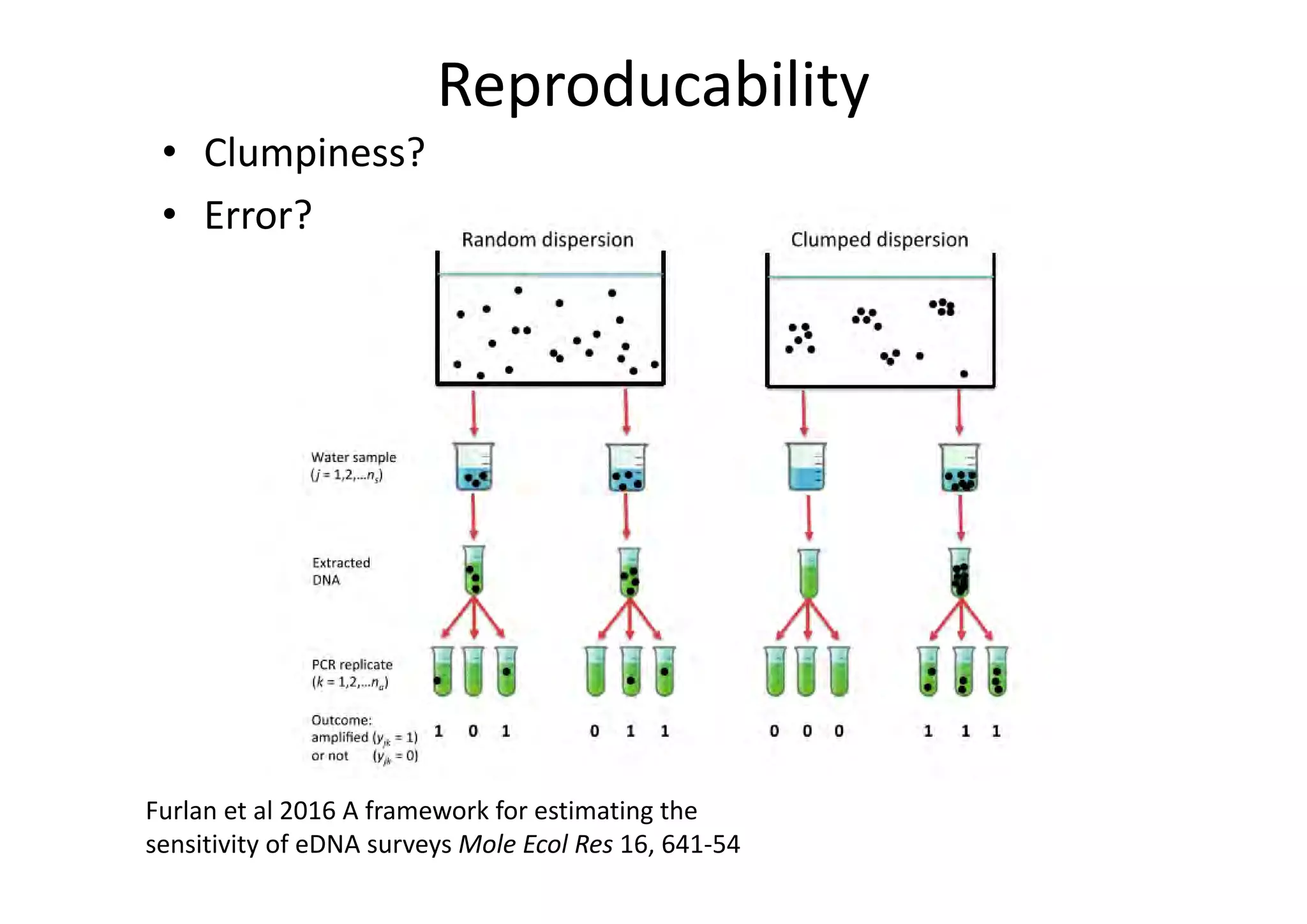
Reproducability
Furlan et al 2016 A framework for estimating the 
sensitivity of eDNA surveys Mole Ecol Res 16, 641‐54
• Clumpiness?
• Error?

WP1 Phytophthora distribution, diversity and management in UK nursery systems