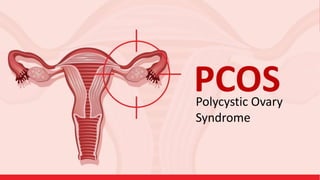
PCOS
Polycystic Ovary
Syndrome
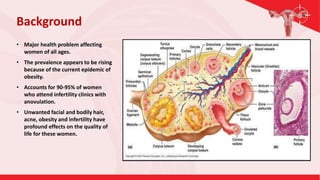
• Major health problem affecting
women of all ages.
• The prevalence appears to be rising
because of the current epidemic of
obesity.
• Accounts for 90-95% of women
who attend infertility clinics with
anovulation.
• Unwanted facial and bodily hair,
acne, obesity and infertility have
profound effects on the quality of
life for these women.
Background
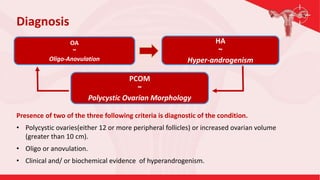
Presence of two of the three following criteria is diagnostic of the condition.
• Polycystic ovaries(either 12 or more peripheral follicles) or increased ovarian volume
(greater than 10 cm).
• Oligo or anovulation.
• Clinical and/ or biochemical evidence of hyperandrogenism.
OA
~
Oligo-Anovulation
HA
~
Hyper-androgenism
PCOM
~
Polycystic Ovarian Morphology
Diagnosis
Diagnosis can only be made when other aetiologies
have been excluded :
• Thyroid dysfunction.
• Congenital adrenal hyperplasia (CAH).
• Hyperprolactinaemia.
• Androgen-secreting tumours.
• Cushing syndrome.
Diagnosis of PCOS
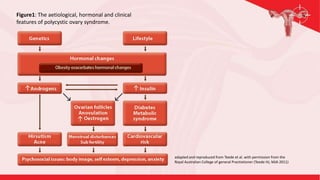
Figure1: The aetiological, hormonal and clinical
features of polycystic ovary syndrome.
adapted and reproduced from Teede et al. with permission from the
Royal Australian College of general Practiotioner (Teede HJ, MJA 2011)
Clinical manifestation of PCOD
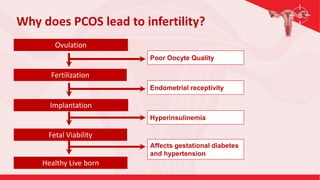
Ovulation
Fertilization
Implantation
Fetal Viability
Healthy Live born
Poor Oocyte Quality
Endometrial receptivity
Hyperinsulinemia
Affects gestational diabetes
and hypertension
Why does PCOS lead to infertility?
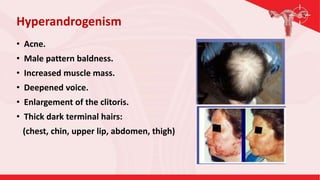
• Acne.
• Male pattern baldness.
• Increased muscle mass.
• Deepened voice.
• Enlargement of the clitoris.
• Thick dark terminal hairs:
(chest, chin, upper lip, abdomen, thigh)
Hyperandrogenism
• Acanthosis Nigricans.
• Skin Tags.
• Abdominal Obesity.
Insulin resistance
• Periods often irregular from the start.
• Periods may be delayed from the start.
• Fewer than nine menstrual periods in a year.
• No menstrual periods for three or more consecutive months.
• Cycles are usually anovulatory, resulting in infertility.
Menstrual dysfunction
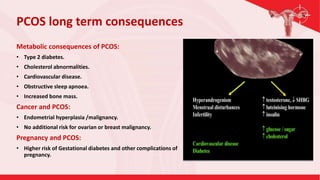
Metabolic consequences of PCOS:
• Type 2 diabetes.
• Cholesterol abnormalities.
• Cardiovascular disease.
• Obstructive sleep apnoea.
• Increased bone mass.
Cancer and PCOS:
• Endometrial hyperplasia /malignancy.
• No additional risk for ovarian or breast malignancy.
Pregnancy and PCOS:
• Higher risk of Gestational diabetes and other complications of
pregnancy.
PCOS long term consequences
• Elevated testosterone.
• Decreased sex hormone binding globulin.
• Elevated LH.
• Elevated LH : FSH ratio.
• Increased fasting insulin.
• Increased prolactin .
• Increased oestrodiol , oestrone
Laboratory tests
PCOS treatment:
What does the patient want?
• Fertility?
• Hirsutism?
• Acne?
• Obesity?
• Irregular periods?
• All off the above!!?
Treatment
Gynaecologist Dietician
Physician/Endocrinologist
Fertility Specialist
Support Groups
Multi-Disciplinary Team
• Diet
• Exercise
• Bariatric surgery may be considered for obese
• PCOS pts.
• Pharmacological Rx
• Bariatric Surgery
Not recommended for
Ovulation Induction
Wt. loss is the first line therapy in obese women with PCOS
Ref. Palomba et.al. Hum. Reprod. 2010 , Nov. 25 :11
Obesity in PCOS-treatmrnt
• 5 % - 10% wt. loss can improve I.R, ovulation rate,
• pregnancy rate even if BMI > normal range
• No consensus on commencement of fertility Rx
• based on optimal BMI.
Ref. Practice Committee of ASRM – Obesity & Reproduction Fertil Steril 2008, 90:S21-9
Contd…
Ref. Clark AM, et. al. Hum Reprod 1998;13:1502-5
It recommends that though BMI of < 35 should be achieved before conception,
“the benefits of postponing pregnancy to achieve wt. loss must be balanced against
risk of declining fertility with advancing age.
Weight loss in infertile obese PCOS
Dietician
• Lifestyle modification
• Moderate exercise (30 minutes
/week)
• Target to normalize BMI
• Reduction of adipose tissue >
Reduces peripheral sites for
Androgen production
• Is the most important aspect of treatment.
• Causes spontaneous resumption of
ovulation
• Improves fertility.
• Increases sex hormone binding globulin
levels.
• Reduces insulin resistance.
• Normalizes the glucose metabolism.
MX of PCOS
• Metabolic control
• IGT / Insulin Resistance
• Risk of Metabolic syndrome secondary to
Obesity
• Higher incidence of Depressive / Anxiety
Disorders
Physician/Endocrinologist
MX of PCOS
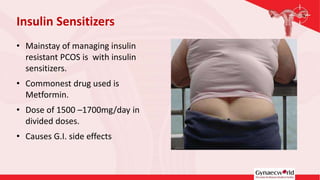
• Mainstay of managing insulin
resistant PCOS is with insulin
sensitizers.
• Commonest drug used is
Metformin.
• Dose of 1500 –1700mg/day in
divided doses.
• Causes G.I. side effects
Insulin Sensitizers
• Metformin is effective as a treatment for anovulatory infertility amongst women with PCOS.
• The clinical pregnancy rate for metformin versus placebo was significantly increased in RCTs
• The advantages of Metformin Vs clomiphene are more.
• Women with PCOS undergoing in vitro fertilisation should be offered metformin to reduce
their risk of ovarian hyperstimulation syndrome.
• Women who have proven to be resistant to clomiphene alone (when clomiphene is used as a
first line agent), the use of metformin alone or in combination with clomiphene is a choice
• Metformin may be a suitable alternative to the OCP for treating hyperandrogenic symptoms
of PCOS including hirsutism and acne.
• Consideration should be given to continuing metformin through the first trimester rather than
stopping metformin abruptly once pregnancy has been diagnosed.
Metformin in PCOS
• There is no clear role for insulin sensitising drugs in
the management of PCOS, and should be restricted to
those patients with IGT or DM-2 rather than those with
just insulin resistance.
• Therefore, on current evidence Metformin is not a first
line treatment of choice in the management of PCOS.
The ESHRE & ASRM Consensus:
Reference: Rotterdam ESHRE/ASRM-Sponsored PCOS Consensus Workshop Group
• two inositol isomers, Myo-inositol (MI) and Dchiro- inositol(DCI), is nutritional supplement
which act as insulin sensitizers
• Decreases circulating insulin & serum total testosterone.
• They act as insulin's secondary messengers and mediate different functions of insulin.
• MI and DCI reduce the levels of luteinizing hormone (LH), LH/FSH ratio and testosterone levels
• MI and DCI can be synergistically integrated by combining them in a ratio of 40:1
• Helps restoring ovulation and normalizing other parameters of PCOS
• improves FSH sensitivity, ovarian function and oocyte development.
• Improves follicles with matured and fertilized oocyte, have higher follicular fluid (FF) volume
• improved oocyte quality in IVF/ICSI
• Reduces acne & weight.
Drug therapy Myo-Inositol and dchiro- inositol
Licensed treatments:
• Oral contraceptive,Dianette , Yasmin.
• Topical facial Eflornithine (Vaniqa).
• Cosmetic measures-
• Weight loss.
Treatment Hirsutism:
Non-Licensed treatments:
• Metformin???.
• Spironolactone and other agents.
• Long acting GnRH analogues.
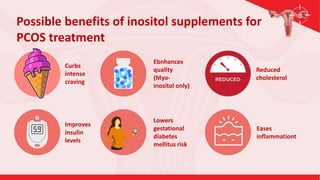
Possible benefits of inositol supplements for
PCOS treatment
Curbs
intense
craving
Improves
insulin
levels
Ebnhances
quality
(Myo-
inositol only)
Lowers
gestational
diabetes
mellitus risk
Reduced
cholesterol
Eases
inflammationt
Fertility treatment in PCOS: an algorithm
• Weight loss 5-10% of body weight (>50% return of ovulatory cycles).
• First line drugs triggers ovulation in 80%.- Clomiphene Citrate /
Tamoxifen.
• Gonadotropin Therapy.
• Metformin /InoFolic.
• Ovarian drilling (reserved for selected anovulatory women with a
normal BMI.)
Treatment of infertility
Hyperandrogenism
Thyroid disease
Hyperprolactinemia
Hypovitaminosis D
Normalize endocrine dysfunction
• First line of treatment is lifestyle improvement. Weight Reduction , exercise,
No smoking/No alcohol
• Inositols may improve insulin sensitivity, ovulation rate and oocyte quality
• Melatonin can be added for regular sleep
• Vitamin D, vitamin B12 and thyroxin could be supplemented if deficient.
• The metabolic and hormonal milieu should be as physiologic as possible and exposure
to pollutants should be kept to a minimum, particularly in the periconceptional
period.
• If a pharmacological treatment is necessary, the same advice could accentuate the
effects of drugs and/or reduce their risks, like multiple pregnancies or ovarian
hyperstimulation syndrome.
Conclusion
PCOS for doctors.pptx

PCOS for doctors.pptx

  • 1.
  • 2.
    • Major healthproblem affecting women of all ages. • The prevalence appears to be rising because of the current epidemic of obesity. • Accounts for 90-95% of women who attend infertility clinics with anovulation. • Unwanted facial and bodily hair, acne, obesity and infertility have profound effects on the quality of life for these women. Background
  • 3.
    Presence of twoof the three following criteria is diagnostic of the condition. • Polycystic ovaries(either 12 or more peripheral follicles) or increased ovarian volume (greater than 10 cm). • Oligo or anovulation. • Clinical and/ or biochemical evidence of hyperandrogenism. OA ~ Oligo-Anovulation HA ~ Hyper-androgenism PCOM ~ Polycystic Ovarian Morphology Diagnosis
  • 5.
    Diagnosis can onlybe made when other aetiologies have been excluded : • Thyroid dysfunction. • Congenital adrenal hyperplasia (CAH). • Hyperprolactinaemia. • Androgen-secreting tumours. • Cushing syndrome. Diagnosis of PCOS
  • 6.
    Figure1: The aetiological,hormonal and clinical features of polycystic ovary syndrome. adapted and reproduced from Teede et al. with permission from the Royal Australian College of general Practiotioner (Teede HJ, MJA 2011)
  • 7.
  • 8.
    Ovulation Fertilization Implantation Fetal Viability Healthy Liveborn Poor Oocyte Quality Endometrial receptivity Hyperinsulinemia Affects gestational diabetes and hypertension Why does PCOS lead to infertility?
  • 9.
    • Acne. • Malepattern baldness. • Increased muscle mass. • Deepened voice. • Enlargement of the clitoris. • Thick dark terminal hairs: (chest, chin, upper lip, abdomen, thigh) Hyperandrogenism
  • 10.
    • Acanthosis Nigricans. •Skin Tags. • Abdominal Obesity. Insulin resistance
  • 11.
    • Periods oftenirregular from the start. • Periods may be delayed from the start. • Fewer than nine menstrual periods in a year. • No menstrual periods for three or more consecutive months. • Cycles are usually anovulatory, resulting in infertility. Menstrual dysfunction
  • 12.
    Metabolic consequences ofPCOS: • Type 2 diabetes. • Cholesterol abnormalities. • Cardiovascular disease. • Obstructive sleep apnoea. • Increased bone mass. Cancer and PCOS: • Endometrial hyperplasia /malignancy. • No additional risk for ovarian or breast malignancy. Pregnancy and PCOS: • Higher risk of Gestational diabetes and other complications of pregnancy. PCOS long term consequences
  • 13.
    • Elevated testosterone. •Decreased sex hormone binding globulin. • Elevated LH. • Elevated LH : FSH ratio. • Increased fasting insulin. • Increased prolactin . • Increased oestrodiol , oestrone Laboratory tests
  • 14.
    PCOS treatment: What doesthe patient want? • Fertility? • Hirsutism? • Acne? • Obesity? • Irregular periods? • All off the above!!? Treatment
  • 15.
  • 16.
    • Diet • Exercise •Bariatric surgery may be considered for obese • PCOS pts. • Pharmacological Rx • Bariatric Surgery Not recommended for Ovulation Induction Wt. loss is the first line therapy in obese women with PCOS Ref. Palomba et.al. Hum. Reprod. 2010 , Nov. 25 :11 Obesity in PCOS-treatmrnt
  • 17.
    • 5 %- 10% wt. loss can improve I.R, ovulation rate, • pregnancy rate even if BMI > normal range • No consensus on commencement of fertility Rx • based on optimal BMI. Ref. Practice Committee of ASRM – Obesity & Reproduction Fertil Steril 2008, 90:S21-9 Contd… Ref. Clark AM, et. al. Hum Reprod 1998;13:1502-5 It recommends that though BMI of < 35 should be achieved before conception, “the benefits of postponing pregnancy to achieve wt. loss must be balanced against risk of declining fertility with advancing age. Weight loss in infertile obese PCOS
  • 18.
    Dietician • Lifestyle modification •Moderate exercise (30 minutes /week) • Target to normalize BMI • Reduction of adipose tissue > Reduces peripheral sites for Androgen production • Is the most important aspect of treatment. • Causes spontaneous resumption of ovulation • Improves fertility. • Increases sex hormone binding globulin levels. • Reduces insulin resistance. • Normalizes the glucose metabolism. MX of PCOS
  • 19.
    • Metabolic control •IGT / Insulin Resistance • Risk of Metabolic syndrome secondary to Obesity • Higher incidence of Depressive / Anxiety Disorders Physician/Endocrinologist MX of PCOS
  • 20.
    • Mainstay ofmanaging insulin resistant PCOS is with insulin sensitizers. • Commonest drug used is Metformin. • Dose of 1500 –1700mg/day in divided doses. • Causes G.I. side effects Insulin Sensitizers
  • 21.
    • Metformin iseffective as a treatment for anovulatory infertility amongst women with PCOS. • The clinical pregnancy rate for metformin versus placebo was significantly increased in RCTs • The advantages of Metformin Vs clomiphene are more. • Women with PCOS undergoing in vitro fertilisation should be offered metformin to reduce their risk of ovarian hyperstimulation syndrome. • Women who have proven to be resistant to clomiphene alone (when clomiphene is used as a first line agent), the use of metformin alone or in combination with clomiphene is a choice • Metformin may be a suitable alternative to the OCP for treating hyperandrogenic symptoms of PCOS including hirsutism and acne. • Consideration should be given to continuing metformin through the first trimester rather than stopping metformin abruptly once pregnancy has been diagnosed. Metformin in PCOS
  • 22.
    • There isno clear role for insulin sensitising drugs in the management of PCOS, and should be restricted to those patients with IGT or DM-2 rather than those with just insulin resistance. • Therefore, on current evidence Metformin is not a first line treatment of choice in the management of PCOS. The ESHRE & ASRM Consensus: Reference: Rotterdam ESHRE/ASRM-Sponsored PCOS Consensus Workshop Group
  • 23.
    • two inositolisomers, Myo-inositol (MI) and Dchiro- inositol(DCI), is nutritional supplement which act as insulin sensitizers • Decreases circulating insulin & serum total testosterone. • They act as insulin's secondary messengers and mediate different functions of insulin. • MI and DCI reduce the levels of luteinizing hormone (LH), LH/FSH ratio and testosterone levels • MI and DCI can be synergistically integrated by combining them in a ratio of 40:1 • Helps restoring ovulation and normalizing other parameters of PCOS • improves FSH sensitivity, ovarian function and oocyte development. • Improves follicles with matured and fertilized oocyte, have higher follicular fluid (FF) volume • improved oocyte quality in IVF/ICSI • Reduces acne & weight. Drug therapy Myo-Inositol and dchiro- inositol
  • 24.
    Licensed treatments: • Oralcontraceptive,Dianette , Yasmin. • Topical facial Eflornithine (Vaniqa). • Cosmetic measures- • Weight loss. Treatment Hirsutism: Non-Licensed treatments: • Metformin???. • Spironolactone and other agents. • Long acting GnRH analogues.
  • 25.
    Possible benefits ofinositol supplements for PCOS treatment Curbs intense craving Improves insulin levels Ebnhances quality (Myo- inositol only) Lowers gestational diabetes mellitus risk Reduced cholesterol Eases inflammationt
  • 26.
    Fertility treatment inPCOS: an algorithm
  • 27.
    • Weight loss5-10% of body weight (>50% return of ovulatory cycles). • First line drugs triggers ovulation in 80%.- Clomiphene Citrate / Tamoxifen. • Gonadotropin Therapy. • Metformin /InoFolic. • Ovarian drilling (reserved for selected anovulatory women with a normal BMI.) Treatment of infertility
  • 28.
  • 29.
    • First lineof treatment is lifestyle improvement. Weight Reduction , exercise, No smoking/No alcohol • Inositols may improve insulin sensitivity, ovulation rate and oocyte quality • Melatonin can be added for regular sleep • Vitamin D, vitamin B12 and thyroxin could be supplemented if deficient. • The metabolic and hormonal milieu should be as physiologic as possible and exposure to pollutants should be kept to a minimum, particularly in the periconceptional period. • If a pharmacological treatment is necessary, the same advice could accentuate the effects of drugs and/or reduce their risks, like multiple pregnancies or ovarian hyperstimulation syndrome. Conclusion