Physiologic,
pharmacokinetic
models, statistic
moment, and mean
residence time
Introduction
 Human body composed of organ systems containing living cells
- Bathed in an extracellular aqueous fluid
 Both drugs and endogenous substances, such as hormones,
nutrients, and oxygen and transported to the organs by the same
network of blood vessels (arteries)
 Drug concentration within target organ depends on:
1. Plasma drug concentration
2. Rate of blood flow to an organ
3. Rate of drug uptake in tissue
 Physiologically, uptake of drug occurs from the
extracellular fluid
-equilibrates rapidly with the capillary blood in the
organ.
 Some drugs cross the plasma membrane into the
intracellular fluid of the cell
Introduction
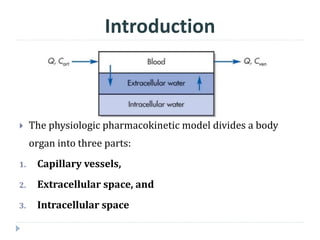
 The physiologic pharmacokinetic model divides a body
organ into three parts:
1. Capillary vessels,
2. Extracellular space, and
3. Intracellular space
Introduction
 Some organs of the body are involved in drug
elimination, either:
- by excretion (eg, kidney) or
- by metabolism (eg, liver).
 The elimination of drug by an organ may be described
by drug clearance in the organ
Introduction
Physiologic Pharmacokinetic Models
 Mathematical models describing drug movement and
disposition in the body based on:
- Organ blood flow
- Organ spaces penetrated by the drug
 Considers the drug to be blood flow limited
 Transmembrane movement of drug is rapid
 Capillary membrane does not offer any resistance to
drug permeation
 Uptake of drug into the tissues is rapid
 A constant ratio of drug concentrations between the
organ and venous blood is quickly established
Physiologic Pharmacokinetic Models
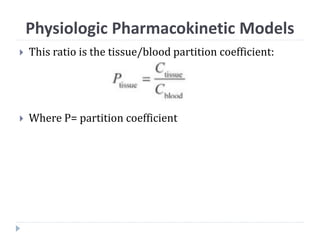
 This ratio is the tissue/blood partition coefficient:
 Where P= partition coefficient
Physiologic Pharmacokinetic Models
 Magnitude of the partition coefficient can vary depending on:
1. The drug
2. The type of tissue.
 Adipose tissue, for example, has a high partition for lipophilic
drugs.
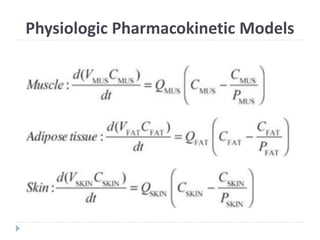
 The rate of drug carried to a tissue organ and tissue drug
uptake depend on the rate of blood flow to the organ and the
tissue/blood partition coefficient, respectively.
Physiologic Pharmacokinetic Models
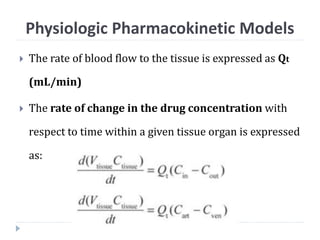
 The rate of blood flow to the tissue is expressed as Qt
(mL/min)
 The rate of change in the drug concentration with
respect to time within a given tissue organ is expressed
as:
Physiologic Pharmacokinetic Models
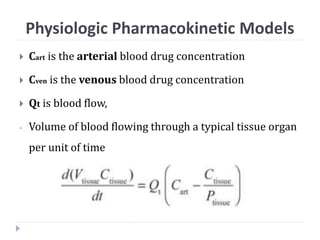
 Cart is the arterial blood drug concentration
 Cven is the venous blood drug concentration
 Qt is blood flow,
- Volume of blood flowing through a typical tissue organ
per unit of time
Physiologic Pharmacokinetic Models
Blood Flow Limited versus Diffusion -
Limited Model
 A more complex type of physiologic pharmacokinetic
model is called the diffusion limited model/the
membrane-limited model.
 The cell membrane acts as a barrier for the drug
-which gradually permeates by diffusion.
 a drug concentration gradient is established
between the tissue and the venous blood
 The rate-limiting step of drug diffusion into the tissue
depends on the permeation across the cell
membrane
 Because of the time lag in equilibration between blood
and tissue, pharmacokinetic equations are very
complicated.
Blood Flow Limited versus Diffusion -
Limited Model
Applications
 The effect of a change in blood flow on the drug
concentration
 The effect of a change in mass size of different tissue
organs on the redistribution of drug
 When several species are involved, the physiologic model
may predict the pharmacokinetics of a drug in humans
 Changes in drug–protein binding, tissue organ drug
partition ratios, and intrinsic hepatic clearance
Limitations
 The implication of venous versus arterial sampling is hard to
estimate
-may be more drug dependent.
 Most pharmacokinetic models are based on sampling of venous
data.
 In theory, mixing occurs quickly when venous blood returns to
the heart and becomes reoxygenated again in the lung.
 For drugs that are highly extracted, the discrepancies may be
substantial between actual concentration and concentration
estimated from well-stirred pharmacokinetic models
Mean residence time
 After an intravenous bolus drug dose (D0), the drug
molecules distribute throughout the body
 These molecules stay (reside) in the body for various
time periods
 Some drug molecules leave the body almost
immediately after entering
 Other drug molecules leave the body at later time
periods.
 MRT describes the average time for all the drug
molecules to reside in the body.
 MRT may be considered also as the mean transit time
or mean sojourn time
 The residence time for the drug molecules in the dose
may be sorted into groups i (i = 1, 2, 3, …, m) according
to their residing time
Mean residence time
 The total residence time is the summation of the
number of molecules in each group i multiplied by the
residence time, ti, for each group.
 The summation of ni (number of molecules in each
group) is the total number of molecules, N.
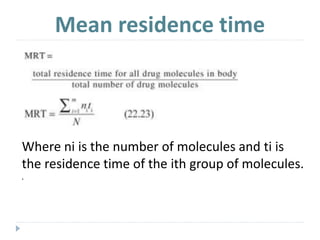
 Thus, MRT is the total residence time for all molecules
in the body divided by the total number of molecules in
the body
Mean residence time
Mean residence time
Where ni is the number of molecules and ti is
the residence time of the ith group of molecules.
.
 The drug dose (mg) may be converted to the number of
molecules by dividing the dose (mg) by 1000 and the
molecular weight of the drug to obtain the
number of moles of drug
 then multiplying the number of moles of drug by 6.023
× 10^23 (Avogadro's number) to obtain the number of
drug molecules
Mean residence time
 Drug molecules may have a residence time ranging
from values near zero (eg, 0.1, 0.2) to very large values
(100, 1000, 10,000).
 The number of i groups may be large and the
summation approach to calculate MRT will be only an
approximation.
 For the summation process to be accurate, data must
be collected continuously in order not to miss any groups
Mean residence time
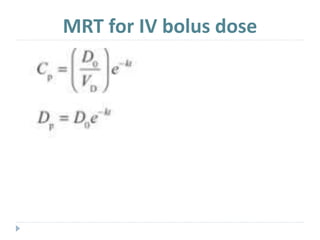
MRT for IV bolus dose
Mean Absorption Time
 After IV bolus injection:
- the rate of systemic drug absorption is zero
- the drug is placed directly into the bloodstream.
 The MRT calculated for a drug after IV bolus injection
basically reflects the elimination rate processes in the
body.
 After oral drug administration, the MRT is the result of
both drug absorption and elimination.
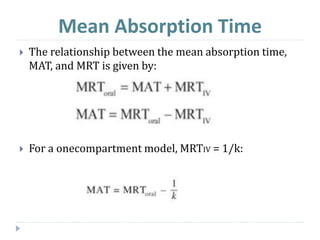
 The relationship between the mean absorption time,
MAT, and MRT is given by:
 For a onecompartment model, MRTIV = 1/k:
Mean Absorption Time
Mean dissolution time
 The mean dissolution time (MDT), or in vivo mean
dissolution time, for a solid drug product is:
Selection of Pharmacokinetic
models
 Adequate experimental design
 The availability of valid data
 For example, the experimental design should
determine whether a drug is being eliminated by
saturable (dose-dependent) or simple linear kinetics.
 Inclusion of pharmacogenetic information
 Inclusion criteria introduces variation

Physiologic, pharmacokinetic models, statistic moment,.pptx

  • 1.
  • 2.
    Introduction  Human bodycomposed of organ systems containing living cells - Bathed in an extracellular aqueous fluid  Both drugs and endogenous substances, such as hormones, nutrients, and oxygen and transported to the organs by the same network of blood vessels (arteries)  Drug concentration within target organ depends on: 1. Plasma drug concentration 2. Rate of blood flow to an organ 3. Rate of drug uptake in tissue
  • 3.
     Physiologically, uptakeof drug occurs from the extracellular fluid -equilibrates rapidly with the capillary blood in the organ.  Some drugs cross the plasma membrane into the intracellular fluid of the cell Introduction
  • 4.
     The physiologicpharmacokinetic model divides a body organ into three parts: 1. Capillary vessels, 2. Extracellular space, and 3. Intracellular space Introduction
  • 5.
     Some organsof the body are involved in drug elimination, either: - by excretion (eg, kidney) or - by metabolism (eg, liver).  The elimination of drug by an organ may be described by drug clearance in the organ Introduction
  • 6.
    Physiologic Pharmacokinetic Models Mathematical models describing drug movement and disposition in the body based on: - Organ blood flow - Organ spaces penetrated by the drug  Considers the drug to be blood flow limited
  • 7.
     Transmembrane movementof drug is rapid  Capillary membrane does not offer any resistance to drug permeation  Uptake of drug into the tissues is rapid  A constant ratio of drug concentrations between the organ and venous blood is quickly established Physiologic Pharmacokinetic Models
  • 8.
     This ratiois the tissue/blood partition coefficient:  Where P= partition coefficient Physiologic Pharmacokinetic Models
  • 9.
     Magnitude ofthe partition coefficient can vary depending on: 1. The drug 2. The type of tissue.  Adipose tissue, for example, has a high partition for lipophilic drugs.  The rate of drug carried to a tissue organ and tissue drug uptake depend on the rate of blood flow to the organ and the tissue/blood partition coefficient, respectively. Physiologic Pharmacokinetic Models
  • 10.
     The rateof blood flow to the tissue is expressed as Qt (mL/min)  The rate of change in the drug concentration with respect to time within a given tissue organ is expressed as: Physiologic Pharmacokinetic Models
  • 11.
     Cart isthe arterial blood drug concentration  Cven is the venous blood drug concentration  Qt is blood flow, - Volume of blood flowing through a typical tissue organ per unit of time Physiologic Pharmacokinetic Models
  • 12.
  • 13.
    Blood Flow Limitedversus Diffusion - Limited Model  A more complex type of physiologic pharmacokinetic model is called the diffusion limited model/the membrane-limited model.  The cell membrane acts as a barrier for the drug -which gradually permeates by diffusion.  a drug concentration gradient is established between the tissue and the venous blood
  • 14.
     The rate-limitingstep of drug diffusion into the tissue depends on the permeation across the cell membrane  Because of the time lag in equilibration between blood and tissue, pharmacokinetic equations are very complicated. Blood Flow Limited versus Diffusion - Limited Model
  • 15.
    Applications  The effectof a change in blood flow on the drug concentration  The effect of a change in mass size of different tissue organs on the redistribution of drug  When several species are involved, the physiologic model may predict the pharmacokinetics of a drug in humans  Changes in drug–protein binding, tissue organ drug partition ratios, and intrinsic hepatic clearance
  • 16.
    Limitations  The implicationof venous versus arterial sampling is hard to estimate -may be more drug dependent.  Most pharmacokinetic models are based on sampling of venous data.  In theory, mixing occurs quickly when venous blood returns to the heart and becomes reoxygenated again in the lung.  For drugs that are highly extracted, the discrepancies may be substantial between actual concentration and concentration estimated from well-stirred pharmacokinetic models
  • 17.
    Mean residence time After an intravenous bolus drug dose (D0), the drug molecules distribute throughout the body  These molecules stay (reside) in the body for various time periods  Some drug molecules leave the body almost immediately after entering  Other drug molecules leave the body at later time periods.
  • 18.
     MRT describesthe average time for all the drug molecules to reside in the body.  MRT may be considered also as the mean transit time or mean sojourn time  The residence time for the drug molecules in the dose may be sorted into groups i (i = 1, 2, 3, …, m) according to their residing time Mean residence time
  • 19.
     The totalresidence time is the summation of the number of molecules in each group i multiplied by the residence time, ti, for each group.  The summation of ni (number of molecules in each group) is the total number of molecules, N.  Thus, MRT is the total residence time for all molecules in the body divided by the total number of molecules in the body Mean residence time
  • 20.
    Mean residence time Whereni is the number of molecules and ti is the residence time of the ith group of molecules. .
  • 21.
     The drugdose (mg) may be converted to the number of molecules by dividing the dose (mg) by 1000 and the molecular weight of the drug to obtain the number of moles of drug  then multiplying the number of moles of drug by 6.023 × 10^23 (Avogadro's number) to obtain the number of drug molecules Mean residence time
  • 22.
     Drug moleculesmay have a residence time ranging from values near zero (eg, 0.1, 0.2) to very large values (100, 1000, 10,000).  The number of i groups may be large and the summation approach to calculate MRT will be only an approximation.  For the summation process to be accurate, data must be collected continuously in order not to miss any groups Mean residence time
  • 23.
    MRT for IVbolus dose
  • 24.
    Mean Absorption Time After IV bolus injection: - the rate of systemic drug absorption is zero - the drug is placed directly into the bloodstream.  The MRT calculated for a drug after IV bolus injection basically reflects the elimination rate processes in the body.  After oral drug administration, the MRT is the result of both drug absorption and elimination.
  • 25.
     The relationshipbetween the mean absorption time, MAT, and MRT is given by:  For a onecompartment model, MRTIV = 1/k: Mean Absorption Time
  • 26.
    Mean dissolution time The mean dissolution time (MDT), or in vivo mean dissolution time, for a solid drug product is:
  • 27.
    Selection of Pharmacokinetic models Adequate experimental design  The availability of valid data  For example, the experimental design should determine whether a drug is being eliminated by saturable (dose-dependent) or simple linear kinetics.  Inclusion of pharmacogenetic information  Inclusion criteria introduces variation