FSC Physics2nd year
Chapter 14: Electromagnetism
Lecture – 18
*Magnetic flux and flux density
*Ampere’s law and determination of flux density
*Force on a moving charge in magnetic field
Magnetic Flux And Flux
Density
Magnetic Flux and Magnetic Flux Density
1. Magnetic Flux:
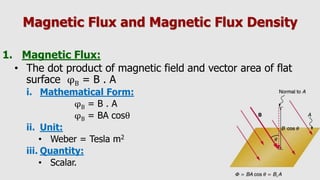
• The dot product of magnetic field and vector area of flat
surface φB = B . A
i. Mathematical Form:
φB = B . A
φB = BA cosθ
ii. Unit:
• Weber = Tesla m2
iii. Quantity:
• Scalar.
iv. Magnetic flux at different orientation:
a. Magnetic flux when Area parallel to Field:
• φB = B . A
φB = 0
Minimum flux
a. Magnetic flux when Area perpendicular to Field:
• φB = BA
Maximum flux
b. Magnetic flux when Area making angle with Field:
• φB = BA cosθ
2. Magnetic Flux Density:
• The amount of magnetic flux in an area taken perpendicular
to the magnetic flux's direction.
i. Formula:
B =
φ
𝐴
B is called magnetic field strength
Magnetic field intensity
Magnetic induction
Flux density
Ampere’s Law And
Determination Of Flux
Density B
Ampere’s Law and determination of Flux
Density B
1. Ampere Circuital Law:
• The sum of the quantities B. ∆L for all path elements into
which the complete loop has been divided equals μo times
the current enclosed by the loop.
i. Mathematical Form:
(𝐵. ∆𝐿)1 + (𝐵. ∆𝐿)2 + ………= r=1
N
(𝐵. ∆𝐿)𝑟 = μoI
B . ∆L = B ∆L cosθ B and ∆L are parallel
Then B ∆L = μoI if path is circle ∆L = 2𝜋r
B (2𝜋r) = μo I B =
μo I
2𝜋r
μo (Permeability constant for free space) = 4 π × 10-7 WbA-1m-1
2. Field due to a Current Carrying Solenoid:
i. Solenoid:
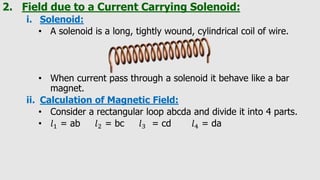
• A solenoid is a long, tightly wound, cylindrical coil of wire.
• When current pass through a solenoid it behave like a bar
magnet.
ii. Calculation of Magnetic Field:
• Consider a rectangular loop abcda and divide it into 4 parts.
• 𝑙1 = ab 𝑙2 = bc 𝑙3 = cd 𝑙4 = da
Magnetic Field Strength Due To Current Carrying Solenoid
When current passes through a solenoid, it behaves like bar magnet. Suppose that
the magnetic field inside a long solenoid is uniform and much strong whereas
outside the solenoid.
We want to find out the magnetic field strength B inside the solenoid by applying
Ampere circuital law. For this we consider a rectangular Amperean loop. We divide
the loop into four elements of lengths ab = l1, bc = l2, cd = l3 and da = l4.
Applying Ampere’s law, we have
𝑟=1
4
(B. ∆L)r = µ0 × current enclosed
(B. ∆L)1 + (B. ∆L)2 + (B. ∆L)3 + (B. ∆L)4 = µ0 × current enclosed ..(1)
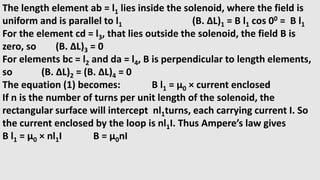
The length element ab = l1 lies inside the solenoid, where the field is
uniform and is parallel to l1 (B. ∆L)1 = B l1 cos 00 = B l1
For the element cd = l3, that lies outside the solenoid, the field B is
zero, so (B. ∆L)3 = 0
For elements bc = l2 and da = l4, B is perpendicular to length elements,
so (B. ∆L)2 = (B. ∆L)4 = 0
The equation (1) becomes: B l1 = µ0 × current enclosed
If n is the number of turns per unit length of the solenoid, the
rectangular surface will intercept nl1turns, each carrying current I. So
the current enclosed by the loop is nl1I. Thus Ampere’s law gives
B l1 = µ0 × nl1I B = µ0nI
iii. Direction of Field along axis of Solenoid:
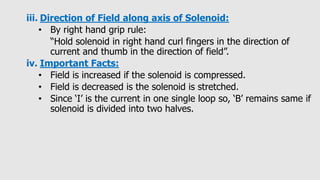
• By right hand grip rule:
“Hold solenoid in right hand curl fingers in the direction of
current and thumb in the direction of field”.
iv. Important Facts:
• Field is increased if the solenoid is compressed.
• Field is decreased is the solenoid is stretched.
• Since ‘I’ is the current in one single loop so, ‘B’ remains same if
solenoid is divided into two halves.
Force On A Moving Charge
In A Magnetic Field
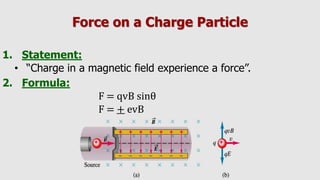
Force on a Charge Particle
1. Statement:
• “Charge in a magnetic field experience a force”.
2. Formula:
F = qvB sinθ
F = + evB
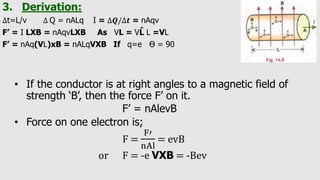
3. Derivation:
∆t=L/v ∆ Q = nALq I = ∆𝑸/∆𝒕 = nAqv
F’ = I LXB = nAqvLXB As VL = VL
̂ L =VL
F’ = nAq(VL)xB = nALqVXB If q=e Ɵ = 90
• If the conductor is at right angles to a magnetic field of
strength ‘B’, then the force F’ on it.
F’ = nAlevB
• Force on one electron is;
F =
F′
nAl
= evB
or F = -e VXB = -Bev
4. Path of a charge moving at 90o to a magnetic field:
FB = FC
F = +eVXB Bev =
mv2
r
F = -eVXB r =
𝑚𝑣
𝐵𝑒
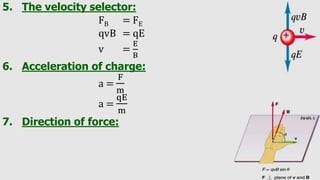
5. The velocity selector:
FB = FE
qvB = qE
v =
E
B
6. Acceleration of charge:
a =
F
m
a =
qE
m
7. Direction of force:

Physics Chapter - 14 (Lecture-18).pptx

  • 1.
    FSC Physics2nd year Chapter14: Electromagnetism Lecture – 18 *Magnetic flux and flux density *Ampere’s law and determination of flux density *Force on a moving charge in magnetic field
  • 2.
    Magnetic Flux AndFlux Density
  • 3.
    Magnetic Flux andMagnetic Flux Density 1. Magnetic Flux: • The dot product of magnetic field and vector area of flat surface φB = B . A i. Mathematical Form: φB = B . A φB = BA cosθ ii. Unit: • Weber = Tesla m2 iii. Quantity: • Scalar.
  • 4.
    iv. Magnetic fluxat different orientation: a. Magnetic flux when Area parallel to Field: • φB = B . A φB = 0 Minimum flux a. Magnetic flux when Area perpendicular to Field: • φB = BA Maximum flux b. Magnetic flux when Area making angle with Field: • φB = BA cosθ
  • 5.
    2. Magnetic FluxDensity: • The amount of magnetic flux in an area taken perpendicular to the magnetic flux's direction. i. Formula: B = φ 𝐴 B is called magnetic field strength Magnetic field intensity Magnetic induction Flux density
  • 6.
  • 7.
    Ampere’s Law anddetermination of Flux Density B 1. Ampere Circuital Law: • The sum of the quantities B. ∆L for all path elements into which the complete loop has been divided equals μo times the current enclosed by the loop. i. Mathematical Form: (𝐵. ∆𝐿)1 + (𝐵. ∆𝐿)2 + ………= r=1 N (𝐵. ∆𝐿)𝑟 = μoI B . ∆L = B ∆L cosθ B and ∆L are parallel Then B ∆L = μoI if path is circle ∆L = 2𝜋r B (2𝜋r) = μo I B = μo I 2𝜋r μo (Permeability constant for free space) = 4 π × 10-7 WbA-1m-1
  • 8.
    2. Field dueto a Current Carrying Solenoid: i. Solenoid: • A solenoid is a long, tightly wound, cylindrical coil of wire. • When current pass through a solenoid it behave like a bar magnet. ii. Calculation of Magnetic Field: • Consider a rectangular loop abcda and divide it into 4 parts. • 𝑙1 = ab 𝑙2 = bc 𝑙3 = cd 𝑙4 = da
  • 9.
    Magnetic Field StrengthDue To Current Carrying Solenoid When current passes through a solenoid, it behaves like bar magnet. Suppose that the magnetic field inside a long solenoid is uniform and much strong whereas outside the solenoid. We want to find out the magnetic field strength B inside the solenoid by applying Ampere circuital law. For this we consider a rectangular Amperean loop. We divide the loop into four elements of lengths ab = l1, bc = l2, cd = l3 and da = l4. Applying Ampere’s law, we have 𝑟=1 4 (B. ∆L)r = µ0 × current enclosed (B. ∆L)1 + (B. ∆L)2 + (B. ∆L)3 + (B. ∆L)4 = µ0 × current enclosed ..(1)
  • 10.
    The length elementab = l1 lies inside the solenoid, where the field is uniform and is parallel to l1 (B. ∆L)1 = B l1 cos 00 = B l1 For the element cd = l3, that lies outside the solenoid, the field B is zero, so (B. ∆L)3 = 0 For elements bc = l2 and da = l4, B is perpendicular to length elements, so (B. ∆L)2 = (B. ∆L)4 = 0 The equation (1) becomes: B l1 = µ0 × current enclosed If n is the number of turns per unit length of the solenoid, the rectangular surface will intercept nl1turns, each carrying current I. So the current enclosed by the loop is nl1I. Thus Ampere’s law gives B l1 = µ0 × nl1I B = µ0nI
  • 11.
    iii. Direction ofField along axis of Solenoid: • By right hand grip rule: “Hold solenoid in right hand curl fingers in the direction of current and thumb in the direction of field”. iv. Important Facts: • Field is increased if the solenoid is compressed. • Field is decreased is the solenoid is stretched. • Since ‘I’ is the current in one single loop so, ‘B’ remains same if solenoid is divided into two halves.
  • 13.
    Force On AMoving Charge In A Magnetic Field
  • 14.
    Force on aCharge Particle 1. Statement: • “Charge in a magnetic field experience a force”. 2. Formula: F = qvB sinθ F = + evB
  • 15.
    3. Derivation: ∆t=L/v ∆Q = nALq I = ∆𝑸/∆𝒕 = nAqv F’ = I LXB = nAqvLXB As VL = VL ̂ L =VL F’ = nAq(VL)xB = nALqVXB If q=e Ɵ = 90 • If the conductor is at right angles to a magnetic field of strength ‘B’, then the force F’ on it. F’ = nAlevB • Force on one electron is; F = F′ nAl = evB or F = -e VXB = -Bev
  • 16.
    4. Path ofa charge moving at 90o to a magnetic field: FB = FC F = +eVXB Bev = mv2 r F = -eVXB r = 𝑚𝑣 𝐵𝑒
  • 17.
    5. The velocityselector: FB = FE qvB = qE v = E B 6. Acceleration of charge: a = F m a = qE m 7. Direction of force: