EXERCISE
&
MENTAL HEALTH
DR. SHILPASREE SAHA (PT),
BPT, MPT (CARDIO THORACIC DISORDERS)
MENTAL HEALTH
• According to the World Health
Organization (WHO), mental health is
“a state of well-being in which the
individual realizes his or her own
abilities, can cope with the normal
stresses of life, can work productively
and fruitfully, and is able to make a
contribution to his or her
community”
World Health Organization. Promoting mental health: concepts, emerging evidence, practice (Summary
Report) Geneva: World Health Organization; 2004.
MENTAL ILLNESS
• As per American Psychiatric Association, Mental illness is defined as a mental,
behavioral, or emotional disorder. It can vary in impact, ranging from no
impairment to mild, moderate, and even severe impairment.
• Mental disorders were the second leading
cause of disease burden in terms of years lived
with disability and the sixth leading cause of
disability-adjusted life-years in the world in
2017.
• In 2017, there were 197·3 million people with
mental disorders in India, comprising 14·3% of
the total population of the country.
WHY IT IS AN
IMPORTANT TOPIC
TO DISCUSS???
India State-Level Disease Burden Initiative Mental Disorders Collaborators. The
burden of mental disorders across the states of India: the Global Burden of
Disease Study 1990-2017. Lancet Psychiatry. 2020 Feb;7(2):148-161. doi:
10.1016/S2215-0366(19)30475-4. Epub 2019 Dec 23. PMID: 31879245; PMCID:
PMC7029418.
• Amid the COVID-19 pandemic, several mental
health and psychosocial problems are
increasing.
• The global prevalence estimate was 28.0% for
depression; 26.9% for anxiety; 24.1% for post-
traumatic stress symptoms; 36.5% for stress;
50.0% for psychological distress; and 27.6% for
sleep problems.
Nochaiwong, S., Ruengorn, C., Thavorn, K. et al. Global prevalence of mental health issues among the
general population during the coronavirus disease-2019 pandemic: a systematic review and meta-
analysis. Sci Rep 11, 10173 (2021). https://doi.org/10.1038/s41598-021-89700-8
• According to the reports published
by the National Crime Records
Bureau (NCRB) India, every year, the
number of suicides are continuously
increasing.
Kamalja, K.K., Khangar, N.V. A statistical study of suicidal behavior of Indians. Egypt J Forensic Sci 7, 12
(2017). https://doi.org/10.1186/s41935-017-0007-9
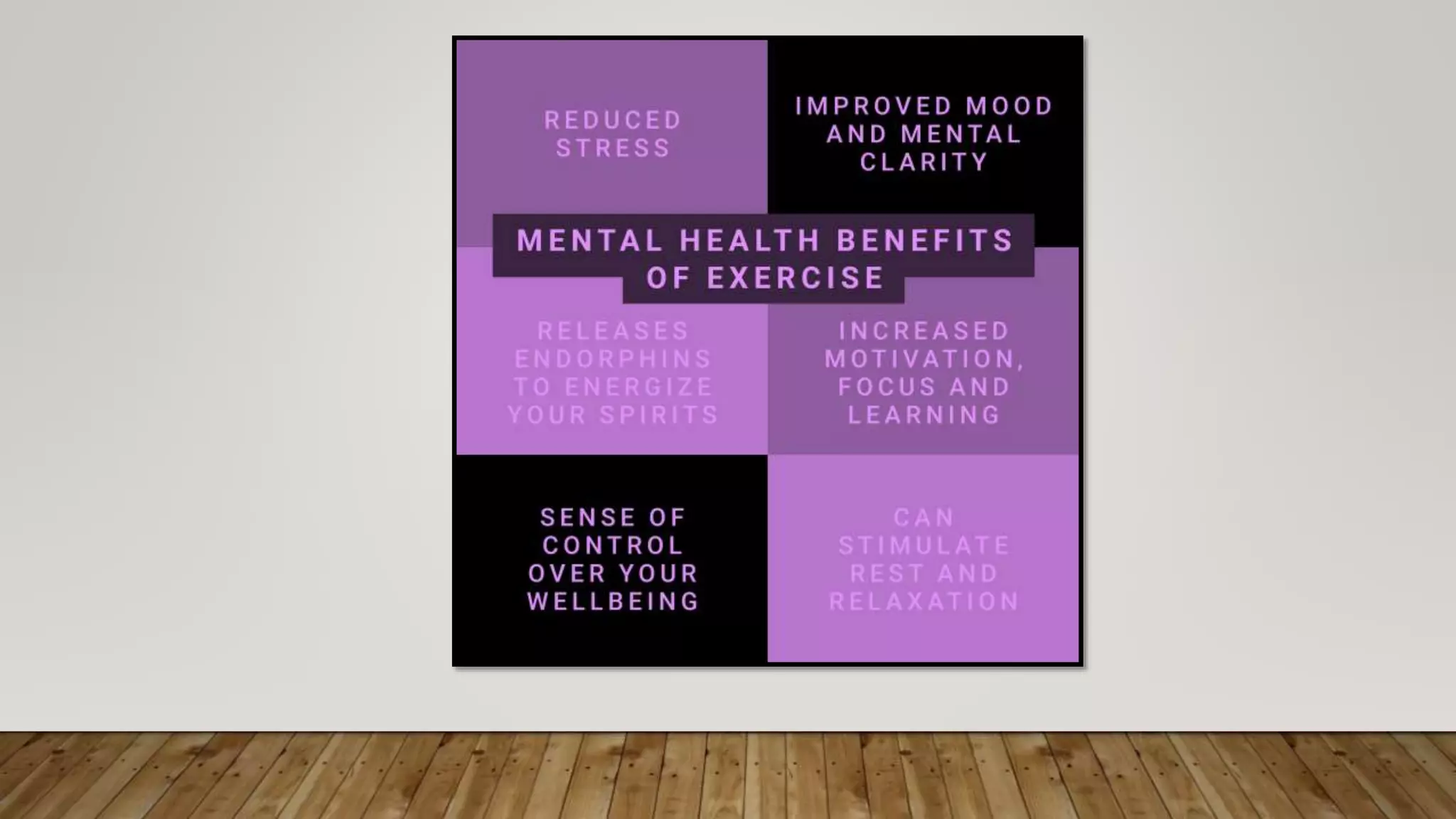
Physical exercise can generate several physiological
changes and mechanisms in the body, which in turn may
lower stress levels, or buffer the stress response which may
protect against the negative health effects of stress, and
improve mood.
Grasdalsmoen, M., Eriksen, H.R., Lønning, K.J. et al. Physical exercise, mental health problems, and suicide
attempts in university students. BMC Psychiatry 20, 175 (2020). https://doi.org/10.1186/s12888-020-02583-3
EXERCISE 'AS GOOD AS MEDICINES'
WHO says, regular moderate intensity physical activity — such as walking, cycling or
participating in sports — can reduce the risk of depression. At least 150 minutes of
moderate-to-vigorous physical activity a week is recommended for adults. But only
53 per cent of adults achieve this, according to the Canadian Health Measures
Survey.
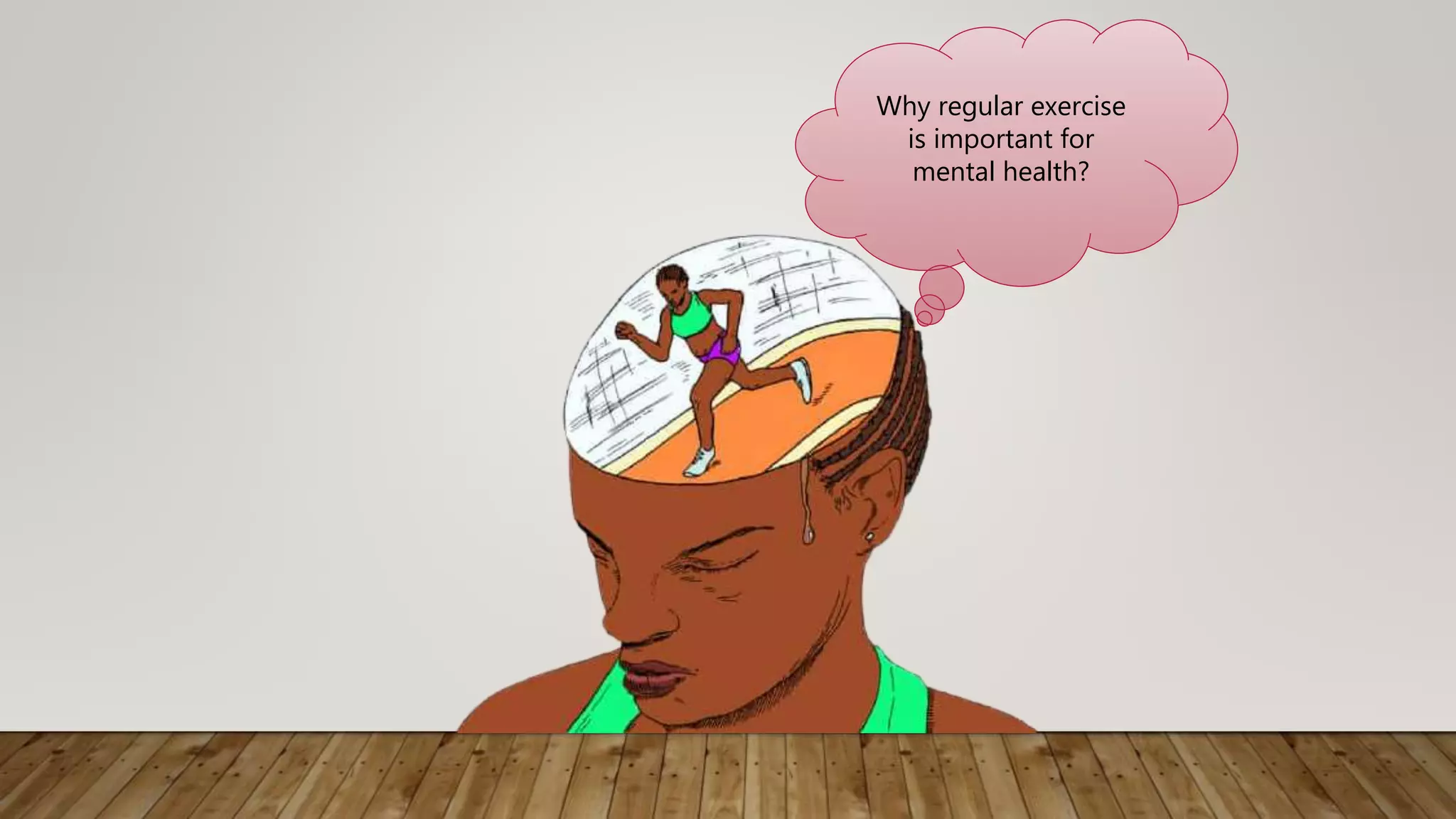
Why regular exercise
is important for
mental health?
• Plasma levels of endorphins are elevated
immediately following physical exercise.
• Physical exercise may act in the same way
as the SSRI antidepressant.
• Physical exercise has been linked to the
functioning of several neurotransmitters in
the brain, including serotonin, dopamine,
and noradrenaline.
Grasdalsmoen, Michael et al. “Physical exercise, mental health problems, and suicide attempts in university
students.” BMC psychiatry vol. 20,1 175. 16 Apr. 2020, doi:10.1186/s12888-020-02583-3
• Physical activity is also essential to maintain mitochondrial biogenesis and
function.
• Physical exercise is important in maintaining proper functioning of the
hypothalamic-pituitary-adrenal (HPA) axis.
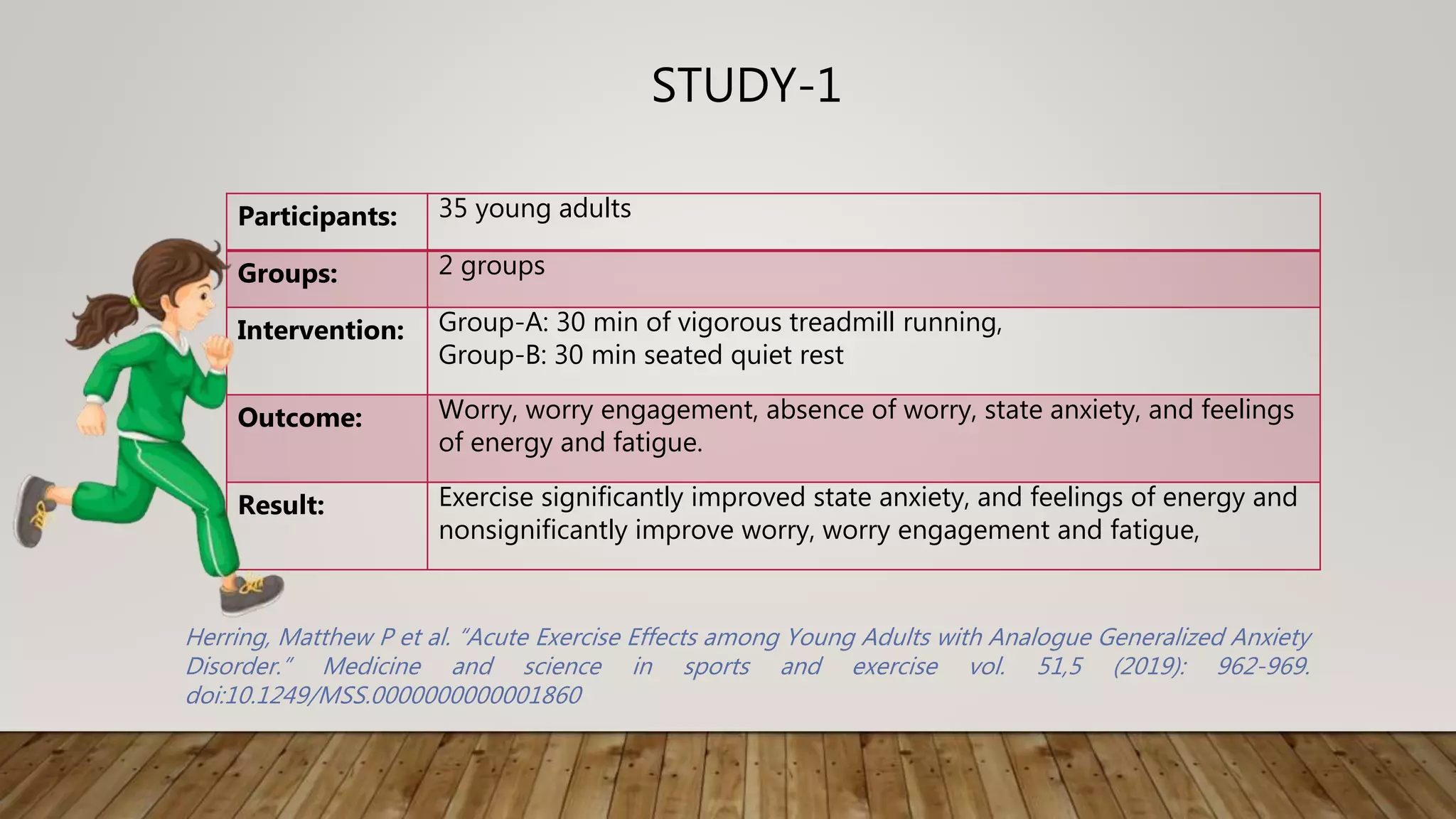
STUDY-1
Participants: 35 young adults
Groups: 2 groups
Intervention: Group-A: 30 min of vigorous treadmill running,
Group-B: 30 min seated quiet rest
Outcome: Worry, worry engagement, absence of worry, state anxiety, and feelings
of energy and fatigue.
Result: Exercise significantly improved state anxiety, and feelings of energy and
nonsignificantly improve worry, worry engagement and fatigue,
Herring, Matthew P et al. “Acute Exercise Effects among Young Adults with Analogue Generalized Anxiety
Disorder.” Medicine and science in sports and exercise vol. 51,5 (2019): 962-969.
doi:10.1249/MSS.0000000000001860
STUDY-2
Participants: 40 participants
Groups: 2 groups
Intervention: i. Breathing intervention group (BIG)
ii. Control group
20 sessions, implemented over 8 weeks
Outcome: Positive and Negative Affect Schedule (PANAS), the Number Cancellation
Test (NCT), and a cortisol test.
Result: Significant improvement is observed in sustained attention, negative
affect, and less cortisol levels in Breathing intervention group.
Ma, Xiao et al. “The Effect of Diaphragmatic Breathing on Attention, Negative Affect and Stress in Healthy
Adults.” Frontiers in psychology vol. 8 874. 6 Jun. 2017, doi:10.3389/fpsyg.2017.00874
The brain responds to exercises as muscle do….
Grow with use, shrink with inactivity.
TAKE AWAY MESSAGES
• Mental health is as important as physical
health.
• Move Your body everyday.
• It is good for your Physical, as well as,
mental Health.
Physical exercise & mental health [autosaved]

Physical exercise & mental health [autosaved]

  • 1.
    EXERCISE & MENTAL HEALTH DR. SHILPASREESAHA (PT), BPT, MPT (CARDIO THORACIC DISORDERS)
  • 2.
    MENTAL HEALTH • Accordingto the World Health Organization (WHO), mental health is “a state of well-being in which the individual realizes his or her own abilities, can cope with the normal stresses of life, can work productively and fruitfully, and is able to make a contribution to his or her community” World Health Organization. Promoting mental health: concepts, emerging evidence, practice (Summary Report) Geneva: World Health Organization; 2004.
  • 3.
    MENTAL ILLNESS • Asper American Psychiatric Association, Mental illness is defined as a mental, behavioral, or emotional disorder. It can vary in impact, ranging from no impairment to mild, moderate, and even severe impairment.
  • 4.
    • Mental disorderswere the second leading cause of disease burden in terms of years lived with disability and the sixth leading cause of disability-adjusted life-years in the world in 2017. • In 2017, there were 197·3 million people with mental disorders in India, comprising 14·3% of the total population of the country. WHY IT IS AN IMPORTANT TOPIC TO DISCUSS??? India State-Level Disease Burden Initiative Mental Disorders Collaborators. The burden of mental disorders across the states of India: the Global Burden of Disease Study 1990-2017. Lancet Psychiatry. 2020 Feb;7(2):148-161. doi: 10.1016/S2215-0366(19)30475-4. Epub 2019 Dec 23. PMID: 31879245; PMCID: PMC7029418.
  • 5.
    • Amid theCOVID-19 pandemic, several mental health and psychosocial problems are increasing. • The global prevalence estimate was 28.0% for depression; 26.9% for anxiety; 24.1% for post- traumatic stress symptoms; 36.5% for stress; 50.0% for psychological distress; and 27.6% for sleep problems. Nochaiwong, S., Ruengorn, C., Thavorn, K. et al. Global prevalence of mental health issues among the general population during the coronavirus disease-2019 pandemic: a systematic review and meta- analysis. Sci Rep 11, 10173 (2021). https://doi.org/10.1038/s41598-021-89700-8
  • 6.
    • According tothe reports published by the National Crime Records Bureau (NCRB) India, every year, the number of suicides are continuously increasing. Kamalja, K.K., Khangar, N.V. A statistical study of suicidal behavior of Indians. Egypt J Forensic Sci 7, 12 (2017). https://doi.org/10.1186/s41935-017-0007-9
  • 7.
    Physical exercise cangenerate several physiological changes and mechanisms in the body, which in turn may lower stress levels, or buffer the stress response which may protect against the negative health effects of stress, and improve mood. Grasdalsmoen, M., Eriksen, H.R., Lønning, K.J. et al. Physical exercise, mental health problems, and suicide attempts in university students. BMC Psychiatry 20, 175 (2020). https://doi.org/10.1186/s12888-020-02583-3
  • 8.
    EXERCISE 'AS GOODAS MEDICINES' WHO says, regular moderate intensity physical activity — such as walking, cycling or participating in sports — can reduce the risk of depression. At least 150 minutes of moderate-to-vigorous physical activity a week is recommended for adults. But only 53 per cent of adults achieve this, according to the Canadian Health Measures Survey.
  • 9.
    Why regular exercise isimportant for mental health?
  • 10.
    • Plasma levelsof endorphins are elevated immediately following physical exercise. • Physical exercise may act in the same way as the SSRI antidepressant. • Physical exercise has been linked to the functioning of several neurotransmitters in the brain, including serotonin, dopamine, and noradrenaline. Grasdalsmoen, Michael et al. “Physical exercise, mental health problems, and suicide attempts in university students.” BMC psychiatry vol. 20,1 175. 16 Apr. 2020, doi:10.1186/s12888-020-02583-3
  • 11.
    • Physical activityis also essential to maintain mitochondrial biogenesis and function. • Physical exercise is important in maintaining proper functioning of the hypothalamic-pituitary-adrenal (HPA) axis.
  • 13.
    STUDY-1 Participants: 35 youngadults Groups: 2 groups Intervention: Group-A: 30 min of vigorous treadmill running, Group-B: 30 min seated quiet rest Outcome: Worry, worry engagement, absence of worry, state anxiety, and feelings of energy and fatigue. Result: Exercise significantly improved state anxiety, and feelings of energy and nonsignificantly improve worry, worry engagement and fatigue, Herring, Matthew P et al. “Acute Exercise Effects among Young Adults with Analogue Generalized Anxiety Disorder.” Medicine and science in sports and exercise vol. 51,5 (2019): 962-969. doi:10.1249/MSS.0000000000001860
  • 14.
    STUDY-2 Participants: 40 participants Groups:2 groups Intervention: i. Breathing intervention group (BIG) ii. Control group 20 sessions, implemented over 8 weeks Outcome: Positive and Negative Affect Schedule (PANAS), the Number Cancellation Test (NCT), and a cortisol test. Result: Significant improvement is observed in sustained attention, negative affect, and less cortisol levels in Breathing intervention group. Ma, Xiao et al. “The Effect of Diaphragmatic Breathing on Attention, Negative Affect and Stress in Healthy Adults.” Frontiers in psychology vol. 8 874. 6 Jun. 2017, doi:10.3389/fpsyg.2017.00874
  • 15.
    The brain respondsto exercises as muscle do…. Grow with use, shrink with inactivity.
  • 16.
    TAKE AWAY MESSAGES •Mental health is as important as physical health. • Move Your body everyday. • It is good for your Physical, as well as, mental Health.