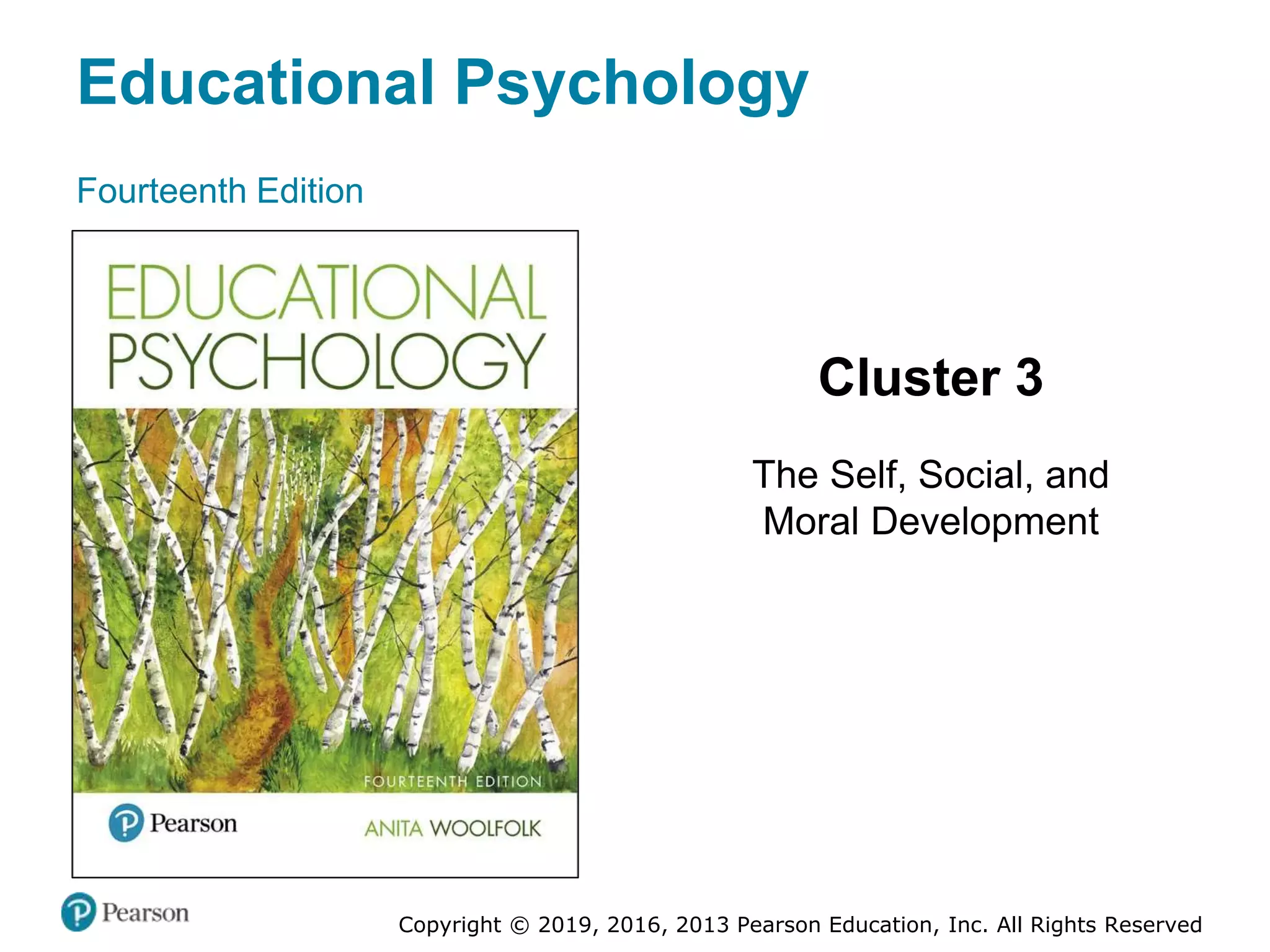
Educational Psychology
Fourteenth Edition
Cluster 3
The Self, Social, and
Moral Development
Copyright © 2019, 2016, 2013 Pearson Education, Inc. All Rights Reserved
Learning Objectives
3.1 Describe general trends, group differences, and
challenges in physical development through childhood and
adolescence.
3.2 Discuss how the components of Bronfenbrenner’s
bioecological model influence development, especially the
impact of families, parenting styles, peers, and teachers.
3.3 Describe general trends and group differences in the
development of identity and self-concept.
3.4 Explain theories of moral development including those of
Kohlberg, Gilligan, Nucci, and Haidt, and discuss how
teachers can deal with one moral challenge for students—
cheating.
Copyright © 2019, 2016, 2013 Pearson Education, Inc. All Rights Reserved
Outline
• Physical Development
• Bronfenbrenner: The Social Context for Development
• Identity and Self-Concept
• Understanding Others and Moral Development
• Personal/Social Development: Lessons for Teachers
Copyright © 2019, 2016, 2013 Pearson Education, Inc. All Rights Reserved
Physical Development: Young
Children
• Gross-motor skill development: Growth of large muscles
– Brains integrate information about movements
– Improve balance; run, jump, and throw
– Change from toddling to smooth walking
• Fine-motor skills: Coordination of small movements
– Need to work with large paintbrushes and Legos, fat
pencils and crayons, large paper, soft clay and
playdough
– Developing hand preference (genetically based)
▪ 90% prefer right hand by age 5
▪ 10% prefer left hand (more boys than girls)
Copyright © 2019, 2016, 2013 Pearson Education, Inc. All Rights Reserved
Physical Development: Elementary
School Years
• Steady physical development
– Tremendous variation among children
– Become taller, leaner, stronger during these years
– Better able to master sports and play games
• Girls may be as large as or larger than boys
– Girls 11-14 on average taller, heavier than same-age
boys
Copyright © 2019, 2016, 2013 Pearson Education, Inc. All Rights Reserved
Physical Development: Adolescent
Years
• Puberty, beginning of sexual maturity
– Series of changes in the body
– Menarche for girls around 12 or 13 on average
▪ Earlier for African American girls
– Spermarche for boys around 12 to 14 on average
• Height differences
– Girls reach final height around age 15 or 16
– Boys reach final height around age 19
– Maximum height reached earlier for African American
and Latino/a adolescents
– Maximum height reached later for Asian America
Copyright © 2019, 2016, 2013 Pearson Education, Inc. All Rights Reserved
Early and Later Maturing
• Wide range for timing of “normal” maturation rates
• Emotional difficulties associated with early maturing girls
– Depression, anxiety, lower achievement in school,
drug/alcohol abuse, unplanned pregnancy, eating disorders
– Powerful social influences such as early dating
• Fewer problems for later maturing girls
• Popularity plus problems associated with early maturing boys
– More delinquent behavior, greater risk for depression
– Early sexual activity, drug/alcohol abuse, eating disorders
• Later maturing boys: creative, tolerant, perceptive in adulthood
Copyright © 2019, 2016, 2013 Pearson Education, Inc. All Rights Reserved
Guidelines: Dealing with Physical
Differences in the Classroom
• Address differences without calling attention to variations
– Seat smaller students to see/participate
– Vary sports/games to use all types of skills
– Forbid use of nicknames based on physical traits
– Accommodate left-handedness
• Help students access facts about physical development
– Stories in literature, science projects, school’s sex education
• Accept adolescents’ concerns about appearance, opposite sex
– End-of-class time to socialize
– Adolescent issues linked to curriculum when appropriate
Copyright © 2019, 2016, 2013 Pearson Education, Inc. All Rights Reserved
Play, Recess, and Physical Activity
• Essential to social and cognitive development at all ages
– Babies: Act on environment, pounding, throwing
– Preschoolers: Make-believe, games with rules
– Elementary: More complex, creative, cooperative
– Adolescents: Games/sports for physical/social development
• Cultural differences in playmates, toys, value of play
• Exercise and recess: Academic, social, physical benefits
– Especially needed for students with ADHD
• Inclusive athletics accommodate students with disabilities
Copyright © 2019, 2016, 2013 Pearson Education, Inc. All Rights Reserved
Challenges in Physical Development
• Child obesity, growing problem in US
– 18% of children ages 6 to 11
– Concerns: Diabetes, bone/joint strain, respiratory
problems
– Interacting causes: Poor diet, genetics, lack of exercise
• Eating disorders—physical and psychological problems
– Binge eating: Uncontrolled eating, large quantities
– Bulimia nervosa: Binge eating, purging to avoid weight
gain
– Anorexia nervosa: Self-starvation (1% U.S. population)
– Eating disorders usually require professional help
Copyright © 2019, 2016, 2013 Pearson Education, Inc. All Rights Reserved
Guidelines: Supporting Positive Body
Images
• Listen to adolescents talk about their health; be attentive
– Provide facts about healthy weight loss, diets
• Ask questions about body image concerns, eating habits
– Ask about diets, healthy eating
• Make available resources regarding body image issues
– Encourage conversations with you, parents,
professionals
– Use curriculum-related approaches
Copyright © 2019, 2016, 2013 Pearson Education, Inc. All Rights Reserved
Bronfenbrenner: The Social Context
for Development
• Context: Total situation that surrounds/interacts with one’s
thoughts, feelings, actions to shape development/learning
• External context: Families, schools, groups, programs, policies
• Bioecological model: Nested social and cultural contexts
– Microsystem: Family, friends, teachers, school activities
– Mesosystem: Interactions among microsystem elements
– Exosystem: Social settings that affect child
– Macrosystem: Larger society, its laws, customs, values
– Chronosystem: Time period of one’s development
• All parts interact, influence, shape development
Copyright © 2019, 2016, 2013 Pearson Education, Inc. All Rights Reserved
Families
• Child’s first context for development, beginning before birth
• Various family structures: 1-parent, 2-parent, blended, extended
• Various parenting styles (based on Baumrind research)
– Authoritative: High in warmth, control, expectations
▪ Children likely to do well in school, be happy
– Authoritarian: Low warmth, autonomy; high control, punishment
▪ Children more likely to feel guilty, depressed
– Permissive: High warmth, low control, few rules
▪ Children likely to have trouble interacting with peers
– Rejecting/Neglecting/Uninvolved: Low in warmth, control; uncaring
▪ Children likely immature, lonely, at risk for abuse
Copyright © 2019, 2016, 2013 Pearson Education, Inc. All Rights Reserved
Culture and Parenting
• Single model of parenting not applicable to all cultures
– Differences in cultural values affect parenting styles
– Baumrind research fits middle-class European
Americans
• Asian parenting characterized by “training” style
• Authoritarian style perceived differently by inner-city
families
• Latino parenting characterized by adult authority and
caring; authoritarian style not perceived as low in warmth
Copyright © 2019, 2016, 2013 Pearson Education, Inc. All Rights Reserved
Attachment
• Forming an emotional bond with another person
• First attachment—between child and parent or caregiver
• Implications for relationship formations throughout life
• Secure attachments: Child more confident to explore
– Less teacher-dependent, socially competent
• Insecure attachments: Child fearful, sad, anxious, or angry
• Divorce and implications from negative effects on child
– Disrupt child’s life (relocate, change schools, leave
friends)
– First two years after divorce most difficult
– Problems in school, lose/gain weight, trouble sleeping
Copyright © 2019, 2016, 2013 Pearson Education, Inc. All Rights Reserved
Guidelines: Helping Children of
Divorce
• Note sudden changes, indications of problems at home
– Fatigue, stomach pain, headaches, inattention
• Talk to individual student about attitude/behavior changes
• Avoid stereotypes about happy homes
• Help student maintain self-esteem
– Don’t take their anger personally
• Find out what resources your school provides
• Be sensitive to both parents’ rights to information
• Problems when child moves between two households
– Child may leave books, assignments behind
Copyright © 2019, 2016, 2013 Pearson Education, Inc. All Rights Reserved
Peers and Friendships
• Children develop within peer groups
• Cliques: Small groups, friendship based
– Usually same sex, age, interests, activities
– Serve emotional, security needs; stable social context
• Crowds: Large, less intimate, loosely organized affiliations
– Shared interests, activities, attitudes, reputations
– Jocks, brains, nerds, druggies, goths, populars, loners
• Peer cultures: Groups with own rules/norms
– Influence matters of style/socializing, but not morals
• Friendships: Central to students’ lives at every age
– May be stable/positive or unstable/negative influences
Copyright © 2019, 2016, 2013 Pearson Education, Inc. All Rights Reserved
Popularity Categories and Causes of
Rejection
1. Popular prosocial or antisocial
– Prosocial: Academically, socially competent
– Antisocial: Often athletic, aggressive boys, defy adult authority
2. Rejected aggressive or withdrawn
– Aggressive: Low self-control, hyperactive/impulsive
– Withdrawn: Timid, socially awkward, often bullied
3. Controversial: Hostile in some situations, prosocial in others
4. Neglected: Well adjusted, socially competent, shy but happy
Rejection: Result of being too different from the norm
Problems: Emotional, physical, behavioral, academic
– Long-lasting effects into adulthood; may become aggressive
Copyright © 2019, 2016, 2013 Pearson Education, Inc. All Rights Reserved
Aggression
Types of aggression:
1. Instrumental: Act to claim object/privilege, get what you want
– Not intended to harm, but may lead to harm
2. Hostile: Direct action to hurt someone; unprovoked
3. Overt: Hostile threats, physical attacks
4. Relational: Verbal attacks, actions to harm social relationships
– More common among girls
5. Cyber: Rumors/threats terrorize peers via e-mail/social media
Children don’t “outgrow” aggressive behaviors
Intervene early; teach conflict management strategies
Copyright © 2019, 2016, 2013 Pearson Education, Inc. All Rights Reserved
Media, Modeling, and Aggression
• TV: Source of aggressive models
– Some violence in 82% of programs in U.S.
– Clear evidence: Media violence increases aggressive
behavior
• Reduce aggression by stressing 3 points about TV
– Most people don’t behave aggressively as seen on TV
– TV violence is not real
– Most people resolve conflicts without violence
• Playing violent video games increases aggressive behavior
– Effects seen clearly in younger children
Copyright © 2019, 2016, 2013 Pearson Education, Inc. All Rights Reserved
Guidelines: Dealing with Aggression
and Encouraging Cooperation
• Present yourself as a nonaggressive model
• Provide space, enough resources for each student
– Avoid highly competitive activities, evaluations
• Do not allow students to profit from aggressive behaviors
– Comfort victim, ignore aggressor, then punish
aggressor
• Teach positive social behaviors
– Incorporate lessons with morals, social ethics
• Provide ways to learn tolerance and cooperation
• Be informed about video games students currently play
Copyright © 2019, 2016, 2013 Pearson Education, Inc. All Rights Reserved
Reaching Every Student: Teacher
Support
• Teachers/school provide predictable structure, stability
• Qualities students want to find in their teachers
– Positive, caring interpersonal relationships with students
– Maintaining appropriate authority, organized classroom
– Innovative, creative, good motivators, make learning fun
• Academic caring: High, reasonable expectations; help students
reach goals
• Personal caring: Interested in students, respectful, humorous,
willing to listen
– Never give up on students
Copyright © 2019, 2016, 2013 Pearson Education, Inc. All Rights Reserved
Teachers and Child Abuse
• Teacher responsibility to report suspected abuse to principal,
school psychologist/social worker
– Must understand your state’s laws, your responsibility
– Definition of abuse can include neglect, improper care
• Know indicators of child abuse (list of a few)
– Physical abuse: Bruises, bite marks, bald spots, burns,
unexplained fractures, lacerations, behavioral extremes,
frequent absence
– Physical neglect: Abandonment, unattended medical needs,
hunger, poor hygiene, fatigue, absences
– Sexual abuse: Difficulty walking/sitting, genital pain,
pregnancy, chronic depression, promiscuity, peer problems
Copyright © 2019, 2016, 2013 Pearson Education, Inc. All Rights Reserved
Society and Media
• 88% of adolescents age 13-17 have access to cell phone
• Check phones on average over 100 times per day
– Pressure to respond quickly
• Interference with school, classroom focus, homework
• Challenges for teachers
Copyright © 2019, 2016, 2013 Pearson Education, Inc. All Rights Reserved
Identity and Self-Concept
• Identity: General sense of self; own beliefs, emotions, values,
commitments, attitudes
– Different from all other people
– Same individual over time
• Erik Erikson’s theory of psychosocial development
– Development viewed as interdependent series of stages
– Each stage with a developmental crisis
– Each crisis requiring resolution in preparation for next stage
– Each crisis resolved productively or unproductively
• Psychosocial theory emphasizes emergence of self, search for
identity, individual’s relationships, role of culture
Copyright © 2019, 2016, 2013 Pearson Education, Inc. All Rights Reserved
Erikson’s Eight Stages of Psychosocial
Development
1. Trust versus mistrust (birth to 12/18 months) Develop trust w/caregiver
2. Autonomy versus shame (18 months to 3 years) Develop physical skills
3. Initiative versus guilt (3 to 6 years) Develop independence, initiative
4. Industry versus inferiority (6 to 12 years) Learn new skills
5. Identity versus role confusion (adolescence) Achieve identity in
occupation, gender roles, politics, religion
6. Intimacy versus isolation (young adulthood) Develop intimacy
7. Generativity versus stagnation (middle adulthood) Satisfy/support
next generation
8. Ego integrity versus despair (late adulthood) Accept one’s life
Copyright © 2019, 2016, 2013 Pearson Education, Inc. All Rights Reserved
The Preschool Years: Trust, Autonomy,
and Initiative
• Already resolved stages of trust versus mistrust and autonomy versus
shame/doubt
• Initiative: More assertive, taking more initiative
– Begin new activities and explore new directions
– Undertake, plan, and attack a task
• Challenge: Show zest for activity and limit impulsivity
• Adults provide supervision without interference
Copyright © 2019, 2016, 2013 Pearson Education, Inc. All Rights Reserved
Elementary and Middle School Years:
Industry Versus Inferiority
• Industry—Eagerness to engage in productive work
• Rapidly progressing cognitive development
• Spending weekdays at school, expanding trust and autonomy
• Recognizing relationship between persevering and achieving
• Growing sense of competence, moving between worlds of
home, neighborhood, school, group activities, friends
– Face being compared to other children, risk failure/inferiority
• Transition to middle school and increased focus on grades,
academic performance
– More impersonal relations, numerous teachers
Copyright © 2019, 2016, 2013 Pearson Education, Inc. All Rights Reserved
Guidelines: Encouraging Initiative
and Industry
• Encourage making and acting on choices; provide choices
• Ensure experiences of success for each child
– Teach skills in small steps; avoid competitive games
• Encourage make-believe with a wide variety of roles
• Tolerate accidents, mistakes; teach clean-up, repair, redo
• Help students set and work toward realistic goals
• Let students show independence, take responsibility
– Delegate tasks; alternate among students
• Support discouraged students; recognize improvements
Copyright © 2019, 2016, 2013 Pearson Education, Inc. All Rights Reserved
Adolescence: The Search for Identity
• Two processes in achieving mature identity (Who am I?)
– Exploration: Try alternative beliefs, values, behaviors
– Commitment: Choose beliefs (religion, politics and such)
• James Marcia’s four categories of identity status
– Identity achievement: Strong sense of commitment to life
choices after considering alternatives
– Moratorium: Explore but struggle; suspend choices
– Foreclosure: Accept parent choices w/o considering options
– Diffusion: Confused about who one is, what one wants
▪ Reach no conclusions (uncentered)
• Technology both hinders and helps with identity formation
Copyright © 2019, 2016, 2013 Pearson Education, Inc. All Rights Reserved
Racial and Ethnic Identity
• Bicultural identity for students from ethnic/racial groups
– Multidimensional identity (country of heritage + American)
• Black racial identity, consciousness: Process of becoming Black
• Nigrescence model (William Cross) and its five stages
– Pre-encounter: Ignore race, feel neutral about it; may feel
self-hate
– Encounter: Attuned to own Blackness, realize race matters
– Immersion/Emersion: Transition in response to
discrimination, eager to understand racial heritage
– Internalization: Secure racial identity, firmly connected
– Internalization-Commitment: Commitment to Black affairs
• Racial and ethnic pride important part of stable identity
Copyright © 2019, 2016, 2013 Pearson Education, Inc. All Rights Reserved
Self-Concept
• Individual’s knowledge/beliefs about self
• Structure of self-concept: Multidimensional (academic,
nonacademic areas)
• Self-concept evolving through constant self-evaluation
– Young children: Often positive, optimistic self-concepts
– Older students: Less optimistic, more realistic (constant
internal and external comparisons)
• Self-concept linked to wide range of accomplishments
– Correlation between success and self-concept in an
academic area
– Influences course selection in school and future path
Copyright © 2019, 2016, 2013 Pearson Education, Inc. All Rights Reserved
Sex Differences in Self-Concept of
Academic Competence
• Boys and girls in 1st grade
– Comparable perceptions of abilities in language arts
– Boys felt more competent in math and sports
• Beliefs about competence decreased across the grades
• Generally, girls feel more able in reading, close friendships
• Generally, boys feel more able in math and athletics
• Ethnic groups (except African American), boys more
confident in math/science
• Self-beliefs reciprocally related to achievement—each
affecting the other
Copyright © 2019, 2016, 2013 Pearson Education, Inc. All Rights Reserved
Self-Esteem
• Overall judgment of one’s self-worth
• Evaluative dimension of self-concept
• Determined by our success in tasks/goals we value
• School efforts to improve students’ self-esteem
– Special programs, curricula, cooperative settings
• Problems with self-esteem movement
– Too much praise, regardless of actual accomplishments
– Tendency to avoid constructive criticism
– No impact on school achievement
• Positives about self-esteem movement
– Practices that allow authentic participation, cooperation
– Increased initiative, better coping skills
Copyright © 2019, 2016, 2013 Pearson Education, Inc. All Rights Reserved
Understanding Others and Moral
Development
• Theory of mind: Understanding that other people are
people too, with their own minds, thoughts, feelings,
beliefs
• By age 2, sense of one’s own intentions
• Later develop ability to assess intentional/unintentional
actions of others
• Increase in perspective-taking ability
– Supports understanding that others have different
feelings and experiences
– Fosters cooperation, moral development, tolerance
Copyright © 2019, 2016, 2013 Pearson Education, Inc. All Rights Reserved
Moral Development: Kohlberg’s
Stages of Moral Reasoning
• Preconventional: Judgment based on person’s own needs
– Stage 1: Obedience orientation: Obey rules, avoid punishment
– Stage 2: Rewards/exchange: Personal needs determine
right/wrong
• Conventional: Take into account laws, society’s expectations
– Stage 3: Relationship: Be nice, please others
– Stage 4: Law/Order: Obey laws/authority; maintain social system
• Postconventional: Abstract judgments, principles of justice
– Stage 5: Social contract: Greatest good for greatest number
– Stage 6: Universal ethical principles: Human dignity, social justice
Weakness: Bias toward Western male values, individualism
Copyright © 2019, 2016, 2013 Pearson Education, Inc. All Rights Reserved
Moral Judgments, Social
Conventions, and Personal Choices
• Criticism of Kohlberg’s stages: Overlook personal choice
• Nucci’s explanation of moral development covers all 3 domains
– Moral judgments: Justice and fairness, human rights/welfare
– Social conventions: Agreed-upon rules, ways to do things
– Personal choices: Individual preferences, private issues
• Moral domain issues: Justice, welfare/compassion
– Distributive justice: Dividing materials/privileges fairly
– Develops from equality to merit to benevolence
• Conventional domain issues: Societal norms, accepting change
– Develops from moral realism (absolute) to morality of
cooperation to acceptance of change
Copyright © 2019, 2016, 2013 Pearson Education, Inc. All Rights Reserved
Implications for Teachers
• Integrate academic content with development in 3 domains
(moral judgment, social conventions, personal choice)
• Create moral climate in your classroom
– Establish mutual respect, warmth, consistent
application of rules
– Respond to student behaviors in ways appropriate to
the domain of the behavior—moral or conventional
– Let children sort out their personal choices
• Recognize how cultural distinctions influence moral
reasoning
Copyright © 2019, 2016, 2013 Pearson Education, Inc. All Rights Reserved
Beyond Reasoning: Haidt’s Social
Intuitionist Model of Moral Psychology
• Moral choices involve more than reasoning
• Three key principles in Haidt’s model:
1. Intuition comes first, reasoning second
2. More to morality than fairness and harm (4 foundations)
▪ Loyalty/betrayal: Self-sacrifice for group’s good
▪ Authority/subversion: Respect for legitimate authority
▪ Sanctity/degradation: Living noble, clean life
▪ Liberty/oppression: Resistance to domination
3. Morality binds and blinds
▪ Bound by group’s moral values, blind to others’ moral
beliefs
Copyright © 2019, 2016, 2013 Pearson Education, Inc. All Rights Reserved
Moral Behavior and the Example of
Cheating
• Three influences on moral behavior
– Modeling: Child exposed to models of moral beliefs/behaviors
– Internalization: Child adopts beliefs/behaviors as own
– Self-concept: Child integrates moral values into sense of self
• Academic cheating based on decisions about goals, abilities, and
costs
– Focused on performance goals
– Feel low self-efficacy for task
– Believe they won’t get caught
• Prevent cheating: Avoid high-pressure situations, prepare students for
assessments, focus on learning not grades, enforce policies and
monitor testing
Copyright © 2019, 2016, 2013 Pearson Education, Inc. All Rights Reserved
Personal/Social Development:
Lessons for Teachers
• Authoritative teachers and clear requirements support
students whose parents are divorcing
• Students’ self-concepts are increasingly differentiated over
time
• Teachers can support students’ quest for meaningful
identity
• Teachers can guide rejected students to develop social
skills, resolve conflicts, cope with aggression
• Teachers/schools discourage cheating by avoiding
conditions that prompt cheating
Copyright © 2019, 2016, 2013 Pearson Education, Inc. All Rights Reserved
Copyright
This work is protected by United States copyright laws and is
provided solely for the use of instructors in teaching their
courses and assessing student learning. Dissemination or sale of
any part of this work (including on the World Wide Web) will
destroy the integrity of the work and is not permitted. The work
and materials from it should never be made available to students
except by instructors using the accompanying text in their
classes. All recipients of this work are expected to abide by these
restrictions and to honor the intended pedagogical purposes and
the needs of other instructors who rely on these materials.

Chapter 3

  • 1.
    Educational Psychology Fourteenth Edition Cluster3 The Self, Social, and Moral Development Copyright © 2019, 2016, 2013 Pearson Education, Inc. All Rights Reserved
  • 2.
    Copyright © 2019,2016, 2013 Pearson Education, Inc. All Rights Reserved Learning Objectives 3.1 Describe general trends, group differences, and challenges in physical development through childhood and adolescence. 3.2 Discuss how the components of Bronfenbrenner’s bioecological model influence development, especially the impact of families, parenting styles, peers, and teachers. 3.3 Describe general trends and group differences in the development of identity and self-concept. 3.4 Explain theories of moral development including those of Kohlberg, Gilligan, Nucci, and Haidt, and discuss how teachers can deal with one moral challenge for students— cheating.
  • 3.
    Copyright © 2019,2016, 2013 Pearson Education, Inc. All Rights Reserved Outline • Physical Development • Bronfenbrenner: The Social Context for Development • Identity and Self-Concept • Understanding Others and Moral Development • Personal/Social Development: Lessons for Teachers
  • 4.
    Copyright © 2019,2016, 2013 Pearson Education, Inc. All Rights Reserved Physical Development: Young Children • Gross-motor skill development: Growth of large muscles – Brains integrate information about movements – Improve balance; run, jump, and throw – Change from toddling to smooth walking • Fine-motor skills: Coordination of small movements – Need to work with large paintbrushes and Legos, fat pencils and crayons, large paper, soft clay and playdough – Developing hand preference (genetically based) ▪ 90% prefer right hand by age 5 ▪ 10% prefer left hand (more boys than girls)
  • 5.
    Copyright © 2019,2016, 2013 Pearson Education, Inc. All Rights Reserved Physical Development: Elementary School Years • Steady physical development – Tremendous variation among children – Become taller, leaner, stronger during these years – Better able to master sports and play games • Girls may be as large as or larger than boys – Girls 11-14 on average taller, heavier than same-age boys
  • 6.
    Copyright © 2019,2016, 2013 Pearson Education, Inc. All Rights Reserved Physical Development: Adolescent Years • Puberty, beginning of sexual maturity – Series of changes in the body – Menarche for girls around 12 or 13 on average ▪ Earlier for African American girls – Spermarche for boys around 12 to 14 on average • Height differences – Girls reach final height around age 15 or 16 – Boys reach final height around age 19 – Maximum height reached earlier for African American and Latino/a adolescents – Maximum height reached later for Asian America
  • 7.
    Copyright © 2019,2016, 2013 Pearson Education, Inc. All Rights Reserved Early and Later Maturing • Wide range for timing of “normal” maturation rates • Emotional difficulties associated with early maturing girls – Depression, anxiety, lower achievement in school, drug/alcohol abuse, unplanned pregnancy, eating disorders – Powerful social influences such as early dating • Fewer problems for later maturing girls • Popularity plus problems associated with early maturing boys – More delinquent behavior, greater risk for depression – Early sexual activity, drug/alcohol abuse, eating disorders • Later maturing boys: creative, tolerant, perceptive in adulthood
  • 8.
    Copyright © 2019,2016, 2013 Pearson Education, Inc. All Rights Reserved Guidelines: Dealing with Physical Differences in the Classroom • Address differences without calling attention to variations – Seat smaller students to see/participate – Vary sports/games to use all types of skills – Forbid use of nicknames based on physical traits – Accommodate left-handedness • Help students access facts about physical development – Stories in literature, science projects, school’s sex education • Accept adolescents’ concerns about appearance, opposite sex – End-of-class time to socialize – Adolescent issues linked to curriculum when appropriate
  • 9.
    Copyright © 2019,2016, 2013 Pearson Education, Inc. All Rights Reserved Play, Recess, and Physical Activity • Essential to social and cognitive development at all ages – Babies: Act on environment, pounding, throwing – Preschoolers: Make-believe, games with rules – Elementary: More complex, creative, cooperative – Adolescents: Games/sports for physical/social development • Cultural differences in playmates, toys, value of play • Exercise and recess: Academic, social, physical benefits – Especially needed for students with ADHD • Inclusive athletics accommodate students with disabilities
  • 10.
    Copyright © 2019,2016, 2013 Pearson Education, Inc. All Rights Reserved Challenges in Physical Development • Child obesity, growing problem in US – 18% of children ages 6 to 11 – Concerns: Diabetes, bone/joint strain, respiratory problems – Interacting causes: Poor diet, genetics, lack of exercise • Eating disorders—physical and psychological problems – Binge eating: Uncontrolled eating, large quantities – Bulimia nervosa: Binge eating, purging to avoid weight gain – Anorexia nervosa: Self-starvation (1% U.S. population) – Eating disorders usually require professional help
  • 11.
    Copyright © 2019,2016, 2013 Pearson Education, Inc. All Rights Reserved Guidelines: Supporting Positive Body Images • Listen to adolescents talk about their health; be attentive – Provide facts about healthy weight loss, diets • Ask questions about body image concerns, eating habits – Ask about diets, healthy eating • Make available resources regarding body image issues – Encourage conversations with you, parents, professionals – Use curriculum-related approaches
  • 12.
    Copyright © 2019,2016, 2013 Pearson Education, Inc. All Rights Reserved Bronfenbrenner: The Social Context for Development • Context: Total situation that surrounds/interacts with one’s thoughts, feelings, actions to shape development/learning • External context: Families, schools, groups, programs, policies • Bioecological model: Nested social and cultural contexts – Microsystem: Family, friends, teachers, school activities – Mesosystem: Interactions among microsystem elements – Exosystem: Social settings that affect child – Macrosystem: Larger society, its laws, customs, values – Chronosystem: Time period of one’s development • All parts interact, influence, shape development
  • 13.
    Copyright © 2019,2016, 2013 Pearson Education, Inc. All Rights Reserved Families • Child’s first context for development, beginning before birth • Various family structures: 1-parent, 2-parent, blended, extended • Various parenting styles (based on Baumrind research) – Authoritative: High in warmth, control, expectations ▪ Children likely to do well in school, be happy – Authoritarian: Low warmth, autonomy; high control, punishment ▪ Children more likely to feel guilty, depressed – Permissive: High warmth, low control, few rules ▪ Children likely to have trouble interacting with peers – Rejecting/Neglecting/Uninvolved: Low in warmth, control; uncaring ▪ Children likely immature, lonely, at risk for abuse
  • 14.
    Copyright © 2019,2016, 2013 Pearson Education, Inc. All Rights Reserved Culture and Parenting • Single model of parenting not applicable to all cultures – Differences in cultural values affect parenting styles – Baumrind research fits middle-class European Americans • Asian parenting characterized by “training” style • Authoritarian style perceived differently by inner-city families • Latino parenting characterized by adult authority and caring; authoritarian style not perceived as low in warmth
  • 15.
    Copyright © 2019,2016, 2013 Pearson Education, Inc. All Rights Reserved Attachment • Forming an emotional bond with another person • First attachment—between child and parent or caregiver • Implications for relationship formations throughout life • Secure attachments: Child more confident to explore – Less teacher-dependent, socially competent • Insecure attachments: Child fearful, sad, anxious, or angry • Divorce and implications from negative effects on child – Disrupt child’s life (relocate, change schools, leave friends) – First two years after divorce most difficult – Problems in school, lose/gain weight, trouble sleeping
  • 16.
    Copyright © 2019,2016, 2013 Pearson Education, Inc. All Rights Reserved Guidelines: Helping Children of Divorce • Note sudden changes, indications of problems at home – Fatigue, stomach pain, headaches, inattention • Talk to individual student about attitude/behavior changes • Avoid stereotypes about happy homes • Help student maintain self-esteem – Don’t take their anger personally • Find out what resources your school provides • Be sensitive to both parents’ rights to information • Problems when child moves between two households – Child may leave books, assignments behind
  • 17.
    Copyright © 2019,2016, 2013 Pearson Education, Inc. All Rights Reserved Peers and Friendships • Children develop within peer groups • Cliques: Small groups, friendship based – Usually same sex, age, interests, activities – Serve emotional, security needs; stable social context • Crowds: Large, less intimate, loosely organized affiliations – Shared interests, activities, attitudes, reputations – Jocks, brains, nerds, druggies, goths, populars, loners • Peer cultures: Groups with own rules/norms – Influence matters of style/socializing, but not morals • Friendships: Central to students’ lives at every age – May be stable/positive or unstable/negative influences
  • 18.
    Copyright © 2019,2016, 2013 Pearson Education, Inc. All Rights Reserved Popularity Categories and Causes of Rejection 1. Popular prosocial or antisocial – Prosocial: Academically, socially competent – Antisocial: Often athletic, aggressive boys, defy adult authority 2. Rejected aggressive or withdrawn – Aggressive: Low self-control, hyperactive/impulsive – Withdrawn: Timid, socially awkward, often bullied 3. Controversial: Hostile in some situations, prosocial in others 4. Neglected: Well adjusted, socially competent, shy but happy Rejection: Result of being too different from the norm Problems: Emotional, physical, behavioral, academic – Long-lasting effects into adulthood; may become aggressive
  • 19.
    Copyright © 2019,2016, 2013 Pearson Education, Inc. All Rights Reserved Aggression Types of aggression: 1. Instrumental: Act to claim object/privilege, get what you want – Not intended to harm, but may lead to harm 2. Hostile: Direct action to hurt someone; unprovoked 3. Overt: Hostile threats, physical attacks 4. Relational: Verbal attacks, actions to harm social relationships – More common among girls 5. Cyber: Rumors/threats terrorize peers via e-mail/social media Children don’t “outgrow” aggressive behaviors Intervene early; teach conflict management strategies
  • 20.
    Copyright © 2019,2016, 2013 Pearson Education, Inc. All Rights Reserved Media, Modeling, and Aggression • TV: Source of aggressive models – Some violence in 82% of programs in U.S. – Clear evidence: Media violence increases aggressive behavior • Reduce aggression by stressing 3 points about TV – Most people don’t behave aggressively as seen on TV – TV violence is not real – Most people resolve conflicts without violence • Playing violent video games increases aggressive behavior – Effects seen clearly in younger children
  • 21.
    Copyright © 2019,2016, 2013 Pearson Education, Inc. All Rights Reserved Guidelines: Dealing with Aggression and Encouraging Cooperation • Present yourself as a nonaggressive model • Provide space, enough resources for each student – Avoid highly competitive activities, evaluations • Do not allow students to profit from aggressive behaviors – Comfort victim, ignore aggressor, then punish aggressor • Teach positive social behaviors – Incorporate lessons with morals, social ethics • Provide ways to learn tolerance and cooperation • Be informed about video games students currently play
  • 22.
    Copyright © 2019,2016, 2013 Pearson Education, Inc. All Rights Reserved Reaching Every Student: Teacher Support • Teachers/school provide predictable structure, stability • Qualities students want to find in their teachers – Positive, caring interpersonal relationships with students – Maintaining appropriate authority, organized classroom – Innovative, creative, good motivators, make learning fun • Academic caring: High, reasonable expectations; help students reach goals • Personal caring: Interested in students, respectful, humorous, willing to listen – Never give up on students
  • 23.
    Copyright © 2019,2016, 2013 Pearson Education, Inc. All Rights Reserved Teachers and Child Abuse • Teacher responsibility to report suspected abuse to principal, school psychologist/social worker – Must understand your state’s laws, your responsibility – Definition of abuse can include neglect, improper care • Know indicators of child abuse (list of a few) – Physical abuse: Bruises, bite marks, bald spots, burns, unexplained fractures, lacerations, behavioral extremes, frequent absence – Physical neglect: Abandonment, unattended medical needs, hunger, poor hygiene, fatigue, absences – Sexual abuse: Difficulty walking/sitting, genital pain, pregnancy, chronic depression, promiscuity, peer problems
  • 24.
    Copyright © 2019,2016, 2013 Pearson Education, Inc. All Rights Reserved Society and Media • 88% of adolescents age 13-17 have access to cell phone • Check phones on average over 100 times per day – Pressure to respond quickly • Interference with school, classroom focus, homework • Challenges for teachers
  • 25.
    Copyright © 2019,2016, 2013 Pearson Education, Inc. All Rights Reserved Identity and Self-Concept • Identity: General sense of self; own beliefs, emotions, values, commitments, attitudes – Different from all other people – Same individual over time • Erik Erikson’s theory of psychosocial development – Development viewed as interdependent series of stages – Each stage with a developmental crisis – Each crisis requiring resolution in preparation for next stage – Each crisis resolved productively or unproductively • Psychosocial theory emphasizes emergence of self, search for identity, individual’s relationships, role of culture
  • 26.
    Copyright © 2019,2016, 2013 Pearson Education, Inc. All Rights Reserved Erikson’s Eight Stages of Psychosocial Development 1. Trust versus mistrust (birth to 12/18 months) Develop trust w/caregiver 2. Autonomy versus shame (18 months to 3 years) Develop physical skills 3. Initiative versus guilt (3 to 6 years) Develop independence, initiative 4. Industry versus inferiority (6 to 12 years) Learn new skills 5. Identity versus role confusion (adolescence) Achieve identity in occupation, gender roles, politics, religion 6. Intimacy versus isolation (young adulthood) Develop intimacy 7. Generativity versus stagnation (middle adulthood) Satisfy/support next generation 8. Ego integrity versus despair (late adulthood) Accept one’s life
  • 27.
    Copyright © 2019,2016, 2013 Pearson Education, Inc. All Rights Reserved The Preschool Years: Trust, Autonomy, and Initiative • Already resolved stages of trust versus mistrust and autonomy versus shame/doubt • Initiative: More assertive, taking more initiative – Begin new activities and explore new directions – Undertake, plan, and attack a task • Challenge: Show zest for activity and limit impulsivity • Adults provide supervision without interference
  • 28.
    Copyright © 2019,2016, 2013 Pearson Education, Inc. All Rights Reserved Elementary and Middle School Years: Industry Versus Inferiority • Industry—Eagerness to engage in productive work • Rapidly progressing cognitive development • Spending weekdays at school, expanding trust and autonomy • Recognizing relationship between persevering and achieving • Growing sense of competence, moving between worlds of home, neighborhood, school, group activities, friends – Face being compared to other children, risk failure/inferiority • Transition to middle school and increased focus on grades, academic performance – More impersonal relations, numerous teachers
  • 29.
    Copyright © 2019,2016, 2013 Pearson Education, Inc. All Rights Reserved Guidelines: Encouraging Initiative and Industry • Encourage making and acting on choices; provide choices • Ensure experiences of success for each child – Teach skills in small steps; avoid competitive games • Encourage make-believe with a wide variety of roles • Tolerate accidents, mistakes; teach clean-up, repair, redo • Help students set and work toward realistic goals • Let students show independence, take responsibility – Delegate tasks; alternate among students • Support discouraged students; recognize improvements
  • 30.
    Copyright © 2019,2016, 2013 Pearson Education, Inc. All Rights Reserved Adolescence: The Search for Identity • Two processes in achieving mature identity (Who am I?) – Exploration: Try alternative beliefs, values, behaviors – Commitment: Choose beliefs (religion, politics and such) • James Marcia’s four categories of identity status – Identity achievement: Strong sense of commitment to life choices after considering alternatives – Moratorium: Explore but struggle; suspend choices – Foreclosure: Accept parent choices w/o considering options – Diffusion: Confused about who one is, what one wants ▪ Reach no conclusions (uncentered) • Technology both hinders and helps with identity formation
  • 31.
    Copyright © 2019,2016, 2013 Pearson Education, Inc. All Rights Reserved Racial and Ethnic Identity • Bicultural identity for students from ethnic/racial groups – Multidimensional identity (country of heritage + American) • Black racial identity, consciousness: Process of becoming Black • Nigrescence model (William Cross) and its five stages – Pre-encounter: Ignore race, feel neutral about it; may feel self-hate – Encounter: Attuned to own Blackness, realize race matters – Immersion/Emersion: Transition in response to discrimination, eager to understand racial heritage – Internalization: Secure racial identity, firmly connected – Internalization-Commitment: Commitment to Black affairs • Racial and ethnic pride important part of stable identity
  • 32.
    Copyright © 2019,2016, 2013 Pearson Education, Inc. All Rights Reserved Self-Concept • Individual’s knowledge/beliefs about self • Structure of self-concept: Multidimensional (academic, nonacademic areas) • Self-concept evolving through constant self-evaluation – Young children: Often positive, optimistic self-concepts – Older students: Less optimistic, more realistic (constant internal and external comparisons) • Self-concept linked to wide range of accomplishments – Correlation between success and self-concept in an academic area – Influences course selection in school and future path
  • 33.
    Copyright © 2019,2016, 2013 Pearson Education, Inc. All Rights Reserved Sex Differences in Self-Concept of Academic Competence • Boys and girls in 1st grade – Comparable perceptions of abilities in language arts – Boys felt more competent in math and sports • Beliefs about competence decreased across the grades • Generally, girls feel more able in reading, close friendships • Generally, boys feel more able in math and athletics • Ethnic groups (except African American), boys more confident in math/science • Self-beliefs reciprocally related to achievement—each affecting the other
  • 34.
    Copyright © 2019,2016, 2013 Pearson Education, Inc. All Rights Reserved Self-Esteem • Overall judgment of one’s self-worth • Evaluative dimension of self-concept • Determined by our success in tasks/goals we value • School efforts to improve students’ self-esteem – Special programs, curricula, cooperative settings • Problems with self-esteem movement – Too much praise, regardless of actual accomplishments – Tendency to avoid constructive criticism – No impact on school achievement • Positives about self-esteem movement – Practices that allow authentic participation, cooperation – Increased initiative, better coping skills
  • 35.
    Copyright © 2019,2016, 2013 Pearson Education, Inc. All Rights Reserved Understanding Others and Moral Development • Theory of mind: Understanding that other people are people too, with their own minds, thoughts, feelings, beliefs • By age 2, sense of one’s own intentions • Later develop ability to assess intentional/unintentional actions of others • Increase in perspective-taking ability – Supports understanding that others have different feelings and experiences – Fosters cooperation, moral development, tolerance
  • 36.
    Copyright © 2019,2016, 2013 Pearson Education, Inc. All Rights Reserved Moral Development: Kohlberg’s Stages of Moral Reasoning • Preconventional: Judgment based on person’s own needs – Stage 1: Obedience orientation: Obey rules, avoid punishment – Stage 2: Rewards/exchange: Personal needs determine right/wrong • Conventional: Take into account laws, society’s expectations – Stage 3: Relationship: Be nice, please others – Stage 4: Law/Order: Obey laws/authority; maintain social system • Postconventional: Abstract judgments, principles of justice – Stage 5: Social contract: Greatest good for greatest number – Stage 6: Universal ethical principles: Human dignity, social justice Weakness: Bias toward Western male values, individualism
  • 37.
    Copyright © 2019,2016, 2013 Pearson Education, Inc. All Rights Reserved Moral Judgments, Social Conventions, and Personal Choices • Criticism of Kohlberg’s stages: Overlook personal choice • Nucci’s explanation of moral development covers all 3 domains – Moral judgments: Justice and fairness, human rights/welfare – Social conventions: Agreed-upon rules, ways to do things – Personal choices: Individual preferences, private issues • Moral domain issues: Justice, welfare/compassion – Distributive justice: Dividing materials/privileges fairly – Develops from equality to merit to benevolence • Conventional domain issues: Societal norms, accepting change – Develops from moral realism (absolute) to morality of cooperation to acceptance of change
  • 38.
    Copyright © 2019,2016, 2013 Pearson Education, Inc. All Rights Reserved Implications for Teachers • Integrate academic content with development in 3 domains (moral judgment, social conventions, personal choice) • Create moral climate in your classroom – Establish mutual respect, warmth, consistent application of rules – Respond to student behaviors in ways appropriate to the domain of the behavior—moral or conventional – Let children sort out their personal choices • Recognize how cultural distinctions influence moral reasoning
  • 39.
    Copyright © 2019,2016, 2013 Pearson Education, Inc. All Rights Reserved Beyond Reasoning: Haidt’s Social Intuitionist Model of Moral Psychology • Moral choices involve more than reasoning • Three key principles in Haidt’s model: 1. Intuition comes first, reasoning second 2. More to morality than fairness and harm (4 foundations) ▪ Loyalty/betrayal: Self-sacrifice for group’s good ▪ Authority/subversion: Respect for legitimate authority ▪ Sanctity/degradation: Living noble, clean life ▪ Liberty/oppression: Resistance to domination 3. Morality binds and blinds ▪ Bound by group’s moral values, blind to others’ moral beliefs
  • 40.
    Copyright © 2019,2016, 2013 Pearson Education, Inc. All Rights Reserved Moral Behavior and the Example of Cheating • Three influences on moral behavior – Modeling: Child exposed to models of moral beliefs/behaviors – Internalization: Child adopts beliefs/behaviors as own – Self-concept: Child integrates moral values into sense of self • Academic cheating based on decisions about goals, abilities, and costs – Focused on performance goals – Feel low self-efficacy for task – Believe they won’t get caught • Prevent cheating: Avoid high-pressure situations, prepare students for assessments, focus on learning not grades, enforce policies and monitor testing
  • 41.
    Copyright © 2019,2016, 2013 Pearson Education, Inc. All Rights Reserved Personal/Social Development: Lessons for Teachers • Authoritative teachers and clear requirements support students whose parents are divorcing • Students’ self-concepts are increasingly differentiated over time • Teachers can support students’ quest for meaningful identity • Teachers can guide rejected students to develop social skills, resolve conflicts, cope with aggression • Teachers/schools discourage cheating by avoiding conditions that prompt cheating
  • 42.
    Copyright © 2019,2016, 2013 Pearson Education, Inc. All Rights Reserved Copyright This work is protected by United States copyright laws and is provided solely for the use of instructors in teaching their courses and assessing student learning. Dissemination or sale of any part of this work (including on the World Wide Web) will destroy the integrity of the work and is not permitted. The work and materials from it should never be made available to students except by instructors using the accompanying text in their classes. All recipients of this work are expected to abide by these restrictions and to honor the intended pedagogical purposes and the needs of other instructors who rely on these materials.

Editor's Notes

  • #2 If this PowerPoint presentation contains mathematical equations, you may need to check that your computer has the following installed: 1) MathType Plugin 2) Math Player (free versions available) 3) NVDA Reader (free versions available)