INDEX
 CERTIFICATE
 ACKNOWLEDGEMENT
 AIM OF PROJECT
 INTRODUCTION
 THEORY
 APPLICATIONS OF EMI
 OBSERVATION
 CONCLUSION
 PRECAUTIONS
 BIBLIOGRAPHY
CERTIFICATE
This is to certify that ___________________, a
student of class
_________________has successfully completed
the research on the topic “Study of the
Phenomenon of Electromagnetic Induction”,
under the guidance of
__________________(Subject Teacher) during the
year 2021-2022 in partial fulfillment of Physics
practical examination of Central Board of
Secondary Education (CBSE).
Principal.
Subject Teacher.
______________
________________
ACKNOWLEDGEMENT
I warmly acknowledge the continuous
encouragement and
timely suggestions offered by our dear
Principal
________________. I extend my hearty thanks for
giving
me the opportunity to make use of the
facilities available in
the campus to carry out the project
successfully.
I am highly indebted to _____________________
for the constant supervision, providing
necessary information and supporting
in completing the project. I would like to
express my
gratitude towards them for their kind
cooperation and
encouragement.
Finally, I extend my gratefulness to one and
all who are
directly or indirectly involved in the successful
completion of
this project work.
I am making this project not only for marks
but to also
increase my knowledge.
INTRODUCTION
Electro Magnet:
An electromagnet is a type of magnet in
which the magnetic field is produced by
electric current. The magnetic field
disappears when the current is turned off.
Induction:
This process of generating current in a
conductor by placing the conductor in a
changing magnetic field is called
induction.
Electromagnetic Induction:
Electromagnetic induction is the
production of a potential difference
(voltage) across a conductor when it is
exposed to a varying magnetic field.
Electromagnetic induction is when an
electromagnetic field causes molecules in
another object to flow. Induction can
produce electricity (in coils), heat (in
ferrous metals), or waves (in a radio
transmitter).
Finally, it refers to the phenomenon where
an emf is induced when the magnetic flux
linking a conductor changes.
Magnetic Flux:
Magnetic Flux is defined as the product of
the magnetic flux density and the area
normal to the field through which the
field is passing. It is a scalar quantity and
its S.l. unit is the weber (Wb).
Φ = BA
PRINCIPLE
Electromagnetic induction (or sometimes
just induction) is
a process where a conductor is placed in
a changing magnetic
field (or a conductor moving through a
stationary magnetic
field) causes the production Of a voltage
across the
conductor. This process of
electromagnetic induction, in
turn causes an electrical current it is said
to induce the
current.
THEORY
Invention:
Michael Faraday is generally credited with
the discovery o induction in 1831 though
it may have been anticipated by the work
of Francesco Zantedeschi in 1829. Around
1830 to 1832. Joseph Henry made a
similar discovery. but did not publish his
findings until later.
Induced e.m.f:
If magnetic flux through a coil is altered
then an E.m.f. will be
generated in the coil. This effect was first
observed and explained by Ampere and
Faraday between 1825 and 1831. Faraday
discovered that an e.m.f. could be
generated either by,
a) Moving the coil or the source of
flux relative to each other or by
b) Changing the magnitude of the
source of magnetic flux in some way.
Note the the e.m.f is only produced while
the flux is changing.
Lenz’s Law:
When an emf is generated by a change in
magnetic flux according to Faraday's Law,
the polarity of the induced emf is such
that it produces a current whose magnetic
field opposes the change which produces
it. The induced magnetic field inside any
loop of wire always acts to keep the
magnetic flux in the loop constant. In the
examples below, if the B field is
increasing. the induced field acts in
opposition to it.
APPLICATION OF
ELECTROMAGNETIC
INDUCTION
Electric Generator:
The EMF generated by Faraday's law of
induction due to relative movement of a
circuit and a magnetic field is the
phenomenon underlying electrical
generators. When a permanent magnet is
moved relative to a conductor, or
vice versa. an electromotive force is
created. If the wire is connected through
an electrical load. current will flow. and
thus electrical energy is generated,
converting the mechanical energy of
motion to electrical energy.
Electric Transformer:
The EMF predicted by Faraday's law is
also responsible for electrical
transformers. When the electric current in
a loop of wire changes. The changing
current creates a changing magnetic field.
The second wire in reach of this magnetic
field will experience this change in the
magnetic field as a change in its coupled
magnetic flux, therefore. an electromotive
force is set up in the second loop called
the induced EMF or transformer EMF. If
the two ends of this loop are connected
through an electrical load, current will
flow.
Faraday’s Experiment:
 One the scientists Faraday performed
series of experiments and based on the
results he gave the law on induction.
 He introduced the phenomenon of
electromagnetic induction.
 Induction means to induce or to generate
something.
 Electromagnetic Induction means the
production of electric
current due to the magnetic field.
 Magnetic field is capable of producing
current in a conductor
 Faraday took a coil and attached a
galvanometer to it.
 As there is no battery attached therefore
there is no source of current.
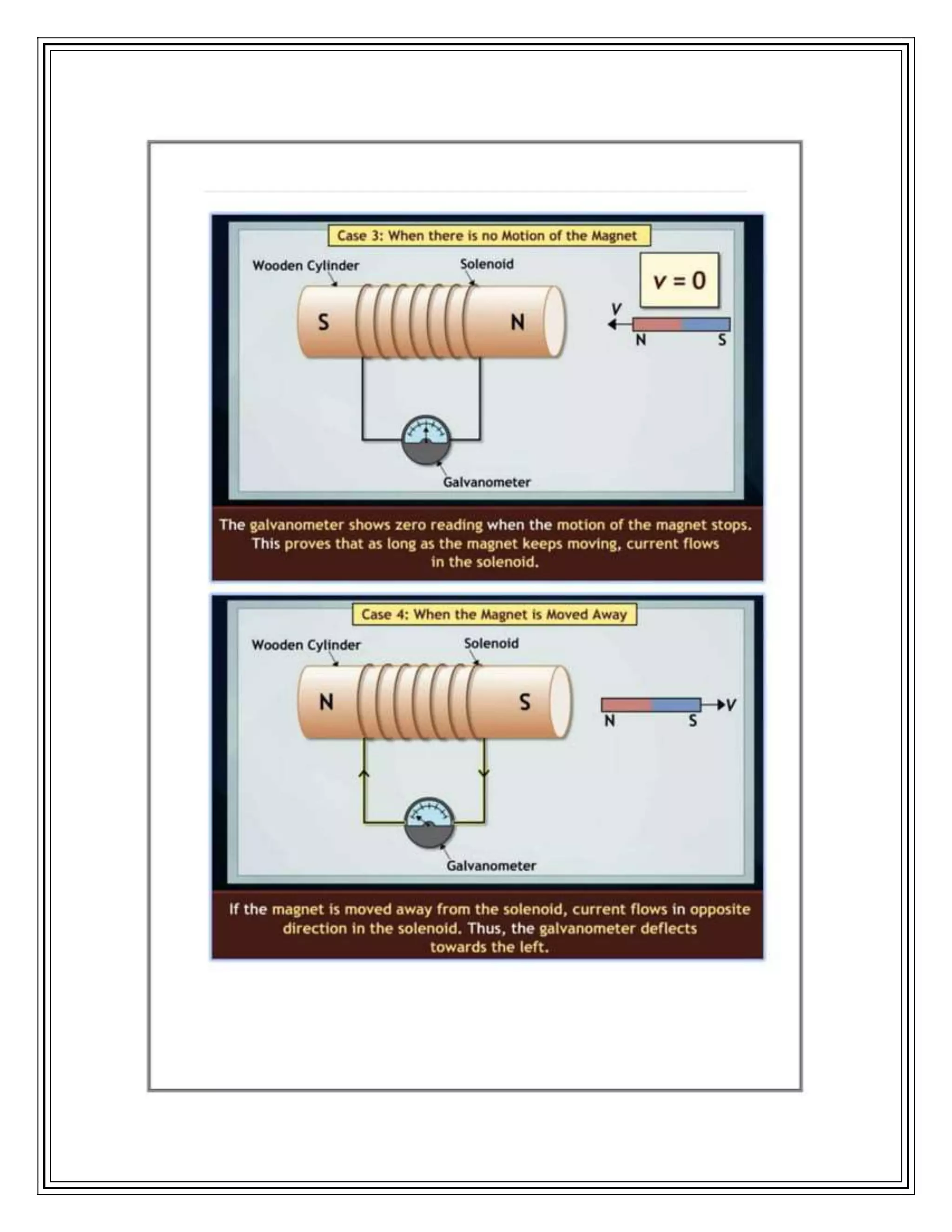
 He brought the magnet near the coil.
 When the magnet is moved towards the
coil galvanometer showed deflection.
 Galvanometer even showed the deflection
in the opposite
direction When the magnet is taken away
from the coil.
 When the magnet was not moved there
was no deflection in the galvanometer.
 This shows current is related to a magnet.
 Faster the magnet is moved the more is
thc deflection in the galvanometer. This
showed more and more current flows if
the magnet is moved very fast.
 Same effect was observed if the coil is
moved and the magnet was not moved.
EXPERIMENT
Aim:
To study the phenomenon of electromagnetic
induction.
Materials Required:
Magnetic bar, a galvanometer, coil and
connecting wires.
Procedure:
1. Take a coil of wire having a large number
of turns.
2. Connect the end of the coil to a
galvanometer.
3. Take a strong bar magnet and move its
north pole into the coil
and observe the changes in the galvanometer
needle.
4. Repeat earlier step with the south pole of
the bar magnet.
5. Now repeat the procedure with the coil
having a different number of turns and the
variation in the deflection of the
galvanometer needle.
Observations:
l. When we move the magnet in or out of the
coil, the needle Of
galvanometer gets deflected in different
directions.
2. When we insert the north pole (N) Of bar
magnet into the coil,
the deflection is towards right.
3. When we insert the south pole (S) of bar
magnet into the coil, the
deflection is towards left.
4. When we move the bar magnet in or out
of the coil with varying
speed, the speed of deflection changes
accordingly.
5. As we increase the number of turns in the
coil, the deflection
increases.
6. Relative motion between magnet and coil
induced electric current in the coil.
DIAGRAMS
RESULT
I. The deflection of galvanometer needle
indicates the presence of
current in the coil.
2. The direction of deflection gives the
direction of flow of current.
3. The speed Of deflection gives the rate at
which the current is
induced.
4. The deflection in galvanometer Changes
with the Change in
number of turns in the coil - more the
number of turns in the coil
greater is the deflection.
CONCLUSION
From this experiment, Faraday concluded that
whenever there is
relative motion between a conductor and a
magnetic field, thc flux
linkage with a coil changes and this change in
flux induces a voltage
across a coil.
BIBLIOGRAPHY
 Physics NCERT Book class XII
 www.Wikipedia.com
 Google Images
 Slideshare.com
THANK
YOU

Electromagnet class XII.docx

  • 1.
    INDEX  CERTIFICATE  ACKNOWLEDGEMENT AIM OF PROJECT  INTRODUCTION  THEORY  APPLICATIONS OF EMI  OBSERVATION  CONCLUSION  PRECAUTIONS  BIBLIOGRAPHY
  • 2.
    CERTIFICATE This is tocertify that ___________________, a student of class _________________has successfully completed the research on the topic “Study of the Phenomenon of Electromagnetic Induction”, under the guidance of __________________(Subject Teacher) during the year 2021-2022 in partial fulfillment of Physics practical examination of Central Board of Secondary Education (CBSE).
  • 3.
  • 4.
    ACKNOWLEDGEMENT I warmly acknowledgethe continuous encouragement and timely suggestions offered by our dear Principal ________________. I extend my hearty thanks for giving me the opportunity to make use of the facilities available in the campus to carry out the project successfully. I am highly indebted to _____________________ for the constant supervision, providing necessary information and supporting
  • 5.
    in completing theproject. I would like to express my gratitude towards them for their kind cooperation and encouragement. Finally, I extend my gratefulness to one and all who are directly or indirectly involved in the successful completion of this project work. I am making this project not only for marks but to also increase my knowledge.
  • 6.
    INTRODUCTION Electro Magnet: An electromagnetis a type of magnet in which the magnetic field is produced by electric current. The magnetic field disappears when the current is turned off. Induction: This process of generating current in a conductor by placing the conductor in a changing magnetic field is called induction. Electromagnetic Induction:
  • 7.
    Electromagnetic induction isthe production of a potential difference (voltage) across a conductor when it is exposed to a varying magnetic field. Electromagnetic induction is when an electromagnetic field causes molecules in another object to flow. Induction can produce electricity (in coils), heat (in ferrous metals), or waves (in a radio transmitter). Finally, it refers to the phenomenon where an emf is induced when the magnetic flux linking a conductor changes.
  • 8.
    Magnetic Flux: Magnetic Fluxis defined as the product of the magnetic flux density and the area normal to the field through which the field is passing. It is a scalar quantity and its S.l. unit is the weber (Wb). Φ = BA
  • 9.
    PRINCIPLE Electromagnetic induction (orsometimes just induction) is a process where a conductor is placed in a changing magnetic field (or a conductor moving through a stationary magnetic field) causes the production Of a voltage across the conductor. This process of electromagnetic induction, in turn causes an electrical current it is said to induce the current.
  • 11.
    THEORY Invention: Michael Faraday isgenerally credited with the discovery o induction in 1831 though it may have been anticipated by the work of Francesco Zantedeschi in 1829. Around 1830 to 1832. Joseph Henry made a similar discovery. but did not publish his findings until later. Induced e.m.f: If magnetic flux through a coil is altered then an E.m.f. will be
  • 12.
    generated in thecoil. This effect was first observed and explained by Ampere and Faraday between 1825 and 1831. Faraday discovered that an e.m.f. could be generated either by, a) Moving the coil or the source of flux relative to each other or by b) Changing the magnitude of the source of magnetic flux in some way. Note the the e.m.f is only produced while the flux is changing. Lenz’s Law:
  • 13.
    When an emfis generated by a change in magnetic flux according to Faraday's Law, the polarity of the induced emf is such that it produces a current whose magnetic field opposes the change which produces it. The induced magnetic field inside any loop of wire always acts to keep the magnetic flux in the loop constant. In the examples below, if the B field is
  • 14.
    increasing. the inducedfield acts in opposition to it.
  • 15.
    APPLICATION OF ELECTROMAGNETIC INDUCTION Electric Generator: TheEMF generated by Faraday's law of induction due to relative movement of a circuit and a magnetic field is the phenomenon underlying electrical generators. When a permanent magnet is moved relative to a conductor, or vice versa. an electromotive force is created. If the wire is connected through an electrical load. current will flow. and thus electrical energy is generated,
  • 16.
    converting the mechanicalenergy of motion to electrical energy. Electric Transformer:
  • 17.
    The EMF predictedby Faraday's law is also responsible for electrical transformers. When the electric current in a loop of wire changes. The changing current creates a changing magnetic field. The second wire in reach of this magnetic field will experience this change in the magnetic field as a change in its coupled
  • 18.
    magnetic flux, therefore.an electromotive force is set up in the second loop called the induced EMF or transformer EMF. If the two ends of this loop are connected through an electrical load, current will flow.
  • 19.
    Faraday’s Experiment:  Onethe scientists Faraday performed series of experiments and based on the results he gave the law on induction.  He introduced the phenomenon of electromagnetic induction.  Induction means to induce or to generate something.  Electromagnetic Induction means the production of electric current due to the magnetic field.  Magnetic field is capable of producing current in a conductor  Faraday took a coil and attached a galvanometer to it.
  • 20.
     As thereis no battery attached therefore there is no source of current.  He brought the magnet near the coil.  When the magnet is moved towards the coil galvanometer showed deflection.  Galvanometer even showed the deflection in the opposite direction When the magnet is taken away from the coil.  When the magnet was not moved there was no deflection in the galvanometer.  This shows current is related to a magnet.  Faster the magnet is moved the more is thc deflection in the galvanometer. This showed more and more current flows if the magnet is moved very fast.
  • 21.
     Same effectwas observed if the coil is moved and the magnet was not moved.
  • 22.
    EXPERIMENT Aim: To study thephenomenon of electromagnetic induction. Materials Required: Magnetic bar, a galvanometer, coil and connecting wires. Procedure: 1. Take a coil of wire having a large number of turns.
  • 23.
    2. Connect theend of the coil to a galvanometer. 3. Take a strong bar magnet and move its north pole into the coil and observe the changes in the galvanometer needle. 4. Repeat earlier step with the south pole of the bar magnet. 5. Now repeat the procedure with the coil having a different number of turns and the variation in the deflection of the galvanometer needle.
  • 24.
    Observations: l. When wemove the magnet in or out of the coil, the needle Of galvanometer gets deflected in different directions. 2. When we insert the north pole (N) Of bar magnet into the coil, the deflection is towards right. 3. When we insert the south pole (S) of bar magnet into the coil, the deflection is towards left. 4. When we move the bar magnet in or out of the coil with varying
  • 25.
    speed, the speedof deflection changes accordingly. 5. As we increase the number of turns in the coil, the deflection increases. 6. Relative motion between magnet and coil induced electric current in the coil.
  • 26.
  • 28.
    RESULT I. The deflectionof galvanometer needle indicates the presence of current in the coil. 2. The direction of deflection gives the direction of flow of current. 3. The speed Of deflection gives the rate at which the current is induced. 4. The deflection in galvanometer Changes with the Change in number of turns in the coil - more the number of turns in the coil greater is the deflection.
  • 29.
    CONCLUSION From this experiment,Faraday concluded that whenever there is relative motion between a conductor and a magnetic field, thc flux linkage with a coil changes and this change in flux induces a voltage across a coil.
  • 30.
    BIBLIOGRAPHY  Physics NCERTBook class XII  www.Wikipedia.com  Google Images  Slideshare.com THANK
  • 31.