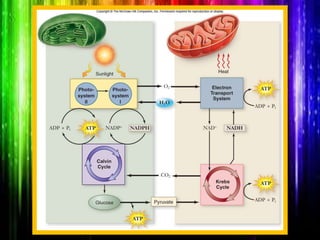
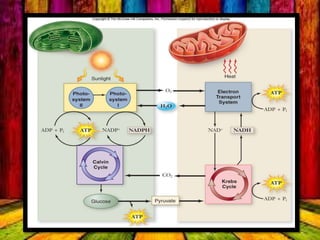
1.Photosynthesis
2.Photosynthesis
Overview
3.Discovery of
Photosynthesis
4.Why is
Photosynthesis
important?
5.Photosystem
Organization
6.Equation of
photosynthesis
 The process by which green plants make their
own food (like glucose) from carbondioxide and
water by using sunlight energy in the presence of
chlorophyll, is called photosynthesis.
Plants use sunlight to turn water and carbon
dioxide into glucose. Glucose is a kind of sugar.
Plants use glucose as food for energy and as a
building block for growing.
Autotrophs make glucose and heterotrophs are
consumers of it.
Makes organic molecules (glucose) out of
inorganic materials (carbon dioxide and water).
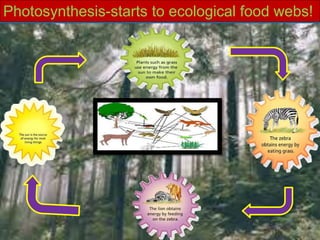
It begins all food chains/webs. Thus all life is
supported by this process.
It also makes oxygen gas!!
Energy for all life on Earth ultimately comes from
photosynthesis.
Oxygenic photosynthesis is carried out by:
cyanobacteria, 7 groups of algae, all land plants
 Photosynthesis is divided into:
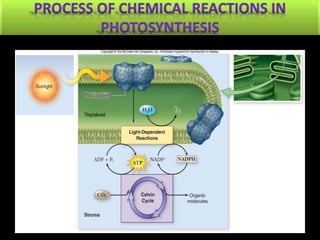
•light-dependent reactions
-capture energy from sunlight.
-make ATP and reduce NADP+ to NADPH.
•carbon fixation reactions
-use ATP and NADPH to synthesize organic molecules
from CO2.
 Autotrophic Process: Plants and plant-like organisms
make their energy (glucose) from sunlight.
Stored as carbohydrate in their bodies.
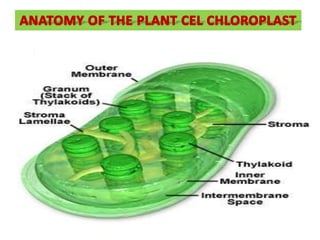
 Photosynthesis takes place in chloroplasts.
•thylakoid membrane – internal membrane arranged in
flattened sacs
-contain chlorophyll and other pigments
•grana – stacks of thylakoid membranes
•stroma – semi-liquid substance surrounding thylakoid
membranes.
 The work of many scientists led to the discovery of
how photosynthesis works.
PLANTS ARE IN ACTIOIN FOR PHOTOSYNTHESIS
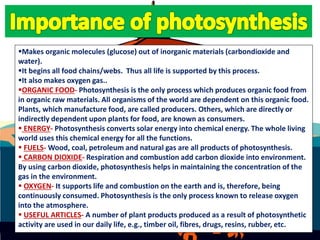
Makes organic molecules (glucose) out of inorganic materials (carbondioxide and
water).
It begins all food chains/webs. Thus all life is supported by this process.
It also makes oxygen gas..
ORGANIC FOOD- Photosynthesis is the only process which produces organic food from
in organic raw materials. All organisms of the world are dependent on this organic food.
Plants, which manufacture food, are called producers. Others, which are directly or
indirectly dependent upon plants for food, are known as consumers.
 ENERGY- Photosynthesis converts solar energy into chemical energy. The whole living
world uses this chemical energy for all the functions.
 FUELS- Wood, coal, petroleum and natural gas are all products of photosynthesis.
 CARBON DIOXIDE- Respiration and combustion add carbon dioxide into environment.
By using carbon dioxide, photosynthesis helps in maintaining the concentration of the
gas in the environment.
 OXYGEN- It supports life and combustion on the earth and is, therefore, being
continuously consumed. Photosynthesis is the only process known to release oxygen
into the atmosphere.
 USEFUL ARTICLES- A number of plant products produced as a result of photosynthetic
activity are used in our daily life, e.g., timber oil, fibres, drugs, resins, rubber, etc.
6CO2 + 6H2O + energy  C6H12O6 + 6O2
sunlight
Absorbed by chlorophyll
Photosynthesis-starts to ecological food webs!
NECESSARY IN PHOTOSYNTHESIS
A. PHOTCHEMICAL PHASE (LIGHT OR HILL
REACTIONS)
(a) PHOTOLYSIS OF WATER
(b) FORMATION OF ASSIMILATORY
POWER
B. BIOSYNTHETIC PHASE(DARK AND
BLACKMAN’S REACTIONS)
Discovery of
Photosynthesis
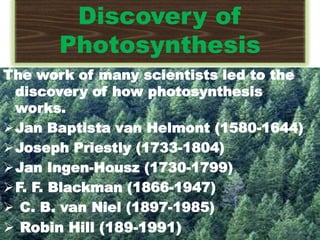
The work of many scientists led to the
discovery of how photosynthesis
works.
Jan Baptista van Helmont (1580-1644)
Joseph Priestly (1733-1804)
Jan Ingen-Housz (1730-1799)
F. F. Blackman (1866-1947)
 C. B. van Niel (1897-1985)
 Robin Hill (189-1991)
Robert hill C. B. van Niel Joseph Priestly
C. B. van Niel Jan Ingen-Housz F. F. Blackman
Light Reaction
(photochemical
reaction)
Dark Reaction
(biosynthetic reaction)
 LIGHT (SUNLIGHT)
 CHLOROPHYLL
 WATER AND MINERALS
 CARBONDIOXIDE
 TEMPERATURE
 NITROGEN
It is the source for energy for photosynthesis.
Light is visible part of the electromagnetic radiations. It has a
wavelength of 390-760 nm.
Photosynthetically active radiations or PAR are 400-700 nm.
Natural source of light is sun but artificial light can also provide
energy to plants for their photosynthesis.
plants absorb light mostly in violet-blue and red parts of the
light.
Violet-blue light carries light carries more energy as compared to
red light
Plants growing under shade of others receive mostly green and
some violet light.
They have lower rates of photosynthesis.
Light has two functions, photolysis of water and excitation of
chlorophyll to emit electrons.
Photolysis of water produces oxygen, protons and electrons and
electrons and protons help in producing ATP and NADPH2.
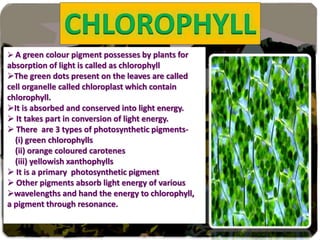
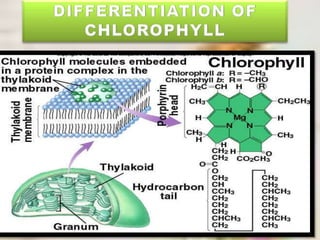
 A green colour pigment possesses by plants for
absorption of light is called as chlorophyll
The green dots present on the leaves are called
cell organelle called chloroplast which contain
chlorophyll.
It is absorbed and conserved into light energy.
 It takes part in conversion of light energy.
 There are 3 types of photosynthetic pigments-
(i) green chlorophylls
(ii) orange coloured carotenes
(iii) yellowish xanthophylls
 It is a primary photosynthetic pigment
 Other pigments absorb light energy of various
wavelengths and hand the energy to chlorophyll,
a pigment through resonance.
Land plants absorb water from soil through their roots.
The absorbed water is transported to photosynthetic areas of
xylem and minerals are also transported alongwith water.
they are used in synthesis of different organic substances like
sulphur in proteins, phosphorous in nucleic acids, magnesium in
chlorophyll etc.
99% of absorbed water is lost through transpiration and only a
small quantity of water is used in photosynthesis as hydrogen
donor.
For this, water splits into its components with the help of light
energy.
the phenomenon is called photolysis of water and oxygen is
evolved.
 Land plants obtain it from atmosphere while aquatic plants absorb the same from
water.
 Atmosphere contains over 0.036% of carbondioxide.
It enters the leaves through stomata function as turgor-operated valves.
 Their guard cells thicker on the inner side and thinner on the outer side.
 K+ ions are closure of stomata. It generally remain open during the daytime. As,
carbondioxide is used internally in photosynthesis is occurring.
 During day time the leaves can also use a small quantity of carbondioxide produced
internally through respiration.
 At night, the carbondioxide evolved in respiration remains unutilised. The stomata
get closed which prevents loss of water through transpiration.
 During evening and early morning, when light intensity is low, the rate of
photosynthetic utilisation of carbon dioxide may just balance respiratory release of the
gas.
 At this time the leaves neither obtain carbondioxide from outside nor release the
gas.
 The light intensity wherein the photosynthesizing organ neither absorbs
carbondioxide nor releases the same is called compensation point.
TEMPERATURE
 Photosynthetic takes place between 5 degree centigrade to 45 degree
centigrade.
 The rate of photosynthesis is maximum at 30 degree centigrade.
 So, photosynthesis start at 5 degree centigrade, increase till30 degree centigrade
and decrease at 45 degree centigrade.
 At high temperature, enzymes of the chlorophyll are inactive so photosynthesis
stops at that temperature
NITROGEN
 It is an essential element which is used in the synthesis of proteins and
other compounds.
 This is taken in the form of inorganic nitrates and nitrites or as inorganic
compounds which have been prepared by bacteria (rhizobium) from
atmospheric nitrogen.
SYSTEM AND TYPES OF LIGHT ENERGY
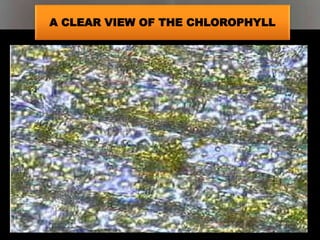
A CLEAR VIEW OF THE CHLOROPHYLL
23
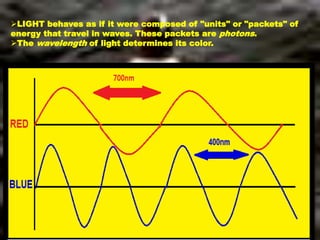
LIGHT behaves as if it were composed of "units" or "packets" of
energy that travel in waves. These packets are photons.
The wavelength of light determines its color.
SYSTEM OF ENTRY AND EXIT OF THE GASES THROUGH
CHLOROPHYLL
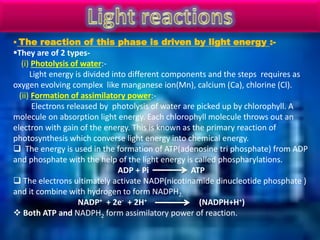
 The reaction of this phase is driven by light energy :-
They are of 2 types-
(i) Photolysis of water:-
Light energy is divided into different components and the steps requires as
oxygen evolving complex like manganese ion(Mn), calcium (Ca), chlorine (Cl).
(ii) Formation of assimilatory power:-
Electrons released by photolysis of water are picked up by chlorophyll. A
molecule on absorption light energy. Each chlorophyll molecule throws out an
electron with gain of the energy. This is known as the primary reaction of
photosynthesis which converse light energy into chemical energy.
 The energy is used in the formation of ATP(adenosine tri phosphate) from ADP
and phosphate with the help of the light energy is called phospharylations.
ADP + Pi ATP
 The electrons ultimately activate NADP(nicotinamide dinucleotide phosphate )
and it combine with hydrogen to form NADPH2.
NADP+ + 2e- + 2H+ (NADPH+H+)
 Both ATP and NADPH2 form assimilatory power of reaction.
DARK REACTIONS
It is actually light independent reaction which can occur both in light and as well in
dark.
It requires the energy and reducing power contained in assimilatory power of light
reaction.
The common pathway of the biosynthetic phase is Kelvin cycle which convert
carbondioxide into glucose by a series of reaction.
Carbondioxide combines ribulose biphosphate in the presence of enzyme ribulose
biphosphate carboxylaze or rubisco.
It produces two molecules of phosphoglyceric acid (PGA).
RuBP+ CO2 2GPA
This glucose then converts into starch and stored in the leaves or flow in the phloem
as liquid glucose.
in the presence of ATP, phosphoglyceric acid is reduced by NADPH2 to form
glyceraldehydrade phosphate.
PGA+ATP+ NADPH2 GAP+NADP+ADP+Pi
12 PGA
6RuBP
12ATP
NADPH2
12NADP
12ADP+12 P1
12GAP
6RuMP
GLUCOSE
CALVIN CYCLE
6 CO2
6ADP
6ATP
DIGRAM OF THE CALVIN CYCLE
BROAD DIGRAM OF CALVIN CYCLE
DARK REACTION
SOME IMPORTANT NOTES
photon: a particle of light
-acts as a discrete bundle of energy.
-energy content of a photon is inversely proportional to the wavelength of the light.
photoelectric effect: removal of an electron from a molecule by light
-occurs when photons transfer energy to electrons.
Pigments: molecules that absorb visible light
Each pigment has a characteristic absorption spectrum, the range and efficiency of photons it
is capable of absorbing.
chlorophyll a – primary pigment in plants and cyanobacteria
-absorbs violet-blue and red light .
chlorophyll b – secondary pigment absorbing light wavelengths that chlorophyll a does not
absorb.
accessory pigments: secondary pigments absorbing light wavelengths other than those
absorbed by chlorophyll a.
-increase the range of light wavelengths that can be used in photosynthesis.
-include: chlorophyll b, carotenoids, phycobiloproteins.
-carotenoids also act as antioxidants.
In sulfur bacteria, only one photosystem is used for cyclic photophosphorylation
1. an electron joins a proton to produce hydrogen.
2. an electron is recycled to chlorophyll
-this process drives the chemiosmotic synthesis of ATP.
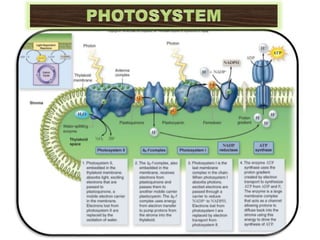
In chloroplasts, two linked photosystems are used in noncyclic photophosphorylation-
1. photosystem I
-reaction center pigment (P700) with a peak absorption at 700nm.
2. photosystem II
-reaction center pigment (P680) has a peak absorption at 680nm.
Photosystem II acts first:
-accessory pigments shuttle energy to the P680 reaction center.
-excited electrons from P680 are transferred to b6-f complex
-electron lost from P680 is replaced by an electron released from the splitting of water.
The b6-f complex is a series of electron carriers.
-electron carrier molecules are embedded in the thylakoid membrane.
-protons are pumped into the thylakoid space to form a proton gradient.
THANK YOU FOR LOOKING MY PRESENTATION
IN
FULL COOPERATION
NAME- CHNMAYA PATTNAIK
CLASS- X – “B”
ROLL-36
SCHOOL- KENDRIYA VIDYALAYA NO.1, CUTTACK

photosynthesis basics study for class 10th

  • 2.
  • 3.
     The processby which green plants make their own food (like glucose) from carbondioxide and water by using sunlight energy in the presence of chlorophyll, is called photosynthesis. Plants use sunlight to turn water and carbon dioxide into glucose. Glucose is a kind of sugar. Plants use glucose as food for energy and as a building block for growing. Autotrophs make glucose and heterotrophs are consumers of it. Makes organic molecules (glucose) out of inorganic materials (carbon dioxide and water). It begins all food chains/webs. Thus all life is supported by this process. It also makes oxygen gas!! Energy for all life on Earth ultimately comes from photosynthesis.
  • 4.
    Oxygenic photosynthesis iscarried out by: cyanobacteria, 7 groups of algae, all land plants  Photosynthesis is divided into: •light-dependent reactions -capture energy from sunlight. -make ATP and reduce NADP+ to NADPH. •carbon fixation reactions -use ATP and NADPH to synthesize organic molecules from CO2.  Autotrophic Process: Plants and plant-like organisms make their energy (glucose) from sunlight. Stored as carbohydrate in their bodies.  Photosynthesis takes place in chloroplasts. •thylakoid membrane – internal membrane arranged in flattened sacs -contain chlorophyll and other pigments •grana – stacks of thylakoid membranes •stroma – semi-liquid substance surrounding thylakoid membranes.  The work of many scientists led to the discovery of how photosynthesis works.
  • 5.
    PLANTS ARE INACTIOIN FOR PHOTOSYNTHESIS
  • 6.
    Makes organic molecules(glucose) out of inorganic materials (carbondioxide and water). It begins all food chains/webs. Thus all life is supported by this process. It also makes oxygen gas.. ORGANIC FOOD- Photosynthesis is the only process which produces organic food from in organic raw materials. All organisms of the world are dependent on this organic food. Plants, which manufacture food, are called producers. Others, which are directly or indirectly dependent upon plants for food, are known as consumers.  ENERGY- Photosynthesis converts solar energy into chemical energy. The whole living world uses this chemical energy for all the functions.  FUELS- Wood, coal, petroleum and natural gas are all products of photosynthesis.  CARBON DIOXIDE- Respiration and combustion add carbon dioxide into environment. By using carbon dioxide, photosynthesis helps in maintaining the concentration of the gas in the environment.  OXYGEN- It supports life and combustion on the earth and is, therefore, being continuously consumed. Photosynthesis is the only process known to release oxygen into the atmosphere.  USEFUL ARTICLES- A number of plant products produced as a result of photosynthetic activity are used in our daily life, e.g., timber oil, fibres, drugs, resins, rubber, etc.
  • 8.
    6CO2 + 6H2O+ energy  C6H12O6 + 6O2 sunlight Absorbed by chlorophyll
  • 9.
  • 10.
    NECESSARY IN PHOTOSYNTHESIS A.PHOTCHEMICAL PHASE (LIGHT OR HILL REACTIONS) (a) PHOTOLYSIS OF WATER (b) FORMATION OF ASSIMILATORY POWER B. BIOSYNTHETIC PHASE(DARK AND BLACKMAN’S REACTIONS)
  • 11.
    Discovery of Photosynthesis The workof many scientists led to the discovery of how photosynthesis works. Jan Baptista van Helmont (1580-1644) Joseph Priestly (1733-1804) Jan Ingen-Housz (1730-1799) F. F. Blackman (1866-1947)  C. B. van Niel (1897-1985)  Robin Hill (189-1991)
  • 12.
    Robert hill C.B. van Niel Joseph Priestly C. B. van Niel Jan Ingen-Housz F. F. Blackman
  • 13.
  • 14.
     LIGHT (SUNLIGHT) CHLOROPHYLL  WATER AND MINERALS  CARBONDIOXIDE  TEMPERATURE  NITROGEN
  • 15.
    It is thesource for energy for photosynthesis. Light is visible part of the electromagnetic radiations. It has a wavelength of 390-760 nm. Photosynthetically active radiations or PAR are 400-700 nm. Natural source of light is sun but artificial light can also provide energy to plants for their photosynthesis. plants absorb light mostly in violet-blue and red parts of the light. Violet-blue light carries light carries more energy as compared to red light Plants growing under shade of others receive mostly green and some violet light. They have lower rates of photosynthesis. Light has two functions, photolysis of water and excitation of chlorophyll to emit electrons. Photolysis of water produces oxygen, protons and electrons and electrons and protons help in producing ATP and NADPH2.
  • 16.
     A greencolour pigment possesses by plants for absorption of light is called as chlorophyll The green dots present on the leaves are called cell organelle called chloroplast which contain chlorophyll. It is absorbed and conserved into light energy.  It takes part in conversion of light energy.  There are 3 types of photosynthetic pigments- (i) green chlorophylls (ii) orange coloured carotenes (iii) yellowish xanthophylls  It is a primary photosynthetic pigment  Other pigments absorb light energy of various wavelengths and hand the energy to chlorophyll, a pigment through resonance.
  • 18.
    Land plants absorbwater from soil through their roots. The absorbed water is transported to photosynthetic areas of xylem and minerals are also transported alongwith water. they are used in synthesis of different organic substances like sulphur in proteins, phosphorous in nucleic acids, magnesium in chlorophyll etc. 99% of absorbed water is lost through transpiration and only a small quantity of water is used in photosynthesis as hydrogen donor. For this, water splits into its components with the help of light energy. the phenomenon is called photolysis of water and oxygen is evolved.
  • 19.
     Land plantsobtain it from atmosphere while aquatic plants absorb the same from water.  Atmosphere contains over 0.036% of carbondioxide. It enters the leaves through stomata function as turgor-operated valves.  Their guard cells thicker on the inner side and thinner on the outer side.  K+ ions are closure of stomata. It generally remain open during the daytime. As, carbondioxide is used internally in photosynthesis is occurring.  During day time the leaves can also use a small quantity of carbondioxide produced internally through respiration.  At night, the carbondioxide evolved in respiration remains unutilised. The stomata get closed which prevents loss of water through transpiration.  During evening and early morning, when light intensity is low, the rate of photosynthetic utilisation of carbon dioxide may just balance respiratory release of the gas.  At this time the leaves neither obtain carbondioxide from outside nor release the gas.  The light intensity wherein the photosynthesizing organ neither absorbs carbondioxide nor releases the same is called compensation point.
  • 20.
    TEMPERATURE  Photosynthetic takesplace between 5 degree centigrade to 45 degree centigrade.  The rate of photosynthesis is maximum at 30 degree centigrade.  So, photosynthesis start at 5 degree centigrade, increase till30 degree centigrade and decrease at 45 degree centigrade.  At high temperature, enzymes of the chlorophyll are inactive so photosynthesis stops at that temperature NITROGEN  It is an essential element which is used in the synthesis of proteins and other compounds.  This is taken in the form of inorganic nitrates and nitrites or as inorganic compounds which have been prepared by bacteria (rhizobium) from atmospheric nitrogen.
  • 21.
    SYSTEM AND TYPESOF LIGHT ENERGY
  • 22.
    A CLEAR VIEWOF THE CHLOROPHYLL
  • 23.
  • 24.
    LIGHT behaves asif it were composed of "units" or "packets" of energy that travel in waves. These packets are photons. The wavelength of light determines its color.
  • 29.
    SYSTEM OF ENTRYAND EXIT OF THE GASES THROUGH CHLOROPHYLL
  • 30.
     The reactionof this phase is driven by light energy :- They are of 2 types- (i) Photolysis of water:- Light energy is divided into different components and the steps requires as oxygen evolving complex like manganese ion(Mn), calcium (Ca), chlorine (Cl). (ii) Formation of assimilatory power:- Electrons released by photolysis of water are picked up by chlorophyll. A molecule on absorption light energy. Each chlorophyll molecule throws out an electron with gain of the energy. This is known as the primary reaction of photosynthesis which converse light energy into chemical energy.  The energy is used in the formation of ATP(adenosine tri phosphate) from ADP and phosphate with the help of the light energy is called phospharylations. ADP + Pi ATP  The electrons ultimately activate NADP(nicotinamide dinucleotide phosphate ) and it combine with hydrogen to form NADPH2. NADP+ + 2e- + 2H+ (NADPH+H+)  Both ATP and NADPH2 form assimilatory power of reaction.
  • 32.
    DARK REACTIONS It isactually light independent reaction which can occur both in light and as well in dark. It requires the energy and reducing power contained in assimilatory power of light reaction. The common pathway of the biosynthetic phase is Kelvin cycle which convert carbondioxide into glucose by a series of reaction. Carbondioxide combines ribulose biphosphate in the presence of enzyme ribulose biphosphate carboxylaze or rubisco. It produces two molecules of phosphoglyceric acid (PGA). RuBP+ CO2 2GPA This glucose then converts into starch and stored in the leaves or flow in the phloem as liquid glucose. in the presence of ATP, phosphoglyceric acid is reduced by NADPH2 to form glyceraldehydrade phosphate. PGA+ATP+ NADPH2 GAP+NADP+ADP+Pi
  • 33.
    12 PGA 6RuBP 12ATP NADPH2 12NADP 12ADP+12 P1 12GAP 6RuMP GLUCOSE CALVINCYCLE 6 CO2 6ADP 6ATP DIGRAM OF THE CALVIN CYCLE
  • 34.
    BROAD DIGRAM OFCALVIN CYCLE
  • 37.
  • 38.
    SOME IMPORTANT NOTES photon:a particle of light -acts as a discrete bundle of energy. -energy content of a photon is inversely proportional to the wavelength of the light. photoelectric effect: removal of an electron from a molecule by light -occurs when photons transfer energy to electrons. Pigments: molecules that absorb visible light Each pigment has a characteristic absorption spectrum, the range and efficiency of photons it is capable of absorbing. chlorophyll a – primary pigment in plants and cyanobacteria -absorbs violet-blue and red light . chlorophyll b – secondary pigment absorbing light wavelengths that chlorophyll a does not absorb. accessory pigments: secondary pigments absorbing light wavelengths other than those absorbed by chlorophyll a. -increase the range of light wavelengths that can be used in photosynthesis. -include: chlorophyll b, carotenoids, phycobiloproteins. -carotenoids also act as antioxidants.
  • 39.
    In sulfur bacteria,only one photosystem is used for cyclic photophosphorylation 1. an electron joins a proton to produce hydrogen. 2. an electron is recycled to chlorophyll -this process drives the chemiosmotic synthesis of ATP. In chloroplasts, two linked photosystems are used in noncyclic photophosphorylation- 1. photosystem I -reaction center pigment (P700) with a peak absorption at 700nm. 2. photosystem II -reaction center pigment (P680) has a peak absorption at 680nm. Photosystem II acts first: -accessory pigments shuttle energy to the P680 reaction center. -excited electrons from P680 are transferred to b6-f complex -electron lost from P680 is replaced by an electron released from the splitting of water. The b6-f complex is a series of electron carriers. -electron carrier molecules are embedded in the thylakoid membrane. -protons are pumped into the thylakoid space to form a proton gradient.
  • 40.
    THANK YOU FORLOOKING MY PRESENTATION IN FULL COOPERATION NAME- CHNMAYA PATTNAIK CLASS- X – “B” ROLL-36 SCHOOL- KENDRIYA VIDYALAYA NO.1, CUTTACK