THE SOUNDS OF
SPEECH
PHONOTACTICS
Renajane N. De Isidro, LPT
Ma. Nichole L. Jugao, LPT
presenters
What is Phonotactics?
Phonotact
ics  Ancient Greek, phōnḗ "voice,
sound" and tacticós, also
spelled/known as
taktikós "having to do with
arranging.
 the study of the ways in
which phonemes are allowed to
combine in a particular language.
Phonotact
ics
 Phonotactics is a branch of
phonology that discusses the
restrictions in a language on the
permissible combinations of
phonemes (Celata & Basilio,
2015).
Phonotact
ics
 Phonotactics gives a
description for the permissible
syllable structure, consonant
clusters and vowel sequences
and explains what role
phonotactic constraints play in
defining the legality of the
sounds sequence. (Smolensky &
Prince, 1993).
Phonotact
ics
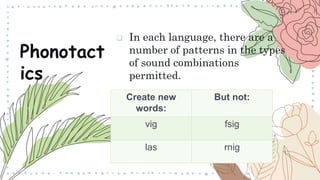
 In each language, there are a
number of patterns in the types
of sound combinations
permitted.
Create new
words:
But not:
vig fsig
las rnig
Phonotact
ics
 “phonotactic knowledge leads to
enhanced speech processing
enables us to use phonotactic
learning and generalization as a
means to better understand how
humans represent speech sounds
and sound sequences” (p. 138).
Phonotact
ics
 Languages are subject to
phonotactic constraints, which are
restrictions on sound sequences
(Goldrick, 2004).
Phonotact
ics
 According to Goldrick, these
constraints could be acquired
through exposure to a set of
syllables which he described
as an implicit learning
paradigm. These constraints
can apply to nonsense words,
too.
Phonotact
ics
 Accidental gaps are words that
do not exist in a language and
are not part of its lexicon, but
its sounds sequence is legal
and does not violate its
phonotactic.
Accidenta
l Gap
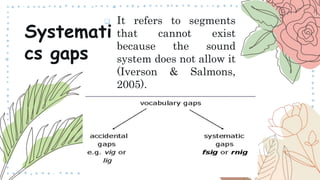
 It refers to segments
that cannot exist
because the sound
system does not allow it
(Iverson & Salmons,
2005).
Systemati
cs gaps
 Over time, a language may undergo
phonotactic variation and change.
 Daniel Schreier points out, “Old
English phonotactics admitted a variety
of consonantal sequences that are no
longer found in contemporary varieties"
(Consonant Change in English
Worldwide, 2005).
 Phonotactic constraints
are rules and restrictions
concerning the ways in
which syllables can be
created in a language.
Understanding
Phonotactic
Constraints
 Elizabeth Zsiga, a linguist,
observes that languages "do not
allow random sequences of
sounds; rather, the sound
sequences a language allows are
a systematic and predictable part
of its structure.“
Understanding
Phonotactic
Constraints
 Elizabeth Zsiga, a linguist,
observes that languages "do not
allow random sequences of
sounds; rather, the sound
sequences a language allows are
a systematic and predictable part
of its structure.“
Understanding
Phonotactic
Constraints
 Phonotactic constraints determine
the syllable structure of a
language.
 Some languages (e.g. English)
allow consonant cluster others (e.g.
Maori) do not.
Phonotactic
Constraints
 English consonant clusters are
themselves subject to a number of
phonotactic constraints.
There are constraints in terms of length
Example : twelfths /twεlfθs/
(four is the maximum
number of consonants in a cluster)
Phonotactic
Constraints
 Many of the phonotactic limitations
are arbitrary, not involving articulation,
but depending only on the idiosyncrasies
of the language in question.
Arbitrary
Phonotactic Constr
aints
 English words like knife and knee are
pronounced /naɪf/ and /ni/. Historically, they
did have the initial /k/, which is still present
in several sister languages. Phonotactic
restrictions are thus not necessarily due
to any articulatory difficulty, because what
cannot be said in one language can be said
in another.
Arbitrary
Phonotactic Constr
aints
IPA
International Phonetic
Alphabet
International Phonetic Alphabet
 International Phonetic Alphabet (IPA), an
alphabet developed in the 19th century to
accurately represent the pronunciation
of languages. One aim of the IPA was to
provide a unique symbol for each distinctive
sound in a language—that is, every sound,
or phoneme, that serves to distinguish one
word from another.
International Phonetic Alphabet
 Its creators’ intent was to standardize the
representation of spoken language thereby
sidestepping the confusion caused by the
inconsistent conventional spellings used in
every language.
 The IPA can be used for broad and narrow
transcription.
 In English there is only one t sound distinguished
by native speakers. Therefore, only one symbol is
needed in a broad transcription to indicate
every t sound. If there is a need to transcribe
narrowly in English, diacritical marks can be added
to indicate that the t’s in the words tap, pat,
and stem differ slightly in pronunciation.
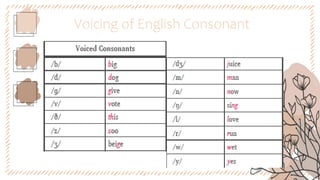
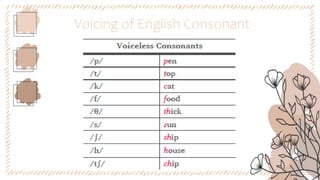
Voicing of English Consonant
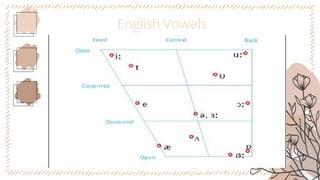
English Vowels
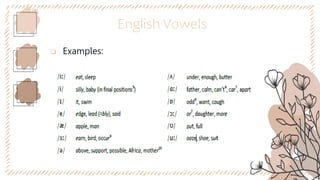
English Vowels
 Examples:
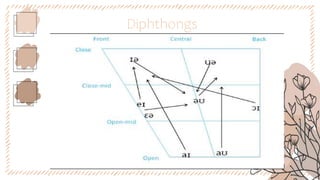
Diphthongs
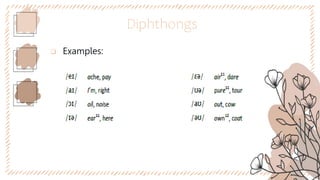
Diphthongs
 Examples:
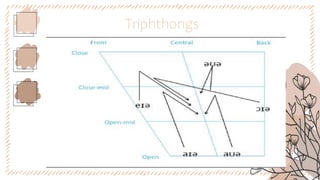
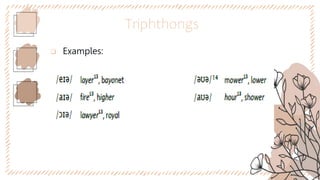
Triphthongs
Triphthongs
 Examples:
Quick IPA Practice:
1. [hit]
2. [ʃrɪŋk]
3. [ræθ]
4. [tʃʌmp]
5. [fejz]
1. hit
2. shrink
3. wrath
4. chump
5. phase
Quick IPA Practice:
1. [tu tɑlk əv mɛni θɪŋz]
to talk of many things
2. [kæbəgəz ænd kɪŋz]
cabbages and kings
3. [wɛθər pɪgz hæv wɪŋz]
whether pigs have wings
References:
1. https://www.thoughtco.com/phonotactics-
phonology-term-4071087
2. https://people.umass.edu/scable/LING201-
SP18/Slides-Handouts/Syllables-P…
3. https://www.britannica.com/topic/International
-Phonetic-Alphabet
4. https://old.liu.se/ikk/english/files/Course+Webpa
ges/english-
3/1.206147/CompendiumVowelsConsonantsof
English.pdf

Phonotactics and IPA.pptx

  • 1.
    THE SOUNDS OF SPEECH PHONOTACTICS RenajaneN. De Isidro, LPT Ma. Nichole L. Jugao, LPT presenters
  • 2.
  • 3.
    Phonotact ics  AncientGreek, phōnḗ "voice, sound" and tacticós, also spelled/known as taktikós "having to do with arranging.
  • 4.
     the studyof the ways in which phonemes are allowed to combine in a particular language. Phonotact ics
  • 5.
     Phonotactics isa branch of phonology that discusses the restrictions in a language on the permissible combinations of phonemes (Celata & Basilio, 2015). Phonotact ics
  • 6.
     Phonotactics givesa description for the permissible syllable structure, consonant clusters and vowel sequences and explains what role phonotactic constraints play in defining the legality of the sounds sequence. (Smolensky & Prince, 1993). Phonotact ics
  • 7.
     In eachlanguage, there are a number of patterns in the types of sound combinations permitted. Create new words: But not: vig fsig las rnig Phonotact ics
  • 8.
     “phonotactic knowledgeleads to enhanced speech processing enables us to use phonotactic learning and generalization as a means to better understand how humans represent speech sounds and sound sequences” (p. 138). Phonotact ics
  • 9.
     Languages aresubject to phonotactic constraints, which are restrictions on sound sequences (Goldrick, 2004). Phonotact ics
  • 10.
     According toGoldrick, these constraints could be acquired through exposure to a set of syllables which he described as an implicit learning paradigm. These constraints can apply to nonsense words, too. Phonotact ics
  • 11.
     Accidental gapsare words that do not exist in a language and are not part of its lexicon, but its sounds sequence is legal and does not violate its phonotactic. Accidenta l Gap
  • 12.
     It refersto segments that cannot exist because the sound system does not allow it (Iverson & Salmons, 2005). Systemati cs gaps
  • 13.
     Over time,a language may undergo phonotactic variation and change.  Daniel Schreier points out, “Old English phonotactics admitted a variety of consonantal sequences that are no longer found in contemporary varieties" (Consonant Change in English Worldwide, 2005).
  • 14.
     Phonotactic constraints arerules and restrictions concerning the ways in which syllables can be created in a language. Understanding Phonotactic Constraints
  • 15.
     Elizabeth Zsiga,a linguist, observes that languages "do not allow random sequences of sounds; rather, the sound sequences a language allows are a systematic and predictable part of its structure.“ Understanding Phonotactic Constraints
  • 16.
     Elizabeth Zsiga,a linguist, observes that languages "do not allow random sequences of sounds; rather, the sound sequences a language allows are a systematic and predictable part of its structure.“ Understanding Phonotactic Constraints
  • 17.
     Phonotactic constraintsdetermine the syllable structure of a language.  Some languages (e.g. English) allow consonant cluster others (e.g. Maori) do not. Phonotactic Constraints
  • 18.
     English consonantclusters are themselves subject to a number of phonotactic constraints. There are constraints in terms of length Example : twelfths /twεlfθs/ (four is the maximum number of consonants in a cluster) Phonotactic Constraints
  • 19.
     Many ofthe phonotactic limitations are arbitrary, not involving articulation, but depending only on the idiosyncrasies of the language in question. Arbitrary Phonotactic Constr aints
  • 20.
     English wordslike knife and knee are pronounced /naɪf/ and /ni/. Historically, they did have the initial /k/, which is still present in several sister languages. Phonotactic restrictions are thus not necessarily due to any articulatory difficulty, because what cannot be said in one language can be said in another. Arbitrary Phonotactic Constr aints
  • 21.
  • 22.
    International Phonetic Alphabet International Phonetic Alphabet (IPA), an alphabet developed in the 19th century to accurately represent the pronunciation of languages. One aim of the IPA was to provide a unique symbol for each distinctive sound in a language—that is, every sound, or phoneme, that serves to distinguish one word from another.
  • 23.
    International Phonetic Alphabet Its creators’ intent was to standardize the representation of spoken language thereby sidestepping the confusion caused by the inconsistent conventional spellings used in every language.
  • 24.
     The IPAcan be used for broad and narrow transcription.  In English there is only one t sound distinguished by native speakers. Therefore, only one symbol is needed in a broad transcription to indicate every t sound. If there is a need to transcribe narrowly in English, diacritical marks can be added to indicate that the t’s in the words tap, pat, and stem differ slightly in pronunciation.
  • 25.
  • 26.
  • 28.
  • 29.
  • 30.
  • 31.
  • 32.
  • 33.
  • 34.
    Quick IPA Practice: 1.[hit] 2. [ʃrɪŋk] 3. [ræθ] 4. [tʃʌmp] 5. [fejz] 1. hit 2. shrink 3. wrath 4. chump 5. phase
  • 35.
    Quick IPA Practice: 1.[tu tɑlk əv mɛni θɪŋz] to talk of many things 2. [kæbəgəz ænd kɪŋz] cabbages and kings 3. [wɛθər pɪgz hæv wɪŋz] whether pigs have wings
  • 36.
    References: 1. https://www.thoughtco.com/phonotactics- phonology-term-4071087 2. https://people.umass.edu/scable/LING201- SP18/Slides-Handouts/Syllables-P… 3.https://www.britannica.com/topic/International -Phonetic-Alphabet 4. https://old.liu.se/ikk/english/files/Course+Webpa ges/english- 3/1.206147/CompendiumVowelsConsonantsof English.pdf

Editor's Notes

  • #7 Each language has its own constraints on permissible sequences which may interact with other languages
  • #9 According to Bernard (2017) Human brain is able to track and learn phonotactics and can generalize at different levels that include word boundaries and syllable positions, stating that
  • #16 "Becoming sensitive to phonotactics is not only important for learning how sounds occur together; it is also crucial for discovering word boundaries.“ (Kyra Karmiloff and Annette Karmiloff-Smith, Pathways to Language. Harvard University Press, 2001)
  • #24 The IPA was also intended to supersede the existing multitude of individual transcription systems. It was first published in 1888 and was revised several times in the 20th and 21st centuries. The International Phonetic Association is responsible for the alphabet and publishes a chart summarizing it.