Phishing in
the cloud era
Ashwin Vamshi &
Abhinav Singh
❖ Staff Security Research Engineer,
Netskope
➢ Innate interest in targeted attacks and
malwares using cloud services.
➢ Identifying malwares, campaigns and threat
actors using ‘cloud as an attack vector’
Ashwin Vamshi
2
Abhinav Singh
❖ Staff Security Research Engineer, Netskope
➢ Background in Malware research, reverse engineering,
incident response and cloud security.
➢ Author and speaker.
3
Agenda
4
Introduction
Cloud abuse
techniques and
case-studies
Motivation behind
abusing cloud
Conclusion
Cloud Adoption Trend
5
Attacks “at the scale of cloud”
• Wide-scale adoption of cloud services by cybercriminals with a large
upscale around phishing attacks.
• The phished baits are designed to mimic login pages of popular cloud
services
• Phishing attacks hosted in the cloud are highly effective and hard to
detect.
• Example - Phishing website with a Microsoft domain and a Microsoft-
issued SSL certificate, asking for Office 365 credentials.
6
7
BEC- It Still Exists!!
Source: Fincen.gov
BEC in the cloud era - Problem statement
• Attacks with SSL certificates/Cloud services to
appear legitimate.
• Tricks corporate users that are savvy enough
to check that the domain and SSL certificate
of a website is from a trusted origin.
• Slow take-downs, fast recovery.
8
1. PhaaS - Phishing as a Service
Cloud Abuse techniques
PhaaS - Attack Description
• Cloud hosted Phishing-as-a-Service cyber-crime model.
• Click, Build & Host.
• Flexible plans with wide variety of payment options being
accepted.
• Additional features like user training, 24/7 customer
support and remote monitoring.
10
Hackshit – Case-study
11
Hackshit – Infection Monitoring Page
12
• The phished baits were served with SSL
certificates signed by LetsEncrypt or Comodo.
• TLD’s: “moe”, “tn”, “cat”, “wtf”, and “space”.
• These websites were clones built using a file
uploading and sharing platform named Pomf.
• Pomf clones not indexed by search engines.
Hackshit – Source Code View
13
Hackshit - Pointers
• Recorded the victims credentials via websocket
service hosted in the cloud.
• Shift of service: Amazon > Evennode > Now.
• Takedowns → resurface and reuse attack elements.
• Classic example of reusing the same attack elements
onto new cloud accounts.
14
15
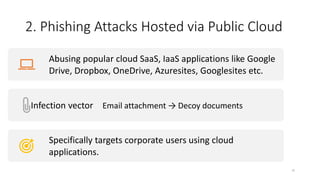
2. Phishing Attacks Hosted via Public Cloud
16
Abusing popular cloud SaaS, IaaS applications like Google
Drive, Dropbox, OneDrive, Azuresites, Googlesites etc.
Infection vector Email attachment → Decoy documents
Specifically targets corporate users using cloud
applications.
17
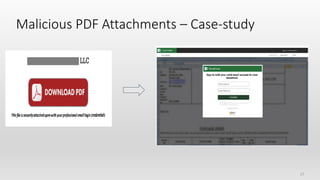
Malicious PDF Attachments – Case-study
Phish → Microsoft-issued SSL certificate &
Microsoft-owned domain
18
Phishing webpage hosted in Azure blob storage
19
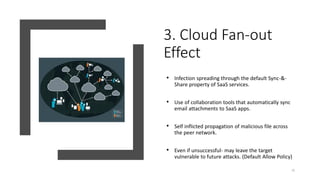
3. Cloud Fan-out
Effect
• Infection spreading through the default Sync-&-
Share property of SaaS services.
• Use of collaboration tools that automatically sync
email attachments to SaaS apps.
• Self inflicted propagation of malicious file across
the peer network.
• Even if unsuccessful- may leave the target
vulnerable to future attacks. (Default Allow Policy)
20
CloudPhishing Fan-out – Case Study
A victim inadvertently shares the phishing
document with colleagues, whether
internal or external, via a cloud service.
Secondary propagation vector.
Shared users lose the context of the document’s external origin and may trust the
internally shared document as if it were created internally.
CloudPhishing Fan Out- Case Study
22
Document Decoys - Default Allow Policy
&
Annotations
Attack Description - Default Allow Policy
24
ABUSES THE “DEFAULT ALLOW” POLICY
FOR POPULAR PDF READERS.
WARNING FROM PDF VIEWING
APPLICATION POINTING TO AN
EXTERNAL LINK CONNECTING TO THE
CLOUD APPLICATION. FOR LEGITIMATE
REASONS.
THE NORTH ALWAYS “REMEMBERS”
Case Study - Zoom Zoom!!
25
Case Study II – PDF Annotations
26
Attack Description - PDF Annotations
27
Indicates that the attackers plan to reuse the decoy template by
appending new links when the URL is taken down.
Annotations mostly carried out using RAD PDF annotator by
threat actors.
Attack campaign artifacts are simply being reused by the
malware author to rapidly adapt to malicious file takedowns.
Targeted attacks abusing Google Cloud
Platform Open Redirection
Attack Description
• Phishing email containing PDF decoy
document which points to Google
app engine.
• Abuses Google Cloud app engine’s
open redirection to deliver malware.
• A design weakness that allows
the attacker to construct a
redirection chain.
• The URL redirection case falls
under the category of
Unvalidated Redirects and
Forwards as per OWASP.
29
GCP Open redirection chain
The user is logged out from appengine.google.com
and a response status code ‘302’ is generated for
URL redirection.
– As this action gets executed, the user is in
turn redirected to google.com/url using the
query “?continue=”.
– Using this redirection logic, the destination
landing page is reached.
• These Themed decoys primarily targeted
governments, banking and financial firms
worldwide via phishing emails sent by the
attackers posing as legitimate customers of
those institutions.
Motivation
behind
abusing
cloud
services
31
Ease of use and abuse.
Reduces the infrastructure overhead.
Way more powerful than traditional hosting or
computing services.
Significantly cheaper than traditional attack
methods (No DGA or BPH needed).
Gives attackers protection by default (encrypted
traffic, API driven communication etc).
Conclusion
32
Cloud adoption helps organizations in
improving their IT infrastructure and control
cost.
Its rapid adoption has also caught the
attention of cyber criminals who are
financially motivated.
Cloud Solution Providers (CSP) have adopted
the concept of shared responsibility model for
securing the workloads.
Organizations should carefully assess the risks
and potential threats when moving towards
the cloud.
https://www.netskope.com/resources/netskope-threat-research-labs
33
Thankyou!!
Netskope Threat Research Labs

Phishing in the cloud era

  • 1.
    Phishing in the cloudera Ashwin Vamshi & Abhinav Singh
  • 2.
    ❖ Staff SecurityResearch Engineer, Netskope ➢ Innate interest in targeted attacks and malwares using cloud services. ➢ Identifying malwares, campaigns and threat actors using ‘cloud as an attack vector’ Ashwin Vamshi 2
  • 3.
    Abhinav Singh ❖ StaffSecurity Research Engineer, Netskope ➢ Background in Malware research, reverse engineering, incident response and cloud security. ➢ Author and speaker. 3
  • 4.
  • 5.
  • 6.
    Attacks “at thescale of cloud” • Wide-scale adoption of cloud services by cybercriminals with a large upscale around phishing attacks. • The phished baits are designed to mimic login pages of popular cloud services • Phishing attacks hosted in the cloud are highly effective and hard to detect. • Example - Phishing website with a Microsoft domain and a Microsoft- issued SSL certificate, asking for Office 365 credentials. 6
  • 7.
    7 BEC- It StillExists!! Source: Fincen.gov
  • 8.
    BEC in thecloud era - Problem statement • Attacks with SSL certificates/Cloud services to appear legitimate. • Tricks corporate users that are savvy enough to check that the domain and SSL certificate of a website is from a trusted origin. • Slow take-downs, fast recovery. 8
  • 9.
    1. PhaaS -Phishing as a Service Cloud Abuse techniques
  • 10.
    PhaaS - AttackDescription • Cloud hosted Phishing-as-a-Service cyber-crime model. • Click, Build & Host. • Flexible plans with wide variety of payment options being accepted. • Additional features like user training, 24/7 customer support and remote monitoring. 10
  • 11.
  • 12.
    Hackshit – InfectionMonitoring Page 12 • The phished baits were served with SSL certificates signed by LetsEncrypt or Comodo. • TLD’s: “moe”, “tn”, “cat”, “wtf”, and “space”. • These websites were clones built using a file uploading and sharing platform named Pomf. • Pomf clones not indexed by search engines.
  • 13.
    Hackshit – SourceCode View 13
  • 14.
    Hackshit - Pointers •Recorded the victims credentials via websocket service hosted in the cloud. • Shift of service: Amazon > Evennode > Now. • Takedowns → resurface and reuse attack elements. • Classic example of reusing the same attack elements onto new cloud accounts. 14
  • 15.
  • 16.
    2. Phishing AttacksHosted via Public Cloud 16 Abusing popular cloud SaaS, IaaS applications like Google Drive, Dropbox, OneDrive, Azuresites, Googlesites etc. Infection vector Email attachment → Decoy documents Specifically targets corporate users using cloud applications.
  • 17.
  • 18.
    Phish → Microsoft-issuedSSL certificate & Microsoft-owned domain 18
  • 19.
    Phishing webpage hostedin Azure blob storage 19
  • 20.
    3. Cloud Fan-out Effect •Infection spreading through the default Sync-&- Share property of SaaS services. • Use of collaboration tools that automatically sync email attachments to SaaS apps. • Self inflicted propagation of malicious file across the peer network. • Even if unsuccessful- may leave the target vulnerable to future attacks. (Default Allow Policy) 20
  • 21.
    CloudPhishing Fan-out –Case Study A victim inadvertently shares the phishing document with colleagues, whether internal or external, via a cloud service. Secondary propagation vector. Shared users lose the context of the document’s external origin and may trust the internally shared document as if it were created internally.
  • 22.
  • 23.
    Document Decoys -Default Allow Policy & Annotations
  • 24.
    Attack Description -Default Allow Policy 24 ABUSES THE “DEFAULT ALLOW” POLICY FOR POPULAR PDF READERS. WARNING FROM PDF VIEWING APPLICATION POINTING TO AN EXTERNAL LINK CONNECTING TO THE CLOUD APPLICATION. FOR LEGITIMATE REASONS. THE NORTH ALWAYS “REMEMBERS”
  • 25.
    Case Study -Zoom Zoom!! 25
  • 26.
    Case Study II– PDF Annotations 26
  • 27.
    Attack Description -PDF Annotations 27 Indicates that the attackers plan to reuse the decoy template by appending new links when the URL is taken down. Annotations mostly carried out using RAD PDF annotator by threat actors. Attack campaign artifacts are simply being reused by the malware author to rapidly adapt to malicious file takedowns.
  • 28.
    Targeted attacks abusingGoogle Cloud Platform Open Redirection
  • 29.
    Attack Description • Phishingemail containing PDF decoy document which points to Google app engine. • Abuses Google Cloud app engine’s open redirection to deliver malware. • A design weakness that allows the attacker to construct a redirection chain. • The URL redirection case falls under the category of Unvalidated Redirects and Forwards as per OWASP. 29
  • 30.
    GCP Open redirectionchain The user is logged out from appengine.google.com and a response status code ‘302’ is generated for URL redirection. – As this action gets executed, the user is in turn redirected to google.com/url using the query “?continue=”. – Using this redirection logic, the destination landing page is reached. • These Themed decoys primarily targeted governments, banking and financial firms worldwide via phishing emails sent by the attackers posing as legitimate customers of those institutions.
  • 31.
    Motivation behind abusing cloud services 31 Ease of useand abuse. Reduces the infrastructure overhead. Way more powerful than traditional hosting or computing services. Significantly cheaper than traditional attack methods (No DGA or BPH needed). Gives attackers protection by default (encrypted traffic, API driven communication etc).
  • 32.
    Conclusion 32 Cloud adoption helpsorganizations in improving their IT infrastructure and control cost. Its rapid adoption has also caught the attention of cyber criminals who are financially motivated. Cloud Solution Providers (CSP) have adopted the concept of shared responsibility model for securing the workloads. Organizations should carefully assess the risks and potential threats when moving towards the cloud.
  • 33.