Make Your Data Work For You
Office365 from a Hacker‘s
perspective
Real life threats, tactics and remedies
Ben Menesi
New York, NY
27th 07 2019
Speaker
• Ben Menesi
– VP Products & Innovation at panagenda
– Started out in the IBM world
– SharePoint & Exchange Admin & Dev
– Certified Ethical Hacker v9 and OSCP student
– Enjoys breaking things
– Speaker at IT events around the globe (SPS
Toronto, Calgary, Geneva, Cambridge)
– Owns a bar (recently) @BenMenesi
panagenda
• Who we are
– HQ in Vienna, Austria
– Offices in Boston, Austria, Germany, The Netherlands and Australia
– >1M user licenses across over 80 countries
panagenda
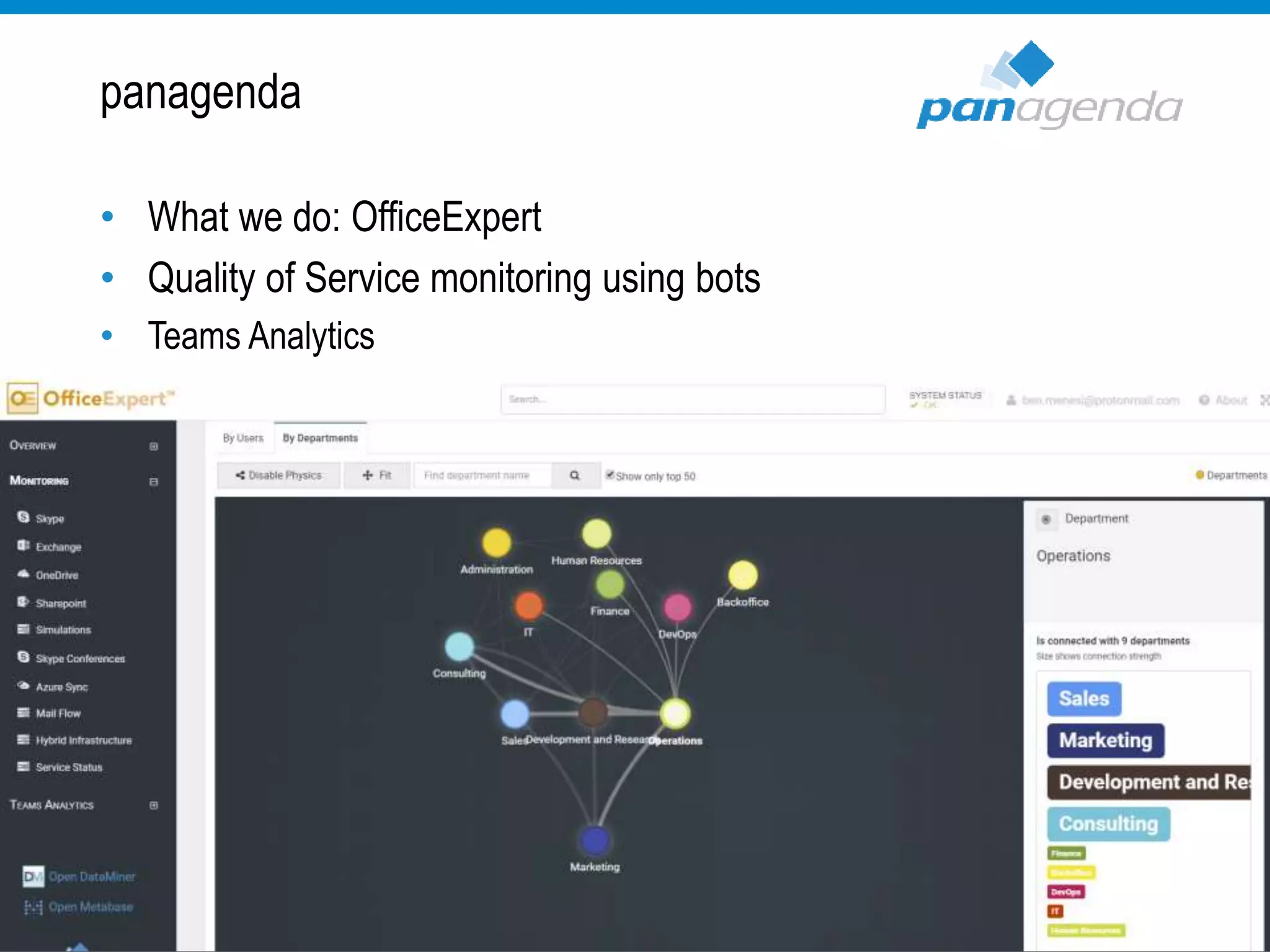
• What we do: OfficeExpert
• Quality of Service monitoring using bots
• Teams Analytics
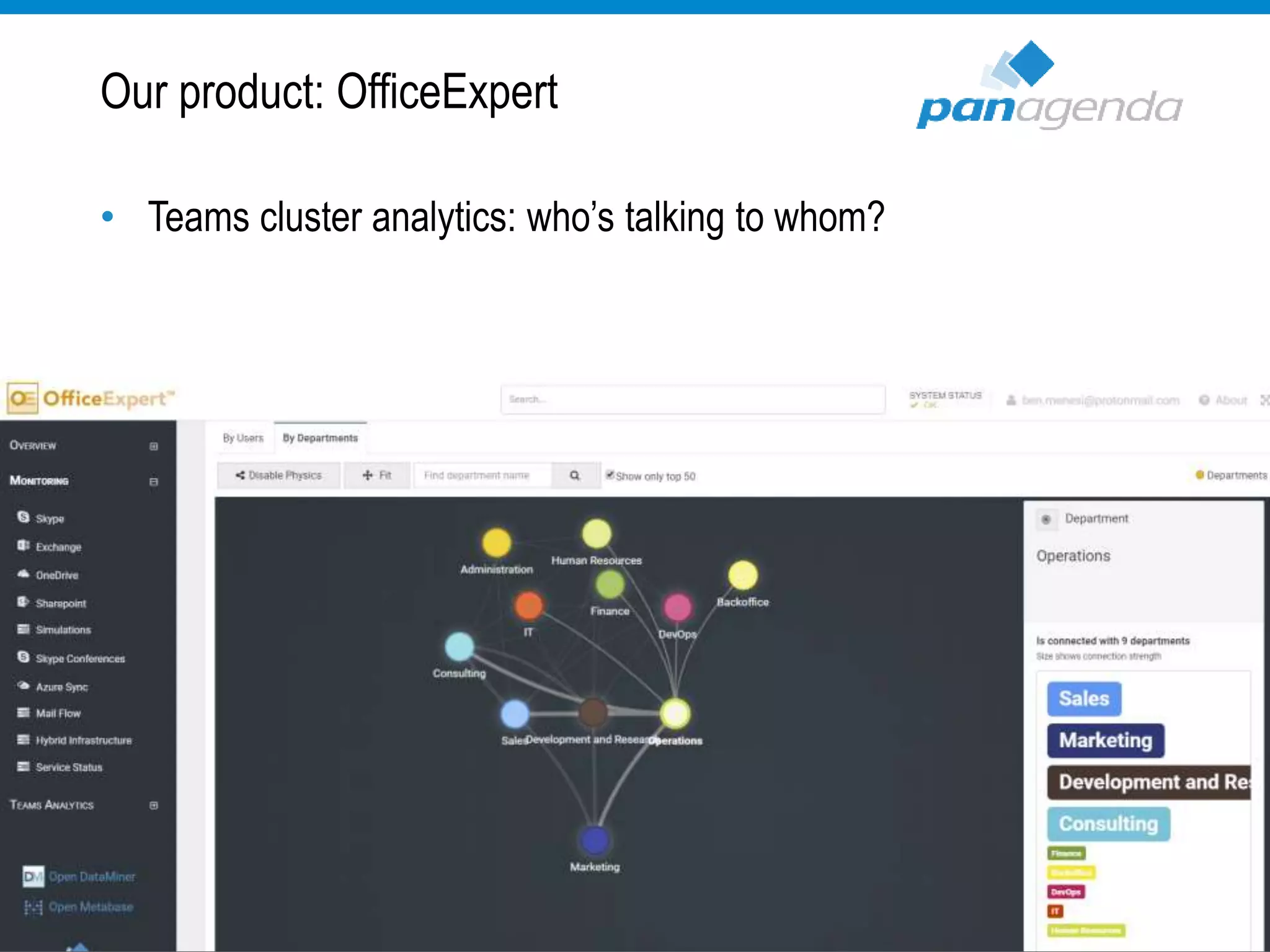
Our product: OfficeExpert
• Teams cluster analytics: who’s talking to whom?
OfficeExpert
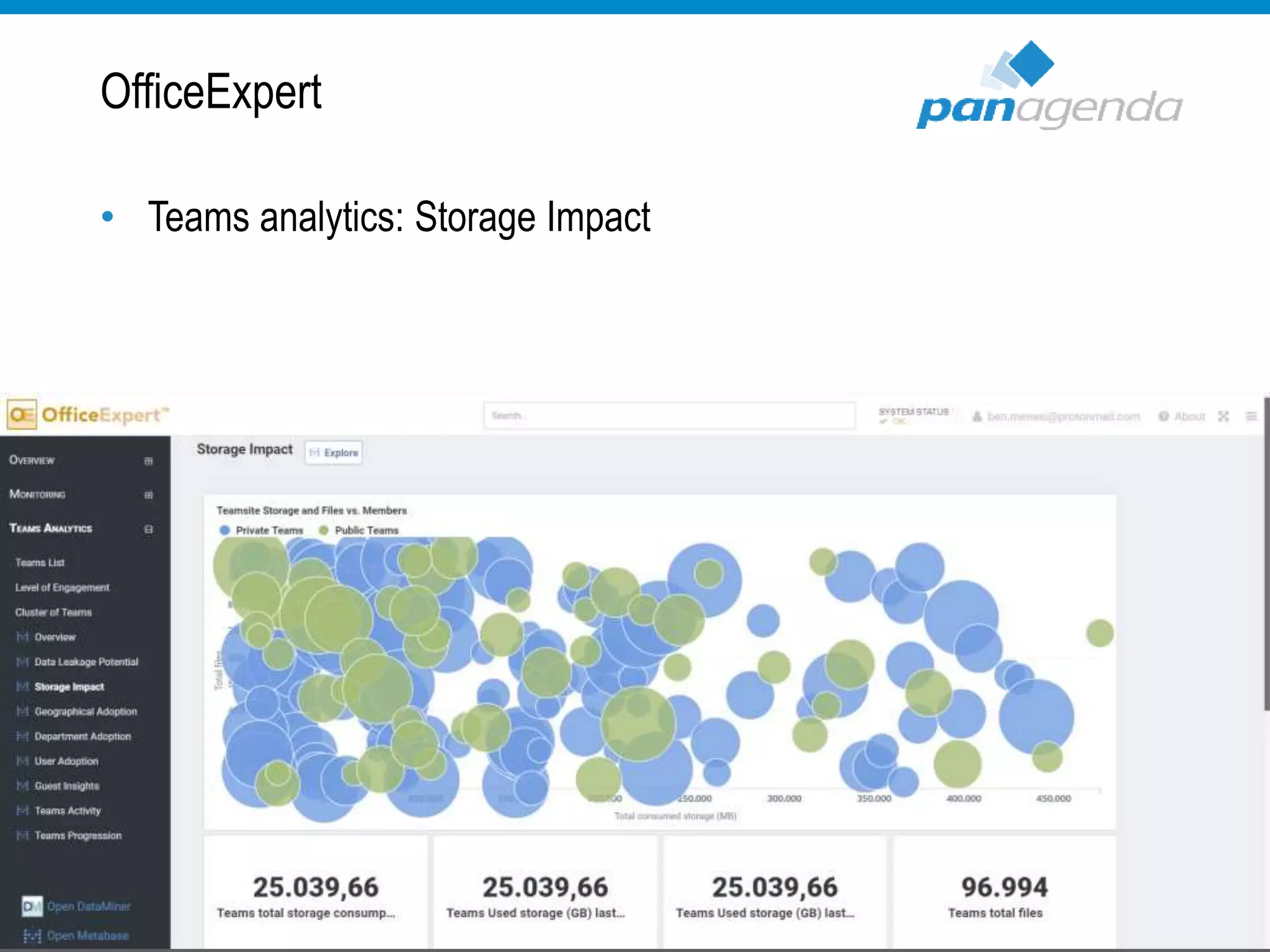
• Teams analytics: Storage Impact
OfficeExpert
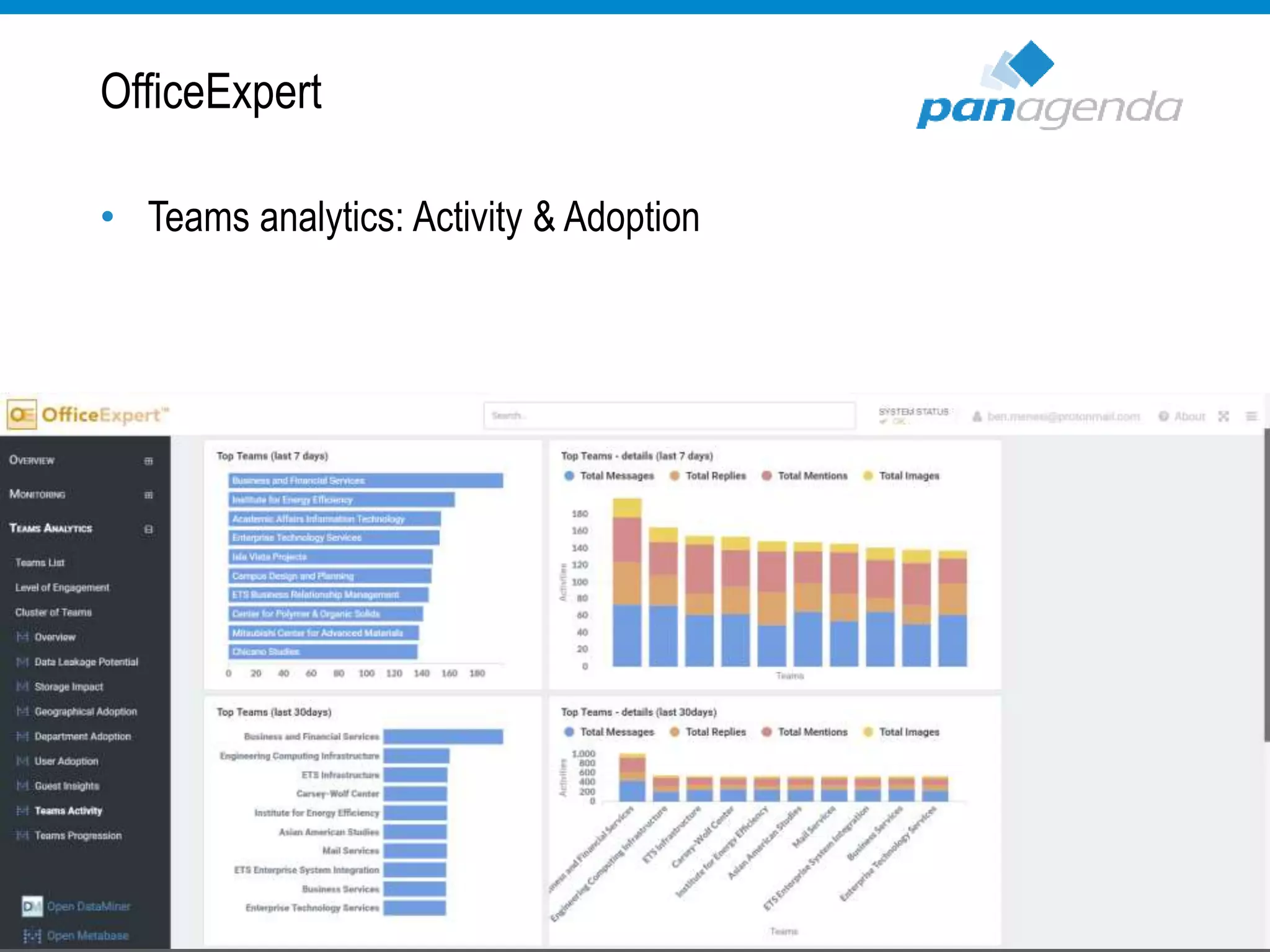
• Teams analytics: Activity & Adoption
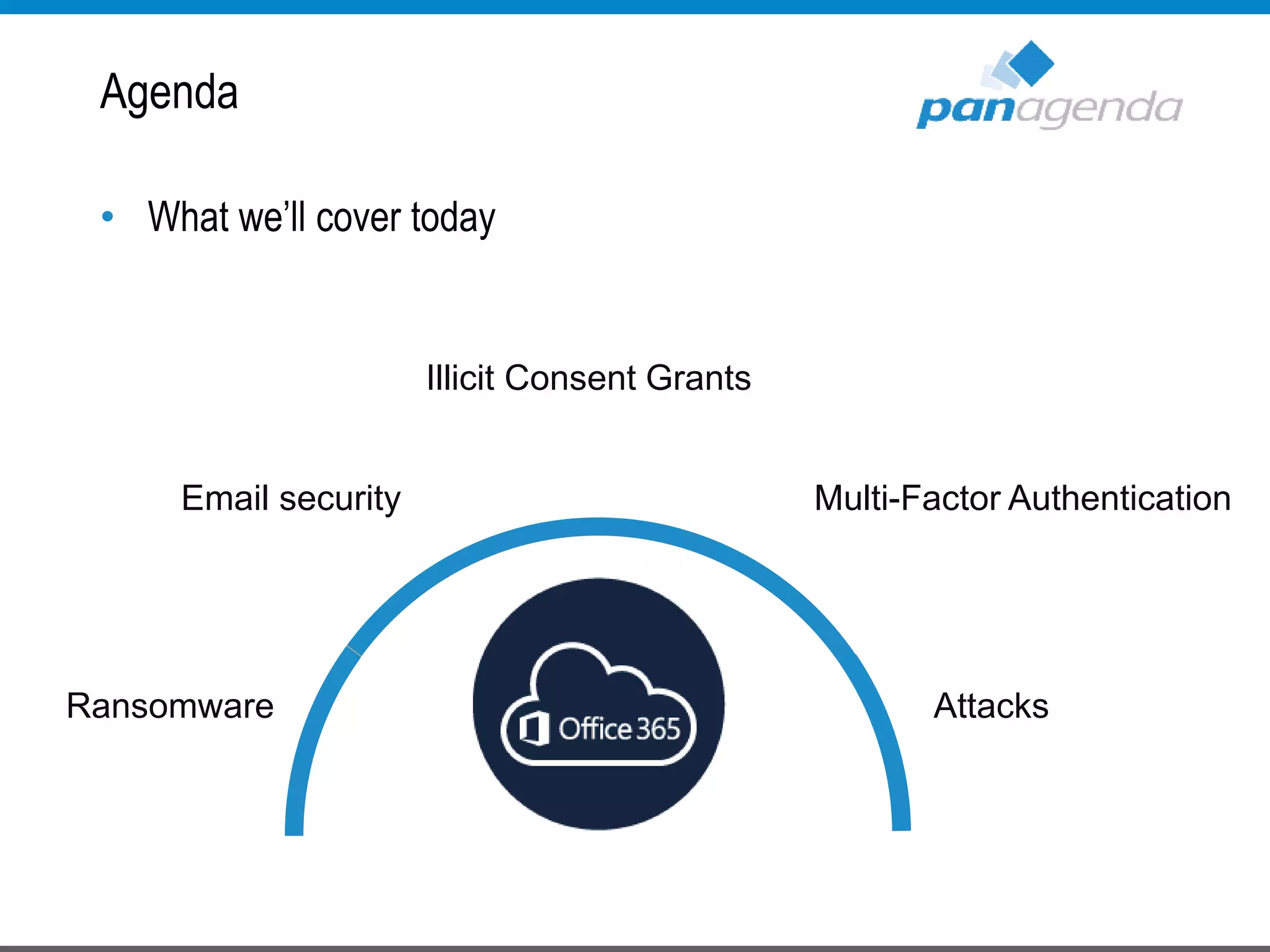
Agenda
• What we’ll cover today
Ransomware Attacks
Email security Multi-Factor Authentication
Illicit Consent Grants
Statistics
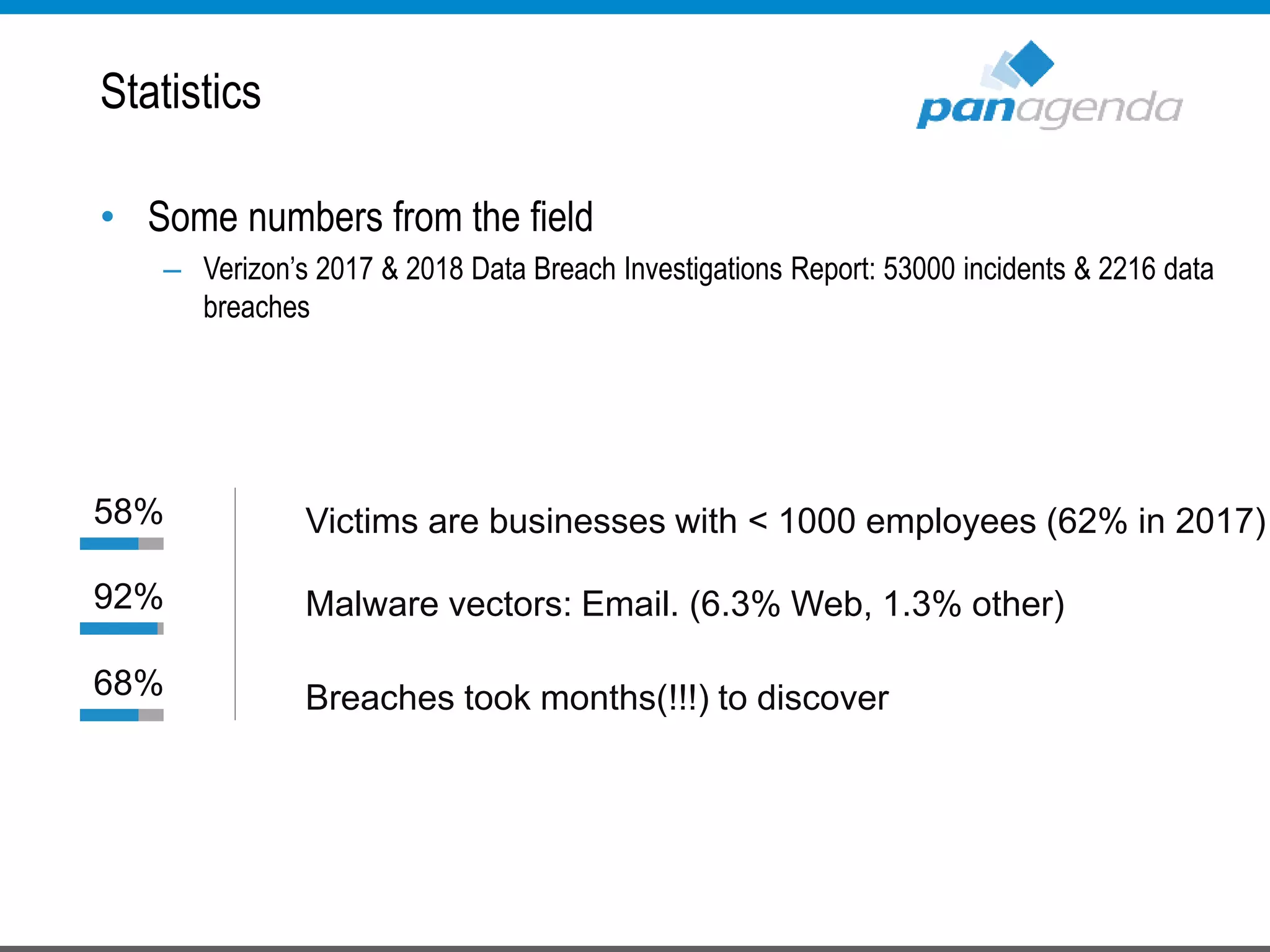
• Some numbers from the field
– Verizon’s 2017 & 2018 Data Breach Investigations Report: 53000 incidents & 2216 data
breaches
58% Victims are businesses with < 1000 employees (62% in 2017)
92%
68% Breaches took months(!!!) to discover
Malware vectors: Email. (6.3% Web, 1.3% other)
On-Prem. Vs. Cloud Security
• Benefits of your data in the cloud
Broader scope of threat intelligence
Larger and more specialized security muscle than most SMBs
Fast and instant delivery (no manual patching required)
On-Prem. Vs. Cloud Security
• Disadvantages of using cloud services
Vulnerability / Risk Mitigation is out of our control
Part of a larger, very attractive attack surface
Less flexibility in customizing defenses
Vulnerability Mitigation
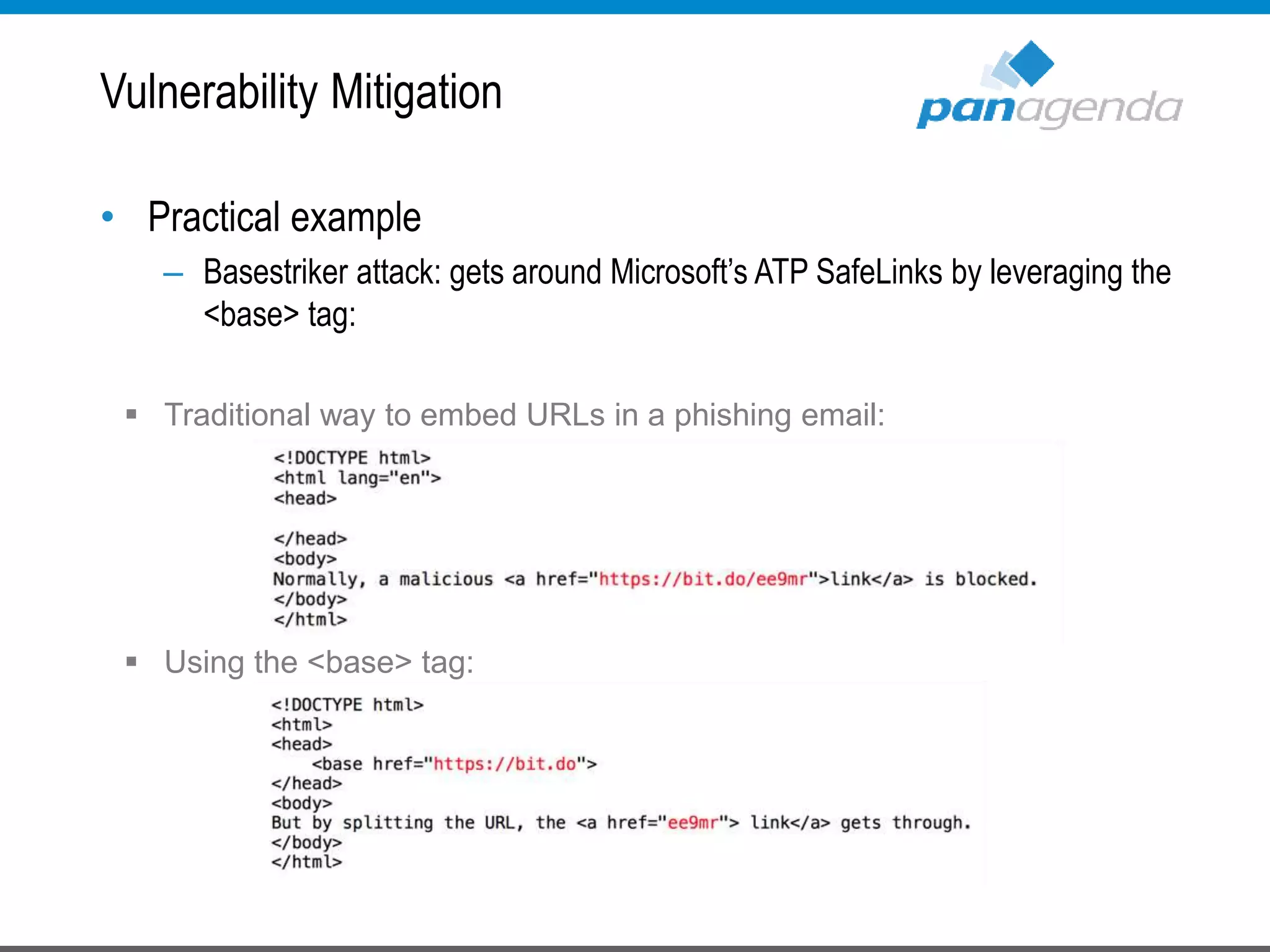
• Practical example
– Basestriker attack: gets around Microsoft’s ATP SafeLinks by leveraging the
<base> tag:
 Traditional way to embed URLs in a phishing email:
 Using the <base> tag:
Vulnerability Mitigation
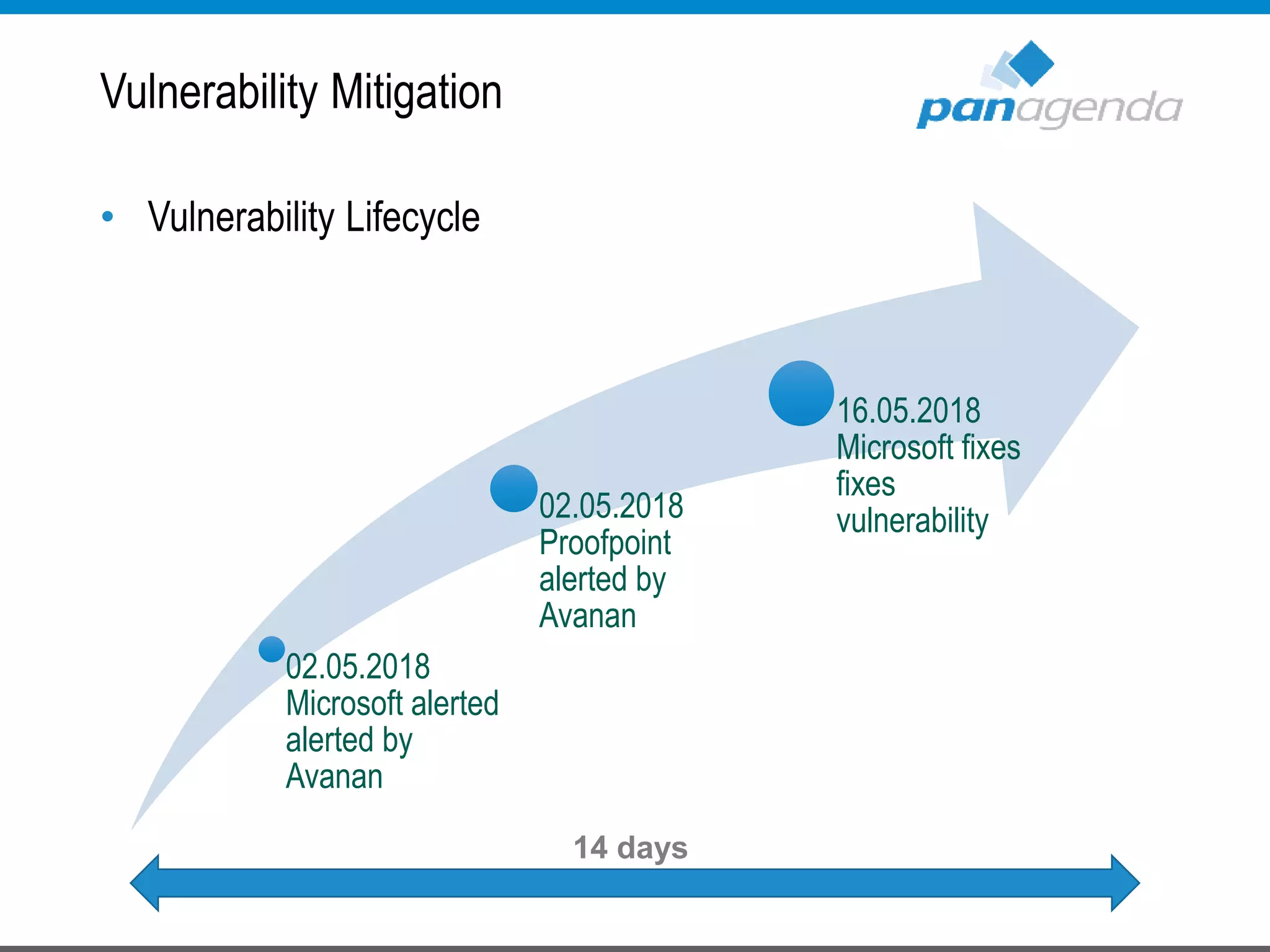
• Vulnerability Lifecycle
02.05.2018
Microsoft alerted
alerted by
Avanan
02.05.2018
Proofpoint
alerted by
Avanan
16.05.2018
Microsoft fixes
fixes
vulnerability
14 days
Ransomware
Ransomware Attacks
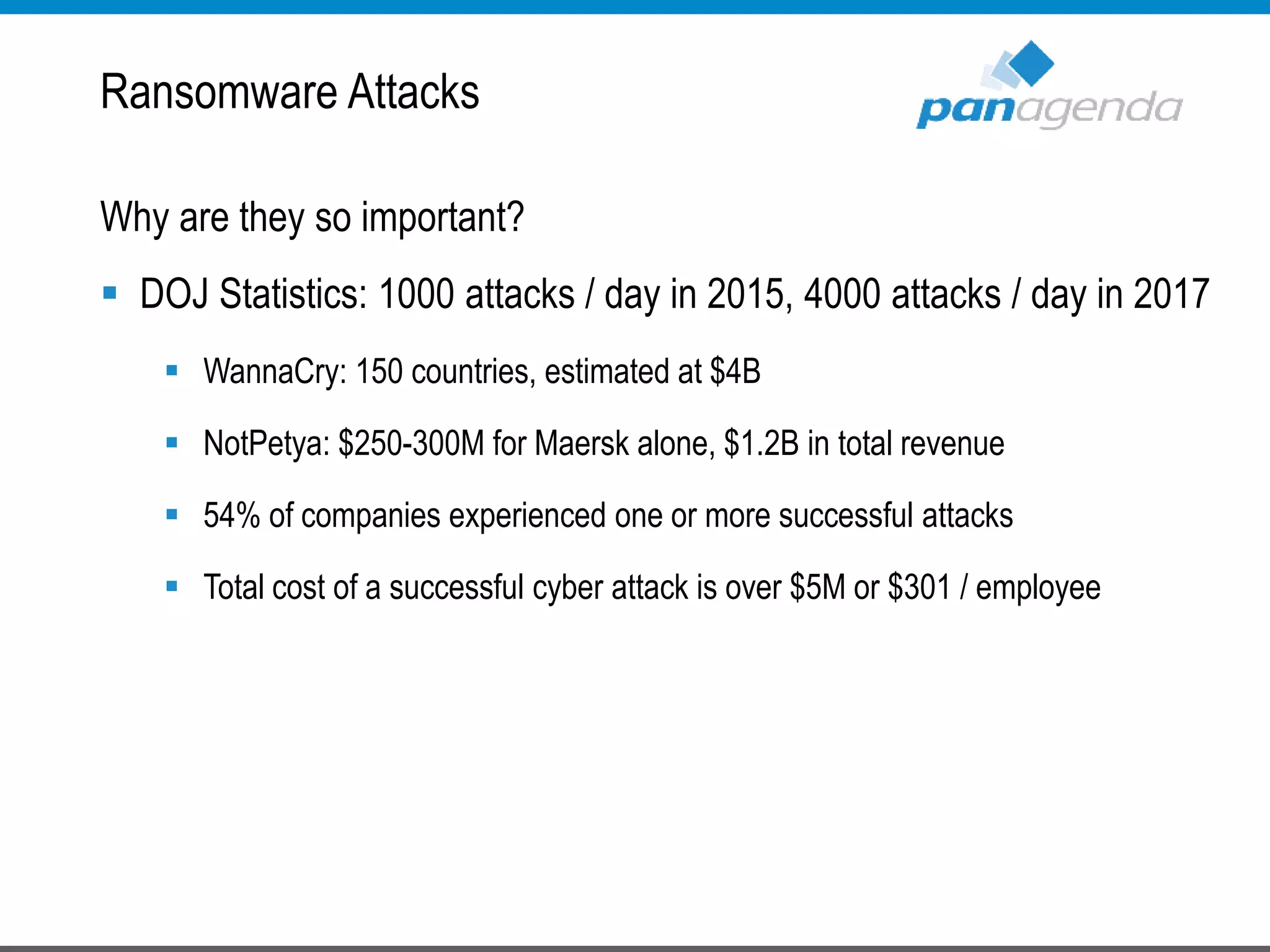
Why are they so important?
 DOJ Statistics: 1000 attacks / day in 2015, 4000 attacks / day in 2017
 WannaCry: 150 countries, estimated at $4B
 NotPetya: $250-300M for Maersk alone, $1.2B in total revenue
 54% of companies experienced one or more successful attacks
 Total cost of a successful cyber attack is over $5M or $301 / employee
Ransomware Attacks
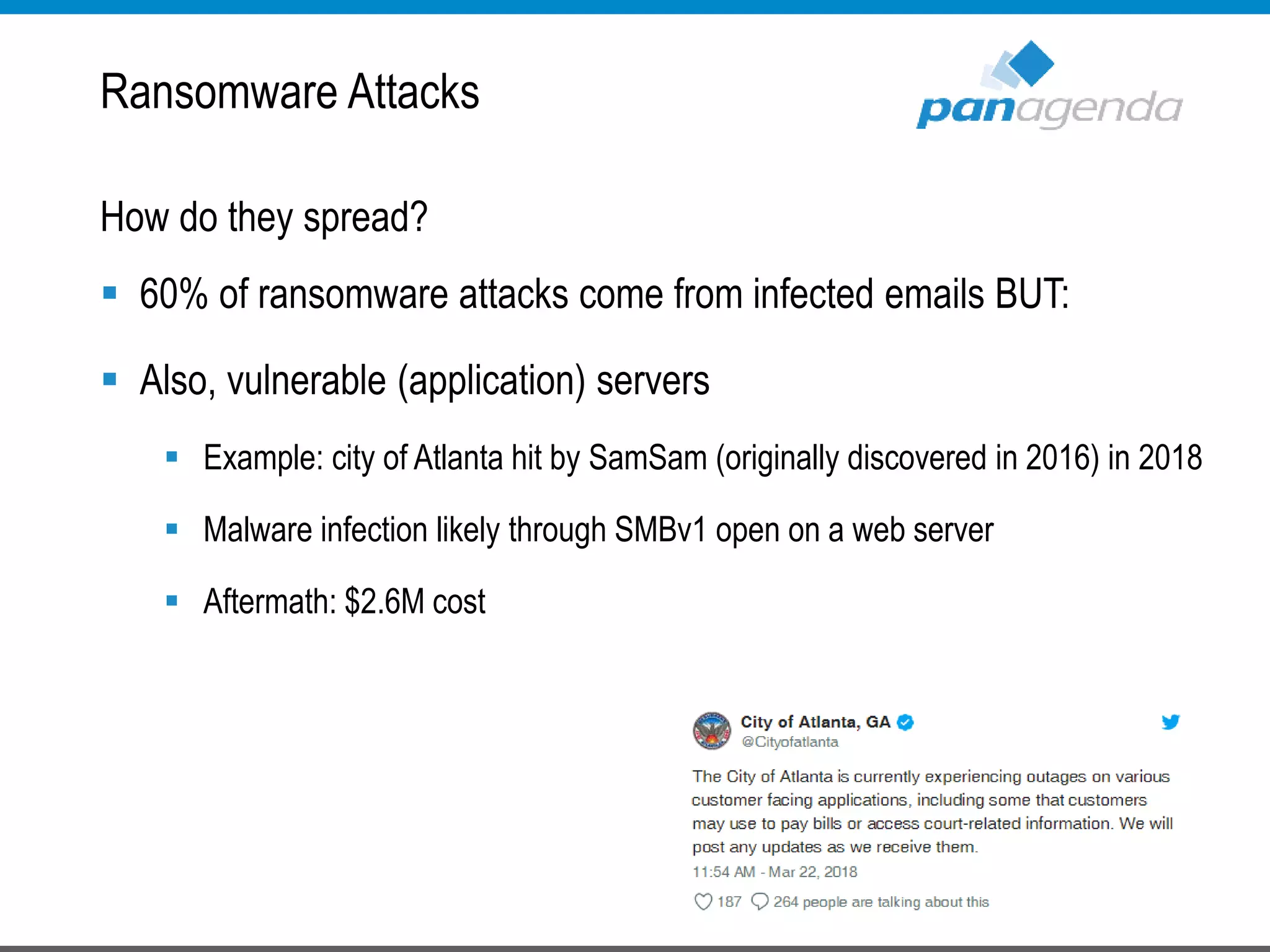
How do they spread?
 60% of ransomware attacks come from infected emails BUT:
 Also, vulnerable (application) servers
 Example: city of Atlanta hit by SamSam (originally discovered in 2016) in 2018
 Malware infection likely through SMBv1 open on a web server
 Aftermath: $2.6M cost
Decrypting Ransomware
 Cautionary tale: Herrington & Company gets ransomwared
 Engages Data Recovery company to retrieve data
 DR company quotes $6000 to recover data
 Data recovery is WAY too fast
 FBI confirms that PDR indeed paid ransom to decrypt victim’s files
 https://pbs.twimg.com/media/DbfP0G7WAAEWQIa.jpg:large
 How do we prevent ransomware?
Ransomware Protection
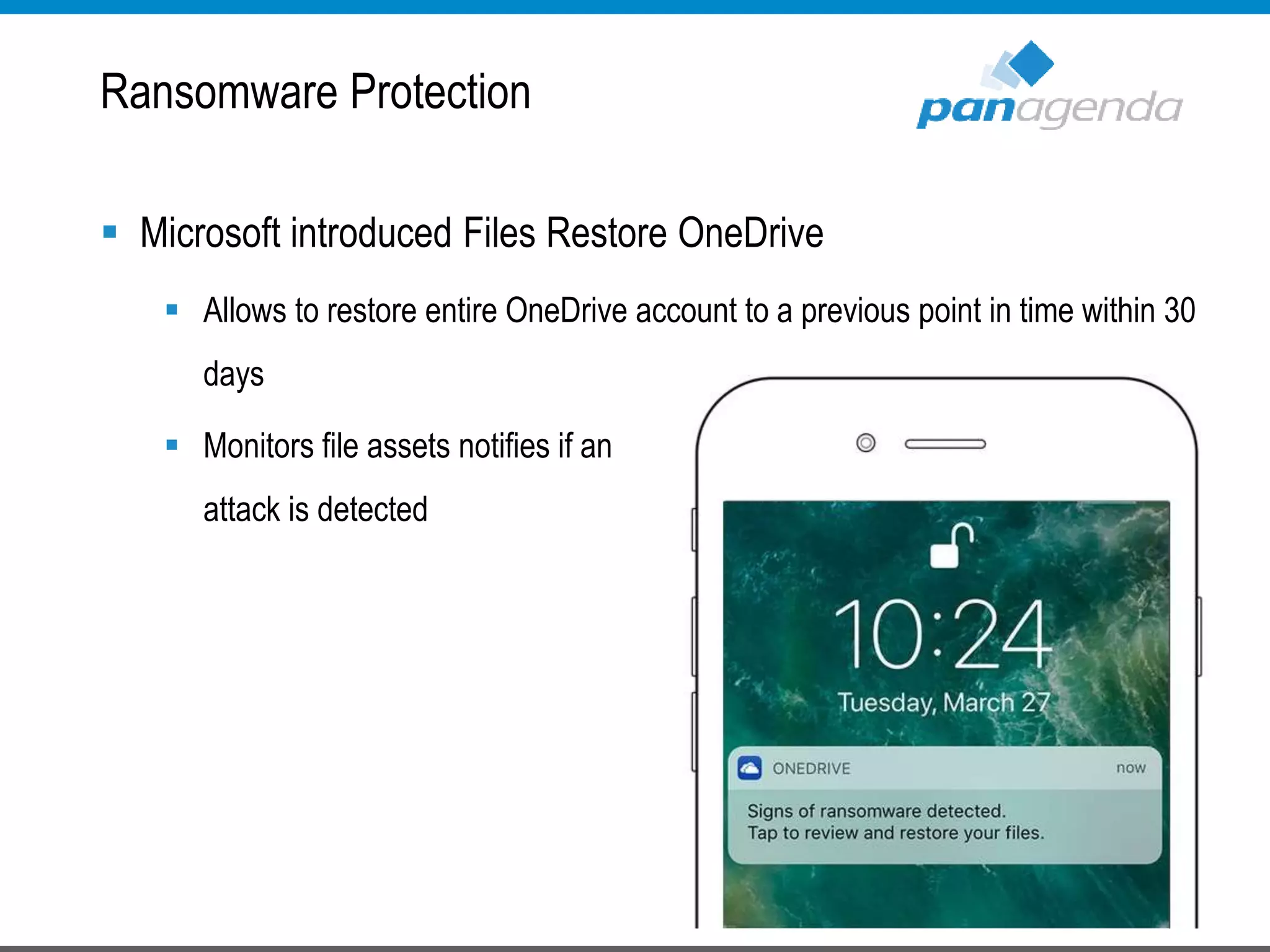
 Microsoft introduced Files Restore OneDrive
 Allows to restore entire OneDrive account to a previous point in time within 30
days
 Monitors file assets notifies if an
attack is detected
Ransomware Protection
 Careful!
 Real time notification might not be as accurate as we think
 AxCrypt encryption on OneDrive files stays under the radar
 Ransomware prevention: have users store important data in OneDrive
Email & Sharing
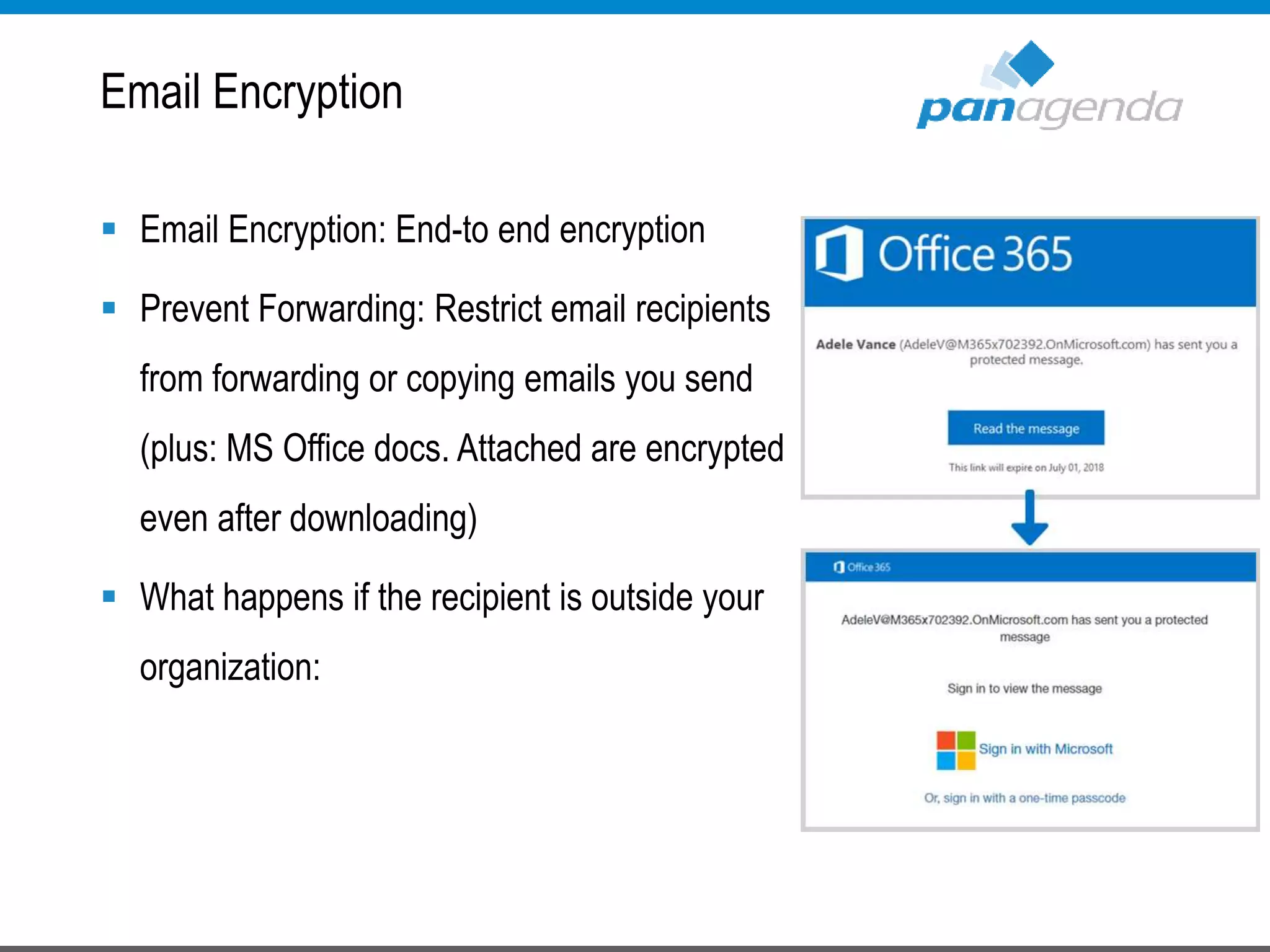
 Email Encryption: End-to end encryption
 Prevent Forwarding: Restrict email recipients
from forwarding or copying emails you send
(plus: MS Office docs. Attached are encrypted
even after downloading)
 What happens if the recipient is outside your
organization:
Email Encryption
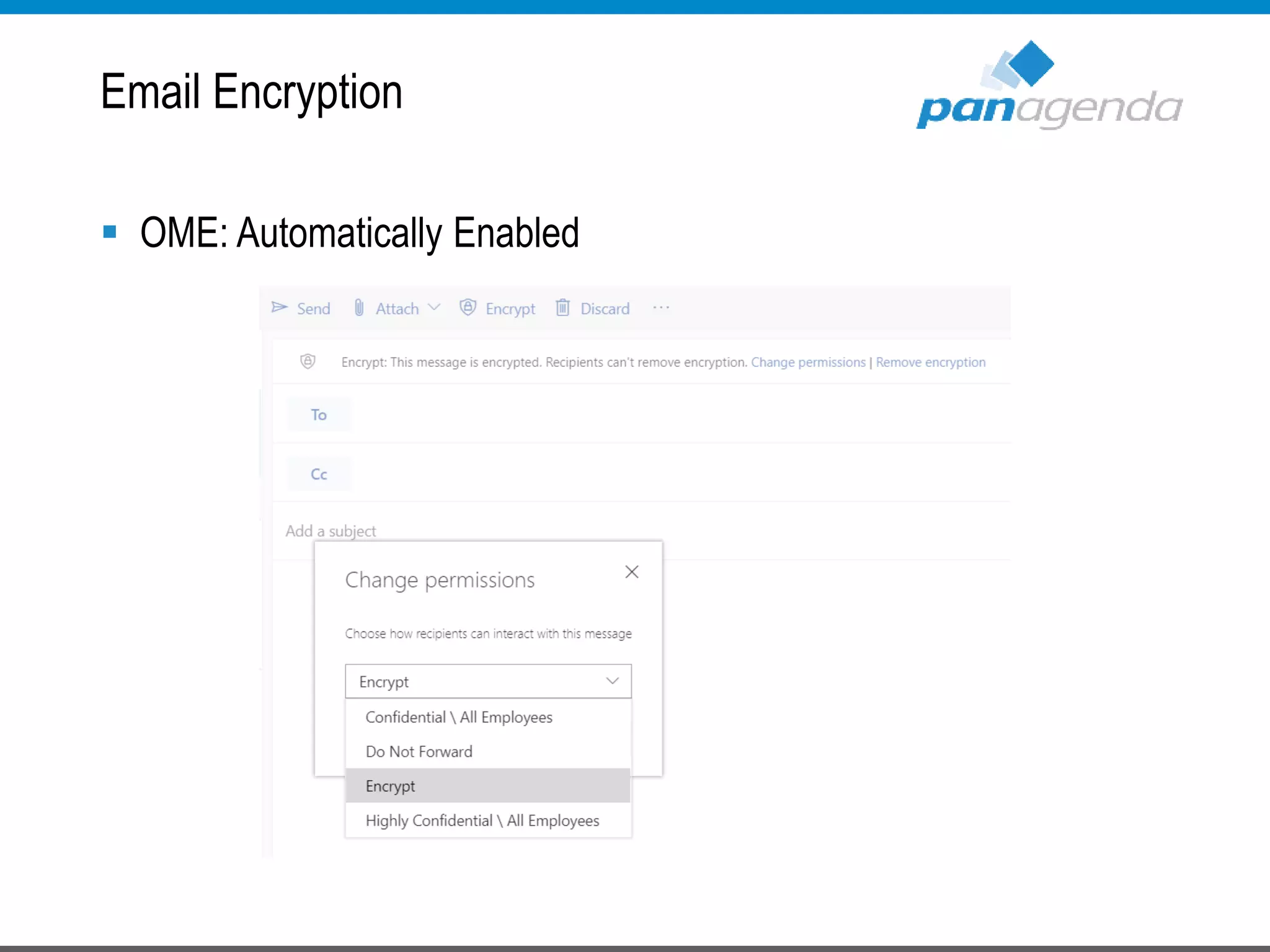
 OME: Automatically Enabled
Email Encryption
 Revoking Encrypted Messages
 This one is thanks to Al Hoitingh: https://alberthoitingh.com/2018/12/20/ome-
message-revocation/
 Encrypted status means: email & content didn’t leave the perimeter.
 You can use Message Trace to locate the outgoing mail and then use powershell to:
 Query the OME status: Get-OMEMessageStatus -MessageID “message id”
 Set message as revoked: Set-OMEMessageRevocation -Revoke $true -MessageID “message id”
Email Encryption
 Revoking Encrypted Messages
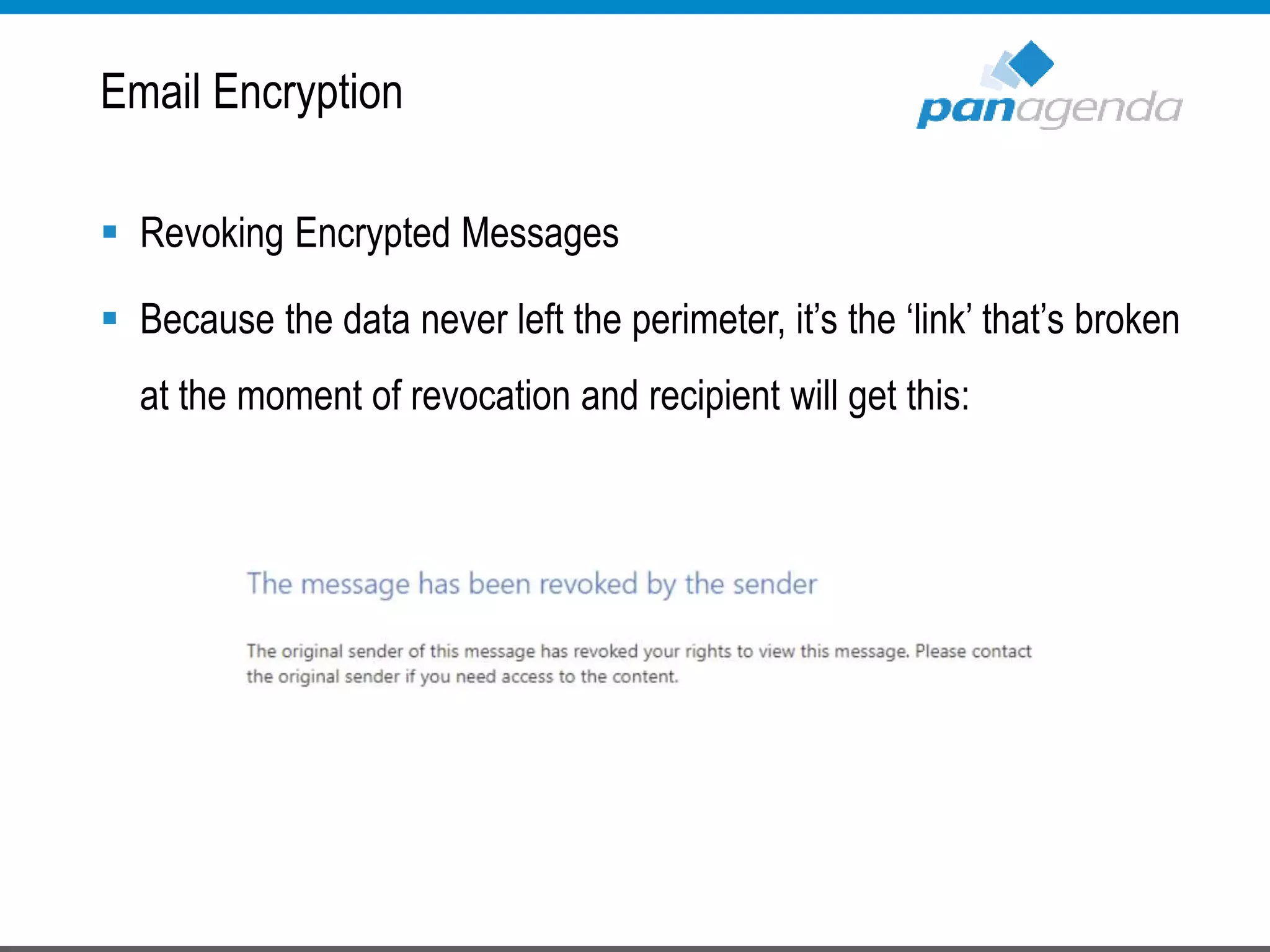
 Because the data never left the perimeter, it’s the ‘link’ that’s broken
at the moment of revocation and recipient will get this:
Email Encryption
Illicit Consent Grants
 In the light of the Facebook Cambridge Analytica scandal, we should
take a look at Azure AD registered applications
 Phishing campaigns could trick users into granting access to applications
 https://blogs.technet.microsoft.com/office365security/defending-against-illicit-
consent-grants/
 Exploit first demonstrated by Kevin Mitnick
Illicit Consent Grants
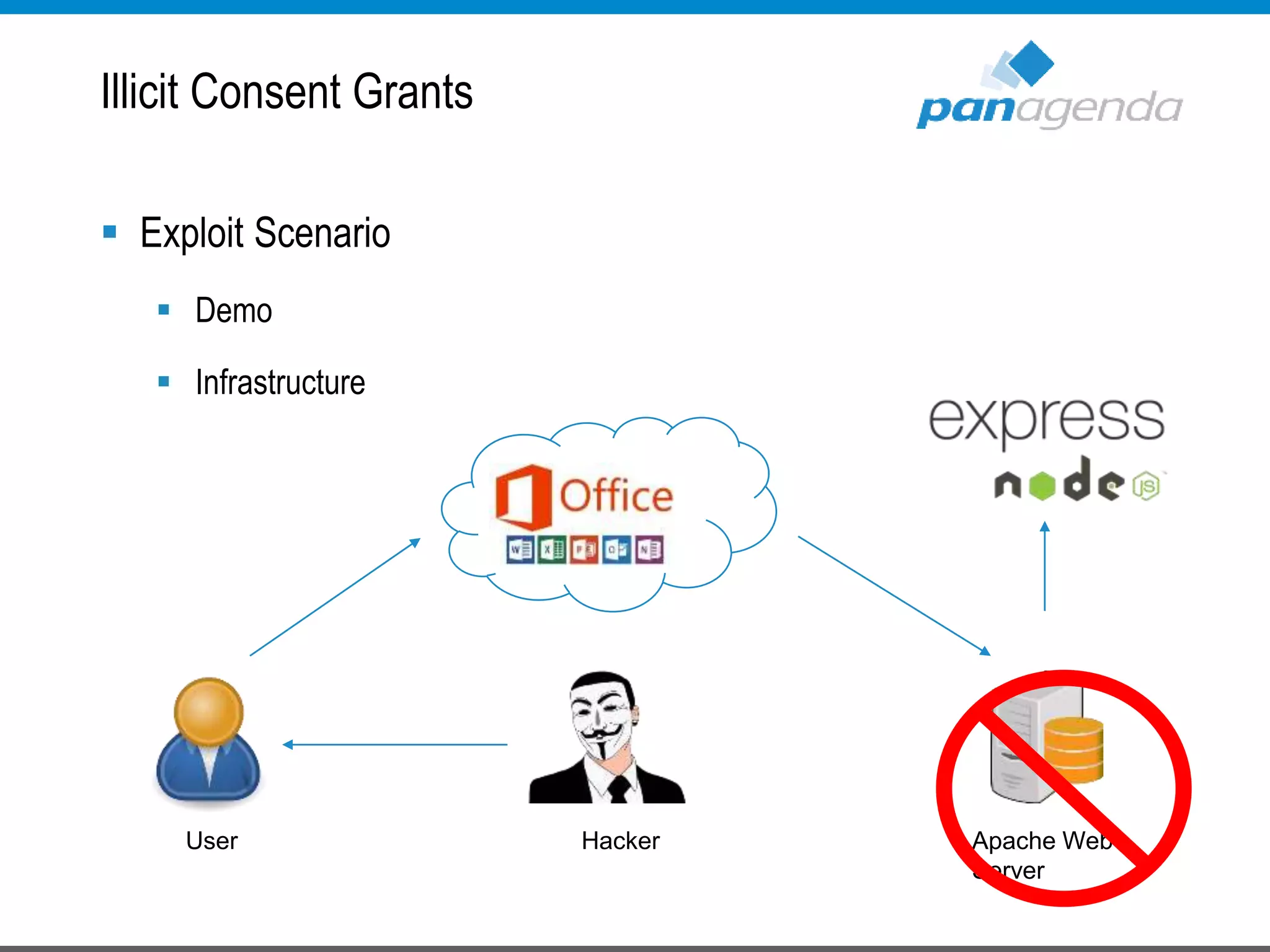
 Exploit Scenario
 Demo
 Infrastructure
Illicit Consent Grants
User Apache Web
Server
Hacker
 Exploit Scenario: Let’s dive in!
Illicit Consent Grants
 Exploit Scenario
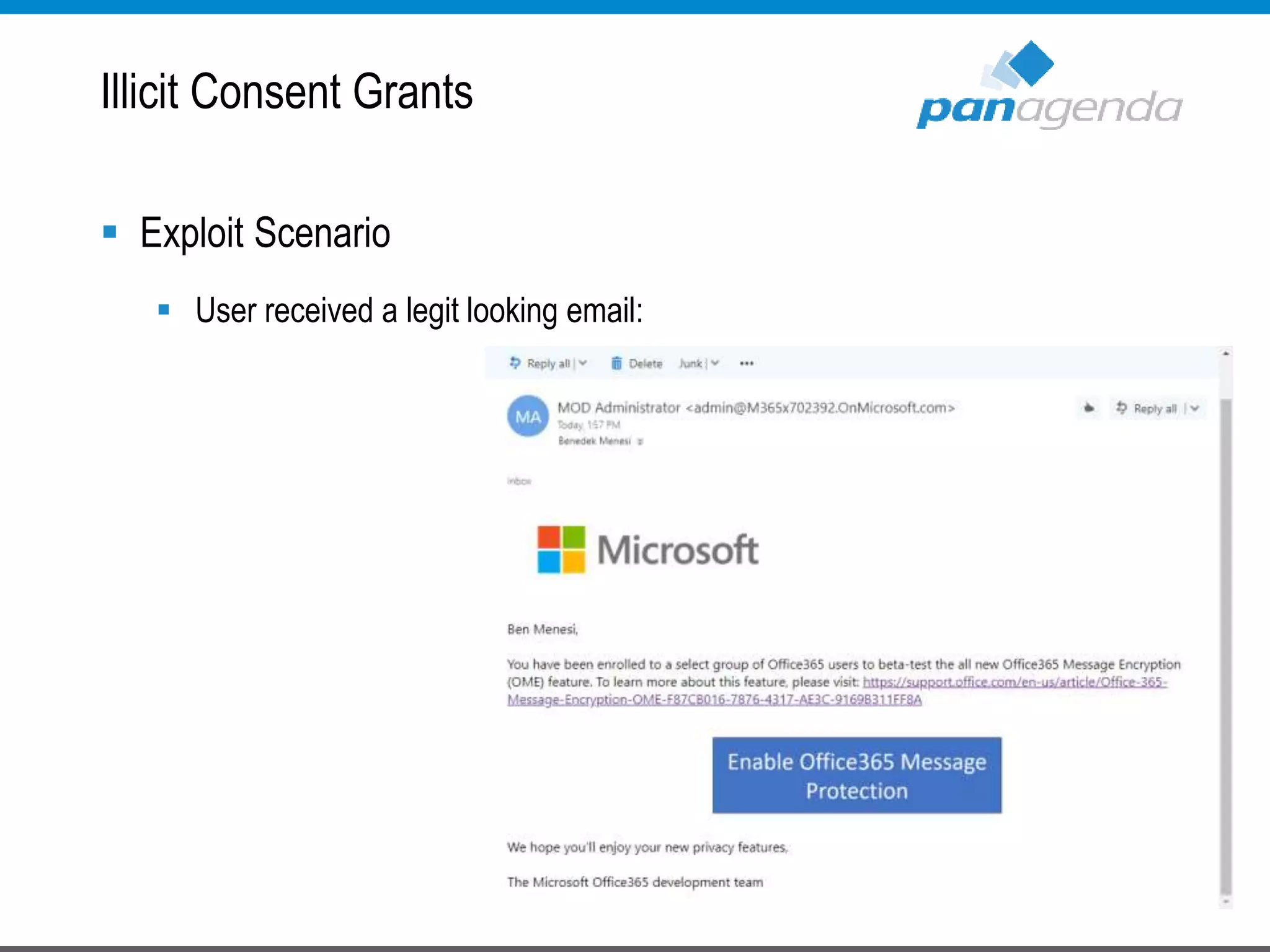
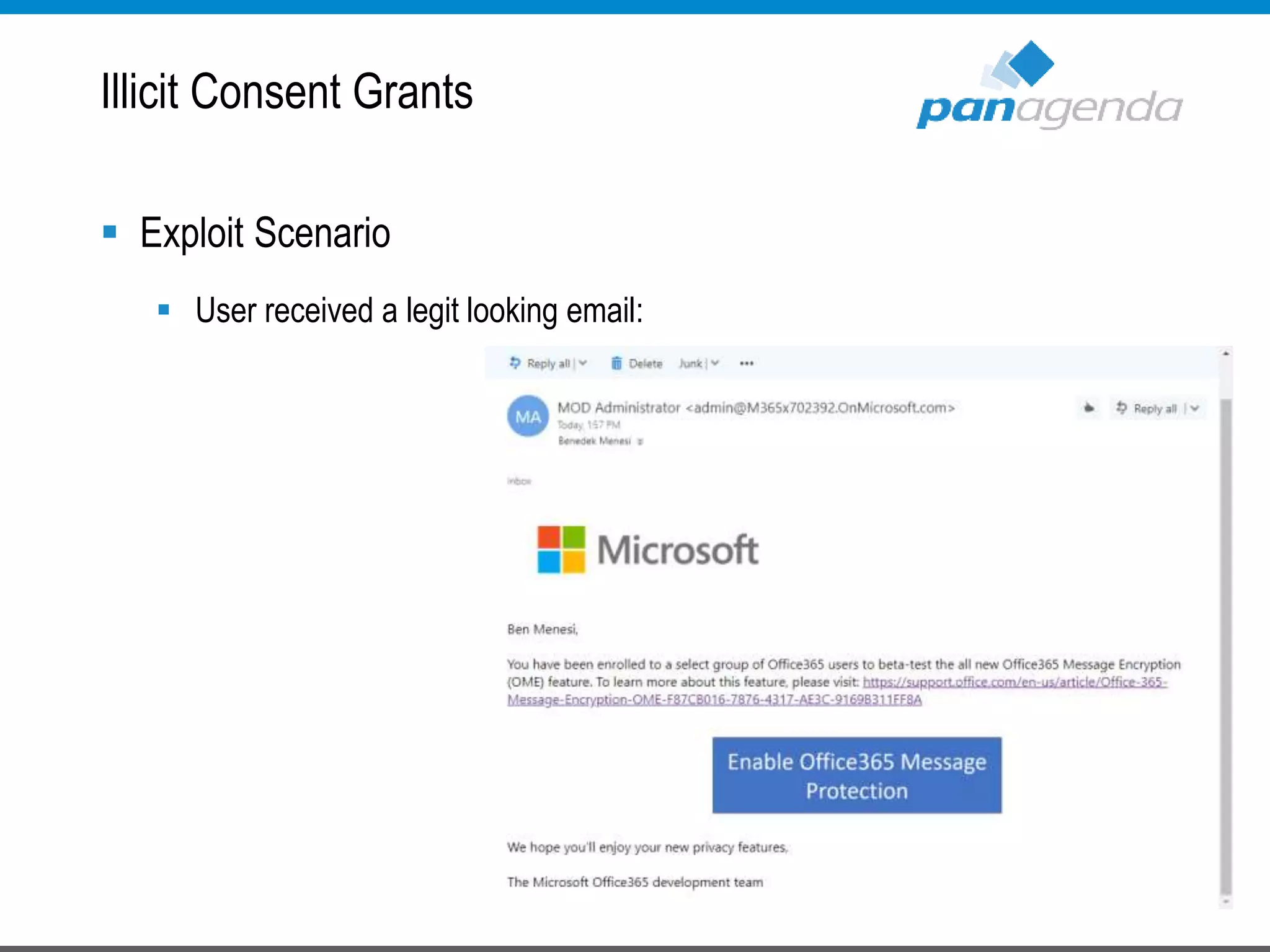
 User received a legit looking email:
Illicit Consent Grants
 Exploit Scenario
 User received a legit looking email:
Illicit Consent Grants
 Exploit Scenario
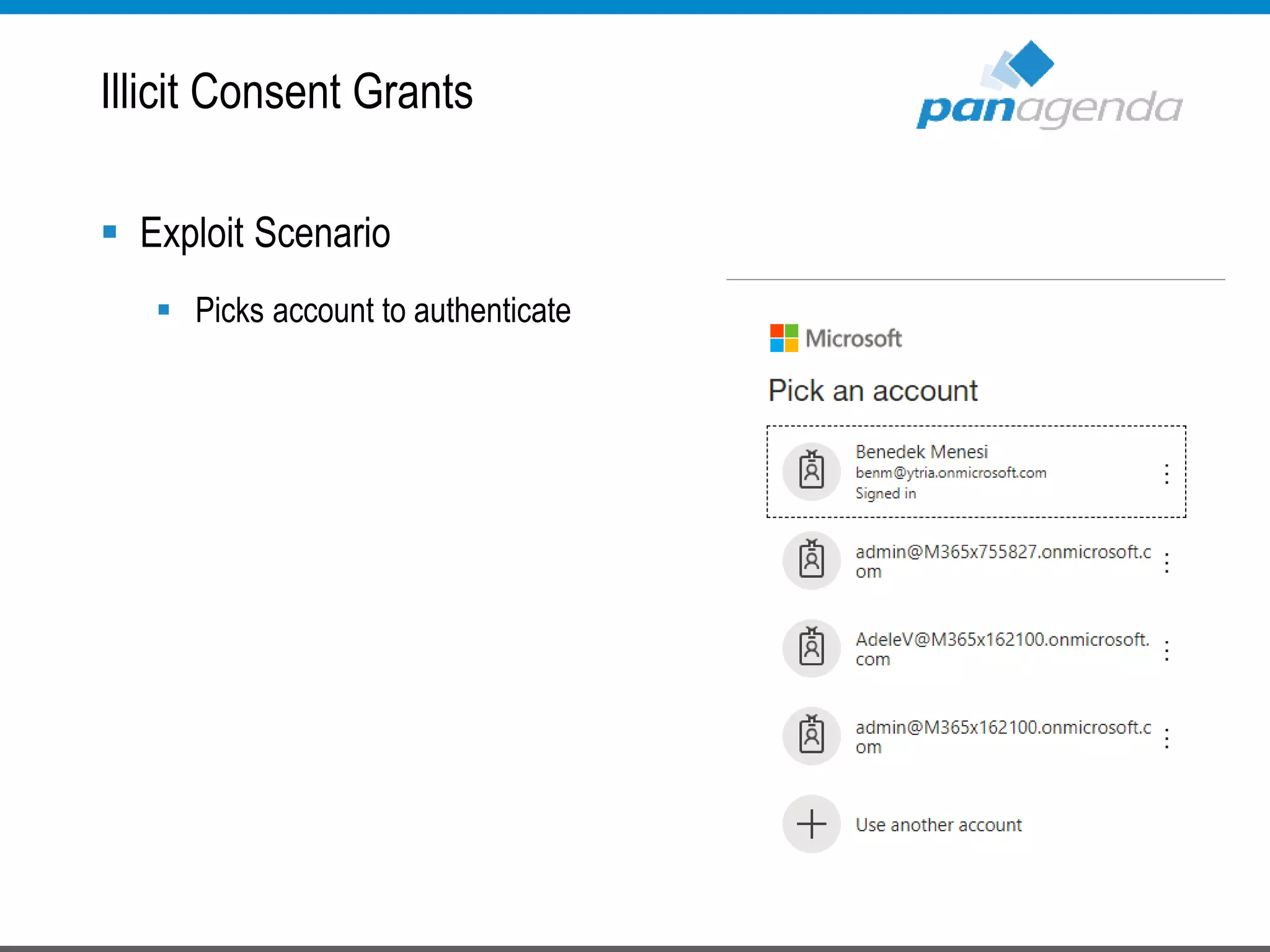
 Picks account to authenticate
Illicit Consent Grants
 Exploit Scenario
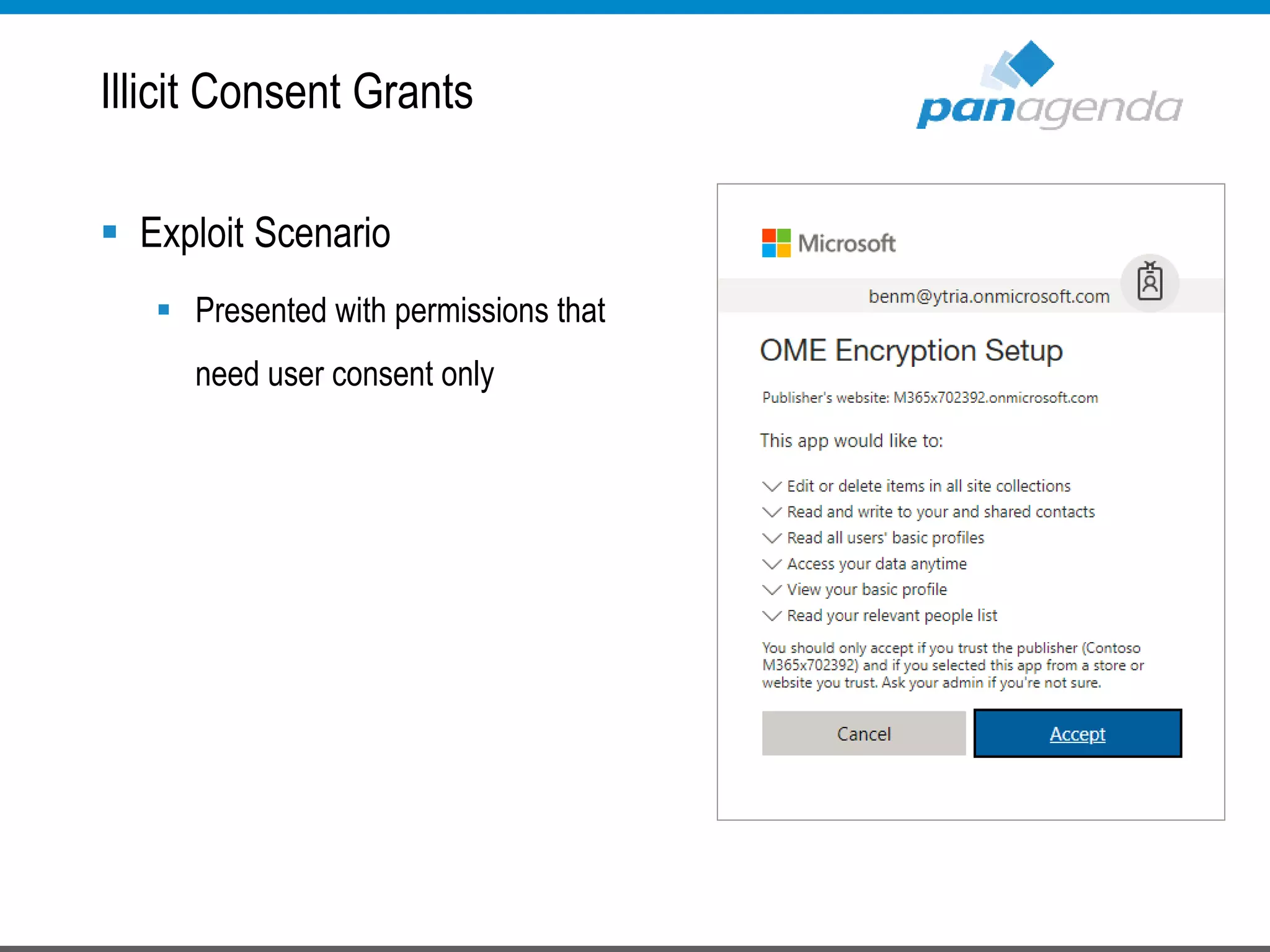
 Presented with permissions that
need user consent only
Illicit Consent Grants
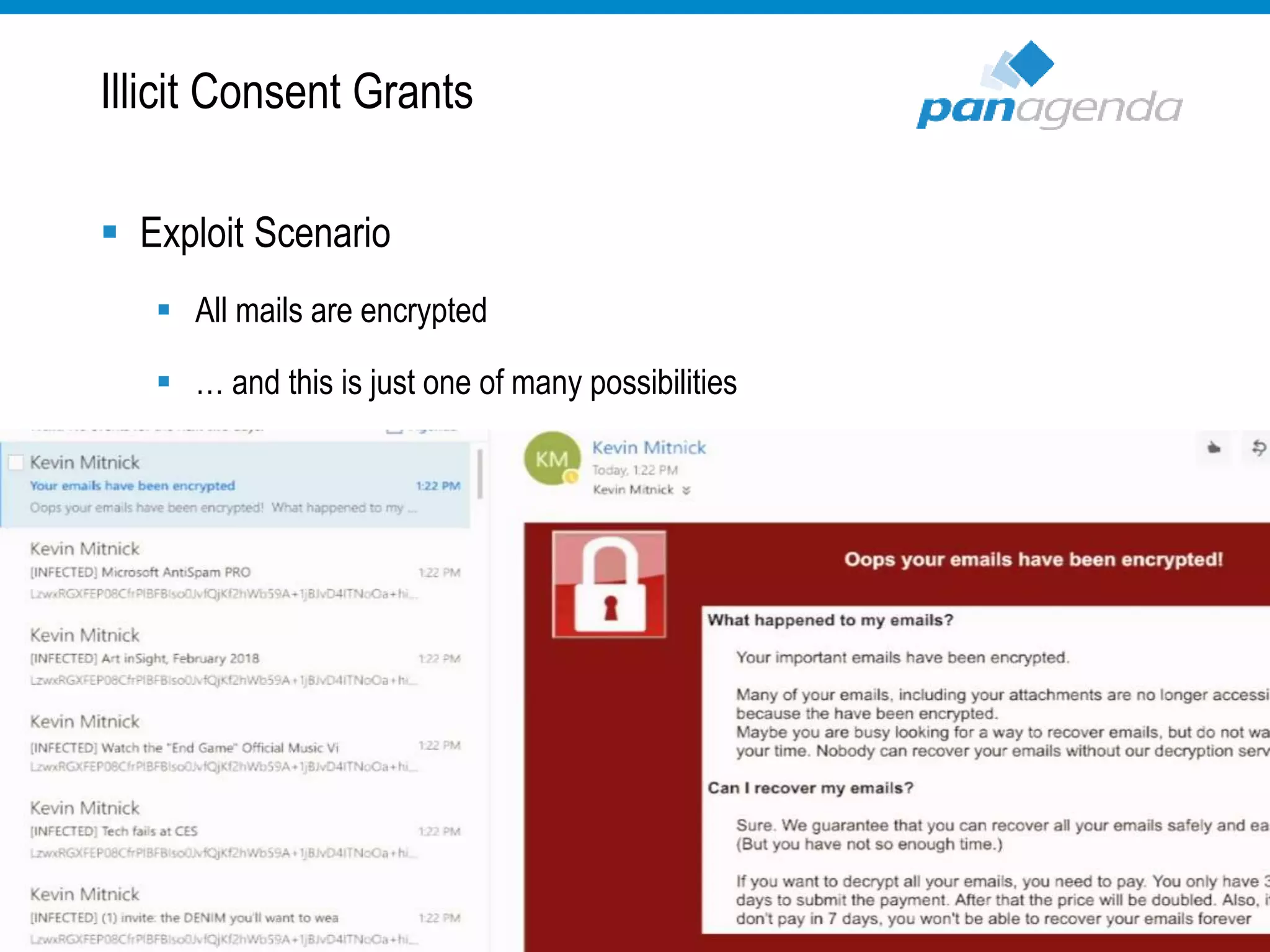
 Exploit Scenario
 All mails are encrypted
 … and this is just one of many possibilities
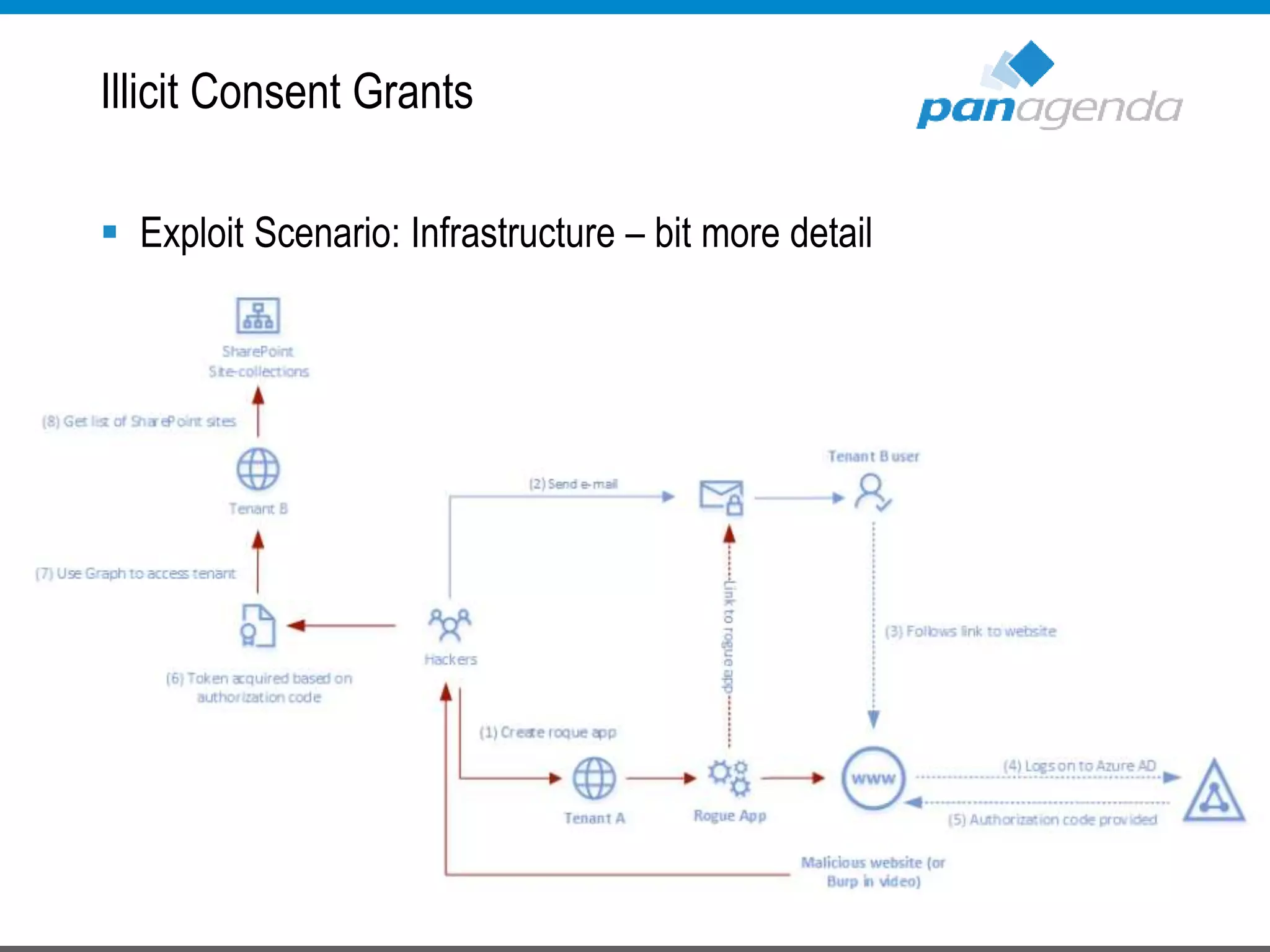
Illicit Consent Grants
 Exploit Scenario: Infrastructure – bit more detail
Illicit Consent Grants
 Consent is key
 Why build integrated applications?
 Using various APIs, you can grant apps access to your tenant data:
 Mail, calendars, contacts, conversations
 Users, groups, files and folders
 SharePoint sites, lists, list items
 OneDrive items, permissions and more
 Integration: Azure AD provides secure sign-in and authorization
 Developer registers the application with Azure AD
 Assign permissions to the application
 Tenant administrator / user must consent to permissions
Digital #metoo era
 Registering the application
 Who can register applications in your tenant?
 By default: any member! This can be a security issue
 Keep in mind: there is a record of what data was shared with which application.
Also: when user adds / allows application to access their data, event can be
audited (Audit reports)
 See more: https://docs.microsoft.com/en-us/azure/active-
directory/develop/active-directory-how-applications-are-added#who-has-
permission-to-add-applications-to-my-azure-ad-instance
Azure AD Applications
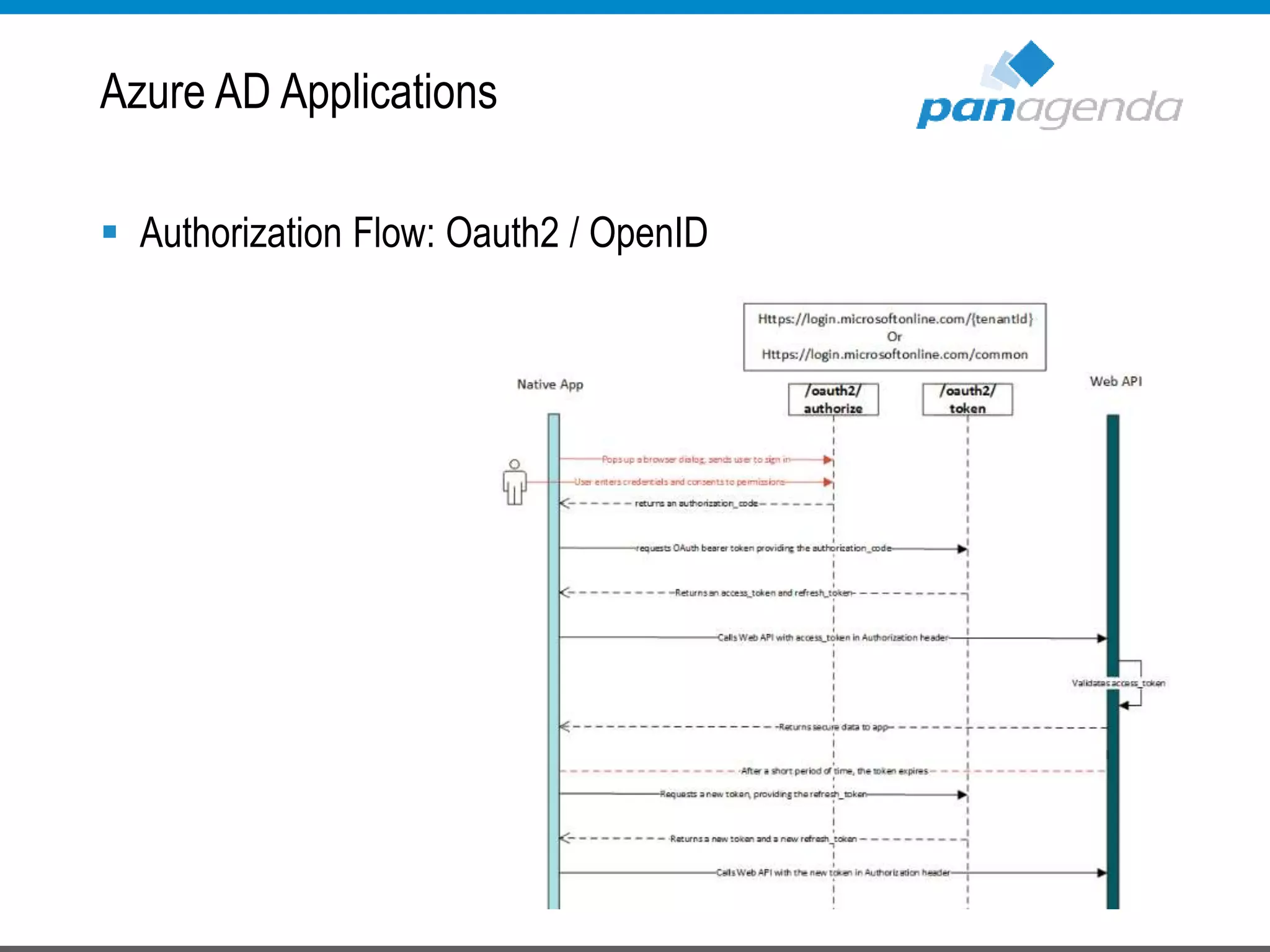
 Authorization Flow: Oauth2 / OpenID
Azure AD Applications
 Authorization flow: let’s simplify
 User consents to permissions required by the app
 Application asks for authorization from the Azure AD
 Azure AD makes the user sign in and returns code to application
 Application uses code to retrieve JWT bearer token to use resource (Microsoft
Graph API)
 Keep in mind: JWT doesn’t authenticate, only authorizes!
Azure AD Applications
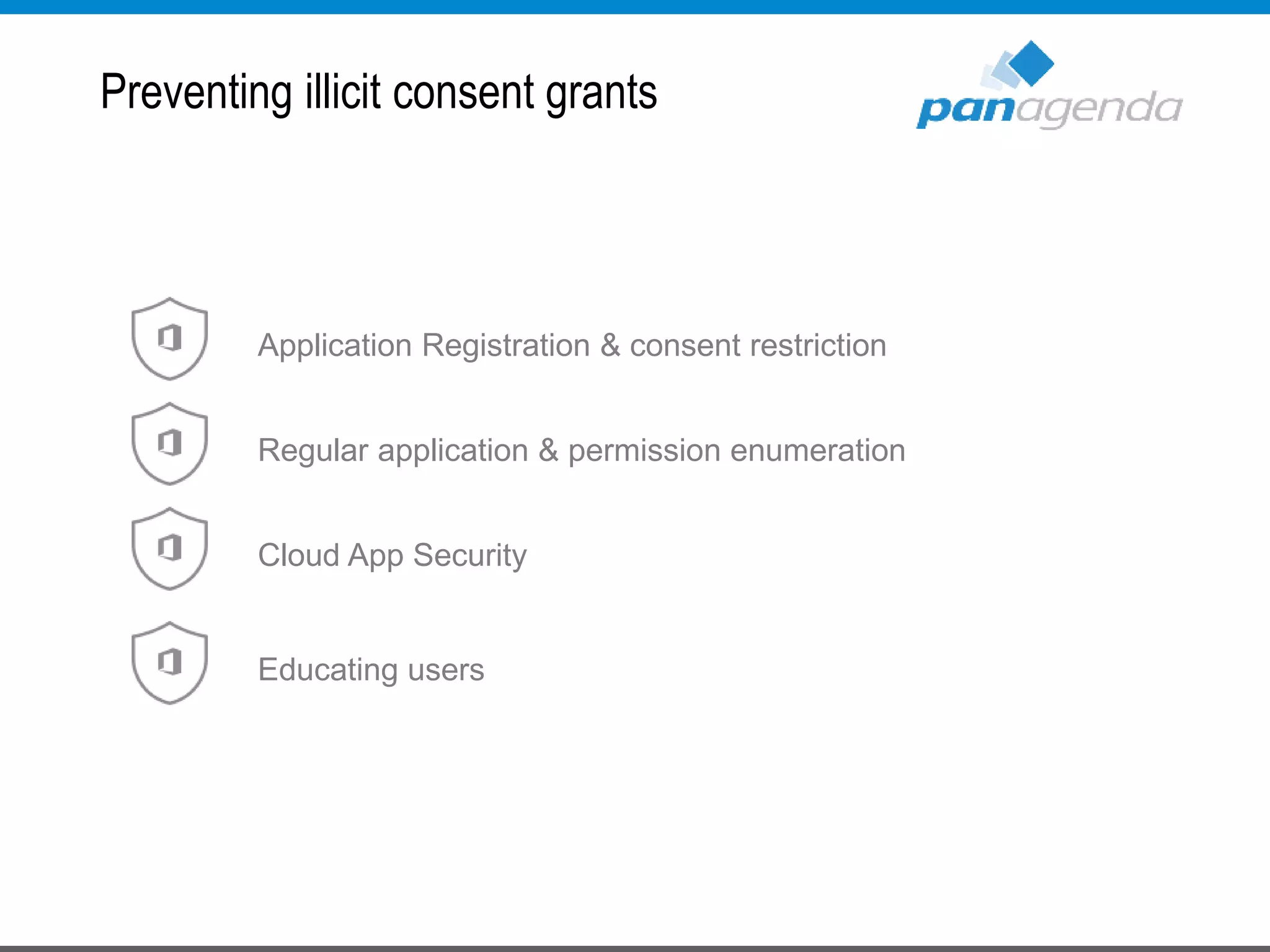
Preventing illicit consent grants
Regular application & permission enumeration
Cloud App Security
Educating users
Application Registration & consent restriction
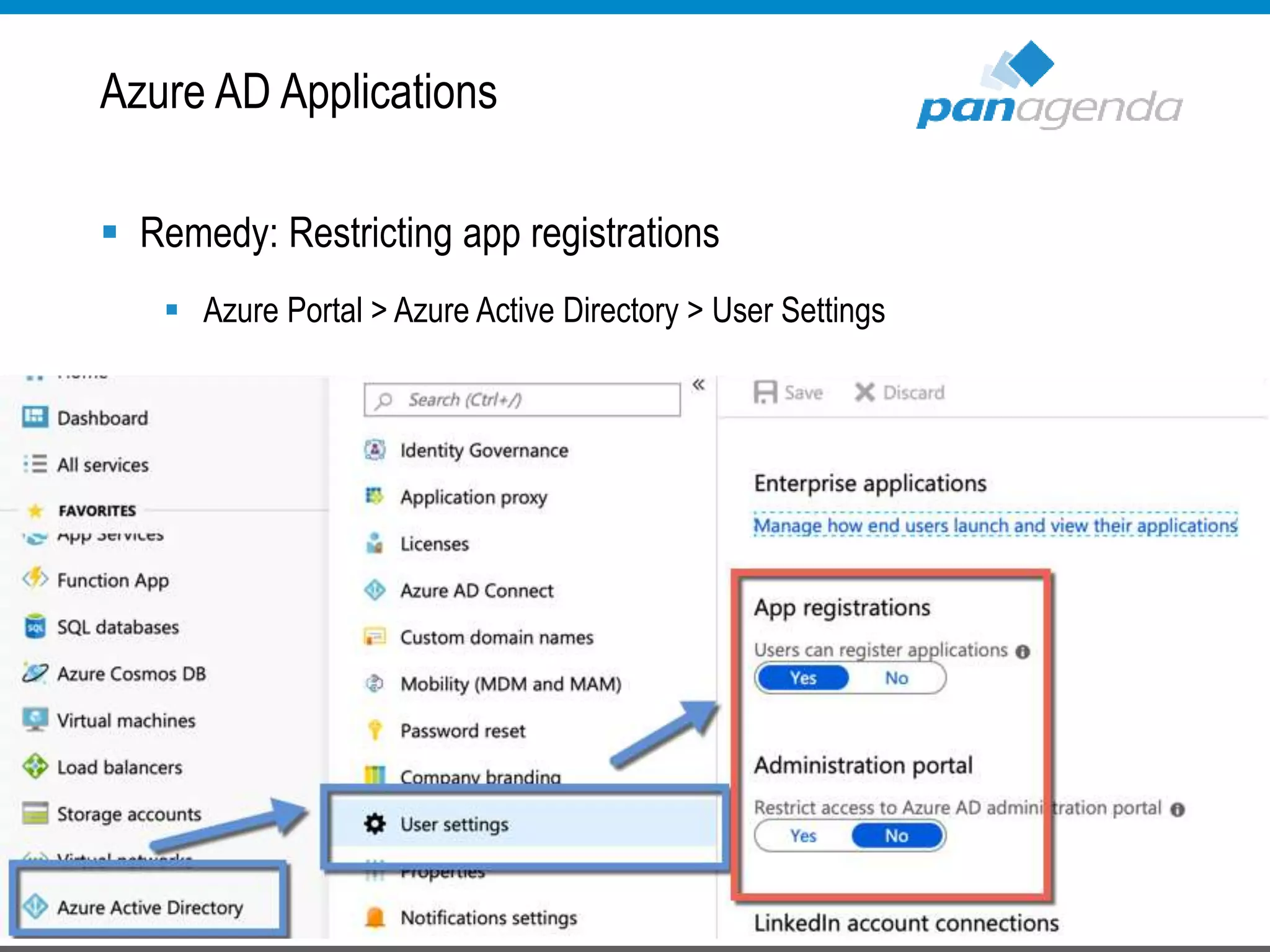
 Remedy: Restricting app registrations
 Azure Portal > Azure Active Directory > User Settings
Azure AD Applications
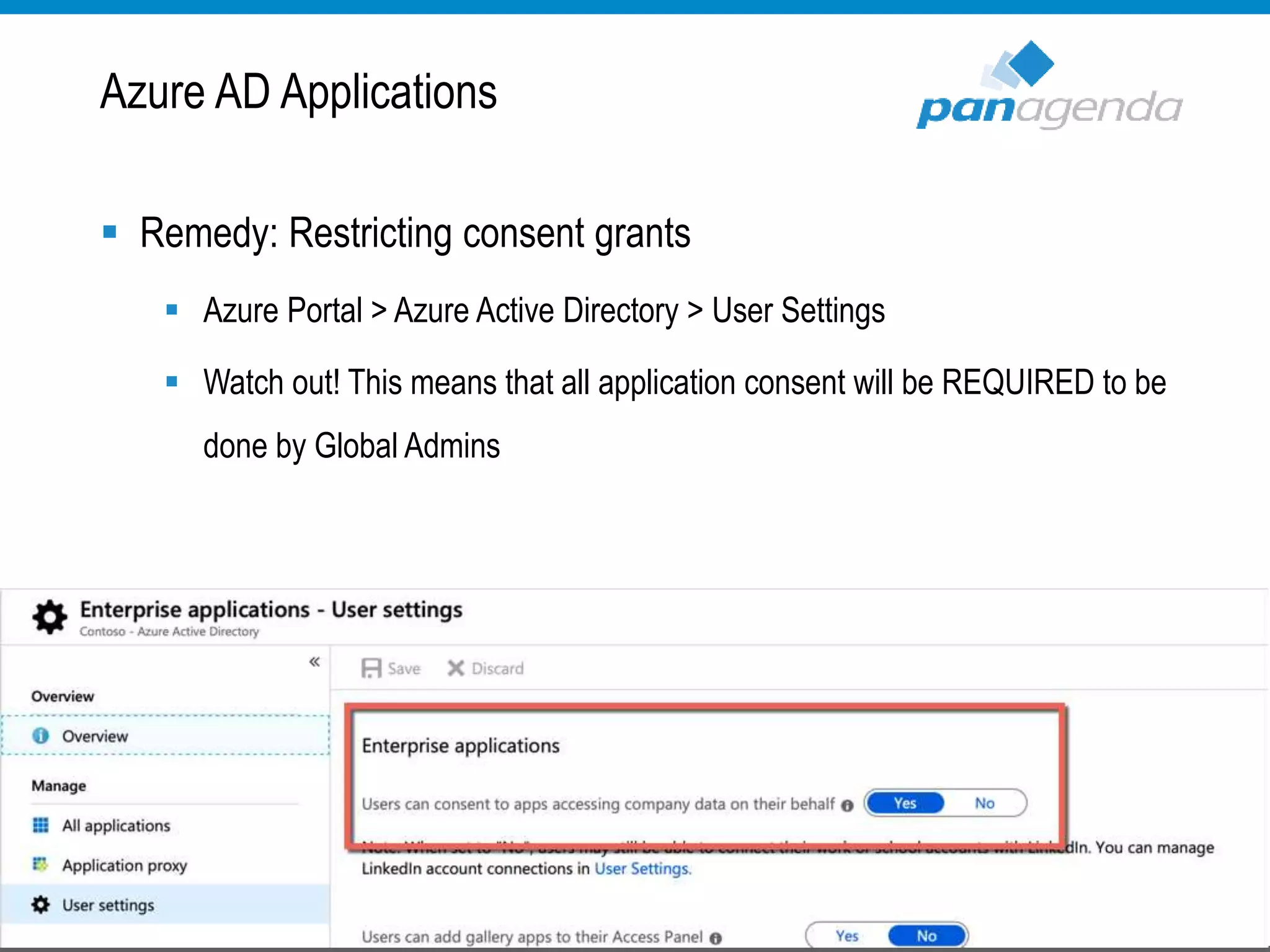
 Remedy: Restricting consent grants
 Azure Portal > Azure Active Directory > User Settings
 Watch out! This means that all application consent will be REQUIRED to be
done by Global Admins
Azure AD Applications
 Remedy: Enumerating apps and permissions
 Enumeration using PowerShell:
 Install the AzureAD PowerShell module
 Launch PowerShell ISE as an Administrator and:
Install-Module AzureAD
 Connect to Azure AD:
Connect-AzureAD
 Use PowerShell script:
https://gist.github.com/psignoret/41793f8c6211d2df5051d77ca3728c09
 Example:
.Get-AzureADPSPermissions.ps1 | Export-Csv -Path "permissions.csv" -
NoTypeInformation
Azure AD Applications
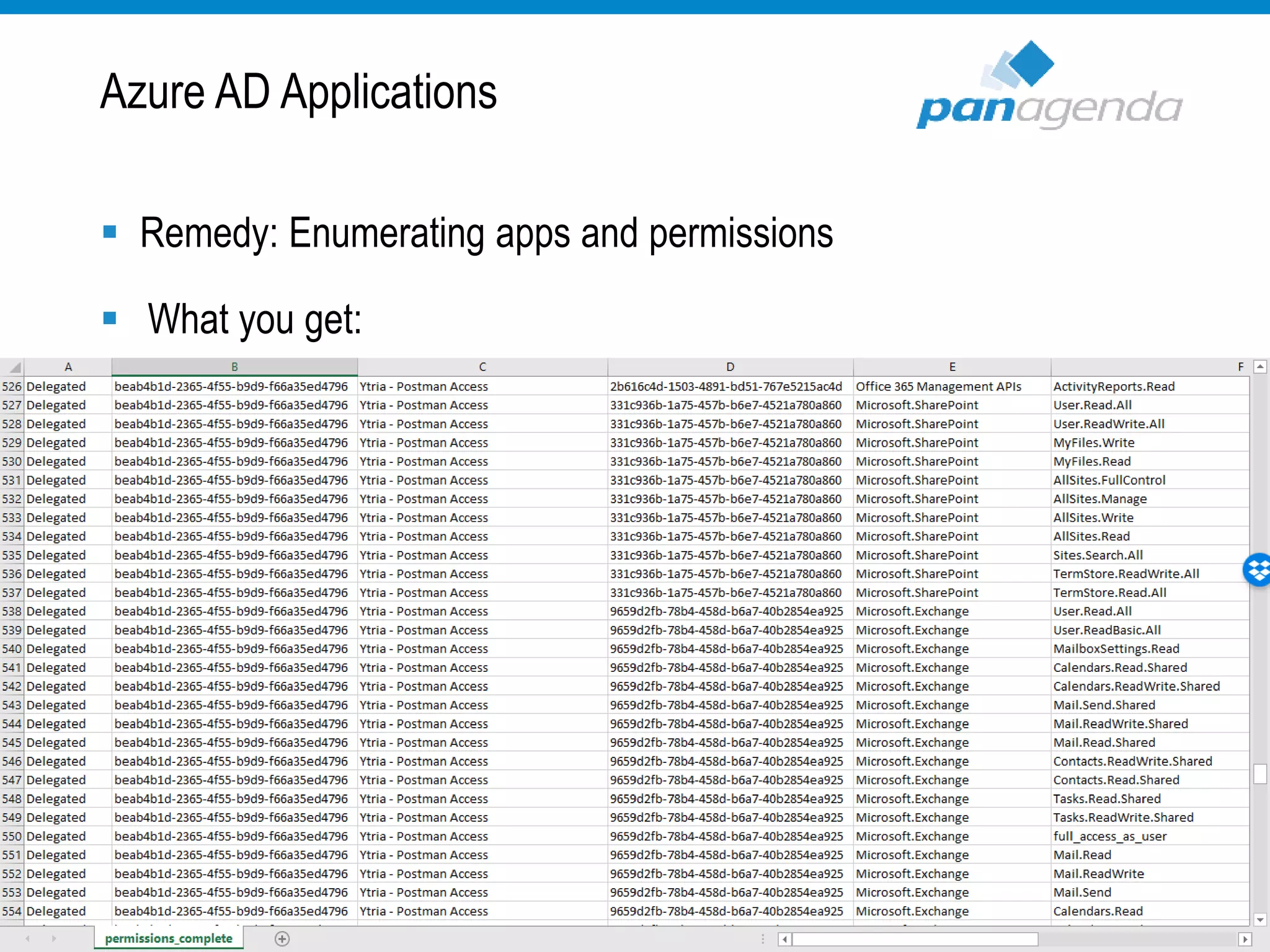
 Remedy: Enumerating apps and permissions
 What you get:
Azure AD Applications
 Remedy: Enumerating apps and permissions
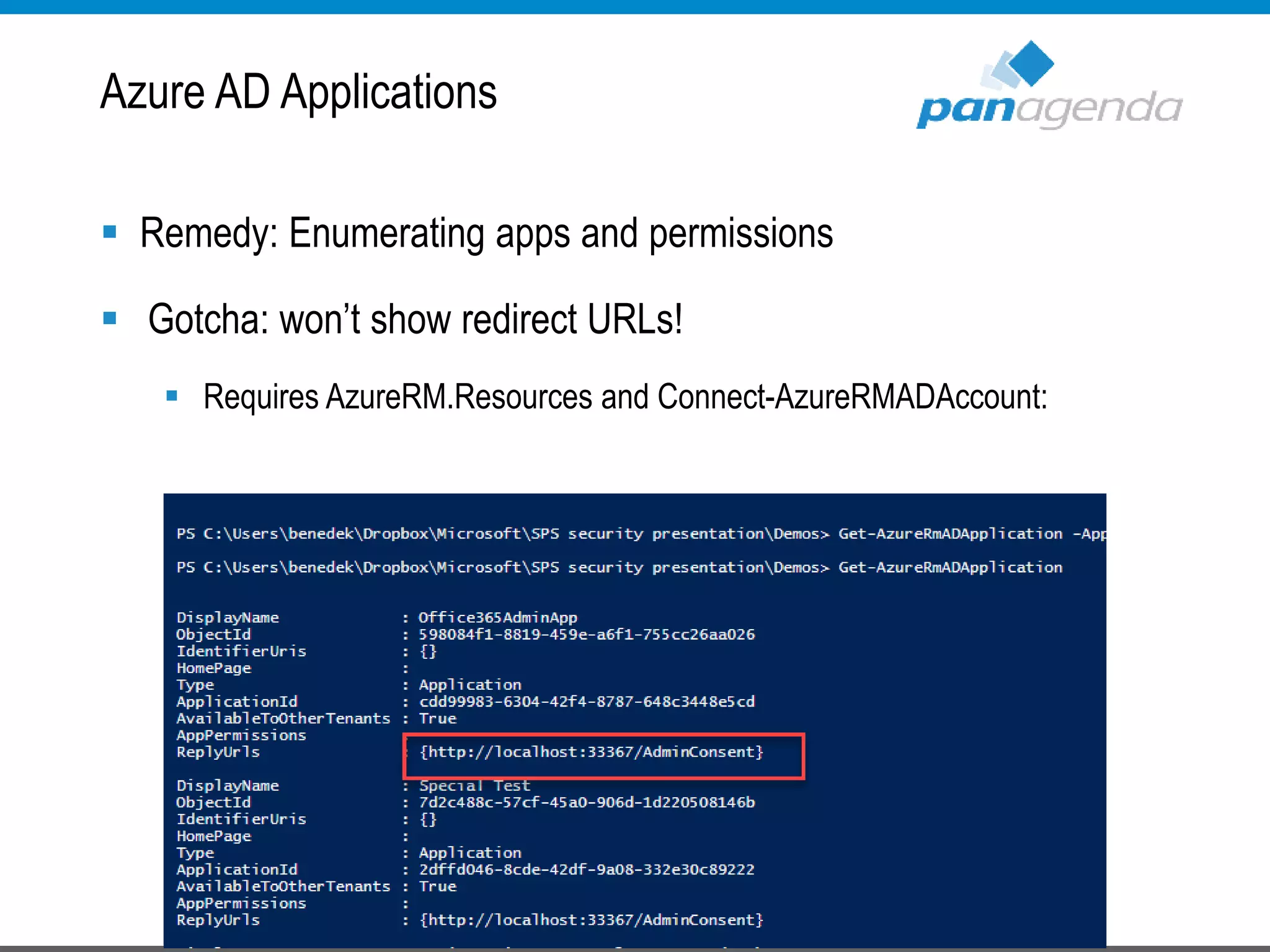
 Gotcha: won’t show redirect URLs!
 Requires AzureRM.Resources and Connect-AzureRMADAccount:
Azure AD Applications
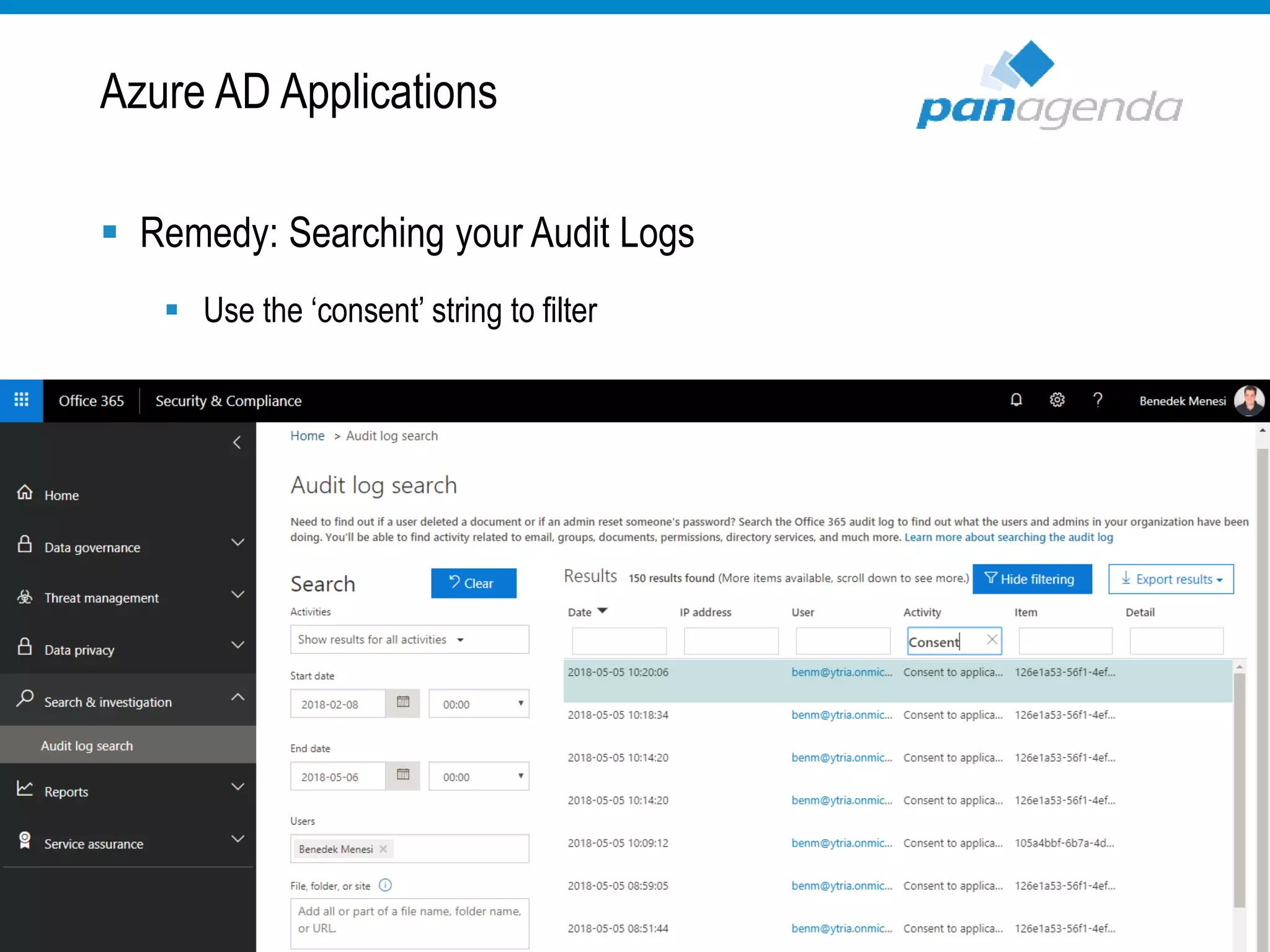
 Remedy: Searching your Audit Logs
 Use the ‘consent’ string to filter
Azure AD Applications
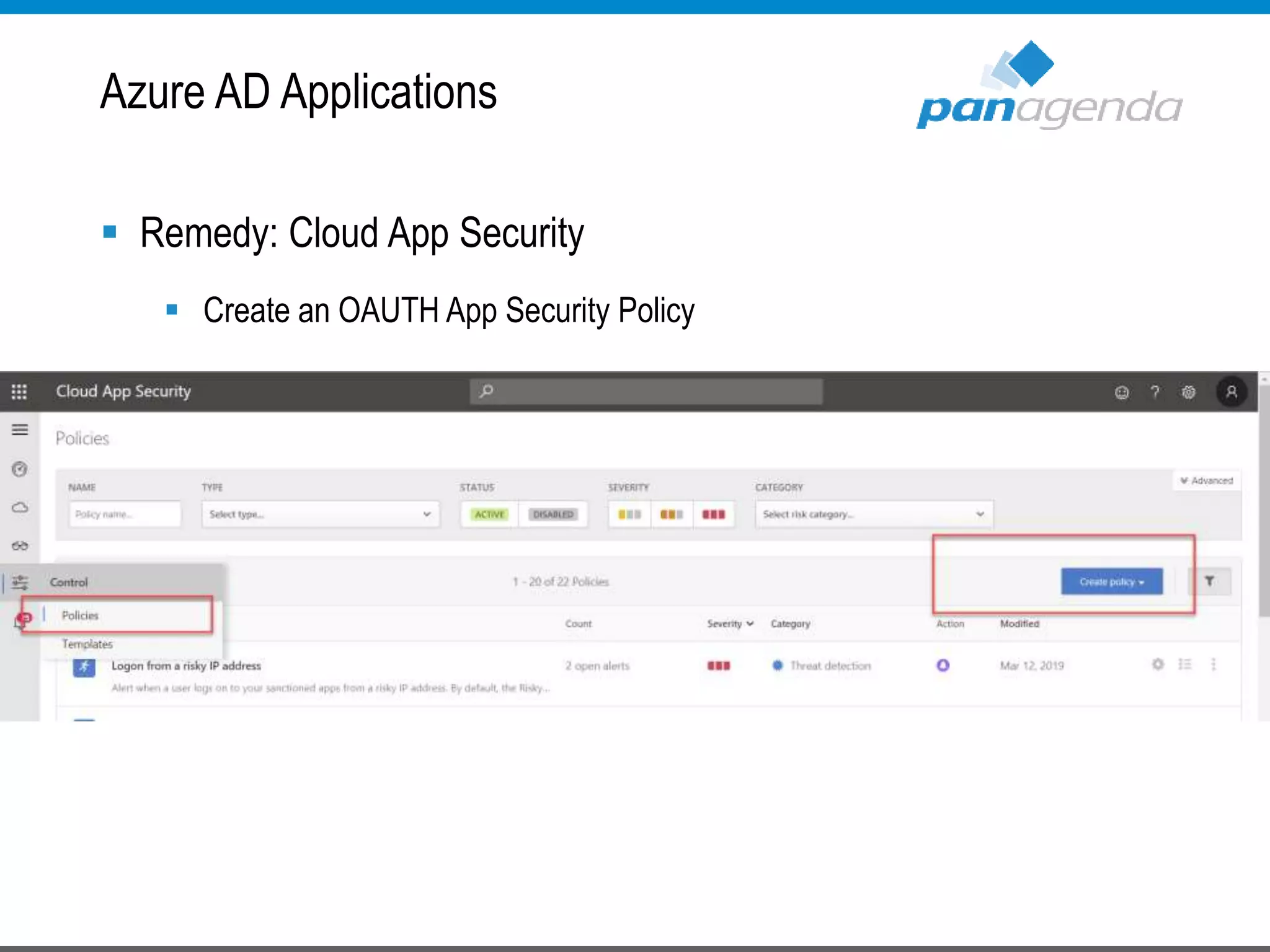
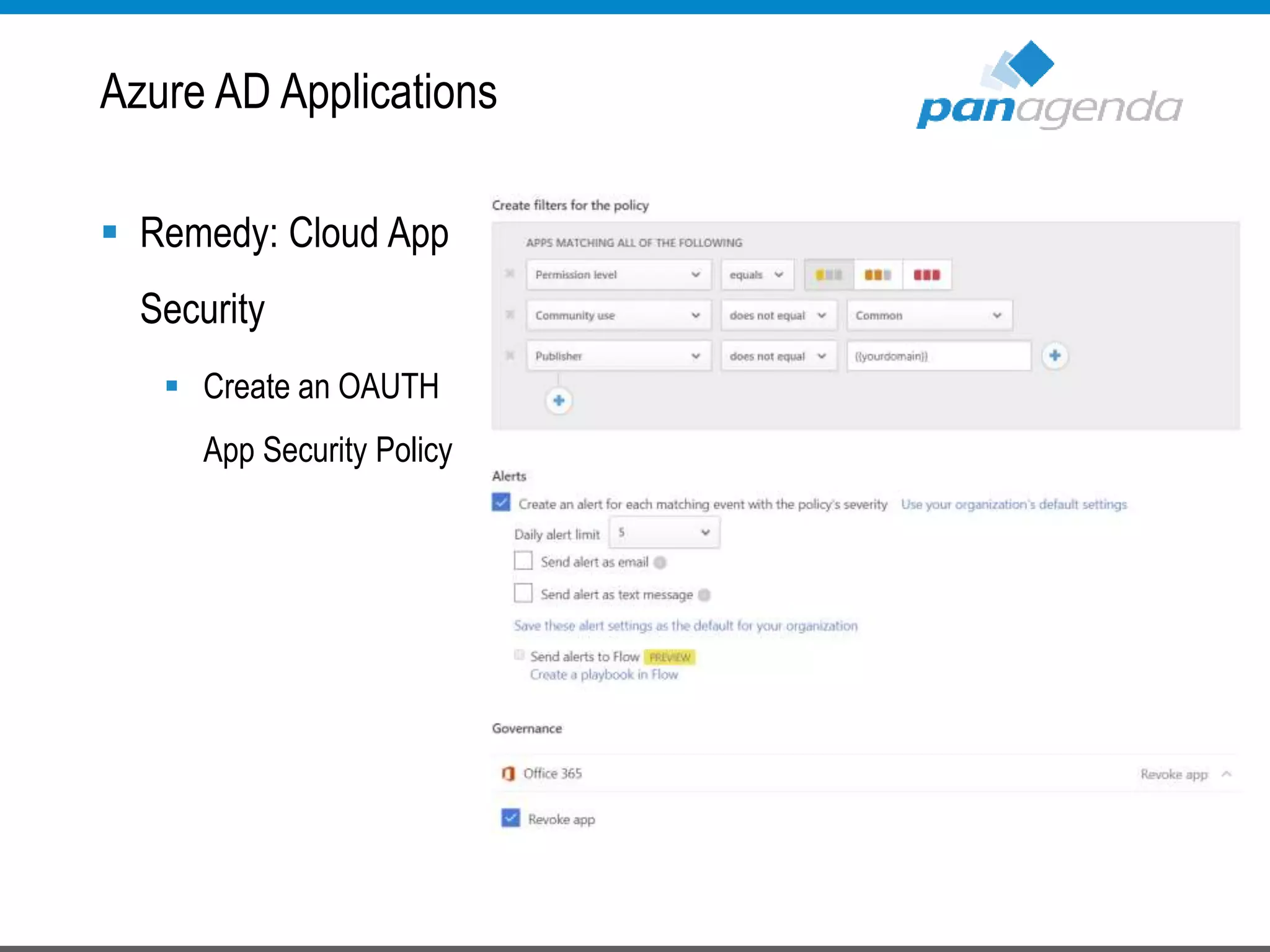
 Remedy: Cloud App Security
 Create an OAUTH App Security Policy
Azure AD Applications
 Remedy: Cloud App
Security
 Create an OAUTH
App Security Policy
Azure AD Applications
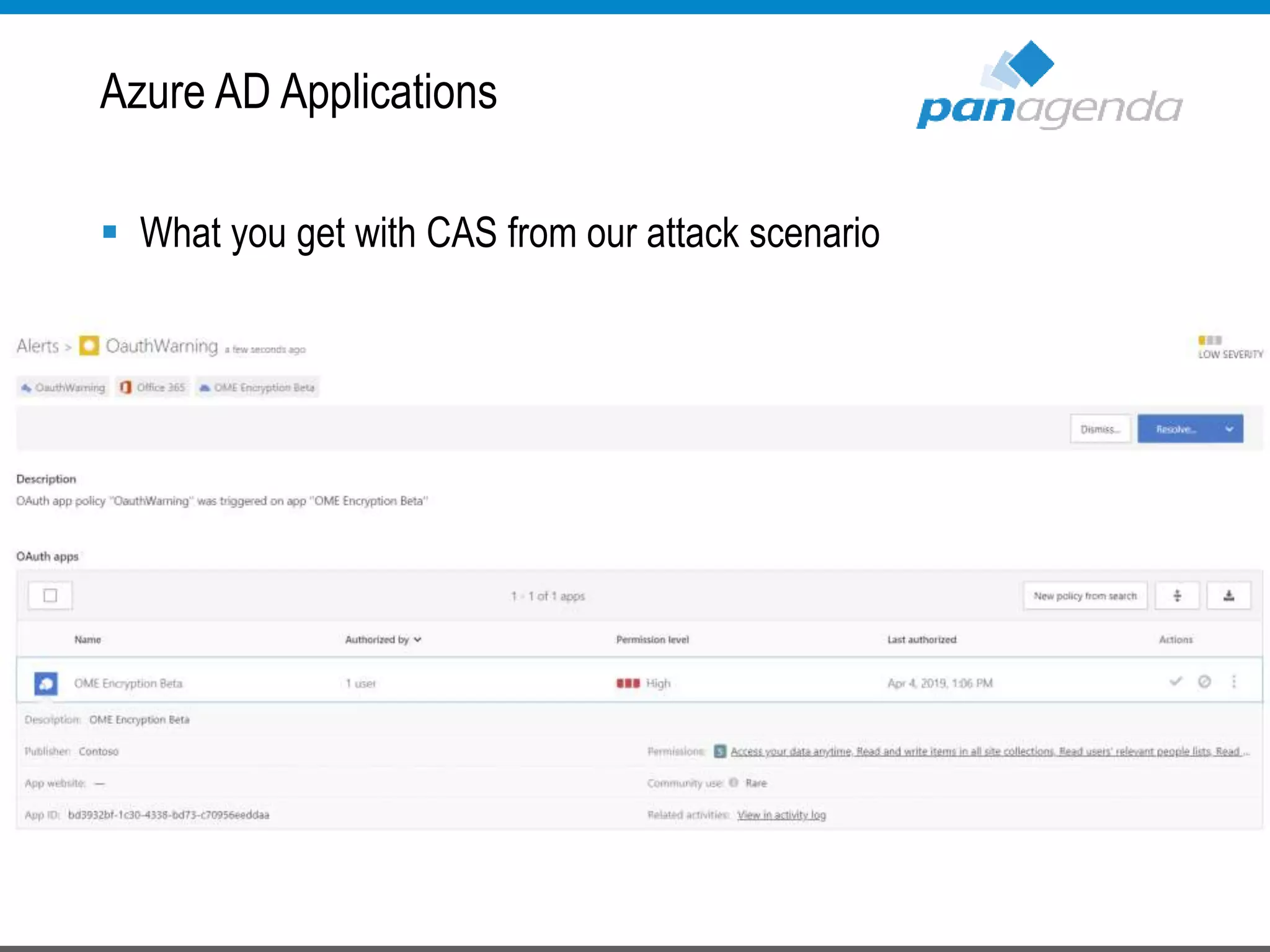
 What you get with CAS from our attack scenario
Azure AD Applications
Password Attacks
 Brute forcing office365 logins
 In the news in August 2017: sophisticated and coordinated attack against 48
Office365 customers
 Brute Force attack unique: targeting multiple cloud providers
 100,000 failed login attempts from 67 Ips and 12 networks over 7 months
 Slow and low to avoid intrusion detection
 Users see unsuccessful login attempts using name up to 17 name variations
 Passwords likely the same (password spray attack)
 https://www.tripwire.com/state-of-security/featured/new-type-brute-force-attack-office-
365-accounts/
Brute Force Attacks
 How hard is it to acquire the right login names?
 Demo
Brute Force Attacks
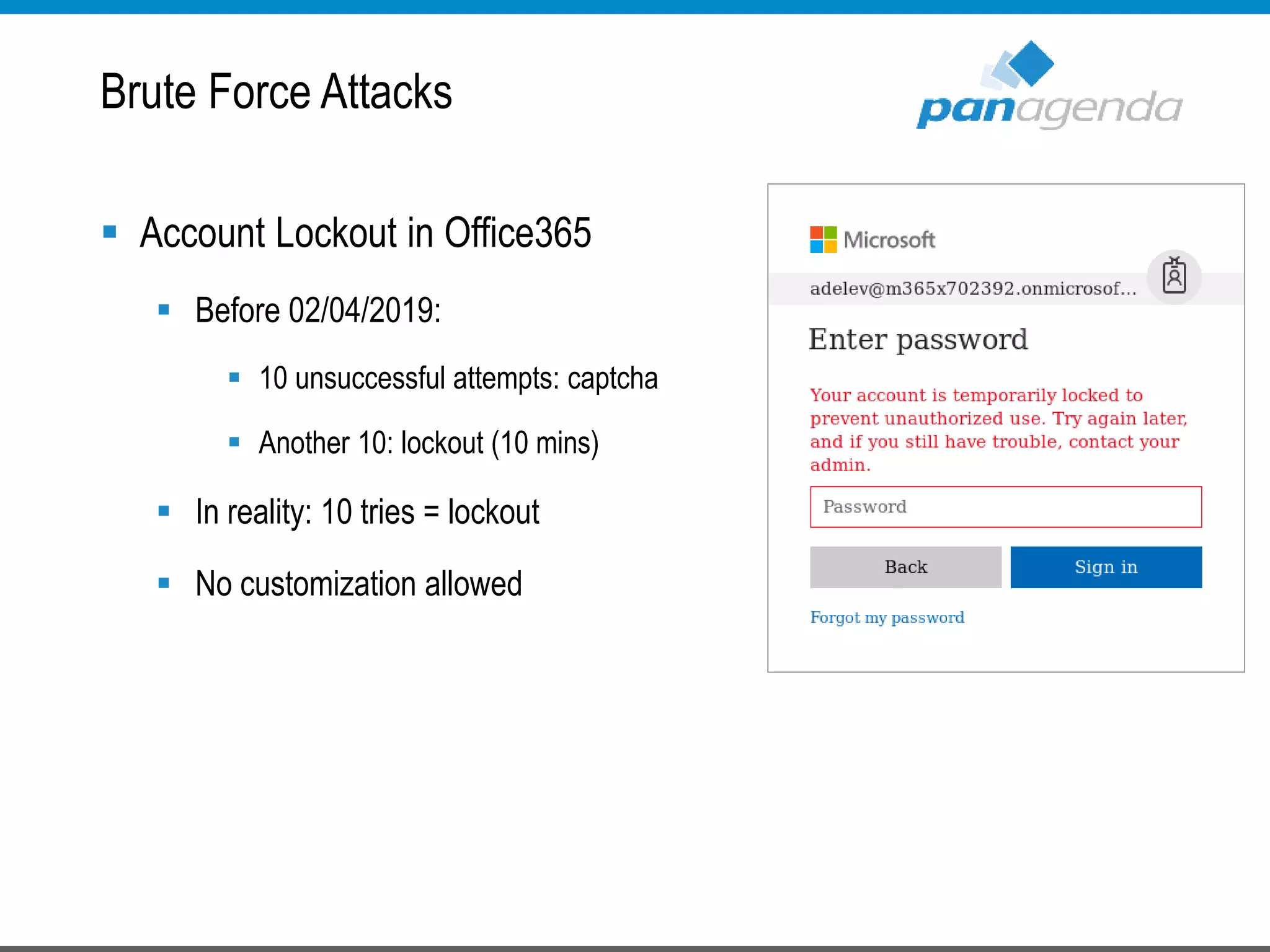
 Account Lockout in Office365
 Before 02/04/2019:
 10 unsuccessful attempts: captcha
 Another 10: lockout (10 mins)
 In reality: 10 tries = lockout
 No customization allowed
Brute Force Attacks
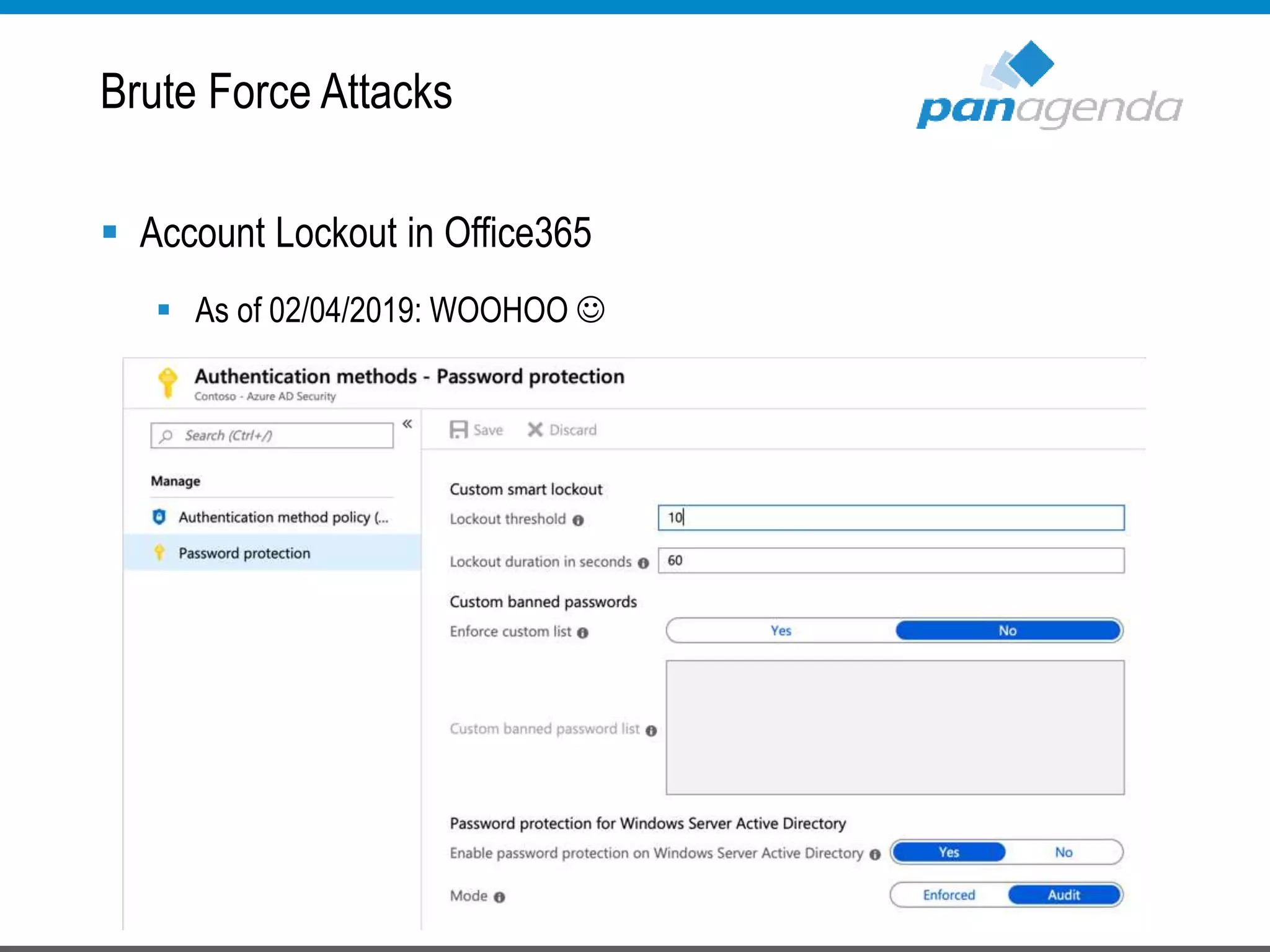
 Account Lockout in Office365
 As of 02/04/2019: WOOHOO 
Brute Force Attacks
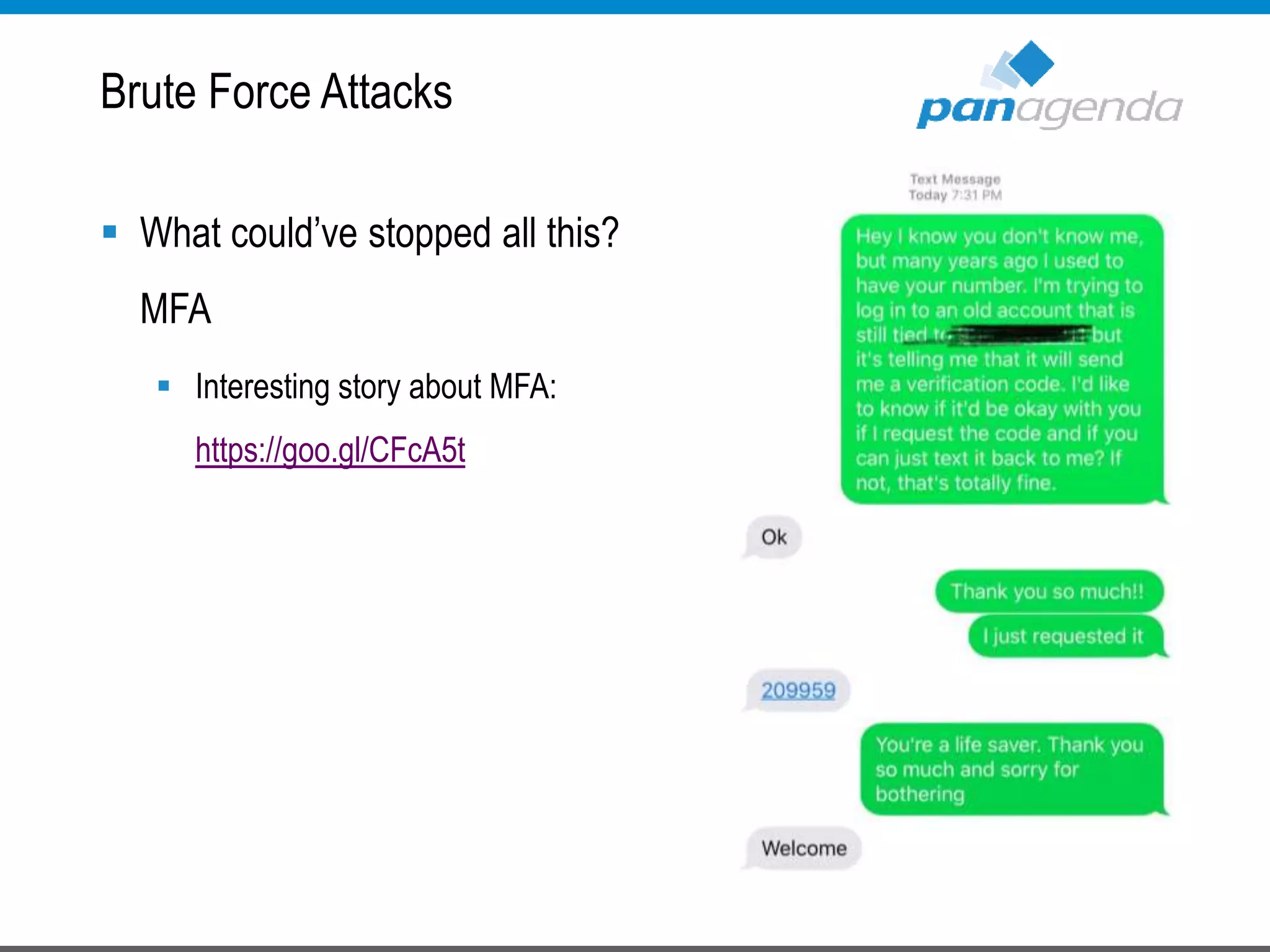
 What could’ve stopped all this?
MFA
 Interesting story about MFA:
https://goo.gl/CFcA5t
Brute Force Attacks
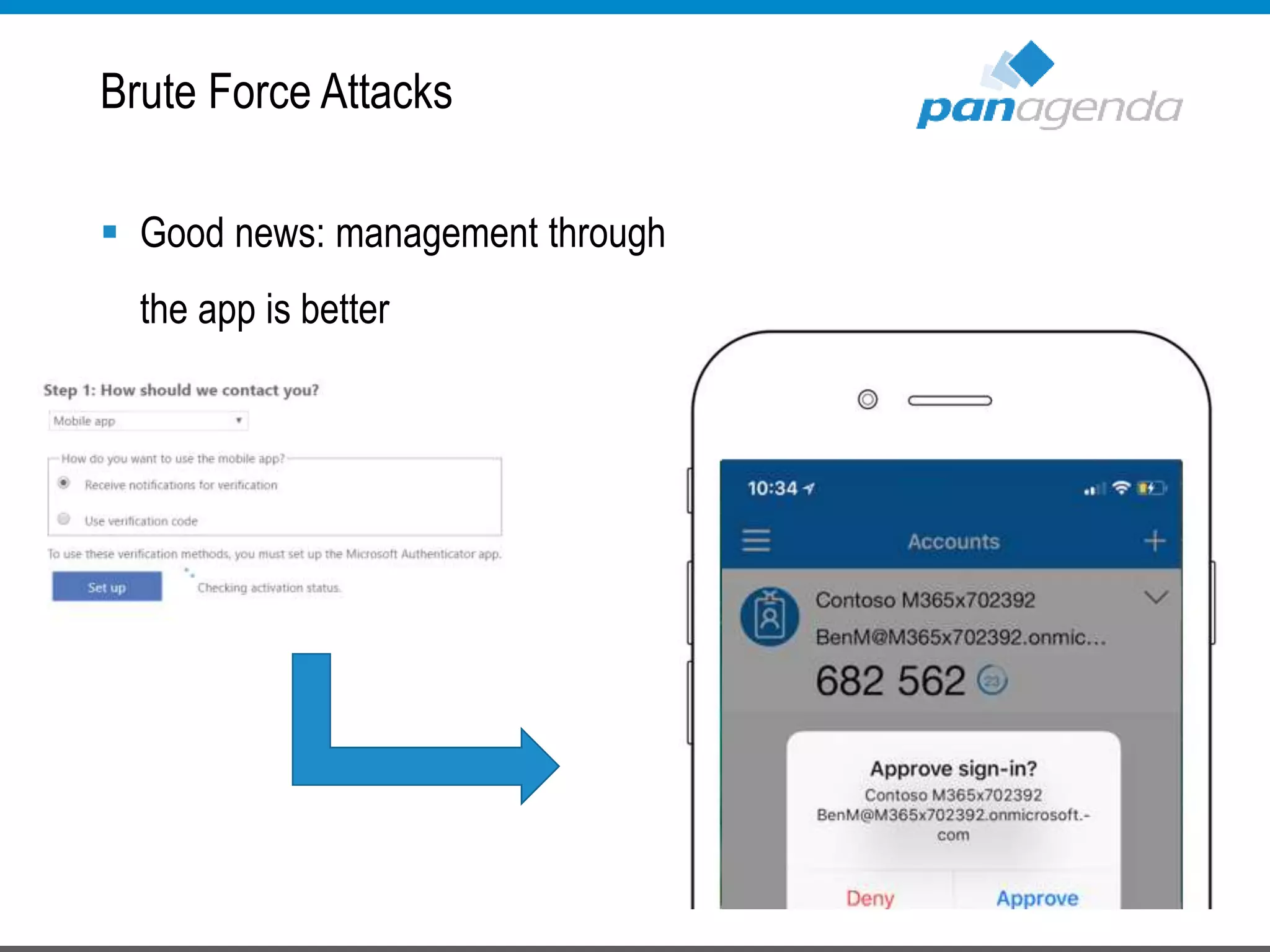
 Good news: management through
the app is better
Brute Force Attacks
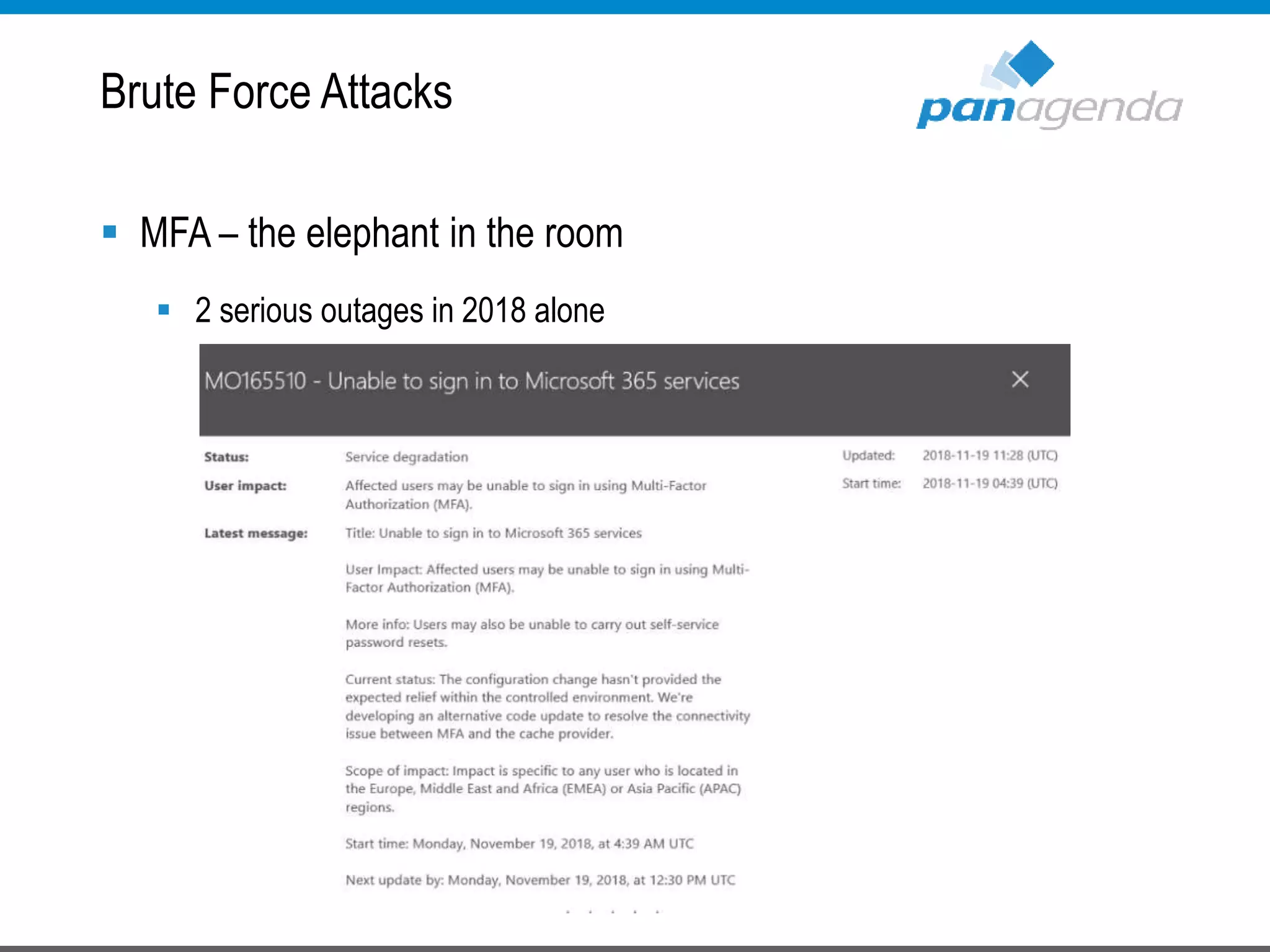
 MFA – the elephant in the room
 2 serious outages in 2018 alone
Brute Force Attacks
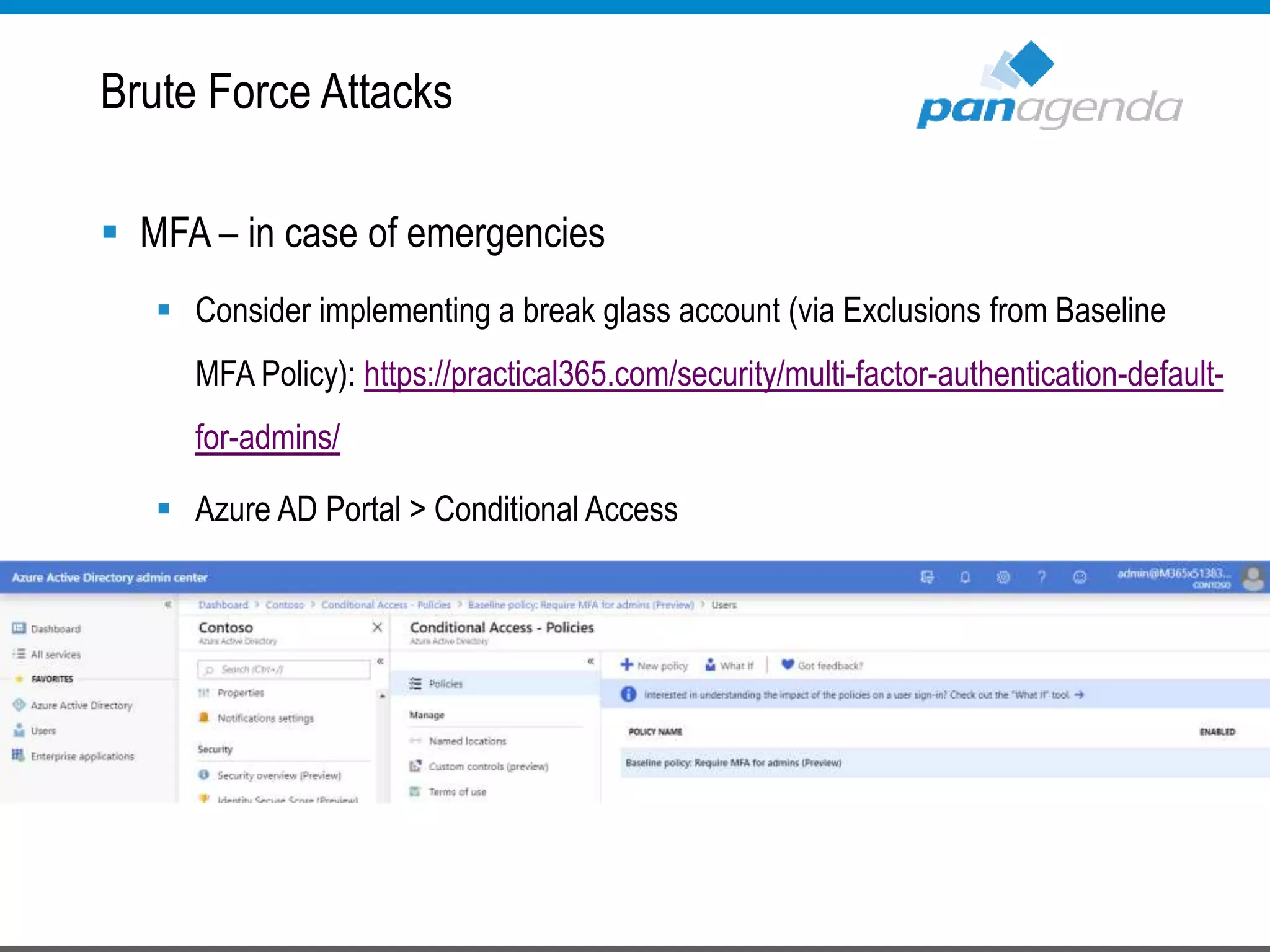
 MFA – in case of emergencies
 Consider implementing a break glass account (via Exclusions from Baseline
MFA Policy): https://practical365.com/security/multi-factor-authentication-default-
for-admins/
 Azure AD Portal > Conditional Access
Brute Force Attacks
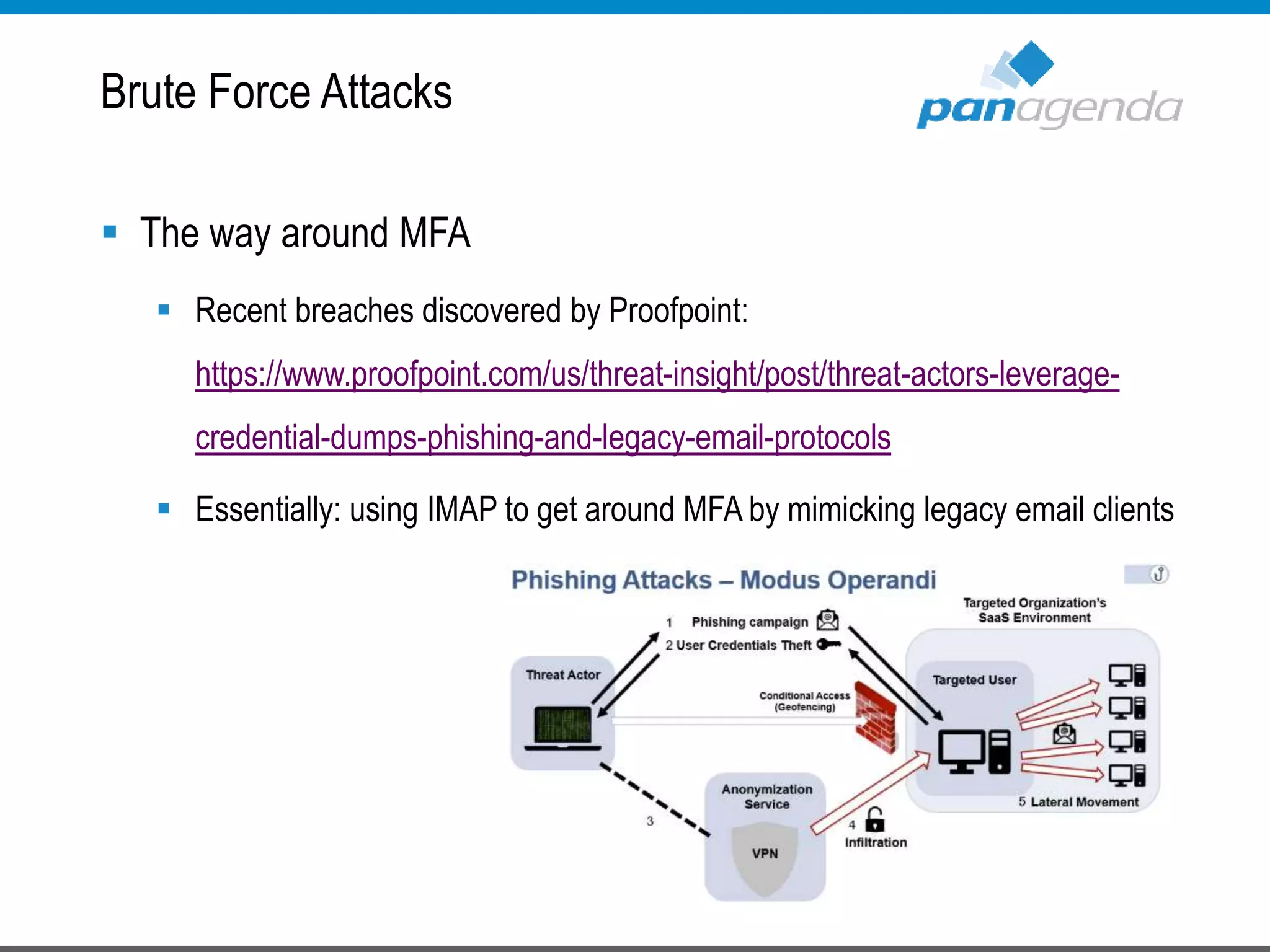
 The way around MFA
 Recent breaches discovered by Proofpoint:
https://www.proofpoint.com/us/threat-insight/post/threat-actors-leverage-
credential-dumps-phishing-and-legacy-email-protocols
 Essentially: using IMAP to get around MFA by mimicking legacy email clients
Brute Force Attacks
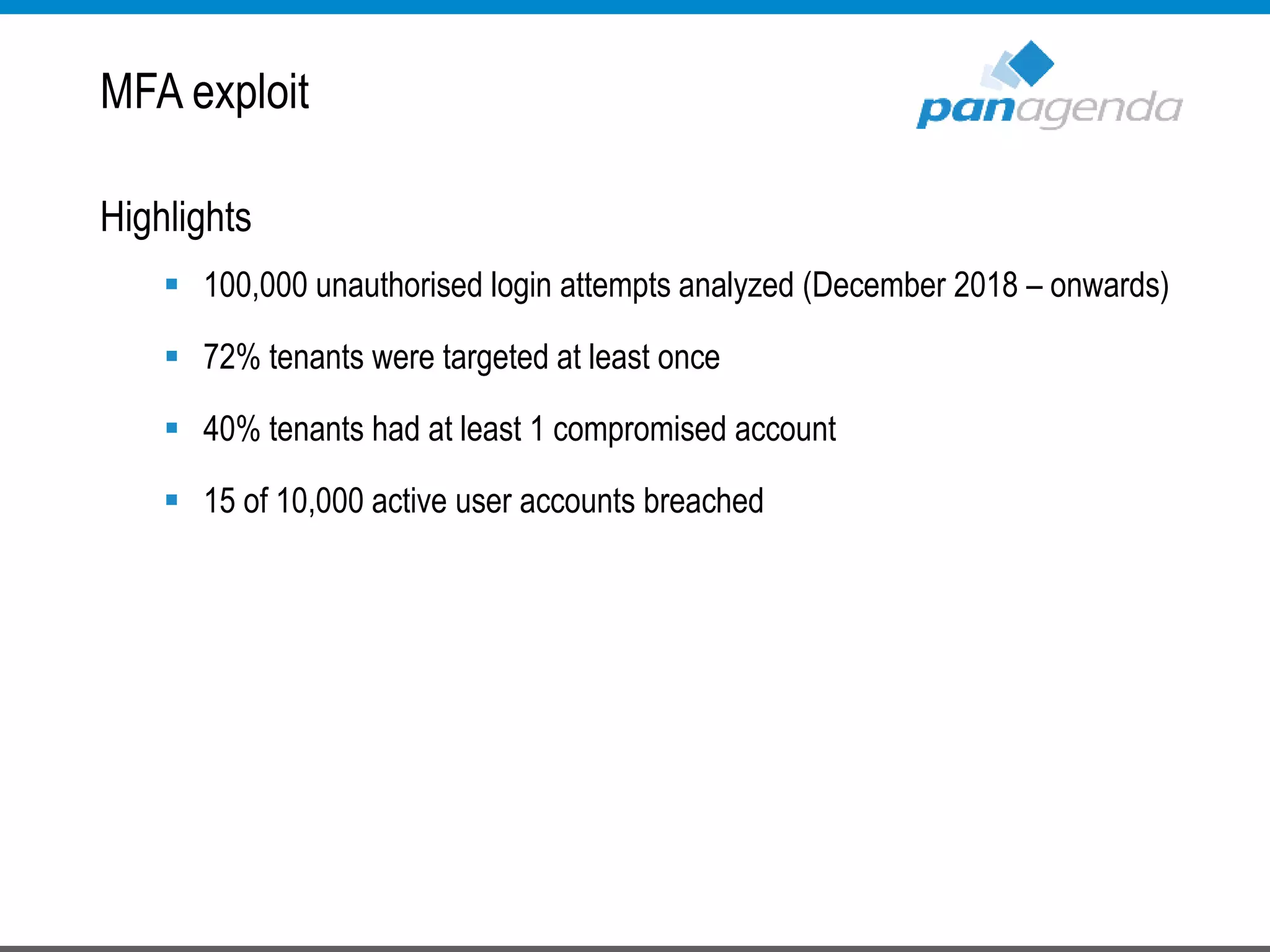
MFA exploit
Highlights
 100,000 unauthorised login attempts analyzed (December 2018 – onwards)
 72% tenants were targeted at least once
 40% tenants had at least 1 compromised account
 15 of 10,000 active user accounts breached
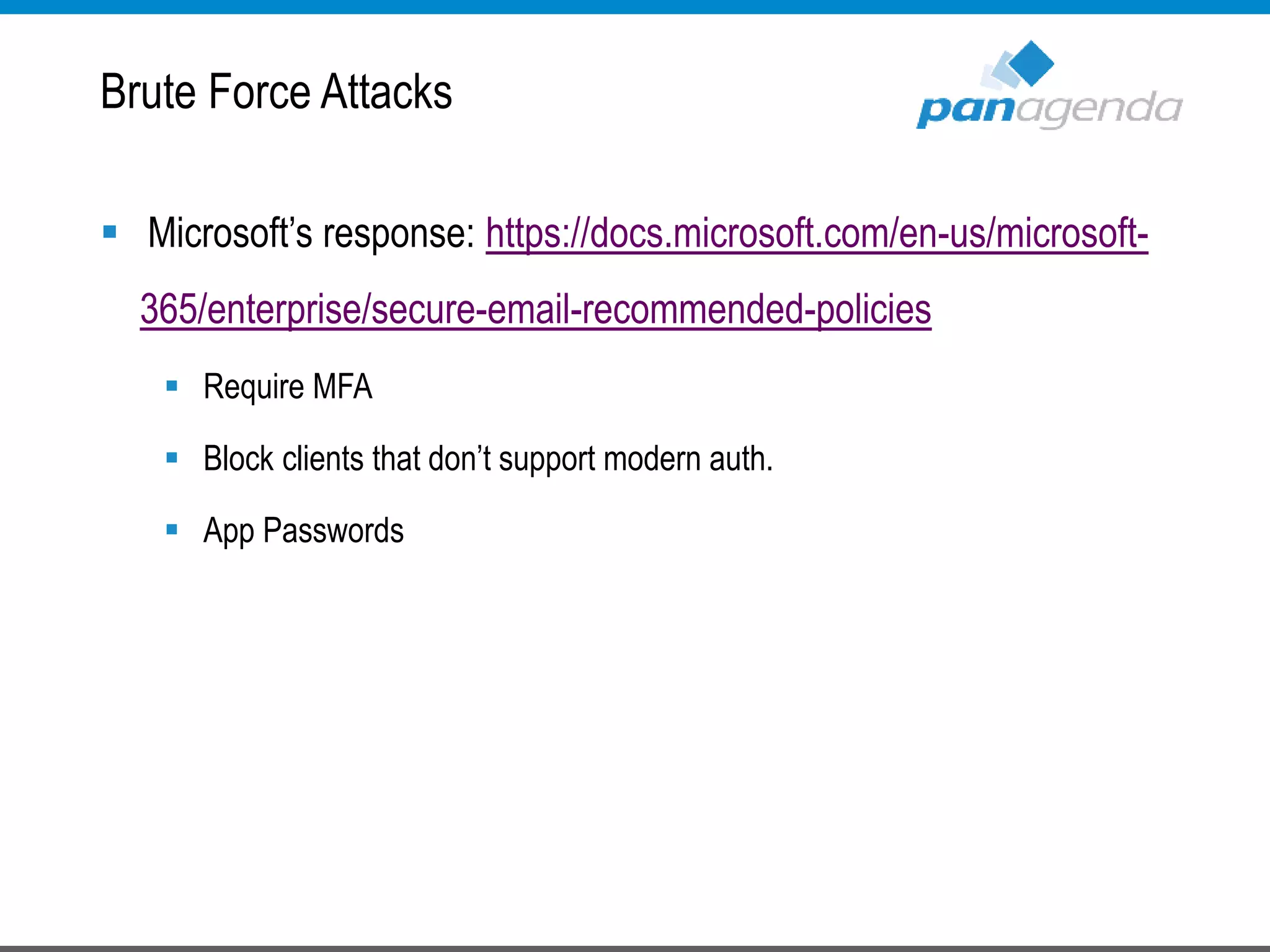
 Microsoft’s response: https://docs.microsoft.com/en-us/microsoft-
365/enterprise/secure-email-recommended-policies
 Require MFA
 Block clients that don’t support modern auth.
 App Passwords
Brute Force Attacks
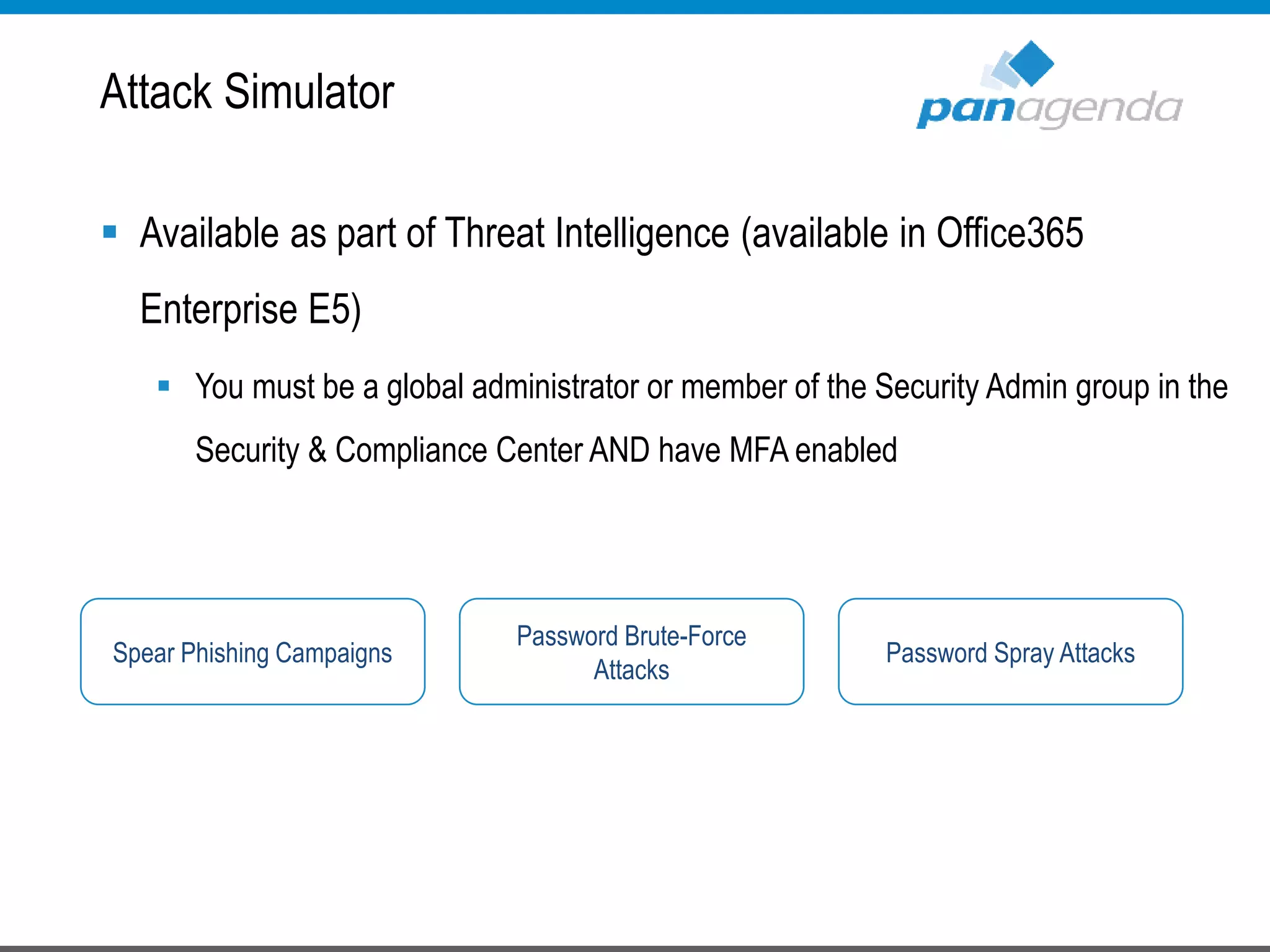
 Available as part of Threat Intelligence (available in Office365
Enterprise E5)
 You must be a global administrator or member of the Security Admin group in the
Security & Compliance Center AND have MFA enabled
Attack Simulator
Spear Phishing Campaigns
Password Brute-Force
Attacks
Password Spray Attacks
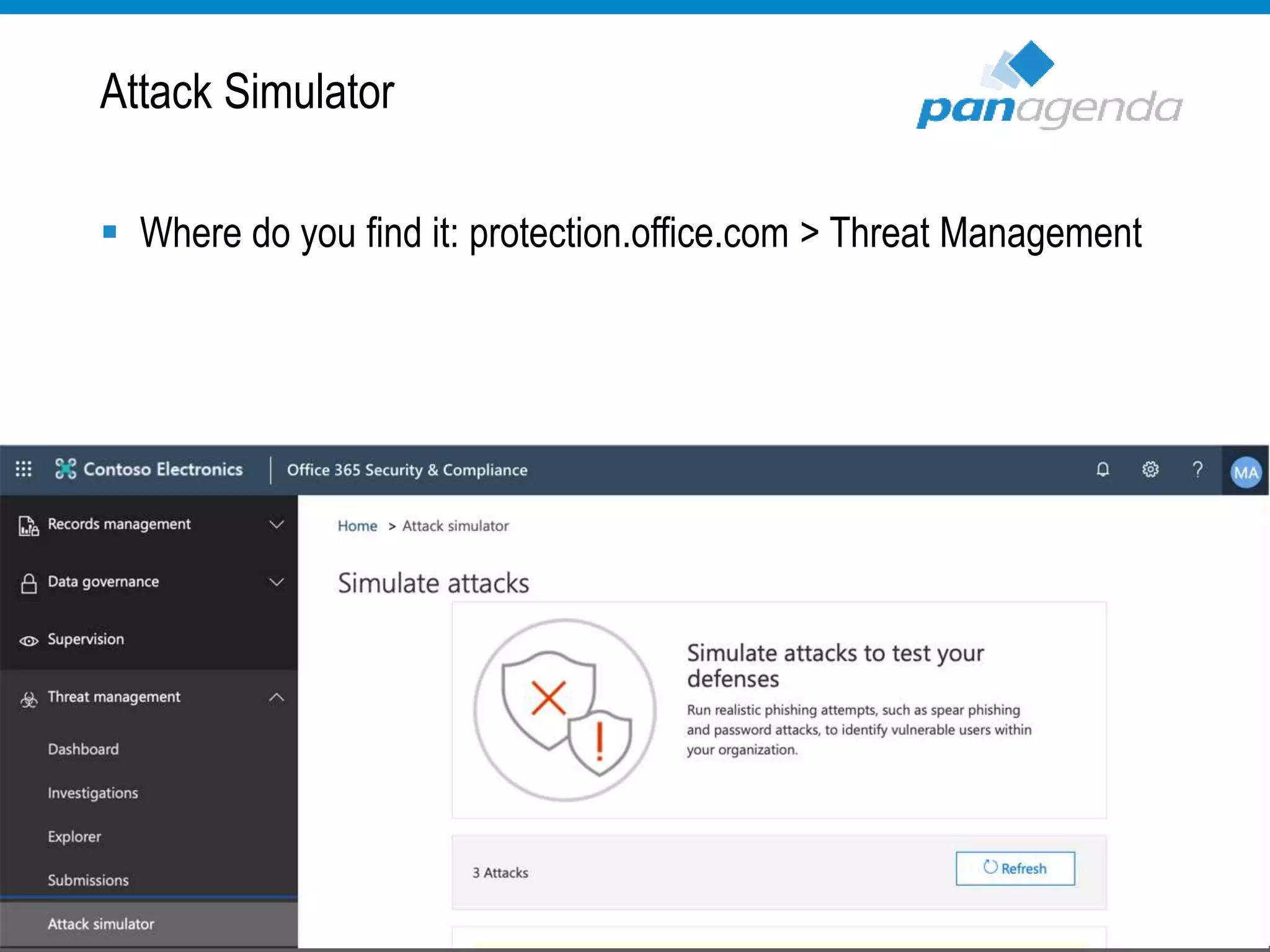
 Where do you find it: protection.office.com > Threat Management
Attack Simulator
 Spear Phishing campaigns
 Tip: target users identified as top targeted in the Threat Management dashboard
 Tip2: You’ll need to enable Office Analytics
Attack Simulator
 Spear Phishing campaigns
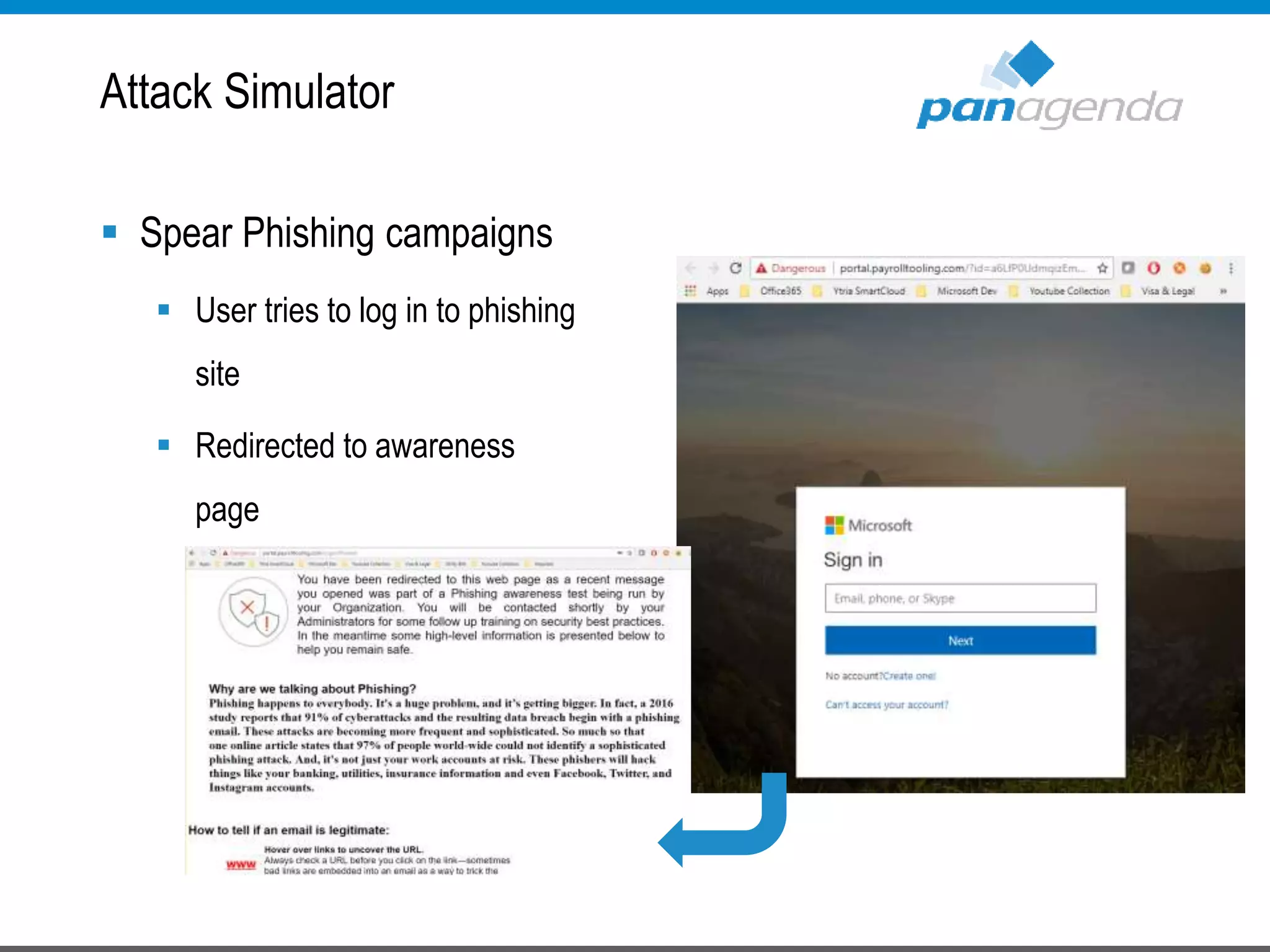
 User tries to log in to phishing
site
 Redirected to awareness
page
Attack Simulator
 Spear Phishing campaigns
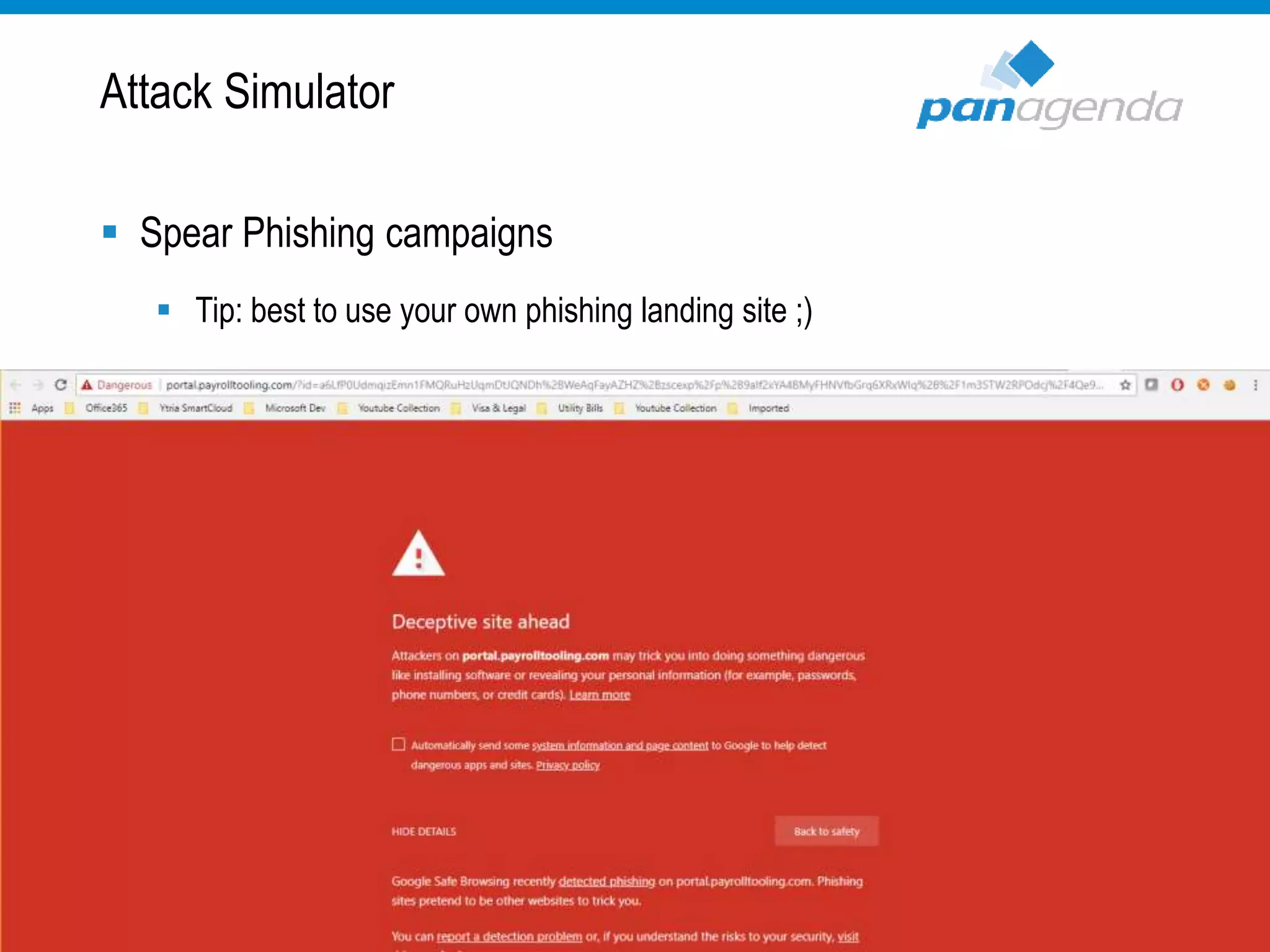
 Tip: best to use your own phishing landing site ;)
Attack Simulator
 Brute Force Password
 Use a pre-set word list against one or multiple user accounts
 Uses the same method an attacker would
 I mean literally: watch out! Currently this locks out the user account.
 Only supports very limited password lists (Internal server error at 10k
passwords)
 Best online resources for common credentials:
https://github.com/danielmiessler/SecLists/tree/master/Passwords/Common-
Credentials
Attack Simulator
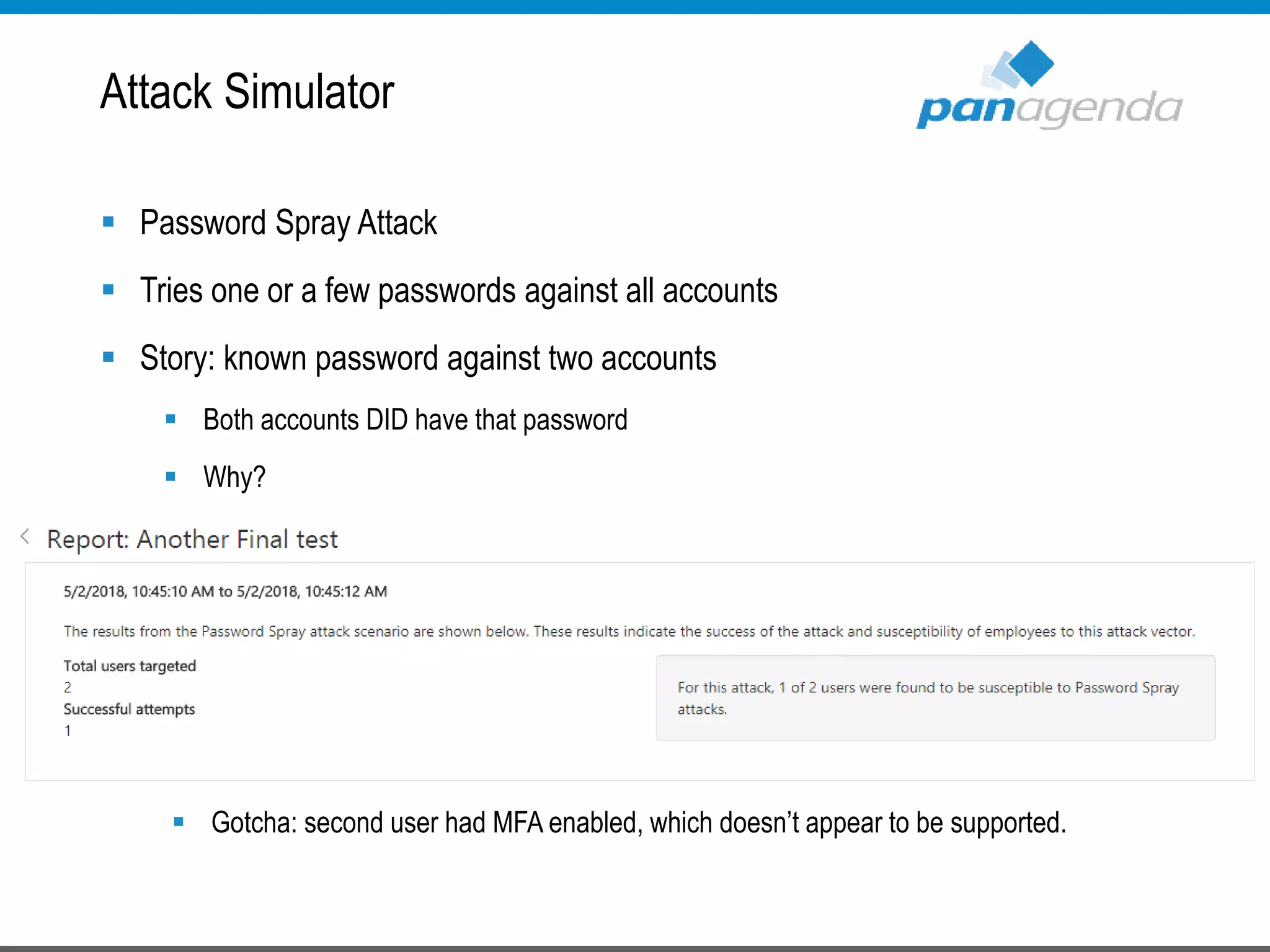
 Password Spray Attack
 Tries one or a few passwords against all accounts
 Story: known password against two accounts
 Both accounts DID have that password
 Why?
 Why?
 Gotcha: second user had MFA enabled, which doesn’t appear to be supported.
Attack Simulator
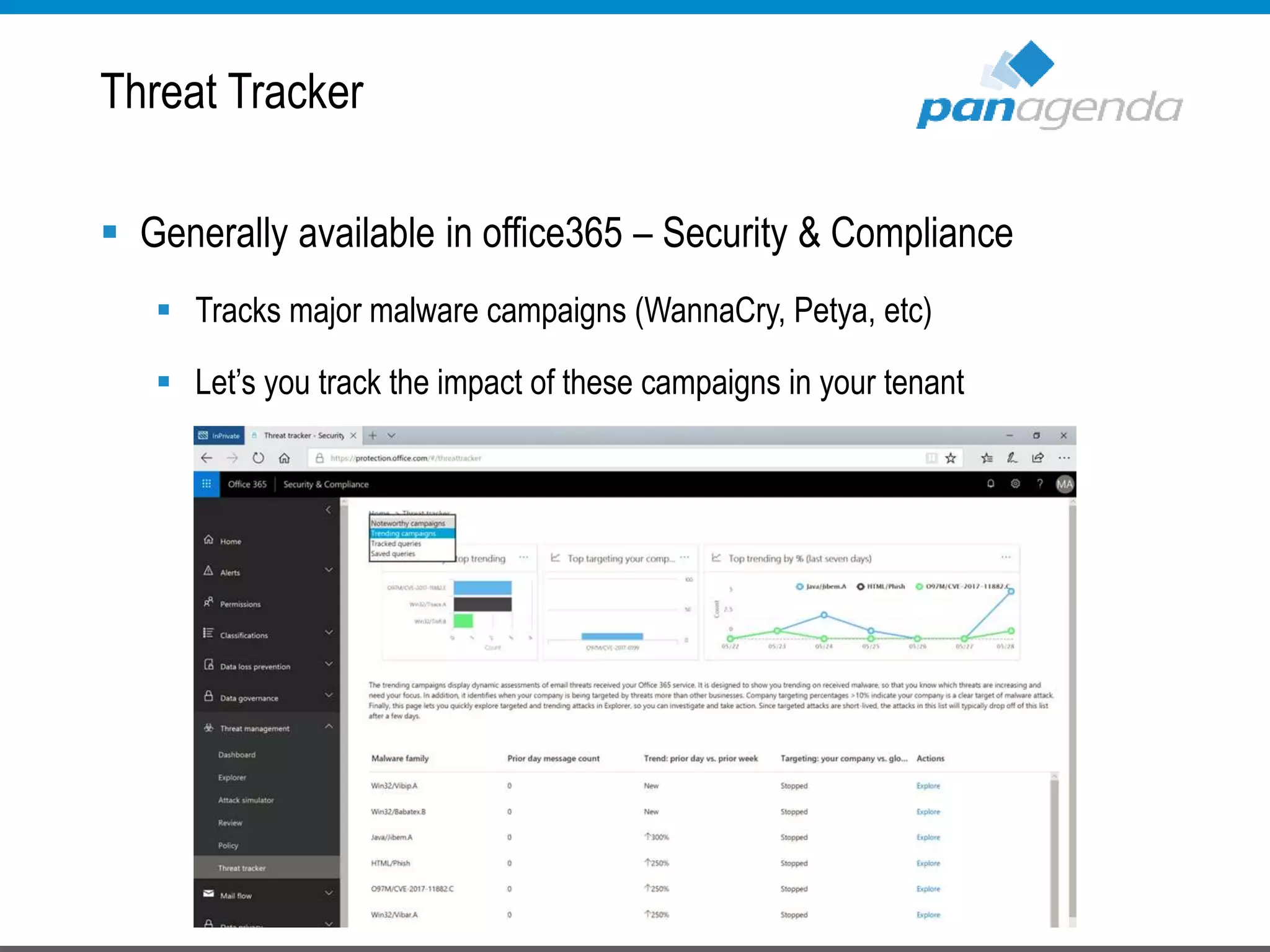
 Generally available in office365 – Security & Compliance
 Tracks major malware campaigns (WannaCry, Petya, etc)
 Let’s you track the impact of these campaigns in your tenant
Threat Tracker
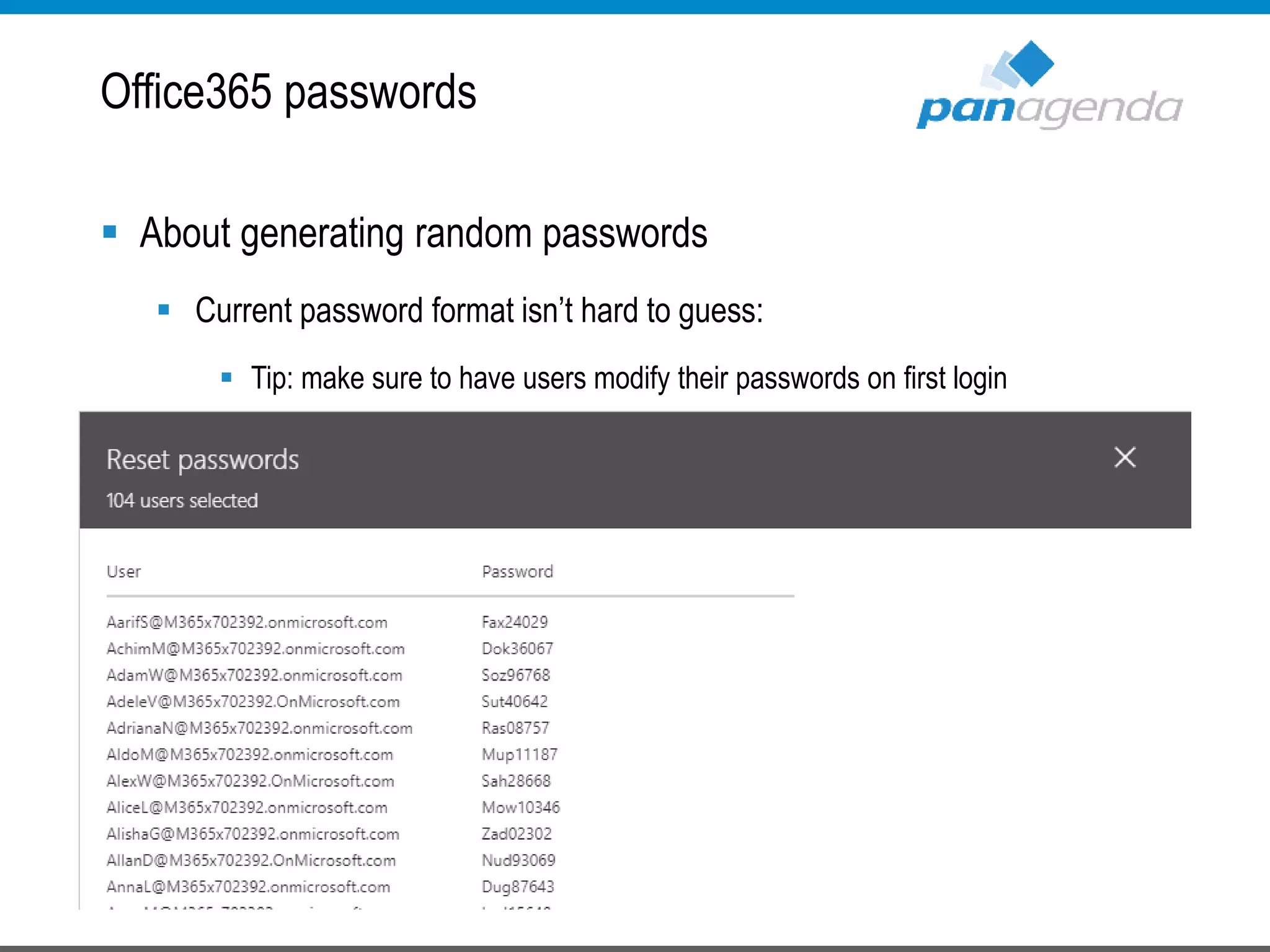
 About generating random passwords
 Current password format isn’t hard to guess:
 Tip: make sure to have users modify their passwords on first login
Office365 passwords
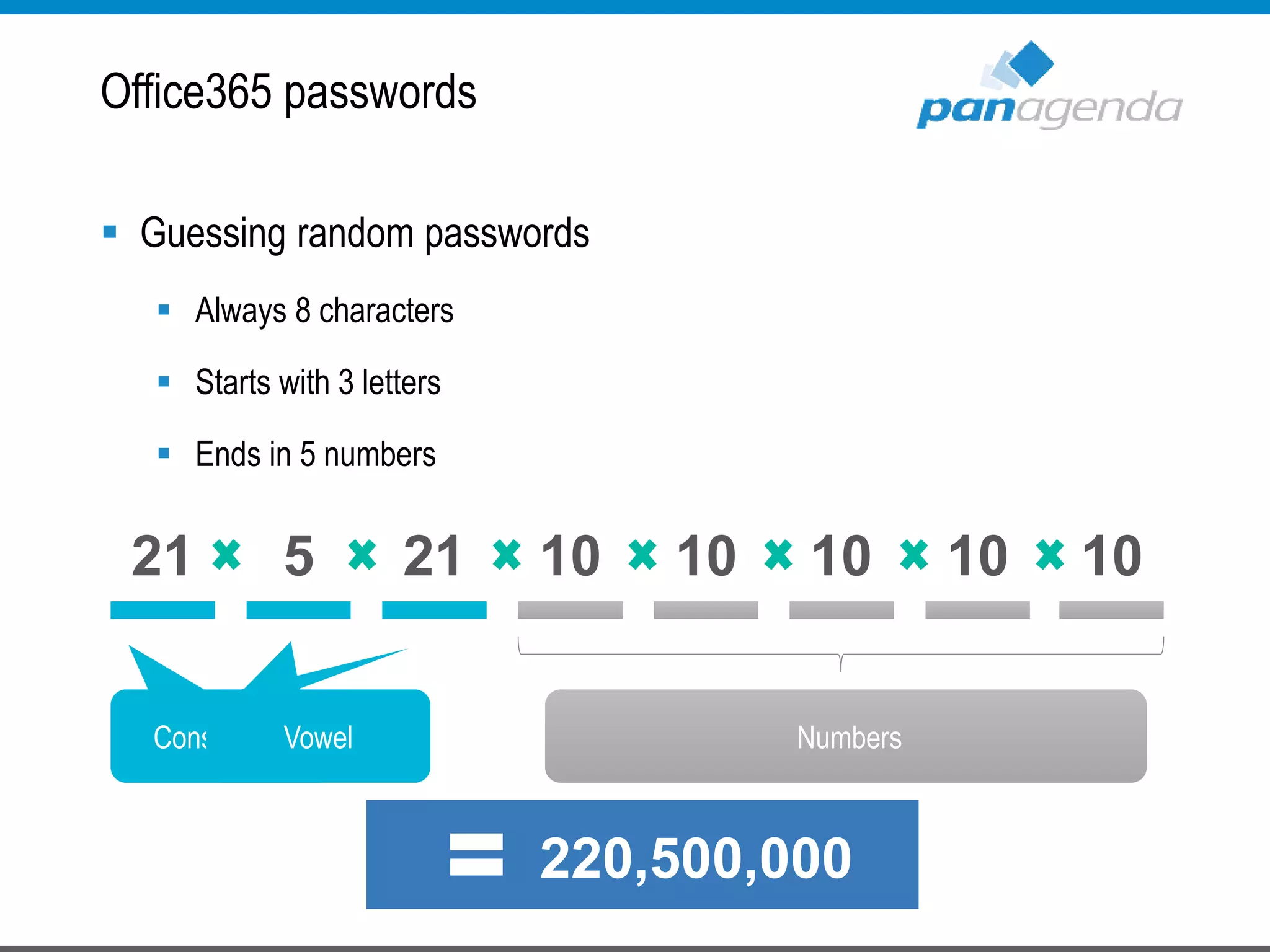
 Guessing random passwords
 Always 8 characters
 Starts with 3 letters
 Ends in 5 numbers
Office365 passwords
ConsonantConsonants
21 21
Vowel
5
Numbers
10 10 10 10 10
220,500,000
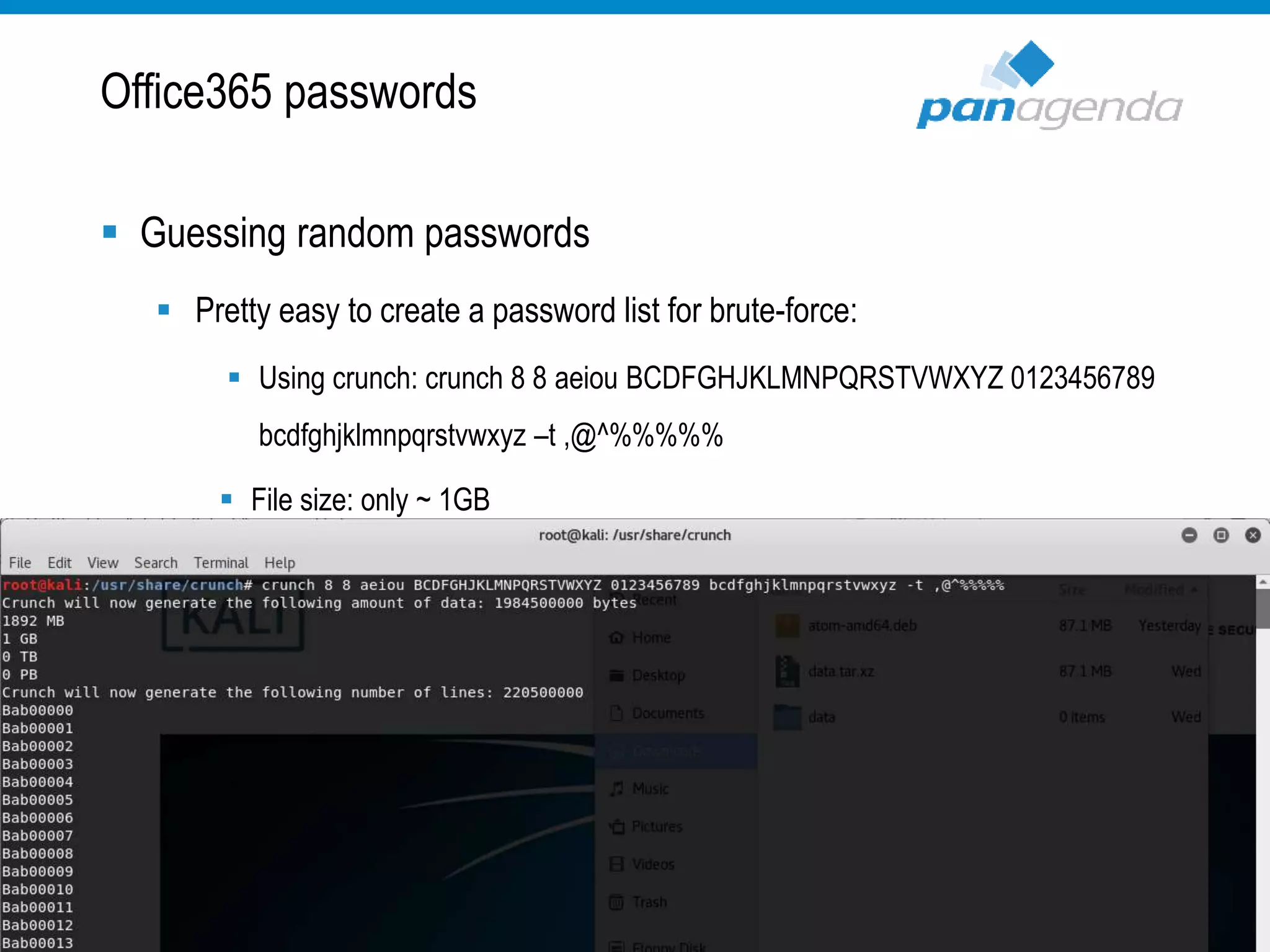
 Guessing random passwords
 Pretty easy to create a password list for brute-force:
 Using crunch: crunch 8 8 aeiou BCDFGHJKLMNPQRSTVWXYZ 0123456789
bcdfghjklmnpqrstvwxyz –t ,@^%%%%%
 File size: only ~ 1GB
Office365 passwords
 Simulate attacks against your own environment
 Keep an eye out for more attack simulation tools
 Use your own phishing tactics and word lists
 Educate users on strong passwords
Conclusion
OfficeExpert
You can sign up for our sandbox (14 days trial – immediately):
https://www.panagenda.com/officeexpert-sandbox
If you’re an MVP, you get a free license from us:
https://www.panagenda.com/exclusive-mvp-offer
Thank You
Questions & Feedback: LOVE IT
Get in touch: ben.menesi@panagenda.com
Presentation online: slideshare.net/benedek.Menesi
@BenMenesi
Linkedin.ca/in/benedekmenesi

Microsoft365 from a Hacker's Perspective

  • 1.
    Make Your DataWork For You Office365 from a Hacker‘s perspective Real life threats, tactics and remedies Ben Menesi New York, NY 27th 07 2019
  • 2.
    Speaker • Ben Menesi –VP Products & Innovation at panagenda – Started out in the IBM world – SharePoint & Exchange Admin & Dev – Certified Ethical Hacker v9 and OSCP student – Enjoys breaking things – Speaker at IT events around the globe (SPS Toronto, Calgary, Geneva, Cambridge) – Owns a bar (recently) @BenMenesi
  • 3.
    panagenda • Who weare – HQ in Vienna, Austria – Offices in Boston, Austria, Germany, The Netherlands and Australia – >1M user licenses across over 80 countries
  • 4.
    panagenda • What wedo: OfficeExpert • Quality of Service monitoring using bots • Teams Analytics
  • 5.
    Our product: OfficeExpert •Teams cluster analytics: who’s talking to whom?
  • 6.
  • 7.
  • 8.
    Agenda • What we’llcover today Ransomware Attacks Email security Multi-Factor Authentication Illicit Consent Grants
  • 9.
    Statistics • Some numbersfrom the field – Verizon’s 2017 & 2018 Data Breach Investigations Report: 53000 incidents & 2216 data breaches 58% Victims are businesses with < 1000 employees (62% in 2017) 92% 68% Breaches took months(!!!) to discover Malware vectors: Email. (6.3% Web, 1.3% other)
  • 10.
    On-Prem. Vs. CloudSecurity • Benefits of your data in the cloud Broader scope of threat intelligence Larger and more specialized security muscle than most SMBs Fast and instant delivery (no manual patching required)
  • 11.
    On-Prem. Vs. CloudSecurity • Disadvantages of using cloud services Vulnerability / Risk Mitigation is out of our control Part of a larger, very attractive attack surface Less flexibility in customizing defenses
  • 12.
    Vulnerability Mitigation • Practicalexample – Basestriker attack: gets around Microsoft’s ATP SafeLinks by leveraging the <base> tag:  Traditional way to embed URLs in a phishing email:  Using the <base> tag:
  • 13.
    Vulnerability Mitigation • VulnerabilityLifecycle 02.05.2018 Microsoft alerted alerted by Avanan 02.05.2018 Proofpoint alerted by Avanan 16.05.2018 Microsoft fixes fixes vulnerability 14 days
  • 14.
  • 15.
    Ransomware Attacks Why arethey so important?  DOJ Statistics: 1000 attacks / day in 2015, 4000 attacks / day in 2017  WannaCry: 150 countries, estimated at $4B  NotPetya: $250-300M for Maersk alone, $1.2B in total revenue  54% of companies experienced one or more successful attacks  Total cost of a successful cyber attack is over $5M or $301 / employee
  • 16.
    Ransomware Attacks How dothey spread?  60% of ransomware attacks come from infected emails BUT:  Also, vulnerable (application) servers  Example: city of Atlanta hit by SamSam (originally discovered in 2016) in 2018  Malware infection likely through SMBv1 open on a web server  Aftermath: $2.6M cost
  • 17.
    Decrypting Ransomware  Cautionarytale: Herrington & Company gets ransomwared  Engages Data Recovery company to retrieve data  DR company quotes $6000 to recover data  Data recovery is WAY too fast  FBI confirms that PDR indeed paid ransom to decrypt victim’s files  https://pbs.twimg.com/media/DbfP0G7WAAEWQIa.jpg:large  How do we prevent ransomware?
  • 18.
    Ransomware Protection  Microsoftintroduced Files Restore OneDrive  Allows to restore entire OneDrive account to a previous point in time within 30 days  Monitors file assets notifies if an attack is detected
  • 19.
    Ransomware Protection  Careful! Real time notification might not be as accurate as we think  AxCrypt encryption on OneDrive files stays under the radar  Ransomware prevention: have users store important data in OneDrive
  • 20.
  • 21.
     Email Encryption:End-to end encryption  Prevent Forwarding: Restrict email recipients from forwarding or copying emails you send (plus: MS Office docs. Attached are encrypted even after downloading)  What happens if the recipient is outside your organization: Email Encryption
  • 22.
     OME: AutomaticallyEnabled Email Encryption
  • 23.
     Revoking EncryptedMessages  This one is thanks to Al Hoitingh: https://alberthoitingh.com/2018/12/20/ome- message-revocation/  Encrypted status means: email & content didn’t leave the perimeter.  You can use Message Trace to locate the outgoing mail and then use powershell to:  Query the OME status: Get-OMEMessageStatus -MessageID “message id”  Set message as revoked: Set-OMEMessageRevocation -Revoke $true -MessageID “message id” Email Encryption
  • 24.
     Revoking EncryptedMessages  Because the data never left the perimeter, it’s the ‘link’ that’s broken at the moment of revocation and recipient will get this: Email Encryption
  • 25.
  • 26.
     In thelight of the Facebook Cambridge Analytica scandal, we should take a look at Azure AD registered applications  Phishing campaigns could trick users into granting access to applications  https://blogs.technet.microsoft.com/office365security/defending-against-illicit- consent-grants/  Exploit first demonstrated by Kevin Mitnick Illicit Consent Grants
  • 27.
     Exploit Scenario Demo  Infrastructure Illicit Consent Grants User Apache Web Server Hacker
  • 28.
     Exploit Scenario:Let’s dive in! Illicit Consent Grants
  • 29.
     Exploit Scenario User received a legit looking email: Illicit Consent Grants
  • 30.
     Exploit Scenario User received a legit looking email: Illicit Consent Grants
  • 31.
     Exploit Scenario Picks account to authenticate Illicit Consent Grants
  • 32.
     Exploit Scenario Presented with permissions that need user consent only Illicit Consent Grants
  • 33.
     Exploit Scenario All mails are encrypted  … and this is just one of many possibilities Illicit Consent Grants
  • 34.
     Exploit Scenario:Infrastructure – bit more detail Illicit Consent Grants
  • 35.
     Consent iskey  Why build integrated applications?  Using various APIs, you can grant apps access to your tenant data:  Mail, calendars, contacts, conversations  Users, groups, files and folders  SharePoint sites, lists, list items  OneDrive items, permissions and more  Integration: Azure AD provides secure sign-in and authorization  Developer registers the application with Azure AD  Assign permissions to the application  Tenant administrator / user must consent to permissions Digital #metoo era
  • 36.
     Registering theapplication  Who can register applications in your tenant?  By default: any member! This can be a security issue  Keep in mind: there is a record of what data was shared with which application. Also: when user adds / allows application to access their data, event can be audited (Audit reports)  See more: https://docs.microsoft.com/en-us/azure/active- directory/develop/active-directory-how-applications-are-added#who-has- permission-to-add-applications-to-my-azure-ad-instance Azure AD Applications
  • 37.
     Authorization Flow:Oauth2 / OpenID Azure AD Applications
  • 38.
     Authorization flow:let’s simplify  User consents to permissions required by the app  Application asks for authorization from the Azure AD  Azure AD makes the user sign in and returns code to application  Application uses code to retrieve JWT bearer token to use resource (Microsoft Graph API)  Keep in mind: JWT doesn’t authenticate, only authorizes! Azure AD Applications
  • 39.
    Preventing illicit consentgrants Regular application & permission enumeration Cloud App Security Educating users Application Registration & consent restriction
  • 40.
     Remedy: Restrictingapp registrations  Azure Portal > Azure Active Directory > User Settings Azure AD Applications
  • 41.
     Remedy: Restrictingconsent grants  Azure Portal > Azure Active Directory > User Settings  Watch out! This means that all application consent will be REQUIRED to be done by Global Admins Azure AD Applications
  • 42.
     Remedy: Enumeratingapps and permissions  Enumeration using PowerShell:  Install the AzureAD PowerShell module  Launch PowerShell ISE as an Administrator and: Install-Module AzureAD  Connect to Azure AD: Connect-AzureAD  Use PowerShell script: https://gist.github.com/psignoret/41793f8c6211d2df5051d77ca3728c09  Example: .Get-AzureADPSPermissions.ps1 | Export-Csv -Path "permissions.csv" - NoTypeInformation Azure AD Applications
  • 43.
     Remedy: Enumeratingapps and permissions  What you get: Azure AD Applications
  • 44.
     Remedy: Enumeratingapps and permissions  Gotcha: won’t show redirect URLs!  Requires AzureRM.Resources and Connect-AzureRMADAccount: Azure AD Applications
  • 45.
     Remedy: Searchingyour Audit Logs  Use the ‘consent’ string to filter Azure AD Applications
  • 46.
     Remedy: CloudApp Security  Create an OAUTH App Security Policy Azure AD Applications
  • 47.
     Remedy: CloudApp Security  Create an OAUTH App Security Policy Azure AD Applications
  • 48.
     What youget with CAS from our attack scenario Azure AD Applications
  • 49.
  • 50.
     Brute forcingoffice365 logins  In the news in August 2017: sophisticated and coordinated attack against 48 Office365 customers  Brute Force attack unique: targeting multiple cloud providers  100,000 failed login attempts from 67 Ips and 12 networks over 7 months  Slow and low to avoid intrusion detection  Users see unsuccessful login attempts using name up to 17 name variations  Passwords likely the same (password spray attack)  https://www.tripwire.com/state-of-security/featured/new-type-brute-force-attack-office- 365-accounts/ Brute Force Attacks
  • 51.
     How hardis it to acquire the right login names?  Demo Brute Force Attacks
  • 52.
     Account Lockoutin Office365  Before 02/04/2019:  10 unsuccessful attempts: captcha  Another 10: lockout (10 mins)  In reality: 10 tries = lockout  No customization allowed Brute Force Attacks
  • 53.
     Account Lockoutin Office365  As of 02/04/2019: WOOHOO  Brute Force Attacks
  • 54.
     What could’vestopped all this? MFA  Interesting story about MFA: https://goo.gl/CFcA5t Brute Force Attacks
  • 55.
     Good news:management through the app is better Brute Force Attacks
  • 56.
     MFA –the elephant in the room  2 serious outages in 2018 alone Brute Force Attacks
  • 57.
     MFA –in case of emergencies  Consider implementing a break glass account (via Exclusions from Baseline MFA Policy): https://practical365.com/security/multi-factor-authentication-default- for-admins/  Azure AD Portal > Conditional Access Brute Force Attacks
  • 58.
     The wayaround MFA  Recent breaches discovered by Proofpoint: https://www.proofpoint.com/us/threat-insight/post/threat-actors-leverage- credential-dumps-phishing-and-legacy-email-protocols  Essentially: using IMAP to get around MFA by mimicking legacy email clients Brute Force Attacks
  • 59.
    MFA exploit Highlights  100,000unauthorised login attempts analyzed (December 2018 – onwards)  72% tenants were targeted at least once  40% tenants had at least 1 compromised account  15 of 10,000 active user accounts breached
  • 60.
     Microsoft’s response:https://docs.microsoft.com/en-us/microsoft- 365/enterprise/secure-email-recommended-policies  Require MFA  Block clients that don’t support modern auth.  App Passwords Brute Force Attacks
  • 61.
     Available aspart of Threat Intelligence (available in Office365 Enterprise E5)  You must be a global administrator or member of the Security Admin group in the Security & Compliance Center AND have MFA enabled Attack Simulator Spear Phishing Campaigns Password Brute-Force Attacks Password Spray Attacks
  • 62.
     Where doyou find it: protection.office.com > Threat Management Attack Simulator
  • 63.
     Spear Phishingcampaigns  Tip: target users identified as top targeted in the Threat Management dashboard  Tip2: You’ll need to enable Office Analytics Attack Simulator
  • 64.
     Spear Phishingcampaigns  User tries to log in to phishing site  Redirected to awareness page Attack Simulator
  • 65.
     Spear Phishingcampaigns  Tip: best to use your own phishing landing site ;) Attack Simulator
  • 66.
     Brute ForcePassword  Use a pre-set word list against one or multiple user accounts  Uses the same method an attacker would  I mean literally: watch out! Currently this locks out the user account.  Only supports very limited password lists (Internal server error at 10k passwords)  Best online resources for common credentials: https://github.com/danielmiessler/SecLists/tree/master/Passwords/Common- Credentials Attack Simulator
  • 67.
     Password SprayAttack  Tries one or a few passwords against all accounts  Story: known password against two accounts  Both accounts DID have that password  Why?  Why?  Gotcha: second user had MFA enabled, which doesn’t appear to be supported. Attack Simulator
  • 68.
     Generally availablein office365 – Security & Compliance  Tracks major malware campaigns (WannaCry, Petya, etc)  Let’s you track the impact of these campaigns in your tenant Threat Tracker
  • 69.
     About generatingrandom passwords  Current password format isn’t hard to guess:  Tip: make sure to have users modify their passwords on first login Office365 passwords
  • 70.
     Guessing randompasswords  Always 8 characters  Starts with 3 letters  Ends in 5 numbers Office365 passwords ConsonantConsonants 21 21 Vowel 5 Numbers 10 10 10 10 10 220,500,000
  • 71.
     Guessing randompasswords  Pretty easy to create a password list for brute-force:  Using crunch: crunch 8 8 aeiou BCDFGHJKLMNPQRSTVWXYZ 0123456789 bcdfghjklmnpqrstvwxyz –t ,@^%%%%%  File size: only ~ 1GB Office365 passwords
  • 72.
     Simulate attacksagainst your own environment  Keep an eye out for more attack simulation tools  Use your own phishing tactics and word lists  Educate users on strong passwords Conclusion
  • 73.
    OfficeExpert You can signup for our sandbox (14 days trial – immediately): https://www.panagenda.com/officeexpert-sandbox If you’re an MVP, you get a free license from us: https://www.panagenda.com/exclusive-mvp-offer
  • 74.
    Thank You Questions &Feedback: LOVE IT Get in touch: ben.menesi@panagenda.com Presentation online: slideshare.net/benedek.Menesi @BenMenesi Linkedin.ca/in/benedekmenesi

Editor's Notes

  • #17 Conclusion: Update, patch, pay attention to cyber hygiene!
  • #18 Todo: Ransomware community effort
  • #19 Todo: Ransomware community effort
  • #20 Todo: Ransomware community effort