Hawassa University
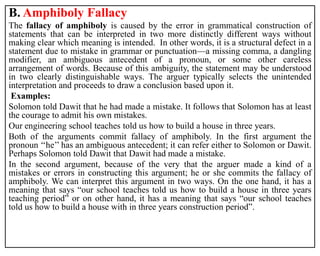
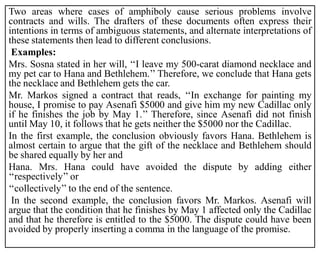
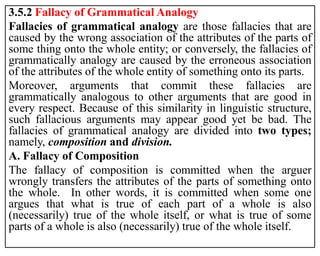
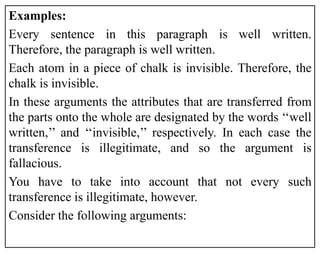
College Law And
Governance
LOGIC AND CRITICAL
THINKING
PHIL101
3crh
Course Description
• This course aims
– To cultivate a critical attitude, both personally
and professionally
– Introduce the nature and concepts of
philosophy in general and logic in particular.
– Nurturing the skills required to construct good
arguments and ability to critically evaluate the
arguments of others
– Cultivate the habits of critical thinking and
develop sensitivity to the clear and accurate use
of language.
Learning Objectives
• On successful completion of this course, the
students will be able to:
– Understand the main concern of philosophy and the
necessity of learning it;
– Recognize the components and types of arguments;
– Develop the skill to construct and evaluate arguments;
– Understand the relationship between logic and
language;
– Recognize the forms of meanings of words and terms;
– Comprehend the types, purposes and techniques of
definitions;
– Understand the concept, principles, and criteria of
critical thinking
Contents
CHAPTER ONE
• Meaning and Nature of Philosophy
– Basic Features of Philosophy
– Core Fields of Philosophy
– Metaphysics and Epistemology
– Axiology and Logic
– Importance of Learning Philosophy
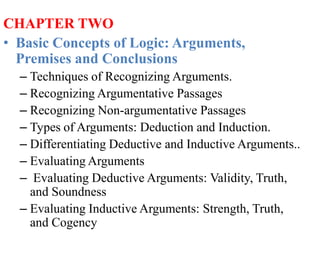
CHAPTER TWO
• Basic Concepts of Logic: Arguments,
Premises and Conclusions
– Techniques of Recognizing Arguments.
– Recognizing Argumentative Passages
– Recognizing Non-argumentative Passages
– Types of Arguments: Deduction and Induction.
– Differentiating Deductive and Inductive Arguments..
– Evaluating Arguments
– Evaluating Deductive Arguments: Validity, Truth,
and Soundness
– Evaluating Inductive Arguments: Strength, Truth,
and Cogency
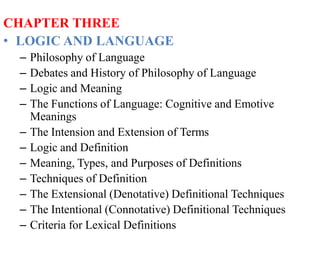
CHAPTER THREE
• LOGIC AND LANGUAGE
– Philosophy of Language
– Debates and History of Philosophy of Language
– Logic and Meaning
– The Functions of Language: Cognitive and Emotive
Meanings
– The Intension and Extension of Terms
– Logic and Definition
– Meaning, Types, and Purposes of Definitions
– Techniques of Definition
– The Extensional (Denotative) Definitional Techniques
– The Intentional (Connotative) Definitional Techniques
– Criteria for Lexical Definitions
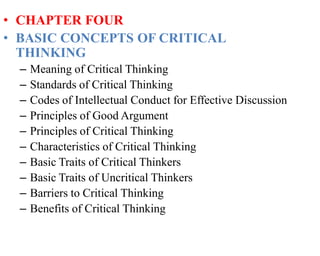
• CHAPTER FOUR
• BASIC CONCEPTS OF CRITICAL
THINKING
– Meaning of Critical Thinking
– Standards of Critical Thinking
– Codes of Intellectual Conduct for Effective Discussion
– Principles of Good Argument
– Principles of Critical Thinking
– Characteristics of Critical Thinking
– Basic Traits of Critical Thinkers
– Basic Traits of Uncritical Thinkers
– Barriers to Critical Thinking
– Benefits of Critical Thinking
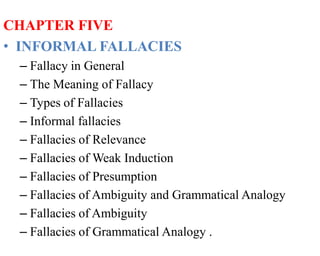
CHAPTER FIVE
• INFORMAL FALLACIES
– Fallacy in General
– The Meaning of Fallacy
– Types of Fallacies
– Informal fallacies
– Fallacies of Relevance
– Fallacies of Weak Induction
– Fallacies of Presumption
– Fallacies of Ambiguity and Grammatical Analogy
– Fallacies of Ambiguity
– Fallacies of Grammatical Analogy .
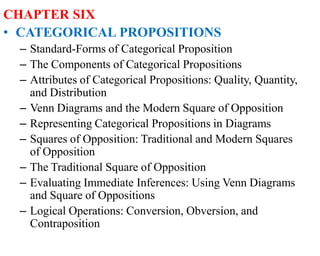
CHAPTER SIX
• CATEGORICAL PROPOSITIONS
– Standard-Forms of Categorical Proposition
– The Components of Categorical Propositions
– Attributes of Categorical Propositions: Quality, Quantity,
and Distribution
– Venn Diagrams and the Modern Square of Opposition
– Representing Categorical Propositions in Diagrams
– Squares of Opposition: Traditional and Modern Squares
of Opposition
– The Traditional Square of Opposition
– Evaluating Immediate Inferences: Using Venn Diagrams
and Square of Oppositions
– Logical Operations: Conversion, Obversion, and
Contraposition
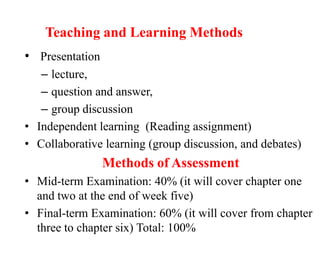
Teaching and Learning Methods
• Presentation
– lecture,
– question and answer,
– group discussion
• Independent learning (Reading assignment)
• Collaborative learning (group discussion, and debates)
Methods of Assessment
• Mid-term Examination: 40% (it will cover chapter one
and two at the end of week five)
• Final-term Examination: 60% (it will cover from chapter
three to chapter six) Total: 100%
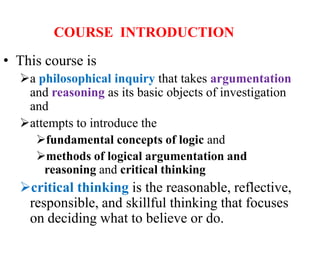
COURSE INTRODUCTION
• This course is
a philosophical inquiry that takes argumentation
and reasoning as its basic objects of investigation
and
attempts to introduce the
fundamental concepts of logic and
methods of logical argumentation and
reasoning and critical thinking
critical thinking is the reasonable, reflective,
responsible, and skillful thinking that focuses
on deciding what to believe or do.
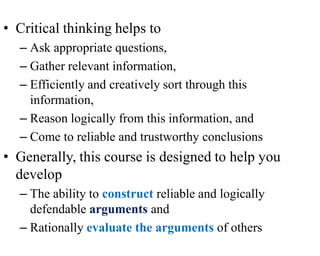
• Critical thinking helps to
– Ask appropriate questions,
– Gather relevant information,
– Efficiently and creatively sort through this
information,
– Reason logically from this information, and
– Come to reliable and trustworthy conclusions
• Generally, this course is designed to help you
develop
– The ability to construct reliable and logically
defendable arguments and
– Rationally evaluate the arguments of others
CHAPTER ONE
INTRODUCING PHILOSOPHY
• Philosophy is the study of general and
fundamental problems
– concerning matters such as existence, knowledge, truth,
beauty, law, justice, validity, mind, and language.
• Logic is a branch of philosophy which treated
simultaneously as a field of study and as an
instrument.
• It study arguments and the principles and
methods of right reasoning
• As an instrument, it help us to formulate our own
rational arguments and critically evaluate the
soundness of others‘ arguments.
Meaning and Nature of Philosophy
• It is difficult to define philosophy because
philosophy has no a specific subject but it
primarily deals with issues
• Etymologically, the word philosophy comes
from two Greek words: philo and sophia, which
mean love and wisdom, respectively.
• Thus, the literal definition of philosophy is “love
of wisdom”. But this is not sufficient to
understand philosophy
• Pythagoras was the first to use the word
philosopher to call a person who clearly shows
a marked curiosity in the things he experiences
and analysis.
• Philosophy refers to the development of
critical habits, the continuous search for
truth, and the questioning of the apparent.
• The best way to learn and understand
philosophy is to philosophize; i.e.
– To be confronted with philosophical questions, to
use philosophical language,
– To become acquainted with differing philosophical
positions and maneuvers,
– To read the philosophers themselves, and
– To grapple with the issues for oneself.
• The wisdom that philosophers seek is not the wisdom
of the expertise or technical skills of professionals
• Philosophy involves reason, rational criticism,
examination,
• For Socrates philosophy is a pursuit of wisdom, i.e.
– The development of critical habits,
– The continuous search for truth, and
– The questioning of the apparent
• Therefore, philosophy is a rational and critical
enterprise that tries to formulate and answer fundamental
questions through:-
– an intensive application of reason
– an application that draws on analysis, comparison, and
evaluation.
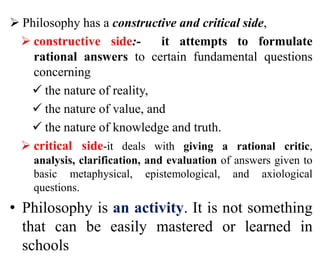
 Philosophy has a constructive and critical side,
 constructive side:- it attempts to formulate
rational answers to certain fundamental questions
concerning
 the nature of reality,
 the nature of value, and
 the nature of knowledge and truth.
 critical side-it deals with giving a rational critic,
analysis, clarification, and evaluation of answers given to
basic metaphysical, epistemological, and axiological
questions.
• Philosophy is an activity. It is not something
that can be easily mastered or learned in
schools
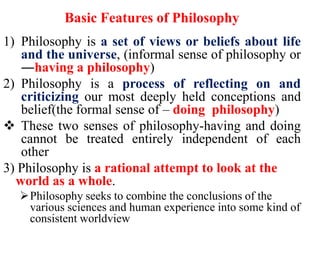
Basic Features of Philosophy
1) Philosophy is a set of views or beliefs about life
and the universe, (informal sense of philosophy or
―having a philosophy)
2) Philosophy is a process of reflecting on and
criticizing our most deeply held conceptions and
belief(the formal sense of – doing philosophy)
 These two senses of philosophy-having and doing
cannot be treated entirely independent of each
other
3) Philosophy is a rational attempt to look at the
world as a whole.
Philosophy seeks to combine the conclusions of the
various sciences and human experience into some kind of
consistent worldview
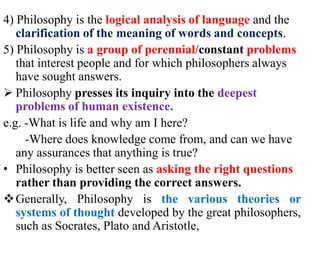
4) Philosophy is the logical analysis of language and the
clarification of the meaning of words and concepts.
5) Philosophy is a group of perennial/constant problems
that interest people and for which philosophers always
have sought answers.
 Philosophy presses its inquiry into the deepest
problems of human existence.
e.g. -What is life and why am I here?
-Where does knowledge come from, and can we have
any assurances that anything is true?
• Philosophy is better seen as asking the right questions
rather than providing the correct answers.
Generally, Philosophy is the various theories or
systems of thought developed by the great philosophers,
such as Socrates, Plato and Aristotle,
Core Fields of Philosophy
• Philosophy has different primary and
secondary branches.
• This course deals only with the primary ones,
namely
– Metaphysics,
– Epistemology,
– Axiology, and
– Logic.
Metaphysics
• Metaphysics is derived from the Greek words “meta” means
beyond, upon or after and physika, means physics.
• Metaphysics studies the ultimate nature of reality or existence.
• It deal with issues of reality, cause and effect relationship, and
other related issues.
• Some of the questions that Metaphysics primarily deals with
includes:
– What is reality? life? Time?
– What is mind, and what is its relation to the body?
– Is there a cause and effect relationship between
reality and appearance?
– Are human actions free, or predetermined by a
supernatural force?
• Metaphysical questions may be divided into
four subsets or aspects.
i) Cosmological Aspect:
 It deals about the origin, nature, and
development of the universe as an orderly
system.
 E.g. How did the universe originate and
develop? Does its existence have any purpose?
ii) Theological Aspect:
Theology is that part of religious theory that
deals with conceptions of and about God.
what is God’s relationship to human?‖
iii) Anthropological Aspect:
• Anthropology deals with the study of human
beings and asks questions like:-
– What is the relation between mind and body?
– Is mind more fundamental than body, with body
depending on mind, or vice versa?
– Are people born good, evil, or morally neutral?
– Do they have free will, or are their thoughts and
actions determined by their environment,
inheritance, or a divine being?
iv) Ontological Aspect:
• Ontology is the study of the nature of
existence, or what it means for anything to
exist.
– Is reality orderly and lawful in itself, or is it
merely orderable by the human mind?
– Is it fixed and stable, or is change its central
feature?
– Is this reality friendly, unfriendly, or neutral
toward humanity?‖
Epistemology
• Etymologically, epistemology ― Greek words episteme,
meaning ―knowledge, understanding, and logos, meaning
―study of.
• Epistemology is referred to as ―theory of knowledge
• Epistemology studies about the nature, scope, meaning, source,
and validity and possibility of knowledge. It deals with issues
of knowledge, opinion, truth, falsity, reason, experience, and
faith.
• Thus, epistemology covers two areas: the content of thought
and thought itself.
– What is knowledge? What does it mean to know?
– What is the source of knowledge? Experience? Reason? Or both?
– How can we be sure that what we perceive through our senses is
correct?
– What makes knowledge different from belief or opinion?
– What is truth, and how can we know a statement is true?
• The first issue in epistemology is asking whether
reality can even be known.
• In this regard, Skepticism(agnosticism) claiming
that people cannot acquire reliable knowledge
and that any search for truth is in vain.
• A second issue foundational to epistemology is
whether all truth is relative, or whether some truths
are absolute.
– Is all truth subject to change?
– Is it possible that what is true today may be false
tomorrow?
• If the answer is “Yes” to the above questions, such
truths are relative
• A major aspect of epistemology relates to the sources of
human knowledge.
• Central to most people‘s answer to that question is
empiricism (Empirical knowledge i.e. knowledge
obtained through the senses).
• However, data obtained from the human senses could be
both incomplete and undependable.
• Fatigue, frustration, and illness could distort and limit
sensory perception. In addition, there are sound and light
waves that are inaudible and invisible to unaided human
perception.
• In general, sensory knowledge is built upon
assumptions that must be accepted by faith in the
dependability of human sensory mechanisms.
• The advantage of empirical knowledge is that many
sensory experiences and experiments are open to
both replication and public examination.
• A second important source of human knowledge is
Reason(rationalism).it claim that the senses alone
cannot provide universal, valid judgments that
are consistent with one another
• Also rationalism claims that humans are capable of
arriving at certain knowledge independently of
sensory experience
• A third source of human knowledge is Intuition-
i.e. the direct apprehension of knowledge that is
not derived from conscious reasoning or
immediate sense perception
• The weakness of intuition is that it is not a safe
method when used alone. But it’s distinct
advantage is helps to bypass the limitations of
human experience.
• A fourth influential source of knowledge is Revelation.
It is the prime importance in the field of religion.
• It differs from all other sources of knowledge because it
presupposes a transcendent supernatural reality that
breaks into the natural order.
• Some people assert that a major disadvantage of
revealed knowledge is that it must be accepted by faith
and cannot be proved or disproved empirically.
• A fifth source of human knowledge, though not a
philosophical position, is Authority. It comes from
experts or has been sanctified over time as tradition.
E.g. textbook, teacher, or reference work.
• If authoritative knowledge is built upon a foundation of
incorrect assumptions, then such knowledge will surely
be distorted(one sided).
Axiology
• The term Axiology stems from two Greek words-
Axios, meaning ―value, worth,
Logos, meaning ―reason/ theory/ symbol / science
/study of.
• Axiology is the philosophical study of value(the
worth of something).
 What is a value?
 Where do values come from?
 How do we justify our values?
 What is the relationship between values and
knowledge?
Axiology deals three areas, namely Ethics,
Aesthetics, and Social/Political Philosophy.
1.Ethics
• It is also known as Moral Philosophy, and it deals with
the philosophical study of moral principles, values, codes,
and rules,
• It used as standards for determining what kind of human
conduct/action is said to be good or bad, right or
wrong.
• Ethics raises various questions including:
 What is good/bad? right/wrong?
 Is an action right because of its good end, or its right
principle?
 Are moral principles universal, conditional or
unconditional?
 What is the ultimate foundation of moral principles? The
supernatural God? Human reason? Mutual social
contract?
 Why we honor and obey moral rules? For the sake of our
own individual benefits?, or for the sake of others?
• Ethics can be grouped into three broad categories:
Normative ethics, Meta-ethics, and Applied Ethics.
Normative Ethics
• It deals with moral rules, principles, standards and
goals to evaluate conducts, actions and decisions.
• Consequentialism or Teleological Ethics,
Deontological Ethics, and Virtue Ethics are the
major examples of normative ethical studies.
Meta-ethics
• It deals with investigation of the meaning of ethical
terms, as good or bad and right or wrong than with
what we think is good or bad and right or wrong.
• Moral Intuitionism/awareness, Moral Emotive, Moral
Prescriptivism, Moral Nihilism, and Ethical
Relativism are the main examples of meta-ethical
studies
Applied Ethics
• It attempts to explain, justify, apply moral
rules, principles, standards, and positions to
specific moral problems, such as capital
punishment, euthanasia, abortion, adultery,
animal right, and so on.
Aesthetics
• Aesthetics is the theory of beauty. It studies
about the particular value of our artistic and
aesthetic experiences. It deals with beauty, art,
enjoyment, sensory/emotional values,
perception, and matters of taste and sentiment.
• The following are typical Aesthetic questions:
– What is art? beauty? the relation between art and
beauty and truth?
– What is artistic creativity and how does it differ from
scientific creativity?
– Does art have any moral value, and obligations or
constraints?
Social/Political Philosophy
• It studies about the value judgments operating
in a civil society, be it social or political.
• It primarily deal with:
– What form of government is best?
– What economic system is best?
– What makes an action/judgment just/unjust?
– Does society exist? If it does, how does it come to
existence?
– How are civil society and government come to exist?
– Are we obligated to obey all laws of the State?
– What is the purpose of government?
Logic
• Logic is the study or theory of principles of right
reasoning.
• It deals with formulating the right principles of
reasoning; and developing scientific methods of
evaluating the validity and soundness of arguments.
The following are among the various questions
raised by Logic:
What is an argument; What does it mean to argue?
What makes an argument valid or invalid
What is a sound argument?
What relation do premise and conclusion have in
argument?
How can we formulate and evaluate an argument?
What is a fallacy?; What makes an argument fallacious?
Importance of Learning Philosophy
“The unexamined life is not worth living”.
philosophy provides us with the tools we need
to critically examine our own lives as well as
the world in which we live.
philosophy can assist us to actualize ourselves
by promoting the ideal of self-actualization.
self-actualization is associated with self-
fulfillment, creativity, self-expression, realization
of one‘s potential, and being everything one can be.
Although philosophy may not necessarily lead to
this
• There are many characteristics of self-
actualization to whose achievement studying
philosophy has a primordial contribution.
1) Intellectual and Behavioral Independence
– we can learn how to develop and integrate our
experiences, thoughts, feelings, and actions for
ourselves, and thus how to be intellectually and
behaviorally independent.
2) Reflective Self-Awareness
– Philosophy helps critically examine the essential
intellectual grounds of our lives
3) Flexibility, Tolerance, and Open-Mindedness:
– we become more tolerant, open-minded, more
receptive, and more sympathetic to views that
contend or clash with ours.
4) Creative and Critical Thinking
– we can learn how to refine our powers of analysis,
our abilities to think critically, to reason, to evaluate,
to theorize, and to justify.
5) Conceptualized and well-thought-out value
systems in morality, art, politics, and the like:
– studying philosophy provides us with an opportunity
to formulate feasible evaluations of value; and
thereby to find meaning in our lives.
CHAPTER TWO
BASIC CONCEPTS OF LOGIC
• The word logic comes from Greek word logos, which means
sentence, discourse, reason, truth and rule.
• Logic in its broader meaning is the science, which evaluates
arguments and the study of correct reasoning.
• It could be also defined as the study of methods and principles
of correct reasoning or the art of correct reasoning.
• Logic can be defined in different ways.
– It is a science that evaluates arguments.
– It is the study of methods for evaluating whether the premises
adequately support or provide a good evidence for the conclusions.
– It is a science that helps to develop the method and principles to
evaluate the arguments of others and construct arguments of own.
 Logic is the attempt to codify/organize the rules of
rational thought.
• Logicians explore the structure of arguments that preserve
truth or allow the optimal extraction of knowledge from
evidence.
• In logic, as an academic discipline, we study
– Reasoning itself:
– Forms of argument,
– General principles and
– Particular errors,
– Methods of arguing.
• Logic can help us understand what is wrong or why
someone is arguing in a particular way. Logic is the organized
body of knowledge, or science that evaluates arguments.
 The aim of logic is to develop a system of methods and
principles that we may use as
criteria for evaluating the arguments of others and
guides in constructing arguments of our own.
Benefit of Studying Logic
“Logic sharpens and refines our natural gifts to think,
reason and argue” (C. S. Layman)
• The study of logic is one of the best ways to refine one‘s
natural ability to think, reason and argue.
• The following are some of the major benefits that we can
gain from the study of logic:
It helps us to develop the skill needed to construct
sound (good) and fallacy-free arguments of one‘s
own and to evaluate the arguments of others
It provides a fundamental defense against the
prejudiced and uncivilized attitudes
It helps us to distinguish good arguments from bad
arguments
 It helps us to understand and identify the common
logical errors in reasoning;
It helps us to understand and identify the common
confusions that often happen due to misuse of
language
It enables us to disclose ill-conceived policies in the
political sphere, to be careful of disguises, and to
distinguish the rational from irrational
• Thus, by studying logic, we able to increase our
confidence when we criticize the arguments of others and
when we advance arguments of our own.
• Generally, the goal of logic is to produce individuals
who are critical, rational and reasonable both in the
sphere of public and private life.
What is an Argument?
• Argument is a systematic combination of two or more
statements, which are classified as a premise/premises
and conclusion.
• From logical point of view, arguments is a group of
statements(premise), which are claimed to provide
support for, one of the other, the (conclusion).
• But an argument has a very specific meaning in logic. It
does not mean, a mere verbal fight, as one might have with
one‘s parent. Because :-
• First, an argument is a group of statements. That is, the first
requirement for a passage to be qualified as an argument is to
combine two or more statements.
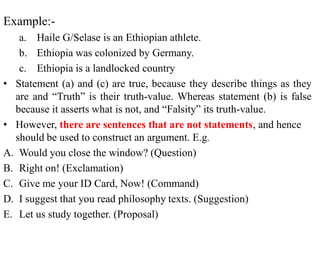
• A statement is a declarative sentence that has a truth-value of either
true or false
Example:-
a. Haile G/Selase is an Ethiopian athlete.
b. Ethiopia was colonized by Germany.
c. Ethiopia is a landlocked country
• Statement (a) and (c) are true, because they describe things as they
are and “Truth” is their truth-value. Whereas statement (b) is false
because it asserts what is not, and “Falsity” its truth-value.
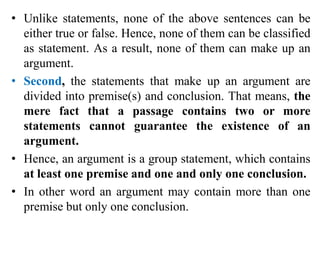
• However, there are sentences that are not statements, and hence
should be used to construct an argument. E.g.
A. Would you close the window? (Question)
B. Right on! (Exclamation)
C. Give me your ID Card, Now! (Command)
D. I suggest that you read philosophy texts. (Suggestion)
E. Let us study together. (Proposal)
• Unlike statements, none of the above sentences can be
either true or false. Hence, none of them can be classified
as statement. As a result, none of them can make up an
argument.
• Second, the statements that make up an argument are
divided into premise(s) and conclusion. That means, the
mere fact that a passage contains two or more
statements cannot guarantee the existence of an
argument.
• Hence, an argument is a group statement, which contains
at least one premise and one and only one conclusion.
• In other word an argument may contain more than one
premise but only one conclusion.
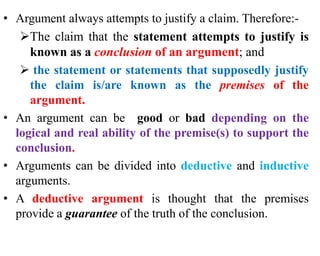
• Argument always attempts to justify a claim. Therefore:-
The claim that the statement attempts to justify is
known as a conclusion of an argument; and
 the statement or statements that supposedly justify
the claim is/are known as the premises of the
argument.
• An argument can be good or bad depending on the
logical and real ability of the premise(s) to support the
conclusion.
• Arguments can be divided into deductive and inductive
arguments.
• A deductive argument is thought that the premises
provide a guarantee of the truth of the conclusion.
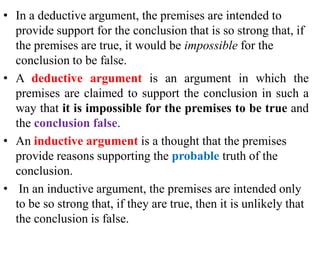
• In a deductive argument, the premises are intended to
provide support for the conclusion that is so strong that, if
the premises are true, it would be impossible for the
conclusion to be false.
• A deductive argument is an argument in which the
premises are claimed to support the conclusion in such a
way that it is impossible for the premises to be true and
the conclusion false.
• An inductive argument is a thought that the premises
provide reasons supporting the probable truth of the
conclusion.
• In an inductive argument, the premises are intended only
to be so strong that, if they are true, then it is unlikely that
the conclusion is false.
• An inductive argument is an argument in which the
premises are claimed to support the conclusion in such a way
that it is improbable that the premises be true and the
conclusion false.
• The difference between the two comes from the sort of
relation the author or expositor of the argument takes there
to be between the premises and the conclusion.
• If the author of the argument believes that the truth of the
premises definitely establishes the truth of the
conclusion due to definition, logical entailment or
mathematical necessity, then the argument is deductive.
• If the author of the argument does not think that the truth of
the premises definitely establishes the truth of the conclusion,
but nonetheless believes that their truth provides good reason
to believe the conclusion true, then the argument is
inductive.
• The deductiveness or inductiveness of an argument can
be determined by
– The particular indicator word it might use,
– The actual strength of the inferential relationship
between its component statements
– Its argumentative form or structure.
• A deductive argument can be evaluated by its validity
and soundness.
• An inductive argument can be evaluated by its strength
and cogency
• Deductive argument can be valid if it is impossible for
the premises to be true and the conclusion false.
• Deductive argument can be invalid if it is possible for
the premises to be true and the conclusion false
• Inductive argument can be strong , if it is improbable for
the premises to be true and the conclusion false.
• Inductive argument can be weak, if it is probable for the
premises to be true and the conclusion false.
• A deductive argument can be sound if it is valid and
true.
• A deductive argument can be unsound if it fails to be
valid and true.
• An inductive argument can be cogent/convincing if it is
strong and probably true,
• An inductive argument can be uncogent if it fails to be
strong and probably true.
What is premise
• Premise refers to the statement, which is claimed to provide a
logical support or evidence to the main point of the
argument, which is known as conclusion.
• It is a statement that set forth the reason or evidence, which is
given for accepting the conclusion of an argument.
• Generally premise is claimed evidence.
What is conclusion
• It is a statement, which is claimed to follow from the given
evidence (premise). In other words, the conclusion is the
claim that an argument is trying to establish.
• Example-1:
All Ethiopians are Africans. (Premise 1)
Tsionawit is Ethiopian. (Premise2)
Therefore, Tsionawit is African. (Conclusion)
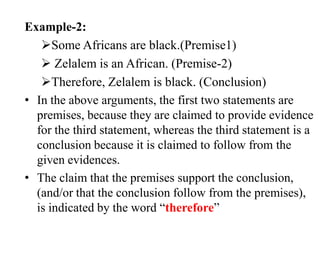
Example-2:
Some Africans are black.(Premise1)
 Zelalem is an African. (Premise-2)
Therefore, Zelalem is black. (Conclusion)
• In the above arguments, the first two statements are
premises, because they are claimed to provide evidence
for the third statement, whereas the third statement is a
conclusion because it is claimed to follow from the
given evidences.
• The claim that the premises support the conclusion,
(and/or that the conclusion follow from the premises),
is indicated by the word “therefore”
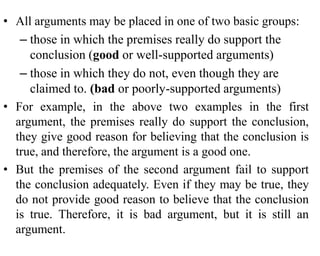
• All arguments may be placed in one of two basic groups:
– those in which the premises really do support the
conclusion (good or well-supported arguments)
– those in which they do not, even though they are
claimed to. (bad or poorly-supported arguments)
• For example, in the above two examples in the first
argument, the premises really do support the conclusion,
they give good reason for believing that the conclusion is
true, and therefore, the argument is a good one.
• But the premises of the second argument fail to support
the conclusion adequately. Even if they may be true, they
do not provide good reason to believe that the conclusion
is true. Therefore, it is bad argument, but it is still an
argument.
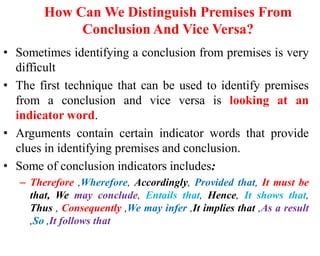
How Can We Distinguish Premises From
Conclusion And Vice Versa?
• Sometimes identifying a conclusion from premises is very
difficult
• The first technique that can be used to identify premises
from a conclusion and vice versa is looking at an
indicator word.
• Arguments contain certain indicator words that provide
clues in identifying premises and conclusion.
• Some of conclusion indicators includes:
– Therefore ,Wherefore, Accordingly, Provided that, It must be
that, We may conclude, Entails that, Hence, It shows that,
Thus , Consequently ,We may infer ,It implies that ,As a result
,So ,It follows that
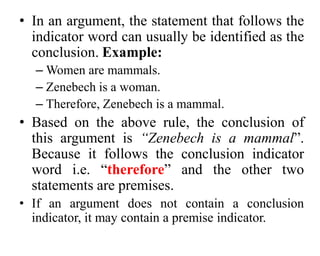
• In an argument, the statement that follows the
indicator word can usually be identified as the
conclusion. Example:
– Women are mammals.
– Zenebech is a woman.
– Therefore, Zenebech is a mammal.
• Based on the above rule, the conclusion of
this argument is “Zenebech is a mammal”.
Because it follows the conclusion indicator
word i.e. “therefore” and the other two
statements are premises.
• If an argument does not contain a conclusion
indicator, it may contain a premise indicator.
• Here are some typical Premise Indicators: Since ,As
indicated by, Because , wing to, Seeing that, Given
that , As , For , In that ,May be inferred from , In,
as much as , For the reason that
• In argument that contains any of the premise indicator
words, a statement that follows the indicator word can
usually be identified as a premise. Example:
– You should avoid any form of cheating on exams
because cheating on exams is punishable by the
Senate Legislation of the University.
• Based on the above rule, the premise of this argument
is “cheating on exams is punishable by the Senate
Legislation of the University” because it follows the
premise indicator word “because”,
• One premise indicator not included in the above list is “for
this reason”. This indicator is special in that it comes
immediately after the premise it indicates and before the
conclusion.
• In the middle place between the premise and the conclusion,
“for this reason” can be both premise and conclusion
indicator.
• The statement that comes before “for this reason” is the
premise of an argument and the statement that comes after
“for this reason” is the conclusion.
• Sometimes a single indicator can be used to identify more
than one premise. Consider the following argument:
– Tsionawit is a faithful wife, for Ethiopian women are
faithful wives and Tsionawit an Ethiopian.
• The premise indicator “for” goes with both premises
“Ethiopian women are faithful wives‘‘ and “Tsionawit is an
Ethiopian”. By process of elimination, “Tsionawit is a faithful
wife” is the conclusion.
• Sometimes you may have an argument without
conclusion and premise indicator word. When this
occurs, the reader/ listener must ask himself or herself
such questions as:
– What single statement is claimed (implicitly) to follow from the
others?
– What is the arguer trying to prove?
– What is the main point in the passage?
• The answers to these questions should point to the
conclusion.
• Example:
– Our country should increase the quality and quantity
of its military. Ethnic conflicts are recently
intensified; boarder conflicts are escalating;
international terrorist activities are increasing.
• The main point of this argument is to show that the
country should increase the size and quality of its
military. The following is the standard form of this
argument:
– Ethnic conflicts are recently intensified. (P-1)
– Boarder conflicts are escalating. (P-2)
– International terrorist activities are increasing.
(P-3)
– Thus, the country should increase the quality and
quantity of its military. (C)
• If a statement has nothing to do with the conclusion
or, for example, simply makes a passing comment, it
should not be included within the context of the
argument. Example:
– Socialized medicine is not recommended because it
would result in a reduction in the overall quality of
medical care available to the average citizen. In
addition, it might very well bankrupt the federal
treasury. This is the whole case against socialized
medicine in a nutshell.
• The conclusion of this argument is “Socialized medicine
is not recommended” and the two statements following
the word, “because‘” are the premises
• The last statement makes only a passing comment about
the argument itself and is therefore neither a premise nor
a conclusion.
Techniques of Recognizing Arguments
Not all passages that contain two or more statements
are argumentative. There are various passages that
contain two or more statements but are not
argumentative.
Argumentative passages are distinguished from such
kind of passages by their primary goal: proving
something.
Recognizing Argumentative Passages
In order to evaluate arguments we need to
– understand the nature of arguments
– understand what argument is not, because not
all passages contain argument.
• Two conditions must be fulfilled for a passage to
purport to prove something:
1. At least one of the statements must claim to
present evidence or reasons.
2. There must be a claim that the alleged
evidence or reasons supports or implies
something- that is, a claim that something
follows from the alleged evidence.
 The first condition refers to premises as it tries
to provide or claim to provide reasons or
evidences for the conclusion; and the second
condition refers to a conclusion
The first condition expresses a factual claim, and
deciding whether it is fulfilled often falls outside
the domain of logic.
Thus, most of our attention will be
concentrated on whether the second condition
is fulfilled. The second condition expresses what
is called an inferential claim The Inferential
Claim is a passage that expresses a certain kind
of reasoning process- that something supports
or implies something or that something follows
from something.
It is an objective feature of an argument
grounded in its language or structure.
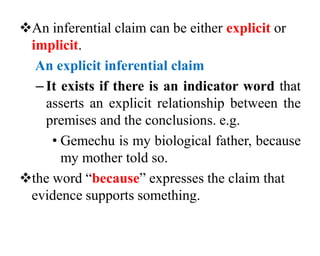
An inferential claim can be either explicit or
implicit.
An explicit inferential claim
– It exists if there is an indicator word that
asserts an explicit relationship between the
premises and the conclusions. e.g.
• Gemechu is my biological father, because
my mother told so.
the word “because” expresses the claim that
evidence supports something.
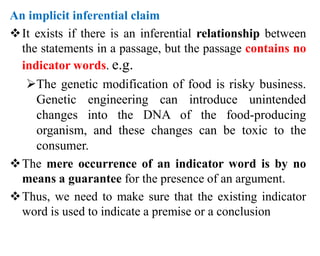
An implicit inferential claim
It exists if there is an inferential relationship between
the statements in a passage, but the passage contains no
indicator words. e.g.
The genetic modification of food is risky business.
Genetic engineering can introduce unintended
changes into the DNA of the food-producing
organism, and these changes can be toxic to the
consumer.
The mere occurrence of an indicator word is by no
means a guarantee for the presence of an argument.
Thus, we need to make sure that the existing indicator
word is used to indicate a premise or a conclusion
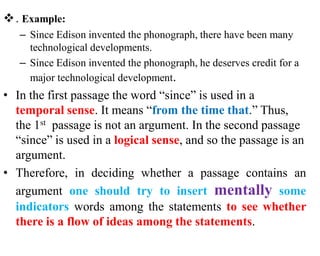
. Example:
– Since Edison invented the phonograph, there have been many
technological developments.
– Since Edison invented the phonograph, he deserves credit for a
major technological development.
• In the first passage the word “since” is used in a
temporal sense. It means “from the time that.” Thus,
the 1st passage is not an argument. In the second passage
“since” is used in a logical sense, and so the passage is an
argument.
• Therefore, in deciding whether a passage contains an
argument one should try to insert mentally some
indicators words among the statements to see whether
there is a flow of ideas among the statements.
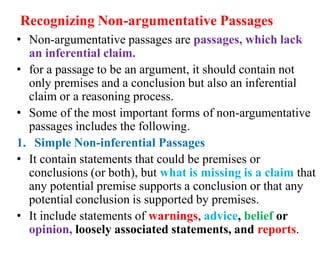
Recognizing Non-argumentative Passages
• Non-argumentative passages are passages, which lack
an inferential claim.
• for a passage to be an argument, it should contain not
only premises and a conclusion but also an inferential
claim or a reasoning process.
• Some of the most important forms of non-argumentative
passages includes the following.
1. Simple Non-inferential Passages
• It contain statements that could be premises or
conclusions (or both), but what is missing is a claim that
any potential premise supports a conclusion or that any
potential conclusion is supported by premises.
• It include statements of warnings, advice, belief or
opinion, loosely associated statements, and reports.
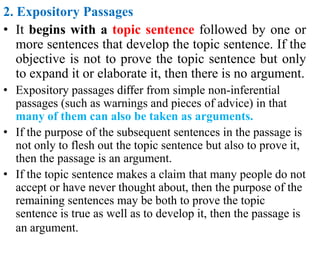
2. Expository Passages
• It begins with a topic sentence followed by one or
more sentences that develop the topic sentence. If the
objective is not to prove the topic sentence but only
to expand it or elaborate it, then there is no argument.
• Expository passages differ from simple non-inferential
passages (such as warnings and pieces of advice) in that
many of them can also be taken as arguments.
• If the purpose of the subsequent sentences in the passage is
not only to flesh out the topic sentence but also to prove it,
then the passage is an argument.
• If the topic sentence makes a claim that many people do not
accept or have never thought about, then the purpose of the
remaining sentences may be both to prove the topic
sentence is true as well as to develop it, then the passage is
an argument.
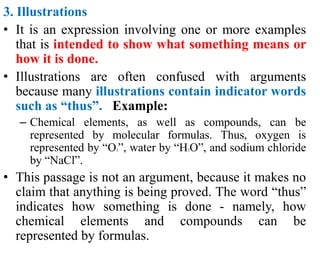
3. Illustrations
• It is an expression involving one or more examples
that is intended to show what something means or
how it is done.
• Illustrations are often confused with arguments
because many illustrations contain indicator words
such as “thus”. Example:
– Chemical elements, as well as compounds, can be
represented by molecular formulas. Thus, oxygen is
represented by “O2”, water by “H2O”, and sodium chloride
by “NaCl”.
• This passage is not an argument, because it makes no
claim that anything is being proved. The word “thus”
indicates how something is done - namely, how
chemical elements and compounds can be
represented by formulas.
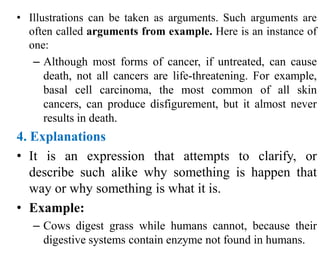
• Illustrations can be taken as arguments. Such arguments are
often called arguments from example. Here is an instance of
one:
– Although most forms of cancer, if untreated, can cause
death, not all cancers are life-threatening. For example,
basal cell carcinoma, the most common of all skin
cancers, can produce disfigurement, but it almost never
results in death.
4. Explanations
• It is an expression that attempts to clarify, or
describe such alike why something is happen that
way or why something is what it is.
• Example:
– Cows digest grass while humans cannot, because their
digestive systems contain enzyme not found in humans.
• Every explanation is composed of two distinct
components:
– Explanandum:- it is the statement that describes the
event or phenomenon to be explained,
– Explanans:- is the statement or group of statements
that purports to do the explaining.
• In the above example, the explanandum is the statement
“Cows digest grass while humans cannot” and the
explanans is “their [cows‟] digestive systems contain
enzyme not found in humans.”
• The purpose of explanans is to show why something is
the case, whereas in an argument, the purpose of the
premises is to prove that something is the case.
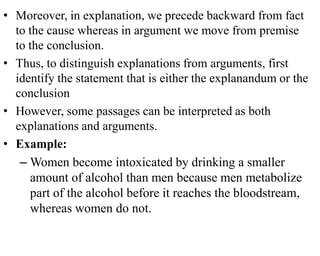
• Moreover, in explanation, we precede backward from fact
to the cause whereas in argument we move from premise
to the conclusion.
• Thus, to distinguish explanations from arguments, first
identify the statement that is either the explanandum or the
conclusion
• However, some passages can be interpreted as both
explanations and arguments.
• Example:
– Women become intoxicated by drinking a smaller
amount of alcohol than men because men metabolize
part of the alcohol before it reaches the bloodstream,
whereas women do not.
Conditional Statements
 They are an “if . . . then . . .” statements.
 Every conditional statement is made up of two component
statements.
 antecedent (if-clause), The component statement immediately
following the “if”
 consequent (then-clause) the one following the “then”
 However, there is an occasion that the order of antecedent
and consequent is reversed.
 Conditional statements are not arguments, because in a
conditional statement there is no claim that either the
antecedent or the consequent presents evidence
 Also conditional statements are not evaluated as true or
false without separately evaluating the antecedent and the
consequent.
 A conditional statement may serve as either the premise
or the conclusion (or both) of an argument. examples:
– If he is selling our national secretes to enemies, then
he is a traitor.
– He is selling our national secretes to enemies.
– Therefore, he is a traitor.
 The relation between conditional statements and
arguments may now be summarized as follows:
I. A single conditional statement is not an argument.
II. A conditional statement may serve as either the
premise or the conclusion (or both) of an argument.
III. The inferential content of a conditional statement
may be re-expressed to form an argument.
 Conditional statements are especially important in logic
(and many other fields) because they express the
relationship between necessary and sufficient
conditions. example
– If X is a dog, then X is an animal.
– If X is not an animal, then X is not a dog.
 The first statement says that being a dog is a sufficient
condition for being an animal, and the second that being
an animal is a necessary condition for being a dog.
 However, a little reflection reveals that these two
statements say exactly the same thing.
 Generally, non-argumentative passages may contain
components that resemble the premises and conclusions of
arguments, but they do not have an inferential claim.
However, some passages like expository passages,
illustrations, and explanations can be interpreted as
arguments; and the inferential contents of conditional
statements may be re-expressed to form arguments.
Therefore, in deciding whether a passage contains an
argument, you should look for three things:
a) Indicator words such as “therefore,” “since,” “because,”
and so on;
b) An inferential relationship between the statements; and
c) Typical kinds of non-arguments.
But the mere occurrence of an indicator word does
not guarantee the presence of an argument. You must
check that the conclusion is supported by one or
more of the premises.
Also keep in mind that in many arguments that lack
indicator words, the conclusion is the first statement.
Differentiating Deductive and Inductive Arguments
• There are three factors that influence the decision
about the deductiveness or inductiveness of an
argument‘s inferential claim. These are:
1) The occurrence of special indicator words,
2) The actual strength of the inferential link between
premises and conclusion, and
3) The character or form of argumentation the arguers use.
• Words like “certainly", 'necessarily”, “absolutely”,
and “definitely” indicate that the argument should be
taken as deductive.
• words like, “probable”, “improbable” “plausible”
“implausible”, ‘‘likely", “unlikely” and “reasonable to
conclude” suggest that an argument is inductive.
• The occurrence of an indicator word is not a certain
guarantee for the deductiveness or inductiveness of an
argument unless it is supported by the other features
 If the conclusion actually does follow with strict necessity
from the premises, the argument is clearly deductive
 If the conclusion of an argument does not follow with strict
necessity but does follow probably, it is usually best to
interpret it as inductive argument.
• Example-1:
– All Ethiopian people love their country.
– Debebe is an Ethiopian.
– Therefore, Debebe loves his country
• Example-2:
– The majority of Ethiopian people are poor.
– Alamudin is an Ethiopian.
– Therefore, Alamudin is poor.
 The character or form of argumentation the arguers use
refers looking at some deductive or inductive
argumentative forms.
Instances of Deductive Argumentative
Forms
 Five examples of such forms or kinds of argumentation
are arguments based on mathematics, arguments from
definition, and syllogisms.
Argument based on mathematics
 Arguments in pure mathematics are deductive and
arguments that depend on statistics are usually best
interpreted as inductive.
 Statistical arguments are based on random sampling of
data gathering, it is impossible to arrive at absolutely
certain conclusion.
Arguments based on definition
It is an argument in which the conclusion is
claimed to depend merely up on the definition of
some words or phrase used in the premise or
conclusion. example,
Angel is honest; therefore, Angel tells the truth.
Kebede is a physician; therefore, he is a doctor.
Arguments based on Syllogisms
Syllogisms are arguments consisting of exactly
two premises and one conclusion.
Syllogisms can be categorized into three groups;
categorical, hypothetical, and disjunctive
syllogism.
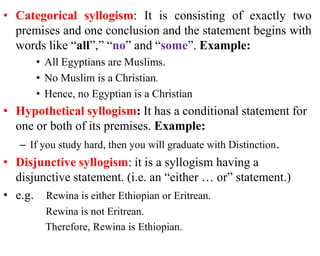
• Categorical syllogism: It is consisting of exactly two
premises and one conclusion and the statement begins with
words like “all”,” “no” and “some”. Example:
• All Egyptians are Muslims.
• No Muslim is a Christian.
• Hence, no Egyptian is a Christian
• Hypothetical syllogism: It has a conditional statement for
one or both of its premises. Example:
– If you study hard, then you will graduate with Distinction.
• Disjunctive syllogism: it is a syllogism having a
disjunctive statement. (i.e. an “either … or” statement.)
• e.g. Rewina is either Ethiopian or Eritrean.
Rewina is not Eritrean.
Therefore, Rewina is Ethiopian.
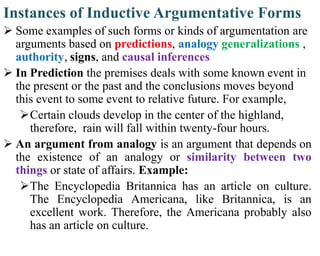
Instances of Inductive Argumentative Forms
 Some examples of such forms or kinds of argumentation are
arguments based on predictions, analogy generalizations ,
authority, signs, and causal inferences
 In Prediction the premises deals with some known event in
the present or the past and the conclusions moves beyond
this event to some event to relative future. For example,
Certain clouds develop in the center of the highland,
therefore, rain will fall within twenty-four hours.
 An argument from analogy is an argument that depends on
the existence of an analogy or similarity between two
things or state of affairs. Example:
The Encyclopedia Britannica has an article on culture.
The Encyclopedia Americana, like Britannica, is an
excellent work. Therefore, the Americana probably also
has an article on culture.
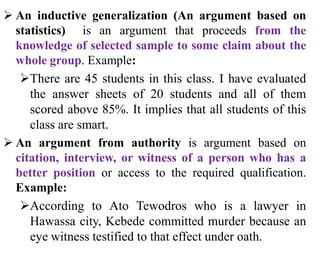
 An inductive generalization (An argument based on
statistics) is an argument that proceeds from the
knowledge of selected sample to some claim about the
whole group. Example:
There are 45 students in this class. I have evaluated
the answer sheets of 20 students and all of them
scored above 85%. It implies that all students of this
class are smart.
 An argument from authority is argument based on
citation, interview, or witness of a person who has a
better position or access to the required qualification.
Example:
According to Ato Tewodros who is a lawyer in
Hawassa city, Kebede committed murder because an
eye witness testified to that effect under oath.
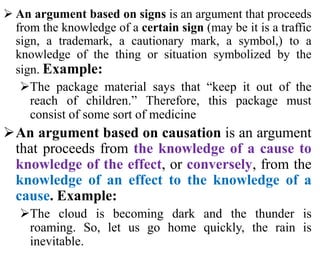
 An argument based on signs is an argument that proceeds
from the knowledge of a certain sign (may be it is a traffic
sign, a trademark, a cautionary mark, a symbol,) to a
knowledge of the thing or situation symbolized by the
sign. Example:
The package material says that “keep it out of the
reach of children.” Therefore, this package must
consist of some sort of medicine
An argument based on causation is an argument
that proceeds from the knowledge of a cause to
knowledge of the effect, or conversely, from the
knowledge of an effect to the knowledge of a
cause. Example:
The cloud is becoming dark and the thunder is
roaming. So, let us go home quickly, the rain is
inevitable.
From the knowledge that a bottle of water had
been accidentally left in the freezer overnight,
someone might conclude that it had frozen
(cause to effect).
Conversely, after tasting a piece of chicken and
finding it dry and tough, one might conclude
that it had been overcooked (effect to cause).
Because specific instances of cause and effect
can never be known with absolute certainty, one
may usually interpret such an argument as
inductive.
 We have to take into consideration that deductive
argument not always proceeds from the general to the
particular and inductive arguments proceed from the
particular to the general.
 This is because there are some deductive or inductive
arguments that proceed from the general to the general or
from the particular to the particular or even from the
particular to the general.
 For example, here is a deductive argument that proceeds
from the particular to the general:
– Three is a prime number. Five is a prime number.
Seven is a prime number. Therefore, all odd numbers
between two and eight are prime numbers.
Here is an inductive argument that proceeds from
the general to the particular:
All emeralds previously found have been green.
Therefore, the next emerald to be found will be
green.
Here is an deductive argument that proceeds
from particular to general
The members of Mohammed’s family are
Kedija, Kemal and Leyla. Kedija wears glasses.
Kemal wears glasses. Leyla wears glasses.
Therefore, all members of Mohammed’s family
wear glasses.
CHAPTER THREE
LOGIC AND LANGUAGE
Philosophy of Language
• According to Semiotics(the study of sign processes in
communication), language is the manipulation and use
of symbols in order to draw attention to signified content.
• Philosophy of language is the reasoned inquiry into the
nature, origins, and usage of language.
• Philosophy of language has been concerned with four
central problems: the nature of meaning, language use,
language cognition, and the relationship between
language, logic and reality.
• It poses questions like
– What is meaning? How does language refer to the real
world?
– Is language learned or is it innate?
– How does the meaning of a sentence emerge out of its parts?
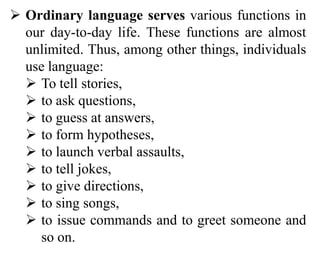
 Ordinary language serves various functions in
our day-to-day life. These functions are almost
unlimited. Thus, among other things, individuals
use language:
 To tell stories,
 to ask questions,
 to guess at answers,
 to form hypotheses,
 to launch verbal assaults,
 to tell jokes,
 to give directions,
 to sing songs,
 to issue commands and to greet someone and
so on.
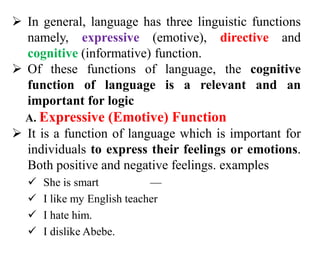
 In general, language has three linguistic functions
namely, expressive (emotive), directive and
cognitive (informative) function.
 Of these functions of language, the cognitive
function of language is a relevant and an
important for logic
A. Expressive (Emotive) Function
 It is a function of language which is important for
individuals to express their feelings or emotions.
Both positive and negative feelings. examples
 She is smart —
 I like my English teacher
 I hate him.
 I dislike Abebe.
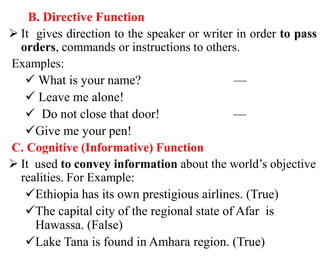
B. Directive Function
 It gives direction to the speaker or writer in order to pass
orders, commands or instructions to others.
Examples:
 What is your name? —
 Leave me alone!
 Do not close that door! —
Give me your pen!
C. Cognitive (Informative) Function
 It used to convey information about the world’s objective
realities. For Example:
Ethiopia has its own prestigious airlines. (True)
The capital city of the regional state of Afar is
Hawassa. (False)
Lake Tana is found in Amhara region. (True)
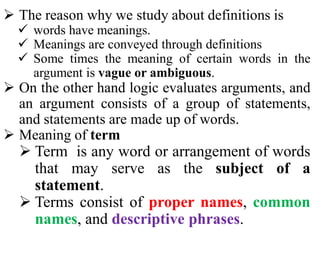
 The reason why we study about definitions is
 words have meanings.
 Meanings are conveyed through definitions
 Some times the meaning of certain words in the
argument is vague or ambiguous.
 On the other hand logic evaluates arguments, and
an argument consists of a group of statements,
and statements are made up of words.
 Meaning of term
 Term is any word or arrangement of words
that may serve as the subject of a
statement.
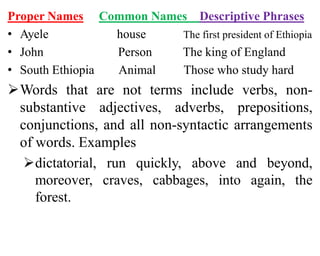
 Terms consist of proper names, common
names, and descriptive phrases.
Proper Names Common Names Descriptive Phrases
• Ayele house The first president of Ethiopia
• John Person The king of England
• South Ethiopia Animal Those who study hard
Words that are not terms include verbs, non-
substantive adjectives, adverbs, prepositions,
conjunctions, and all non-syntactic arrangements
of words. Examples
dictatorial, run quickly, above and beyond,
moreover, craves, cabbages, into again, the
forest.
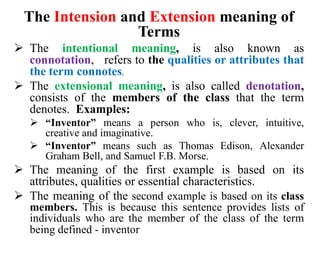
The Intension and Extension meaning of
Terms
 The intentional meaning, is also known as
connotation, refers to the qualities or attributes that
the term connotes.
 The extensional meaning, is also called denotation,
consists of the members of the class that the term
denotes. Examples:
 “Inventor” means a person who is, clever, intuitive,
creative and imaginative.
 “Inventor” means such as Thomas Edison, Alexander
Graham Bell, and Samuel F.B. Morse.
 The meaning of the first example is based on its
attributes, qualities or essential characteristics.
 The meaning of the second example is based on its class
members. This is because this sentence provides lists of
individuals who are the member of the class of the term
being defined - inventor
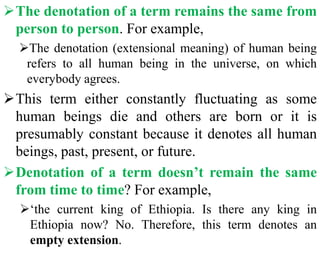
The denotation of a term remains the same from
person to person. For example,
The denotation (extensional meaning) of human being
refers to all human being in the universe, on which
everybody agrees.
This term either constantly fluctuating as some
human beings die and others are born or it is
presumably constant because it denotes all human
beings, past, present, or future.
Denotation of a term doesn’t remain the same
from time to time? For example,
‘the current king of Ethiopia. Is there any king in
Ethiopia now? No. Therefore, this term denotes an
empty extension.
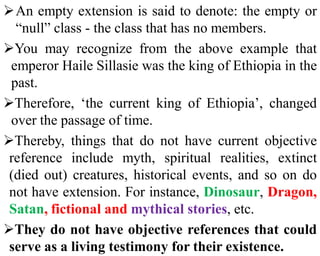
An empty extension is said to denote: the empty or
“null” class - the class that has no members.
You may recognize from the above example that
emperor Haile Sillasie was the king of Ethiopia in the
past.
Therefore, ‘the current king of Ethiopia’, changed
over the passage of time.
Thereby, things that do not have current objective
reference include myth, spiritual realities, extinct
(died out) creatures, historical events, and so on do
not have extension. For instance, Dinosaur, Dragon,
Satan, fictional and mythical stories, etc.
They do not have objective references that could
serve as a living testimony for their existence.
Our knowledge of these things is based on their
properties and but not based on their living class
members’ characteristics.
However, the intentional meaning of a term serves
as the criteria for deciding what the extension
consists of. That is why intentional meaning
determines extensional meaning.
 Example:
Satan is an evil sprit that causes people to suffer.
Dinosaur is an extinct reptile of the Mesozoic
era.
Terms may be put in the order of depending on the
increase or decrease of attributes and sets of things
added to the term being defined.
Increasing intension, increasing extension,
decreasing intension, and decreasing extension
If the member of a class of things decrease, then the
attribute of particular objects increase. The order of
decreasing intension is the reverse of that of increasing
intension but not always.
If the member of a class size gets larger with each
consecutive term, then the attribute of the particular object
decreases. Decreasing extension is the reverse of this
order. Example:
– Increasing Intension: Africa, East Africa,
Ethiopia, Addis Ababa.
– Decreasing Intension: Addis Ababa, Ethiopia,
East Africa, Africa.
– Increasing Extension: Addis Ababa, Ethiopia,
East Africa, Africa.
– Decreasing Extension: Africa, East Africa,
Ethiopia, Addis Ababa.
• Definitions and Their Purposes
 Many logicians define the term ‘definition’ as a group of
words that assigns a meaning to some words or group
of words.
Accordingly, every definition consists of two parts: the
definiendum and the definiens.
The Latin term definiendum is the word or group of
words that is supposed to be defined, and the Latin term
definiens is the word or group of words that does the
defining or gives a meaning to the definiendum.
• Example:
diffident means lacking confidence in oneself.
In this definition, the term ‘‘diffident’’ is the definiendum,
and everything that comes the word “means” (lacking
confidence in oneself; characterized by modest reserve) is
the definiens.
•
The most important objective of definition is to
provide meaning for the terms that are not
clearly understood in the context of other terms.
• Purposes of Definitions in logic
Definition helps us
To avoid confusion or misleading use of words and
phrases;
To avoid obscurity(insignificance),unintelligibility(un
clearness), subjectivity(bias) , and complexity of
words;
To introduce new words and to persuade(ecourage)
others;
To avoid useless controversies, disputes,
disagreements and conflicts over the meaning of terms
,words, phrases and passages which considered as an
argument;
To prevent incorrect reasoning; and to develop the
ability to reason logically.
There are five different types of definitions,
namely, Stipulative, Lexical, Précising,
Theoretical, and Persuasive Definitions.
A. Stipulative Definition
Stipulative definition assigns a meaning to a
word for the first time. This may involve either
creating a new word or giving a new meaning
to an old word.
The purpose of a stipulative definition is to
introduce unusual or unfamiliar words, which
have no pervious meaning in the language.
Stipulative definition is used to introduce new
meanings to some newly discovered
phenomenon or things in the area of archeological
findings, and innovations, such as new modes of
behaviors, new kinds of fashion clothes, new
dances, new food inventions, etc
• Example:
 A few years ago the attempt was made at a certain
zoo to crossbreed male tiger and female lion by
biologists. As a result of this, the offspring was born
from male Tiger and female lion. Thus, this
suggests a need for assigning a new name.
 So, they may call the new offspring ‘‘Tigon’’
taking the first three letters from tiger (tig) and the
last two letters from lion (on).
 Another use of stipulative definitions is to set up
Secret Codes. It was (and still is) common to give a
secret code for the military invasion.
• Examples:
 ‘‘Operation Barbarosa’’ was the name the
code Germans gave to the invasion of Russia;
 ‘‘Operation Desert Storm’’ was the code
name given to the military invasion of Iraq.
 “Operation Sun Set” was the code name
given to the military victory of Ethiopia armed
force against Eritrea, which is the most
recently.
B. Lexical Definition
A lexical definition is used to report the meaning
that a word already has in a language.
Dictionary definitions are all the best examples of
lexical definitions.
The purpose of a lexical definition is to eliminate
ambiguity that would arise over the improper use
of word to its context.
A word is ambiguous if it has more than one
meaning.
Some words that are subjected to ambiguous usage
are: “light”, “bank”, “sound”, “right” , “race”,
‘‘mad’’, “defuse” , “humanity” ,etc. Examples:
 ‘‘Light,’’can mean light in weight or radiant energy.
 ‘‘Bank’’ can mean a finical institution or the edge of
river.
 A word is vague
 If it is so imprecise and unclear, that is, it is
impossible to tell about the applicability of the
word.
 If it is impossible to tell whether the word
applies to them or not.
 Words such as “love”, ”happiness”, “peace”, “fresh”,
“normal”, “rich”, ”poor”, “polluted” etc are vague
words.
 It is difficult to draw a line or a boundary between the
things to which those words apply or do not apply.
 We can not tell with any degree of precision who rich
is or how we counted as rich.
C. Précising Definition
A précising definition provides a more precise,
specific, exact and restricting meaning to a
term.
Its use is to reduce vagueness of the term.
For example, the word ‘poor’ is a vague word.
Suppose you are an administrator of one
humanitarian organization and want to give a
direct financial assistance to the poor.
Therefore, we may define Poor as: “Poor”
means a person having a monthly income of
less than Birr 150 . This is an example of a
précising definition.
Précising definition used to clarify a highly
systematic context such as science, mathematics,
medicine or law. Examples:-
‘‘force’’, ‘‘energy’’, ‘‘acid’’, ‘‘element’’,
‘‘number” “equality’’, ‘‘contract’’, and ‘‘agent’’
A précising definition differs from a stipulative
definition in that
Stipulative definition involves a purely
arbitrary assignment of meaning
The assignment of meaning in a précising
definition is not at all arbitrary.
Care must be taken that the meaning in a
précising definition is appropriate and
legitimate for the context within which the term
is to be employed.
• D. Theoretical Definition
A theoretical definition assigns a meaning to a word
by suggesting a theory that gives a certain
characterization to the entities that the term denotes.
In other words, it gives us the way of seeing or
conceiving (imagining) theoretical (that is, non-
experimental or non- practical) entity.
Fore example there is no any way to see or view “heat”
except in theoretical way.
Not all theoretical definitions are associated with
science. Many terms in philosophy, such as
‘‘substance’’, ‘‘form’’, ‘‘cause’’, ‘‘change’’, ‘‘idea’’,
‘‘good’’, and ‘‘mind’’, have been given theoretical
definitions.
•
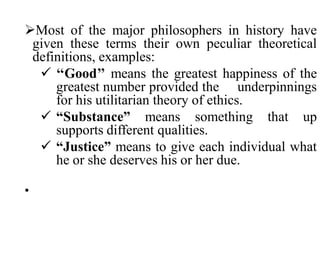
Most of the major philosophers in history have
given these terms their own peculiar theoretical
definitions, examples:
 ‘‘Good’’ means the greatest happiness of the
greatest number provided the underpinnings
for his utilitarian theory of ethics.
 “Substance” means something that up
supports different qualities.
 “Justice” means to give each individual what
he or she deserves his or her due.
•
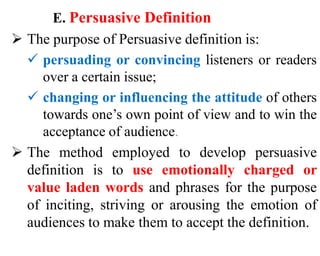
E. Persuasive Definition
 The purpose of Persuasive definition is:
 persuading or convincing listeners or readers
over a certain issue;
 changing or influencing the attitude of others
towards one’s own point of view and to win the
acceptance of audience.
 The method employed to develop persuasive
definition is to use emotionally charged or
value laden words and phrases for the purpose
of inciting, striving or arousing the emotion of
audiences to make them to accept the definition.
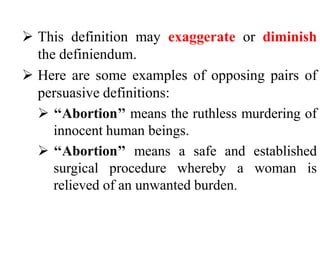
 This definition may exaggerate or diminish
the definiendum.
 Here are some examples of opposing pairs of
persuasive definitions:
 ‘‘Abortion’’ means the ruthless murdering of
innocent human beings.
 ‘‘Abortion’’ means a safe and established
surgical procedure whereby a woman is
relieved of an unwanted burden.
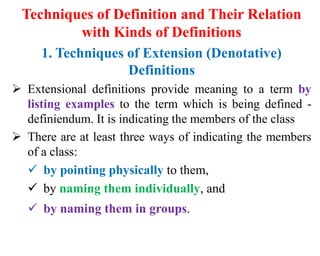
Techniques of Definition and Their Relation
with Kinds of Definitions
1. Techniques of Extension (Denotative)
Definitions
 Extensional definitions provide meaning to a term by
listing examples to the term which is being defined -
definiendum. It is indicating the members of the class
 There are at least three ways of indicating the members
of a class:
 by pointing physically to them,
 by naming them individually, and
 by naming them in groups.
 Thus, based on this we identify three different
kinds of definitions, namely, demonstrative or
ostensive definitions, enumerative definitions,
and definition by subclass respectively
• Demonstrative (Ostensive) Definition
 It assigns a meaning to a term by pointing
physically to the thing or object to be defined.
 It is probably the most primitive form of
definition. This definition might be either partial
in a sense that when we point to only some part of
things or complete
 Therefore, ostensive definition attempts to define
a term by showing the object physically.
• Examples:
‘‘Chair’’ means this and this and this—as you
point to a number of chairs, one after the other.
 ‘‘House’’ means this one—using a picture
demonstrating a house.
Demonstrative definitions differ from the other
kinds of definitions in that the definiens is
constituted at least in part by a gesture—the
gesture of pointing.
Since the definiens in any definition is a group of
words, however, a gesture, such as pointing,
must count as a word.
While this conclusion may appear strange at first,
it is supported by the fact that the ‘‘words’’ in
many sign languages consist exclusively of
gestures.
•
Enumerative Definition
 It the members of the class that the definiendum denotes
individually.
 It assigns a meaning to a term by naming
individually the members of the class the term
denotes. Like demonstrative definitions, they may also
be either partial or complete.
 It is carried out through listing some or all of the
objects or entities symbolized by the definiendum.
Examples:
‘‘Actor’’ means a person such as Nick Nolte, Al Pacino, or
Richard Gere.
 “Athlete” means a person such as Hail G/sillassie,
Kenensia Bekele, Derartu Tulu, etc.
Definition by Subclass
 A definition by subclass assigns a meaning to a
term by naming subclasses of the class
denoted by the term.
 Definition by subclass assigns a meaning to a
term by naming either partial or complete.
• Examples:
 ‘‘Tree’’ means an oak, pine, elm, spruce, maple,
and the like.
 ‘‘Flower’’ means a rose, lily, daisy, geranium,
zinnia, and the like.
 “Professional person” means a person such as a
doctor, or an architect.
2. Techniques of Intentional (Connotative)
Definitions
 Intentional or connotative definition provides a
meaning to a term by describing the essential
characteristics or features possessed by the term
being defined.
 Kinds of intentional definitions includes:
 Synonymous Definition,
 Etymological Definition,
 Operational Definition, and
 Definition by Genus and Difference.
• A. Synonymous Definition
• A synonymous definition is one in which
The definiens is a single word that connotes the same
attributes as the definiendum.
The definiens connotes exactly the same attributes
as the definiendum.
• Examples:
 ‘‘Physician’’ means doctor.
 ‘‘Intentional” means willful.
 ‘‘Observe’’ means see.
Therefore, we can interchangeably use the
definiens and the definiendum of synonymous
definitions.
B. Etymological Definition
 An etymological definition assigns a meaning to a
word by revealing the word’s root or ancestry in
both its own language and other languages.
That is why most ordinary English words have
ancestors either in Old or Middle English as well as
are derived or come from some other language such as
Greek, Latin, or French, etc.
• Examples:
The word “Democracy” is derived from the two Greek
words, ’demos’ and ‘crates’, which means people and
power respectively.
 The English word ‘‘License’’ is derived from the Latin
verb licere, which means to be permitted, and
The English word ‘‘Captain’’ derives from the
Latin noun caput which means head.
C. Operational Definition
 It assigns a meaning to a word by specifying
certain experimental procedures and it is
carried out by performing the actions,
operations, activities and procedures that the
word implies .
 It can be identified by words “if and only if”
which is equivalent to ‘necessary and sufficient
condition.’
• Examples:
 One substance is ‘‘Harder than’’ another if and only if
one scratches the other when the two are rubbed together.
 A solution is an ‘‘Acid’’ if and only if litmus paper turns
red when dipped into it.
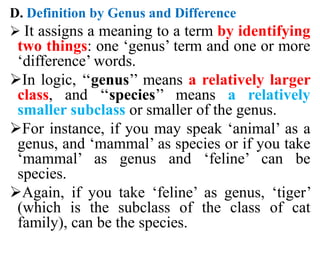
D. Definition by Genus and Difference
 It assigns a meaning to a term by identifying
two things: one ‘genus’ term and one or more
‘difference’ words.
In logic, ‘‘genus’’ means a relatively larger
class, and ‘‘species’’ means a relatively
smaller subclass or smaller of the genus.
For instance, if you may speak ‘animal’ as a
genus, and ‘mammal’ as species or if you take
‘mammal’ as genus and ‘feline’ can be
species.
Again, if you take ‘feline’ as genus, ‘tiger’
(which is the subclass of the class of cat
family), can be the species.
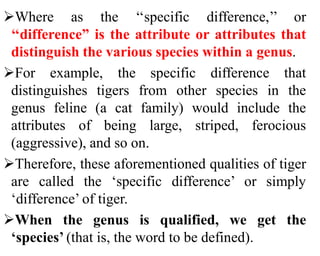
Where as the ‘‘specific difference,’’ or
‘‘difference” is the attribute or attributes that
distinguish the various species within a genus.
For example, the specific difference that
distinguishes tigers from other species in the
genus feline (a cat family) would include the
attributes of being large, striped, ferocious
(aggressive), and so on.
Therefore, these aforementioned qualities of tiger
are called the ‘specific difference’ or simply
‘difference’ of tiger.
When the genus is qualified, we get the
‘species’ (that is, the word to be defined).
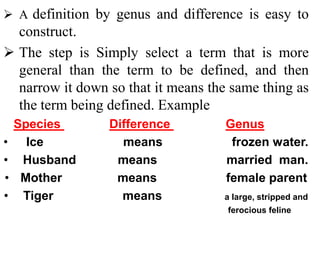
 A definition by genus and difference is easy to
construct.
 The step is Simply select a term that is more
general than the term to be defined, and then
narrow it down so that it means the same thing as
the term being defined. Example
Species Difference Genus
• Ice means frozen water.
• Husband means married man.
• Mother means female parent
• Tiger means a large, stripped and
ferocious feline
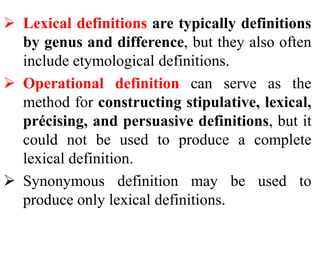
 Lexical definitions are typically definitions
by genus and difference, but they also often
include etymological definitions.
 Operational definition can serve as the
method for constructing stipulative, lexical,
précising, and persuasive definitions, but it
could not be used to produce a complete
lexical definition.
 Synonymous definition may be used to
produce only lexical definitions.
 Synonymous definition cannot be used to
produce stipulative definitions because the
definiendum must have a meaning before a
synonymous definition.
 Also Synonymous can not be used to construct
précising, theoretical, and persuasive
definitions because the definiens of
synonymous definitions contains no more
information than the definiendum.
 In other words, the definiens of a synonymous
definition adds nothing new to the
definiendum.
• Criteria for Lexical Definitions
Rule1:A Lexical definition should match to the
standards of proper grammar.
 A definition should be grammatically correct.
Definitions that are grammatically incorrect create
disagreements and disputes among individuals over the
meaning of terms.
 Examples: Consider the following definitions that are
grammatically incorrect are as follows:
 Vacation is when you don’t have to go to work or school.
 Furious means if you’re angry at someone.
 The corrected versions are:
 ‘‘Vacation’’ means a period during which activity is
suspended from work or school.
 ‘‘Furious’’ means a condition of being angry.
Rule 2:A lexical definition should convey or
communicate the essential meaning or characteristics of
the word being defined.
Thus, a correct definition attempts to point out the
attributes that are essential to the designation of
things as the members of the relevant group.
Example:
‘‘Human being’’ means a featherless biped.
 This definition fails to says nothing about the
important attributes that distinguish human beings
from the other.
A correct and adequate definition would be
“Human being” means “the rational animal that has
the capacity to reason and to speak” and not as a
featherless biped.
• Rule 3: A lexical definition should be neither
too broad nor narrow.
If a definition is too broad, the definiens includes
too much; if it is too narrow, the definiens includes
too little.
In other words, a good or correct definition
should be proportionate, that is, the extent of the
defining word (definiens) should be equal to the
extent of word to be defined (definiendum),
 A definition is too broad if the definiens applies to
things to which the definiendum does not. In a too
broad definition, the definiendum is less than the
definiens.
A definition is too narrow if the definiendum applies to
things to which the definiens does not.
In a too narrow definition the definiendum is greater than
the definiens.
Examples: The following definitions are broad
 ‘‘Birds’’ means any warm-blooded animals having
wings.
 “Pen” means an instrument used for writing.
In the first example, the phrase “any warm-blooded animal
having wings” would include bats, and bats are not birds.
In the second example, the phrase “an instrument used for
writing “ includes things like chalk, pencil, marker, pen,
etc.
Examples: The following definitions are narrow
‘‘Bird’’ means warm-blooded, feathered animal that
can fly.
“Gun” means a tool used in the battle for defending
the enemy.
These two definitions would be too narrow.
The first definition would exclude ostriches,
which cannot fly.
In the second definition the term gun is defined
using a few attributes, that is, the definiens fails it
include different attribute of gun.
• Rule 4: A lexical definition should avoid
circularity
A circular definition presents the meaning of a
word: either by using the same word with the same
meaning in the definiens, or by using grammatical
variation of the same word (the definiendum) in
the definiens. Examples:
‘‘Religious ’’ means any one engaged in religious
activity.
‘‘Scientist’’ means anyone who engages in science.
A circular definition cannot provide any useful
additional information to the word being defined
or their definiendum becomes visible in the
Rule 5: A lexical definition should not be negative
when it can be affirmative.
Of the following two definitions, the first one
negative, and the second affirmative: Example
‘‘Concord’’ means the absence of discord.
“Concord’’ means harmony.
Thus, definition should explain what a term does
mean rather than what it does not mean.
 Some words, however, are intrinsically
negative. For them, a negative definition is quite
appropriate. Example
‘‘Bald’’ means lacking hair.
‘‘Darkness’’ means the absence of light.
 “Death” means the end of life
• Rule6:A lexical definition should not be
expressed in figurative, obscure, vague, or
ambiguous language.
A definition is figurative when it involves and
based on metaphors. A metaphor is a word or a
phrase used in the imaginative way.
A definition is figurative when it also tends to paint
a picture (describes the thing in a particular way)
instead of exposing the essential meaning of a term.
Example1: If you define ‘architecture’ as frozen
music, you are expressing it in figurative language.
Example 2: If you define ‘camel’ as ship of the
desert you are also expressing it in figurative
language.
A definition is Obscure if its meaning is hidden as a
result of defective or inappropriate language or
expression. One source of obscurity is excessively technical
language. Examples
 ‘‘Bunny’’ means a mammalian of the family
Leporidae of the order Lagomorpha whose young are
born furless and blind.
‘‘Bunny’’ means a rabbit. The problem lies not with
technical language as such but with needlessly technical
language. Because ‘‘bunny’’ is very much a no
technical term, no technical definition is needed.
A definition is vague if it lacks precision or if its meaning
is unclear—that is, if there is no way of telling exactly what
class of things the definiens refers to.
• Example:
‘‘Democracy’’ means a kind of government where the
people are in control.
This definition fails to identify the people who are
in control, how they exercise their control, and
what they are in control of.
 A definition is ambiguous if it lends itself to
more than one different interpretation.
• Example:
‘‘Triangle’’ means a figure composed of three straight
lines in which all the angles are equal to 1800.
 Does this mean that each angle separately is equal to 1800
or that the angles taken together are equal to 1800?
Rule7:A lexical definition should avoid
affective terminology.
 Affective terminology is an expression that influences
others positively or negatively. It includes Sarcastic and
facetious (inappropriate) language and any other kind of
language that is liable to influence attitudes. Examples:
‘‘Communism’’ means that ‘‘brilliant’’ invention of
Karl Marx and other foolish political visionaries.
 The intended meaning is the opposite of what is meant by
brilliant. This is what we call a sarcastic use of language.
Dear learner, again look at the following examples:
 “Ethiopia” is a country of illiterate and hungry people.
 “Africans” are uncivilized and have no history.
Rule 8: A lexical definition should indicate the
context to which the definiens pertains.
A reference to the context is important
definiendum means different meanings in the
different context. Examples:
‘‘Strike’’ means (in baseball) a pitch at which a
batter swings and misses.
‘‘Strike’’ means (in fishing) a pull and a line
made by a fish in taking the bait.
In the above definitions at term “strike” has two
different meanings in the different contexts given
above (baseball and fishing).
• CHAPTER FOUR
• 4.1.BASIC CONCEPTS OF CRITICAL
THINKING
• 4.1.1. Meaning of Critical Thinking
 Critical thinking can be defined as
A wide range of cognitive skills and intellectual
dispositions needed to effectively identify, analyze,
and evaluate arguments and truth claims.
Involving or exercising skilled judgment or
observation i.e. Thinking clearly and intelligently.
A wide range of cognitive skills and intellectual
dispositions needed to effectively identify, analyze,
and evaluate arguments and truth claims.
 Critical thinking is a process or journey that helps
us
 To arrive at the most useful, helpful, and most
likely destinations when evaluating claims for
scientific truth
 To formulate and present convincing reasons in
support of conclusions; and
 To make reasonable, intelligent decisions about
what to believe and what to do.
 Critical thinking, thus, is thinking clearly, thinking
fairly, thinking rationally, thinking objectively,
and thinking independently
 Therefore, the aim of critical thinking is to arrive
at well-reasoned, considered, and justifiable
conclusions.
 The American philosopher, John Dewey, has defined
critical thinking as
an active, persistent, and careful consideration of a
belief or supposed form of knowledge
 ‘active’ ,refers think things through for yourself, raise
questions yourself, find relevant information yourself
and so on, rather than learning in a largely passive way
from someone else.
 ‘persistent’ and ‘careful consideration’-- Dewey
contrasting critical thinking with the kind of unreflective
thinking we all sometimes engage in .
 For example, we sometimes jump to a conclusion or make a
quick decision without thinking about it.
 What Dewey is saying, to express it in a more familiar
language, is that what matters are the reasons we have for
believing something and the implications of our beliefs.
Edward Glaser defined critical thinking as:
1.An attitude of being disposed to consider in a
thoughtful way the problems and subjects that come
within the range of one’s experience;
2.Knowledge of the methods of logical enquiry and
reasoning; and
3.Some skill in applying those methods.
Robert Ennis-defined critical thinking as
reasonable, reflective thinking that is focused on
deciding what to believe or do.
So ‘deciding what to . . . do’, or decision-making is
an important part of critical thinking in Ennis’s
conception.
•
 For Richard Paul Critical thinking is Mode of thinking
about any subject, content or problem – in which the
thinker improves the quality of his or her thinking by
skillful thinking and imposing intellectual standards upon
them. Paul associates critical thinking with reflecting on
thoughts.
 Michael Scriven has defined critical thinking as skilled
and active interpretation and evaluation of observations
and communications, information and argumentation.
 interpretation‘ of texts, speech, film, graphics, actions
and e body language helps to construct and select the
best alternatives
evaluating the truth, probability or reliability of claims.
Evaluation is the process of determining the merit,
quality, worth, or value of something‘
According to Scriven to be critical, thinking has
to meet certain standards like clarity, relevance,
reasonableness and so on.
Critical thinking is sometimes referred to as
‘criticocreative’ thinking. This word is the
combination of two words: critical and creative.
This is because critical thinking is a kind of
evaluative thinking – which
involves both criticism and creative thinking –
and
particularly concerned with the quality of
reasoning or argument that is presented in
support of a belief, or a course of action.
• Standards of Critical Thinking
To identify a critical thinking from the uncritical, we
refer to some standards.
The most important intellectual standards are clarity,
precision, accuracy, relevance, consistency, logical
correctness, completeness, and fairness.
1. Clarity: refers to clear understanding of concepts
and clearly expressing them in a language that is
free of obscurity and vagueness.
2. Precision: refers a matter of being exact, accurate
and careful. Most ideas are vague and obscures
though we think we have precise understanding of
them.
• 3. Accuracy: refers to correct/genuine information.
 Decision based on wrong and false information will
likely to result in distorting realities.
• 4. Relevance: refers to the connections of ideas
Critical thinkers carefully choose only the
information that has logical relation with the ideas at
hands
• 5. Consistency:- refers to the quality of having the
same opinions or standards.
Logic tells us that if a person holds inconsistent
beliefs, at least one of those beliefs must be false.
There are two kinds of inconsistency that should be avoided.
Logical Inconsistency, which involves saying or
believing inconsistent things (i.e., things that cannot
both or all be true) about a particular matter.
Practical Inconsistency, which involves saying one
thing and doing another.
• 6. Logical Correctness:- When the
combinations of thoughts are mutually
supporting and make sense in combination, the
thinking is logical.
 To think logically is to reason correctly,
therefore we need to use accurate and well
supported beliefs.
• 7. Completeness: Deep and complete thinking
are more preferable than shallow and superficial
thinking. Thinking is better when it is deep rather
than shallow, thorough rather than superficial.
• 8. Fairness :- Refers open minded, impartial,
and free of distorting biases and preconceptions.
–Principles of Good Argument
• 1. The Structural Principle
 An argument should meet the fundamental
structural requirements of a well-formed
argument.
 In other words, it should be formed in such a
way that
 The conclusion either follows necessarily from its
premises, in the case of deductive arguments, or
 The conclusion Follows probably from its
premises, in the case of inductive arguments.
• 2. The Relevance Principle
An argument should set forth only reasons whose
truth provides some evidence for the truth of the
conclusion.
The premises of a good argument must be
relevant to the truth or merit of the conclusion.
• 3. The Acceptability Principle
The reasons set forth in support of a conclusion
must be acceptable.
• 4. The Sufficiency Principle
 An argument should attempt to provide
relevant and acceptable reasons of the
right kind, that together are sufficient in
number and weight to justify the
acceptance of the conclusion.
• 5. The Rebuttal Principle
 An argument should be with effective
rebuttal to all anticipated serious criticisms
that may be brought against it.
–Principles of Critical Thinking
• 1. The Fallibility Principle
 Each participant in a discussion of a disputed
issue should be willing to accept the fact that
he or she is imperfect.
 One must acknowledge that one’s own initial
view may not be the most defensible position
on the question.
• 2. The Truth Seeking Principle
 Each participant should be committed to the
task of seriously searching for the truth
 One should be willing to examine alternative
positions seriously and look for insights in the
positions of others.
• 3. The Clarity Principle
It requires that the formulations of all positions,
defenses, and attacks should be free of any kind
of linguistic confusion and clearly separated from
other positions and issues.
• 4. The Burden of Proof Principle
This principle requires that the burden of proof for
any position usually rests on the participant
who sets forth the position.
If an opponent asks the proponent should provide
an argument for that position.
•
• 5. The Principle of Charity
If a participant’s argument is reformulated by an
opponent, it should be carefully expressed in its
strongest possible version that is consistent with
what is believed to be the original intention of the
arguer.
If there is any question about the argument, the
arguer should be given the benefit of any
doubt in the reformulation and/or, when
possible, given the opportunity to amend it.
• 6. The Suspension of Judgment Principle
This principle requires that if no position is
defended by a good argument, or if two or more
positions seem to be defended with equal strength,
one should suspend judgment about the issue.
If practical considerations seem to require a more
immediate decision, one should weigh the relative
benefits or harm connected with the consequences
of suspending judgment and decides the issue on
those grounds.
If suitable evidence is so lacking that one has no
good basis for making a decision either way, it may
be quite appropriate to suspend judgment on the
matter and wait until there is more of a basis for
decision.
7. The Resolution Principle
An issue should be considered resolved if the
argument is
a structurally sound
uses relevant and acceptable reasons
provide sufficient grounds to justify the
conclusion and
include an effective rebuttal to all serious
criticisms and/or the position it supports.
Characteristics of Critical Thinking
Basic Traits of Critical Thinkers
There are some dispositions and attitudes, skills
and abilities, habits and values that every critical
person should manifest.
Critical thinkers:
 Are honest with themselves, acknowledging what
they don't know, recognizing their limitations,
and being watchful of their own errors.
 Regard problems and controversial issues as
exciting/stimulating challenges.
 Strive for understanding, keep curiosity alive,
remain patient with complexity, and are ready to
invest time to overcome confusion.
 Base judgments on evidence rather than personal
preferences, deferring judgment whenever evidence
is insufficient.
 They revise judgments when new evidence reveals
error.
 Are interested in other people's ideas even when
they tend to disagree with the other person.
 Recognize that extreme views (whether
conservative or liberal) are seldom correct, so they
avoid them, practice fair-mindedness, and seek a
balance view.
 Practice restraint(controlling) their feelings rather
than being controlled by them, and thinking before
acting.
– Basic Traits of Uncritical Thinkers
Some traits of uncritical thinkers includes:-
Believe they know more than they do, ignore their
limitations, and assume their views are error-free.
Regard problems and controversial issues as nuisances or
threats to their ego.
Are inpatient with complexity and remain confused than
make the effort to understand.
Base judgments on first impressions and gut/instinctive
reactions. And tend to follow their feelings
Are preoccupied with themselves and their own opinions,
and
Are unwilling to pay attention to others' views. At the
first sign of disagreement, they tend to think, "How can I
refute this?“
Ignore the need for balance and give preference to views
that support their established views.
• Key intellectual traits of critical thinkers and
the relevant traits of uncritical thinkers
First, critical thinkers have a passionate drive
for clarity, precision, accuracy, and other critical
thinking standards while uncritical thinker’s are
unclear, imprecise, and inaccurate.
In addition to this, critical thinkers are sensitive to
ways in which critical thinking can be skewed
by egocentrism, sociocentrism, wishful
thinking, and other impediments,
while uncritical thinkers often fall prey to egocentrism,
sociocentrism, relativistic thinking, unwarranted
assumptions, and wishful thinking.
 Second, critical thinkers are skilled at understanding,
analyzing, and evaluating arguments whereas uncritical
thinkers often misunderstand or evaluate unfairly
 Critical thinkers reason logically, draw appropriate
conclusions from evidence and data, while uncritical
thinkers are illogical, and draw unsupported conclusions
 Third, critical thinkers are intellectually honest with
themselves, acknowledging what they do not know and
recognizing their limitations while uncritical thinkers
pretend they know more than they do and ignore their
limitations.
 Furthermore, critical thinkers listen open-mindedly to
opposing points of view, whereas uncritical thinkers are
closed-minded, and resist criticisms.
Fourth, critical thinkers base their beliefs on facts and
evidence while uncritical thinkers often base beliefs on
mere personal preferences or self-interests.
Critical thinkers are aware of the biases and
preconceptions that shape the way they perceive the
world, whereas uncritical thinkers lack awareness of their
own biases and preconceptions.
Fifth, critical thinkers think independently and are not
afraid to disagree with group opinion whereas uncritical
thinkers tend to engage in “groupthink” uncritically
following the beliefs and values of the crowd.
Moreover, critical thinkers have the intellectual courage
to face and assess fairly ideas that challenge even their
most basic beliefs whereas uncritical thinkers fear and
resist ideas that challenge their basic beliefs..
Finally yet importantly, critical thinkers pursue truth
despite obstacles or difficulties whereas uncritical thinkers
are often relatively indifferent to truth and lack curiosity.
• Barriers to Critical Thinking
Egocentrism, Sociocentrism, Unwarranted Assumptions
and Stereotypes, Relativistic Thinking and Wishful
Thinking are some of the barriers to Critical Thinking
• 1. Egocentrism
Egocentrism is the tendency to see reality as centered on
oneself.
Egocentrics are selfish, self-absorbed people who view
their interests, ideas, and values as superior to everyone
else’s.
Two common forms Egocentrism are self-interested
thinking and the superiority bias.
Self-interested thinking is the tendency to accept and
defend beliefs that harmonize with one’s self-interest.
Almost no one is immune to self-interested thinking.
For example, most doctors support legislation making it more difficult
for them to be sued for malpractice because they do not want to
punish for mistakes committed in the workplace.
• superiority bias (also known as illusory
superiority or the better-than average effect) is
the tendency to overrate oneself - to see oneself
as better in some respect than one actually is.
• 2. Sociocentrism
 It is group-centered thinking and it can hinder
rational thinking by focusing excessively on
the group.
 It can distort critical thinking in many ways.
Two of the most important types of
Sociocentrism are group bias and
conformism.
 Group bias is the tendency to see one’s own
group (nation, tribe, sect, peer group, and
the like) as being inherently better than
others.
 Most people absorb group bias
unconsciously, usually from early childhood.
 Conformism refers to our tendency to follow
the crowd unthinkingly to authority or to
group standards of conduct and belief.
3. Unwarranted Assumptions and Stereotypes
 An assumption is something we believe to be
true without any proof or conclusive evidence.
Almost everything we think and do is based on
assumptions.
 If the weather report calls for rain, we take an
umbrella because we assume that
 the meteorologist is not lying,
 the report is based on a scientific analysis of
weather patterns,
 the instruments are accurate, and so forth.
• 4. Relativistic Thinking
 Relativism is the view that truth is a matter of opinion. It
is strongest challenges to critical thinking.
 There is no objective or absolute standard of truth.
 There are two popular forms of relativism: subjectivism
and cultural relativism.
• A. Subjectivism
 It is the view that truth is a matter of individual
opinion.
 Whatever an individual believes is true, is true for that
person, and there is no such thing as “objective” or
“absolute” truth, i.e., truth that exists independent of
what anyone believes.
 For example, suppose Abdella believes that abortion is
wrong and Obang believes that abortion is not always
wrong. According to subjectivism, abortion is always
wrong for Abdella and not always wrong for Obang.
Both beliefs are true – for them.
• B. Cultural Relativism
 It believe that truth is a matter of social or cultural
opinion.What is true is whatever most people in a
society or culture believe to be true.
 e.g Drinking wine is widely considered to be wrong in
Iran but is not generally considered to be wrong in
France. Therefore, drinking wine is immoral in Iran but
is morally permissible in France.
 The most common form of relativism is moral
relativism.
 Moral subjectivism is the view that what is morally
right and good for an individual, A, is whatever A
believes is morally right and good.
 Moral subjectivism comes in two major forms: moral
subjectivism and cultural moral relativism.
• 5. Wishful Thinking
 It refers to a state of believing something not because
you had good evidence for it but simply because you
wished it were true.
 People fear the unknown and invent comforting myths
to render the universe less hostile and more predictable.
• Benefits of Critical Thinking
• Critical Thinking: Skills and Dispositions
Critical thinking teaches
how to raise and identify fundamental questions
and problems in the community.
How to reformulate these problems clearly and
precisely.
How to gather and assess relevant information,
How develop reasoned conclusions and solutions,
testing them against relevant criterion and
standards.
How to be open minded to alternative system of
thought, recognize and assess your own
assumptions, implications
Critical thinking is what university is all about.
University is not only about teaching students with
facts. It’s about teaching students to think(think
critically).
• Critical Thinking in the Classroom
Students learn a variety of skills that can greatly
improve their classroom performance. These skills
include:
Understanding the arguments and beliefs of others
Critically evaluating those arguments and beliefs
Developing and defending one’s own well-
supported arguments and beliefs
 Also, critical thinking can help us
 To avoid making foolish personal decisions.
 To promote democratic processes. In democracy,
it is the people who have the ultimate say over
who governs and for what purposes. Citizens
should vote, should evaluate different public
policies, and collectively determine their fate
and et cetera.
 To have personal enrichment/improvement it can
bring to our lives. One of the most basic truths
of the human condition is that most people, most
of the time, believe what they are told.
CHAPTER FIVE
Logical
Reasoning
&
Fallacies
3.1. The Meaning of ‘Fallacy’
In ordinary language usage, the term ‘fallacy’
refers to a mistaken or false belief.
However, from the logician point of view, the
term fallacy refers to a defect in an argument.
Generally, fallacies can be committed b/c of
Logical error (error in reasoning) or
The creation of some illusion that makes a bad
argument appear good.
If deductive arguments are unsound or if
inductive arguments are uncogent, then they
contain fallacies.
This is because such kinds of arguments have one
or more false premises or they contain a fallacy
(or both).
CAUSES OF FALLACIES
 Causes of fallacies, among others, include:
The failure to provide genuine evidences or premises
for the conclusion;
The failure to provide premises that provide good
support of the premises and conclusion;
The failure to address the most important or relevant
aspects of the issue the arguer arguing for and so forth.
The Classifications of Fallacies
 Fallacies are usually divided into formal and informal.
 Formal fallacies are those fallacies that arise from an
error or mistake in the form or structure of an
argument and they are found only in deductive
arguments such as in categorical syllogisms, disjunctive
syllogisms, and hypothetical syllogisms.
 The following categorical syllogism contains a formal
fallacy:
All tigers are animals.
All mammals are animals.
Therefore, all tigers are mammals
 The above argument has the following form: Letter A,
B, and C represents “tigers”, “animals”, and
“mammals” ,respectively.
All A are B.
All C are B.
Therefore, all A are C.
 This argument is invalid, because the conclusion does
not follow from the premises and the conclusion
proves false for there is no any A which is also found
in C.
Informal fallacies are fallacies that can be
detected only through analysis of content
of the argument.
Informal fallacies are logical errors in the
content of the argument but not in the
structure or form of the argument.
Example:
All factories are plants.
All plants are things that contain chlorophyll.
Therefore, all factories are things that contain
chlorophyll.
This argument has the following form: Letter A,
B, and C represents “factories”, “plants” and
“chlorophyll”, respectively.
All A are B.
All B are C.
Therefore, All A are C.
Since this form is valid, one might conclude that
the argument itself is valid.
But the argument is invalid since it
has true premises and false conclusion
 The word “plant” is used in two different senses. In the
first premise it means a building where something is
manufactured, and in the second it means a life form.
 Hence, the argument has the following invalid form:
(Remember that, two letters are used to indicate the
different meaning of the word ‘plant’).
All A are B.
All C are D.
Therefore, All A are D.
 Formal fallacies are always invalid; however informal
fallacies can be valid. But Their validity is not
genuine and logical.
 The correctness of reasoning in informal fallacies is
only from psychological and rhetoric sense of the
argument.
 Therefore, the effect of an informal fallacy is to make a
bad argument appear good.
MAJOR CAUSES OF INFORMAL FALLACIES
when the premise becomes irrelevant to the
conclusion(but the arguer presents it as if the premise is
relevant to the conclusion) see fallacies of relevance;
when the premise becomes unacceptable to the claims of
the conclusion (the arguer however states the premise as if
it is correct) see fallacies presumption;
when the premise becomes insufficient to provide
evidences to the conclusion(instead the arguer states the
premise having adequate evidence to the conclusion) see
fallacies of weak induction; and,
when the premise is expressed by unclear language (the
arguer state the idea with the assumption that there is no
problem of linguistic confusion) see fallacies of ambiguity
and grammatical analogy.
Characteristics Informal fallacies
They are frequently backed by some
motive on the part of the arguer to
deceive the reader or listener;
The arguer may not have sufficient
evidence to support a certain conclusion
and as a result may attempt to win its
acceptance by restoring to a trick; and
Sometimes the trick fools even the arguer
and may mislead him or herself into
thinking that he or she is presenting
genuine evidence when in fact he or she
is not.
TYPES OF INFORMAL FALLACIES
We shall consider just 22 different types of
informal fallacies that are classified under five
major classifications of informal fallacies. This
includes:
fallacies of relevance,
fallacies of weak induction,
fallacies of presumption,
fallacies of ambiguity, and
fallacies of grammatical analogy.
Fallacies of Relevance
 They are fallacies that fail to provide relevant and
acceptable premises to their conclusion.
 They are arguments that provide irrelevant premises
to the conclusion.
 The premises are relevant psychologically and the
connection between premises and conclusion is
emotional or not logical.
 Fallacies of Relevance contains eight different types of
informal fallacies. Namely, appeal to force, appeal to
pity, appeal to people, argument against the person,
straw man, red- herring, accident, and missing the
point.
1. Appeal to Force (Argumentum ad Baculum:Appeal
to the Stick)
 It occurs whenever an arguer creates a conclusion to
another person and tells the person either implicitly or
explicitly that some harm will come to him or her if
he or she does not accept the conclusion.
 In other words, an appeal to force fallacy occurs
whenever one irrelevantly appeals to force or threat
of force to win an argument.
 This fallacy always involves a threat by the arguer to
the physical or psychological wellbeing of the
listener or reader,
 Obviously, such a threat is logically irrelevant to the
subject matter of the conclusion.
 Premises of an argument are full of threat, intimidation,
scary words, etc.
 Thus, in this fallacy attempt is made to persuade others
of one’s point of view by using threat of force, or
psychological intimidation in any form,
 Indicating that some kind of unfortunate consequence
will occur upon those who challenge to disagree with
the idea presented in the argument.
Examples:
 ‘‘Meet ETV’’ is the best show on ETV; and if you do
not believe it, I am going to call my big brother over
here and he is going to beat you up.
Anyone who believes the government has exceeded
its proper authority under the constitution will be
subjected to severe harassment by the provincial
police. Therefore, the government has not exceeded
its authority.
A teacher to his student: Aristotle has the only
correct philosophical view on this matter. If you do
not think so, wait to see what mark I give you on the
final exam.
These three arguments fail to provide logical
evidence to the truth of their conclusion. Instead
they provide a kind of harm or threat as a reason
to accept their conclusion. Thus, the first two
examples involve a physical threat whereas the
last example a psychological threat.
2. Appeal to Pity (Argumentum ad Misericordium)
 It occurs when an arguer attempts to support a conclusion by
simply evoking pity from the reader or listener in an effort to
get him or her to accept the conclusion.
 The pity does not have any logical connection or relevance to
the conclusion.
 But it is psychologically relevant for the conclusion as the
arguer can usually succeed in getting a pitting heart from his
audience.
 The appeal to pity is quite common and frequently appears in
schools between instructors and students; court rooms
between judges and defendants and their attorneys; streets
between traffic Police and illegal driver; offices between
employer and vacancy candidates; and the likes.
Examples:
A student to his instructor: Professor, this paper deserves
at least a ‘B’ grade. I stayed up all the night working on it.
And if I do not get a ‘B’, I will be on academic probation.
 The conclusion of this argument is “this paper deserves
at least a ‘B’ grade.” And the student tries to support
his conclusion using pitiable ideas such as ‘I stayed up
all the night ‘and ‘I will be in academic probation’.
 The information the arguer has given might seem
relevant and might even get the audience to consider
the conclusion. It is psychologically relevant
 But evidences are not logically relevant to the
conclusion. so the argument is fallacious
Your honor, it is true that I killed my parents. I
fully admit that I murdered them in cold blood. But
I should get a light sentence. After all, I am an
orphan.
3. Appeal to People (Argumentum ad Populum)
 It occurs when the arguer attempts to persuade the
reader or listener about a certain issue on the ground
that most people approve it or disapprove the issue
being in question.
 It consist arguments with language that is calculated to
excite enthusiasm, excitement, anger, or hate.
 It has two approaches, namely, direct and indirect
approaches .
 The direct approach occurs when an arguer,
addressing a large group of people, excites the
emotions and enthusiasm of the crowd to win the
acceptance for his/her conclusion.
 The objective of direct approach is to arouse a kind of
mob mentality. This strategy is usually used by
propagandists, demagogues, preachers, advertisement
workers and so forth.
direct approach consist in the handling of one’s
audience by appealing inappropriately to that
love.
Indirect approach is appeal to some or more
individuals separately, focusing up on some aspect
of their relationship to the crowd.
The heaviest reliance on this approach in particular
is to be found in advertising industry where the
products advertised are often associated with things
that we like: luxury, success, riches, and so on.
Individuals associated with the advertisement are
also usually beautiful or handsome, famous, clever,
etc.
There are three varieties of the indirect
approach. These are appeal to bandwagon, appeal
to vanity, and appeal to snobbery.
A. Appeal to Bandwagon
 It emphasizes that the majority choice is a correct one
 It is fallacious because peer pressure urges the acceptance of a
claim on the ground of the approval of friends or associates.
Examples:
Chewing chat can not be all wrong because 70% of
Werabe university students see nothing wrong with it.
A film is good because there are long lines of people
waiting to see it.
 They tell us nothing more than what large number of people
does or believes and about the quality of a thing or the truth
of the idea.
 The idea can be believed by everyone and yet not be true. So,
it is fallacious.
 loyalty to a group and the need to belong can give people very
strong reasons to agree to the views and positions of those
groups
B. Appeal to Vanity
It associates the product with certain celebrities
such as artists, athletes, footballers, respected
leaders, etc. and informs the audiences that if you
buy and use the item you also will be admired.
Examples:
“Who is going to wear this new fashion T-shirt worn
by the famous artist Gosaye for the new Ethiopian
Millennium?”
“Who is going to buy this new fashion Shoes, a shoe
used by the famous Haile G/ Sellassie in the
London Marathon.”
In the above examples T- shirt and shoe are
associated with the famous persons Gosaye and
Haile and if others managed to buy these products
they will be admired like these two artists.
C. Appeal to Snobbery
 It is an appeal to the desire to be regarded as
superior to others.
 It occurs when an arguer associates a product with a
selected few persons (distinguished person) that have
an exaggerated social position, health and some other
qualities.
Examples:
This is not for ordinary people. If you want to be from
among the selected few dignitaries buy the shoe.
Look at the mark of this cell phone-it is Nokia and Nokia is
not for everyone. Buy Nokia and join the selected few.
First of all, did you see the mark of the shoe-its Clark? You
should know that Clark is not for the ordinary citizens buy
Clark and join with the dignitaries.
4. Argument Against the Person (Argumentum ad
Hominem)
 This fallacy always involves two arguers.
 One can commit this fallacy if someone refuses to
consider his or her opponent’s argument on its merit
alone, and instead attacks his or her opponent on the
ground of his belief, motive, religion, character, practice.
 The argument against the person occurs in three forms:
the ad hominem abusive, the ad hominem
circumstantial, and the tu quoque (You Too).
4.1 Ad hominem abusive
 Here the second person responds to the first person’s
argument by verbally abusing the first person and
discredits the character of the opponent; deny his or her
intelligence or reasonableness.
The person can be abused for being ugly, smoker,
gambler, and conservative.
But the character of the individual is logically
irrelevant to the truth or falsehood of what that
person says, or to the correctness or incorrectness
of that person’s reasoning.
Examples:
How a stingy person can tell us about charity. Hence,
let us stop discussing about these issue raised by
Tamirat.
These arguments commit the fallacy ad hominem
abusive because they are directed to attack or abuse
the person who made the claim instead of attacking
the claim or argument itself.
4.2. Ad hominem circumstantial
 Instead of focusing on verbal abuse on his or her
opponent, the respondent attempts to discredit the
opponent’s argument by mentioning to certain
circumstances that affect the opponent.
 It involves substituting an attack on person’s
circumstances such as the person’s religion, political
affiliation, ethnic background, position, etc for
evidences in an argument.
 It has the form “of course Mr. X argues this way; just
look at the circumstance that affects him.”
 Examples:
Dr. Tewodros advocates a policy of increasing financial
spending for higher education. But that is not innocent
advocacy, for the reason that he is a college professor and
would benefit financially from such a policy.
4.3. Tu quoque (‘‘you too’’): it is pronounced as
“too kwo_kway”
The tu quoque (you too) fallacy begins the same
way as the other two varieties of the ad hominem
argument, except that the second arguer attempts to
make the first appear to be hypocritical or arguing in
bad faith.
“You also or you do it, too” implies that person’s
action are not consistent (contradicts) with that for
which he or she is arguing.
In this you too fallacy, the second arguer usually
accomplishes this by citing features in the life or
behavior of the first arguer that conflict with the
latter’s conclusion. In effect, the second arguer says,
‘‘How dare you argue that I should stop doing X;
why, you do (or have done) X yourself.’’
Examples:
 Child to parent: Your argument that I should stop
stealing candy from the corner store is no good. You
told me yourself just a week ago that you, too, stole
candy when you were a kid.
Obviously, whether the parent stole candy is
irrelevant to whether the parent’s premises support
the conclusion that the child should not steal candy.
This is committed when one of the arguers (the
second arguer) rejects the other arguer (the first
arguer) opinion by attacking or abusing him or
herself (their personality, character, motives, and
qualification) other than their argument.
 My doctor told me to lose some weight. Why
should I listen to a doctor who is himself
overweight?
 Determining what kind of person someone is includes
determining whether that person is trustworthy.
 Thus personal comments are often relevant in evaluating
whether a person’s proclamations or statements,
unsupported by evidence, warrant our belief.
 Examples of such statements include promises to do
something, testimony given by a witness, and testimonials
in support of a product or service.
 Here is an example of an argument that discredits a witness:
Geremew has testified that he saw Belay set fir
to the building. But Geremew was recently
convicted on ten counts of perjury, and he hates
Belay with a passion and would love to see him
sent to jail. Therefore, you should not believe
Geremew’s testimony.
 This argument commits no fallacy. The conclusion is
not that you should reject Geremew’s’ argument but
rather that you should reject his testimony.
 Testimony is not argument, and the fact that the
witness is a known liar and has a motive to lie now
is relevant to whether we should believe him.
 Furthermore, note that the conclusion is not that
Geremew’s statement is literally false but rather that
we should not believe the statement.
 It is quite possible that Geremew really did see
Belay set fire to the building and that
Geremew’s statement to that effect is true. But
if our only reason for believing this statement
is the mere fact that Mickey has made it, then
given the circumstances, we are not justified
in that belief.
Personal factors are never relevant to truth
and false.
In general, ad hominum arguments are
effective due to the following reasons:
Close connection between truth and
believability.
They engaged the emotion of readers and
listeners and their by motive them to transfer
their negative feelings about the arguer on the
argument.
5. Fallacy of Accident
 It is committed when a general rule is applied to a specific
case that was not intended to cover. In this fallacy, the
general truth, law or principle is either applied to particular
instance whose circumstance by accident or to a situation to
which it cannot be applied.
 The general rule is cited in the premises and then wrongly
applied to the specific case mentioned in the conclusion.
Because of the “accidental’ features of the specific case, the
general rule does not fit or is misplaced.
Examples:
 Freedom of speech is a constitutionally guaranteed right.
Therefore, Abebe should not be arrested for his speech that
inspired the riot last week.
 Kidist! All good patients obey the order of their doctors. Hence,
you should not refuse when your doctor invites you for bed.
6. Straw Man Fallacy
 The straw man fallacy is committed when an arguer
distorts an opponent’s argument for the purpose of
more easily attacking it, demolishes the distorted
argument, and then concludes that the opponent’s real
argument has been demolished.
 By so doing, the arguer is said to have set up a straw
man and knocked it down, only to conclude that the
real man (opposing argument) has been knocked down
as well. In short, this fallacy occurs when the arguer
attack misrepresentation of the opponent’s view.
Example:
Mengesha: It would be a good idea to ban advertising
beer and wine on radio and television. These
advertisements encourage teenagers to drink, often
with disastrous consequences.
Tsegaye: You cannot get people to give up drinking;
they have been doing it for thousands of years.
 The straw man fallacy has three essential components.
1. The first is that there is a pair of arguers taking part in a
dialogue.
2. The second component is that each is arguing with the other.
3. The third is that each is advocating a position opposed to that
of the other party.
 In the above example, you can observe that Tsegaye attempts
to oppose Mengasha’s idea but with a distorted form.
Mary: We must not betray the principles of justice and
democracy. Suspected terrorists must be granted basic
rights as well as legal representation and access to a fair
court.
 Tom: Mary is advocating the release of known terrorists.
We cannot afford to allow our enemies to move freely in
our society.
7. The Fallacy of Missing the Point (Ignoratio
Elenchii)
This fallacy occurs when the premise of an
argument support one particular conclusion. In
other words, it occurs when the premise of an
argument support one particular conclusion, but
then a different conclusion, often vaguely related
to the correct conclusion is drawn.
Examples:
Crimes of theft and robbery have been
increasing at an alarming rate lately.
The conclusion is obvious: We must reinstate
death penalty immediately.
 At least two correct conclusions are implied by the
premises of the argument. Either “we should provide
increased police protection in the invulnerable
neighborhoods” or “we should initiate programs to
eliminate the cause of the crimes.”
 The punishment for theft and robbery should be very
serious. But it does not support the claim that the death
penalty, therefore, reinstating the death penalty is not a
logical conclusion at all.
KKC University has a lot of problems. Students’
services and facilities are inadequate. Many of the
instructors are inexperienced. It follows that, the
university should be entirely closed.
 The conclusion of the example misses logical
implication from the premise.
The logical conclusion for the premise is not
closing the university but it could have been stated
in other ways like:
providing additional facilities for students,
getting experienced instructors from other
countries, developing the capacity of the
administration of the university, and the like.
In general, the fallacy of missing the point is called
ignoratio elenchi which means ‘‘ignorance of the
proof.’’
This means the arguer is ignorant of the logical
implications of his or her own premises and, as a
result, draws a conclusion that misses the point
entirely
8. Red-Herring (Off the Truck Fallacy)
 The red herring fallacy is committed when the arguer diverts
the attention of the reader or listener by changing the subject
to a different but sometimes subtly related one.
 It usually appears in the form of appeal to humor, ridicule or
appeal to thought provoking questions for the purpose of
diverting the attention of the audiences, which is logically
irrelevant to the subject, issue or topic of the debate raised
first.
Examples:
 The minister: The new education policy is appreciative. Bezawit:
Did you hear about his first son? The important question confronting
this great nation is the question of terrorism. Let me tell you how I
plan to defeat it. He is going to marry an orphanage girl. Before the
minister is talking about in practical education policy; he should give
a lesson for his son to get a good wife. So, his new education policy
is not appreciative.
 This argument commits the fallacy of red-herring
because the arguer diverts the subject or topic of the
argument for “new education policy appreciative” to
marry an orphanage girl and get a good wife_ a topic
which is irrelevance to the topic or the subject under
discussion.
Interviewer: Your opponent has argued for immigration
reform. Do you agree with her position?
Candidate: I think the more important question confronting
this great nation is the question of terrorism. Let me tell you
how I plan to defeat it.
B. Fallacies of Weak Induction: Definition and Types
Usually fallacies of weak induction appear in
inductive arguments and contain appeal to authority,
argument based on prediction, sign, analogy,
inductive generalization, and causal inference. If the
arguer made a kind of mistakes or errors in these
forms of argumentation, the fallacies of weak
induction are committed.
Fallacies of weak induction involve that are in some
degree relevant to their conclusion but do not
provide sufficient support for them. Hence, fallacies
of weak induction involve insufficient evidence
because their premises provide shred or little
evidence to the conclusion.
1. Appeal to Unqualified Authority (Argumentum ad
Verecundiam)
The appeal to unqualified authority is also called
argumentum ad verecundiam in Latin. This fallacy
commits because of the person who presents argument
which has not a legitimate authority on the subject or the
issue which he or she is arguing about. More specifically,
when an individual we relied on to provide the
information that we seek might be unreliable due to the
problems of lack of expertise in a certain profession, bias
or prejudice, a motive to lie, lack of the requisite ability to
perceive or recall, and personality problem to disseminate
wrong information.
Examples:
It is always better to drink white wine with fish. Tony
Blair says so, he must know what he is talking about, and
he is the prime minister.
In this example, you can see the following structure in
the argument:
Tony Blair says that it is always better to drink white wine
with fish.
Tony Blair is Prime Minister.
If some one is prime minister, then they must always
have knowledge about all the Subjects they talk about.
Therefore, it is always better to drink white wine with
fish.
Tom Jones, a respected actor who plays the brilliant
cardiologist Dr. John Smith in the film Emergency,
recommends Drug X for improving the overall health of
the heart.
Therefore, it would be wise to take Drug X.
2. Appeal to Ignorance (Argumentum ad Ignoratio)
The fallacy of appeal to ignorance, also called
argumentum ad ignoratio in Latin, and it implies that
lack of evidence or proof for something is used to support
the truth of the conclusion.
This fallacy is committed when the premises of an argument state
that nothing has been proved one way or the other about some thing
due to lack of evidence rather than by knowledge or tangible
information.
There are two ways for appeal to ignorance fallacy to be committed:
arguing that some thing is true because no one has proved to be false,
and arguing that some thing is false because no one has proved to be
true.
Examples:
Nobody has ever proved to me there’s a God, so I know there is no
God.
After centuries of trying no one has been able to prove that God does
not exist.
Therefore, God exists.
The premises of the above arguments tell us nothing about the
existence of God.
Therefore, rather concluding that God exists or does not exist based
on the mere ground that no one has proved or disproved it, the best
way we have to do is simply to suspend our judgment about things
which are incapable of being proved. If we judge either way, our
judgment would be fallacies.
Appeal to ignorance has two exceptions:
1. The first stems from the fact that if qualified
researchers investigate a certain phenomenon within their
range of expertise and fail to turn up any evidence that the
phenomenon exists, this fruitless search by itself
constitutes positive evidence about the question. Consider,
for example, the following argument:
Teams of scientists attempted over a number of decades to
detect the existence of the luminiferous aether, and all
failed to do so. Therefore, the luminiferous aether does
not exist.
The premises of this argument are true. Given the
circumstances, it is likely that the scientists in question
would have detected the aether if in fact it did exist. Since
they did not detect it, it probably does not exist.
Thus, we can say that the above argument is inductively
strong (but not deductively valid).
It is not always necessary, however, that the investigators
have special qualifications. The kinds of qualifications
needed depend on the situation. Sometimes the mere
ability to see and report what one sees is sufficient.
Example: No one has ever seen Mr. Samuel drink a glass
of wine, beer, or any other alcoholic beverage. Probably
Mr. Samuel is a nondrinker.
Because it is highly probable that if Mr.Samuel was a
drinker, somebody would have seen him drinking, this
argument is inductively strong. No special qualifications
are needed to be able to see someone take a drink.
2. The second exception to the appeal to ignorance relates to
courtroom procedure. In the United States and Canada, among
other countries, a person is presumed innocent until proven guilty.
If the prosecutor in a criminal trial fails to prove the guilt of the
defendant beyond reasonable doubt, counsel for the defense may
justifiably argue that his or her client is not guilty.
Example: Members of the jury, you have heard the prosecution
present its case against the defendant. Nothing, however, has been
proved beyond a reasonable doubt.
Therefore, under the law, the defendant is not guilty. This argument
commits no fallacy because ‘‘not guilty’’ means, in the legal sense,
that guilt beyond a reasonable doubt has not been proved. The
defendant may indeed have committed the crime of which he or she
is accused, but if the prosecutor fails to prove guilt beyond a
reasonable doubt, the defendant is considered ‘‘not guilty.’’
3. Hasty Generalization (Converse Accident)
The fallacy of hasty generalization is just the opposite of accident.
This fallacy is committed whenever one arrives to a conclusion,
on the basis of very little evidence or whereby generalization is
asserted or concluded based on: very limited information,
inadequate information, and unrepresentative sample.
Examples:
I have met two persons in Hawassa town so far, and they were
both nice to me. So, all people I will meet in Hawassa will be nice
to me.
Freshman Governance and Development Studies students of 2009
are one – hundred sixty in number. Blood is taken out of three
students and upon examination of all, three students are found to
have their blood type “B”. Therefore, on the basis of this, I
conclude that the rest of the students will also have the same
blood type, which is “B”.
Examples:
Ten milligrams of substance Z was fed to four mice and within
two minutes all four went into shock and died. Probably
substance Z, in this amount, is fatal to the average mouse.
On three separate occasions I drank a bottle of Meta beer and
found it flat and bitter. Probably I would find every bottle of
Meta beer flat and bitter.
Neither of these arguments commits the fallacy of hasty
generalization because in neither case is there any likelihood
that the sample is atypical of the group. In the first argument the
fact that the mice died in only two minutes suggests the
existence of a causal connection between eating substance Z
and death. If there is such a connection, it would hold for other
mice as well. In the second example the fact that the taste of
beer typically remains constant from bottle to bottle causes the
argument to be strong, even though only three bottles were
sampled.
 Hasty generalization is also called converse accident,
because it proceeds from particular to general (the
premises deal with a particular issue, but the conclusion
generalizes that something is true or false merely based
on the knowledge of the particular issue-the sample)
while accident proceeds from the general to the particular
(the premises deal with a general issues, but the
conclusion deals with something particular),
4. The Fallacy of False Cause
• The fallacy of false cause commits when the link
between premises and conclusion depends on some
imagined causal connection that probably does not exist.
• In this fallacy, when the arguer in his or her argument
oversimplified the cause of a certain event, makes a kind
of confusion between the cause and effect, or identifies a
certain event as the cause of another event merely on the
ground that the first event, which the arguer identifies as a
cause, occurs before the new action.
 There are three varieties of false cause fallacy, namely, Post Hoc Ergo
Propter Hoc Fallacy, Non Causa pro Causa Fallacy, and
Oversimplified cause.
A. Post Hoc Ergo Propter Hoc Fallacy (Post Hoc Fallacy)
The Latin expression Post Hoc Ergo Propter Hoc Fallacy traditionally
refers to “after this, therefore because of this, or after this, therefore the
consequence of this”. Sometimes this fallacy is called Post Hoc Fallacy.
The post hoc ergo propter hoc fallacy occurs when it is concluded that one
event causes another simply because the proposed cause occurred before
the proposed effect.
Post hoc fallacy presupposes just because one event precedes another
event. The first event causes the second. That is event Y is caused by event
X because event “Y” follows event “X”, or X precedes Y in time. This is
way of reasoning has the following form:
event “X” occurs before event “Y”; therefore, event “X” is the cause for
event “Y”.
• Examples:
– During the last two months, the football team has worn
red ribbons in their hairs, and the team was defeated.
Therefore, to prevent defeats in the future, the team should
get rid of those red ribbons.
– Every time I wash the car, it starts to rain shortly
afterwards. Therefore, my car-washing activities are
causing outbursts of precipitation in the clouds.
• The above two arguments commit the post hoc
fallacy. This is because of the fact that the arguer
wrongly thinks those actions which come before
another action in time as a cause for the next event.
The first argument, for instance, considers the
wearing of red ribbons in their hairs as a cause for
the defeating of the football team. The second
argument also considers the car-washing activity as
the cause for outburst of precipitation in the clouds.
B. Non Causa Pro Causa Fallacy
The Latin phrase Non causa pro causa fallacy has been
traditionally interpreted as “not the cause for the cause”.
This variety is committed when what is taken to be the
cause of something is not really the cause at all and the
mistake is based on something other than mere temporal
succession.
In general, this fallacy considers something as the cause of
an effect when in reality it is not; and on the other hand
when a kind of confusion occurs between the causes and
effect of a certain event.
Examples:
There are more churches& Mosques in Ethiopia today
than ever before, and more HIV victims than ever before,
so, to eliminate the pandemic we must abolish the
Successful business executives are paid salaries in
excess of $5,000. Therefore, the best way to ensure
that Ferguson will become a successful executive is
to raise his salary to at least $5,000.
These two arguments commit non causa pro causa
fallacy. In the first argument, the increase in
churches is only correlated with the increase in the
HIV pandemic. And obviously, the simple fact that
one event is correlated with another is not sufficient
reason to consider that one caused the other. In the
second argument, increases in salary causes success
as an executive- the arguer fails to leave room for
other possible causes, so, the arguer mistakes the
cause for the effect.
A. Over Simplified Cause Fallacy
This variety of false cause fallacy is more probably committed
than the other two varieties. The Over simplified cause fallacy
occurs when a large number of causes are responsible for an effect,
but the arguer selects just one of these causes and represents it as if
it is the sole cause of the event.
Example:
The quality of education in our grade schools and high schools has
been declining for years. Clearly our teachers just are not doing
their jobs these days.
The argument of the above example commits over simplified cause
fallacy. For the reason that in this argument the cause for the
declining of the quality of education is not limited to one single
cause though there are many factors that can be considered as the
cause for this effect. For instance, to mention some of factors that
are responsible for the decline quality of education are: lack of
discipline in the home; parental un-involvement; and, drug use by
students, and etc
5. The Fallacy of Slippery Slope
The fallacy of slippery slope occurs when we assume that series of
events happen, after one other event as a result of the first cause.
This fallacy is occurred when a certain argument rests on chains of
events and the arguer fails to provide sufficient reasons why this
chain of events committed. In other words, it is committed when
one affirms an unjustifiable “chain reaction” of causes which, if it is
allowed to continue leads inevitably to disaster.
Example:
I know the impetus for the whole tragedy in her life. She was
jobless and has no other choice but to join bar ladies. While she was
working in bars, she becomes infected with HIV/AIDS. Then, she
becomes bedridden patient and in the lost her life. All these
misfortune fall up on her due to her dismissal from the university in
the first semesters of the first year.
The arguer, in the example, associated the death of a girl with her
failure in the national examination, without considering other
factors that lead her to join bar ladies, such as poverty, the problem
of parents that could advice her to head a good life even after she
failed to pass national examination, and so
6. The Fallacy of Weak Analogy
The fallacy of weak analogy is an inductive argument in
which the conclusion depends on the existence of analogy,
or similarities between two things. Argument based on
analogy would be strong when either property cited, as
relevant between two or more things, or when relevant
differences between the objects are taken into
consideration.
When these requirements are failed, the inductive
argument becomes weak.
The fallacy of weak analogy is committed when
important differences between two things or more things
compared are not real similar in the relevant respects or
when the analogy is not strong enough to support the
conclusion. This fallacy has the following form:
Object “A” has attributes a, b, c, and z.
Object “B” has attributes a, b, c.
Therefore, object B probably has attributes z also.
Examples:
Kebede’s new car is bright blue in color and has leather upholstery
and gets excellent gas mileage. Taye’s new car is also bright blue in
color and has leather upholstery. Therefore, it probably gets
excellent gas mileage, too.
I do not see what all the argument is about guns. Of course gun
ownership should not be prohibited. You can kill someone with a
cricket bat, but no one proposes to ban ownership of cricket bats.
These arguments commit the fallacy of weak analogy. In the first
argument, the color of a car and the choice of upholstery have
nothing to do with gasoline consumption. In the second example
whereas you can see the following structure:
Guns are like cricket bats in that both can be used to kill people.
Whenever an object “X” is similar to an object “y” in one respect, it
is similar in all -respects
Objects that are similar to each other in all respects should be
treated identically
We would not ban ownership of cricket bats
Therefore, we should not ban ownership of guns.
NB: see the module on page 97
3.4 Fallacies of Presumption: Definition and Types
The fallacies of presumption include four different types of
fallacies, namely: begging the question, complex question, false
dichotomy, and suppressed evidence. The fallacies of
presumption arise not because the premises are not irrelevant to
the conclusion or provided insufficient reason for believing the
conclusion. These fallacies committed when the arguer provides
an argument that has premises which try to presume what they
purport to prove.
The fallacies of presumption frequently have tricky and
confusing phraseologies for the purpose of concealing or hiding
the wrong ideas stated in the premise, even though the ideas
stated in the premises are not supported by logical evidence or
proof, the arguer invites readers or listeners to accept his or her
argument as if it does not need proof or evidence. Therefore,
when the fallacy contains tricky and confusing expressions for
the purpose of concealing the wrong assumption stated in the
premise is called presumption fallacy.
1. Begging the Question Fallacy (Petito Principii)
The fallacy of begging the question occurs when an arguer uses
some form of phraseology that tends to conceal the questionably
true character of a key premise. To make it clear, this fallacy is
committed when the arguer, without providing real evidence, asks
the readers or listeners to simply accept the conclusion of his or her
argument. Some times this argument is known as circular
reasoning since the argument depends upon premises that states the
same thing as the conclusion.
Consequently, the arguments into have premises claiming to prove
the truth of the conclusion. In an argument that commits the fallacy
of begging the question, it is the conclusion (with the other
premises) that claims to prove the questionable character of key
premises that is why the fallacy is otherwise called as the circular
reasoning.
Examples:
I believe the prime minister is telling the truth since he says he is
telling the truth.
Capital punishment is justified for crimes of murder and kidnapping
because it is quite legitimate and appropriate that some one be put to
death for having committed such hateful and inhuman acts.
 These examples commit the fallacy of begging the question.
In each example, the premise and the conclusion are worded
differently but say the same thing. The premise in each case
is relevant to the conclusion, but the ideas stated in the
premise (which are repeated in the conclusion) are
questionable.
 When we look at the first argument, it ignores an important
premise which is needed to make the argument acceptable. In
the argument, proof is not given on the truth of the prime
minister’s speech. Even though the arguer does not give
proof, he or she begs us to accept it as true as if it does not
need proof.
 On the other hand, in the second argument, the arguer has
really said the same thing twice to say that capital
punishment is “justified” means the same thing as to say that
it is
 “legitimate” and “appropriate” because premise and
conclusion means the same thing. But the arguer fails to give
as real reasons why capital punishment is justified for the
indicated crimes.
2. The fallacy of Complex or Loaded Question
This happens when the conclusion (that is, answer) is
supported by confusing and tricky questions (that is,
premises). This fallacy is committed when a single
question that is really two or more questions is asked and a
single answer is then applied to both questions.
Examples:
1. Have you stopped cheating on exams?
Let us suppose the respondent answers ‘‘Yes’’ to the
question. The following argument comes out:
You were asked whether you have stopped cheating on
exams. You answered ‘‘Yes’’ to the question. Therefore, it
follows that you have cheated in the past.
On the other hand, let us suppose that the respondent
answers ‘‘No’’ to the question. And we then have the
following arguments: You were asked whether you have
stopped cheating on exams. You answered ‘‘No.’’
Therefore, you continue to cheat.
Obviously, the above question is really two questions: Did
you cheat on exams in the past? If you did cheat in the
past, have you stopped now?
Therefore, this argument commits the fallacy of complex
question. Because the arguer in his argument gives two
different questions as if they are one. You can also look the
same error in the following argument.
. The Fallacy of False Dichotomy
The fallacy of false dichotomy can be also known as “false bifurcation”,
false dilemma, black and white thinking, and “either…or…fallacy”.
This fallacy is committed when the premise of an argument is an
either… or… statement or a disjunctive statement that presents two
alternatives as if they were jointly exhaustive (as if no third alternative
was possible).
To make more precise, the fallacy of false dichotomy is occurred when a
person provides two alternatives, which are false, as the only option in
the argument and then eliminates one alternative and it seems that we are
left with only one option. The one the arguer wanted to choose. But,
there are many different alternatives that the arguer fails to provide.
Example:
Well, it is time for a decision. Will you contribute $10 to our
environmental fund, or are you on the side of environmental destruction?
The argument allows us only two options. You should contribute $10 to
the fund or you are in favor of environmental destruction. Therefore, this
argument commits the fallacy of dichotomy. Because, on the one hand,
the two options are not exhaustive, there are many alternatives that the
arguer fails to provide.
For instance, there seems to other possibilities such as contributing
less than $10 or contributing nothing but supporting the
environmental protection by other means.
The fallacious nature of false dilemma lies in the attempt by the
arguer to mislead the reader or listener into thinking that the
disjunctive premise jointly exhaustive alternatives, and is therefore
true by necessity.
4. The Fallacy of Suppressed Evidence
The fallacy of suppressed evidence is committed when the
inductive argument ignores some important piece of evidences and
entails an extremely different conclusion. In such argument, the
arguer intentionally or unintentionally suppresses or omits
important evidence that fails to support his or her position and
emphasizes on some other reasons that are not such important to the
conclusion of the argument.
Example:
Hawassa University is the best university in Ethiopia; because it has
very fat and tall teachers, finest buildings and a number of students.
The key evidences omitted in the example such as the
organization of the university, the qualification and
experience of instructors, equipment available for
instruction, student services, and the likes. The argument
of the above example de-emphasizing these important
cases but the argument consists of insignificant evidences
for determining the standard of a good university. Thus,
this argument commits the fallacy of suppressed evidence.
Linguistic Fallacies
Linguistic fallacies are the result of a misuse of language,
such as incorrect use of words, grammatical lack of clarity,
vagueness and other linguistic impressions. There are two
types of linguistic fallacies, namely; fallacies of
ambiguity and fallacies of grammatical analogy.
3.5.1 Fallacies of Ambiguity
Fallacies of ambiguity arise from the occurrence of some
form of ambiguity in either the premises or the conclusion
(or both). They are committed when misleading or wrong
conclusion of an argument is drawn from ambiguous
words or sentences. The fallacies of ambiguity include two
types of fallacies: equivocation and amphiboly.
A. Equivocation Fallacy
The fallacy of equivocation occurs when the conclusion
of an argument depends on the fact that one or more words
are used in two different senses in the argument.
Examples:
Odd things arouse human suspicion. But seventeen is an
odd number. Therefore, seventeen arouses human
suspicion.
 Any law can be repealed by the legislative authority. But the
law of gravity is a law.
 Therefore, the law of gravity can be repealed by the
legislative authority.
These two arguments commit the fallacy of equivocation.
In both examples, the same words (‘odd’ and ‘law’ in the first
and in the second argument, respectively) are used in two
different senses. In example one, in the first premise the word
“odd” means ‘strange’, while in the second premise it implies a
“number that is not divisible by two”. Likewise, the second
argument equivocates on the word ‘‘law.’’ In the first premise it
means “statutory law”, and in the second premise it means “law
of nature”.
All stars are in orbit in outer space.
Sarah Flamingo is a star.
Therefore, Sarah Flamingo is in orbit in outer space.
This argument would be said to be an equivocation because the
term ‘star’ is used ambiguously. In the first premise, ‘star’ is
most plausibly taken to mean ‘distant, luminous celestial body.’
Then there is a shift of meaning. In the second premise, ‘star’
would most plausibly be taken to mean ‘entertainment
celebrity.’ Because of this meaning shift, the argument could be
taken to be valid when in fact it may not be valid.
In some cases equivocation can be associated with the shift of
meaning of a relative term as it occurs in different contexts. For
example, “small’’, ‘‘good’’, ‘‘bad’’, ‘‘light’’, ‘‘heavy’’,
‘‘difficult’’, ‘‘easy’’, ‘‘tall’’, ‘‘short’’, and so on are relative
terms that shift their meanings in different contexts. A short
basketball player may not be a short man.
Look at the following example:
4. A mouse is an animal. Therefore, a large mouse is a large
animal.
This argument illustrates the ambiguous use of a relative term.
The word ‘‘large’’ means different things depending on the
context.
B. Amphiboly Fallacy
The fallacy of amphiboly is caused by the error in grammatical construction of
statements that can be interpreted in two more distinctly different ways without
making clear which meaning is intended. In other words, it is a structural defect in a
statement due to mistake in grammar or punctuation—a missing comma, a dangling
modifier, an ambiguous antecedent of a pronoun, or some other careless
arrangement of words. Because of this ambiguity, the statement may be understood
in two clearly distinguishable ways. The arguer typically selects the unintended
interpretation and proceeds to draw a conclusion based upon it.
Examples:
Solomon told Dawit that he had made a mistake. It follows that Solomon has at least
the courage to admit his own mistakes.
Our engineering school teaches told us how to build a house in three years.
Both of the arguments commit fallacy of amphiboly. In the first argument the
pronoun ‘‘he’’ has an ambiguous antecedent; it can refer either to Solomon or Dawit.
Perhaps Solomon told Dawit that Dawit had made a mistake.
In the second argument, because of the very that the arguer made a kind of a
mistakes or errors in constructing this argument; he or she commits the fallacy of
amphiboly. We can interpret this argument in two ways. On the one hand, it has a
meaning that says “our school teaches told us how to build a house in three years
teaching period” or on other hand, it has a meaning that says “our school teaches
told us how to build a house with in three years construction period”.
Two areas where cases of amphiboly cause serious problems involve
contracts and wills. The drafters of these documents often express their
intentions in terms of ambiguous statements, and alternate interpretations of
these statements then lead to different conclusions.
Examples:
Mrs. Sosna stated in her will, ‘‘I leave my 500-carat diamond necklace and
my pet car to Hana and Bethlehem.’’ Therefore, we conclude that Hana gets
the necklace and Bethlehem gets the car.
Mr. Markos signed a contract that reads, ‘‘In exchange for painting my
house, I promise to pay Asenafi $5000 and give him my new Cadillac only
if he finishes the job by May 1.’’ Therefore, since Asenafi did not finish
until May 10, it follows that he gets neither the $5000 nor the Cadillac.
In the first example, the conclusion obviously favors Hana. Bethlehem is
almost certain to argue that the gift of the necklace and Bethlehem should
be shared equally by her and
Hana. Mrs. Hana could have avoided the dispute by adding either
‘‘respectively’’ or
‘‘collectively’’ to the end of the sentence.
In the second example, the conclusion favors Mr. Markos. Asenafi will
argue that the condition that he finishes by May 1 affected only the Cadillac
and that he therefore is entitled to the $5000. The dispute could have been
avoided by properly inserting a comma in the language of the promise.
3.5.2 Fallacy of Grammatical Analogy
Fallacies of grammatical analogy are those fallacies that are
caused by the wrong association of the attributes of the parts of
some thing onto the whole entity; or conversely, the fallacies of
grammatically analogy are caused by the erroneous association
of the attributes of the whole entity of something onto its parts.
Moreover, arguments that commit these fallacies are
grammatically analogous to other arguments that are good in
every respect. Because of this similarity in linguistic structure,
such fallacious arguments may appear good yet be bad. The
fallacies of grammatical analogy are divided into two types;
namely, composition and division.
A. Fallacy of Composition
The fallacy of composition is committed when the arguer
wrongly transfers the attributes of the parts of something onto
the whole. In other words, it is committed when some one
argues that what is true of each part of a whole is also
(necessarily) true of the whole itself, or what is true of some
parts of a whole is also (necessarily) true of the whole itself.
Examples:
Every sentence in this paragraph is well written.
Therefore, the paragraph is well written.
Each atom in a piece of chalk is invisible. Therefore, the
chalk is invisible.
In these arguments the attributes that are transferred from
the parts onto the whole are designated by the words ‘‘well
written,’’ and ‘‘invisible,’’ respectively. In each case the
transference is illegitimate, and so the argument is
fallacious.
You have to take into account that not every such
transference is illegitimate, however.
Consider the following arguments:
Examples:
Every atom in this piece of chalk has mass. Therefore, the
piece of chalk has mass.
Every component in this picket fence is white. Therefore,
the whole fence is white.
In each case an attribute (having mass, being white) is
transferred from the parts onto the whole, but these
transferences are quite legitimate. Indeed, the fact that the
atoms have mass is the very reason why the chalk has
mass. The same reasoning extends to the fence. Thus, the
acceptability of these arguments is attributable, at least in
part, to the legitimate transference of an attribute from
parts onto the whole
B. Fallacy of Division
The fallacy of division is the direct opposite or converse
of composition. The fallacy of division is committed when
attributes are wrongly transferred from whole to parts. In
other words, it is committed when some one argues that
what is true of a whole is also (necessarily) true of its
parts, or what is true of a whole is also (necessarily) true
of some of its part.
Examples:
This chalk is visible. Therefore, each atom in a piece of
chalk is visible.
The USA is the wealthiest country in the world. Hence,
my uncle who live there must be wealthy.
These examples show that; the attributes of the collective
of the parts is considered as the distributive property of the
parts.
The arguer fails to understand that a whole often
represents something different from its parts. In each case
the attribute, designated respectively by the terms
‘‘visible,’’ and ‘‘wealthiest’’ is illegitimately transferred
from the whole or class onto the parts or members.
As with the fallacy of composition, however, this kind of
transference is not always illegitimate. The following
arguments contain no fallacy:
This piece of chalk has mass. Therefore, the atoms that
compose this piece of chalk have mass.
This field of poppies is uniformly orange in color.
Therefore, the individual poppies are orange in color.
The
End

Logic and CT Lecture Notes 2 (Chapters 1–6).pdf

  • 1.
  • 2.
  • 3.
    Course Description • Thiscourse aims – To cultivate a critical attitude, both personally and professionally – Introduce the nature and concepts of philosophy in general and logic in particular. – Nurturing the skills required to construct good arguments and ability to critically evaluate the arguments of others – Cultivate the habits of critical thinking and develop sensitivity to the clear and accurate use of language.
  • 4.
    Learning Objectives • Onsuccessful completion of this course, the students will be able to: – Understand the main concern of philosophy and the necessity of learning it; – Recognize the components and types of arguments; – Develop the skill to construct and evaluate arguments; – Understand the relationship between logic and language; – Recognize the forms of meanings of words and terms; – Comprehend the types, purposes and techniques of definitions; – Understand the concept, principles, and criteria of critical thinking
  • 5.
    Contents CHAPTER ONE • Meaningand Nature of Philosophy – Basic Features of Philosophy – Core Fields of Philosophy – Metaphysics and Epistemology – Axiology and Logic – Importance of Learning Philosophy
  • 6.
    CHAPTER TWO • BasicConcepts of Logic: Arguments, Premises and Conclusions – Techniques of Recognizing Arguments. – Recognizing Argumentative Passages – Recognizing Non-argumentative Passages – Types of Arguments: Deduction and Induction. – Differentiating Deductive and Inductive Arguments.. – Evaluating Arguments – Evaluating Deductive Arguments: Validity, Truth, and Soundness – Evaluating Inductive Arguments: Strength, Truth, and Cogency
  • 7.
    CHAPTER THREE • LOGICAND LANGUAGE – Philosophy of Language – Debates and History of Philosophy of Language – Logic and Meaning – The Functions of Language: Cognitive and Emotive Meanings – The Intension and Extension of Terms – Logic and Definition – Meaning, Types, and Purposes of Definitions – Techniques of Definition – The Extensional (Denotative) Definitional Techniques – The Intentional (Connotative) Definitional Techniques – Criteria for Lexical Definitions
  • 8.
    • CHAPTER FOUR •BASIC CONCEPTS OF CRITICAL THINKING – Meaning of Critical Thinking – Standards of Critical Thinking – Codes of Intellectual Conduct for Effective Discussion – Principles of Good Argument – Principles of Critical Thinking – Characteristics of Critical Thinking – Basic Traits of Critical Thinkers – Basic Traits of Uncritical Thinkers – Barriers to Critical Thinking – Benefits of Critical Thinking
  • 9.
    CHAPTER FIVE • INFORMALFALLACIES – Fallacy in General – The Meaning of Fallacy – Types of Fallacies – Informal fallacies – Fallacies of Relevance – Fallacies of Weak Induction – Fallacies of Presumption – Fallacies of Ambiguity and Grammatical Analogy – Fallacies of Ambiguity – Fallacies of Grammatical Analogy .
  • 10.
    CHAPTER SIX • CATEGORICALPROPOSITIONS – Standard-Forms of Categorical Proposition – The Components of Categorical Propositions – Attributes of Categorical Propositions: Quality, Quantity, and Distribution – Venn Diagrams and the Modern Square of Opposition – Representing Categorical Propositions in Diagrams – Squares of Opposition: Traditional and Modern Squares of Opposition – The Traditional Square of Opposition – Evaluating Immediate Inferences: Using Venn Diagrams and Square of Oppositions – Logical Operations: Conversion, Obversion, and Contraposition
  • 11.
    Teaching and LearningMethods • Presentation – lecture, – question and answer, – group discussion • Independent learning (Reading assignment) • Collaborative learning (group discussion, and debates) Methods of Assessment • Mid-term Examination: 40% (it will cover chapter one and two at the end of week five) • Final-term Examination: 60% (it will cover from chapter three to chapter six) Total: 100%
  • 12.
    COURSE INTRODUCTION • Thiscourse is a philosophical inquiry that takes argumentation and reasoning as its basic objects of investigation and attempts to introduce the fundamental concepts of logic and methods of logical argumentation and reasoning and critical thinking critical thinking is the reasonable, reflective, responsible, and skillful thinking that focuses on deciding what to believe or do.
  • 13.
    • Critical thinkinghelps to – Ask appropriate questions, – Gather relevant information, – Efficiently and creatively sort through this information, – Reason logically from this information, and – Come to reliable and trustworthy conclusions • Generally, this course is designed to help you develop – The ability to construct reliable and logically defendable arguments and – Rationally evaluate the arguments of others
  • 14.
    CHAPTER ONE INTRODUCING PHILOSOPHY •Philosophy is the study of general and fundamental problems – concerning matters such as existence, knowledge, truth, beauty, law, justice, validity, mind, and language. • Logic is a branch of philosophy which treated simultaneously as a field of study and as an instrument. • It study arguments and the principles and methods of right reasoning • As an instrument, it help us to formulate our own rational arguments and critically evaluate the soundness of others‘ arguments.
  • 15.
    Meaning and Natureof Philosophy • It is difficult to define philosophy because philosophy has no a specific subject but it primarily deals with issues • Etymologically, the word philosophy comes from two Greek words: philo and sophia, which mean love and wisdom, respectively. • Thus, the literal definition of philosophy is “love of wisdom”. But this is not sufficient to understand philosophy • Pythagoras was the first to use the word philosopher to call a person who clearly shows a marked curiosity in the things he experiences and analysis.
  • 16.
    • Philosophy refersto the development of critical habits, the continuous search for truth, and the questioning of the apparent. • The best way to learn and understand philosophy is to philosophize; i.e. – To be confronted with philosophical questions, to use philosophical language, – To become acquainted with differing philosophical positions and maneuvers, – To read the philosophers themselves, and – To grapple with the issues for oneself.
  • 17.
    • The wisdomthat philosophers seek is not the wisdom of the expertise or technical skills of professionals • Philosophy involves reason, rational criticism, examination, • For Socrates philosophy is a pursuit of wisdom, i.e. – The development of critical habits, – The continuous search for truth, and – The questioning of the apparent • Therefore, philosophy is a rational and critical enterprise that tries to formulate and answer fundamental questions through:- – an intensive application of reason – an application that draws on analysis, comparison, and evaluation.
  • 18.
     Philosophy hasa constructive and critical side,  constructive side:- it attempts to formulate rational answers to certain fundamental questions concerning  the nature of reality,  the nature of value, and  the nature of knowledge and truth.  critical side-it deals with giving a rational critic, analysis, clarification, and evaluation of answers given to basic metaphysical, epistemological, and axiological questions. • Philosophy is an activity. It is not something that can be easily mastered or learned in schools
  • 19.
    Basic Features ofPhilosophy 1) Philosophy is a set of views or beliefs about life and the universe, (informal sense of philosophy or ―having a philosophy) 2) Philosophy is a process of reflecting on and criticizing our most deeply held conceptions and belief(the formal sense of – doing philosophy)  These two senses of philosophy-having and doing cannot be treated entirely independent of each other 3) Philosophy is a rational attempt to look at the world as a whole. Philosophy seeks to combine the conclusions of the various sciences and human experience into some kind of consistent worldview
  • 20.
    4) Philosophy isthe logical analysis of language and the clarification of the meaning of words and concepts. 5) Philosophy is a group of perennial/constant problems that interest people and for which philosophers always have sought answers.  Philosophy presses its inquiry into the deepest problems of human existence. e.g. -What is life and why am I here? -Where does knowledge come from, and can we have any assurances that anything is true? • Philosophy is better seen as asking the right questions rather than providing the correct answers. Generally, Philosophy is the various theories or systems of thought developed by the great philosophers, such as Socrates, Plato and Aristotle,
  • 21.
    Core Fields ofPhilosophy • Philosophy has different primary and secondary branches. • This course deals only with the primary ones, namely – Metaphysics, – Epistemology, – Axiology, and – Logic.
  • 22.
    Metaphysics • Metaphysics isderived from the Greek words “meta” means beyond, upon or after and physika, means physics. • Metaphysics studies the ultimate nature of reality or existence. • It deal with issues of reality, cause and effect relationship, and other related issues. • Some of the questions that Metaphysics primarily deals with includes: – What is reality? life? Time? – What is mind, and what is its relation to the body? – Is there a cause and effect relationship between reality and appearance? – Are human actions free, or predetermined by a supernatural force?
  • 23.
    • Metaphysical questionsmay be divided into four subsets or aspects. i) Cosmological Aspect:  It deals about the origin, nature, and development of the universe as an orderly system.  E.g. How did the universe originate and develop? Does its existence have any purpose? ii) Theological Aspect: Theology is that part of religious theory that deals with conceptions of and about God. what is God’s relationship to human?‖
  • 24.
    iii) Anthropological Aspect: •Anthropology deals with the study of human beings and asks questions like:- – What is the relation between mind and body? – Is mind more fundamental than body, with body depending on mind, or vice versa? – Are people born good, evil, or morally neutral? – Do they have free will, or are their thoughts and actions determined by their environment, inheritance, or a divine being?
  • 25.
    iv) Ontological Aspect: •Ontology is the study of the nature of existence, or what it means for anything to exist. – Is reality orderly and lawful in itself, or is it merely orderable by the human mind? – Is it fixed and stable, or is change its central feature? – Is this reality friendly, unfriendly, or neutral toward humanity?‖
  • 26.
    Epistemology • Etymologically, epistemology― Greek words episteme, meaning ―knowledge, understanding, and logos, meaning ―study of. • Epistemology is referred to as ―theory of knowledge • Epistemology studies about the nature, scope, meaning, source, and validity and possibility of knowledge. It deals with issues of knowledge, opinion, truth, falsity, reason, experience, and faith. • Thus, epistemology covers two areas: the content of thought and thought itself. – What is knowledge? What does it mean to know? – What is the source of knowledge? Experience? Reason? Or both? – How can we be sure that what we perceive through our senses is correct? – What makes knowledge different from belief or opinion? – What is truth, and how can we know a statement is true?
  • 27.
    • The firstissue in epistemology is asking whether reality can even be known. • In this regard, Skepticism(agnosticism) claiming that people cannot acquire reliable knowledge and that any search for truth is in vain. • A second issue foundational to epistemology is whether all truth is relative, or whether some truths are absolute. – Is all truth subject to change? – Is it possible that what is true today may be false tomorrow? • If the answer is “Yes” to the above questions, such truths are relative
  • 28.
    • A majoraspect of epistemology relates to the sources of human knowledge. • Central to most people‘s answer to that question is empiricism (Empirical knowledge i.e. knowledge obtained through the senses). • However, data obtained from the human senses could be both incomplete and undependable. • Fatigue, frustration, and illness could distort and limit sensory perception. In addition, there are sound and light waves that are inaudible and invisible to unaided human perception. • In general, sensory knowledge is built upon assumptions that must be accepted by faith in the dependability of human sensory mechanisms. • The advantage of empirical knowledge is that many sensory experiences and experiments are open to both replication and public examination.
  • 29.
    • A secondimportant source of human knowledge is Reason(rationalism).it claim that the senses alone cannot provide universal, valid judgments that are consistent with one another • Also rationalism claims that humans are capable of arriving at certain knowledge independently of sensory experience • A third source of human knowledge is Intuition- i.e. the direct apprehension of knowledge that is not derived from conscious reasoning or immediate sense perception • The weakness of intuition is that it is not a safe method when used alone. But it’s distinct advantage is helps to bypass the limitations of human experience.
  • 30.
    • A fourthinfluential source of knowledge is Revelation. It is the prime importance in the field of religion. • It differs from all other sources of knowledge because it presupposes a transcendent supernatural reality that breaks into the natural order. • Some people assert that a major disadvantage of revealed knowledge is that it must be accepted by faith and cannot be proved or disproved empirically. • A fifth source of human knowledge, though not a philosophical position, is Authority. It comes from experts or has been sanctified over time as tradition. E.g. textbook, teacher, or reference work. • If authoritative knowledge is built upon a foundation of incorrect assumptions, then such knowledge will surely be distorted(one sided).
  • 31.
    Axiology • The termAxiology stems from two Greek words- Axios, meaning ―value, worth, Logos, meaning ―reason/ theory/ symbol / science /study of. • Axiology is the philosophical study of value(the worth of something).  What is a value?  Where do values come from?  How do we justify our values?  What is the relationship between values and knowledge? Axiology deals three areas, namely Ethics, Aesthetics, and Social/Political Philosophy.
  • 32.
    1.Ethics • It isalso known as Moral Philosophy, and it deals with the philosophical study of moral principles, values, codes, and rules, • It used as standards for determining what kind of human conduct/action is said to be good or bad, right or wrong. • Ethics raises various questions including:  What is good/bad? right/wrong?  Is an action right because of its good end, or its right principle?  Are moral principles universal, conditional or unconditional?  What is the ultimate foundation of moral principles? The supernatural God? Human reason? Mutual social contract?  Why we honor and obey moral rules? For the sake of our own individual benefits?, or for the sake of others?
  • 33.
    • Ethics canbe grouped into three broad categories: Normative ethics, Meta-ethics, and Applied Ethics. Normative Ethics • It deals with moral rules, principles, standards and goals to evaluate conducts, actions and decisions. • Consequentialism or Teleological Ethics, Deontological Ethics, and Virtue Ethics are the major examples of normative ethical studies. Meta-ethics • It deals with investigation of the meaning of ethical terms, as good or bad and right or wrong than with what we think is good or bad and right or wrong. • Moral Intuitionism/awareness, Moral Emotive, Moral Prescriptivism, Moral Nihilism, and Ethical Relativism are the main examples of meta-ethical studies
  • 34.
    Applied Ethics • Itattempts to explain, justify, apply moral rules, principles, standards, and positions to specific moral problems, such as capital punishment, euthanasia, abortion, adultery, animal right, and so on.
  • 35.
    Aesthetics • Aesthetics isthe theory of beauty. It studies about the particular value of our artistic and aesthetic experiences. It deals with beauty, art, enjoyment, sensory/emotional values, perception, and matters of taste and sentiment. • The following are typical Aesthetic questions: – What is art? beauty? the relation between art and beauty and truth? – What is artistic creativity and how does it differ from scientific creativity? – Does art have any moral value, and obligations or constraints?
  • 36.
    Social/Political Philosophy • Itstudies about the value judgments operating in a civil society, be it social or political. • It primarily deal with: – What form of government is best? – What economic system is best? – What makes an action/judgment just/unjust? – Does society exist? If it does, how does it come to existence? – How are civil society and government come to exist? – Are we obligated to obey all laws of the State? – What is the purpose of government?
  • 37.
    Logic • Logic isthe study or theory of principles of right reasoning. • It deals with formulating the right principles of reasoning; and developing scientific methods of evaluating the validity and soundness of arguments. The following are among the various questions raised by Logic: What is an argument; What does it mean to argue? What makes an argument valid or invalid What is a sound argument? What relation do premise and conclusion have in argument? How can we formulate and evaluate an argument? What is a fallacy?; What makes an argument fallacious?
  • 38.
    Importance of LearningPhilosophy “The unexamined life is not worth living”. philosophy provides us with the tools we need to critically examine our own lives as well as the world in which we live. philosophy can assist us to actualize ourselves by promoting the ideal of self-actualization. self-actualization is associated with self- fulfillment, creativity, self-expression, realization of one‘s potential, and being everything one can be. Although philosophy may not necessarily lead to this
  • 39.
    • There aremany characteristics of self- actualization to whose achievement studying philosophy has a primordial contribution. 1) Intellectual and Behavioral Independence – we can learn how to develop and integrate our experiences, thoughts, feelings, and actions for ourselves, and thus how to be intellectually and behaviorally independent. 2) Reflective Self-Awareness – Philosophy helps critically examine the essential intellectual grounds of our lives
  • 40.
    3) Flexibility, Tolerance,and Open-Mindedness: – we become more tolerant, open-minded, more receptive, and more sympathetic to views that contend or clash with ours. 4) Creative and Critical Thinking – we can learn how to refine our powers of analysis, our abilities to think critically, to reason, to evaluate, to theorize, and to justify. 5) Conceptualized and well-thought-out value systems in morality, art, politics, and the like: – studying philosophy provides us with an opportunity to formulate feasible evaluations of value; and thereby to find meaning in our lives.
  • 41.
    CHAPTER TWO BASIC CONCEPTSOF LOGIC • The word logic comes from Greek word logos, which means sentence, discourse, reason, truth and rule. • Logic in its broader meaning is the science, which evaluates arguments and the study of correct reasoning. • It could be also defined as the study of methods and principles of correct reasoning or the art of correct reasoning. • Logic can be defined in different ways. – It is a science that evaluates arguments. – It is the study of methods for evaluating whether the premises adequately support or provide a good evidence for the conclusions. – It is a science that helps to develop the method and principles to evaluate the arguments of others and construct arguments of own.  Logic is the attempt to codify/organize the rules of rational thought.
  • 42.
    • Logicians explorethe structure of arguments that preserve truth or allow the optimal extraction of knowledge from evidence. • In logic, as an academic discipline, we study – Reasoning itself: – Forms of argument, – General principles and – Particular errors, – Methods of arguing. • Logic can help us understand what is wrong or why someone is arguing in a particular way. Logic is the organized body of knowledge, or science that evaluates arguments.  The aim of logic is to develop a system of methods and principles that we may use as criteria for evaluating the arguments of others and guides in constructing arguments of our own.
  • 43.
    Benefit of StudyingLogic “Logic sharpens and refines our natural gifts to think, reason and argue” (C. S. Layman) • The study of logic is one of the best ways to refine one‘s natural ability to think, reason and argue. • The following are some of the major benefits that we can gain from the study of logic: It helps us to develop the skill needed to construct sound (good) and fallacy-free arguments of one‘s own and to evaluate the arguments of others It provides a fundamental defense against the prejudiced and uncivilized attitudes
  • 44.
    It helps usto distinguish good arguments from bad arguments  It helps us to understand and identify the common logical errors in reasoning; It helps us to understand and identify the common confusions that often happen due to misuse of language It enables us to disclose ill-conceived policies in the political sphere, to be careful of disguises, and to distinguish the rational from irrational • Thus, by studying logic, we able to increase our confidence when we criticize the arguments of others and when we advance arguments of our own. • Generally, the goal of logic is to produce individuals who are critical, rational and reasonable both in the sphere of public and private life.
  • 45.
    What is anArgument? • Argument is a systematic combination of two or more statements, which are classified as a premise/premises and conclusion. • From logical point of view, arguments is a group of statements(premise), which are claimed to provide support for, one of the other, the (conclusion). • But an argument has a very specific meaning in logic. It does not mean, a mere verbal fight, as one might have with one‘s parent. Because :- • First, an argument is a group of statements. That is, the first requirement for a passage to be qualified as an argument is to combine two or more statements. • A statement is a declarative sentence that has a truth-value of either true or false
  • 46.
    Example:- a. Haile G/Selaseis an Ethiopian athlete. b. Ethiopia was colonized by Germany. c. Ethiopia is a landlocked country • Statement (a) and (c) are true, because they describe things as they are and “Truth” is their truth-value. Whereas statement (b) is false because it asserts what is not, and “Falsity” its truth-value. • However, there are sentences that are not statements, and hence should be used to construct an argument. E.g. A. Would you close the window? (Question) B. Right on! (Exclamation) C. Give me your ID Card, Now! (Command) D. I suggest that you read philosophy texts. (Suggestion) E. Let us study together. (Proposal)
  • 47.
    • Unlike statements,none of the above sentences can be either true or false. Hence, none of them can be classified as statement. As a result, none of them can make up an argument. • Second, the statements that make up an argument are divided into premise(s) and conclusion. That means, the mere fact that a passage contains two or more statements cannot guarantee the existence of an argument. • Hence, an argument is a group statement, which contains at least one premise and one and only one conclusion. • In other word an argument may contain more than one premise but only one conclusion.
  • 48.
    • Argument alwaysattempts to justify a claim. Therefore:- The claim that the statement attempts to justify is known as a conclusion of an argument; and  the statement or statements that supposedly justify the claim is/are known as the premises of the argument. • An argument can be good or bad depending on the logical and real ability of the premise(s) to support the conclusion. • Arguments can be divided into deductive and inductive arguments. • A deductive argument is thought that the premises provide a guarantee of the truth of the conclusion.
  • 49.
    • In adeductive argument, the premises are intended to provide support for the conclusion that is so strong that, if the premises are true, it would be impossible for the conclusion to be false. • A deductive argument is an argument in which the premises are claimed to support the conclusion in such a way that it is impossible for the premises to be true and the conclusion false. • An inductive argument is a thought that the premises provide reasons supporting the probable truth of the conclusion. • In an inductive argument, the premises are intended only to be so strong that, if they are true, then it is unlikely that the conclusion is false.
  • 50.
    • An inductiveargument is an argument in which the premises are claimed to support the conclusion in such a way that it is improbable that the premises be true and the conclusion false. • The difference between the two comes from the sort of relation the author or expositor of the argument takes there to be between the premises and the conclusion. • If the author of the argument believes that the truth of the premises definitely establishes the truth of the conclusion due to definition, logical entailment or mathematical necessity, then the argument is deductive. • If the author of the argument does not think that the truth of the premises definitely establishes the truth of the conclusion, but nonetheless believes that their truth provides good reason to believe the conclusion true, then the argument is inductive.
  • 51.
    • The deductivenessor inductiveness of an argument can be determined by – The particular indicator word it might use, – The actual strength of the inferential relationship between its component statements – Its argumentative form or structure. • A deductive argument can be evaluated by its validity and soundness. • An inductive argument can be evaluated by its strength and cogency • Deductive argument can be valid if it is impossible for the premises to be true and the conclusion false. • Deductive argument can be invalid if it is possible for the premises to be true and the conclusion false
  • 52.
    • Inductive argumentcan be strong , if it is improbable for the premises to be true and the conclusion false. • Inductive argument can be weak, if it is probable for the premises to be true and the conclusion false. • A deductive argument can be sound if it is valid and true. • A deductive argument can be unsound if it fails to be valid and true. • An inductive argument can be cogent/convincing if it is strong and probably true, • An inductive argument can be uncogent if it fails to be strong and probably true.
  • 53.
    What is premise •Premise refers to the statement, which is claimed to provide a logical support or evidence to the main point of the argument, which is known as conclusion. • It is a statement that set forth the reason or evidence, which is given for accepting the conclusion of an argument. • Generally premise is claimed evidence. What is conclusion • It is a statement, which is claimed to follow from the given evidence (premise). In other words, the conclusion is the claim that an argument is trying to establish. • Example-1: All Ethiopians are Africans. (Premise 1) Tsionawit is Ethiopian. (Premise2) Therefore, Tsionawit is African. (Conclusion)
  • 54.
    Example-2: Some Africans areblack.(Premise1)  Zelalem is an African. (Premise-2) Therefore, Zelalem is black. (Conclusion) • In the above arguments, the first two statements are premises, because they are claimed to provide evidence for the third statement, whereas the third statement is a conclusion because it is claimed to follow from the given evidences. • The claim that the premises support the conclusion, (and/or that the conclusion follow from the premises), is indicated by the word “therefore”
  • 55.
    • All argumentsmay be placed in one of two basic groups: – those in which the premises really do support the conclusion (good or well-supported arguments) – those in which they do not, even though they are claimed to. (bad or poorly-supported arguments) • For example, in the above two examples in the first argument, the premises really do support the conclusion, they give good reason for believing that the conclusion is true, and therefore, the argument is a good one. • But the premises of the second argument fail to support the conclusion adequately. Even if they may be true, they do not provide good reason to believe that the conclusion is true. Therefore, it is bad argument, but it is still an argument.
  • 56.
    How Can WeDistinguish Premises From Conclusion And Vice Versa? • Sometimes identifying a conclusion from premises is very difficult • The first technique that can be used to identify premises from a conclusion and vice versa is looking at an indicator word. • Arguments contain certain indicator words that provide clues in identifying premises and conclusion. • Some of conclusion indicators includes: – Therefore ,Wherefore, Accordingly, Provided that, It must be that, We may conclude, Entails that, Hence, It shows that, Thus , Consequently ,We may infer ,It implies that ,As a result ,So ,It follows that
  • 57.
    • In anargument, the statement that follows the indicator word can usually be identified as the conclusion. Example: – Women are mammals. – Zenebech is a woman. – Therefore, Zenebech is a mammal. • Based on the above rule, the conclusion of this argument is “Zenebech is a mammal”. Because it follows the conclusion indicator word i.e. “therefore” and the other two statements are premises. • If an argument does not contain a conclusion indicator, it may contain a premise indicator.
  • 58.
    • Here aresome typical Premise Indicators: Since ,As indicated by, Because , wing to, Seeing that, Given that , As , For , In that ,May be inferred from , In, as much as , For the reason that • In argument that contains any of the premise indicator words, a statement that follows the indicator word can usually be identified as a premise. Example: – You should avoid any form of cheating on exams because cheating on exams is punishable by the Senate Legislation of the University. • Based on the above rule, the premise of this argument is “cheating on exams is punishable by the Senate Legislation of the University” because it follows the premise indicator word “because”,
  • 59.
    • One premiseindicator not included in the above list is “for this reason”. This indicator is special in that it comes immediately after the premise it indicates and before the conclusion. • In the middle place between the premise and the conclusion, “for this reason” can be both premise and conclusion indicator. • The statement that comes before “for this reason” is the premise of an argument and the statement that comes after “for this reason” is the conclusion. • Sometimes a single indicator can be used to identify more than one premise. Consider the following argument: – Tsionawit is a faithful wife, for Ethiopian women are faithful wives and Tsionawit an Ethiopian. • The premise indicator “for” goes with both premises “Ethiopian women are faithful wives‘‘ and “Tsionawit is an Ethiopian”. By process of elimination, “Tsionawit is a faithful wife” is the conclusion.
  • 60.
    • Sometimes youmay have an argument without conclusion and premise indicator word. When this occurs, the reader/ listener must ask himself or herself such questions as: – What single statement is claimed (implicitly) to follow from the others? – What is the arguer trying to prove? – What is the main point in the passage? • The answers to these questions should point to the conclusion. • Example: – Our country should increase the quality and quantity of its military. Ethnic conflicts are recently intensified; boarder conflicts are escalating; international terrorist activities are increasing.
  • 61.
    • The mainpoint of this argument is to show that the country should increase the size and quality of its military. The following is the standard form of this argument: – Ethnic conflicts are recently intensified. (P-1) – Boarder conflicts are escalating. (P-2) – International terrorist activities are increasing. (P-3) – Thus, the country should increase the quality and quantity of its military. (C)
  • 62.
    • If astatement has nothing to do with the conclusion or, for example, simply makes a passing comment, it should not be included within the context of the argument. Example: – Socialized medicine is not recommended because it would result in a reduction in the overall quality of medical care available to the average citizen. In addition, it might very well bankrupt the federal treasury. This is the whole case against socialized medicine in a nutshell. • The conclusion of this argument is “Socialized medicine is not recommended” and the two statements following the word, “because‘” are the premises • The last statement makes only a passing comment about the argument itself and is therefore neither a premise nor a conclusion.
  • 63.
    Techniques of RecognizingArguments Not all passages that contain two or more statements are argumentative. There are various passages that contain two or more statements but are not argumentative. Argumentative passages are distinguished from such kind of passages by their primary goal: proving something. Recognizing Argumentative Passages In order to evaluate arguments we need to – understand the nature of arguments – understand what argument is not, because not all passages contain argument.
  • 64.
    • Two conditionsmust be fulfilled for a passage to purport to prove something: 1. At least one of the statements must claim to present evidence or reasons. 2. There must be a claim that the alleged evidence or reasons supports or implies something- that is, a claim that something follows from the alleged evidence.  The first condition refers to premises as it tries to provide or claim to provide reasons or evidences for the conclusion; and the second condition refers to a conclusion
  • 65.
    The first conditionexpresses a factual claim, and deciding whether it is fulfilled often falls outside the domain of logic. Thus, most of our attention will be concentrated on whether the second condition is fulfilled. The second condition expresses what is called an inferential claim The Inferential Claim is a passage that expresses a certain kind of reasoning process- that something supports or implies something or that something follows from something. It is an objective feature of an argument grounded in its language or structure.
  • 66.
    An inferential claimcan be either explicit or implicit. An explicit inferential claim – It exists if there is an indicator word that asserts an explicit relationship between the premises and the conclusions. e.g. • Gemechu is my biological father, because my mother told so. the word “because” expresses the claim that evidence supports something.
  • 67.
    An implicit inferentialclaim It exists if there is an inferential relationship between the statements in a passage, but the passage contains no indicator words. e.g. The genetic modification of food is risky business. Genetic engineering can introduce unintended changes into the DNA of the food-producing organism, and these changes can be toxic to the consumer. The mere occurrence of an indicator word is by no means a guarantee for the presence of an argument. Thus, we need to make sure that the existing indicator word is used to indicate a premise or a conclusion
  • 68.
    . Example: – SinceEdison invented the phonograph, there have been many technological developments. – Since Edison invented the phonograph, he deserves credit for a major technological development. • In the first passage the word “since” is used in a temporal sense. It means “from the time that.” Thus, the 1st passage is not an argument. In the second passage “since” is used in a logical sense, and so the passage is an argument. • Therefore, in deciding whether a passage contains an argument one should try to insert mentally some indicators words among the statements to see whether there is a flow of ideas among the statements.
  • 69.
    Recognizing Non-argumentative Passages •Non-argumentative passages are passages, which lack an inferential claim. • for a passage to be an argument, it should contain not only premises and a conclusion but also an inferential claim or a reasoning process. • Some of the most important forms of non-argumentative passages includes the following. 1. Simple Non-inferential Passages • It contain statements that could be premises or conclusions (or both), but what is missing is a claim that any potential premise supports a conclusion or that any potential conclusion is supported by premises. • It include statements of warnings, advice, belief or opinion, loosely associated statements, and reports.
  • 70.
    2. Expository Passages •It begins with a topic sentence followed by one or more sentences that develop the topic sentence. If the objective is not to prove the topic sentence but only to expand it or elaborate it, then there is no argument. • Expository passages differ from simple non-inferential passages (such as warnings and pieces of advice) in that many of them can also be taken as arguments. • If the purpose of the subsequent sentences in the passage is not only to flesh out the topic sentence but also to prove it, then the passage is an argument. • If the topic sentence makes a claim that many people do not accept or have never thought about, then the purpose of the remaining sentences may be both to prove the topic sentence is true as well as to develop it, then the passage is an argument.
  • 71.
    3. Illustrations • Itis an expression involving one or more examples that is intended to show what something means or how it is done. • Illustrations are often confused with arguments because many illustrations contain indicator words such as “thus”. Example: – Chemical elements, as well as compounds, can be represented by molecular formulas. Thus, oxygen is represented by “O2”, water by “H2O”, and sodium chloride by “NaCl”. • This passage is not an argument, because it makes no claim that anything is being proved. The word “thus” indicates how something is done - namely, how chemical elements and compounds can be represented by formulas.
  • 72.
    • Illustrations canbe taken as arguments. Such arguments are often called arguments from example. Here is an instance of one: – Although most forms of cancer, if untreated, can cause death, not all cancers are life-threatening. For example, basal cell carcinoma, the most common of all skin cancers, can produce disfigurement, but it almost never results in death. 4. Explanations • It is an expression that attempts to clarify, or describe such alike why something is happen that way or why something is what it is. • Example: – Cows digest grass while humans cannot, because their digestive systems contain enzyme not found in humans.
  • 73.
    • Every explanationis composed of two distinct components: – Explanandum:- it is the statement that describes the event or phenomenon to be explained, – Explanans:- is the statement or group of statements that purports to do the explaining. • In the above example, the explanandum is the statement “Cows digest grass while humans cannot” and the explanans is “their [cows‟] digestive systems contain enzyme not found in humans.” • The purpose of explanans is to show why something is the case, whereas in an argument, the purpose of the premises is to prove that something is the case.
  • 74.
    • Moreover, inexplanation, we precede backward from fact to the cause whereas in argument we move from premise to the conclusion. • Thus, to distinguish explanations from arguments, first identify the statement that is either the explanandum or the conclusion • However, some passages can be interpreted as both explanations and arguments. • Example: – Women become intoxicated by drinking a smaller amount of alcohol than men because men metabolize part of the alcohol before it reaches the bloodstream, whereas women do not.
  • 75.
    Conditional Statements  Theyare an “if . . . then . . .” statements.  Every conditional statement is made up of two component statements.  antecedent (if-clause), The component statement immediately following the “if”  consequent (then-clause) the one following the “then”  However, there is an occasion that the order of antecedent and consequent is reversed.  Conditional statements are not arguments, because in a conditional statement there is no claim that either the antecedent or the consequent presents evidence  Also conditional statements are not evaluated as true or false without separately evaluating the antecedent and the consequent.
  • 76.
     A conditionalstatement may serve as either the premise or the conclusion (or both) of an argument. examples: – If he is selling our national secretes to enemies, then he is a traitor. – He is selling our national secretes to enemies. – Therefore, he is a traitor.  The relation between conditional statements and arguments may now be summarized as follows: I. A single conditional statement is not an argument. II. A conditional statement may serve as either the premise or the conclusion (or both) of an argument. III. The inferential content of a conditional statement may be re-expressed to form an argument.
  • 77.
     Conditional statementsare especially important in logic (and many other fields) because they express the relationship between necessary and sufficient conditions. example – If X is a dog, then X is an animal. – If X is not an animal, then X is not a dog.  The first statement says that being a dog is a sufficient condition for being an animal, and the second that being an animal is a necessary condition for being a dog.  However, a little reflection reveals that these two statements say exactly the same thing.  Generally, non-argumentative passages may contain components that resemble the premises and conclusions of arguments, but they do not have an inferential claim.
  • 78.
    However, some passageslike expository passages, illustrations, and explanations can be interpreted as arguments; and the inferential contents of conditional statements may be re-expressed to form arguments. Therefore, in deciding whether a passage contains an argument, you should look for three things: a) Indicator words such as “therefore,” “since,” “because,” and so on; b) An inferential relationship between the statements; and c) Typical kinds of non-arguments. But the mere occurrence of an indicator word does not guarantee the presence of an argument. You must check that the conclusion is supported by one or more of the premises. Also keep in mind that in many arguments that lack indicator words, the conclusion is the first statement.
  • 79.
    Differentiating Deductive andInductive Arguments • There are three factors that influence the decision about the deductiveness or inductiveness of an argument‘s inferential claim. These are: 1) The occurrence of special indicator words, 2) The actual strength of the inferential link between premises and conclusion, and 3) The character or form of argumentation the arguers use. • Words like “certainly", 'necessarily”, “absolutely”, and “definitely” indicate that the argument should be taken as deductive. • words like, “probable”, “improbable” “plausible” “implausible”, ‘‘likely", “unlikely” and “reasonable to conclude” suggest that an argument is inductive. • The occurrence of an indicator word is not a certain guarantee for the deductiveness or inductiveness of an argument unless it is supported by the other features
  • 80.
     If theconclusion actually does follow with strict necessity from the premises, the argument is clearly deductive  If the conclusion of an argument does not follow with strict necessity but does follow probably, it is usually best to interpret it as inductive argument. • Example-1: – All Ethiopian people love their country. – Debebe is an Ethiopian. – Therefore, Debebe loves his country • Example-2: – The majority of Ethiopian people are poor. – Alamudin is an Ethiopian. – Therefore, Alamudin is poor.
  • 81.
     The characteror form of argumentation the arguers use refers looking at some deductive or inductive argumentative forms. Instances of Deductive Argumentative Forms  Five examples of such forms or kinds of argumentation are arguments based on mathematics, arguments from definition, and syllogisms. Argument based on mathematics  Arguments in pure mathematics are deductive and arguments that depend on statistics are usually best interpreted as inductive.  Statistical arguments are based on random sampling of data gathering, it is impossible to arrive at absolutely certain conclusion.
  • 82.
    Arguments based ondefinition It is an argument in which the conclusion is claimed to depend merely up on the definition of some words or phrase used in the premise or conclusion. example, Angel is honest; therefore, Angel tells the truth. Kebede is a physician; therefore, he is a doctor. Arguments based on Syllogisms Syllogisms are arguments consisting of exactly two premises and one conclusion. Syllogisms can be categorized into three groups; categorical, hypothetical, and disjunctive syllogism.
  • 83.
    • Categorical syllogism:It is consisting of exactly two premises and one conclusion and the statement begins with words like “all”,” “no” and “some”. Example: • All Egyptians are Muslims. • No Muslim is a Christian. • Hence, no Egyptian is a Christian • Hypothetical syllogism: It has a conditional statement for one or both of its premises. Example: – If you study hard, then you will graduate with Distinction. • Disjunctive syllogism: it is a syllogism having a disjunctive statement. (i.e. an “either … or” statement.) • e.g. Rewina is either Ethiopian or Eritrean. Rewina is not Eritrean. Therefore, Rewina is Ethiopian.
  • 84.
    Instances of InductiveArgumentative Forms  Some examples of such forms or kinds of argumentation are arguments based on predictions, analogy generalizations , authority, signs, and causal inferences  In Prediction the premises deals with some known event in the present or the past and the conclusions moves beyond this event to some event to relative future. For example, Certain clouds develop in the center of the highland, therefore, rain will fall within twenty-four hours.  An argument from analogy is an argument that depends on the existence of an analogy or similarity between two things or state of affairs. Example: The Encyclopedia Britannica has an article on culture. The Encyclopedia Americana, like Britannica, is an excellent work. Therefore, the Americana probably also has an article on culture.
  • 85.
     An inductivegeneralization (An argument based on statistics) is an argument that proceeds from the knowledge of selected sample to some claim about the whole group. Example: There are 45 students in this class. I have evaluated the answer sheets of 20 students and all of them scored above 85%. It implies that all students of this class are smart.  An argument from authority is argument based on citation, interview, or witness of a person who has a better position or access to the required qualification. Example: According to Ato Tewodros who is a lawyer in Hawassa city, Kebede committed murder because an eye witness testified to that effect under oath.
  • 86.
     An argumentbased on signs is an argument that proceeds from the knowledge of a certain sign (may be it is a traffic sign, a trademark, a cautionary mark, a symbol,) to a knowledge of the thing or situation symbolized by the sign. Example: The package material says that “keep it out of the reach of children.” Therefore, this package must consist of some sort of medicine An argument based on causation is an argument that proceeds from the knowledge of a cause to knowledge of the effect, or conversely, from the knowledge of an effect to the knowledge of a cause. Example: The cloud is becoming dark and the thunder is roaming. So, let us go home quickly, the rain is inevitable.
  • 87.
    From the knowledgethat a bottle of water had been accidentally left in the freezer overnight, someone might conclude that it had frozen (cause to effect). Conversely, after tasting a piece of chicken and finding it dry and tough, one might conclude that it had been overcooked (effect to cause). Because specific instances of cause and effect can never be known with absolute certainty, one may usually interpret such an argument as inductive.
  • 88.
     We haveto take into consideration that deductive argument not always proceeds from the general to the particular and inductive arguments proceed from the particular to the general.  This is because there are some deductive or inductive arguments that proceed from the general to the general or from the particular to the particular or even from the particular to the general.  For example, here is a deductive argument that proceeds from the particular to the general: – Three is a prime number. Five is a prime number. Seven is a prime number. Therefore, all odd numbers between two and eight are prime numbers.
  • 89.
    Here is aninductive argument that proceeds from the general to the particular: All emeralds previously found have been green. Therefore, the next emerald to be found will be green. Here is an deductive argument that proceeds from particular to general The members of Mohammed’s family are Kedija, Kemal and Leyla. Kedija wears glasses. Kemal wears glasses. Leyla wears glasses. Therefore, all members of Mohammed’s family wear glasses.
  • 90.
    CHAPTER THREE LOGIC ANDLANGUAGE Philosophy of Language • According to Semiotics(the study of sign processes in communication), language is the manipulation and use of symbols in order to draw attention to signified content. • Philosophy of language is the reasoned inquiry into the nature, origins, and usage of language. • Philosophy of language has been concerned with four central problems: the nature of meaning, language use, language cognition, and the relationship between language, logic and reality. • It poses questions like – What is meaning? How does language refer to the real world? – Is language learned or is it innate? – How does the meaning of a sentence emerge out of its parts?
  • 91.
     Ordinary languageserves various functions in our day-to-day life. These functions are almost unlimited. Thus, among other things, individuals use language:  To tell stories,  to ask questions,  to guess at answers,  to form hypotheses,  to launch verbal assaults,  to tell jokes,  to give directions,  to sing songs,  to issue commands and to greet someone and so on.
  • 92.
     In general,language has three linguistic functions namely, expressive (emotive), directive and cognitive (informative) function.  Of these functions of language, the cognitive function of language is a relevant and an important for logic A. Expressive (Emotive) Function  It is a function of language which is important for individuals to express their feelings or emotions. Both positive and negative feelings. examples  She is smart —  I like my English teacher  I hate him.  I dislike Abebe.
  • 93.
    B. Directive Function It gives direction to the speaker or writer in order to pass orders, commands or instructions to others. Examples:  What is your name? —  Leave me alone!  Do not close that door! — Give me your pen! C. Cognitive (Informative) Function  It used to convey information about the world’s objective realities. For Example: Ethiopia has its own prestigious airlines. (True) The capital city of the regional state of Afar is Hawassa. (False) Lake Tana is found in Amhara region. (True)
  • 94.
     The reasonwhy we study about definitions is  words have meanings.  Meanings are conveyed through definitions  Some times the meaning of certain words in the argument is vague or ambiguous.  On the other hand logic evaluates arguments, and an argument consists of a group of statements, and statements are made up of words.  Meaning of term  Term is any word or arrangement of words that may serve as the subject of a statement.  Terms consist of proper names, common names, and descriptive phrases.
  • 95.
    Proper Names CommonNames Descriptive Phrases • Ayele house The first president of Ethiopia • John Person The king of England • South Ethiopia Animal Those who study hard Words that are not terms include verbs, non- substantive adjectives, adverbs, prepositions, conjunctions, and all non-syntactic arrangements of words. Examples dictatorial, run quickly, above and beyond, moreover, craves, cabbages, into again, the forest.
  • 96.
    The Intension andExtension meaning of Terms  The intentional meaning, is also known as connotation, refers to the qualities or attributes that the term connotes.  The extensional meaning, is also called denotation, consists of the members of the class that the term denotes. Examples:  “Inventor” means a person who is, clever, intuitive, creative and imaginative.  “Inventor” means such as Thomas Edison, Alexander Graham Bell, and Samuel F.B. Morse.  The meaning of the first example is based on its attributes, qualities or essential characteristics.  The meaning of the second example is based on its class members. This is because this sentence provides lists of individuals who are the member of the class of the term being defined - inventor
  • 97.
    The denotation ofa term remains the same from person to person. For example, The denotation (extensional meaning) of human being refers to all human being in the universe, on which everybody agrees. This term either constantly fluctuating as some human beings die and others are born or it is presumably constant because it denotes all human beings, past, present, or future. Denotation of a term doesn’t remain the same from time to time? For example, ‘the current king of Ethiopia. Is there any king in Ethiopia now? No. Therefore, this term denotes an empty extension.
  • 98.
    An empty extensionis said to denote: the empty or “null” class - the class that has no members. You may recognize from the above example that emperor Haile Sillasie was the king of Ethiopia in the past. Therefore, ‘the current king of Ethiopia’, changed over the passage of time. Thereby, things that do not have current objective reference include myth, spiritual realities, extinct (died out) creatures, historical events, and so on do not have extension. For instance, Dinosaur, Dragon, Satan, fictional and mythical stories, etc. They do not have objective references that could serve as a living testimony for their existence.
  • 99.
    Our knowledge ofthese things is based on their properties and but not based on their living class members’ characteristics. However, the intentional meaning of a term serves as the criteria for deciding what the extension consists of. That is why intentional meaning determines extensional meaning.  Example: Satan is an evil sprit that causes people to suffer. Dinosaur is an extinct reptile of the Mesozoic era. Terms may be put in the order of depending on the increase or decrease of attributes and sets of things added to the term being defined. Increasing intension, increasing extension, decreasing intension, and decreasing extension
  • 100.
    If the memberof a class of things decrease, then the attribute of particular objects increase. The order of decreasing intension is the reverse of that of increasing intension but not always. If the member of a class size gets larger with each consecutive term, then the attribute of the particular object decreases. Decreasing extension is the reverse of this order. Example: – Increasing Intension: Africa, East Africa, Ethiopia, Addis Ababa. – Decreasing Intension: Addis Ababa, Ethiopia, East Africa, Africa. – Increasing Extension: Addis Ababa, Ethiopia, East Africa, Africa. – Decreasing Extension: Africa, East Africa, Ethiopia, Addis Ababa.
  • 101.
    • Definitions andTheir Purposes  Many logicians define the term ‘definition’ as a group of words that assigns a meaning to some words or group of words. Accordingly, every definition consists of two parts: the definiendum and the definiens. The Latin term definiendum is the word or group of words that is supposed to be defined, and the Latin term definiens is the word or group of words that does the defining or gives a meaning to the definiendum. • Example: diffident means lacking confidence in oneself. In this definition, the term ‘‘diffident’’ is the definiendum, and everything that comes the word “means” (lacking confidence in oneself; characterized by modest reserve) is the definiens. •
  • 102.
    The most importantobjective of definition is to provide meaning for the terms that are not clearly understood in the context of other terms. • Purposes of Definitions in logic Definition helps us To avoid confusion or misleading use of words and phrases; To avoid obscurity(insignificance),unintelligibility(un clearness), subjectivity(bias) , and complexity of words; To introduce new words and to persuade(ecourage) others; To avoid useless controversies, disputes, disagreements and conflicts over the meaning of terms ,words, phrases and passages which considered as an argument; To prevent incorrect reasoning; and to develop the ability to reason logically.
  • 103.
    There are fivedifferent types of definitions, namely, Stipulative, Lexical, Précising, Theoretical, and Persuasive Definitions. A. Stipulative Definition Stipulative definition assigns a meaning to a word for the first time. This may involve either creating a new word or giving a new meaning to an old word. The purpose of a stipulative definition is to introduce unusual or unfamiliar words, which have no pervious meaning in the language.
  • 104.
    Stipulative definition isused to introduce new meanings to some newly discovered phenomenon or things in the area of archeological findings, and innovations, such as new modes of behaviors, new kinds of fashion clothes, new dances, new food inventions, etc • Example:  A few years ago the attempt was made at a certain zoo to crossbreed male tiger and female lion by biologists. As a result of this, the offspring was born from male Tiger and female lion. Thus, this suggests a need for assigning a new name.  So, they may call the new offspring ‘‘Tigon’’ taking the first three letters from tiger (tig) and the last two letters from lion (on).
  • 105.
     Another useof stipulative definitions is to set up Secret Codes. It was (and still is) common to give a secret code for the military invasion. • Examples:  ‘‘Operation Barbarosa’’ was the name the code Germans gave to the invasion of Russia;  ‘‘Operation Desert Storm’’ was the code name given to the military invasion of Iraq.  “Operation Sun Set” was the code name given to the military victory of Ethiopia armed force against Eritrea, which is the most recently.
  • 106.
    B. Lexical Definition Alexical definition is used to report the meaning that a word already has in a language. Dictionary definitions are all the best examples of lexical definitions. The purpose of a lexical definition is to eliminate ambiguity that would arise over the improper use of word to its context. A word is ambiguous if it has more than one meaning. Some words that are subjected to ambiguous usage are: “light”, “bank”, “sound”, “right” , “race”, ‘‘mad’’, “defuse” , “humanity” ,etc. Examples:  ‘‘Light,’’can mean light in weight or radiant energy.  ‘‘Bank’’ can mean a finical institution or the edge of river.
  • 107.
     A wordis vague  If it is so imprecise and unclear, that is, it is impossible to tell about the applicability of the word.  If it is impossible to tell whether the word applies to them or not.  Words such as “love”, ”happiness”, “peace”, “fresh”, “normal”, “rich”, ”poor”, “polluted” etc are vague words.  It is difficult to draw a line or a boundary between the things to which those words apply or do not apply.  We can not tell with any degree of precision who rich is or how we counted as rich.
  • 108.
    C. Précising Definition Aprécising definition provides a more precise, specific, exact and restricting meaning to a term. Its use is to reduce vagueness of the term. For example, the word ‘poor’ is a vague word. Suppose you are an administrator of one humanitarian organization and want to give a direct financial assistance to the poor. Therefore, we may define Poor as: “Poor” means a person having a monthly income of less than Birr 150 . This is an example of a précising definition.
  • 109.
    Précising definition usedto clarify a highly systematic context such as science, mathematics, medicine or law. Examples:- ‘‘force’’, ‘‘energy’’, ‘‘acid’’, ‘‘element’’, ‘‘number” “equality’’, ‘‘contract’’, and ‘‘agent’’ A précising definition differs from a stipulative definition in that Stipulative definition involves a purely arbitrary assignment of meaning The assignment of meaning in a précising definition is not at all arbitrary. Care must be taken that the meaning in a précising definition is appropriate and legitimate for the context within which the term is to be employed.
  • 110.
    • D. TheoreticalDefinition A theoretical definition assigns a meaning to a word by suggesting a theory that gives a certain characterization to the entities that the term denotes. In other words, it gives us the way of seeing or conceiving (imagining) theoretical (that is, non- experimental or non- practical) entity. Fore example there is no any way to see or view “heat” except in theoretical way. Not all theoretical definitions are associated with science. Many terms in philosophy, such as ‘‘substance’’, ‘‘form’’, ‘‘cause’’, ‘‘change’’, ‘‘idea’’, ‘‘good’’, and ‘‘mind’’, have been given theoretical definitions. •
  • 111.
    Most of themajor philosophers in history have given these terms their own peculiar theoretical definitions, examples:  ‘‘Good’’ means the greatest happiness of the greatest number provided the underpinnings for his utilitarian theory of ethics.  “Substance” means something that up supports different qualities.  “Justice” means to give each individual what he or she deserves his or her due. •
  • 112.
    E. Persuasive Definition The purpose of Persuasive definition is:  persuading or convincing listeners or readers over a certain issue;  changing or influencing the attitude of others towards one’s own point of view and to win the acceptance of audience.  The method employed to develop persuasive definition is to use emotionally charged or value laden words and phrases for the purpose of inciting, striving or arousing the emotion of audiences to make them to accept the definition.
  • 113.
     This definitionmay exaggerate or diminish the definiendum.  Here are some examples of opposing pairs of persuasive definitions:  ‘‘Abortion’’ means the ruthless murdering of innocent human beings.  ‘‘Abortion’’ means a safe and established surgical procedure whereby a woman is relieved of an unwanted burden.
  • 114.
    Techniques of Definitionand Their Relation with Kinds of Definitions 1. Techniques of Extension (Denotative) Definitions  Extensional definitions provide meaning to a term by listing examples to the term which is being defined - definiendum. It is indicating the members of the class  There are at least three ways of indicating the members of a class:  by pointing physically to them,  by naming them individually, and  by naming them in groups.
  • 115.
     Thus, basedon this we identify three different kinds of definitions, namely, demonstrative or ostensive definitions, enumerative definitions, and definition by subclass respectively • Demonstrative (Ostensive) Definition  It assigns a meaning to a term by pointing physically to the thing or object to be defined.  It is probably the most primitive form of definition. This definition might be either partial in a sense that when we point to only some part of things or complete  Therefore, ostensive definition attempts to define a term by showing the object physically.
  • 116.
    • Examples: ‘‘Chair’’ meansthis and this and this—as you point to a number of chairs, one after the other.  ‘‘House’’ means this one—using a picture demonstrating a house. Demonstrative definitions differ from the other kinds of definitions in that the definiens is constituted at least in part by a gesture—the gesture of pointing. Since the definiens in any definition is a group of words, however, a gesture, such as pointing, must count as a word. While this conclusion may appear strange at first, it is supported by the fact that the ‘‘words’’ in many sign languages consist exclusively of gestures. •
  • 117.
    Enumerative Definition  Itthe members of the class that the definiendum denotes individually.  It assigns a meaning to a term by naming individually the members of the class the term denotes. Like demonstrative definitions, they may also be either partial or complete.  It is carried out through listing some or all of the objects or entities symbolized by the definiendum. Examples: ‘‘Actor’’ means a person such as Nick Nolte, Al Pacino, or Richard Gere.  “Athlete” means a person such as Hail G/sillassie, Kenensia Bekele, Derartu Tulu, etc.
  • 118.
    Definition by Subclass A definition by subclass assigns a meaning to a term by naming subclasses of the class denoted by the term.  Definition by subclass assigns a meaning to a term by naming either partial or complete. • Examples:  ‘‘Tree’’ means an oak, pine, elm, spruce, maple, and the like.  ‘‘Flower’’ means a rose, lily, daisy, geranium, zinnia, and the like.  “Professional person” means a person such as a doctor, or an architect.
  • 119.
    2. Techniques ofIntentional (Connotative) Definitions  Intentional or connotative definition provides a meaning to a term by describing the essential characteristics or features possessed by the term being defined.  Kinds of intentional definitions includes:  Synonymous Definition,  Etymological Definition,  Operational Definition, and  Definition by Genus and Difference.
  • 120.
    • A. SynonymousDefinition • A synonymous definition is one in which The definiens is a single word that connotes the same attributes as the definiendum. The definiens connotes exactly the same attributes as the definiendum. • Examples:  ‘‘Physician’’ means doctor.  ‘‘Intentional” means willful.  ‘‘Observe’’ means see. Therefore, we can interchangeably use the definiens and the definiendum of synonymous definitions.
  • 121.
    B. Etymological Definition An etymological definition assigns a meaning to a word by revealing the word’s root or ancestry in both its own language and other languages. That is why most ordinary English words have ancestors either in Old or Middle English as well as are derived or come from some other language such as Greek, Latin, or French, etc. • Examples: The word “Democracy” is derived from the two Greek words, ’demos’ and ‘crates’, which means people and power respectively.  The English word ‘‘License’’ is derived from the Latin verb licere, which means to be permitted, and The English word ‘‘Captain’’ derives from the Latin noun caput which means head.
  • 122.
    C. Operational Definition It assigns a meaning to a word by specifying certain experimental procedures and it is carried out by performing the actions, operations, activities and procedures that the word implies .  It can be identified by words “if and only if” which is equivalent to ‘necessary and sufficient condition.’ • Examples:  One substance is ‘‘Harder than’’ another if and only if one scratches the other when the two are rubbed together.  A solution is an ‘‘Acid’’ if and only if litmus paper turns red when dipped into it.
  • 123.
    D. Definition byGenus and Difference  It assigns a meaning to a term by identifying two things: one ‘genus’ term and one or more ‘difference’ words. In logic, ‘‘genus’’ means a relatively larger class, and ‘‘species’’ means a relatively smaller subclass or smaller of the genus. For instance, if you may speak ‘animal’ as a genus, and ‘mammal’ as species or if you take ‘mammal’ as genus and ‘feline’ can be species. Again, if you take ‘feline’ as genus, ‘tiger’ (which is the subclass of the class of cat family), can be the species.
  • 124.
    Where as the‘‘specific difference,’’ or ‘‘difference” is the attribute or attributes that distinguish the various species within a genus. For example, the specific difference that distinguishes tigers from other species in the genus feline (a cat family) would include the attributes of being large, striped, ferocious (aggressive), and so on. Therefore, these aforementioned qualities of tiger are called the ‘specific difference’ or simply ‘difference’ of tiger. When the genus is qualified, we get the ‘species’ (that is, the word to be defined).
  • 125.
     A definitionby genus and difference is easy to construct.  The step is Simply select a term that is more general than the term to be defined, and then narrow it down so that it means the same thing as the term being defined. Example Species Difference Genus • Ice means frozen water. • Husband means married man. • Mother means female parent • Tiger means a large, stripped and ferocious feline
  • 126.
     Lexical definitionsare typically definitions by genus and difference, but they also often include etymological definitions.  Operational definition can serve as the method for constructing stipulative, lexical, précising, and persuasive definitions, but it could not be used to produce a complete lexical definition.  Synonymous definition may be used to produce only lexical definitions.
  • 127.
     Synonymous definitioncannot be used to produce stipulative definitions because the definiendum must have a meaning before a synonymous definition.  Also Synonymous can not be used to construct précising, theoretical, and persuasive definitions because the definiens of synonymous definitions contains no more information than the definiendum.  In other words, the definiens of a synonymous definition adds nothing new to the definiendum.
  • 128.
    • Criteria forLexical Definitions Rule1:A Lexical definition should match to the standards of proper grammar.  A definition should be grammatically correct. Definitions that are grammatically incorrect create disagreements and disputes among individuals over the meaning of terms.  Examples: Consider the following definitions that are grammatically incorrect are as follows:  Vacation is when you don’t have to go to work or school.  Furious means if you’re angry at someone.  The corrected versions are:  ‘‘Vacation’’ means a period during which activity is suspended from work or school.  ‘‘Furious’’ means a condition of being angry.
  • 129.
    Rule 2:A lexicaldefinition should convey or communicate the essential meaning or characteristics of the word being defined. Thus, a correct definition attempts to point out the attributes that are essential to the designation of things as the members of the relevant group. Example: ‘‘Human being’’ means a featherless biped.  This definition fails to says nothing about the important attributes that distinguish human beings from the other. A correct and adequate definition would be “Human being” means “the rational animal that has the capacity to reason and to speak” and not as a featherless biped.
  • 130.
    • Rule 3:A lexical definition should be neither too broad nor narrow. If a definition is too broad, the definiens includes too much; if it is too narrow, the definiens includes too little. In other words, a good or correct definition should be proportionate, that is, the extent of the defining word (definiens) should be equal to the extent of word to be defined (definiendum),  A definition is too broad if the definiens applies to things to which the definiendum does not. In a too broad definition, the definiendum is less than the definiens.
  • 131.
    A definition istoo narrow if the definiendum applies to things to which the definiens does not. In a too narrow definition the definiendum is greater than the definiens. Examples: The following definitions are broad  ‘‘Birds’’ means any warm-blooded animals having wings.  “Pen” means an instrument used for writing. In the first example, the phrase “any warm-blooded animal having wings” would include bats, and bats are not birds. In the second example, the phrase “an instrument used for writing “ includes things like chalk, pencil, marker, pen, etc.
  • 132.
    Examples: The followingdefinitions are narrow ‘‘Bird’’ means warm-blooded, feathered animal that can fly. “Gun” means a tool used in the battle for defending the enemy. These two definitions would be too narrow. The first definition would exclude ostriches, which cannot fly. In the second definition the term gun is defined using a few attributes, that is, the definiens fails it include different attribute of gun.
  • 133.
    • Rule 4:A lexical definition should avoid circularity A circular definition presents the meaning of a word: either by using the same word with the same meaning in the definiens, or by using grammatical variation of the same word (the definiendum) in the definiens. Examples: ‘‘Religious ’’ means any one engaged in religious activity. ‘‘Scientist’’ means anyone who engages in science. A circular definition cannot provide any useful additional information to the word being defined or their definiendum becomes visible in the
  • 134.
    Rule 5: Alexical definition should not be negative when it can be affirmative. Of the following two definitions, the first one negative, and the second affirmative: Example ‘‘Concord’’ means the absence of discord. “Concord’’ means harmony. Thus, definition should explain what a term does mean rather than what it does not mean.  Some words, however, are intrinsically negative. For them, a negative definition is quite appropriate. Example ‘‘Bald’’ means lacking hair. ‘‘Darkness’’ means the absence of light.  “Death” means the end of life
  • 135.
    • Rule6:A lexicaldefinition should not be expressed in figurative, obscure, vague, or ambiguous language. A definition is figurative when it involves and based on metaphors. A metaphor is a word or a phrase used in the imaginative way. A definition is figurative when it also tends to paint a picture (describes the thing in a particular way) instead of exposing the essential meaning of a term. Example1: If you define ‘architecture’ as frozen music, you are expressing it in figurative language. Example 2: If you define ‘camel’ as ship of the desert you are also expressing it in figurative language.
  • 136.
    A definition isObscure if its meaning is hidden as a result of defective or inappropriate language or expression. One source of obscurity is excessively technical language. Examples  ‘‘Bunny’’ means a mammalian of the family Leporidae of the order Lagomorpha whose young are born furless and blind. ‘‘Bunny’’ means a rabbit. The problem lies not with technical language as such but with needlessly technical language. Because ‘‘bunny’’ is very much a no technical term, no technical definition is needed. A definition is vague if it lacks precision or if its meaning is unclear—that is, if there is no way of telling exactly what class of things the definiens refers to.
  • 137.
    • Example: ‘‘Democracy’’ meansa kind of government where the people are in control. This definition fails to identify the people who are in control, how they exercise their control, and what they are in control of.  A definition is ambiguous if it lends itself to more than one different interpretation. • Example: ‘‘Triangle’’ means a figure composed of three straight lines in which all the angles are equal to 1800.  Does this mean that each angle separately is equal to 1800 or that the angles taken together are equal to 1800?
  • 138.
    Rule7:A lexical definitionshould avoid affective terminology.  Affective terminology is an expression that influences others positively or negatively. It includes Sarcastic and facetious (inappropriate) language and any other kind of language that is liable to influence attitudes. Examples: ‘‘Communism’’ means that ‘‘brilliant’’ invention of Karl Marx and other foolish political visionaries.  The intended meaning is the opposite of what is meant by brilliant. This is what we call a sarcastic use of language. Dear learner, again look at the following examples:  “Ethiopia” is a country of illiterate and hungry people.  “Africans” are uncivilized and have no history.
  • 139.
    Rule 8: Alexical definition should indicate the context to which the definiens pertains. A reference to the context is important definiendum means different meanings in the different context. Examples: ‘‘Strike’’ means (in baseball) a pitch at which a batter swings and misses. ‘‘Strike’’ means (in fishing) a pull and a line made by a fish in taking the bait. In the above definitions at term “strike” has two different meanings in the different contexts given above (baseball and fishing).
  • 140.
    • CHAPTER FOUR •4.1.BASIC CONCEPTS OF CRITICAL THINKING • 4.1.1. Meaning of Critical Thinking  Critical thinking can be defined as A wide range of cognitive skills and intellectual dispositions needed to effectively identify, analyze, and evaluate arguments and truth claims. Involving or exercising skilled judgment or observation i.e. Thinking clearly and intelligently. A wide range of cognitive skills and intellectual dispositions needed to effectively identify, analyze, and evaluate arguments and truth claims.
  • 141.
     Critical thinkingis a process or journey that helps us  To arrive at the most useful, helpful, and most likely destinations when evaluating claims for scientific truth  To formulate and present convincing reasons in support of conclusions; and  To make reasonable, intelligent decisions about what to believe and what to do.  Critical thinking, thus, is thinking clearly, thinking fairly, thinking rationally, thinking objectively, and thinking independently  Therefore, the aim of critical thinking is to arrive at well-reasoned, considered, and justifiable conclusions.
  • 142.
     The Americanphilosopher, John Dewey, has defined critical thinking as an active, persistent, and careful consideration of a belief or supposed form of knowledge  ‘active’ ,refers think things through for yourself, raise questions yourself, find relevant information yourself and so on, rather than learning in a largely passive way from someone else.  ‘persistent’ and ‘careful consideration’-- Dewey contrasting critical thinking with the kind of unreflective thinking we all sometimes engage in .  For example, we sometimes jump to a conclusion or make a quick decision without thinking about it.  What Dewey is saying, to express it in a more familiar language, is that what matters are the reasons we have for believing something and the implications of our beliefs.
  • 143.
    Edward Glaser definedcritical thinking as: 1.An attitude of being disposed to consider in a thoughtful way the problems and subjects that come within the range of one’s experience; 2.Knowledge of the methods of logical enquiry and reasoning; and 3.Some skill in applying those methods. Robert Ennis-defined critical thinking as reasonable, reflective thinking that is focused on deciding what to believe or do. So ‘deciding what to . . . do’, or decision-making is an important part of critical thinking in Ennis’s conception. •
  • 144.
     For RichardPaul Critical thinking is Mode of thinking about any subject, content or problem – in which the thinker improves the quality of his or her thinking by skillful thinking and imposing intellectual standards upon them. Paul associates critical thinking with reflecting on thoughts.  Michael Scriven has defined critical thinking as skilled and active interpretation and evaluation of observations and communications, information and argumentation.  interpretation‘ of texts, speech, film, graphics, actions and e body language helps to construct and select the best alternatives evaluating the truth, probability or reliability of claims. Evaluation is the process of determining the merit, quality, worth, or value of something‘
  • 145.
    According to Scrivento be critical, thinking has to meet certain standards like clarity, relevance, reasonableness and so on. Critical thinking is sometimes referred to as ‘criticocreative’ thinking. This word is the combination of two words: critical and creative. This is because critical thinking is a kind of evaluative thinking – which involves both criticism and creative thinking – and particularly concerned with the quality of reasoning or argument that is presented in support of a belief, or a course of action.
  • 146.
    • Standards ofCritical Thinking To identify a critical thinking from the uncritical, we refer to some standards. The most important intellectual standards are clarity, precision, accuracy, relevance, consistency, logical correctness, completeness, and fairness. 1. Clarity: refers to clear understanding of concepts and clearly expressing them in a language that is free of obscurity and vagueness. 2. Precision: refers a matter of being exact, accurate and careful. Most ideas are vague and obscures though we think we have precise understanding of them. • 3. Accuracy: refers to correct/genuine information.  Decision based on wrong and false information will likely to result in distorting realities.
  • 147.
    • 4. Relevance:refers to the connections of ideas Critical thinkers carefully choose only the information that has logical relation with the ideas at hands • 5. Consistency:- refers to the quality of having the same opinions or standards. Logic tells us that if a person holds inconsistent beliefs, at least one of those beliefs must be false. There are two kinds of inconsistency that should be avoided. Logical Inconsistency, which involves saying or believing inconsistent things (i.e., things that cannot both or all be true) about a particular matter. Practical Inconsistency, which involves saying one thing and doing another.
  • 148.
    • 6. LogicalCorrectness:- When the combinations of thoughts are mutually supporting and make sense in combination, the thinking is logical.  To think logically is to reason correctly, therefore we need to use accurate and well supported beliefs. • 7. Completeness: Deep and complete thinking are more preferable than shallow and superficial thinking. Thinking is better when it is deep rather than shallow, thorough rather than superficial. • 8. Fairness :- Refers open minded, impartial, and free of distorting biases and preconceptions.
  • 149.
    –Principles of GoodArgument • 1. The Structural Principle  An argument should meet the fundamental structural requirements of a well-formed argument.  In other words, it should be formed in such a way that  The conclusion either follows necessarily from its premises, in the case of deductive arguments, or  The conclusion Follows probably from its premises, in the case of inductive arguments.
  • 150.
    • 2. TheRelevance Principle An argument should set forth only reasons whose truth provides some evidence for the truth of the conclusion. The premises of a good argument must be relevant to the truth or merit of the conclusion. • 3. The Acceptability Principle The reasons set forth in support of a conclusion must be acceptable.
  • 151.
    • 4. TheSufficiency Principle  An argument should attempt to provide relevant and acceptable reasons of the right kind, that together are sufficient in number and weight to justify the acceptance of the conclusion. • 5. The Rebuttal Principle  An argument should be with effective rebuttal to all anticipated serious criticisms that may be brought against it.
  • 152.
    –Principles of CriticalThinking • 1. The Fallibility Principle  Each participant in a discussion of a disputed issue should be willing to accept the fact that he or she is imperfect.  One must acknowledge that one’s own initial view may not be the most defensible position on the question. • 2. The Truth Seeking Principle  Each participant should be committed to the task of seriously searching for the truth  One should be willing to examine alternative positions seriously and look for insights in the positions of others.
  • 153.
    • 3. TheClarity Principle It requires that the formulations of all positions, defenses, and attacks should be free of any kind of linguistic confusion and clearly separated from other positions and issues. • 4. The Burden of Proof Principle This principle requires that the burden of proof for any position usually rests on the participant who sets forth the position. If an opponent asks the proponent should provide an argument for that position. •
  • 154.
    • 5. ThePrinciple of Charity If a participant’s argument is reformulated by an opponent, it should be carefully expressed in its strongest possible version that is consistent with what is believed to be the original intention of the arguer. If there is any question about the argument, the arguer should be given the benefit of any doubt in the reformulation and/or, when possible, given the opportunity to amend it.
  • 155.
    • 6. TheSuspension of Judgment Principle This principle requires that if no position is defended by a good argument, or if two or more positions seem to be defended with equal strength, one should suspend judgment about the issue. If practical considerations seem to require a more immediate decision, one should weigh the relative benefits or harm connected with the consequences of suspending judgment and decides the issue on those grounds. If suitable evidence is so lacking that one has no good basis for making a decision either way, it may be quite appropriate to suspend judgment on the matter and wait until there is more of a basis for decision.
  • 156.
    7. The ResolutionPrinciple An issue should be considered resolved if the argument is a structurally sound uses relevant and acceptable reasons provide sufficient grounds to justify the conclusion and include an effective rebuttal to all serious criticisms and/or the position it supports.
  • 157.
    Characteristics of CriticalThinking Basic Traits of Critical Thinkers There are some dispositions and attitudes, skills and abilities, habits and values that every critical person should manifest. Critical thinkers:  Are honest with themselves, acknowledging what they don't know, recognizing their limitations, and being watchful of their own errors.  Regard problems and controversial issues as exciting/stimulating challenges.  Strive for understanding, keep curiosity alive, remain patient with complexity, and are ready to invest time to overcome confusion.
  • 158.
     Base judgmentson evidence rather than personal preferences, deferring judgment whenever evidence is insufficient.  They revise judgments when new evidence reveals error.  Are interested in other people's ideas even when they tend to disagree with the other person.  Recognize that extreme views (whether conservative or liberal) are seldom correct, so they avoid them, practice fair-mindedness, and seek a balance view.  Practice restraint(controlling) their feelings rather than being controlled by them, and thinking before acting.
  • 159.
    – Basic Traitsof Uncritical Thinkers Some traits of uncritical thinkers includes:- Believe they know more than they do, ignore their limitations, and assume their views are error-free. Regard problems and controversial issues as nuisances or threats to their ego. Are inpatient with complexity and remain confused than make the effort to understand. Base judgments on first impressions and gut/instinctive reactions. And tend to follow their feelings Are preoccupied with themselves and their own opinions, and Are unwilling to pay attention to others' views. At the first sign of disagreement, they tend to think, "How can I refute this?“ Ignore the need for balance and give preference to views that support their established views.
  • 160.
    • Key intellectualtraits of critical thinkers and the relevant traits of uncritical thinkers First, critical thinkers have a passionate drive for clarity, precision, accuracy, and other critical thinking standards while uncritical thinker’s are unclear, imprecise, and inaccurate. In addition to this, critical thinkers are sensitive to ways in which critical thinking can be skewed by egocentrism, sociocentrism, wishful thinking, and other impediments, while uncritical thinkers often fall prey to egocentrism, sociocentrism, relativistic thinking, unwarranted assumptions, and wishful thinking.
  • 161.
     Second, criticalthinkers are skilled at understanding, analyzing, and evaluating arguments whereas uncritical thinkers often misunderstand or evaluate unfairly  Critical thinkers reason logically, draw appropriate conclusions from evidence and data, while uncritical thinkers are illogical, and draw unsupported conclusions  Third, critical thinkers are intellectually honest with themselves, acknowledging what they do not know and recognizing their limitations while uncritical thinkers pretend they know more than they do and ignore their limitations.  Furthermore, critical thinkers listen open-mindedly to opposing points of view, whereas uncritical thinkers are closed-minded, and resist criticisms.
  • 162.
    Fourth, critical thinkersbase their beliefs on facts and evidence while uncritical thinkers often base beliefs on mere personal preferences or self-interests. Critical thinkers are aware of the biases and preconceptions that shape the way they perceive the world, whereas uncritical thinkers lack awareness of their own biases and preconceptions. Fifth, critical thinkers think independently and are not afraid to disagree with group opinion whereas uncritical thinkers tend to engage in “groupthink” uncritically following the beliefs and values of the crowd. Moreover, critical thinkers have the intellectual courage to face and assess fairly ideas that challenge even their most basic beliefs whereas uncritical thinkers fear and resist ideas that challenge their basic beliefs.. Finally yet importantly, critical thinkers pursue truth despite obstacles or difficulties whereas uncritical thinkers are often relatively indifferent to truth and lack curiosity.
  • 163.
    • Barriers toCritical Thinking Egocentrism, Sociocentrism, Unwarranted Assumptions and Stereotypes, Relativistic Thinking and Wishful Thinking are some of the barriers to Critical Thinking • 1. Egocentrism Egocentrism is the tendency to see reality as centered on oneself. Egocentrics are selfish, self-absorbed people who view their interests, ideas, and values as superior to everyone else’s. Two common forms Egocentrism are self-interested thinking and the superiority bias. Self-interested thinking is the tendency to accept and defend beliefs that harmonize with one’s self-interest. Almost no one is immune to self-interested thinking. For example, most doctors support legislation making it more difficult for them to be sued for malpractice because they do not want to punish for mistakes committed in the workplace.
  • 164.
    • superiority bias(also known as illusory superiority or the better-than average effect) is the tendency to overrate oneself - to see oneself as better in some respect than one actually is. • 2. Sociocentrism  It is group-centered thinking and it can hinder rational thinking by focusing excessively on the group.  It can distort critical thinking in many ways. Two of the most important types of Sociocentrism are group bias and conformism.
  • 165.
     Group biasis the tendency to see one’s own group (nation, tribe, sect, peer group, and the like) as being inherently better than others.  Most people absorb group bias unconsciously, usually from early childhood.  Conformism refers to our tendency to follow the crowd unthinkingly to authority or to group standards of conduct and belief.
  • 166.
    3. Unwarranted Assumptionsand Stereotypes  An assumption is something we believe to be true without any proof or conclusive evidence. Almost everything we think and do is based on assumptions.  If the weather report calls for rain, we take an umbrella because we assume that  the meteorologist is not lying,  the report is based on a scientific analysis of weather patterns,  the instruments are accurate, and so forth.
  • 167.
    • 4. RelativisticThinking  Relativism is the view that truth is a matter of opinion. It is strongest challenges to critical thinking.  There is no objective or absolute standard of truth.  There are two popular forms of relativism: subjectivism and cultural relativism. • A. Subjectivism  It is the view that truth is a matter of individual opinion.  Whatever an individual believes is true, is true for that person, and there is no such thing as “objective” or “absolute” truth, i.e., truth that exists independent of what anyone believes.
  • 168.
     For example,suppose Abdella believes that abortion is wrong and Obang believes that abortion is not always wrong. According to subjectivism, abortion is always wrong for Abdella and not always wrong for Obang. Both beliefs are true – for them. • B. Cultural Relativism  It believe that truth is a matter of social or cultural opinion.What is true is whatever most people in a society or culture believe to be true.  e.g Drinking wine is widely considered to be wrong in Iran but is not generally considered to be wrong in France. Therefore, drinking wine is immoral in Iran but is morally permissible in France.
  • 169.
     The mostcommon form of relativism is moral relativism.  Moral subjectivism is the view that what is morally right and good for an individual, A, is whatever A believes is morally right and good.  Moral subjectivism comes in two major forms: moral subjectivism and cultural moral relativism. • 5. Wishful Thinking  It refers to a state of believing something not because you had good evidence for it but simply because you wished it were true.  People fear the unknown and invent comforting myths to render the universe less hostile and more predictable.
  • 170.
    • Benefits ofCritical Thinking • Critical Thinking: Skills and Dispositions Critical thinking teaches how to raise and identify fundamental questions and problems in the community. How to reformulate these problems clearly and precisely. How to gather and assess relevant information, How develop reasoned conclusions and solutions, testing them against relevant criterion and standards. How to be open minded to alternative system of thought, recognize and assess your own assumptions, implications
  • 171.
    Critical thinking iswhat university is all about. University is not only about teaching students with facts. It’s about teaching students to think(think critically). • Critical Thinking in the Classroom Students learn a variety of skills that can greatly improve their classroom performance. These skills include: Understanding the arguments and beliefs of others Critically evaluating those arguments and beliefs Developing and defending one’s own well- supported arguments and beliefs
  • 172.
     Also, criticalthinking can help us  To avoid making foolish personal decisions.  To promote democratic processes. In democracy, it is the people who have the ultimate say over who governs and for what purposes. Citizens should vote, should evaluate different public policies, and collectively determine their fate and et cetera.  To have personal enrichment/improvement it can bring to our lives. One of the most basic truths of the human condition is that most people, most of the time, believe what they are told.
  • 173.
  • 174.
    3.1. The Meaningof ‘Fallacy’ In ordinary language usage, the term ‘fallacy’ refers to a mistaken or false belief. However, from the logician point of view, the term fallacy refers to a defect in an argument. Generally, fallacies can be committed b/c of Logical error (error in reasoning) or The creation of some illusion that makes a bad argument appear good. If deductive arguments are unsound or if inductive arguments are uncogent, then they contain fallacies. This is because such kinds of arguments have one or more false premises or they contain a fallacy (or both).
  • 175.
    CAUSES OF FALLACIES Causes of fallacies, among others, include: The failure to provide genuine evidences or premises for the conclusion; The failure to provide premises that provide good support of the premises and conclusion; The failure to address the most important or relevant aspects of the issue the arguer arguing for and so forth. The Classifications of Fallacies  Fallacies are usually divided into formal and informal.  Formal fallacies are those fallacies that arise from an error or mistake in the form or structure of an argument and they are found only in deductive arguments such as in categorical syllogisms, disjunctive syllogisms, and hypothetical syllogisms.
  • 176.
     The followingcategorical syllogism contains a formal fallacy: All tigers are animals. All mammals are animals. Therefore, all tigers are mammals  The above argument has the following form: Letter A, B, and C represents “tigers”, “animals”, and “mammals” ,respectively. All A are B. All C are B. Therefore, all A are C.  This argument is invalid, because the conclusion does not follow from the premises and the conclusion proves false for there is no any A which is also found in C.
  • 177.
    Informal fallacies arefallacies that can be detected only through analysis of content of the argument. Informal fallacies are logical errors in the content of the argument but not in the structure or form of the argument. Example: All factories are plants. All plants are things that contain chlorophyll. Therefore, all factories are things that contain chlorophyll.
  • 178.
    This argument hasthe following form: Letter A, B, and C represents “factories”, “plants” and “chlorophyll”, respectively. All A are B. All B are C. Therefore, All A are C. Since this form is valid, one might conclude that the argument itself is valid. But the argument is invalid since it has true premises and false conclusion
  • 179.
     The word“plant” is used in two different senses. In the first premise it means a building where something is manufactured, and in the second it means a life form.  Hence, the argument has the following invalid form: (Remember that, two letters are used to indicate the different meaning of the word ‘plant’). All A are B. All C are D. Therefore, All A are D.  Formal fallacies are always invalid; however informal fallacies can be valid. But Their validity is not genuine and logical.  The correctness of reasoning in informal fallacies is only from psychological and rhetoric sense of the argument.
  • 180.
     Therefore, theeffect of an informal fallacy is to make a bad argument appear good. MAJOR CAUSES OF INFORMAL FALLACIES when the premise becomes irrelevant to the conclusion(but the arguer presents it as if the premise is relevant to the conclusion) see fallacies of relevance; when the premise becomes unacceptable to the claims of the conclusion (the arguer however states the premise as if it is correct) see fallacies presumption; when the premise becomes insufficient to provide evidences to the conclusion(instead the arguer states the premise having adequate evidence to the conclusion) see fallacies of weak induction; and, when the premise is expressed by unclear language (the arguer state the idea with the assumption that there is no problem of linguistic confusion) see fallacies of ambiguity and grammatical analogy.
  • 181.
    Characteristics Informal fallacies Theyare frequently backed by some motive on the part of the arguer to deceive the reader or listener; The arguer may not have sufficient evidence to support a certain conclusion and as a result may attempt to win its acceptance by restoring to a trick; and Sometimes the trick fools even the arguer and may mislead him or herself into thinking that he or she is presenting genuine evidence when in fact he or she is not.
  • 182.
    TYPES OF INFORMALFALLACIES We shall consider just 22 different types of informal fallacies that are classified under five major classifications of informal fallacies. This includes: fallacies of relevance, fallacies of weak induction, fallacies of presumption, fallacies of ambiguity, and fallacies of grammatical analogy.
  • 183.
    Fallacies of Relevance They are fallacies that fail to provide relevant and acceptable premises to their conclusion.  They are arguments that provide irrelevant premises to the conclusion.  The premises are relevant psychologically and the connection between premises and conclusion is emotional or not logical.  Fallacies of Relevance contains eight different types of informal fallacies. Namely, appeal to force, appeal to pity, appeal to people, argument against the person, straw man, red- herring, accident, and missing the point.
  • 184.
    1. Appeal toForce (Argumentum ad Baculum:Appeal to the Stick)  It occurs whenever an arguer creates a conclusion to another person and tells the person either implicitly or explicitly that some harm will come to him or her if he or she does not accept the conclusion.  In other words, an appeal to force fallacy occurs whenever one irrelevantly appeals to force or threat of force to win an argument.  This fallacy always involves a threat by the arguer to the physical or psychological wellbeing of the listener or reader,  Obviously, such a threat is logically irrelevant to the subject matter of the conclusion.
  • 185.
     Premises ofan argument are full of threat, intimidation, scary words, etc.  Thus, in this fallacy attempt is made to persuade others of one’s point of view by using threat of force, or psychological intimidation in any form,  Indicating that some kind of unfortunate consequence will occur upon those who challenge to disagree with the idea presented in the argument. Examples:  ‘‘Meet ETV’’ is the best show on ETV; and if you do not believe it, I am going to call my big brother over here and he is going to beat you up.
  • 186.
    Anyone who believesthe government has exceeded its proper authority under the constitution will be subjected to severe harassment by the provincial police. Therefore, the government has not exceeded its authority. A teacher to his student: Aristotle has the only correct philosophical view on this matter. If you do not think so, wait to see what mark I give you on the final exam. These three arguments fail to provide logical evidence to the truth of their conclusion. Instead they provide a kind of harm or threat as a reason to accept their conclusion. Thus, the first two examples involve a physical threat whereas the last example a psychological threat.
  • 187.
    2. Appeal toPity (Argumentum ad Misericordium)  It occurs when an arguer attempts to support a conclusion by simply evoking pity from the reader or listener in an effort to get him or her to accept the conclusion.  The pity does not have any logical connection or relevance to the conclusion.  But it is psychologically relevant for the conclusion as the arguer can usually succeed in getting a pitting heart from his audience.  The appeal to pity is quite common and frequently appears in schools between instructors and students; court rooms between judges and defendants and their attorneys; streets between traffic Police and illegal driver; offices between employer and vacancy candidates; and the likes. Examples: A student to his instructor: Professor, this paper deserves at least a ‘B’ grade. I stayed up all the night working on it. And if I do not get a ‘B’, I will be on academic probation.
  • 188.
     The conclusionof this argument is “this paper deserves at least a ‘B’ grade.” And the student tries to support his conclusion using pitiable ideas such as ‘I stayed up all the night ‘and ‘I will be in academic probation’.  The information the arguer has given might seem relevant and might even get the audience to consider the conclusion. It is psychologically relevant  But evidences are not logically relevant to the conclusion. so the argument is fallacious Your honor, it is true that I killed my parents. I fully admit that I murdered them in cold blood. But I should get a light sentence. After all, I am an orphan.
  • 189.
    3. Appeal toPeople (Argumentum ad Populum)  It occurs when the arguer attempts to persuade the reader or listener about a certain issue on the ground that most people approve it or disapprove the issue being in question.  It consist arguments with language that is calculated to excite enthusiasm, excitement, anger, or hate.  It has two approaches, namely, direct and indirect approaches .  The direct approach occurs when an arguer, addressing a large group of people, excites the emotions and enthusiasm of the crowd to win the acceptance for his/her conclusion.  The objective of direct approach is to arouse a kind of mob mentality. This strategy is usually used by propagandists, demagogues, preachers, advertisement workers and so forth.
  • 190.
    direct approach consistin the handling of one’s audience by appealing inappropriately to that love. Indirect approach is appeal to some or more individuals separately, focusing up on some aspect of their relationship to the crowd. The heaviest reliance on this approach in particular is to be found in advertising industry where the products advertised are often associated with things that we like: luxury, success, riches, and so on. Individuals associated with the advertisement are also usually beautiful or handsome, famous, clever, etc. There are three varieties of the indirect approach. These are appeal to bandwagon, appeal to vanity, and appeal to snobbery.
  • 191.
    A. Appeal toBandwagon  It emphasizes that the majority choice is a correct one  It is fallacious because peer pressure urges the acceptance of a claim on the ground of the approval of friends or associates. Examples: Chewing chat can not be all wrong because 70% of Werabe university students see nothing wrong with it. A film is good because there are long lines of people waiting to see it.  They tell us nothing more than what large number of people does or believes and about the quality of a thing or the truth of the idea.  The idea can be believed by everyone and yet not be true. So, it is fallacious.  loyalty to a group and the need to belong can give people very strong reasons to agree to the views and positions of those groups
  • 192.
    B. Appeal toVanity It associates the product with certain celebrities such as artists, athletes, footballers, respected leaders, etc. and informs the audiences that if you buy and use the item you also will be admired. Examples: “Who is going to wear this new fashion T-shirt worn by the famous artist Gosaye for the new Ethiopian Millennium?” “Who is going to buy this new fashion Shoes, a shoe used by the famous Haile G/ Sellassie in the London Marathon.” In the above examples T- shirt and shoe are associated with the famous persons Gosaye and Haile and if others managed to buy these products they will be admired like these two artists.
  • 193.
    C. Appeal toSnobbery  It is an appeal to the desire to be regarded as superior to others.  It occurs when an arguer associates a product with a selected few persons (distinguished person) that have an exaggerated social position, health and some other qualities. Examples: This is not for ordinary people. If you want to be from among the selected few dignitaries buy the shoe. Look at the mark of this cell phone-it is Nokia and Nokia is not for everyone. Buy Nokia and join the selected few. First of all, did you see the mark of the shoe-its Clark? You should know that Clark is not for the ordinary citizens buy Clark and join with the dignitaries.
  • 194.
    4. Argument Againstthe Person (Argumentum ad Hominem)  This fallacy always involves two arguers.  One can commit this fallacy if someone refuses to consider his or her opponent’s argument on its merit alone, and instead attacks his or her opponent on the ground of his belief, motive, religion, character, practice.  The argument against the person occurs in three forms: the ad hominem abusive, the ad hominem circumstantial, and the tu quoque (You Too). 4.1 Ad hominem abusive  Here the second person responds to the first person’s argument by verbally abusing the first person and discredits the character of the opponent; deny his or her intelligence or reasonableness.
  • 195.
    The person canbe abused for being ugly, smoker, gambler, and conservative. But the character of the individual is logically irrelevant to the truth or falsehood of what that person says, or to the correctness or incorrectness of that person’s reasoning. Examples: How a stingy person can tell us about charity. Hence, let us stop discussing about these issue raised by Tamirat. These arguments commit the fallacy ad hominem abusive because they are directed to attack or abuse the person who made the claim instead of attacking the claim or argument itself.
  • 196.
    4.2. Ad hominemcircumstantial  Instead of focusing on verbal abuse on his or her opponent, the respondent attempts to discredit the opponent’s argument by mentioning to certain circumstances that affect the opponent.  It involves substituting an attack on person’s circumstances such as the person’s religion, political affiliation, ethnic background, position, etc for evidences in an argument.  It has the form “of course Mr. X argues this way; just look at the circumstance that affects him.”  Examples: Dr. Tewodros advocates a policy of increasing financial spending for higher education. But that is not innocent advocacy, for the reason that he is a college professor and would benefit financially from such a policy.
  • 197.
    4.3. Tu quoque(‘‘you too’’): it is pronounced as “too kwo_kway” The tu quoque (you too) fallacy begins the same way as the other two varieties of the ad hominem argument, except that the second arguer attempts to make the first appear to be hypocritical or arguing in bad faith. “You also or you do it, too” implies that person’s action are not consistent (contradicts) with that for which he or she is arguing. In this you too fallacy, the second arguer usually accomplishes this by citing features in the life or behavior of the first arguer that conflict with the latter’s conclusion. In effect, the second arguer says, ‘‘How dare you argue that I should stop doing X; why, you do (or have done) X yourself.’’
  • 198.
    Examples:  Child toparent: Your argument that I should stop stealing candy from the corner store is no good. You told me yourself just a week ago that you, too, stole candy when you were a kid. Obviously, whether the parent stole candy is irrelevant to whether the parent’s premises support the conclusion that the child should not steal candy. This is committed when one of the arguers (the second arguer) rejects the other arguer (the first arguer) opinion by attacking or abusing him or herself (their personality, character, motives, and qualification) other than their argument.  My doctor told me to lose some weight. Why should I listen to a doctor who is himself overweight?
  • 199.
     Determining whatkind of person someone is includes determining whether that person is trustworthy.  Thus personal comments are often relevant in evaluating whether a person’s proclamations or statements, unsupported by evidence, warrant our belief.  Examples of such statements include promises to do something, testimony given by a witness, and testimonials in support of a product or service.  Here is an example of an argument that discredits a witness: Geremew has testified that he saw Belay set fir to the building. But Geremew was recently convicted on ten counts of perjury, and he hates Belay with a passion and would love to see him sent to jail. Therefore, you should not believe Geremew’s testimony.
  • 200.
     This argumentcommits no fallacy. The conclusion is not that you should reject Geremew’s’ argument but rather that you should reject his testimony.  Testimony is not argument, and the fact that the witness is a known liar and has a motive to lie now is relevant to whether we should believe him.  Furthermore, note that the conclusion is not that Geremew’s statement is literally false but rather that we should not believe the statement.  It is quite possible that Geremew really did see Belay set fire to the building and that
  • 201.
    Geremew’s statement tothat effect is true. But if our only reason for believing this statement is the mere fact that Mickey has made it, then given the circumstances, we are not justified in that belief. Personal factors are never relevant to truth and false. In general, ad hominum arguments are effective due to the following reasons: Close connection between truth and believability. They engaged the emotion of readers and listeners and their by motive them to transfer their negative feelings about the arguer on the argument.
  • 202.
    5. Fallacy ofAccident  It is committed when a general rule is applied to a specific case that was not intended to cover. In this fallacy, the general truth, law or principle is either applied to particular instance whose circumstance by accident or to a situation to which it cannot be applied.  The general rule is cited in the premises and then wrongly applied to the specific case mentioned in the conclusion. Because of the “accidental’ features of the specific case, the general rule does not fit or is misplaced. Examples:  Freedom of speech is a constitutionally guaranteed right. Therefore, Abebe should not be arrested for his speech that inspired the riot last week.  Kidist! All good patients obey the order of their doctors. Hence, you should not refuse when your doctor invites you for bed.
  • 203.
    6. Straw ManFallacy  The straw man fallacy is committed when an arguer distorts an opponent’s argument for the purpose of more easily attacking it, demolishes the distorted argument, and then concludes that the opponent’s real argument has been demolished.  By so doing, the arguer is said to have set up a straw man and knocked it down, only to conclude that the real man (opposing argument) has been knocked down as well. In short, this fallacy occurs when the arguer attack misrepresentation of the opponent’s view. Example: Mengesha: It would be a good idea to ban advertising beer and wine on radio and television. These advertisements encourage teenagers to drink, often with disastrous consequences. Tsegaye: You cannot get people to give up drinking; they have been doing it for thousands of years.
  • 204.
     The strawman fallacy has three essential components. 1. The first is that there is a pair of arguers taking part in a dialogue. 2. The second component is that each is arguing with the other. 3. The third is that each is advocating a position opposed to that of the other party.  In the above example, you can observe that Tsegaye attempts to oppose Mengasha’s idea but with a distorted form. Mary: We must not betray the principles of justice and democracy. Suspected terrorists must be granted basic rights as well as legal representation and access to a fair court.  Tom: Mary is advocating the release of known terrorists. We cannot afford to allow our enemies to move freely in our society.
  • 205.
    7. The Fallacyof Missing the Point (Ignoratio Elenchii) This fallacy occurs when the premise of an argument support one particular conclusion. In other words, it occurs when the premise of an argument support one particular conclusion, but then a different conclusion, often vaguely related to the correct conclusion is drawn. Examples: Crimes of theft and robbery have been increasing at an alarming rate lately. The conclusion is obvious: We must reinstate death penalty immediately.
  • 206.
     At leasttwo correct conclusions are implied by the premises of the argument. Either “we should provide increased police protection in the invulnerable neighborhoods” or “we should initiate programs to eliminate the cause of the crimes.”  The punishment for theft and robbery should be very serious. But it does not support the claim that the death penalty, therefore, reinstating the death penalty is not a logical conclusion at all. KKC University has a lot of problems. Students’ services and facilities are inadequate. Many of the instructors are inexperienced. It follows that, the university should be entirely closed.  The conclusion of the example misses logical implication from the premise.
  • 207.
    The logical conclusionfor the premise is not closing the university but it could have been stated in other ways like: providing additional facilities for students, getting experienced instructors from other countries, developing the capacity of the administration of the university, and the like. In general, the fallacy of missing the point is called ignoratio elenchi which means ‘‘ignorance of the proof.’’ This means the arguer is ignorant of the logical implications of his or her own premises and, as a result, draws a conclusion that misses the point entirely
  • 208.
    8. Red-Herring (Offthe Truck Fallacy)  The red herring fallacy is committed when the arguer diverts the attention of the reader or listener by changing the subject to a different but sometimes subtly related one.  It usually appears in the form of appeal to humor, ridicule or appeal to thought provoking questions for the purpose of diverting the attention of the audiences, which is logically irrelevant to the subject, issue or topic of the debate raised first. Examples:  The minister: The new education policy is appreciative. Bezawit: Did you hear about his first son? The important question confronting this great nation is the question of terrorism. Let me tell you how I plan to defeat it. He is going to marry an orphanage girl. Before the minister is talking about in practical education policy; he should give a lesson for his son to get a good wife. So, his new education policy is not appreciative.
  • 209.
     This argumentcommits the fallacy of red-herring because the arguer diverts the subject or topic of the argument for “new education policy appreciative” to marry an orphanage girl and get a good wife_ a topic which is irrelevance to the topic or the subject under discussion. Interviewer: Your opponent has argued for immigration reform. Do you agree with her position? Candidate: I think the more important question confronting this great nation is the question of terrorism. Let me tell you how I plan to defeat it.
  • 210.
    B. Fallacies ofWeak Induction: Definition and Types Usually fallacies of weak induction appear in inductive arguments and contain appeal to authority, argument based on prediction, sign, analogy, inductive generalization, and causal inference. If the arguer made a kind of mistakes or errors in these forms of argumentation, the fallacies of weak induction are committed. Fallacies of weak induction involve that are in some degree relevant to their conclusion but do not provide sufficient support for them. Hence, fallacies of weak induction involve insufficient evidence because their premises provide shred or little evidence to the conclusion.
  • 211.
    1. Appeal toUnqualified Authority (Argumentum ad Verecundiam) The appeal to unqualified authority is also called argumentum ad verecundiam in Latin. This fallacy commits because of the person who presents argument which has not a legitimate authority on the subject or the issue which he or she is arguing about. More specifically, when an individual we relied on to provide the information that we seek might be unreliable due to the problems of lack of expertise in a certain profession, bias or prejudice, a motive to lie, lack of the requisite ability to perceive or recall, and personality problem to disseminate wrong information. Examples: It is always better to drink white wine with fish. Tony Blair says so, he must know what he is talking about, and he is the prime minister. In this example, you can see the following structure in the argument:
  • 212.
    Tony Blair saysthat it is always better to drink white wine with fish. Tony Blair is Prime Minister. If some one is prime minister, then they must always have knowledge about all the Subjects they talk about. Therefore, it is always better to drink white wine with fish. Tom Jones, a respected actor who plays the brilliant cardiologist Dr. John Smith in the film Emergency, recommends Drug X for improving the overall health of the heart. Therefore, it would be wise to take Drug X. 2. Appeal to Ignorance (Argumentum ad Ignoratio) The fallacy of appeal to ignorance, also called argumentum ad ignoratio in Latin, and it implies that lack of evidence or proof for something is used to support the truth of the conclusion.
  • 213.
    This fallacy iscommitted when the premises of an argument state that nothing has been proved one way or the other about some thing due to lack of evidence rather than by knowledge or tangible information. There are two ways for appeal to ignorance fallacy to be committed: arguing that some thing is true because no one has proved to be false, and arguing that some thing is false because no one has proved to be true. Examples: Nobody has ever proved to me there’s a God, so I know there is no God. After centuries of trying no one has been able to prove that God does not exist. Therefore, God exists. The premises of the above arguments tell us nothing about the existence of God. Therefore, rather concluding that God exists or does not exist based on the mere ground that no one has proved or disproved it, the best way we have to do is simply to suspend our judgment about things which are incapable of being proved. If we judge either way, our judgment would be fallacies.
  • 214.
    Appeal to ignorancehas two exceptions: 1. The first stems from the fact that if qualified researchers investigate a certain phenomenon within their range of expertise and fail to turn up any evidence that the phenomenon exists, this fruitless search by itself constitutes positive evidence about the question. Consider, for example, the following argument: Teams of scientists attempted over a number of decades to detect the existence of the luminiferous aether, and all failed to do so. Therefore, the luminiferous aether does not exist. The premises of this argument are true. Given the circumstances, it is likely that the scientists in question would have detected the aether if in fact it did exist. Since they did not detect it, it probably does not exist.
  • 215.
    Thus, we cansay that the above argument is inductively strong (but not deductively valid). It is not always necessary, however, that the investigators have special qualifications. The kinds of qualifications needed depend on the situation. Sometimes the mere ability to see and report what one sees is sufficient. Example: No one has ever seen Mr. Samuel drink a glass of wine, beer, or any other alcoholic beverage. Probably Mr. Samuel is a nondrinker. Because it is highly probable that if Mr.Samuel was a drinker, somebody would have seen him drinking, this argument is inductively strong. No special qualifications are needed to be able to see someone take a drink.
  • 216.
    2. The secondexception to the appeal to ignorance relates to courtroom procedure. In the United States and Canada, among other countries, a person is presumed innocent until proven guilty. If the prosecutor in a criminal trial fails to prove the guilt of the defendant beyond reasonable doubt, counsel for the defense may justifiably argue that his or her client is not guilty. Example: Members of the jury, you have heard the prosecution present its case against the defendant. Nothing, however, has been proved beyond a reasonable doubt. Therefore, under the law, the defendant is not guilty. This argument commits no fallacy because ‘‘not guilty’’ means, in the legal sense, that guilt beyond a reasonable doubt has not been proved. The defendant may indeed have committed the crime of which he or she is accused, but if the prosecutor fails to prove guilt beyond a reasonable doubt, the defendant is considered ‘‘not guilty.’’
  • 217.
    3. Hasty Generalization(Converse Accident) The fallacy of hasty generalization is just the opposite of accident. This fallacy is committed whenever one arrives to a conclusion, on the basis of very little evidence or whereby generalization is asserted or concluded based on: very limited information, inadequate information, and unrepresentative sample. Examples: I have met two persons in Hawassa town so far, and they were both nice to me. So, all people I will meet in Hawassa will be nice to me. Freshman Governance and Development Studies students of 2009 are one – hundred sixty in number. Blood is taken out of three students and upon examination of all, three students are found to have their blood type “B”. Therefore, on the basis of this, I conclude that the rest of the students will also have the same blood type, which is “B”.
  • 218.
    Examples: Ten milligrams ofsubstance Z was fed to four mice and within two minutes all four went into shock and died. Probably substance Z, in this amount, is fatal to the average mouse. On three separate occasions I drank a bottle of Meta beer and found it flat and bitter. Probably I would find every bottle of Meta beer flat and bitter. Neither of these arguments commits the fallacy of hasty generalization because in neither case is there any likelihood that the sample is atypical of the group. In the first argument the fact that the mice died in only two minutes suggests the existence of a causal connection between eating substance Z and death. If there is such a connection, it would hold for other mice as well. In the second example the fact that the taste of beer typically remains constant from bottle to bottle causes the argument to be strong, even though only three bottles were sampled.
  • 219.
     Hasty generalizationis also called converse accident, because it proceeds from particular to general (the premises deal with a particular issue, but the conclusion generalizes that something is true or false merely based on the knowledge of the particular issue-the sample) while accident proceeds from the general to the particular (the premises deal with a general issues, but the conclusion deals with something particular), 4. The Fallacy of False Cause • The fallacy of false cause commits when the link between premises and conclusion depends on some imagined causal connection that probably does not exist. • In this fallacy, when the arguer in his or her argument oversimplified the cause of a certain event, makes a kind of confusion between the cause and effect, or identifies a certain event as the cause of another event merely on the ground that the first event, which the arguer identifies as a cause, occurs before the new action.
  • 220.
     There arethree varieties of false cause fallacy, namely, Post Hoc Ergo Propter Hoc Fallacy, Non Causa pro Causa Fallacy, and Oversimplified cause. A. Post Hoc Ergo Propter Hoc Fallacy (Post Hoc Fallacy) The Latin expression Post Hoc Ergo Propter Hoc Fallacy traditionally refers to “after this, therefore because of this, or after this, therefore the consequence of this”. Sometimes this fallacy is called Post Hoc Fallacy. The post hoc ergo propter hoc fallacy occurs when it is concluded that one event causes another simply because the proposed cause occurred before the proposed effect. Post hoc fallacy presupposes just because one event precedes another event. The first event causes the second. That is event Y is caused by event X because event “Y” follows event “X”, or X precedes Y in time. This is way of reasoning has the following form: event “X” occurs before event “Y”; therefore, event “X” is the cause for event “Y”.
  • 221.
    • Examples: – Duringthe last two months, the football team has worn red ribbons in their hairs, and the team was defeated. Therefore, to prevent defeats in the future, the team should get rid of those red ribbons. – Every time I wash the car, it starts to rain shortly afterwards. Therefore, my car-washing activities are causing outbursts of precipitation in the clouds. • The above two arguments commit the post hoc fallacy. This is because of the fact that the arguer wrongly thinks those actions which come before another action in time as a cause for the next event. The first argument, for instance, considers the wearing of red ribbons in their hairs as a cause for the defeating of the football team. The second argument also considers the car-washing activity as the cause for outburst of precipitation in the clouds.
  • 222.
    B. Non CausaPro Causa Fallacy The Latin phrase Non causa pro causa fallacy has been traditionally interpreted as “not the cause for the cause”. This variety is committed when what is taken to be the cause of something is not really the cause at all and the mistake is based on something other than mere temporal succession. In general, this fallacy considers something as the cause of an effect when in reality it is not; and on the other hand when a kind of confusion occurs between the causes and effect of a certain event. Examples: There are more churches& Mosques in Ethiopia today than ever before, and more HIV victims than ever before, so, to eliminate the pandemic we must abolish the
  • 223.
    Successful business executivesare paid salaries in excess of $5,000. Therefore, the best way to ensure that Ferguson will become a successful executive is to raise his salary to at least $5,000. These two arguments commit non causa pro causa fallacy. In the first argument, the increase in churches is only correlated with the increase in the HIV pandemic. And obviously, the simple fact that one event is correlated with another is not sufficient reason to consider that one caused the other. In the second argument, increases in salary causes success as an executive- the arguer fails to leave room for other possible causes, so, the arguer mistakes the cause for the effect.
  • 224.
    A. Over SimplifiedCause Fallacy This variety of false cause fallacy is more probably committed than the other two varieties. The Over simplified cause fallacy occurs when a large number of causes are responsible for an effect, but the arguer selects just one of these causes and represents it as if it is the sole cause of the event. Example: The quality of education in our grade schools and high schools has been declining for years. Clearly our teachers just are not doing their jobs these days. The argument of the above example commits over simplified cause fallacy. For the reason that in this argument the cause for the declining of the quality of education is not limited to one single cause though there are many factors that can be considered as the cause for this effect. For instance, to mention some of factors that are responsible for the decline quality of education are: lack of discipline in the home; parental un-involvement; and, drug use by students, and etc
  • 225.
    5. The Fallacyof Slippery Slope The fallacy of slippery slope occurs when we assume that series of events happen, after one other event as a result of the first cause. This fallacy is occurred when a certain argument rests on chains of events and the arguer fails to provide sufficient reasons why this chain of events committed. In other words, it is committed when one affirms an unjustifiable “chain reaction” of causes which, if it is allowed to continue leads inevitably to disaster. Example: I know the impetus for the whole tragedy in her life. She was jobless and has no other choice but to join bar ladies. While she was working in bars, she becomes infected with HIV/AIDS. Then, she becomes bedridden patient and in the lost her life. All these misfortune fall up on her due to her dismissal from the university in the first semesters of the first year. The arguer, in the example, associated the death of a girl with her failure in the national examination, without considering other factors that lead her to join bar ladies, such as poverty, the problem of parents that could advice her to head a good life even after she failed to pass national examination, and so
  • 226.
    6. The Fallacyof Weak Analogy The fallacy of weak analogy is an inductive argument in which the conclusion depends on the existence of analogy, or similarities between two things. Argument based on analogy would be strong when either property cited, as relevant between two or more things, or when relevant differences between the objects are taken into consideration. When these requirements are failed, the inductive argument becomes weak. The fallacy of weak analogy is committed when important differences between two things or more things compared are not real similar in the relevant respects or when the analogy is not strong enough to support the conclusion. This fallacy has the following form: Object “A” has attributes a, b, c, and z. Object “B” has attributes a, b, c. Therefore, object B probably has attributes z also.
  • 227.
    Examples: Kebede’s new caris bright blue in color and has leather upholstery and gets excellent gas mileage. Taye’s new car is also bright blue in color and has leather upholstery. Therefore, it probably gets excellent gas mileage, too. I do not see what all the argument is about guns. Of course gun ownership should not be prohibited. You can kill someone with a cricket bat, but no one proposes to ban ownership of cricket bats. These arguments commit the fallacy of weak analogy. In the first argument, the color of a car and the choice of upholstery have nothing to do with gasoline consumption. In the second example whereas you can see the following structure: Guns are like cricket bats in that both can be used to kill people. Whenever an object “X” is similar to an object “y” in one respect, it is similar in all -respects Objects that are similar to each other in all respects should be treated identically We would not ban ownership of cricket bats Therefore, we should not ban ownership of guns. NB: see the module on page 97
  • 228.
    3.4 Fallacies ofPresumption: Definition and Types The fallacies of presumption include four different types of fallacies, namely: begging the question, complex question, false dichotomy, and suppressed evidence. The fallacies of presumption arise not because the premises are not irrelevant to the conclusion or provided insufficient reason for believing the conclusion. These fallacies committed when the arguer provides an argument that has premises which try to presume what they purport to prove. The fallacies of presumption frequently have tricky and confusing phraseologies for the purpose of concealing or hiding the wrong ideas stated in the premise, even though the ideas stated in the premises are not supported by logical evidence or proof, the arguer invites readers or listeners to accept his or her argument as if it does not need proof or evidence. Therefore, when the fallacy contains tricky and confusing expressions for the purpose of concealing the wrong assumption stated in the premise is called presumption fallacy.
  • 229.
    1. Begging theQuestion Fallacy (Petito Principii) The fallacy of begging the question occurs when an arguer uses some form of phraseology that tends to conceal the questionably true character of a key premise. To make it clear, this fallacy is committed when the arguer, without providing real evidence, asks the readers or listeners to simply accept the conclusion of his or her argument. Some times this argument is known as circular reasoning since the argument depends upon premises that states the same thing as the conclusion. Consequently, the arguments into have premises claiming to prove the truth of the conclusion. In an argument that commits the fallacy of begging the question, it is the conclusion (with the other premises) that claims to prove the questionable character of key premises that is why the fallacy is otherwise called as the circular reasoning. Examples: I believe the prime minister is telling the truth since he says he is telling the truth. Capital punishment is justified for crimes of murder and kidnapping because it is quite legitimate and appropriate that some one be put to death for having committed such hateful and inhuman acts.
  • 230.
     These examplescommit the fallacy of begging the question. In each example, the premise and the conclusion are worded differently but say the same thing. The premise in each case is relevant to the conclusion, but the ideas stated in the premise (which are repeated in the conclusion) are questionable.  When we look at the first argument, it ignores an important premise which is needed to make the argument acceptable. In the argument, proof is not given on the truth of the prime minister’s speech. Even though the arguer does not give proof, he or she begs us to accept it as true as if it does not need proof.  On the other hand, in the second argument, the arguer has really said the same thing twice to say that capital punishment is “justified” means the same thing as to say that it is  “legitimate” and “appropriate” because premise and conclusion means the same thing. But the arguer fails to give as real reasons why capital punishment is justified for the indicated crimes.
  • 231.
    2. The fallacyof Complex or Loaded Question This happens when the conclusion (that is, answer) is supported by confusing and tricky questions (that is, premises). This fallacy is committed when a single question that is really two or more questions is asked and a single answer is then applied to both questions. Examples: 1. Have you stopped cheating on exams? Let us suppose the respondent answers ‘‘Yes’’ to the question. The following argument comes out: You were asked whether you have stopped cheating on exams. You answered ‘‘Yes’’ to the question. Therefore, it follows that you have cheated in the past.
  • 232.
    On the otherhand, let us suppose that the respondent answers ‘‘No’’ to the question. And we then have the following arguments: You were asked whether you have stopped cheating on exams. You answered ‘‘No.’’ Therefore, you continue to cheat. Obviously, the above question is really two questions: Did you cheat on exams in the past? If you did cheat in the past, have you stopped now? Therefore, this argument commits the fallacy of complex question. Because the arguer in his argument gives two different questions as if they are one. You can also look the same error in the following argument.
  • 233.
    . The Fallacyof False Dichotomy The fallacy of false dichotomy can be also known as “false bifurcation”, false dilemma, black and white thinking, and “either…or…fallacy”. This fallacy is committed when the premise of an argument is an either… or… statement or a disjunctive statement that presents two alternatives as if they were jointly exhaustive (as if no third alternative was possible). To make more precise, the fallacy of false dichotomy is occurred when a person provides two alternatives, which are false, as the only option in the argument and then eliminates one alternative and it seems that we are left with only one option. The one the arguer wanted to choose. But, there are many different alternatives that the arguer fails to provide. Example: Well, it is time for a decision. Will you contribute $10 to our environmental fund, or are you on the side of environmental destruction? The argument allows us only two options. You should contribute $10 to the fund or you are in favor of environmental destruction. Therefore, this argument commits the fallacy of dichotomy. Because, on the one hand, the two options are not exhaustive, there are many alternatives that the arguer fails to provide.
  • 234.
    For instance, thereseems to other possibilities such as contributing less than $10 or contributing nothing but supporting the environmental protection by other means. The fallacious nature of false dilemma lies in the attempt by the arguer to mislead the reader or listener into thinking that the disjunctive premise jointly exhaustive alternatives, and is therefore true by necessity. 4. The Fallacy of Suppressed Evidence The fallacy of suppressed evidence is committed when the inductive argument ignores some important piece of evidences and entails an extremely different conclusion. In such argument, the arguer intentionally or unintentionally suppresses or omits important evidence that fails to support his or her position and emphasizes on some other reasons that are not such important to the conclusion of the argument. Example: Hawassa University is the best university in Ethiopia; because it has very fat and tall teachers, finest buildings and a number of students.
  • 235.
    The key evidencesomitted in the example such as the organization of the university, the qualification and experience of instructors, equipment available for instruction, student services, and the likes. The argument of the above example de-emphasizing these important cases but the argument consists of insignificant evidences for determining the standard of a good university. Thus, this argument commits the fallacy of suppressed evidence. Linguistic Fallacies Linguistic fallacies are the result of a misuse of language, such as incorrect use of words, grammatical lack of clarity, vagueness and other linguistic impressions. There are two types of linguistic fallacies, namely; fallacies of ambiguity and fallacies of grammatical analogy.
  • 236.
    3.5.1 Fallacies ofAmbiguity Fallacies of ambiguity arise from the occurrence of some form of ambiguity in either the premises or the conclusion (or both). They are committed when misleading or wrong conclusion of an argument is drawn from ambiguous words or sentences. The fallacies of ambiguity include two types of fallacies: equivocation and amphiboly. A. Equivocation Fallacy The fallacy of equivocation occurs when the conclusion of an argument depends on the fact that one or more words are used in two different senses in the argument. Examples: Odd things arouse human suspicion. But seventeen is an odd number. Therefore, seventeen arouses human suspicion.
  • 237.
     Any lawcan be repealed by the legislative authority. But the law of gravity is a law.  Therefore, the law of gravity can be repealed by the legislative authority. These two arguments commit the fallacy of equivocation. In both examples, the same words (‘odd’ and ‘law’ in the first and in the second argument, respectively) are used in two different senses. In example one, in the first premise the word “odd” means ‘strange’, while in the second premise it implies a “number that is not divisible by two”. Likewise, the second argument equivocates on the word ‘‘law.’’ In the first premise it means “statutory law”, and in the second premise it means “law of nature”. All stars are in orbit in outer space. Sarah Flamingo is a star. Therefore, Sarah Flamingo is in orbit in outer space.
  • 238.
    This argument wouldbe said to be an equivocation because the term ‘star’ is used ambiguously. In the first premise, ‘star’ is most plausibly taken to mean ‘distant, luminous celestial body.’ Then there is a shift of meaning. In the second premise, ‘star’ would most plausibly be taken to mean ‘entertainment celebrity.’ Because of this meaning shift, the argument could be taken to be valid when in fact it may not be valid. In some cases equivocation can be associated with the shift of meaning of a relative term as it occurs in different contexts. For example, “small’’, ‘‘good’’, ‘‘bad’’, ‘‘light’’, ‘‘heavy’’, ‘‘difficult’’, ‘‘easy’’, ‘‘tall’’, ‘‘short’’, and so on are relative terms that shift their meanings in different contexts. A short basketball player may not be a short man. Look at the following example: 4. A mouse is an animal. Therefore, a large mouse is a large animal. This argument illustrates the ambiguous use of a relative term. The word ‘‘large’’ means different things depending on the context.
  • 239.
    B. Amphiboly Fallacy Thefallacy of amphiboly is caused by the error in grammatical construction of statements that can be interpreted in two more distinctly different ways without making clear which meaning is intended. In other words, it is a structural defect in a statement due to mistake in grammar or punctuation—a missing comma, a dangling modifier, an ambiguous antecedent of a pronoun, or some other careless arrangement of words. Because of this ambiguity, the statement may be understood in two clearly distinguishable ways. The arguer typically selects the unintended interpretation and proceeds to draw a conclusion based upon it. Examples: Solomon told Dawit that he had made a mistake. It follows that Solomon has at least the courage to admit his own mistakes. Our engineering school teaches told us how to build a house in three years. Both of the arguments commit fallacy of amphiboly. In the first argument the pronoun ‘‘he’’ has an ambiguous antecedent; it can refer either to Solomon or Dawit. Perhaps Solomon told Dawit that Dawit had made a mistake. In the second argument, because of the very that the arguer made a kind of a mistakes or errors in constructing this argument; he or she commits the fallacy of amphiboly. We can interpret this argument in two ways. On the one hand, it has a meaning that says “our school teaches told us how to build a house in three years teaching period” or on other hand, it has a meaning that says “our school teaches told us how to build a house with in three years construction period”.
  • 240.
    Two areas wherecases of amphiboly cause serious problems involve contracts and wills. The drafters of these documents often express their intentions in terms of ambiguous statements, and alternate interpretations of these statements then lead to different conclusions. Examples: Mrs. Sosna stated in her will, ‘‘I leave my 500-carat diamond necklace and my pet car to Hana and Bethlehem.’’ Therefore, we conclude that Hana gets the necklace and Bethlehem gets the car. Mr. Markos signed a contract that reads, ‘‘In exchange for painting my house, I promise to pay Asenafi $5000 and give him my new Cadillac only if he finishes the job by May 1.’’ Therefore, since Asenafi did not finish until May 10, it follows that he gets neither the $5000 nor the Cadillac. In the first example, the conclusion obviously favors Hana. Bethlehem is almost certain to argue that the gift of the necklace and Bethlehem should be shared equally by her and Hana. Mrs. Hana could have avoided the dispute by adding either ‘‘respectively’’ or ‘‘collectively’’ to the end of the sentence. In the second example, the conclusion favors Mr. Markos. Asenafi will argue that the condition that he finishes by May 1 affected only the Cadillac and that he therefore is entitled to the $5000. The dispute could have been avoided by properly inserting a comma in the language of the promise.
  • 241.
    3.5.2 Fallacy ofGrammatical Analogy Fallacies of grammatical analogy are those fallacies that are caused by the wrong association of the attributes of the parts of some thing onto the whole entity; or conversely, the fallacies of grammatically analogy are caused by the erroneous association of the attributes of the whole entity of something onto its parts. Moreover, arguments that commit these fallacies are grammatically analogous to other arguments that are good in every respect. Because of this similarity in linguistic structure, such fallacious arguments may appear good yet be bad. The fallacies of grammatical analogy are divided into two types; namely, composition and division. A. Fallacy of Composition The fallacy of composition is committed when the arguer wrongly transfers the attributes of the parts of something onto the whole. In other words, it is committed when some one argues that what is true of each part of a whole is also (necessarily) true of the whole itself, or what is true of some parts of a whole is also (necessarily) true of the whole itself.
  • 242.
    Examples: Every sentence inthis paragraph is well written. Therefore, the paragraph is well written. Each atom in a piece of chalk is invisible. Therefore, the chalk is invisible. In these arguments the attributes that are transferred from the parts onto the whole are designated by the words ‘‘well written,’’ and ‘‘invisible,’’ respectively. In each case the transference is illegitimate, and so the argument is fallacious. You have to take into account that not every such transference is illegitimate, however. Consider the following arguments:
  • 243.
    Examples: Every atom inthis piece of chalk has mass. Therefore, the piece of chalk has mass. Every component in this picket fence is white. Therefore, the whole fence is white. In each case an attribute (having mass, being white) is transferred from the parts onto the whole, but these transferences are quite legitimate. Indeed, the fact that the atoms have mass is the very reason why the chalk has mass. The same reasoning extends to the fence. Thus, the acceptability of these arguments is attributable, at least in part, to the legitimate transference of an attribute from parts onto the whole
  • 244.
    B. Fallacy ofDivision The fallacy of division is the direct opposite or converse of composition. The fallacy of division is committed when attributes are wrongly transferred from whole to parts. In other words, it is committed when some one argues that what is true of a whole is also (necessarily) true of its parts, or what is true of a whole is also (necessarily) true of some of its part. Examples: This chalk is visible. Therefore, each atom in a piece of chalk is visible. The USA is the wealthiest country in the world. Hence, my uncle who live there must be wealthy. These examples show that; the attributes of the collective of the parts is considered as the distributive property of the parts.
  • 245.
    The arguer failsto understand that a whole often represents something different from its parts. In each case the attribute, designated respectively by the terms ‘‘visible,’’ and ‘‘wealthiest’’ is illegitimately transferred from the whole or class onto the parts or members. As with the fallacy of composition, however, this kind of transference is not always illegitimate. The following arguments contain no fallacy: This piece of chalk has mass. Therefore, the atoms that compose this piece of chalk have mass. This field of poppies is uniformly orange in color. Therefore, the individual poppies are orange in color.

  • 246.