
Culturally Responsive
Teaching
Objective
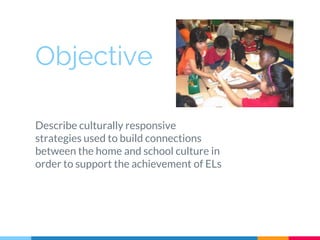
Describe culturally responsive
strategies used to build connections
between the home and school culture in
order to support the achievement of ELs
1.
What is Culturally
Responsive Teaching
(CRT)?
CRT
❏ Culturally responsive teaching emerged from
culturally relevant pedagogy, which is a term
created by Gloria Ladson-Billings (1994) to
describe “a pedagogy that empowers students
intellectually, socially, emotionally, and
politically by using cultural referents to impart
knowledge, skills, and attitudes” (pp. 17-18).
❏ CRT is essential to multicultural education
because it:
❏ Affirms the students’ cultures
❏ Views culture and experiences of students as
strengths
❏ Reflects the culture in the teaching process
Ladson-Billings, G. (1994). The Dreamkeepers: Successful teaching for African-American students. San Francisco: Jossey-Bass, pp. 17–18.
Culturally Relevant Teaching is
based on the premise that
culture influences the way
students learn
This is why culture must be
reflected in the teaching
process!
Gollnick, D. M., & Chinn, P. C. (2017). Multicultural education in a pluralistic society. Boston: Pearson.
2.
Elements of CRT in the
Teaching and Learning
Process
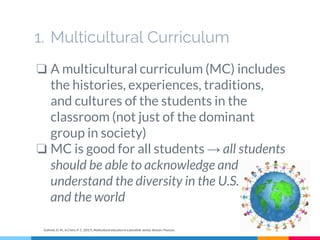
1. Multicultural Curriculum
❏ A multicultural curriculum (MC) includes
the histories, experiences, traditions,
and cultures of the students in the
classroom (not just of the dominant
group in society)
❏ MC is good for all students → all students
should be able to acknowledge and
understand the diversity in the U.S.
and the world
Gollnick, D. M., & Chinn, P. C. (2017). Multicultural education in a pluralistic society. Boston: Pearson.
1. Multicultural Curriculum (cont.)
❏ When delivering a MC, teachers should
avoid only focusing on the Deadly Five
Fs (food, festivals, fashion, faces and flags)
❏ Teachers should avoid giving superficial
attention to groups (go deeper than the
Five Fs)
❏ MC should become the lens through
which the curriculum is presented
Gollnick, D. M., & Chinn, P. C. (2017). Multicultural education in a pluralistic society. Boston: Pearson.
2. Culture in Academic Subjects
❏ Embedding culture in academic subjects
(math, science, social studies, etc.)
allows the subject to have meaning for
students because it relates to their lives
and experiences
Gollnick, D. M., & Chinn, P. C. (2017). Multicultural education in a pluralistic society. Boston: Pearson.
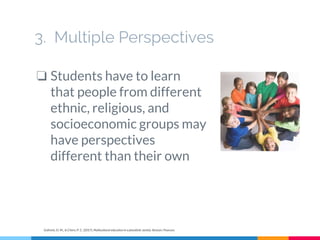
3. Multiple Perspectives
❏ Students have to learn
that people from different
ethnic, religious, and
socioeconomic groups may
have perspectives
different than their own
Gollnick, D. M., & Chinn, P. C. (2017). Multicultural education in a pluralistic society. Boston: Pearson.
3. Multiple Perspectives (cont.)
❏ Teachers should examine sensitive
issues and topics and look at historical
and contemporary events from multiple
perspectives:
❏ The point of view of European Americans,
African Americans, Mexican Americans, Puerto
Ricans, men, women, etc.
Gollnick, D. M., & Chinn, P. C. (2017). Multicultural education in a pluralistic society. Boston: Pearson.
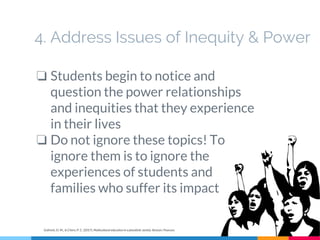
4. Address Issues of Inequity & Power
❏ Students begin to notice and
question the power relationships
and inequities that they experience
in their lives
❏ Do not ignore these topics! To
ignore them is to ignore the
experiences of students and
families who suffer its impact
Gollnick, D. M., & Chinn, P. C. (2017). Multicultural education in a pluralistic society. Boston: Pearson.
3.
Strategies for CRT
Strategies for Culturally
Relevant Teaching:
❏ Explicit instruction in linguistic and behavioral codes
❏ Culturally congruent interactions
❏ Utilizing instructional scaffolding
❏ Capitalizing on students cultural styles and strengths
❏ Legitimizing students’ real life experiences
❏ Link students’ histories and worlds to the subject
matter
❏ Provide students with opportunities for pro-social
interactions
❏ Good classroom organization and management
❏ Provide opportunities for affective stimulation and
movement for males
❏ Investigative learning methods
SOURCE: https://www.gadoe.org/Curriculum-Instruction-and-Assessment/Special-Education-Services/Documents/culturally%20relevant%20teaching%20strategies.pdf
Instructional Strategies for
Culturally Relevant Teaching
(cont.):
❏ Call-and-response
❏ Cooperative learning
❏ Differentiated instruction
❏ Cognitively guided instruction
SOURCE: http://www.indiana.edu/~equity/docs/Strategies_for_WOrking_with_Culturally_Diverse_Students__Renae_Azziz.pdf
Call-and-Response
❏ Call-and-response is a type of
interaction between speaker and
listener(s) in which the statements
("calls") are emphasized by expressions
("responses") from the listener(s), in
which responses can be solicited or
spontaneous.
SOURCE: http://www.indiana.edu/~equity/docs/Strategies_for_WOrking_with_Culturally_Diverse_Students__Renae_Azziz.pdf
Cooperative Learning
❏ Cooperative Learning (CL) is a learner
centered instructional process in which
small intentionally selected teams work
together on a well-defined learning task
for the primary purpose of increasing
mastery of course content.
SOURCE: http://www.indiana.edu/~equity/docs/Strategies_for_WOrking_with_Culturally_Diverse_Students__Renae_Azziz.pdf
Examples of Cooperative
Learning
Example Description
Think-Pair-Share Students each think of their answers, then discuss them with partners, and share
their combined responses with the class.
Roundtable A single piece of paper is systematically passed around a small group on which
each student responds to a question.
Corners Different aspects of a topic are posted in each corner of the room. The students
move to the corner that represents their feelings on the topic and discuss their
options with others. Finally, each group reports their responses to the class.
Graffiti Each small group is given a large piece of paper and a marker, and they respond
to a question or topic by writing words and phrases on the paper.
Learning Together Students are paired in small groups and assigned individual roles. The group
works together to prepare one product.
Jigsaw Members of a small group each become “experts” on a different aspect of a topic
and then teach one another in the group.
Group Investigation Students plan and carry out a project or plan of study within a small group. The
group decides what to investigate, what role each member will play, and how to
communicate information to the entire class.
SOURCE: http://www.indiana.edu/~equity/docs/Strategies_for_WOrking_with_Culturally_Diverse_Students__Renae_Azziz.pdf
Differentiated Instruction
❏ Differentiated instruction is a teaching
approach in which teachers adapt their
instruction to student differences.
❏ Teachers modify their instruction to
meet individual student’s readiness
levels, preferences, and interests.
SOURCE: http://www.indiana.edu/~equity/docs/Strategies_for_WOrking_with_Culturally_Diverse_Students__Renae_Azziz.pdf
Cognitively Guided Instruction
❏ Cognitively Guided Instruction
emphasizes learning strategies that
enhance a student’s meta-cognitive
development.
❏ Focuses on the DIRECT teaching and
modeling of cognitive learning
strategies.
❏ Students learn how to monitor their own
learning(comprehension).
SOURCE: http://www.indiana.edu/~equity/docs/Strategies_for_WOrking_with_Culturally_Diverse_Students__Renae_Azziz.pdf
Video: Culturally Responsive
Teaching and Learning
What CRT strategies does the teacher use?

Culturally Responsive Teaching

  • 1.
  • 2.
    Objective Describe culturally responsive strategiesused to build connections between the home and school culture in order to support the achievement of ELs
  • 3.
  • 4.
    CRT ❏ Culturally responsiveteaching emerged from culturally relevant pedagogy, which is a term created by Gloria Ladson-Billings (1994) to describe “a pedagogy that empowers students intellectually, socially, emotionally, and politically by using cultural referents to impart knowledge, skills, and attitudes” (pp. 17-18). ❏ CRT is essential to multicultural education because it: ❏ Affirms the students’ cultures ❏ Views culture and experiences of students as strengths ❏ Reflects the culture in the teaching process Ladson-Billings, G. (1994). The Dreamkeepers: Successful teaching for African-American students. San Francisco: Jossey-Bass, pp. 17–18.
  • 5.
    Culturally Relevant Teachingis based on the premise that culture influences the way students learn This is why culture must be reflected in the teaching process! Gollnick, D. M., & Chinn, P. C. (2017). Multicultural education in a pluralistic society. Boston: Pearson.
  • 6.
    2. Elements of CRTin the Teaching and Learning Process
  • 7.
    1. Multicultural Curriculum ❏A multicultural curriculum (MC) includes the histories, experiences, traditions, and cultures of the students in the classroom (not just of the dominant group in society) ❏ MC is good for all students → all students should be able to acknowledge and understand the diversity in the U.S. and the world Gollnick, D. M., & Chinn, P. C. (2017). Multicultural education in a pluralistic society. Boston: Pearson.
  • 8.
    1. Multicultural Curriculum(cont.) ❏ When delivering a MC, teachers should avoid only focusing on the Deadly Five Fs (food, festivals, fashion, faces and flags) ❏ Teachers should avoid giving superficial attention to groups (go deeper than the Five Fs) ❏ MC should become the lens through which the curriculum is presented Gollnick, D. M., & Chinn, P. C. (2017). Multicultural education in a pluralistic society. Boston: Pearson.
  • 9.
    2. Culture inAcademic Subjects ❏ Embedding culture in academic subjects (math, science, social studies, etc.) allows the subject to have meaning for students because it relates to their lives and experiences Gollnick, D. M., & Chinn, P. C. (2017). Multicultural education in a pluralistic society. Boston: Pearson.
  • 10.
    3. Multiple Perspectives ❏Students have to learn that people from different ethnic, religious, and socioeconomic groups may have perspectives different than their own Gollnick, D. M., & Chinn, P. C. (2017). Multicultural education in a pluralistic society. Boston: Pearson.
  • 11.
    3. Multiple Perspectives(cont.) ❏ Teachers should examine sensitive issues and topics and look at historical and contemporary events from multiple perspectives: ❏ The point of view of European Americans, African Americans, Mexican Americans, Puerto Ricans, men, women, etc. Gollnick, D. M., & Chinn, P. C. (2017). Multicultural education in a pluralistic society. Boston: Pearson.
  • 12.
    4. Address Issuesof Inequity & Power ❏ Students begin to notice and question the power relationships and inequities that they experience in their lives ❏ Do not ignore these topics! To ignore them is to ignore the experiences of students and families who suffer its impact Gollnick, D. M., & Chinn, P. C. (2017). Multicultural education in a pluralistic society. Boston: Pearson.
  • 13.
  • 14.
    Strategies for Culturally RelevantTeaching: ❏ Explicit instruction in linguistic and behavioral codes ❏ Culturally congruent interactions ❏ Utilizing instructional scaffolding ❏ Capitalizing on students cultural styles and strengths ❏ Legitimizing students’ real life experiences ❏ Link students’ histories and worlds to the subject matter ❏ Provide students with opportunities for pro-social interactions ❏ Good classroom organization and management ❏ Provide opportunities for affective stimulation and movement for males ❏ Investigative learning methods SOURCE: https://www.gadoe.org/Curriculum-Instruction-and-Assessment/Special-Education-Services/Documents/culturally%20relevant%20teaching%20strategies.pdf
  • 15.
    Instructional Strategies for CulturallyRelevant Teaching (cont.): ❏ Call-and-response ❏ Cooperative learning ❏ Differentiated instruction ❏ Cognitively guided instruction SOURCE: http://www.indiana.edu/~equity/docs/Strategies_for_WOrking_with_Culturally_Diverse_Students__Renae_Azziz.pdf
  • 16.
    Call-and-Response ❏ Call-and-response isa type of interaction between speaker and listener(s) in which the statements ("calls") are emphasized by expressions ("responses") from the listener(s), in which responses can be solicited or spontaneous. SOURCE: http://www.indiana.edu/~equity/docs/Strategies_for_WOrking_with_Culturally_Diverse_Students__Renae_Azziz.pdf
  • 17.
    Cooperative Learning ❏ CooperativeLearning (CL) is a learner centered instructional process in which small intentionally selected teams work together on a well-defined learning task for the primary purpose of increasing mastery of course content. SOURCE: http://www.indiana.edu/~equity/docs/Strategies_for_WOrking_with_Culturally_Diverse_Students__Renae_Azziz.pdf
  • 18.
    Examples of Cooperative Learning ExampleDescription Think-Pair-Share Students each think of their answers, then discuss them with partners, and share their combined responses with the class. Roundtable A single piece of paper is systematically passed around a small group on which each student responds to a question. Corners Different aspects of a topic are posted in each corner of the room. The students move to the corner that represents their feelings on the topic and discuss their options with others. Finally, each group reports their responses to the class. Graffiti Each small group is given a large piece of paper and a marker, and they respond to a question or topic by writing words and phrases on the paper. Learning Together Students are paired in small groups and assigned individual roles. The group works together to prepare one product. Jigsaw Members of a small group each become “experts” on a different aspect of a topic and then teach one another in the group. Group Investigation Students plan and carry out a project or plan of study within a small group. The group decides what to investigate, what role each member will play, and how to communicate information to the entire class. SOURCE: http://www.indiana.edu/~equity/docs/Strategies_for_WOrking_with_Culturally_Diverse_Students__Renae_Azziz.pdf
  • 19.
    Differentiated Instruction ❏ Differentiatedinstruction is a teaching approach in which teachers adapt their instruction to student differences. ❏ Teachers modify their instruction to meet individual student’s readiness levels, preferences, and interests. SOURCE: http://www.indiana.edu/~equity/docs/Strategies_for_WOrking_with_Culturally_Diverse_Students__Renae_Azziz.pdf
  • 20.
    Cognitively Guided Instruction ❏Cognitively Guided Instruction emphasizes learning strategies that enhance a student’s meta-cognitive development. ❏ Focuses on the DIRECT teaching and modeling of cognitive learning strategies. ❏ Students learn how to monitor their own learning(comprehension). SOURCE: http://www.indiana.edu/~equity/docs/Strategies_for_WOrking_with_Culturally_Diverse_Students__Renae_Azziz.pdf
  • 21.
    Video: Culturally Responsive Teachingand Learning What CRT strategies does the teacher use?