A Study of Innovation 
Philip Wheat 
Singularity Innovations 
Phil@SingularityInnovations.com
Innovation 
• It’s the new wonder word 
• Noun - a creation (a new device or process) resulting from study and experimentation 
• Verb - the act of starting something for the first time; introducing something new 
• But can’t we get more targeted than that?
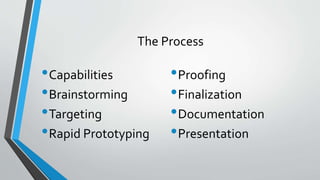
The Process 
•Capabilities 
•Brainstorming 
•Targeting 
•Rapid Prototyping 
•Proofing 
•Finalization 
•Documentation 
•Presentation
Capabilities 
• These are your Knowns and Known 
Unknowns 
• Building Capabilities is often the 
most challenging part of the 
process. 
• Diverse Capabilities are key to a 
successful effort 
• Be Careful not to center on a single 
capability 
• Example: 
• EDDIE Robotics Research 
Platform 
• Kinect Game Sensor 
• Windows 8 Alpha SDK 
• Phidgets Hardware Interface 
System
Brainstorming 
• “I need a…” 
• “I want a…” 
• “Wouldn’t it be cool if…” 
• “I read about a…” 
• “I saw a movie about…” 
• Key parts of Brainstorming are 
understanding the scope and 
objectives. 
• Product 
• Press 
• Process 
• Inspritation
Targeting 
• This is where the mapping happens 
• How do you use Capability X/Y/Z to get to Brainstorm A/B/C? 
• Quickly throw out the impractical or the improbable. 
• Decide on at least the general feature set 
• Don’t get too detailed yet 
• Build your list of questions
Rapid Prototyping 
• THIS is where you want to spend your time 
• Rapid means many things – ideally you want to have a cycle time of about 24 
hours. 
• Hardware is actually easier to break down into rapid chunks than software 
• Let your answers guide your path – a “It won’t work” result is the second best 
answer you’ll get. “Not sure” is the worst. 
• When working with hardware – budget for failure (3x requirements are 
conservative.)
Finalization 
• At some point you’ll have to decide what will make the first cut 
• Remember that it should be just the first cut – waiting for production quality 
on everything leads to paralysis. 
• Finalization will often take as much time as prototyping did. 
• Things that don’t make this cut go back into the idea pile for Rev Next. 
• Never let there be a final Rev (or at least always act as if there is a Rev Next.)
Documentation 
• Nothing’s done until the paperwork is in. 
• Seriously – you’ll need to push out the information to others. If you can’t, you’re 
stuck with it. 
• Documentation is also your QC – this is where you find all those obvious problems 
before you go out in public. 
• Build it as a hand-off packet – and a budget justification for that Rev Next. 
• Bring the lawyers in at this point – this will likely be when the patents and 
trademarks happen.
Presentation 
• Part of the Innovation process is the presentation - what kind will depend on the 
goals you started with 
• Press – Pretty clear 
• Process – Internal leads 
• Inspiration – Internal and external 
• Product – Production people first, and then release 
• This is also why communications skills are an important part of an innovation team 
• This is the payoff – where teams get to gather mindshare for their innovations
So how do YOU do it? 
• Build the right team 
• Give them the support and budget to explore 
• Give them cover from Bureaucracy 
• Give them a time limit 
• Give them a target 
• Give them the authority to get it done 
• Get out of the way
Questions?
A Study of Innovation 
Philip Wheat 
Singularity Innovations 
Phil@SingularityInnovations.com

A Study of Innovation by Phil Wheat

  • 1.
    A Study ofInnovation Philip Wheat Singularity Innovations Phil@SingularityInnovations.com
  • 2.
    Innovation • It’sthe new wonder word • Noun - a creation (a new device or process) resulting from study and experimentation • Verb - the act of starting something for the first time; introducing something new • But can’t we get more targeted than that?
  • 3.
    The Process •Capabilities •Brainstorming •Targeting •Rapid Prototyping •Proofing •Finalization •Documentation •Presentation
  • 4.
    Capabilities • Theseare your Knowns and Known Unknowns • Building Capabilities is often the most challenging part of the process. • Diverse Capabilities are key to a successful effort • Be Careful not to center on a single capability • Example: • EDDIE Robotics Research Platform • Kinect Game Sensor • Windows 8 Alpha SDK • Phidgets Hardware Interface System
  • 5.
    Brainstorming • “Ineed a…” • “I want a…” • “Wouldn’t it be cool if…” • “I read about a…” • “I saw a movie about…” • Key parts of Brainstorming are understanding the scope and objectives. • Product • Press • Process • Inspritation
  • 6.
    Targeting • Thisis where the mapping happens • How do you use Capability X/Y/Z to get to Brainstorm A/B/C? • Quickly throw out the impractical or the improbable. • Decide on at least the general feature set • Don’t get too detailed yet • Build your list of questions
  • 7.
    Rapid Prototyping •THIS is where you want to spend your time • Rapid means many things – ideally you want to have a cycle time of about 24 hours. • Hardware is actually easier to break down into rapid chunks than software • Let your answers guide your path – a “It won’t work” result is the second best answer you’ll get. “Not sure” is the worst. • When working with hardware – budget for failure (3x requirements are conservative.)
  • 8.
    Finalization • Atsome point you’ll have to decide what will make the first cut • Remember that it should be just the first cut – waiting for production quality on everything leads to paralysis. • Finalization will often take as much time as prototyping did. • Things that don’t make this cut go back into the idea pile for Rev Next. • Never let there be a final Rev (or at least always act as if there is a Rev Next.)
  • 9.
    Documentation • Nothing’sdone until the paperwork is in. • Seriously – you’ll need to push out the information to others. If you can’t, you’re stuck with it. • Documentation is also your QC – this is where you find all those obvious problems before you go out in public. • Build it as a hand-off packet – and a budget justification for that Rev Next. • Bring the lawyers in at this point – this will likely be when the patents and trademarks happen.
  • 10.
    Presentation • Partof the Innovation process is the presentation - what kind will depend on the goals you started with • Press – Pretty clear • Process – Internal leads • Inspiration – Internal and external • Product – Production people first, and then release • This is also why communications skills are an important part of an innovation team • This is the payoff – where teams get to gather mindshare for their innovations
  • 12.
    So how doYOU do it? • Build the right team • Give them the support and budget to explore • Give them cover from Bureaucracy • Give them a time limit • Give them a target • Give them the authority to get it done • Get out of the way
  • 13.
  • 14.
    A Study ofInnovation Philip Wheat Singularity Innovations Phil@SingularityInnovations.com