Mixed-Initiative
  Mixed Initiative for Situated
Interaction with Public Displays
                            p y
        Jorge C. S. Cardoso
             Rui José
Summary
•   Motivation
•   Challenges
•   Approach
•   Objectives
•   Methodology
•   Current Work
Motivation
Public digital displays have become ubiquitous but have not yet
atained their full potential as


cultural reference     objects of a place,

objects with an active    role in a place,

a source of meaningful      situated interaction,

a mirror   of the social environment, and something that helps
define that environment.
Challenges
How to automatically infer and characterise the
social environment of a public display
                             p      p y

How to provide interactive features that users
       p
recognize and can use in a shared manner

How to entice and react to users’
interactions with the display
Approach
Interaction is fundamental to achieve this view

not only to support public situated interaction
with and between people,

but also to enable the display to characterise and
adapt to the place.
Approach
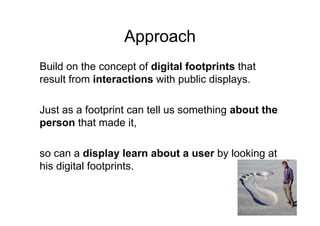
Build on the concept of digital footprints that
result from interactions with public displays.

Just as a footprint can tell us something about the
person that made it,

so can a display learn about a user by looking at
his digital footprints
            footprints.
Approach
Develop mixed-initiative approaches that

allow the display to entice people to interact and

guide people’s interaction in a way that allows
the display to

collect traces of activity and interests
Objectives
Develop a mixed-initiative interaction model that
builds on the digital footprints by

studying interaction mechanisms that produce relevant
footprints,
    p     ,
studying how to provide those interactive features in an
understandable and familiar way
                            way,

studying ways to generate them efficiently, and

studying system-initiative approaches to entice users into
producing more digital footprints
Objectives
Understand if this approach is effective at
generating an evolving display that adapts to the
place
generating a display that is perceived as a
shared object
fostering new kinds of social interaction
Methodology
Study interactive features and the digital footprints that
result from them and that the display can use to
characterise the place

Study interface conventions used in standard GUI
desktop or Web interfaces and how they may be adapted
to pub c display interaction
   public d sp ay te act o

Perform real settings experiments with different situated
display solutions
Current work
Cardoso, J. C. S. & José, R. Meersman, R.;
Herrero, P. & Dillon, T. (ed.) A framework for
context-aware adaptation in public displays
OTM 2009 Workshops, Springer-Verlag Berlin
Heidelberg, 2009, 118-127

Study interaction conventions used on standard
systems like desktop or web interfaces that can be
adapted to public displays
The End
Thank you!

PhD Proposal Presentation

  • 1.
    Mixed-Initiative MixedInitiative for Situated Interaction with Public Displays p y Jorge C. S. Cardoso Rui José
  • 2.
    Summary • Motivation • Challenges • Approach • Objectives • Methodology • Current Work
  • 3.
    Motivation Public digital displayshave become ubiquitous but have not yet atained their full potential as cultural reference objects of a place, objects with an active role in a place, a source of meaningful situated interaction, a mirror of the social environment, and something that helps define that environment.
  • 4.
    Challenges How to automaticallyinfer and characterise the social environment of a public display p p y How to provide interactive features that users p recognize and can use in a shared manner How to entice and react to users’ interactions with the display
  • 5.
    Approach Interaction is fundamentalto achieve this view not only to support public situated interaction with and between people, but also to enable the display to characterise and adapt to the place.
  • 6.
    Approach Build on theconcept of digital footprints that result from interactions with public displays. Just as a footprint can tell us something about the person that made it, so can a display learn about a user by looking at his digital footprints footprints.
  • 7.
    Approach Develop mixed-initiative approachesthat allow the display to entice people to interact and guide people’s interaction in a way that allows the display to collect traces of activity and interests
  • 8.
    Objectives Develop a mixed-initiativeinteraction model that builds on the digital footprints by studying interaction mechanisms that produce relevant footprints, p , studying how to provide those interactive features in an understandable and familiar way way, studying ways to generate them efficiently, and studying system-initiative approaches to entice users into producing more digital footprints
  • 9.
    Objectives Understand if thisapproach is effective at generating an evolving display that adapts to the place generating a display that is perceived as a shared object fostering new kinds of social interaction
  • 10.
    Methodology Study interactive featuresand the digital footprints that result from them and that the display can use to characterise the place Study interface conventions used in standard GUI desktop or Web interfaces and how they may be adapted to pub c display interaction public d sp ay te act o Perform real settings experiments with different situated display solutions
  • 11.
    Current work Cardoso, J.C. S. & José, R. Meersman, R.; Herrero, P. & Dillon, T. (ed.) A framework for context-aware adaptation in public displays OTM 2009 Workshops, Springer-Verlag Berlin Heidelberg, 2009, 118-127 Study interaction conventions used on standard systems like desktop or web interfaces that can be adapted to public displays
  • 12.