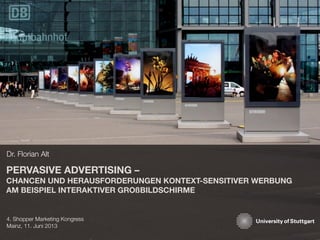
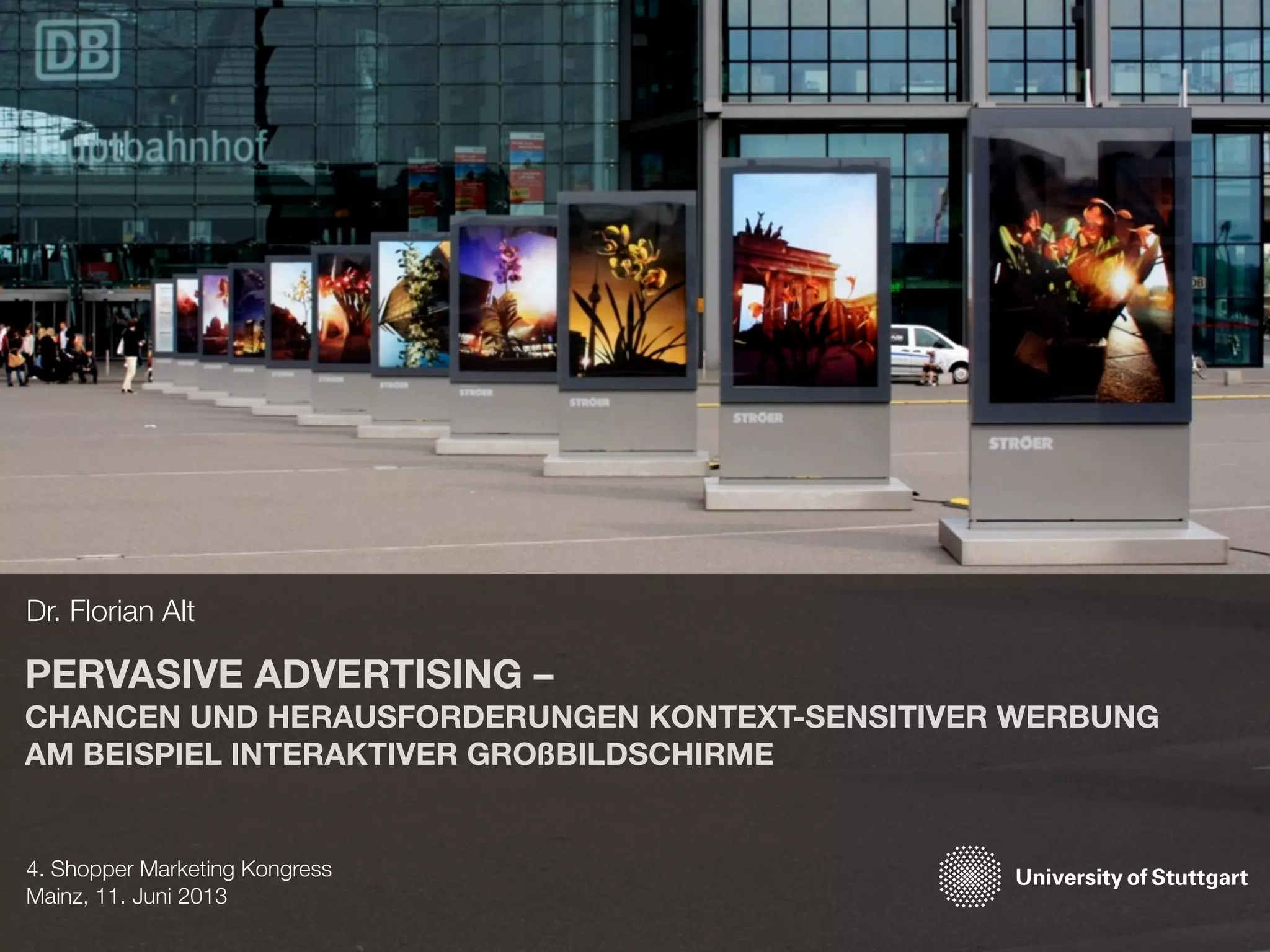

PERVASIVE ADVERTISING –
CHANCEN UND HERAUSFORDERUNGEN KONTEXT-SENSITIVER WERBUNG
AM BEISPIEL INTERAKTIVER GROßBILDSCHIRME
Dr. Florian Alt
4. Shopper Marketing Kongress
Mainz, 11. Juni 2013
3
The Lightning Man
7
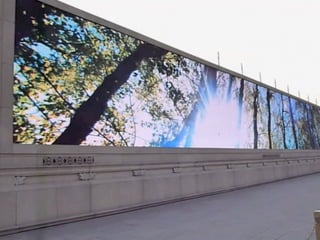
State-of-the-Art Displays
7
Pervasive Advertising
• The Long Tail
• Audience Measurement
• Context Adaptivity and Personalization
• User Feedback
• Engaging Experiences
Opportunities of Pervasive Advertising
9
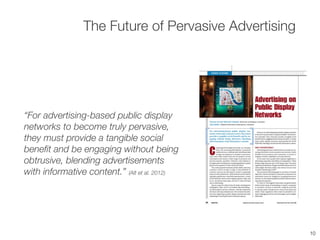
“For advertising-based public display
networks to become truly pervasive,
they must provide a tangible social
benefit and be engaging without being
obtrusive, blending advertisements
with informative content.” (Alt et al. 2012)
The Future of Pervasive Advertising
10
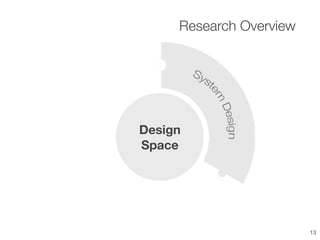
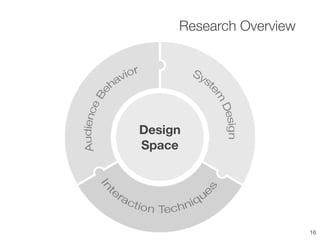
Design Space
Research Overview
13
Design
Space
Design
Space
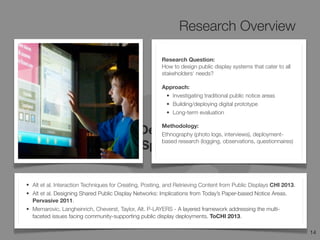
Research Overview
14
Design
Space
Research Question:
How to design public display systems that cater to all
stakeholders‘ needs?
Approach:
• Investigating traditional public notice areas
• Building/deploying digital prototype
• Long-term evaluation
Methodology:
Ethnography (photo logs, interviews), deployment-
based research (logging, observations, questionnaires)
• Alt et al. Interaction Techniques for Creating, Posting, and Retrieving Content from Public Displays CHI 2013.
• Alt et al. Designing Shared Public Display Networks: Implications from Today’s Paper-based Notice Areas.
Pervasive 2011.
• Memarovic, Langheinrich, Cheverst, Taylor, Alt. P-LAYERS - A layered framework addressing the multi-
faceted issues facing community-supporting public display deployments. ToCHI 2013.
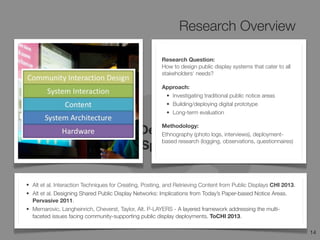
Research Overview
14
Design
Space
Research Question:
How to design public display systems that cater to all
stakeholders‘ needs?
Approach:
• Investigating traditional public notice areas
• Building/deploying digital prototype
• Long-term evaluation
Methodology:
Ethnography (photo logs, interviews), deployment-
based research (logging, observations, questionnaires)
• Alt et al. Interaction Techniques for Creating, Posting, and Retrieving Content from Public Displays CHI 2013.
• Alt et al. Designing Shared Public Display Networks: Implications from Today’s Paper-based Notice Areas.
Pervasive 2011.
• Memarovic, Langheinrich, Cheverst, Taylor, Alt. P-LAYERS - A layered framework addressing the multi-
faceted issues facing community-supporting public display deployments. ToCHI 2013.
Research Overview
15
Design
Space
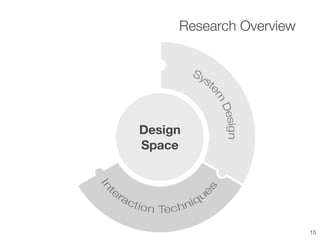
Research Overview
15
Design
Space
• Müller, Alt, Michelis, Schmidt. Requirements and Design Space for Large Interactive Displays.
ACM Multimedia 2010.
• Alt et al. Interaction Techniques for Creating, Posting, and Retrieving Content from Public Displays CHI 2013.
• Alt, Kubitza, Bial, Zaidan, Ortel, Zurmaar, Lewen, Sahami, Schmidt. Digifieds: Evaluating Suitable Interaction
Techniques for Shared Public Notice Areas. MUM 2011.
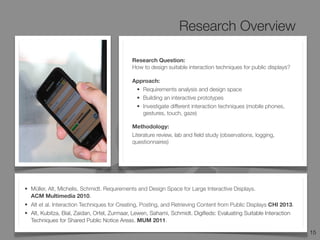
Research Question:
How to design suitable interaction techniques for public displays?
Approach:
• Requirements analysis and design space
• Building an interactive prototypes
• Investigate different interaction techniques (mobile phones,
gestures, touch, gaze)
Methodology:
Literature review, lab and field study (observations, logging,
questionnaires)
Research Overview
16
Design
Space
Research Overview
16
Design
Space
• Beyer, Alt, Müller, Schmidt, Isakovic, Klose, Schiewe, Haulsen. Audience Behavior Around Large
Interactive Cylindrical Screens. CHI 2011.
• Müller, Walter, Bailly, Nischt, Alt. Looking Glass: A Field Study on Noticing Interactivity of Shop Windows.
CHI 2012.
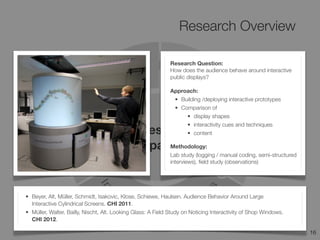
Research Question:
How does the audience behave around interactive
public displays?
Approach:
• Building /deploying interactive prototypes
• Comparison of
• display shapes
• interactivity cues and techniques
• content
Methodology:
Lab study (logging / manual coding, semi-structured
interviews), field study (observations)
Audience Behavior
23
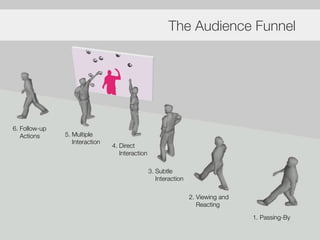
1. Passing-By
2. Viewing and
Reacting
3. Subtle
Interaction
4. Direct
Interaction
5. Multiple
Interaction
6. Follow-up
Actions
The Audience Funnel
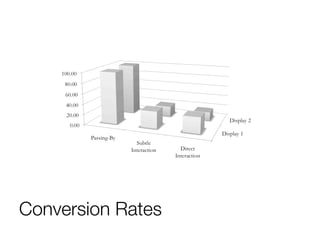
Conversion Rates
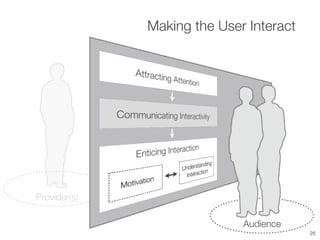
Making the User Interact
Audience
Provider(s)
25
Looking Glass
• Call-to-action
• Attract sequence
• Analog signage
• Honeypot effect
• Persons inviting passersby
User Representation
Interactivity Cues
Other
people
27
Cognitive
Processing
Lab Study: User Representation
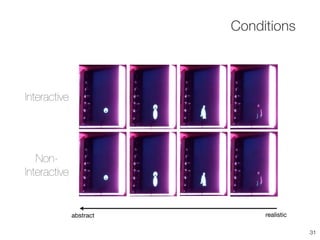
Interactive
Non-
Interactive
31
Conditions
realisticabstract
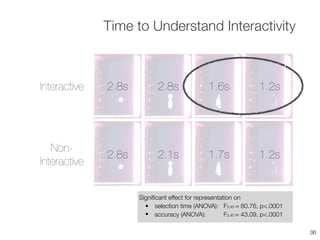
36
Significant effect for representation on
• selection time (ANOVA): F3,45 = 80.76, p<.0001
• accuracy (ANOVA): F3,45 = 43.09, p<.0001
Time to Understand Interactivity
Interactive 2.8s 2.8s 1.6s 1.2s
Non-
Interactive
2.8s 2.1s 1.7s 1.2s
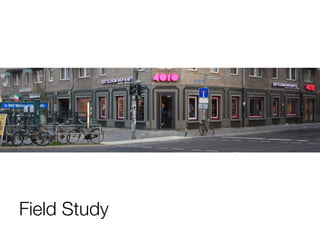
Field Study
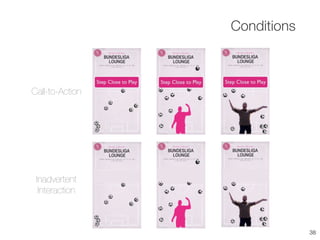
Call-to-Action
Inadvertent
Interaction
Conditions
38
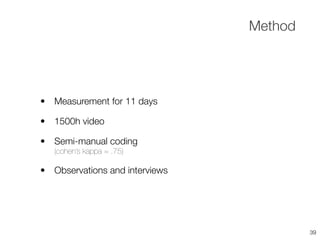
• Measurement for 11 days
• 1500h video
• Semi-manual coding
(cohen’s kappa = .75)
• Observations and interviews
Method
39
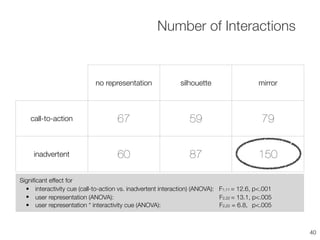
no representation silhouette mirror
call-to-action 67 59 79
inadvertent 60 87 150
Number of Interactions
40
Significant effect for
• interactivity cue (call-to-action vs. inadvertent interaction) (ANOVA): F1,11 = 12.6, p<.001
• user representation (ANOVA): F2,22 = 13.1, p<.005
• user representation * interactivity cue (ANOVA): F2,22 = 6.8, p<.005
The Landing Effect
• Image representation is a powerful cue to
communicate interactivity.
• Developers of public display applications should
design for the landing effect.
• Attract many people to interact (honeypot effect).
• Almost all people interact in groups.
Looking Glass - Summary
44
Why should we install interactive displays?Why to install interactive public displays?
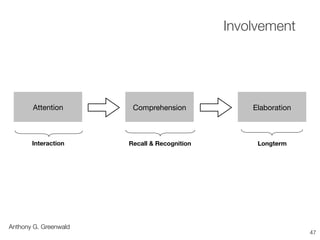
Hypothesis
Interaction influences cognition
by increasing involvement.
Involvement
Attention ElaborationComprehension
Interaction LongtermRecall & Recognition
Anthony G. Greenwald
47
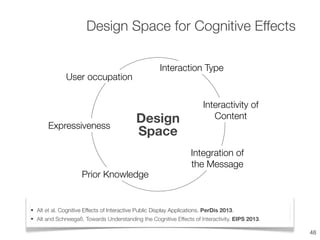
Design Space for Cognitive Effects
48
• Alt et al. Cognitive Effects of Interactive Public Display Applications. PerDis 2013.
• Alt and Schneegaß. Towards Understanding the Cognitive Effects of Interactivity. EIPS 2013.
User occupation
Expressiveness
Interactivity of
Content
Interaction Type
Integration of
the Message
Prior Knowledge
Design
Space
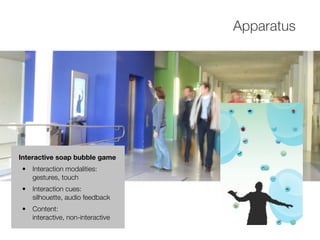
Apparatus
Interactive soap bubble game
• Interaction modalities:
gestures, touch
• Interaction cues:
silhouette, audio feedback
• Content:
interactive, non-interactive
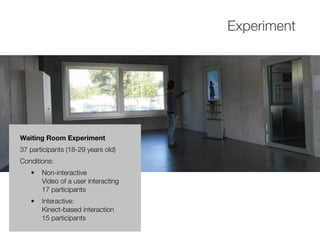
Experiment
Waiting Room Experiment
37 participants (18-29 years old)
Conditions:
• Non-interactive
Video of a user interacting
17 participants
• Interactive:
Kinect-based interaction
15 participants
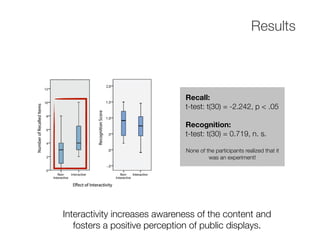
Results
Recall:
t-test: t(30) = -2.242, p < .05
Recognition:
t-test: t(30) = 0.719, n. s.
None of the participants realized that it
was an experiment!
Interactivity increases awareness of the content and
fosters a positive perception of public displays.
Take-Home Messages
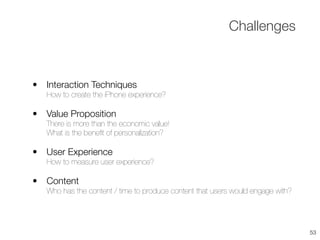
• Interaction Techniques
How to create the iPhone experience?
• Value Proposition
There is more than the economic value!
What is the benefit of personalization?
• User Experience
How to measure user experience?
• Content
Who has the content / time to produce content that users would engage with?
Challenges
53
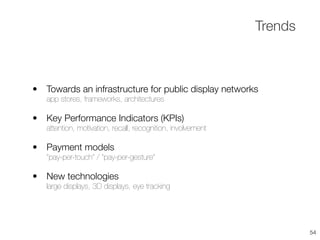
• Towards an infrastructure for public display networks
app stores, frameworks, architectures
• Key Performance Indicators (KPIs)
attention, motivation, recall, recognition, involvement
• Payment models
”pay-per-touch” / “pay-per-gesture”
• New technologies
large displays, 3D displays, eye tracking
Trends
54
4. Shopper Marketing Kongress
Mainz, 11. Juni 2013
Dr. Florian Alt
Web: www.florian-alt.de
Email: florian.alt@vis.uni-stuttgart.de
Questions?
Discussion?

Pervasive Advertising - Chancen und Herausforderungen kontext-sensitiver Werbung am Beispiel interaktiver Großbildschirme | Dr. Florian Alt, Universität Stuttgart, auf dem 4. Shopper Marketing Kongress

  • 1.
    PERVASIVE ADVERTISING – CHANCENUND HERAUSFORDERUNGEN KONTEXT-SENSITIVER WERBUNG AM BEISPIEL INTERAKTIVER GROßBILDSCHIRME Dr. Florian Alt 4. Shopper Marketing Kongress Mainz, 11. Juni 2013
  • 2.
  • 3.
  • 4.
  • 5.
  • 6.
    • The LongTail • Audience Measurement • Context Adaptivity and Personalization • User Feedback • Engaging Experiences Opportunities of Pervasive Advertising 9
  • 7.
    “For advertising-based publicdisplay networks to become truly pervasive, they must provide a tangible social benefit and be engaging without being obtrusive, blending advertisements with informative content.” (Alt et al. 2012) The Future of Pervasive Advertising 10
  • 8.
  • 9.
  • 10.
    Research Overview 14 Design Space Research Question: Howto design public display systems that cater to all stakeholders‘ needs? Approach: • Investigating traditional public notice areas • Building/deploying digital prototype • Long-term evaluation Methodology: Ethnography (photo logs, interviews), deployment- based research (logging, observations, questionnaires) • Alt et al. Interaction Techniques for Creating, Posting, and Retrieving Content from Public Displays CHI 2013. • Alt et al. Designing Shared Public Display Networks: Implications from Today’s Paper-based Notice Areas. Pervasive 2011. • Memarovic, Langheinrich, Cheverst, Taylor, Alt. P-LAYERS - A layered framework addressing the multi- faceted issues facing community-supporting public display deployments. ToCHI 2013.
  • 11.
    Research Overview 14 Design Space Research Question: Howto design public display systems that cater to all stakeholders‘ needs? Approach: • Investigating traditional public notice areas • Building/deploying digital prototype • Long-term evaluation Methodology: Ethnography (photo logs, interviews), deployment- based research (logging, observations, questionnaires) • Alt et al. Interaction Techniques for Creating, Posting, and Retrieving Content from Public Displays CHI 2013. • Alt et al. Designing Shared Public Display Networks: Implications from Today’s Paper-based Notice Areas. Pervasive 2011. • Memarovic, Langheinrich, Cheverst, Taylor, Alt. P-LAYERS - A layered framework addressing the multi- faceted issues facing community-supporting public display deployments. ToCHI 2013.
  • 12.
  • 13.
    Research Overview 15 Design Space • Müller,Alt, Michelis, Schmidt. Requirements and Design Space for Large Interactive Displays. ACM Multimedia 2010. • Alt et al. Interaction Techniques for Creating, Posting, and Retrieving Content from Public Displays CHI 2013. • Alt, Kubitza, Bial, Zaidan, Ortel, Zurmaar, Lewen, Sahami, Schmidt. Digifieds: Evaluating Suitable Interaction Techniques for Shared Public Notice Areas. MUM 2011. Research Question: How to design suitable interaction techniques for public displays? Approach: • Requirements analysis and design space • Building an interactive prototypes • Investigate different interaction techniques (mobile phones, gestures, touch, gaze) Methodology: Literature review, lab and field study (observations, logging, questionnaires)
  • 14.
  • 15.
    Research Overview 16 Design Space • Beyer,Alt, Müller, Schmidt, Isakovic, Klose, Schiewe, Haulsen. Audience Behavior Around Large Interactive Cylindrical Screens. CHI 2011. • Müller, Walter, Bailly, Nischt, Alt. Looking Glass: A Field Study on Noticing Interactivity of Shop Windows. CHI 2012. Research Question: How does the audience behave around interactive public displays? Approach: • Building /deploying interactive prototypes • Comparison of • display shapes • interactivity cues and techniques • content Methodology: Lab study (logging / manual coding, semi-structured interviews), field study (observations)
  • 16.
  • 17.
    23 1. Passing-By 2. Viewingand Reacting 3. Subtle Interaction 4. Direct Interaction 5. Multiple Interaction 6. Follow-up Actions The Audience Funnel
  • 18.
  • 19.
    Making the UserInteract Audience Provider(s) 25
  • 20.
  • 21.
    • Call-to-action • Attractsequence • Analog signage • Honeypot effect • Persons inviting passersby User Representation Interactivity Cues Other people 27 Cognitive Processing
  • 22.
    Lab Study: UserRepresentation
  • 23.
  • 24.
    36 Significant effect forrepresentation on • selection time (ANOVA): F3,45 = 80.76, p<.0001 • accuracy (ANOVA): F3,45 = 43.09, p<.0001 Time to Understand Interactivity Interactive 2.8s 2.8s 1.6s 1.2s Non- Interactive 2.8s 2.1s 1.7s 1.2s
  • 25.
  • 26.
  • 27.
    • Measurement for11 days • 1500h video • Semi-manual coding (cohen’s kappa = .75) • Observations and interviews Method 39
  • 28.
    no representation silhouettemirror call-to-action 67 59 79 inadvertent 60 87 150 Number of Interactions 40 Significant effect for • interactivity cue (call-to-action vs. inadvertent interaction) (ANOVA): F1,11 = 12.6, p<.001 • user representation (ANOVA): F2,22 = 13.1, p<.005 • user representation * interactivity cue (ANOVA): F2,22 = 6.8, p<.005
  • 29.
  • 30.
    • Image representationis a powerful cue to communicate interactivity. • Developers of public display applications should design for the landing effect. • Attract many people to interact (honeypot effect). • Almost all people interact in groups. Looking Glass - Summary 44
  • 31.
    Why should weinstall interactive displays?Why to install interactive public displays?
  • 32.
  • 33.
  • 34.
    Design Space forCognitive Effects 48 • Alt et al. Cognitive Effects of Interactive Public Display Applications. PerDis 2013. • Alt and Schneegaß. Towards Understanding the Cognitive Effects of Interactivity. EIPS 2013. User occupation Expressiveness Interactivity of Content Interaction Type Integration of the Message Prior Knowledge Design Space
  • 35.
    Apparatus Interactive soap bubblegame • Interaction modalities: gestures, touch • Interaction cues: silhouette, audio feedback • Content: interactive, non-interactive
  • 36.
    Experiment Waiting Room Experiment 37participants (18-29 years old) Conditions: • Non-interactive Video of a user interacting 17 participants • Interactive: Kinect-based interaction 15 participants
  • 37.
    Results Recall: t-test: t(30) =-2.242, p < .05 Recognition: t-test: t(30) = 0.719, n. s. None of the participants realized that it was an experiment! Interactivity increases awareness of the content and fosters a positive perception of public displays.
  • 38.
  • 39.
    • Interaction Techniques Howto create the iPhone experience? • Value Proposition There is more than the economic value! What is the benefit of personalization? • User Experience How to measure user experience? • Content Who has the content / time to produce content that users would engage with? Challenges 53
  • 40.
    • Towards aninfrastructure for public display networks app stores, frameworks, architectures • Key Performance Indicators (KPIs) attention, motivation, recall, recognition, involvement • Payment models ”pay-per-touch” / “pay-per-gesture” • New technologies large displays, 3D displays, eye tracking Trends 54
  • 41.
    4. Shopper MarketingKongress Mainz, 11. Juni 2013 Dr. Florian Alt Web: www.florian-alt.de Email: florian.alt@vis.uni-stuttgart.de Questions? Discussion?