Ubiquitous Interactions
        Ilya Shmorgun
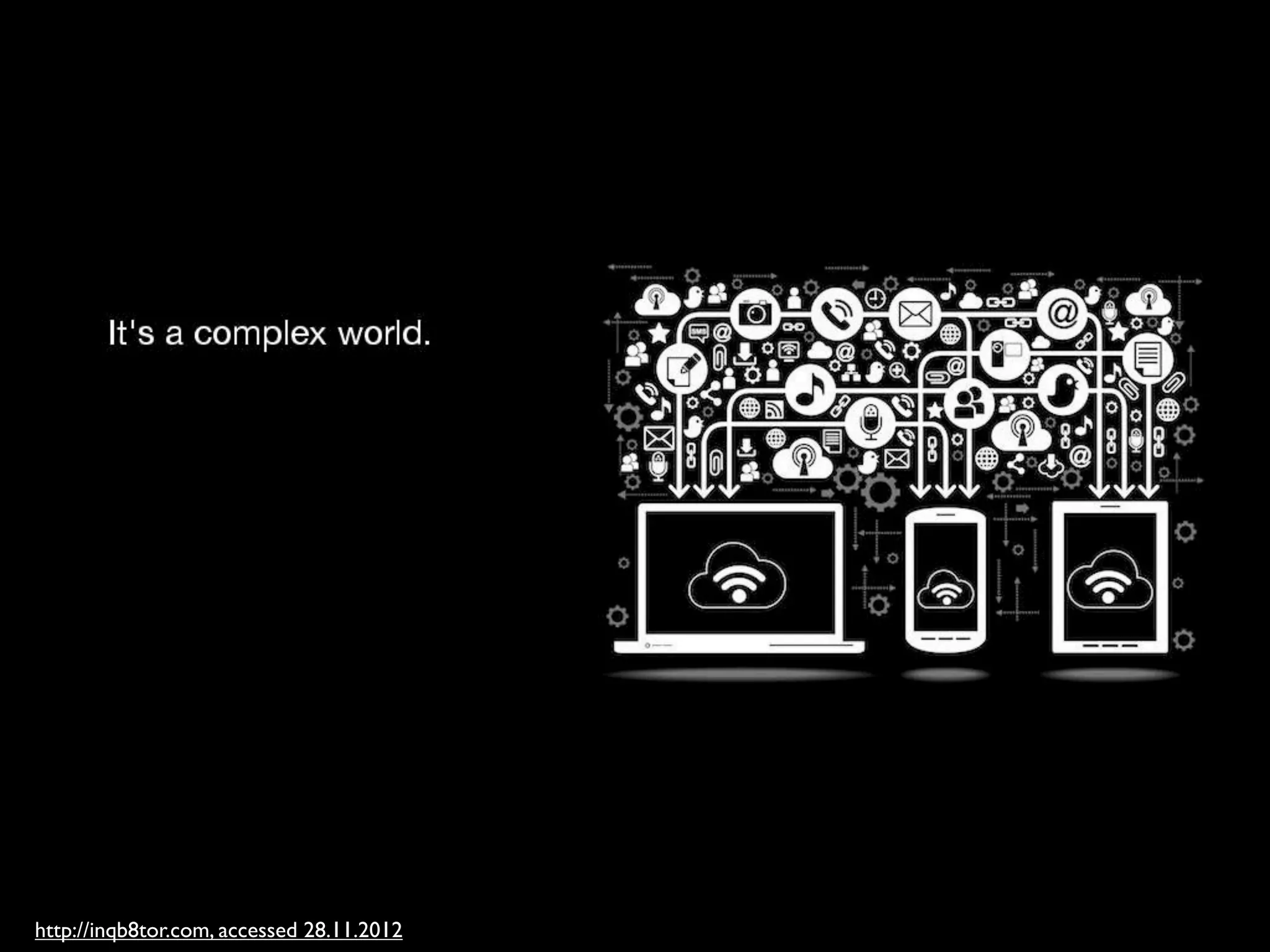
A Complex World
http://inqb8tor.com, accessed 28.11.2012
New Types of
          Interaction
• Our activities are supported by a wide
  range of devices and software.
• Our devices are capable of sensing the
  context of our activities.
• Our devices and services are still being
  designed in isolation.
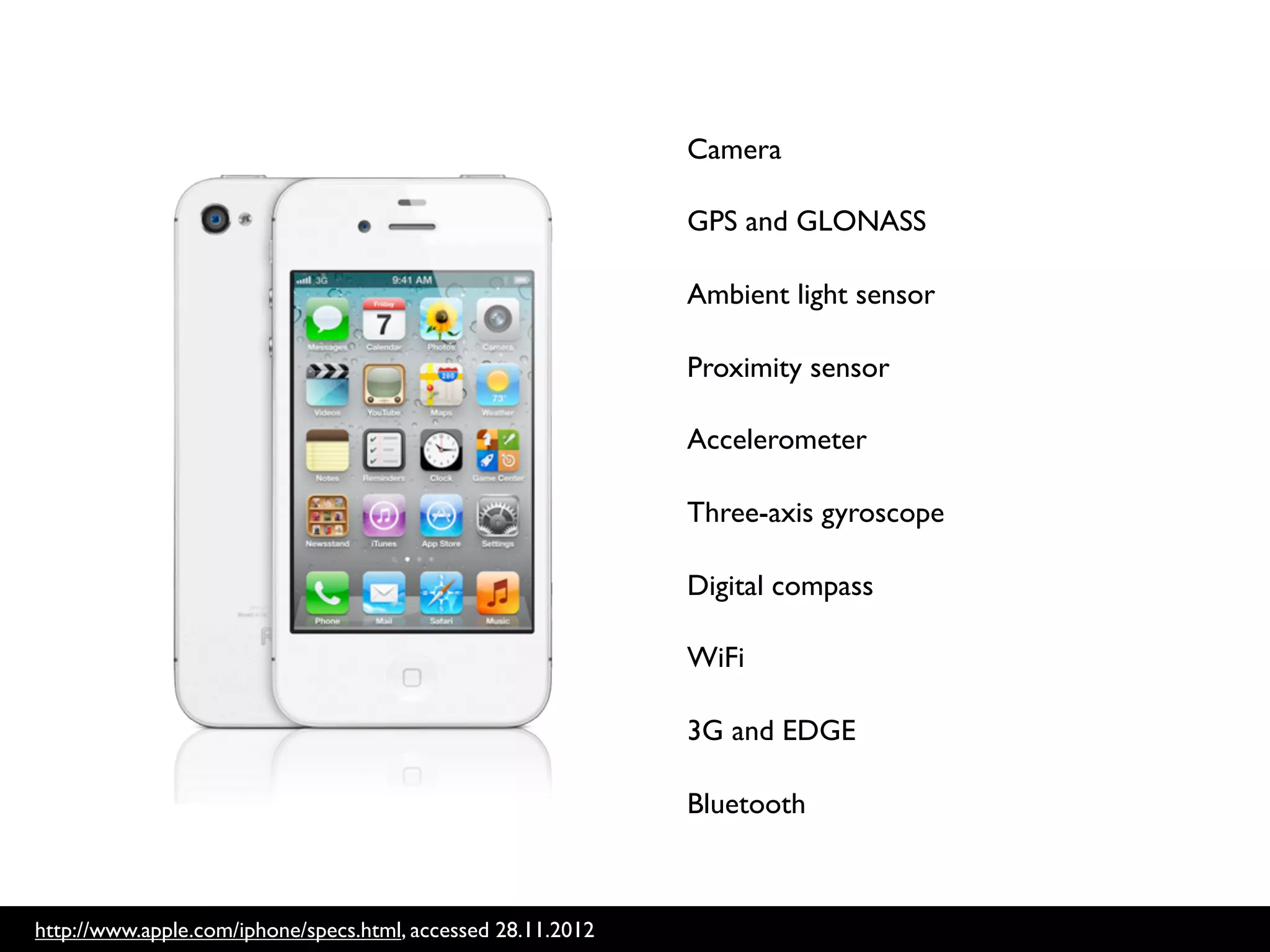
Camera

                                                              GPS and GLONASS

                                                              Ambient light sensor

                                                              Proximity sensor

                                                              Accelerometer

                                                              Three-axis gyroscope

                                                              Digital compass

                                                              WiFi

                                                              3G and EDGE

                                                              Bluetooth


http://www.apple.com/iphone/specs.html, accessed 28.11.2012
Ubiquitous Computing
Post-Desktop Model of
                      HCI
                • Information processing is integrated into
                      everyday objects [1].
                • Ubiquitous computing is subsuming
                      traditional computing paradigms, for
                      example desktop and mobile computing
                      [2].


1. Zhao, R., Wang, J.:Visualizing the research on pervasive and ubiquitous computing. Scientometrics 86(3), 593–612 (2011)
2. Greenfield, A.: Everyware: The Dawning Age of Ubiquitous Computing. New Riders Publishing, 1st edn. (Mar 2006)
Invisible Computing
                • Interaction with computers should be
                      more like interaction with the physical
                      world [1].
                • Users should be able to sense and control
                      what directly interests them [2].
                • Our devices remain the focus of attention
                      instead of fading into the background.
1. Abowd, G., Mynatt, E.: Charting past, present, and future research in ubiquitous computing. ACM Transactions on Computer-Human
   Interaction (TOCHI) 7(1), 29–58 (2000)
2. Roussos, G., Musolesi, M., Magoulas, G.D.: Human behavior in ubiquitous environments: Experience and interaction design. Pervasive and
   Mobile Computing 6(5), 497–498 (Oct 2010)
http://www.flickr.com/photos/biligiri/1844862632/, accessed 11.01.2013
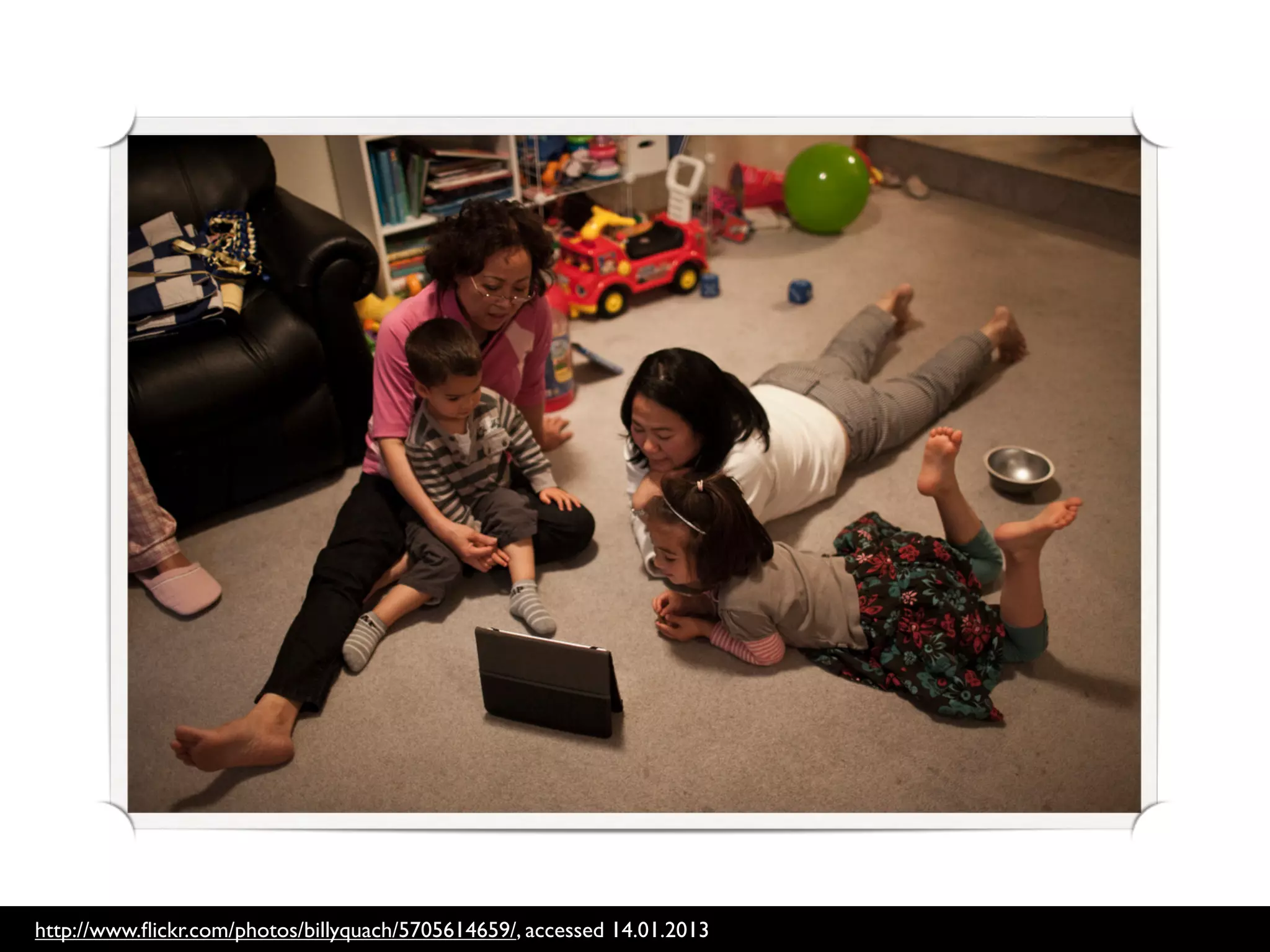
People and Computers

             • Previously a ”one-to-one” relationship, one
                  technology - one application - one user.
             • Nowadays “many-to-many”, with ever-
                  changing configurations of devices,
                  applications, and users.


Brodersen, C., Bødker, S., Klokmose, C.: Ubiquitous substitution. Human-Computer Interaction–INTERACT 2007 pp. 179–192 (2007)
http://www.flickr.com/photos/billyquach/5705614659/, accessed 14.01.2013
Context

                • Any information, which characterizes the
                      situation of a person, a place or an object,
                      relevant to the interaction between a user
                      and an application [1].
                • Ubiquitous computing as ”a technology of
                      context” [2].


1. Chen, G., Kotz, D.: A survey of context-aware mobile computing research (2000)
2. Dourish,P.: Where the Action Is: The Foundations of Embodied Interaction (Bradford Books). The MIT Press, new ed edn. (Aug 2004)
Types of Context

              • Where you are.
              • Who you are with.
              • What resources are nearby.

Schilit, B., Adams, N., Want, R.: Context-aware computing applications (1994)
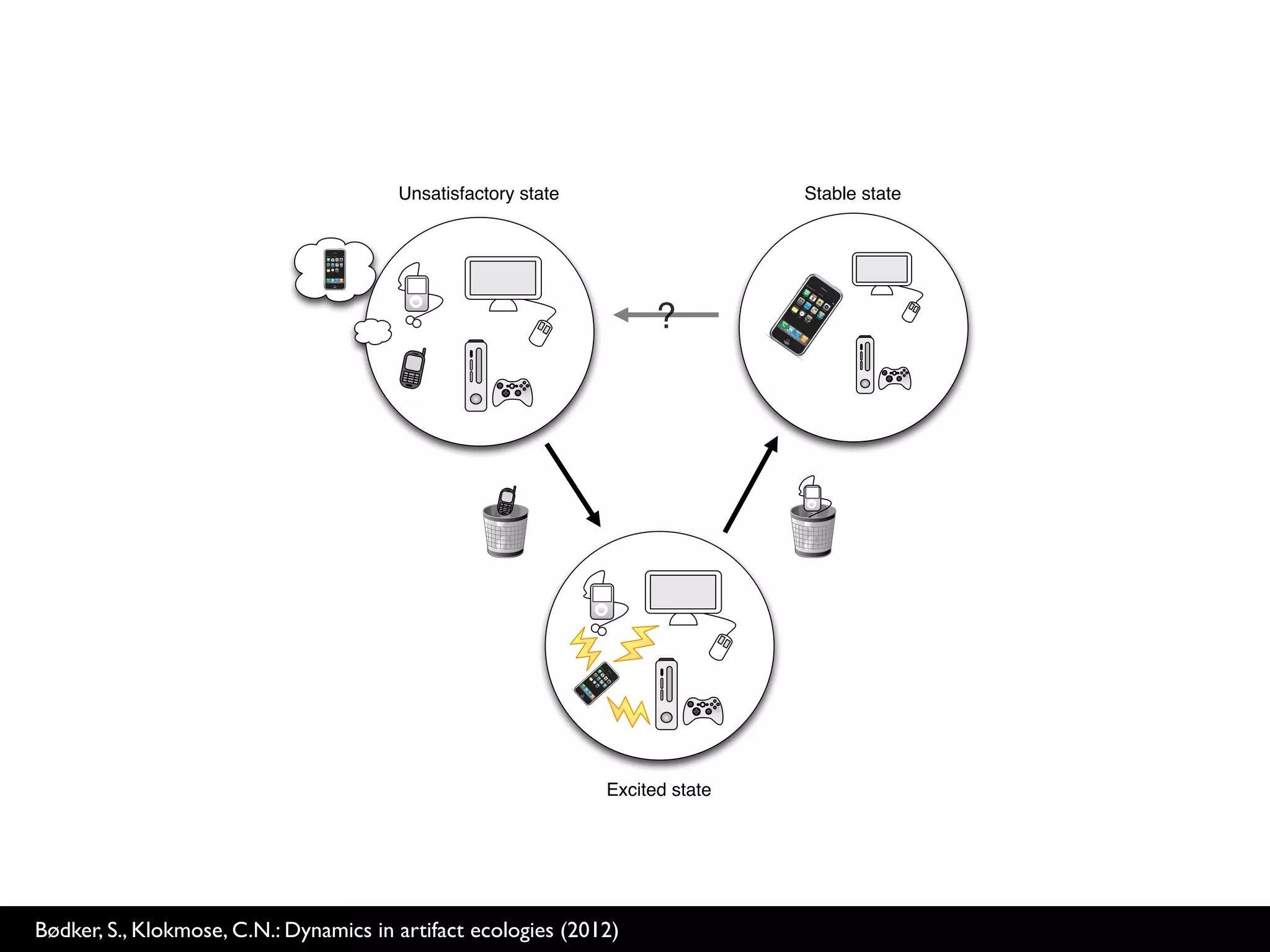
wn apps                                   Unsatisfactory state                   Stable state


seen as
                                                                       ?
Artifact
  ‘how’
pending
ng that
reading

s men-
 deeper
ble dy-
                                                                 Excited state


                    Figure 2. The states of the artifact ecology. In the unsatisfactory
gies are
                    state the current artifact ecology no longer lives up to the users
 sms of S., Klokmose, C.N.: Dynamics in artifact ecologies (2012)
   Bødker,
Ubiquitous Interactions
Definition


               Interactions in the context of ubiquitous
               computing, which include multiple, dynamic,
               and distributed interfaces.


Klokmose, C.N.: An Instrumental Paradigm for Ubiquitous Interaction. DHRS 2006 p. 33 (2006)
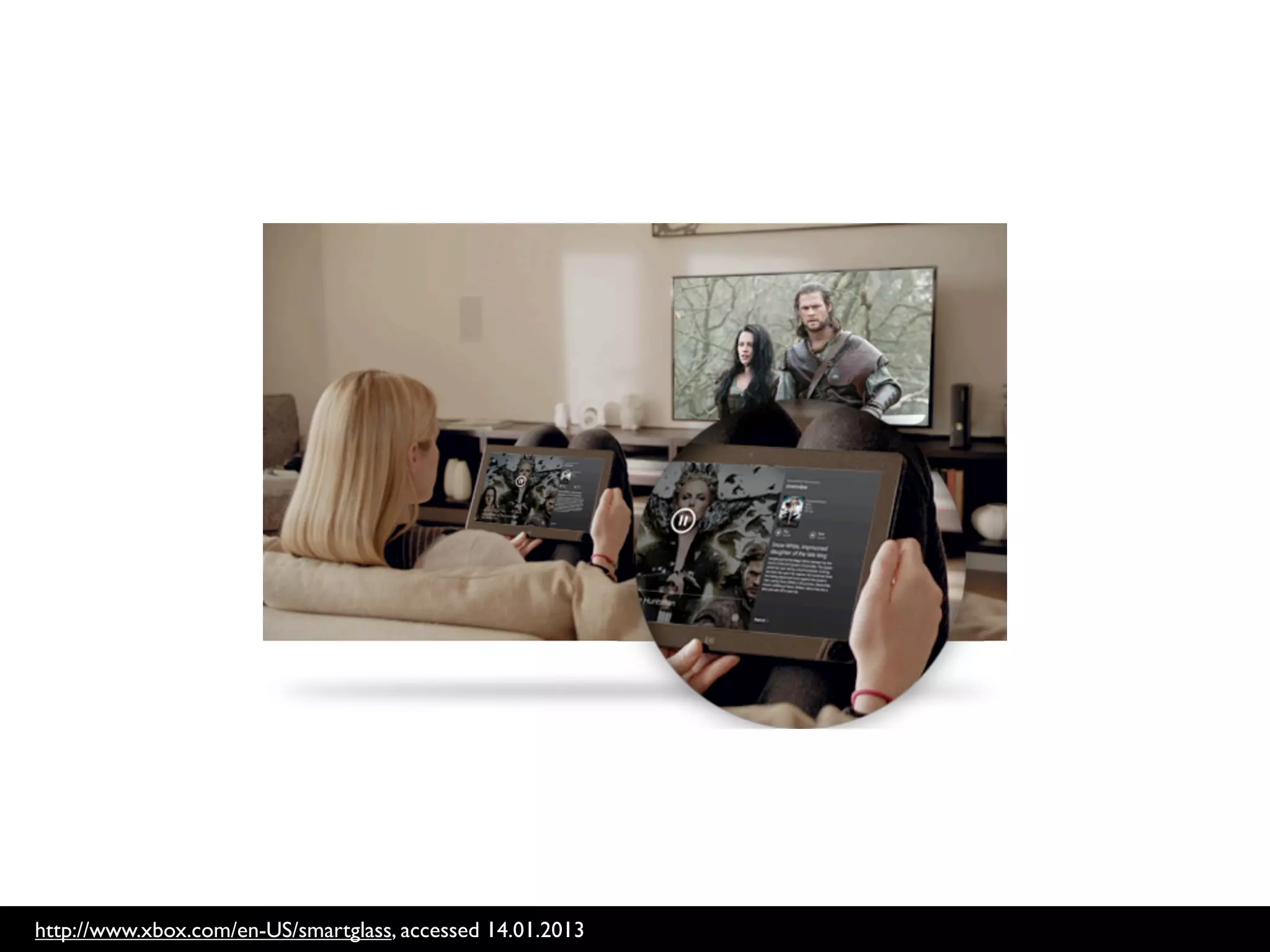
http://www.xbox.com/en-US/smartglass, accessed 14.01.2013
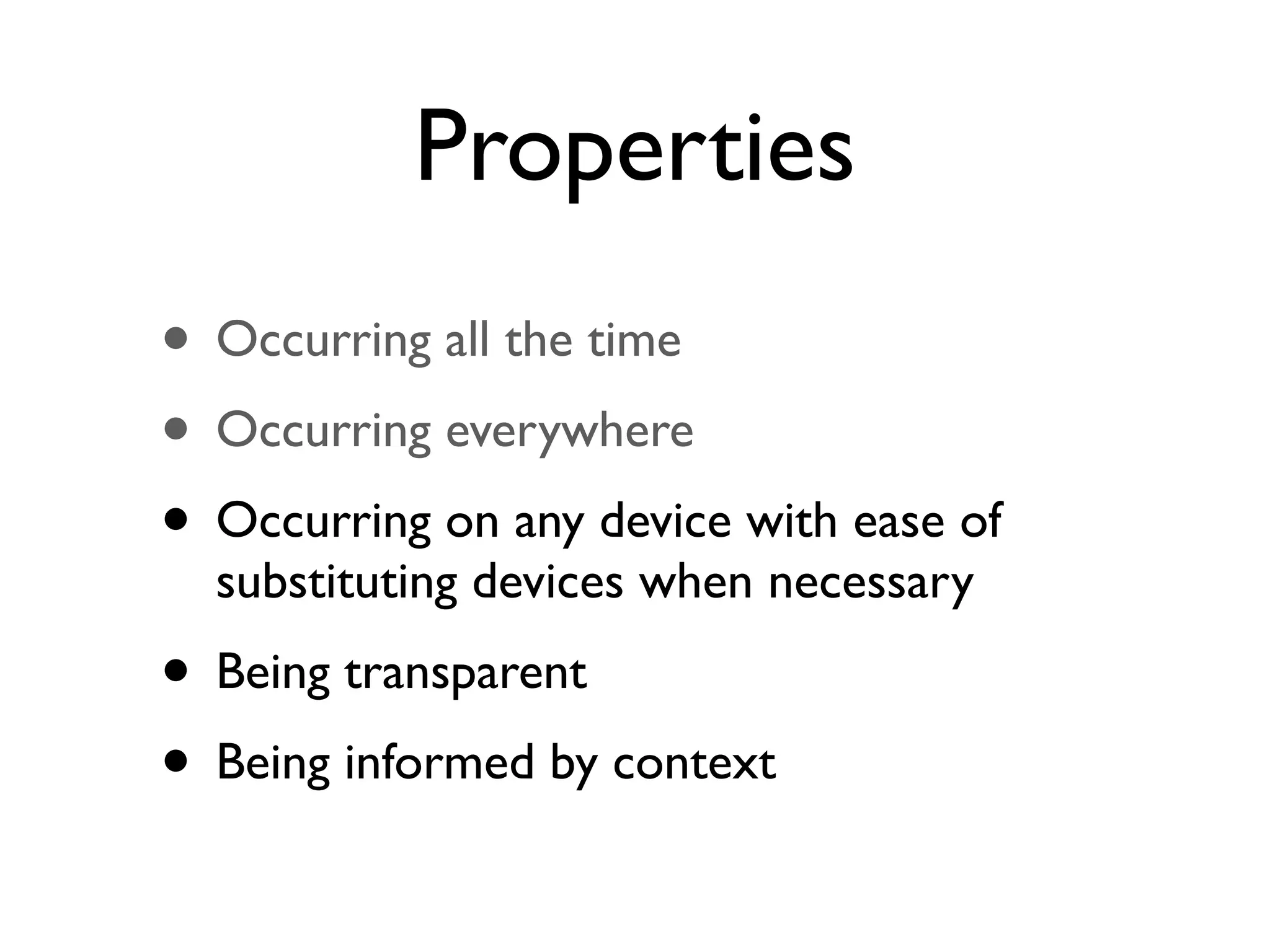
Properties
• Occurring all the time
• Occurring everywhere
• Occurring on any device with ease of
  substituting devices when necessary
• Being transparent
• Being informed by context
Properties
• Occurring all the time
• Occurring everywhere
• Occurring on any device with ease of
  substituting devices when necessary
• Being transparent
• Being informed by context
Properties
• Occurring all the time
• Occurring everywhere
• Occurring on any device with ease of
  substituting devices when necessary
• Being transparent
• Being informed by context
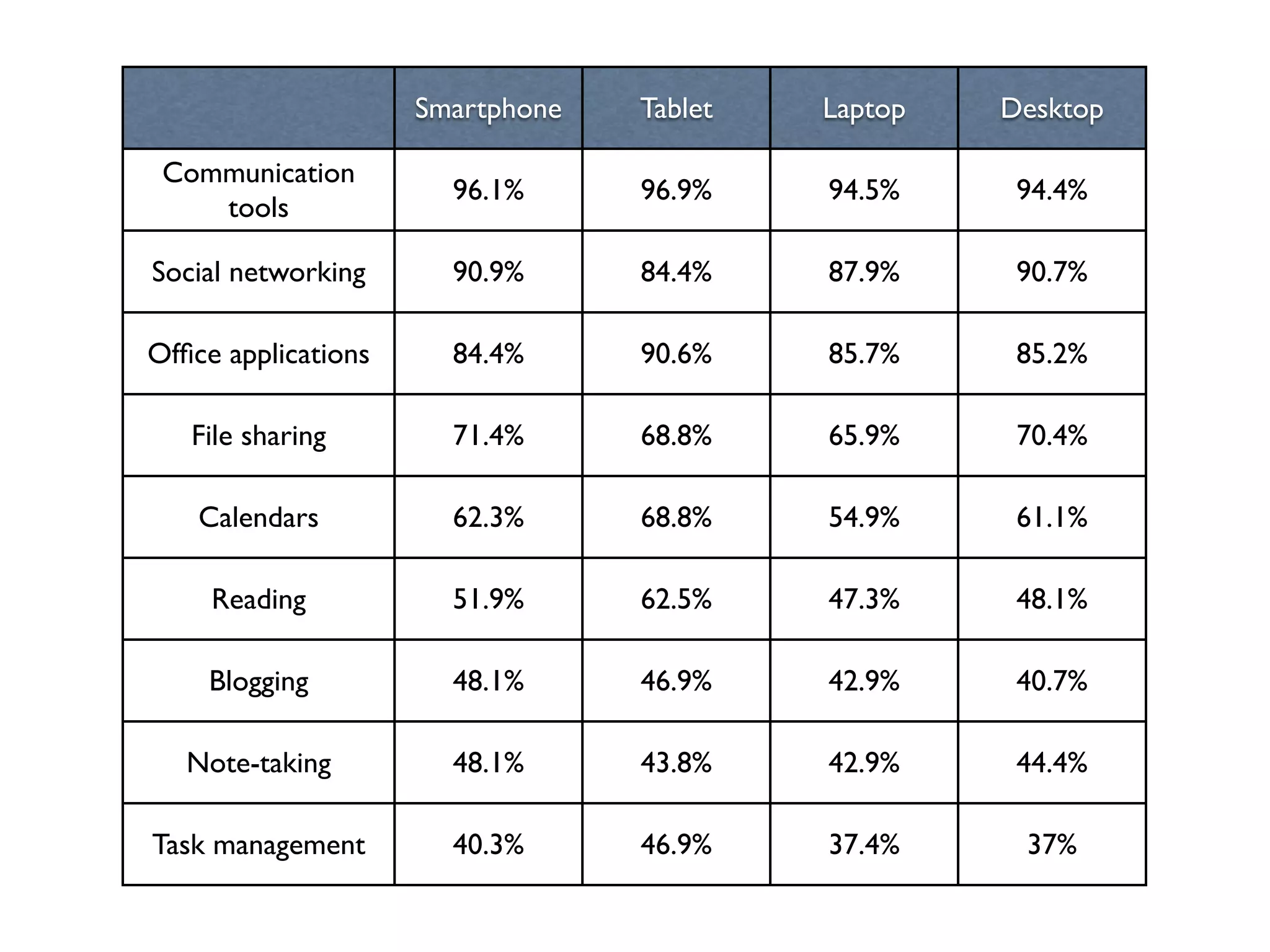
Smartphone   Tablet   Laptop   Desktop

 Communication
                       96.1%      96.9%    94.5%     94.4%
    tools

Social networking      90.9%      84.4%    87.9%     90.7%

Office applications     84.4%      90.6%    85.7%     85.2%

   File sharing        71.4%      68.8%    65.9%     70.4%

    Calendars          62.3%      68.8%    54.9%     61.1%

     Reading           51.9%      62.5%    47.3%     48.1%

    Blogging           48.1%      46.9%    42.9%     40.7%

   Note-taking         48.1%      43.8%    42.9%     44.4%

Task management        40.3%      46.9%    37.4%     37%
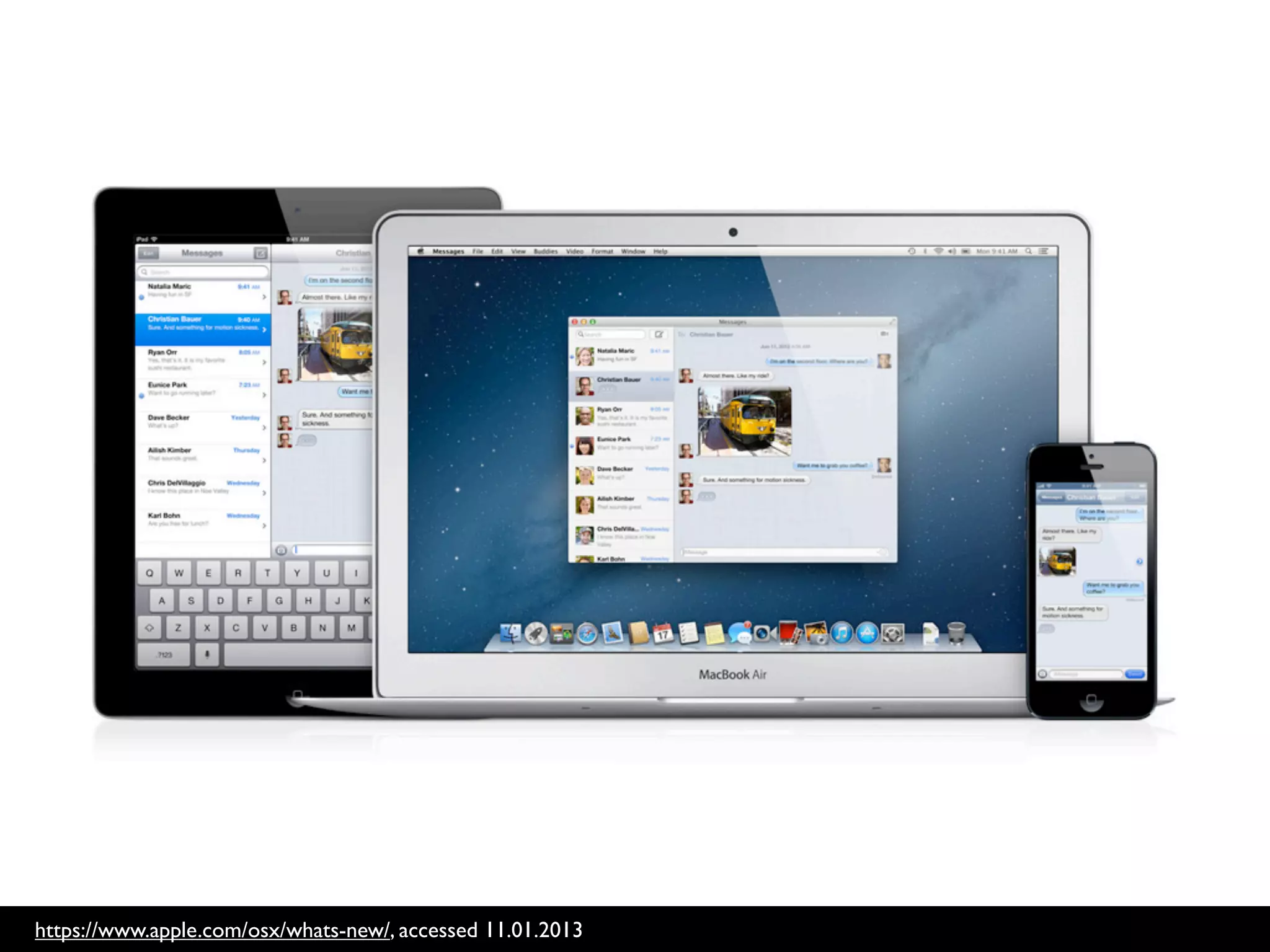
https://www.apple.com/osx/whats-new/, accessed 11.01.2013
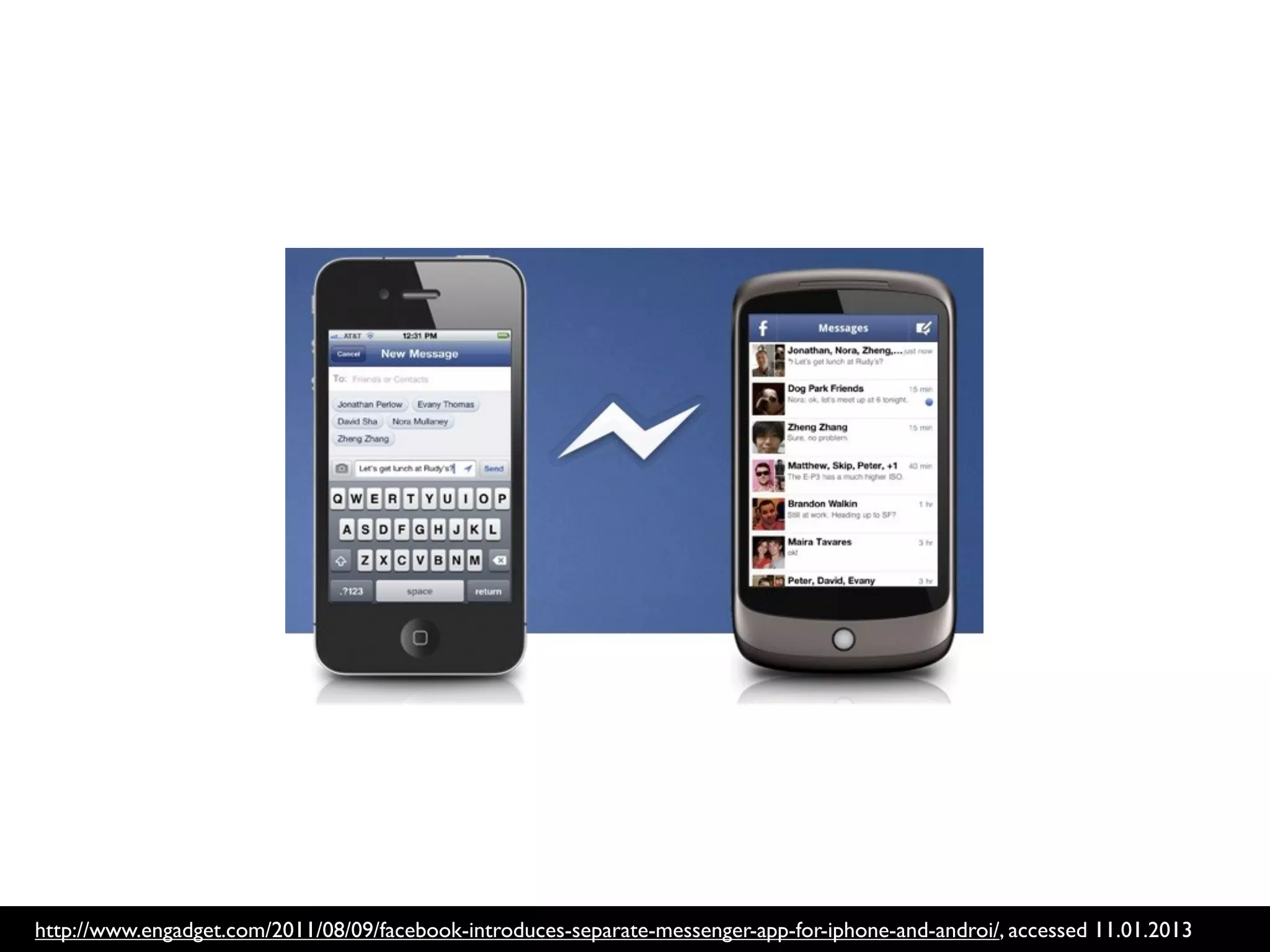
http://www.engadget.com/2011/08/09/facebook-introduces-separate-messenger-app-for-iphone-and-androi/, accessed 11.01.2013
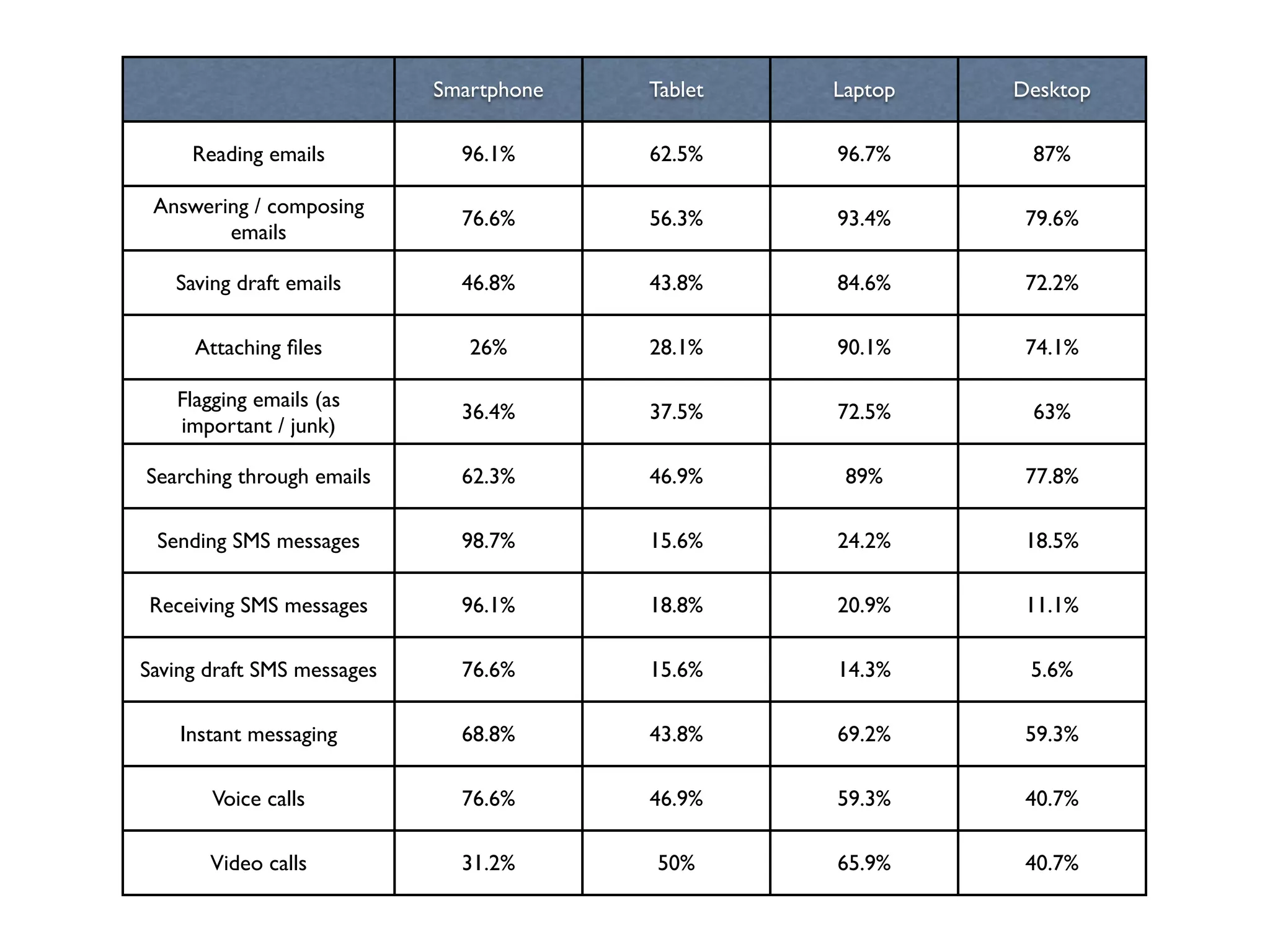
Smartphone   Tablet   Laptop   Desktop

     Reading emails           96.1%      62.5%    96.7%     87%

 Answering / composing
                              76.6%      56.3%    93.4%     79.6%
        emails

   Saving draft emails        46.8%      43.8%    84.6%     72.2%

     Attaching files            26%       28.1%    90.1%     74.1%

   Flagging emails (as
                              36.4%      37.5%    72.5%     63%
   important / junk)

Searching through emails      62.3%      46.9%     89%      77.8%

 Sending SMS messages         98.7%      15.6%    24.2%     18.5%

Receiving SMS messages        96.1%      18.8%    20.9%     11.1%

Saving draft SMS messages     76.6%      15.6%    14.3%     5.6%

    Instant messaging         68.8%      43.8%    69.2%     59.3%

       Voice calls            76.6%      46.9%    59.3%     40.7%

       Video calls            31.2%      50%      65.9%     40.7%
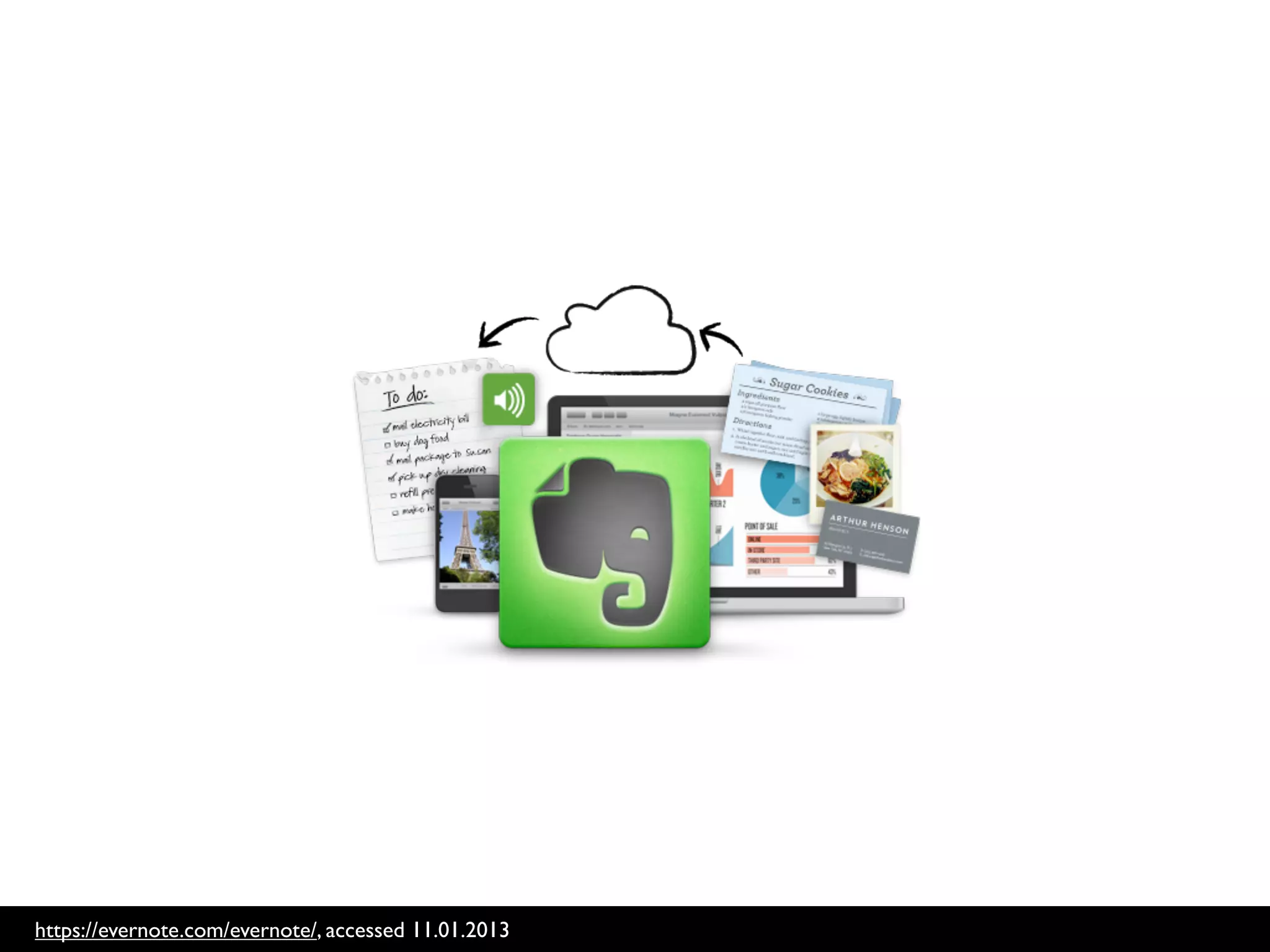
https://evernote.com/evernote/, accessed 11.01.2013
Conclusion
The New Reality
• People use a plethora of different devices
  and services to support their activities.
• Devices can collect and leverage contextual
  information.
• We currently do not have a clear
  understanding how to design for this type
  of interaction.
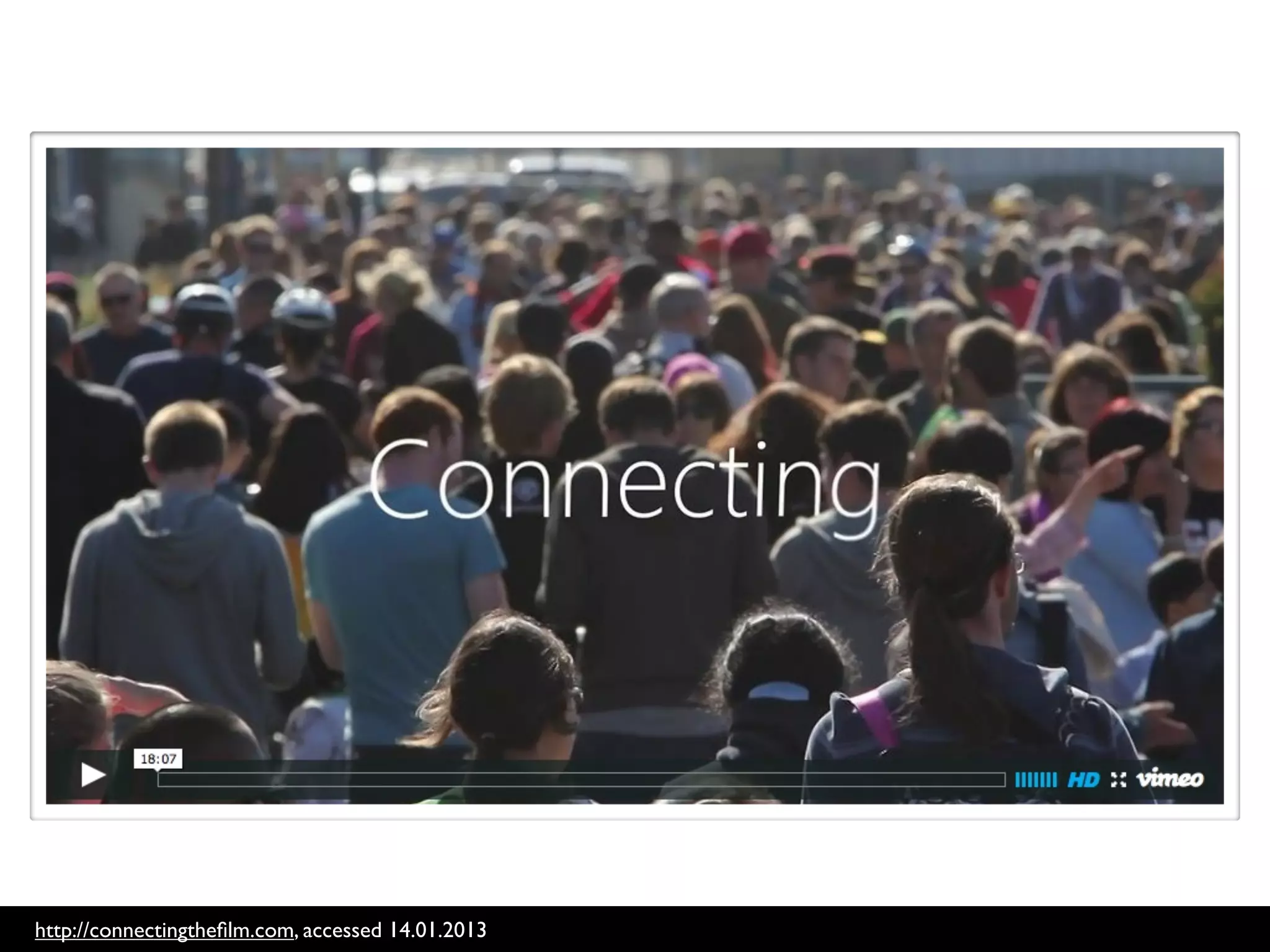
http://connectingthefilm.com, accessed 14.01.2013
Thank you

Ubiquitous interactions

  • 1.
  • 2.
  • 3.
  • 4.
    New Types of Interaction • Our activities are supported by a wide range of devices and software. • Our devices are capable of sensing the context of our activities. • Our devices and services are still being designed in isolation.
  • 5.
    Camera GPS and GLONASS Ambient light sensor Proximity sensor Accelerometer Three-axis gyroscope Digital compass WiFi 3G and EDGE Bluetooth http://www.apple.com/iphone/specs.html, accessed 28.11.2012
  • 6.
  • 7.
    Post-Desktop Model of HCI • Information processing is integrated into everyday objects [1]. • Ubiquitous computing is subsuming traditional computing paradigms, for example desktop and mobile computing [2]. 1. Zhao, R., Wang, J.:Visualizing the research on pervasive and ubiquitous computing. Scientometrics 86(3), 593–612 (2011) 2. Greenfield, A.: Everyware: The Dawning Age of Ubiquitous Computing. New Riders Publishing, 1st edn. (Mar 2006)
  • 8.
    Invisible Computing • Interaction with computers should be more like interaction with the physical world [1]. • Users should be able to sense and control what directly interests them [2]. • Our devices remain the focus of attention instead of fading into the background. 1. Abowd, G., Mynatt, E.: Charting past, present, and future research in ubiquitous computing. ACM Transactions on Computer-Human Interaction (TOCHI) 7(1), 29–58 (2000) 2. Roussos, G., Musolesi, M., Magoulas, G.D.: Human behavior in ubiquitous environments: Experience and interaction design. Pervasive and Mobile Computing 6(5), 497–498 (Oct 2010)
  • 9.
  • 10.
    People and Computers • Previously a ”one-to-one” relationship, one technology - one application - one user. • Nowadays “many-to-many”, with ever- changing configurations of devices, applications, and users. Brodersen, C., Bødker, S., Klokmose, C.: Ubiquitous substitution. Human-Computer Interaction–INTERACT 2007 pp. 179–192 (2007)
  • 11.
  • 12.
    Context • Any information, which characterizes the situation of a person, a place or an object, relevant to the interaction between a user and an application [1]. • Ubiquitous computing as ”a technology of context” [2]. 1. Chen, G., Kotz, D.: A survey of context-aware mobile computing research (2000) 2. Dourish,P.: Where the Action Is: The Foundations of Embodied Interaction (Bradford Books). The MIT Press, new ed edn. (Aug 2004)
  • 13.
    Types of Context • Where you are. • Who you are with. • What resources are nearby. Schilit, B., Adams, N., Want, R.: Context-aware computing applications (1994)
  • 14.
    wn apps Unsatisfactory state Stable state seen as ? Artifact ‘how’ pending ng that reading s men- deeper ble dy- Excited state Figure 2. The states of the artifact ecology. In the unsatisfactory gies are state the current artifact ecology no longer lives up to the users sms of S., Klokmose, C.N.: Dynamics in artifact ecologies (2012) Bødker,
  • 15.
  • 16.
    Definition Interactions in the context of ubiquitous computing, which include multiple, dynamic, and distributed interfaces. Klokmose, C.N.: An Instrumental Paradigm for Ubiquitous Interaction. DHRS 2006 p. 33 (2006)
  • 17.
  • 18.
    Properties • Occurring allthe time • Occurring everywhere • Occurring on any device with ease of substituting devices when necessary • Being transparent • Being informed by context
  • 19.
    Properties • Occurring allthe time • Occurring everywhere • Occurring on any device with ease of substituting devices when necessary • Being transparent • Being informed by context
  • 20.
    Properties • Occurring allthe time • Occurring everywhere • Occurring on any device with ease of substituting devices when necessary • Being transparent • Being informed by context
  • 21.
    Smartphone Tablet Laptop Desktop Communication 96.1% 96.9% 94.5% 94.4% tools Social networking 90.9% 84.4% 87.9% 90.7% Office applications 84.4% 90.6% 85.7% 85.2% File sharing 71.4% 68.8% 65.9% 70.4% Calendars 62.3% 68.8% 54.9% 61.1% Reading 51.9% 62.5% 47.3% 48.1% Blogging 48.1% 46.9% 42.9% 40.7% Note-taking 48.1% 43.8% 42.9% 44.4% Task management 40.3% 46.9% 37.4% 37%
  • 22.
  • 23.
  • 24.
    Smartphone Tablet Laptop Desktop Reading emails 96.1% 62.5% 96.7% 87% Answering / composing 76.6% 56.3% 93.4% 79.6% emails Saving draft emails 46.8% 43.8% 84.6% 72.2% Attaching files 26% 28.1% 90.1% 74.1% Flagging emails (as 36.4% 37.5% 72.5% 63% important / junk) Searching through emails 62.3% 46.9% 89% 77.8% Sending SMS messages 98.7% 15.6% 24.2% 18.5% Receiving SMS messages 96.1% 18.8% 20.9% 11.1% Saving draft SMS messages 76.6% 15.6% 14.3% 5.6% Instant messaging 68.8% 43.8% 69.2% 59.3% Voice calls 76.6% 46.9% 59.3% 40.7% Video calls 31.2% 50% 65.9% 40.7%
  • 25.
  • 26.
  • 27.
    The New Reality •People use a plethora of different devices and services to support their activities. • Devices can collect and leverage contextual information. • We currently do not have a clear understanding how to design for this type of interaction.
  • 28.
  • 29.