Università di Pavia - Dipartimento di Elettronica
Dottorato di Ricerca in Microelettronica - XXIII Ciclo


Class-G Headphones Amplifier

         Ph.D. Candidate: Alex Lollio

                            TUTORE:
                            CHIAR.MO PROF. RINALDO CASTELLO
                            COORDINATORE:
                            CHIAR.MO PROF. FRANCO MALOBERTI
1/28
           Headphone audio amplifiers
                  Target application

  Modern cellular phones incorporates music playback and
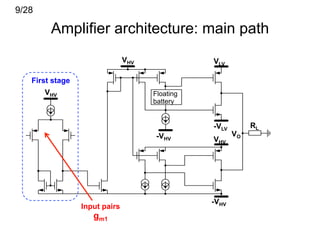
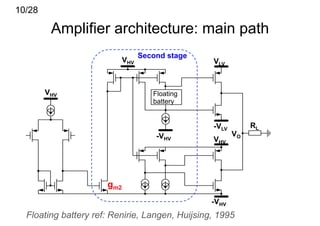
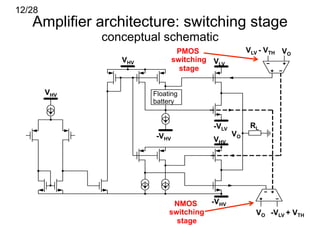
users may wish to use this feature for many hours

 Typical operating conditions
                                          Key objectives:
        VHV        •  Single ended
                                          •  Low distortion
                   •  RL = 32/16 Ω
                   •  BW = 20Hz–20kHz
  VIN              •  PO,MAX > 40mW (on   •  Low noise
                   16 Ω)
        -VHV                              •  High efficiency
Outline
•  Headphone amplifier
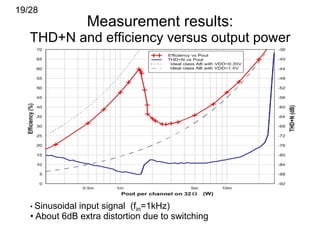
    (Class-AB, Class-D, Class-G PROs and CONs)

•  Class-G headphone driver
    (architecture, switching principle, distortion analysis)

•  Prototype in 65nm CMOS technology
    (implementation, results, comparison)

•  Class G improved version
    (new SNR Spec, proposed solution, results and comparison)

•  Conclusions
Outline
•  Headphone amplifier
    (Class-AB, Class-D, Class-G PROs and CONs)

•  Class-G headphone driver
    (architecture, switching principle, distortion analysis)

•  Prototype in 65nm CMOS technology
    (implementation, results, comparison)

•  Class G improved version
    (new SNR Spec, proposed solution, results and comparison)

•  Conclusions
2/28
            Headphone audio amplifiers
                    Alternative topologies
      Class AB (Linear amplifier)
  PROs:      Best linearity
             No EMI problems
  CONs:      Low efficiency
  Typically the preferred solution in headphone application


      Class D (Switching amplifier)
  PROs:      Best efficiency
  CONs:      Less linearity than class AB
             EMI problems
  Emerging solution in headphone application
3/28
              Headphone audio amplifiers
                     Alternative topologies
      Class G: It is a linear amplifier which uses two voltage supply
       rails which switches to the appropriate voltage as required by
       the instantaneous output voltage

                   VHV                   VHV
                      VLV                VLV
                               VOUT                       VOUT
VIN                                      -VLV
                      -VLV               -VHV
                   -VHV
  PROs: High efficiency but less than class D
            High linearity but less than class AB
            No EMI problems
  CONs: It needs two voltage supply rails
4/28
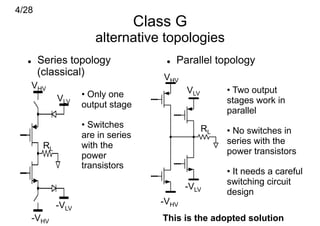
                                    Class G
                       alternative topologies
      Series topology                      Parallel topology
       (classical)                      VHV
   VHV                                                    •  Two output
                    •  Only one                VLV
             VLV                                          stages work in
                    output stage
                                                          parallel
                    •  Switches                      RL
                    are in series                         •  No switches in
                    with the                              series with the
        RL
                    power                                 power transistors
                    transistors
                                                          •  It needs a careful
                                                          switching circuit
                                              -VLV
                                                          design
             -VLV                      -VHV
   -VHV                                This is the adopted solution
5/28

                   Class G: working principle
   VHV
                                             Iout[A]         HV stage
                    Iout[A]                            iHV   LV stage
          VLV
                              iLV                             iLV
                                             t                              t

iHV          iLV

iHV          iLV

                                                 Switching
                                                   point
          -VLV
   -VHV

 For Vout below the switching point the low voltage stage is active.
 For Vout above the switching point both the low voltage and high voltage
 stages drive the load (in different moments).
6/28

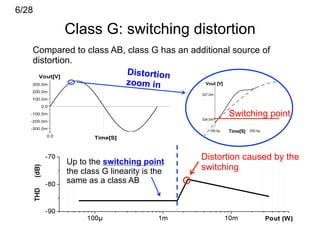
          Class G: switching distortion
   Compared to class AB, class G has an additional source of
   distortion.
                         Distortion
                        zoom in


                                                  Switching point


                                           Distortion caused by the
           Up to the switching point
           the class G linearity is the    switching
           same as a class AB


                                                                    9
7/28

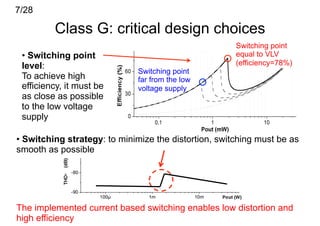
         Class G: critical design choices
                                                       Switching point
 •  Switching point                                    equal to VLV
 level:                                                (efficiency=78%)
                              Switching point
 To achieve high              far from the low
 efficiency, it must be       voltage supply
 as close as possible
 to the low voltage
 supply

•  Switching strategy: to minimize the distortion, switching must be as
smooth as possible


The implemented current based switching enables low distortion and
high efficiency
Outline
•  Headphone amplifier
    (Class-AB, Class-D, Class-G PROs and CONs)

•  Class-G headphone driver
    (architecture, switching principle, distortion analysis)

•  Prototype in 65nm CMOS technology
    (implementation, results, comparison)

•  Class G improved version
    (new SNR Spec, proposed solution, results and comparison)

•  Conclusions
8/28

            Overall amplifier architecture
  Main path                R2
                                                         •  Three stage
                                 CM2        Switching    opamp with
                                              stage      differential input
                     gm2                                 and single ended
                                 -gm3L
                                                         output.
       R1
              gm1                                        •  The two
                                            VOUT         identical second
       R1                                                stages, gm2, and
            R2       gm2         -gm3H         RL
                                                         the third stages,
                                                         gm3L and gm3H,
                      CM1        CM2                     work in parallel.


 •  Only the low voltage stage gm3L is supplied by the low voltage rail
 ±VLV. The rest of the circuit is supplied by the high voltage rail ±VHV
9/28

        Amplifier architecture: main path
                               VHV              VLV

   First stage
       VHV                           Floating
                                     battery


                                                -VLV        RL
                                      -VHV             VO
                                                VHV


                                                -VHV
                 Input pairs                                     13
                    gm1
10/28

         Amplifier architecture: main path
                                  Second stage
                            VHV                  VLV


        VHV                          Floating
                                     battery


                                                 -VLV        RL
                                      -VHV              VO
                                                 VHV


                      gm2
                                                 -VHV
                                                                  14
  Floating battery ref: Renirie, Langen, Huijsing, 1995
11/28

         Amplifier architecture: main path
                            LV stage
                   VHV        gm3L       VLV


        VHV              Floating
                         battery


                                         -VLV        RL
                          -VHV                  VO
                                         VHV


                            HV stage     -VHV
                                 gm3H   Third
                                                          15

                                        stage
12/28
   Amplifier architecture: switching stage
              conceptual schematic
                                PMOS                 VLV - VTH VO
                 VHV           switching VLV
                                 stage


        VHV            Floating
                       battery


                                         -VLV         RL
                        -VHV                    VO
                                         VHV


                             NMOS     -VHV
                            switching                  VO -VLV + VTH
                              stage
13/28
   Amplifier architecture: switching stage
              conceptual schematic
                                PMOS                 VLV - VTH VO
                 VHV           switching VLV
                                 stage


        VHV            Floating
                       battery


                                         -VLV         RL
                        -VHV                    VO
                                         VHV


                                        -VHV
                                                       VO -VLV + VTH
14/28

                  Switching principle details
                           VHV
                                 VLV
                        iJL                    •  Switching point sensing is in
                                               voltage domain.
                     VHV
                                    LV stage   A differential pair compares the
                                               output voltage to the switching
                                               point voltage VLV-VTH

                                 -VLV   VOUT   •  The switching between the
                                 VHV           high voltage and low voltage
                        iJH                    output stage is current based.
VOUT
                                               The switching circuit injects all
                  VLV - VTH                    its bias current into the gate of
                                               the MOS to be switched off.
          IBIAS                     HV stage

  PMOS switching stage
                                 -VHV
15/28

                            Output currents during switching
                  Vout[V]

     VLV                                   •  When VOUT is lower than the
VLV -VTH                                   switching point (VLV-VTH) the
                                           switching circuit enables the LV stage
                                           and disables the HV stage

                                           •  When VOUT is higher than the low
                                       t   voltage supply VLV only the HV stage
                  Iout[A]                  drives the load
Output currents


                                iHV
                       iLV                 •  When VOUT is between VLV-VTH and
                                           VLV both stages drive the load
                                       t
16/28
                      Switching distortion:
         Amplifier model during the switching
•  We use a simplified linear model of the amplifier during the switching.
                           R2
                                         CM1

                                         CM2               This current is
                                                           used to
    R1                                                     represent the
                                                 VOUT      disturbance
                gm1        gm2          -gm3
                                                           generated by
                                                     RL
    R1     R2                                              the switching
                                 iJ                        stage.


                                      Where
Outline
•  Headphone amplifier
    (Class-AB, Class-D, Class-G PROs and CONs)

•  Class-G headphone driver
    (architecture, switching principle, distortion analysis)

•  Prototype in 65nm CMOS technology
    (implementation, results, comparison)

•  Class G improved version
    (new SNR Spec, proposed solution, results and comparison)

•  Conclusions
17/28

        Chip micrograph


                 •  65nm CMOS process
                     (1.8V analog transistors)
                 •  0.14mm2 active area per
                    channel
                 •  Voltage supplies:
                   High voltage rail ±1.4V
                   Low voltage rail ±0.35V
                 •  Switching point 50mV under
                    the low voltage supply
                 •  Max load capacitance 1nF
18/28
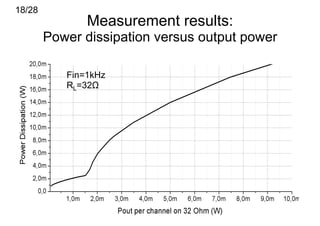
               Measurement results:
        Power dissipation versus output power

           Fin=1kHz
           RL=32Ω


                                                23
19/28
                   Measurement results:
   THD+N and efficiency versus output power


   •  Sinusoidal
               input signal (fin=1kHz)
   •  About 6dB extra distortion due to switching
20/28
               Performance summary and
                comparison with literature
                                         JSSC 09     ESSCIRC 06     ISCAS 09
                            This work
          Parameter                     (Class AB)    (Class AB)    (Class D)
                            (Class G)
                                            [1]           [2]          [3]
          Technology          65nm       130nm          65nm            0.13um
                              ±1.4V        ±1V
        Supply voltage                                  2.5V             3.6V
                             ±0.35V       ±0.6V
    Quiescent power (per
                             0.41mW      1.2mW        12.5mW            1.8mW
         channel)

   Peak load power (16Ω)     90mW         40mW        53.5mW            50mW

                            -80dB @      -84dB @       -68dB @      -80dB @
   THD+N @ PRMS (32Ω)
                             16mW         10mW       27mW (16Ω)      10mW
                                        92dB (un-
        SNR A-weighted       101dB                        -             96dB
                                        weighted)
  [1] Vijay Dhanasekaran, JSCC ‘09         [2] P. Bogner, ESSCIRC ’06
  [3] Pillonet, ISCAS ‘09
21/28

   Performance comparison with products
                        This work         MAX9725         TPA6141         LM48824
    Parameter
                        (Class G)        (Class AB)       (Class G)       (Class G)
                      1.4V with two                       3.6V with 1     3.6V with 1
                                        1.5V with one
  Supply voltage    charge pumps + 1                    charge pump +   charge pump +
                                        charge pump
                          buck                              1 buck          1 buck
Quiescent power (per 0.41mW + 0.3mW
                                          1.57mW          2.16mW          1.62mW
     channel)        (2 CPs + 1 buck)
 PSUP @ PL=0.1mW    0.87mW + 0.4mW            -            4.5mW          3.24mW

 PSUP @ PL=0.5mW    1.63mW + 0.6mW            -            7.2mW          5.58mW
  Peak load power    90mW     70mW
                                           50mW            50mW            74mW
       (16Ω)         (CPs RON=2.5Ω)
  THD+N @ PRMS
                     -80dB @ 16mW       -84dB @12mW -80dB @20mW         -69dB@20mW
     (32Ω)
  SNR A-weighted          101dB            92dB            105dB           102dB
Outline
•  Headphone amplifier
    (Class-AB, Class-D, Class-G PROs and CONs)

•  Class-G headphone driver
    (architecture, switching principle, distortion analysis)

•  Prototype in 65nm CMOS technology
    (implementation, results, comparison)

•  Class G improved version
    (new SNR Spec, proposed solution, results and comparison)

•  Conclusions
22/28

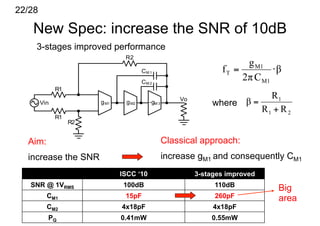
   New Spec: increase the SNR of 10dB
    3-stages improved performance


                                             where


  Aim:                           Classical approach:
  increase the SNR               increase gM1 and consequently CM1
                      ISCC ‘10           3-stages improved
   SNR @ 1VRMS         100dB                  110dB
                                                             Big
         CM1            15pF                  260pF          area
         CM2           4x18pF                 4x18pF
         PQ           0.41mW                 0.55mW
23/28

    4-stages Feed Forward (FF) solution

                                      •  The additional stages
                                         increase the open loop
                                         gain of the amplifier at
                                         low frequencies
                                      •  The stage gM11
                                         dominates the noise
                                         performance


                                   Additional stages


               Ref: A. Bosi et all. VDSL2 Analog Front End, ISSCC, 2009
24/28

    4-stages Feed Forward (FF) solution

                                      •  The amplifier cuf off
        High                             frequency is gM1/CM1
        freq path

                                      •  The GLOOP shows a
                                         zero at
             Low
             freq path


                         High freq path      gM1
                         Low freq path       gM11/sC · gM12
25/28

             4-stages FF: GLOOP plot


         Audio BW (20Hz-20kHz)


4-stages FF solution:
1.  gM11 determines the noise performances
2.  More open-loop gain in the audio BW
26/28

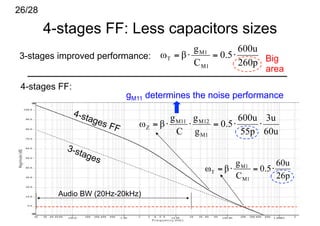
        4-stages FF: Less capacitors sizes
3-stages improved performance:                             Big
                                                           area
 4-stages FF:
                           gM11 determines the noise performance


          Audio BW (20Hz-20kHz)
27/28

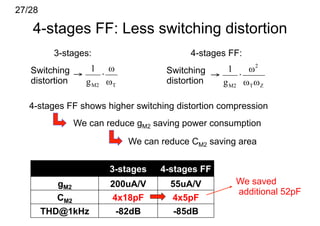
   4-stages FF: Less switching distortion
          3-stages:                       4-stages FF:
   Switching                        Switching
   distortion                       distortion

   4-stages FF shows higher switching distortion compression
                We can reduce gM2 saving power consumption

                            We can reduce CM2 saving area


                        3-stages   4-stages FF
           gM2          200uA/V      55uA/V         We saved
                                                    additional 52pF
           CM2          4x18pF       4x5pF
        THD@1kHz         -82dB        -85dB
28/28

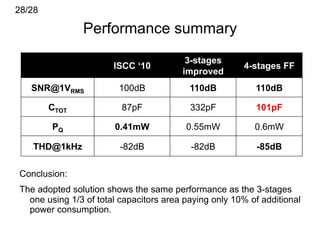
               Performance summary
                                         3-stages
                       ISCC ‘10                        4-stages FF
                                        improved
   SNR@1VRMS            100dB             110dB           110dB

        CTOT             87pF             332pF           101pF

        PQ             0.41mW            0.55mW           0.6mW

   THD@1kHz              -82dB            -82dB            -85dB

Conclusion:
The adopted solution shows the same performance as the 3-stages
  one using 1/3 of total capacitors area paying only 10% of additional
  power consumption.
Outline
•  Headphone amplifier
   (Class-AB, Class-D, Class-G PROs and CONs)


•  Class-G headphone driver
   (architecture, switching principle, distortion analysis)


•  Prototype in 65nm CMOS technology
   (implementation, results, comparison)


•  Conclusions
Conclusions

•  A class-G headphone driver has been presented. It shows 50%
   less power consumption than the best competitor.


•  The class-G improved version satisfies the most aggressive
   market requirements (110dB of SNR and better than 80dB of
   THD)


•  The class-G improved version will be integrated in Dec 2010 into
   a novel Marvell audio codec
Publications
•  Marvell Patent Ref No. MP3391:
  A. Lollio, G. Bollati, R. Castello, “CIRCUITS AND METHODS
  FOR AMPLIFYING SIGNALS”


•  A. Lollio, G. Bollati, R. Castello, “Class-G Headphone Driver in
   65nm CMOS Technology”, Proc. ISSCC 2010, San Francisco,
   7-11 Feb. 2010, pp.84-85


•  A. Lollio, G. Bollati, R. Castello, “A Class-G Headphone
   Amplifier in 65nm CMOS Technology” IEEE J. Solid-State
   Circuits, vol. 45, no. 12, Dec. 2010.
Activities Summary
Seminari organizzati dal dottorato (3.8 CFU)
Scuole di Dottorato (12 CFU)
Corso Elementi di Elettronica di Potenza (5 CFU)
Corso di Misure Elettriche (5 CFU)
Tutorato di Elettronica (2 CFU)
Presentazione a Congresso Internazionale: ISSCC2010 (3 CFU)
Pubblicazione su rivista internazionale: JSSC2010 (4 CFU)
Presentazioni annuale sull’attività di ricerca svolta (1.5 CFU)


                                                Totale CFU: 36.3
Buck and CPs:
Power consumption estimation (per channel)
2 Charge pumps                       PQ -> 0.2mW
1 Buck (80% efficiency), PL=0       Pdiss -> 0.1mW
1 Buck (80% efficiency), PL=0.1mW   Pdiss -> 0.2mW
1 Buck (80% efficiency), PL=0.5mW   Pdiss -> 0.4mW
Total power consumption
        PQ -> 0.2mW+0.1mW = 0.3mW
PL=0.1mW -> 0.2mW+0.2mW = 0.4mW
PL=0.5mW -> 0.2mW+0.4mW = 0.6mW
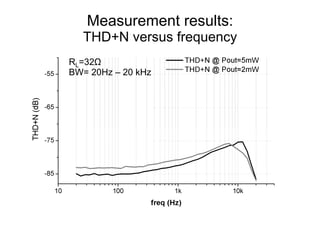
Measurement results:
  THD+N versus frequency
RL=32Ω
BW= 20Hz – 20 kHz
Measurement results:
Spectrum at different output power

  PO=1mW               PO=20mW
  Fin=1kHz             Fin=1kHz


                                     41
References
[1] Vijay Dhanasekaran; Jose Silva-Martinez; Edgar Sanchez-Sinencio, "Design of
    Three-Stage Class-AB 16Ohm Headphone Driver Capable of Handling Wide
    Range of Load Capacitance," Solid-State Circuits, IEEE Journal of , vol.44, no.6,
    pp.1734-1744, Jun 2009.

[2] P. Bogner, H. Habibovic and T. Hartig, ‘‘A High Signal Swing Class AB Earpiece
Amplifier in 65nm CMOS Technology,’’ Proc. ESSCIRC, pp.372-375, 2006.

[3] Pillonet, G., et al,”A 0.01% THD, 70dB PSRR Single Ended Class D using
    variable hysteresis control for Headphone Amplifiers”, ISCAS 2009 pp.1181-1184.

[4] Maxim, ‘‘1V, Low-Power, DirectDrive, Stereo Headphone Amplifier with
    Shutdown,’’ Rev. 3; 8/08, accessed on Jul. 7, 2009 < http://datasheets.maximic.
com/en/ds/MAX9725.pdf>

[5] Texas Instrument, ‘‘Class-G Directpath Stereo Headphone Amplifier,’’ 3/09,
    accessed on Jul. 7, 2009 < http://focus.ti.com/lit/ds/symlink/tpa6141a2.pdf>

[6] National Semiconductor ”Class G Headphone Amplifier with I2C Volume Control,”
    August 31,2009, accessed on Jan. 25, 2010
< http://www.national.com/ds/LM/LM48824.pdf >

Phd 3rd year Research Activity

  • 1.
    Università di Pavia- Dipartimento di Elettronica Dottorato di Ricerca in Microelettronica - XXIII Ciclo Class-G Headphones Amplifier Ph.D. Candidate: Alex Lollio TUTORE: CHIAR.MO PROF. RINALDO CASTELLO COORDINATORE: CHIAR.MO PROF. FRANCO MALOBERTI
  • 2.
    1/28 Headphone audio amplifiers Target application Modern cellular phones incorporates music playback and users may wish to use this feature for many hours Typical operating conditions Key objectives: VHV •  Single ended •  Low distortion •  RL = 32/16 Ω •  BW = 20Hz–20kHz VIN •  PO,MAX > 40mW (on •  Low noise 16 Ω) -VHV •  High efficiency
  • 3.
    Outline •  Headphone amplifier (Class-AB, Class-D, Class-G PROs and CONs) •  Class-G headphone driver (architecture, switching principle, distortion analysis) •  Prototype in 65nm CMOS technology (implementation, results, comparison) •  Class G improved version (new SNR Spec, proposed solution, results and comparison) •  Conclusions
  • 4.
    Outline •  Headphone amplifier (Class-AB, Class-D, Class-G PROs and CONs) •  Class-G headphone driver (architecture, switching principle, distortion analysis) •  Prototype in 65nm CMOS technology (implementation, results, comparison) •  Class G improved version (new SNR Spec, proposed solution, results and comparison) •  Conclusions
  • 5.
    2/28 Headphone audio amplifiers Alternative topologies   Class AB (Linear amplifier) PROs: Best linearity No EMI problems CONs: Low efficiency Typically the preferred solution in headphone application   Class D (Switching amplifier) PROs: Best efficiency CONs: Less linearity than class AB EMI problems Emerging solution in headphone application
  • 6.
    3/28 Headphone audio amplifiers Alternative topologies   Class G: It is a linear amplifier which uses two voltage supply rails which switches to the appropriate voltage as required by the instantaneous output voltage VHV VHV VLV VLV VOUT VOUT VIN -VLV -VLV -VHV -VHV PROs: High efficiency but less than class D High linearity but less than class AB No EMI problems CONs: It needs two voltage supply rails
  • 7.
    4/28 Class G alternative topologies   Series topology   Parallel topology (classical) VHV VHV •  Two output •  Only one VLV VLV stages work in output stage parallel •  Switches RL are in series •  No switches in with the series with the RL power power transistors transistors •  It needs a careful switching circuit -VLV design -VLV -VHV -VHV This is the adopted solution
  • 8.
    5/28 Class G: working principle VHV Iout[A] HV stage Iout[A] iHV LV stage VLV iLV iLV t t iHV iLV iHV iLV Switching point -VLV -VHV For Vout below the switching point the low voltage stage is active. For Vout above the switching point both the low voltage and high voltage stages drive the load (in different moments).
  • 9.
    6/28 Class G: switching distortion Compared to class AB, class G has an additional source of distortion. Distortion zoom in Switching point Distortion caused by the Up to the switching point the class G linearity is the switching same as a class AB 9
  • 10.
    7/28 Class G: critical design choices Switching point •  Switching point equal to VLV level: (efficiency=78%) Switching point To achieve high far from the low efficiency, it must be voltage supply as close as possible to the low voltage supply •  Switching strategy: to minimize the distortion, switching must be as smooth as possible The implemented current based switching enables low distortion and high efficiency
  • 11.
    Outline •  Headphone amplifier (Class-AB, Class-D, Class-G PROs and CONs) •  Class-G headphone driver (architecture, switching principle, distortion analysis) •  Prototype in 65nm CMOS technology (implementation, results, comparison) •  Class G improved version (new SNR Spec, proposed solution, results and comparison) •  Conclusions
  • 12.
    8/28 Overall amplifier architecture Main path R2 •  Three stage CM2 Switching opamp with stage differential input gm2 and single ended -gm3L output. R1 gm1 •  The two VOUT identical second R1 stages, gm2, and R2 gm2 -gm3H RL the third stages, gm3L and gm3H, CM1 CM2 work in parallel. •  Only the low voltage stage gm3L is supplied by the low voltage rail ±VLV. The rest of the circuit is supplied by the high voltage rail ±VHV
  • 13.
    9/28 Amplifier architecture: main path VHV VLV First stage VHV Floating battery -VLV RL -VHV VO VHV -VHV Input pairs 13 gm1
  • 14.
    10/28 Amplifier architecture: main path Second stage VHV VLV VHV Floating battery -VLV RL -VHV VO VHV gm2 -VHV 14 Floating battery ref: Renirie, Langen, Huijsing, 1995
  • 15.
    11/28 Amplifier architecture: main path LV stage VHV gm3L VLV VHV Floating battery -VLV RL -VHV VO VHV HV stage -VHV gm3H Third 15 stage
  • 16.
    12/28 Amplifier architecture: switching stage conceptual schematic PMOS VLV - VTH VO VHV switching VLV stage VHV Floating battery -VLV RL -VHV VO VHV NMOS -VHV switching VO -VLV + VTH stage
  • 17.
    13/28 Amplifier architecture: switching stage conceptual schematic PMOS VLV - VTH VO VHV switching VLV stage VHV Floating battery -VLV RL -VHV VO VHV -VHV VO -VLV + VTH
  • 18.
    14/28 Switching principle details VHV VLV iJL •  Switching point sensing is in voltage domain. VHV LV stage A differential pair compares the output voltage to the switching point voltage VLV-VTH -VLV VOUT •  The switching between the VHV high voltage and low voltage iJH output stage is current based. VOUT The switching circuit injects all VLV - VTH its bias current into the gate of the MOS to be switched off. IBIAS HV stage PMOS switching stage -VHV
  • 19.
    15/28 Output currents during switching Vout[V] VLV •  When VOUT is lower than the VLV -VTH switching point (VLV-VTH) the switching circuit enables the LV stage and disables the HV stage •  When VOUT is higher than the low t voltage supply VLV only the HV stage Iout[A] drives the load Output currents iHV iLV •  When VOUT is between VLV-VTH and VLV both stages drive the load t
  • 20.
    16/28 Switching distortion: Amplifier model during the switching •  We use a simplified linear model of the amplifier during the switching. R2 CM1 CM2 This current is used to R1 represent the VOUT disturbance gm1 gm2 -gm3 generated by RL R1 R2 the switching iJ stage. Where
  • 21.
    Outline •  Headphone amplifier (Class-AB, Class-D, Class-G PROs and CONs) •  Class-G headphone driver (architecture, switching principle, distortion analysis) •  Prototype in 65nm CMOS technology (implementation, results, comparison) •  Class G improved version (new SNR Spec, proposed solution, results and comparison) •  Conclusions
  • 22.
    17/28 Chip micrograph •  65nm CMOS process (1.8V analog transistors) •  0.14mm2 active area per channel •  Voltage supplies: High voltage rail ±1.4V Low voltage rail ±0.35V •  Switching point 50mV under the low voltage supply •  Max load capacitance 1nF
  • 23.
    18/28 Measurement results: Power dissipation versus output power Fin=1kHz RL=32Ω 23
  • 24.
    19/28 Measurement results: THD+N and efficiency versus output power •  Sinusoidal input signal (fin=1kHz) •  About 6dB extra distortion due to switching
  • 25.
    20/28 Performance summary and comparison with literature JSSC 09 ESSCIRC 06 ISCAS 09 This work Parameter (Class AB) (Class AB) (Class D) (Class G) [1] [2] [3] Technology 65nm 130nm 65nm 0.13um ±1.4V ±1V Supply voltage 2.5V 3.6V ±0.35V ±0.6V Quiescent power (per 0.41mW 1.2mW 12.5mW 1.8mW channel) Peak load power (16Ω) 90mW 40mW 53.5mW 50mW -80dB @ -84dB @ -68dB @ -80dB @ THD+N @ PRMS (32Ω) 16mW 10mW 27mW (16Ω) 10mW 92dB (un- SNR A-weighted 101dB - 96dB weighted) [1] Vijay Dhanasekaran, JSCC ‘09 [2] P. Bogner, ESSCIRC ’06 [3] Pillonet, ISCAS ‘09
  • 26.
    21/28 Performance comparison with products This work MAX9725 TPA6141 LM48824 Parameter (Class G) (Class AB) (Class G) (Class G) 1.4V with two 3.6V with 1 3.6V with 1 1.5V with one Supply voltage charge pumps + 1 charge pump + charge pump + charge pump buck 1 buck 1 buck Quiescent power (per 0.41mW + 0.3mW 1.57mW 2.16mW 1.62mW channel) (2 CPs + 1 buck) PSUP @ PL=0.1mW 0.87mW + 0.4mW - 4.5mW 3.24mW PSUP @ PL=0.5mW 1.63mW + 0.6mW - 7.2mW 5.58mW Peak load power 90mW 70mW 50mW 50mW 74mW (16Ω) (CPs RON=2.5Ω) THD+N @ PRMS -80dB @ 16mW -84dB @12mW -80dB @20mW -69dB@20mW (32Ω) SNR A-weighted 101dB 92dB 105dB 102dB
  • 27.
    Outline •  Headphone amplifier (Class-AB, Class-D, Class-G PROs and CONs) •  Class-G headphone driver (architecture, switching principle, distortion analysis) •  Prototype in 65nm CMOS technology (implementation, results, comparison) •  Class G improved version (new SNR Spec, proposed solution, results and comparison) •  Conclusions
  • 28.
    22/28 New Spec: increase the SNR of 10dB 3-stages improved performance where Aim: Classical approach: increase the SNR increase gM1 and consequently CM1 ISCC ‘10 3-stages improved SNR @ 1VRMS 100dB 110dB Big CM1 15pF 260pF area CM2 4x18pF 4x18pF PQ 0.41mW 0.55mW
  • 29.
    23/28 4-stages Feed Forward (FF) solution •  The additional stages increase the open loop gain of the amplifier at low frequencies •  The stage gM11 dominates the noise performance Additional stages Ref: A. Bosi et all. VDSL2 Analog Front End, ISSCC, 2009
  • 30.
    24/28 4-stages Feed Forward (FF) solution •  The amplifier cuf off High frequency is gM1/CM1 freq path •  The GLOOP shows a zero at Low freq path High freq path gM1 Low freq path gM11/sC · gM12
  • 31.
    25/28 4-stages FF: GLOOP plot Audio BW (20Hz-20kHz) 4-stages FF solution: 1.  gM11 determines the noise performances 2.  More open-loop gain in the audio BW
  • 32.
    26/28 4-stages FF: Less capacitors sizes 3-stages improved performance: Big area 4-stages FF: gM11 determines the noise performance Audio BW (20Hz-20kHz)
  • 33.
    27/28 4-stages FF: Less switching distortion 3-stages: 4-stages FF: Switching Switching distortion distortion 4-stages FF shows higher switching distortion compression We can reduce gM2 saving power consumption We can reduce CM2 saving area 3-stages 4-stages FF gM2 200uA/V 55uA/V We saved additional 52pF CM2 4x18pF 4x5pF THD@1kHz -82dB -85dB
  • 34.
    28/28 Performance summary 3-stages ISCC ‘10 4-stages FF improved SNR@1VRMS 100dB 110dB 110dB CTOT 87pF 332pF 101pF PQ 0.41mW 0.55mW 0.6mW THD@1kHz -82dB -82dB -85dB Conclusion: The adopted solution shows the same performance as the 3-stages one using 1/3 of total capacitors area paying only 10% of additional power consumption.
  • 35.
    Outline •  Headphone amplifier (Class-AB, Class-D, Class-G PROs and CONs) •  Class-G headphone driver (architecture, switching principle, distortion analysis) •  Prototype in 65nm CMOS technology (implementation, results, comparison) •  Conclusions
  • 36.
    Conclusions •  A class-Gheadphone driver has been presented. It shows 50% less power consumption than the best competitor. •  The class-G improved version satisfies the most aggressive market requirements (110dB of SNR and better than 80dB of THD) •  The class-G improved version will be integrated in Dec 2010 into a novel Marvell audio codec
  • 37.
    Publications •  Marvell PatentRef No. MP3391: A. Lollio, G. Bollati, R. Castello, “CIRCUITS AND METHODS FOR AMPLIFYING SIGNALS” •  A. Lollio, G. Bollati, R. Castello, “Class-G Headphone Driver in 65nm CMOS Technology”, Proc. ISSCC 2010, San Francisco, 7-11 Feb. 2010, pp.84-85 •  A. Lollio, G. Bollati, R. Castello, “A Class-G Headphone Amplifier in 65nm CMOS Technology” IEEE J. Solid-State Circuits, vol. 45, no. 12, Dec. 2010.
  • 38.
    Activities Summary Seminari organizzatidal dottorato (3.8 CFU) Scuole di Dottorato (12 CFU) Corso Elementi di Elettronica di Potenza (5 CFU) Corso di Misure Elettriche (5 CFU) Tutorato di Elettronica (2 CFU) Presentazione a Congresso Internazionale: ISSCC2010 (3 CFU) Pubblicazione su rivista internazionale: JSSC2010 (4 CFU) Presentazioni annuale sull’attività di ricerca svolta (1.5 CFU) Totale CFU: 36.3
  • 39.
    Buck and CPs: Powerconsumption estimation (per channel) 2 Charge pumps PQ -> 0.2mW 1 Buck (80% efficiency), PL=0 Pdiss -> 0.1mW 1 Buck (80% efficiency), PL=0.1mW Pdiss -> 0.2mW 1 Buck (80% efficiency), PL=0.5mW Pdiss -> 0.4mW Total power consumption PQ -> 0.2mW+0.1mW = 0.3mW PL=0.1mW -> 0.2mW+0.2mW = 0.4mW PL=0.5mW -> 0.2mW+0.4mW = 0.6mW
  • 40.
    Measurement results: THD+N versus frequency RL=32Ω BW= 20Hz – 20 kHz
  • 41.
    Measurement results: Spectrum atdifferent output power PO=1mW PO=20mW Fin=1kHz Fin=1kHz 41
  • 42.
    References [1] Vijay Dhanasekaran;Jose Silva-Martinez; Edgar Sanchez-Sinencio, "Design of Three-Stage Class-AB 16Ohm Headphone Driver Capable of Handling Wide Range of Load Capacitance," Solid-State Circuits, IEEE Journal of , vol.44, no.6, pp.1734-1744, Jun 2009. [2] P. Bogner, H. Habibovic and T. Hartig, ‘‘A High Signal Swing Class AB Earpiece Amplifier in 65nm CMOS Technology,’’ Proc. ESSCIRC, pp.372-375, 2006. [3] Pillonet, G., et al,”A 0.01% THD, 70dB PSRR Single Ended Class D using variable hysteresis control for Headphone Amplifiers”, ISCAS 2009 pp.1181-1184. [4] Maxim, ‘‘1V, Low-Power, DirectDrive, Stereo Headphone Amplifier with Shutdown,’’ Rev. 3; 8/08, accessed on Jul. 7, 2009 < http://datasheets.maximic. com/en/ds/MAX9725.pdf> [5] Texas Instrument, ‘‘Class-G Directpath Stereo Headphone Amplifier,’’ 3/09, accessed on Jul. 7, 2009 < http://focus.ti.com/lit/ds/symlink/tpa6141a2.pdf> [6] National Semiconductor ”Class G Headphone Amplifier with I2C Volume Control,” August 31,2009, accessed on Jan. 25, 2010 < http://www.national.com/ds/LM/LM48824.pdf >