Phase 1 clinical trial
M.RAMESH BABU,M.PHARM
ASSISTANT PROFESSOR
Dept. of Pharmaceutical Analysis
SRPS-BESTAVARIPETA
What is a clinical trial?


General definition: A clinical trial is any research study that
prospectively assigns human participants or groups of humans to one
or more health-related interventions to evaluate the effects on health
outcomes.
1. Interventions include but are not restricted to drugs,
2. cells and other biological products
3. surgical procedures
4. radiological procedures, devices
5. behavioral treatments
6. process-of-care changes
7. preventive care (WHO)
Clinical trial of drugs: a systematic study of pharmaceutical
products on human subjects in order to determine or verify the
clinical, pharmacological and adverse effects with the objective of
determining their safety and efficacy.
History of clinical trials





Earliest documented clinical trial:
found in old testament (605-562 BC)
1537: clinical trial to prevent infection of
battlefield wounds
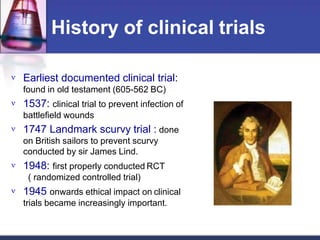
1747 Landmark scurvy trial : done
on British sailors to prevent scurvy
conducted by sir James Lind.
1948: first properly conducted RCT
( randomized controlled trial)
1945 onwards ethical impact on clinical
trials became increasingly important.
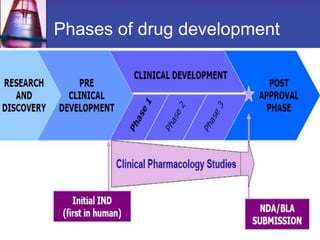
Phases of clinical trial of
new drug
 Phase I: determines whether drug is safe to check for
efficacy
 Phase II: determines whether drug can have any efficacy
 Phase III: determines a drug's therapeutic effect
 Post marketing surveillance or Phase IV: watch
drug's long term effects
Phases of drug development
PHASE-1
 studies designed mainly to investigate the safety/tolerability , identify
maximum tolerated dose ( MTD), pharmacokinetics and
pharmacodynamics of an investigational drug in humans
 PK: what the body does to the drug (Absorption, Distribution,
Metabolism, Excretion)
 PD: what the drug does to the body
 The development of new and better medicines is vital for public health.
 A key step in taking potential new medicines from the laboratory to
humans is the phase 1 clinical trial.
 Phase 1 is the gateway between scientific research and clinical
practice.
Few terms associated with
 Potential new medicines are called investigational medicinal products
(IMPs)
 Clinical trials of an IMP that do not benefit subjects are called phase
1 or nontherapeutic trials
 The premises where trials are done are called phase 1 units, or
simply units
 People who take part in clinical trials are called subjects
 The discipline that underpins phase 1 trials is called clinical or human
pharmacology
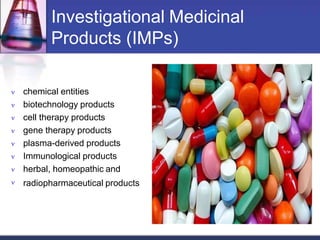
Investigational Medicinal
Products (IMPs)








chemical entities
biotechnology products
cell therapy products
gene therapy products
plasma-derived products
Immunological products
herbal, homeopathic and
radiopharmaceutical products
High risk IMPs










any agent that might cause severe disturbance of vital body systems
agents with agonistic or stimulatory action
novel agents or mechanisms of action for which there is no prior
experience
species-specificity, making pre-clinical risk assessment difficult or
impossible
high potency, e.g. compared with a natural ligand
multifunctional agents, e.g. bivalent antibodies
cell-associated targets
targets that bypass normal control mechanisms
immune system targets
targets in systems with potential for large biological amplification in vivo
Objectives
1. To assess a safe & tolerated dose
2. To see if pharmacokinetics differ much from animal to man
3. To see if kinetics show proper absorption, bioavailability
4. To detect effects unrelated to the expected action
5. To detect any toxicity
Method of First In Man study











Done in small number of healthy volunteers or in certain cases
patients
First in a small group of 20 to 25
Start with a dose adjusted from animal data
Slowly increase the dose to find a safe tolerated dose
If safe  in a larger group of up to about 50 –75
Randomized , placebo controlled studies.
Performed by clinical pharmacologists
Performed after receiving ethics committee clearance and proper
regulatory approval.
Centre has emergency care & facility for kinetics study
Performed in a single centre
Takes 3 – 6 months [ 70% success rate]
Stages of FIH study
 Single ascending dose (Phase Ia): In single ascending
dose studies, small groups of subjects are given a single dose of the
drug while they are observed and tested for a period of time to confirm
safety
 Multiple ascending dose (Phase Ib): Multiple ascending
dose studies investigate the pharmacokinetics and pharmacodynamics
of multiple doses of the drug, looking at safety and tolerability.
Preclinical assessments of
safety
 Pre clinical safety evaluation is essential for a safe starting dose for FIH
studies and identification of potential adverse effects that may occur
 Studies include: 1. single dose toxicity studies
2. repeat dose toxicity studies
3. safety pharmacology studies
4. pharmacokinetic and toxicology studies
5. local tolerance studies
6. genotoxicity and carcinogenecity studies
7. reproductive toxicity studies
Study Designs Applied


Parallel group design
Crossover study design
a. standard sequential dosing
b. interlocking cohort design
(Crossover studies are more favored over parallel designs
because they allow more efficient use of subjects who
serves as their own control with respect to safety and PK,
PD, there by reducing variability.)
Execution of phase 1-Subject
selection
Inclusion criteria
 Healthy volunteers ,
Uniformity of subjects
about age, sex,
nutritional status
[Informed consent a
must]
Exception:
 Patients only for toxic
drugs Eg AntiHIV,
Anticancer
Exclusion criteria
 Women of child bearing
age, children
Execution of phase 1-
Informed consent
Informed consent :
 subjects who enter phase 1 trial need to be fully informed that these
studies usually the initial clinical experiments in human
 Expected side effects as noted in preclinical studies are presented and
the possibility of other unpredictable side effects can occur must be
stated.
 Preferably be explained by clinical staff at the study site rather than the
sponsor and must contain rationale for the start dose and maximum
dose in lay language.
Execution of phase 1- starting
dose selection
 No observed adverse effect level (NOAEL) approach: most
commonly used approach. includes the following steps
1.determination of NOAELs in animal species.
2.conversion of NOAELs into human equivalent dose. Done by the
following equation:
HED (mg/Kg) = animal NOAEL x (weight animal/ weight
human) (1- b )
3.selection of the most appropriate animal species.
4.the application of a safety factor to determine the maximum
recommended starting dose (MRSD) for human studies.
 Minimum anticipated biological effect level (MABEL)
approach: usually done in case of high risk IMPs. Start with lowest dose
anticipated to be active rather than highest dose evaluated to be safe.
there is no definite protocol yet
Execution of phase 1- study
site







Regulatory agency
Appropriate medical governance
Drug specific biomarker
assessment facilities are present
Experienced with clinical trials of
IMPs at various levels of risk
standard protocols for carrying
out detailed safety monitoring is
present
Has a strategy for and
experience with dose escalation
decisions
Facilities and personnel for
acute emergency are present
coupled with intensive care unit
facilities
Execution of phase 1-
formulation applied
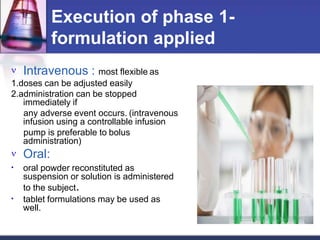
 Intravenous : most flexible as
1.doses can be adjusted easily
2.administration can be stopped
immediately if
any adverse event occurs. (intravenous
infusion using a controllable infusion
pump is preferable to bolus
administration)
 Oral:
•
•
oral powder reconstituted as
suspension or solution is administered
to the subject.
tablet formulations may be used as
well.
Execution of phase 1-
Required testing
 Regular monitoring of vitals- BP, pulse, respiration,
intake-output
 Routine investigations of hematological,
biochemical parameters, ECG, X-Ray, urine
analysis etc.
 Special investigations if needed
 blood and other laboratory tests are performed at
frequent intervals, measure the blood level of the
agent to monitor PK and PD profile of the drug
Execution of phase 1- data
collected about IND
 Pharmacokinetic data:
plasma level of drug and its metabolites are measured. Properties
include: Cmax
Tmax
AUC
plasma T1/2
Clearance
Volume of distribution
Early pharmacodynamics: target molecule binding etc
 PK Modeling: dose responserelationship
Benefits
 Safety, tolerability , pharmacokinetic profile of the drug are interpreted.
 A dose for phase 2 studies is decided based on MTD
 Usually phase 2 dose is about 80% of MTD
 While phase 1 studies are primarily directed toward establishing a
dose for further study there is always possibility of therapeutic benefit
in these studies when patients are taken as study subjects.
Subsequent Studies Done
1. ADME (i.e. Mass Balance) Study :


Objective: To understand the full clearance mechanisms of the drug and
its metabolites in humans
Information gained:
Primary mechanism(s) of elimination and excretion from the body
Proportion of parent drug converted to metabolite(s)
2.Bioavailability/Bioequivalence (BA/BE )Studies :


Objective: To evaluate the rate and extent of absorption of drug from a
test formulation (vs. reference formulation)
Information gained: Relative BA, Absolute BA of drug from a formulation
BE (no significant difference in BA) of test vs.
reference
Subsequent Studies Done
3.Food Effect Study :


Objective: To evaluate the effect of food on rate and extent of drug
absorption from a given formulation
Information gained: effect of food on the BA of oral drugs and
whether to administer drug on empty stomach or without regard to
meals
4.Renal Impairment Study :


Effect of renal impairment on drug clearance; dosage recommendations
for various stages of renal impairment
Effect of hemodialysis (HD) on drug exposure; info on whether dialysis
could be used as treatment for drug overdosage
Subsequent Studies Done
5.Hepatic Impairment Study


Effect of hepatic impairment on PK of parent drug and metabolites
Dosage recommendations for various stages of hepatic impairment
6.Drug Interaction Studies :
 Exposure-response information on the drug is important in assessing the
clinical significance of the change in AUC of substrate by inhibitor/inducer.
7.Thorough QT Study (TQT):


In vivo safety study required for all IMPs
identify drugs that prolong QT and need a more thorough ECG monitoring
in pivotal trials
Desirable Clinical Pharmacology
Properties of a Drug
ABSORPTION:



High absolute bioavailability with low variability
Exhibits linear PK over therapeutic dose range
AUC, Cmax not significantly affected by concomitant food, pH-
altering medications, grapefruit, alcohol, etc.
DISTRIBUTION:
 Reaches the target site(s) of action immediately and at
effective/nontoxic concentrations; doesn’t accumulate in non-
target organs.
 Not significantly (>80 to 95%) bound to plasma proteins; extent of
protein binding not concentration- and time-dependent
Desirable Clinical Pharmacology
Properties of a Drug
METABOLISM/EXCRETION:




Not extensively metabolized or not exclusively metabolized by a
CYP450 enzyme.
Not metabolized by polymorphic enzymes (e.g., CYPs 2D6, 2C19, 2C9,
NAT2).
CL not highly variable.
CL not time-dependent
OTHERS:
Not a Narrow Therapeutic Index Drug
Does not prolong the QT interval
Not a significant inhibitor or inducer of CYP3A, P-gp, etc.
Does not trigger formation of neutralizing anti-drug antibodies or organ-
damaging immune complexes
Phase 1 Studies: Impact on
Labeling
Conclusion




Conducting FIH studies of new drug involves many complex issues that
require a multidisciplinary approach involving close collaboration
between pharmacologists
toxicologists
statisticians
pharmacists
pharmaceutical chemists and
clinicians
The primary concern at study site must be the safety of study
participants.
The selection of study subjects, design, initial dose selection and dose
escalation strategies are largely dictated by character of the IMP.
Implementation is done after strictly maintaining scientific, regulatory
and ethical obligations.
Renal Impairment
Example:

doripenem powder for
IV use:
Because doripenem is primarily
eliminated by the kidneys, a Full PK
study in patients with renal impairment
was conducted.
 In Phase 2/3 trials, dosage was adjusted
based on creatinine clearance (CrCL).
 The label recommends dosage reduction
for patients with moderate or severe
renal impairment and hemodialysis as a
treatment for overdosage.
Food Effect Example:

atazanavir oral capsules:
Administration of a single dose of atazanavir
(800 mg) with a light meal increased Cmax by
57% and AUC by 70%; a high-fat meal
increased AUC by 35% with no change in Cmax.
Clinical trials were conducted under fed
conditions
 Label directs administration with a meal or snack
Drug Interaction Example:

bosutinib oral tablets:
Bosutinib a CYP3A substrate is extensively
metabolized; only 3% of the dose is
excreted unchanged in the urine.


In vivo, bosutinib AUC ↑ 9x with
ketoconazole (a strong CYP3A inhibitor), ↓
by 93% with rifampin (strong CYP3A
inducer).
Avoid concomitant use with all strong or
moderate CYP3A inducers or inhibitors.
Thank you

Phase clinicaltrial

  • 1.
    Phase 1 clinicaltrial M.RAMESH BABU,M.PHARM ASSISTANT PROFESSOR Dept. of Pharmaceutical Analysis SRPS-BESTAVARIPETA
  • 2.
    What is aclinical trial?   General definition: A clinical trial is any research study that prospectively assigns human participants or groups of humans to one or more health-related interventions to evaluate the effects on health outcomes. 1. Interventions include but are not restricted to drugs, 2. cells and other biological products 3. surgical procedures 4. radiological procedures, devices 5. behavioral treatments 6. process-of-care changes 7. preventive care (WHO) Clinical trial of drugs: a systematic study of pharmaceutical products on human subjects in order to determine or verify the clinical, pharmacological and adverse effects with the objective of determining their safety and efficacy.
  • 3.
    History of clinicaltrials      Earliest documented clinical trial: found in old testament (605-562 BC) 1537: clinical trial to prevent infection of battlefield wounds 1747 Landmark scurvy trial : done on British sailors to prevent scurvy conducted by sir James Lind. 1948: first properly conducted RCT ( randomized controlled trial) 1945 onwards ethical impact on clinical trials became increasingly important.
  • 4.
    Phases of clinicaltrial of new drug  Phase I: determines whether drug is safe to check for efficacy  Phase II: determines whether drug can have any efficacy  Phase III: determines a drug's therapeutic effect  Post marketing surveillance or Phase IV: watch drug's long term effects
  • 5.
    Phases of drugdevelopment
  • 7.
    PHASE-1  studies designedmainly to investigate the safety/tolerability , identify maximum tolerated dose ( MTD), pharmacokinetics and pharmacodynamics of an investigational drug in humans  PK: what the body does to the drug (Absorption, Distribution, Metabolism, Excretion)  PD: what the drug does to the body  The development of new and better medicines is vital for public health.  A key step in taking potential new medicines from the laboratory to humans is the phase 1 clinical trial.  Phase 1 is the gateway between scientific research and clinical practice.
  • 8.
    Few terms associatedwith  Potential new medicines are called investigational medicinal products (IMPs)  Clinical trials of an IMP that do not benefit subjects are called phase 1 or nontherapeutic trials  The premises where trials are done are called phase 1 units, or simply units  People who take part in clinical trials are called subjects  The discipline that underpins phase 1 trials is called clinical or human pharmacology
  • 9.
    Investigational Medicinal Products (IMPs)         chemicalentities biotechnology products cell therapy products gene therapy products plasma-derived products Immunological products herbal, homeopathic and radiopharmaceutical products
  • 10.
    High risk IMPs           anyagent that might cause severe disturbance of vital body systems agents with agonistic or stimulatory action novel agents or mechanisms of action for which there is no prior experience species-specificity, making pre-clinical risk assessment difficult or impossible high potency, e.g. compared with a natural ligand multifunctional agents, e.g. bivalent antibodies cell-associated targets targets that bypass normal control mechanisms immune system targets targets in systems with potential for large biological amplification in vivo
  • 11.
    Objectives 1. To assessa safe & tolerated dose 2. To see if pharmacokinetics differ much from animal to man 3. To see if kinetics show proper absorption, bioavailability 4. To detect effects unrelated to the expected action 5. To detect any toxicity
  • 12.
    Method of FirstIn Man study            Done in small number of healthy volunteers or in certain cases patients First in a small group of 20 to 25 Start with a dose adjusted from animal data Slowly increase the dose to find a safe tolerated dose If safe  in a larger group of up to about 50 –75 Randomized , placebo controlled studies. Performed by clinical pharmacologists Performed after receiving ethics committee clearance and proper regulatory approval. Centre has emergency care & facility for kinetics study Performed in a single centre Takes 3 – 6 months [ 70% success rate]
  • 13.
    Stages of FIHstudy  Single ascending dose (Phase Ia): In single ascending dose studies, small groups of subjects are given a single dose of the drug while they are observed and tested for a period of time to confirm safety  Multiple ascending dose (Phase Ib): Multiple ascending dose studies investigate the pharmacokinetics and pharmacodynamics of multiple doses of the drug, looking at safety and tolerability.
  • 14.
    Preclinical assessments of safety Pre clinical safety evaluation is essential for a safe starting dose for FIH studies and identification of potential adverse effects that may occur  Studies include: 1. single dose toxicity studies 2. repeat dose toxicity studies 3. safety pharmacology studies 4. pharmacokinetic and toxicology studies 5. local tolerance studies 6. genotoxicity and carcinogenecity studies 7. reproductive toxicity studies
  • 15.
    Study Designs Applied   Parallelgroup design Crossover study design a. standard sequential dosing b. interlocking cohort design (Crossover studies are more favored over parallel designs because they allow more efficient use of subjects who serves as their own control with respect to safety and PK, PD, there by reducing variability.)
  • 16.
    Execution of phase1-Subject selection Inclusion criteria  Healthy volunteers , Uniformity of subjects about age, sex, nutritional status [Informed consent a must] Exception:  Patients only for toxic drugs Eg AntiHIV, Anticancer Exclusion criteria  Women of child bearing age, children
  • 17.
    Execution of phase1- Informed consent Informed consent :  subjects who enter phase 1 trial need to be fully informed that these studies usually the initial clinical experiments in human  Expected side effects as noted in preclinical studies are presented and the possibility of other unpredictable side effects can occur must be stated.  Preferably be explained by clinical staff at the study site rather than the sponsor and must contain rationale for the start dose and maximum dose in lay language.
  • 18.
    Execution of phase1- starting dose selection  No observed adverse effect level (NOAEL) approach: most commonly used approach. includes the following steps 1.determination of NOAELs in animal species. 2.conversion of NOAELs into human equivalent dose. Done by the following equation: HED (mg/Kg) = animal NOAEL x (weight animal/ weight human) (1- b ) 3.selection of the most appropriate animal species. 4.the application of a safety factor to determine the maximum recommended starting dose (MRSD) for human studies.  Minimum anticipated biological effect level (MABEL) approach: usually done in case of high risk IMPs. Start with lowest dose anticipated to be active rather than highest dose evaluated to be safe. there is no definite protocol yet
  • 19.
    Execution of phase1- study site        Regulatory agency Appropriate medical governance Drug specific biomarker assessment facilities are present Experienced with clinical trials of IMPs at various levels of risk standard protocols for carrying out detailed safety monitoring is present Has a strategy for and experience with dose escalation decisions Facilities and personnel for acute emergency are present coupled with intensive care unit facilities
  • 20.
    Execution of phase1- formulation applied  Intravenous : most flexible as 1.doses can be adjusted easily 2.administration can be stopped immediately if any adverse event occurs. (intravenous infusion using a controllable infusion pump is preferable to bolus administration)  Oral: • • oral powder reconstituted as suspension or solution is administered to the subject. tablet formulations may be used as well.
  • 21.
    Execution of phase1- Required testing  Regular monitoring of vitals- BP, pulse, respiration, intake-output  Routine investigations of hematological, biochemical parameters, ECG, X-Ray, urine analysis etc.  Special investigations if needed  blood and other laboratory tests are performed at frequent intervals, measure the blood level of the agent to monitor PK and PD profile of the drug
  • 22.
    Execution of phase1- data collected about IND  Pharmacokinetic data: plasma level of drug and its metabolites are measured. Properties include: Cmax Tmax AUC plasma T1/2 Clearance Volume of distribution Early pharmacodynamics: target molecule binding etc  PK Modeling: dose responserelationship
  • 23.
    Benefits  Safety, tolerability, pharmacokinetic profile of the drug are interpreted.  A dose for phase 2 studies is decided based on MTD  Usually phase 2 dose is about 80% of MTD  While phase 1 studies are primarily directed toward establishing a dose for further study there is always possibility of therapeutic benefit in these studies when patients are taken as study subjects.
  • 24.
    Subsequent Studies Done 1.ADME (i.e. Mass Balance) Study :   Objective: To understand the full clearance mechanisms of the drug and its metabolites in humans Information gained: Primary mechanism(s) of elimination and excretion from the body Proportion of parent drug converted to metabolite(s) 2.Bioavailability/Bioequivalence (BA/BE )Studies :   Objective: To evaluate the rate and extent of absorption of drug from a test formulation (vs. reference formulation) Information gained: Relative BA, Absolute BA of drug from a formulation BE (no significant difference in BA) of test vs. reference
  • 25.
    Subsequent Studies Done 3.FoodEffect Study :   Objective: To evaluate the effect of food on rate and extent of drug absorption from a given formulation Information gained: effect of food on the BA of oral drugs and whether to administer drug on empty stomach or without regard to meals 4.Renal Impairment Study :   Effect of renal impairment on drug clearance; dosage recommendations for various stages of renal impairment Effect of hemodialysis (HD) on drug exposure; info on whether dialysis could be used as treatment for drug overdosage
  • 26.
    Subsequent Studies Done 5.HepaticImpairment Study   Effect of hepatic impairment on PK of parent drug and metabolites Dosage recommendations for various stages of hepatic impairment 6.Drug Interaction Studies :  Exposure-response information on the drug is important in assessing the clinical significance of the change in AUC of substrate by inhibitor/inducer. 7.Thorough QT Study (TQT):   In vivo safety study required for all IMPs identify drugs that prolong QT and need a more thorough ECG monitoring in pivotal trials
  • 27.
    Desirable Clinical Pharmacology Propertiesof a Drug ABSORPTION:    High absolute bioavailability with low variability Exhibits linear PK over therapeutic dose range AUC, Cmax not significantly affected by concomitant food, pH- altering medications, grapefruit, alcohol, etc. DISTRIBUTION:  Reaches the target site(s) of action immediately and at effective/nontoxic concentrations; doesn’t accumulate in non- target organs.  Not significantly (>80 to 95%) bound to plasma proteins; extent of protein binding not concentration- and time-dependent
  • 28.
    Desirable Clinical Pharmacology Propertiesof a Drug METABOLISM/EXCRETION:     Not extensively metabolized or not exclusively metabolized by a CYP450 enzyme. Not metabolized by polymorphic enzymes (e.g., CYPs 2D6, 2C19, 2C9, NAT2). CL not highly variable. CL not time-dependent OTHERS: Not a Narrow Therapeutic Index Drug Does not prolong the QT interval Not a significant inhibitor or inducer of CYP3A, P-gp, etc. Does not trigger formation of neutralizing anti-drug antibodies or organ- damaging immune complexes
  • 29.
    Phase 1 Studies:Impact on Labeling
  • 30.
    Conclusion     Conducting FIH studiesof new drug involves many complex issues that require a multidisciplinary approach involving close collaboration between pharmacologists toxicologists statisticians pharmacists pharmaceutical chemists and clinicians The primary concern at study site must be the safety of study participants. The selection of study subjects, design, initial dose selection and dose escalation strategies are largely dictated by character of the IMP. Implementation is done after strictly maintaining scientific, regulatory and ethical obligations.
  • 31.
    Renal Impairment Example:  doripenem powderfor IV use: Because doripenem is primarily eliminated by the kidneys, a Full PK study in patients with renal impairment was conducted.  In Phase 2/3 trials, dosage was adjusted based on creatinine clearance (CrCL).  The label recommends dosage reduction for patients with moderate or severe renal impairment and hemodialysis as a treatment for overdosage.
  • 32.
    Food Effect Example:  atazanaviroral capsules: Administration of a single dose of atazanavir (800 mg) with a light meal increased Cmax by 57% and AUC by 70%; a high-fat meal increased AUC by 35% with no change in Cmax. Clinical trials were conducted under fed conditions  Label directs administration with a meal or snack
  • 33.
    Drug Interaction Example:  bosutiniboral tablets: Bosutinib a CYP3A substrate is extensively metabolized; only 3% of the dose is excreted unchanged in the urine.   In vivo, bosutinib AUC ↑ 9x with ketoconazole (a strong CYP3A inhibitor), ↓ by 93% with rifampin (strong CYP3A inducer). Avoid concomitant use with all strong or moderate CYP3A inducers or inhibitors.
  • 34.