Presentation
on
Developments in battery thermal management systems for Electric Vehicles
Indian Institute of Technology Jodhpur
Course Instructor:
Dr. Durgamadhab Mishra
Materials For Electrochemical Energy Conversion and Storage: Batteries
(Course Code: PHL7521)
Presented By:
Ratul Panja (M22CI009)
Shailendra Chauhan (M22CI010)
MTech in Infrastructure Engineering with Specialization in Energy
Department of Civil and Infrastructure Engineering
1
NARROW DOWN APPROACH
EV Components
 Battery Technology
 Charging Infrastructure
 Motor
 Drivetrain
 Energy Management Software
 Materials
 Alternative Power Source
 Infrastructure and Grid Integration
Battery Technology
 Anode and Cathode Materials
 Electrolyte Chemistry
 Solid-State Batteries
 Battery Thermal Management
Systems (BTMS)
 Fast Charging Technology
 Battery Management Systems
(BMS)
 Recycling and Sustainability
BTMS
 Air-cooled BTMS
 Liquid-cooled BTMS
 PCM-based BTMS
 Heat pipe based BTMS
 Refrigeration based BTMS
 Hybrid BTMS
 Others
2
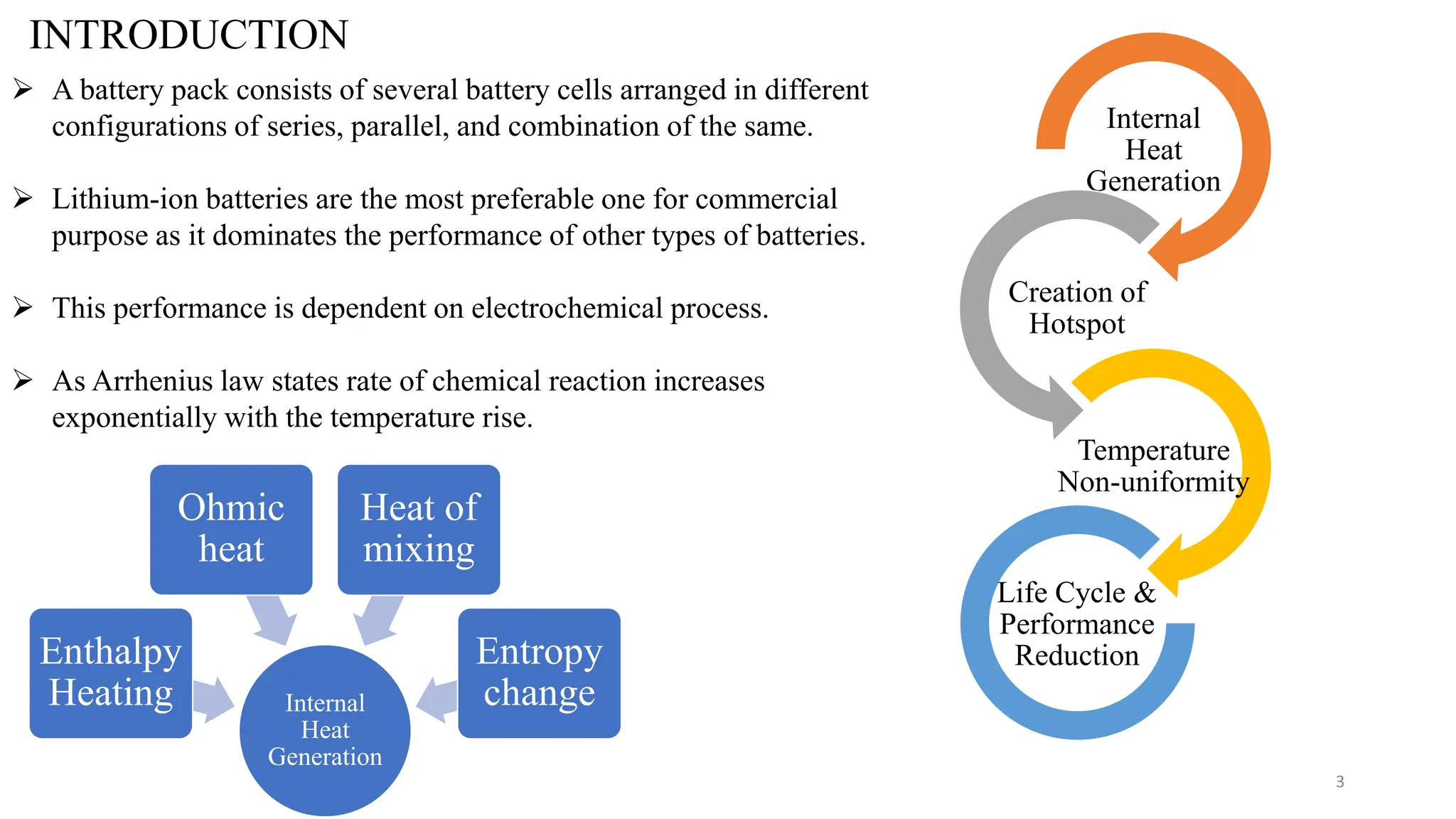
INTRODUCTION
 A battery pack consists of several battery cells arranged in different
configurations of series, parallel, and combination of the same.
 Lithium-ion batteries are the most preferable one for commercial
purpose as it dominates the performance of other types of batteries.
 This performance is dependent on electrochemical process.
 As Arrhenius law states rate of chemical reaction increases
exponentially with the temperature rise.
Internal
Heat
Generation
Enthalpy
Heating
Ohmic
heat
Heat of
mixing
Entropy
change
Internal
Heat
Generation
Creation of
Hotspot
Temperature
Non-uniformity
Life Cycle &
Performance
Reduction
3
EFFECT OF TEMPERATURE ON BATTERY PERFORMANCE
 The cycle life of a Li-ion battery is 3323 cycles at 45ºC , falling
significantly to 1037 cycles at 60ºC .
 The battery cells lost more than 60% of initial power at 50ºC after
800 cycles
 Lost 70% at 55ºC after 500 cycles.
 With high temperature, self-discharge of the battery occurs
TEMPERATURE
 The viscosity of the electrolyte increases.
 Ionic conductivity decreases
 Increase in the internal resistance of the battery pack.
 An increase in charge-transfer resistance, lithium plating, and lithium dendrites.
TEMPERATURE
Charging
• Endother
mic
Discharging
• Exothermic
Internal Heat
Generation
4
EFFECT OF TEMPERATURE ON BATTERY PERFORMANCE (Contd.)
THERMAL RUNWAY
Decomposition of Solid Electrolyte Interface
(SEI) layer of Anode at 80ºC
Breaking Down of Electrolyte into exothermic reaction
producing various gases at 100ºC-120ºC
Melting of Separator causing an internal
short circuit at 120ºC-130ºC
Decomposition of cathode and
production of Oxygen at 130ºC-
150ºC
Reaction of oxygen along with
the other chemical reactions
cell to burn and catch fire
 The desired operating temperature range of the battery
is 15ºC to 35ºC or 20ºC to 40ºC
 The maximum temperature difference (ΔTmax) should
be less than 5ºC from module to module to maintain a
uniform temperature distribution
STANDARD OPERATION
5
BROADER CLASSIFICATION OF BTMS
6
AIR-COOLED BTMS
 Simplicity
 Low cost
 Electrical Safety
 Lightweight
 No-leakage concern
 Easier maintenance
Air-Cooled
BTMS
Free
Convection
Cooling
Forced
Convection
Cooling
 Demand of a high temperature
working environment
 Larger battery pack cooling
 High charge-discharge cycles
 Exhaust fans
 Blowers
 Modified air-flow
channels
 Fins structure
EV models such as BYD E6,
Toyota Prius, Nissan Leaf, etc.
Applications
7
AIR-COOLED BTMS (Contd.)
Series Cooling Configuration
a) Simple channel- This will lead to that the cell
temperature near the exit is obviously higher than that
near the inlet – NON UNIFORM COOLING
b) Wedged channel - Have an enlarged inlet, a shrunken
outlet, and the cross section area of channel contracts
gradually from inlet to outlet - the cell near inlet has
lower surface heat transfer coefficient whereas the cell
near outlet has a higher surface heat transfer coefficient,
thus the maximum temperature difference between cells
decrease.
c) Simple channel with reciprocating cooling - Two
identical fans were placed at inlet and outlet of the
tunnel and produced reciprocating flow by activating
and deactivating them in turn- temperature difference
among cells was reduce from 1.3ºC to 0.6ºC 8
AIR-COOLED BTMS (Contd.)
Parallel Cooling Configuration
a) Z-parallel configuration- The ΔTmax between the cells is
dropped by 45% and 41% for a fixed inlet flow rate of air
and fixed power consumption respectively under constant
heat generation after optimization.
b) U-parallel configuration - After optimization of the inlet and
outlet widths, ΔTmax between the cells is dropped by 70%.
9
AIR-COOLED BTMS (Contd.)
Series-Parallel Mixed Cooling Configuration
a) Aligned Arrangement- Under a specified air flow rate, the
maximum temperature rise was inverse to the longitudinal
interval for the aligned arrays. A larger longitudinal spacing
can weaken influence of the stagnant region existing between
each two cells in a longitudinal row, thus can enhance cell
heat dissipation.
b) Staggered Arrangement - Under a specified air flow rate, the
maximum temperature rise was proportional to the
longitudinal interval for the staggered arrays.
c) Trapezoid configuration- Follows the wedged channel
mechanism. The maximum temperature and maximum
temperature difference in the battery pack was always below
+40ºC and 6.6 ºC.
10
LIQUID-COOLED BTMS
 Liquid-cooling can be 3500 times more
efficient than air cooling
 It can save up to 40% parasitic energy
 Liquid-cooling can reduce the noise level
 Battery pack can be more compact without
decreasing cooling efficiency
Liquid-Cooled
BTMS
Direct Cooling Indirect Cooling
 Complexity
 Cost
 Potential leakage
 Tube cooling
 Cold plate cooling with
mini/micro channels
 Jacket cooling
11
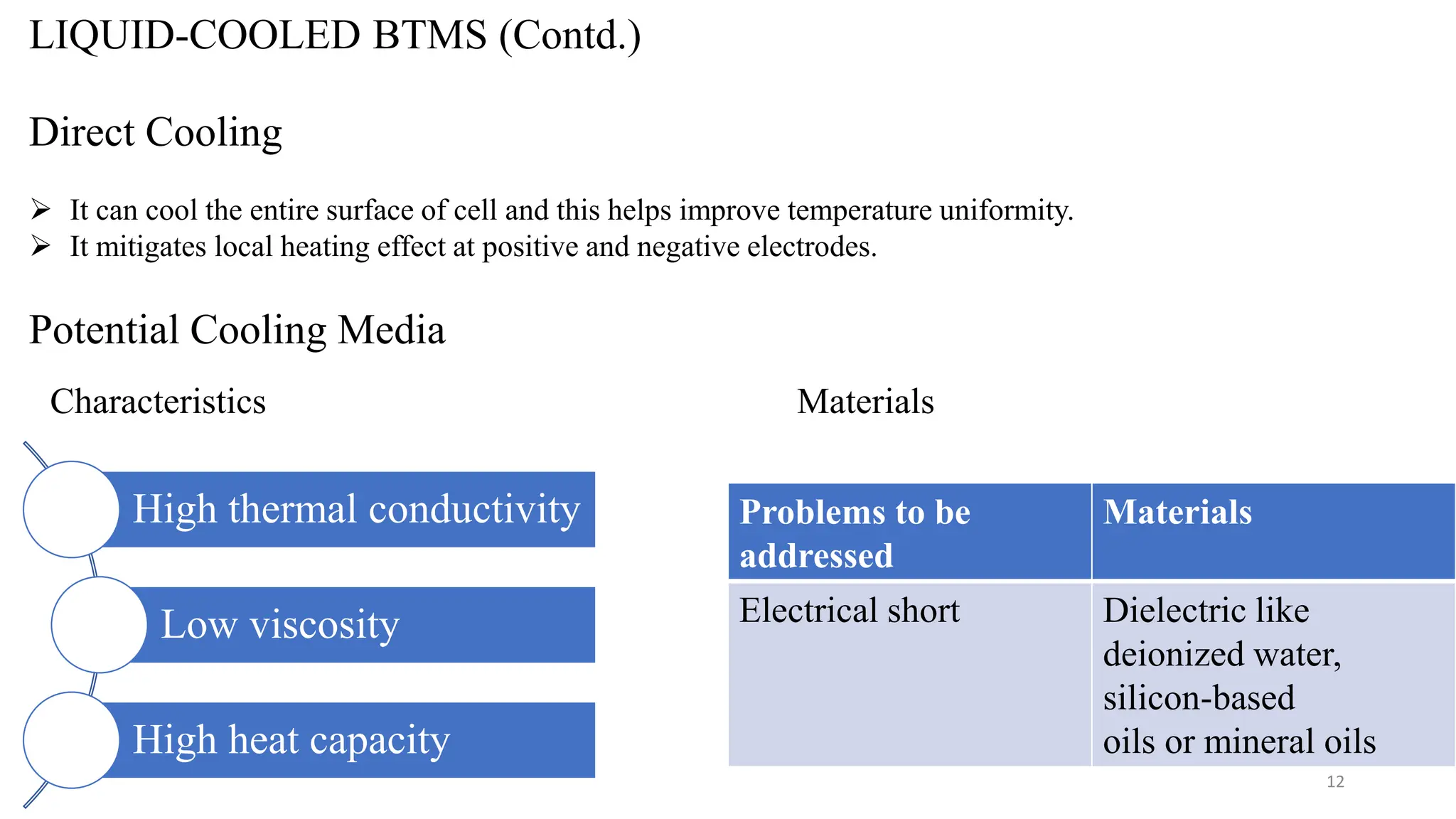
LIQUID-COOLED BTMS (Contd.)
 It can cool the entire surface of cell and this helps improve temperature uniformity.
 It mitigates local heating effect at positive and negative electrodes.
High thermal conductivity
Low viscosity
High heat capacity
Characteristics
Potential Cooling Media
Materials
Problems to be
addressed
Materials
Electrical short Dielectric like
deionized water,
silicon-based
oils or mineral oils
Direct Cooling
12
LIQUID-COOLED BTMS (Contd.)
Advantage of Direct Cooling over air-cooling
 For the same flow rate, the heat-transfer rate of oil was much higher than that of air due to thinner
boundary layer and higher fluid thermal conductivity.
 It can be seen that direct oil cooling was still more thermal efficient than direct air cooling even though
direct oil cooling kept low flow rate to make compromise between pressure loss and thermal efficiency.
13
LIQUID-COOLED BTMS (Contd.)
Materials
Problems to be addressed Materials
Electrical short Mixture of water and
ethylene glycol
Indirect Cooling
a) Wavy tubes
b) Coolant jacket
c) Liquid cooled cylinder
d) Cold plate with mini-
channels
e) Combination of fin and
cold plate with mini-
channels
14
LIQUID-COOLED BTMS (Contd.)
Used Mechanisms Description Cooling Effect Applica
tion
Wavy tubes
• Series cooling configuration.
• Safer based on mechanical and
electrical evaluation
• Thermally conductive yet electrically isolative
materials need to be arranged to fill the void
space between cells and tube
Tesla
Coolant Jacket
• Series-parallel cooling
configuration.
• Temperature uniformity will be improved.
• More thermally effective than Wavy tubes
BMW,
and LG
Chem
Liquid cooled
cylinder (LCC)
• Parallel cooling configuration
• Maximum temperature could be controlled
under +40ºC at 5C discharging rate
• Local temperature difference was 5ºC by just
increasing the mass flow rate of water
Tesla
Model S
Cold plate with
mini-channels
• Due to that the plate surface is flat,
it is suitable for cooling prismatic
cell
• Maximum temperature and local temperature
difference could be controlled under +35ºC and
5ºC respectively.
Chevrol
et Volt
Combination of fin
and cold plate
• Fins are placed between cells and
the bases of fins connect to cold
plate to form an integral heat sink
• The metal fins facilitate the heat
dissipation from cells to cold plates
• Maximum cell temperature could be controlled
below maximum cell temperature could be
controlled below +35ºC
• Maximum temperature difference is 2ºC.
-
15
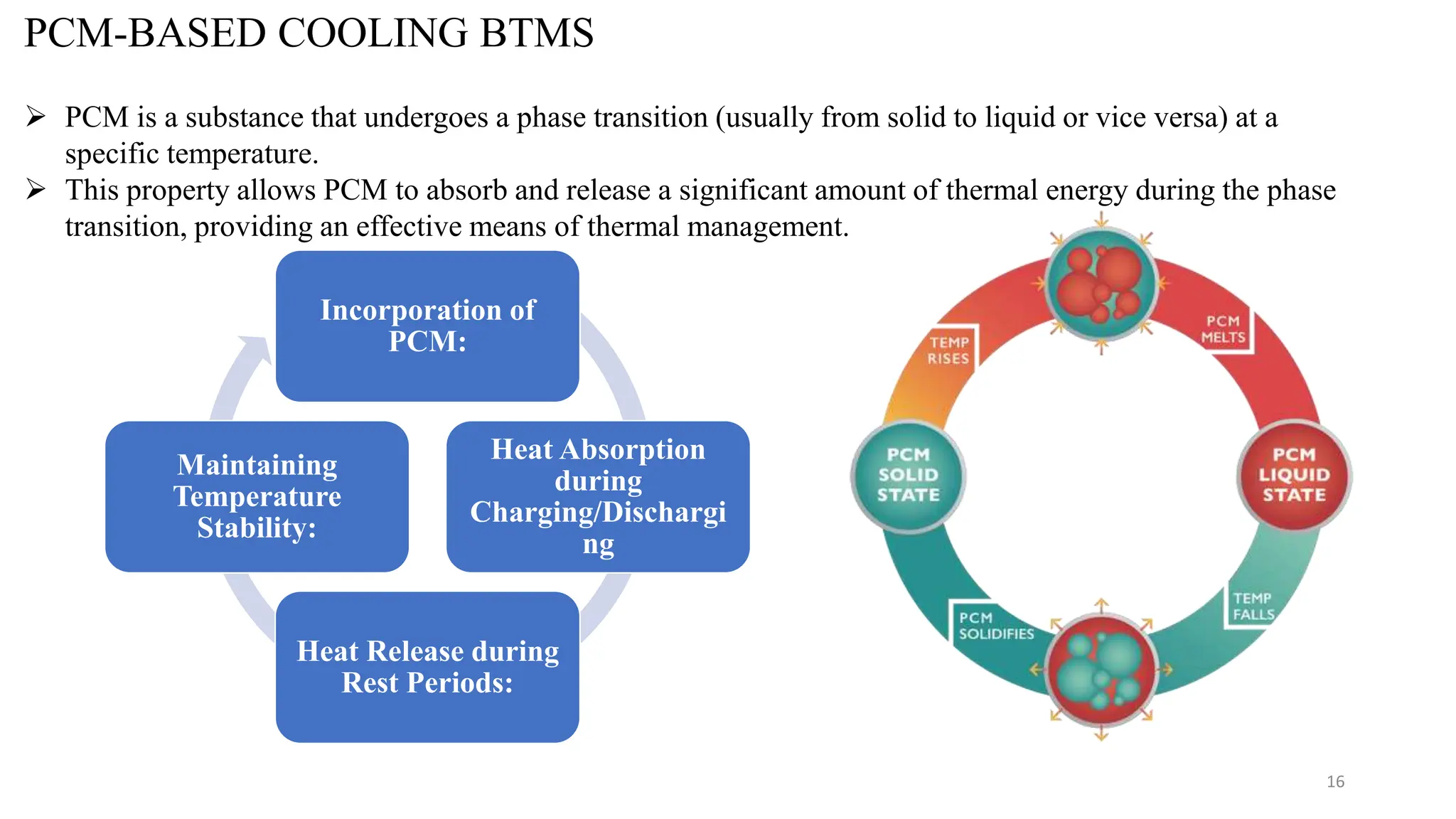
PCM-BASED COOLING BTMS
 PCM is a substance that undergoes a phase transition (usually from solid to liquid or vice versa) at a
specific temperature.
 This property allows PCM to absorb and release a significant amount of thermal energy during the phase
transition, providing an effective means of thermal management.
Incorporation of
PCM:
Heat Absorption
during
Charging/Dischargi
ng
Heat Release during
Rest Periods:
Maintaining
Temperature
Stability:
16
PCM-BASED COOLING BTMS (Contd.)
 High Heat Absorption Capacity
 Reduced Dependency on Active
Cooling
 Enhanced Safety
Advantages of PCM-based EV battery cooling
Selection of PCM for EV battery cooling
 Material having lower melting point
 High thermal conductivity
 High Chemical Stability
 High Thermal Cycling Stability
 High Latent Heat of Fusion
Materials used as PCM
 Graphite
 Fibers
 nano-PCM (Metal Nanoparticles +PCM)
17
CONCLUSION
 Temperature range and temperature variation are two critical parameters influencing the battery pack
performance.
 The ambient temperature may vary from -35ºC to +50ºC in different regions, climates and seasons, whereas
the desired temperature range of battery is about +15ºC~+35ºC.
 These three processes dominate the battery temperature heat generation, heat transport, and heat
dissipation.
 Compared to series configuration, parallel and mixed series-parallel configurations have been proved to be
more effective to mitigate the temperature difference between cells.
 Direct liquid cooling, especially liquid immersion cooling, emerges as a promising cooling technology for
BTM. Compared to indirect liquid cooling, the cooling efficiency improves due to increased contact area
between cells and liquid coolant and removal of thermal-conduction resistance and thermal contact
resistance.
 At present, the dominant battery cooling strategies are based on air, liquid and PCM
18
References
 Developments in battery thermal management systems for electric vehicles: A technical review - Pranjali R.
Tete *, Mahendra M. Gupta, Sandeep S. Joshi, 5 January 2021 https://doi.org/10.1016/j.est.2021.102255
 A review on battery thermal management in electric vehicle application - Guodong Xia*, Lei Cao,
Guanglong Bi, 12 September 2017 http://dx.doi.org/10.1016/j.jpowsour.2017.09.046
 D. Chen, J. Jiang, G. Kim, et al., Comparison of different cooling methods for lithium ion battery cells,
Appl. Therm. Eng. 94 (2016) 846e854.
 H. Wang, F. He, L. Ma, Experimental and modelling study of controller-based thermal management of
battery modules under dynamic loads, Int. J. Heat. Mass Tran 103 (2016) 154e164.
 T. Wang, K.J. Tseng, J. Zhao, et al., Thermal investigation of lithium-ion battery module with different cell
arrangement structures and forced air cooling strategies, Appl. Energy 134 (2014) 229e238
 N. Yang, X. Zhang, G. Li, D. Hua, Assessment of the forced air-cooling performance for cylindrical lithium-
ion battery packs: a comparative analysis between aligned and staggered cell arrangements, Appl. Therm.
Eng. 80 (2015) 55e65.
19
THANK YOU
20

Phase changing material in batteryPresentation_RP & SC.pptx

  • 1.
    Presentation on Developments in batterythermal management systems for Electric Vehicles Indian Institute of Technology Jodhpur Course Instructor: Dr. Durgamadhab Mishra Materials For Electrochemical Energy Conversion and Storage: Batteries (Course Code: PHL7521) Presented By: Ratul Panja (M22CI009) Shailendra Chauhan (M22CI010) MTech in Infrastructure Engineering with Specialization in Energy Department of Civil and Infrastructure Engineering 1
  • 2.
    NARROW DOWN APPROACH EVComponents  Battery Technology  Charging Infrastructure  Motor  Drivetrain  Energy Management Software  Materials  Alternative Power Source  Infrastructure and Grid Integration Battery Technology  Anode and Cathode Materials  Electrolyte Chemistry  Solid-State Batteries  Battery Thermal Management Systems (BTMS)  Fast Charging Technology  Battery Management Systems (BMS)  Recycling and Sustainability BTMS  Air-cooled BTMS  Liquid-cooled BTMS  PCM-based BTMS  Heat pipe based BTMS  Refrigeration based BTMS  Hybrid BTMS  Others 2
  • 3.
    INTRODUCTION  A batterypack consists of several battery cells arranged in different configurations of series, parallel, and combination of the same.  Lithium-ion batteries are the most preferable one for commercial purpose as it dominates the performance of other types of batteries.  This performance is dependent on electrochemical process.  As Arrhenius law states rate of chemical reaction increases exponentially with the temperature rise. Internal Heat Generation Enthalpy Heating Ohmic heat Heat of mixing Entropy change Internal Heat Generation Creation of Hotspot Temperature Non-uniformity Life Cycle & Performance Reduction 3
  • 4.
    EFFECT OF TEMPERATUREON BATTERY PERFORMANCE  The cycle life of a Li-ion battery is 3323 cycles at 45ºC , falling significantly to 1037 cycles at 60ºC .  The battery cells lost more than 60% of initial power at 50ºC after 800 cycles  Lost 70% at 55ºC after 500 cycles.  With high temperature, self-discharge of the battery occurs TEMPERATURE  The viscosity of the electrolyte increases.  Ionic conductivity decreases  Increase in the internal resistance of the battery pack.  An increase in charge-transfer resistance, lithium plating, and lithium dendrites. TEMPERATURE Charging • Endother mic Discharging • Exothermic Internal Heat Generation 4
  • 5.
    EFFECT OF TEMPERATUREON BATTERY PERFORMANCE (Contd.) THERMAL RUNWAY Decomposition of Solid Electrolyte Interface (SEI) layer of Anode at 80ºC Breaking Down of Electrolyte into exothermic reaction producing various gases at 100ºC-120ºC Melting of Separator causing an internal short circuit at 120ºC-130ºC Decomposition of cathode and production of Oxygen at 130ºC- 150ºC Reaction of oxygen along with the other chemical reactions cell to burn and catch fire  The desired operating temperature range of the battery is 15ºC to 35ºC or 20ºC to 40ºC  The maximum temperature difference (ΔTmax) should be less than 5ºC from module to module to maintain a uniform temperature distribution STANDARD OPERATION 5
  • 6.
  • 7.
    AIR-COOLED BTMS  Simplicity Low cost  Electrical Safety  Lightweight  No-leakage concern  Easier maintenance Air-Cooled BTMS Free Convection Cooling Forced Convection Cooling  Demand of a high temperature working environment  Larger battery pack cooling  High charge-discharge cycles  Exhaust fans  Blowers  Modified air-flow channels  Fins structure EV models such as BYD E6, Toyota Prius, Nissan Leaf, etc. Applications 7
  • 8.
    AIR-COOLED BTMS (Contd.) SeriesCooling Configuration a) Simple channel- This will lead to that the cell temperature near the exit is obviously higher than that near the inlet – NON UNIFORM COOLING b) Wedged channel - Have an enlarged inlet, a shrunken outlet, and the cross section area of channel contracts gradually from inlet to outlet - the cell near inlet has lower surface heat transfer coefficient whereas the cell near outlet has a higher surface heat transfer coefficient, thus the maximum temperature difference between cells decrease. c) Simple channel with reciprocating cooling - Two identical fans were placed at inlet and outlet of the tunnel and produced reciprocating flow by activating and deactivating them in turn- temperature difference among cells was reduce from 1.3ºC to 0.6ºC 8
  • 9.
    AIR-COOLED BTMS (Contd.) ParallelCooling Configuration a) Z-parallel configuration- The ΔTmax between the cells is dropped by 45% and 41% for a fixed inlet flow rate of air and fixed power consumption respectively under constant heat generation after optimization. b) U-parallel configuration - After optimization of the inlet and outlet widths, ΔTmax between the cells is dropped by 70%. 9
  • 10.
    AIR-COOLED BTMS (Contd.) Series-ParallelMixed Cooling Configuration a) Aligned Arrangement- Under a specified air flow rate, the maximum temperature rise was inverse to the longitudinal interval for the aligned arrays. A larger longitudinal spacing can weaken influence of the stagnant region existing between each two cells in a longitudinal row, thus can enhance cell heat dissipation. b) Staggered Arrangement - Under a specified air flow rate, the maximum temperature rise was proportional to the longitudinal interval for the staggered arrays. c) Trapezoid configuration- Follows the wedged channel mechanism. The maximum temperature and maximum temperature difference in the battery pack was always below +40ºC and 6.6 ºC. 10
  • 11.
    LIQUID-COOLED BTMS  Liquid-coolingcan be 3500 times more efficient than air cooling  It can save up to 40% parasitic energy  Liquid-cooling can reduce the noise level  Battery pack can be more compact without decreasing cooling efficiency Liquid-Cooled BTMS Direct Cooling Indirect Cooling  Complexity  Cost  Potential leakage  Tube cooling  Cold plate cooling with mini/micro channels  Jacket cooling 11
  • 12.
    LIQUID-COOLED BTMS (Contd.) It can cool the entire surface of cell and this helps improve temperature uniformity.  It mitigates local heating effect at positive and negative electrodes. High thermal conductivity Low viscosity High heat capacity Characteristics Potential Cooling Media Materials Problems to be addressed Materials Electrical short Dielectric like deionized water, silicon-based oils or mineral oils Direct Cooling 12
  • 13.
    LIQUID-COOLED BTMS (Contd.) Advantageof Direct Cooling over air-cooling  For the same flow rate, the heat-transfer rate of oil was much higher than that of air due to thinner boundary layer and higher fluid thermal conductivity.  It can be seen that direct oil cooling was still more thermal efficient than direct air cooling even though direct oil cooling kept low flow rate to make compromise between pressure loss and thermal efficiency. 13
  • 14.
    LIQUID-COOLED BTMS (Contd.) Materials Problemsto be addressed Materials Electrical short Mixture of water and ethylene glycol Indirect Cooling a) Wavy tubes b) Coolant jacket c) Liquid cooled cylinder d) Cold plate with mini- channels e) Combination of fin and cold plate with mini- channels 14
  • 15.
    LIQUID-COOLED BTMS (Contd.) UsedMechanisms Description Cooling Effect Applica tion Wavy tubes • Series cooling configuration. • Safer based on mechanical and electrical evaluation • Thermally conductive yet electrically isolative materials need to be arranged to fill the void space between cells and tube Tesla Coolant Jacket • Series-parallel cooling configuration. • Temperature uniformity will be improved. • More thermally effective than Wavy tubes BMW, and LG Chem Liquid cooled cylinder (LCC) • Parallel cooling configuration • Maximum temperature could be controlled under +40ºC at 5C discharging rate • Local temperature difference was 5ºC by just increasing the mass flow rate of water Tesla Model S Cold plate with mini-channels • Due to that the plate surface is flat, it is suitable for cooling prismatic cell • Maximum temperature and local temperature difference could be controlled under +35ºC and 5ºC respectively. Chevrol et Volt Combination of fin and cold plate • Fins are placed between cells and the bases of fins connect to cold plate to form an integral heat sink • The metal fins facilitate the heat dissipation from cells to cold plates • Maximum cell temperature could be controlled below maximum cell temperature could be controlled below +35ºC • Maximum temperature difference is 2ºC. - 15
  • 16.
    PCM-BASED COOLING BTMS PCM is a substance that undergoes a phase transition (usually from solid to liquid or vice versa) at a specific temperature.  This property allows PCM to absorb and release a significant amount of thermal energy during the phase transition, providing an effective means of thermal management. Incorporation of PCM: Heat Absorption during Charging/Dischargi ng Heat Release during Rest Periods: Maintaining Temperature Stability: 16
  • 17.
    PCM-BASED COOLING BTMS(Contd.)  High Heat Absorption Capacity  Reduced Dependency on Active Cooling  Enhanced Safety Advantages of PCM-based EV battery cooling Selection of PCM for EV battery cooling  Material having lower melting point  High thermal conductivity  High Chemical Stability  High Thermal Cycling Stability  High Latent Heat of Fusion Materials used as PCM  Graphite  Fibers  nano-PCM (Metal Nanoparticles +PCM) 17
  • 18.
    CONCLUSION  Temperature rangeand temperature variation are two critical parameters influencing the battery pack performance.  The ambient temperature may vary from -35ºC to +50ºC in different regions, climates and seasons, whereas the desired temperature range of battery is about +15ºC~+35ºC.  These three processes dominate the battery temperature heat generation, heat transport, and heat dissipation.  Compared to series configuration, parallel and mixed series-parallel configurations have been proved to be more effective to mitigate the temperature difference between cells.  Direct liquid cooling, especially liquid immersion cooling, emerges as a promising cooling technology for BTM. Compared to indirect liquid cooling, the cooling efficiency improves due to increased contact area between cells and liquid coolant and removal of thermal-conduction resistance and thermal contact resistance.  At present, the dominant battery cooling strategies are based on air, liquid and PCM 18
  • 19.
    References  Developments inbattery thermal management systems for electric vehicles: A technical review - Pranjali R. Tete *, Mahendra M. Gupta, Sandeep S. Joshi, 5 January 2021 https://doi.org/10.1016/j.est.2021.102255  A review on battery thermal management in electric vehicle application - Guodong Xia*, Lei Cao, Guanglong Bi, 12 September 2017 http://dx.doi.org/10.1016/j.jpowsour.2017.09.046  D. Chen, J. Jiang, G. Kim, et al., Comparison of different cooling methods for lithium ion battery cells, Appl. Therm. Eng. 94 (2016) 846e854.  H. Wang, F. He, L. Ma, Experimental and modelling study of controller-based thermal management of battery modules under dynamic loads, Int. J. Heat. Mass Tran 103 (2016) 154e164.  T. Wang, K.J. Tseng, J. Zhao, et al., Thermal investigation of lithium-ion battery module with different cell arrangement structures and forced air cooling strategies, Appl. Energy 134 (2014) 229e238  N. Yang, X. Zhang, G. Li, D. Hua, Assessment of the forced air-cooling performance for cylindrical lithium- ion battery packs: a comparative analysis between aligned and staggered cell arrangements, Appl. Therm. Eng. 80 (2015) 55e65. 19
  • 20.