Pharmacy Education and practice in
Ethiopia :
From where to where?
Mohammed A Mohammed
B.pharm, Msc.clinpharm, PhD candidate
mohzum@hotmail.com
5/14/2015 Mohammed A 1
Who I am
5/14/2015 Mohammed A 2
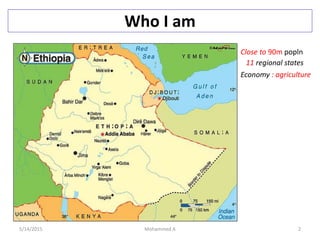
Close to 90m popln
11 regional states
Economy : agriculture
Who I am
5/14/2015 Mohammed A 3
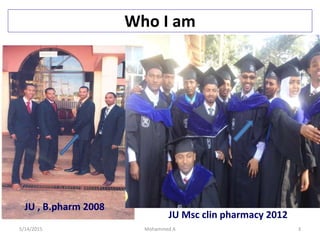
JU Msc clin pharmacy 2012
JU , B.pharm 2008
Pharmacy schools in Ethiopia(8/33)
5/14/2015 Mohammed A 4
B.Pharm since 1961
M. Pharm prac since 2010
University of Gonder
Addis Ababa university
Mekele university
Jimma university
B.Pharm since 2001
M clin pharm since 2009
Haramaya university
Ambo universityWellega universityWollo university
Over view of the old pharmacy
educ/practice in Ethiopia?
5/14/2015 Mohammed A 5
Drawbacks of the Old educ /practice
in Ethiopia
 Pharmacists in practice know more about the product
but have little info about their patients.
Provide meds they know for patients they do not know
Not well trained in clinical sciences/ Pathophysiology
curriculum
Not well trained/lack skills
To collect and interpret patient specific data,
 To take medication related histories
To identify drug- therapy related problems./DTPs
5/14/2015 Mohammed A 6
Community pharmacies in Ethiopia
5/14/2015 Mohammed A 7
What has been done towards implementing
new Pharmacy educ & Service in Ethiopia
5/14/2015 Mohammed A 8
Initiatives in Ethiopia
• Curricular revision 2008: nationwide
• Pharmacy UG curriculum: more patient oriented (4 years + 1
internship)
• Majority of the courses under new patient oriented curriculum are
clinical pharmacy courses
• PG advanced clinical oriented pharmacy curriculum
MSC in Clinical Pharmacy JU Since 2009
MSC in Pharmacy practice AAU Since 2010
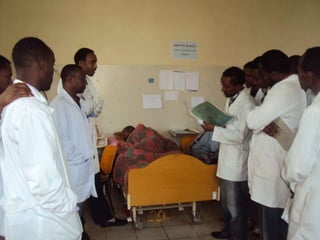
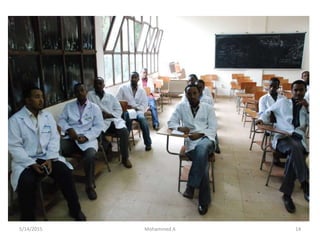
• Intensive 1mo in-service training for Clinical Pharmacy services.
hospital pharmacists (200). Started at JU, 2012 and then other unis
5/14/2015 Mohammed A 9
5/14/2015 Mohammed A 10
5/14/2015 Mohammed A 11
5/14/2015 Mohammed A 12
5/14/2015 Mohammed A 13
5/14/2015 Mohammed A 14
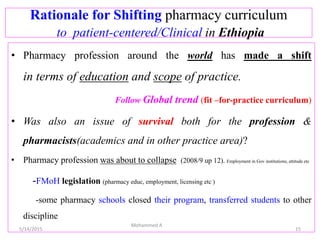
Rationale for Shifting pharmacy curriculum
to patient-centered/Clinical in Ethiopia
• Pharmacy profession around the world has made a shift
in terms of education and scope of practice.
Follow Global trend (fit –for-practice curriculum)
• Was also an issue of survival both for the profession &
pharmacists(academics and in other practice area)?
• Pharmacy profession was about to collapse (2008/9 up 12). Employment in Gov institutions, attitude etc
-FMoH legislation (pharmacy educ, employment, licensing etc )
-some pharmacy schools closed their program, transferred students to other
discipline
15
Mohammed A
5/14/2015
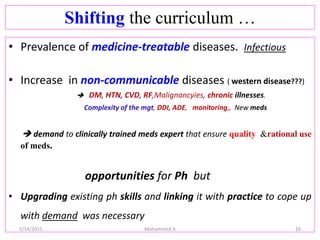
Shifting the curriculum …
• Prevalence of medicine-treatable diseases. Infectious
• Increase in non-communicable diseases ( western disease???)
 DM, HTN, CVD, RF,Malignancyies, chronic illnesses.
Complexity of the mgt, DDI, ADE, monitoring,, New meds
 demand to clinically trained meds expert that ensure quality &rational use
of meds.
opportunities for Ph but
• Upgrading existing ph skills and linking it with practice to cope up
with demand was necessary
5/14/2015 Mohammed A 16
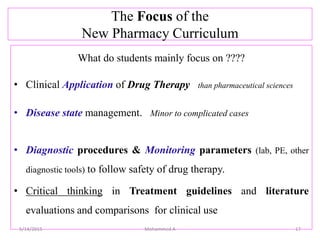
The Focus of the
New Pharmacy Curriculum
What do students mainly focus on ????
• Clinical Application of Drug Therapy than pharmaceutical sciences
• Disease state management. Minor to complicated cases
• Diagnostic procedures & Monitoring parameters (lab, PE, other
diagnostic tools) to follow safety of drug therapy.
• Critical thinking in Treatment guidelines and literature
evaluations and comparisons for clinical use
17Mohammed A5/14/2015
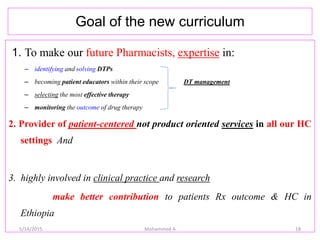
Goal of the new curriculum
1. To make our future Pharmacists, expertise in:
– identifying and solving DTPs
– becoming patient educators within their scope DT management
– selecting the most effective therapy
– monitoring the outcome of drug therapy
2. Provider of patient-centered not product oriented services in all our HC
settings And
3. highly involved in clinical practice and research
make better contribution to patients Rx outcome & HC in
Ethiopia
18Mohammed A5/14/2015
Recognition of the professions
after the curriculum shift
5/14/2015 Mohammed A 19
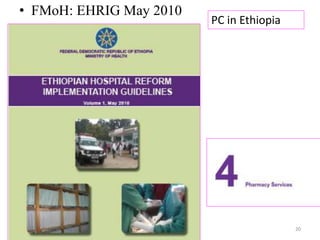
• FMoH: EHRIG May 2010
5/14/2015 Mohammed A 20
PC in Ethiopia
Hospitals’ feedback
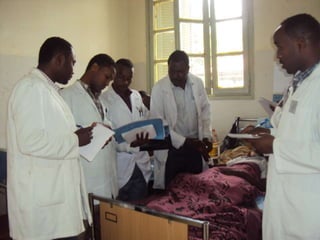
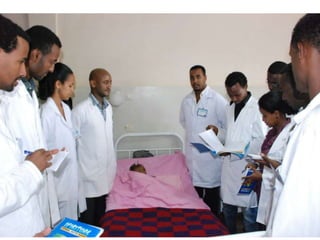
• Some hospitals(JU) pharmacist medication chart into patients
charts . 2013
• Hospitals directors’ positive feedback of the program and the
benefit of clinical pharmacy in-service training. Data??
• Consultants, medical residents, medical students etc were happy
having Clinically trained pharmacists in their team.
I have witnessed this.
5/14/2015 Mohammed A 21
Challenges of the new practice pregame
• Implementation of the faced several challenges at the beginning
– Lack of human resource for clinical courses and rotations
 fly-in professors & clinicians
 this still remained a challenge
– Resistance from some faculty/pharmacist
change the curriculum
22Mohammed A5/14/2015
Future directions of educ and
Practice in Ethiopia
5/14/2015 Mohammed A 23
Future Direction
• Gradual training all Pharmacists(graduates of old curriculum) to enable them provide
clinical pharmacy services/ advanced patient services:
 In hospitals, clinics and community pharmacies
 time and financial resource ??? Not sure of the plan
• Launching pharm D program.
Was planed to start 3 years ago
Feasibility? Resource?
• Focus on Bpharm + 2 years PG clin pharmacy
5/14/2015 Mohammed A 24
THANK YOU FOR YOUR
KIND ATTENTION!
5/14/2015 Mohammed A 25

pharmacy prac in Ethiop.

  • 1.
    Pharmacy Education andpractice in Ethiopia : From where to where? Mohammed A Mohammed B.pharm, Msc.clinpharm, PhD candidate mohzum@hotmail.com 5/14/2015 Mohammed A 1
  • 2.
    Who I am 5/14/2015Mohammed A 2 Close to 90m popln 11 regional states Economy : agriculture
  • 3.
    Who I am 5/14/2015Mohammed A 3 JU Msc clin pharmacy 2012 JU , B.pharm 2008
  • 4.
    Pharmacy schools inEthiopia(8/33) 5/14/2015 Mohammed A 4 B.Pharm since 1961 M. Pharm prac since 2010 University of Gonder Addis Ababa university Mekele university Jimma university B.Pharm since 2001 M clin pharm since 2009 Haramaya university Ambo universityWellega universityWollo university
  • 5.
    Over view ofthe old pharmacy educ/practice in Ethiopia? 5/14/2015 Mohammed A 5
  • 6.
    Drawbacks of theOld educ /practice in Ethiopia  Pharmacists in practice know more about the product but have little info about their patients. Provide meds they know for patients they do not know Not well trained in clinical sciences/ Pathophysiology curriculum Not well trained/lack skills To collect and interpret patient specific data,  To take medication related histories To identify drug- therapy related problems./DTPs 5/14/2015 Mohammed A 6
  • 7.
    Community pharmacies inEthiopia 5/14/2015 Mohammed A 7
  • 8.
    What has beendone towards implementing new Pharmacy educ & Service in Ethiopia 5/14/2015 Mohammed A 8
  • 9.
    Initiatives in Ethiopia •Curricular revision 2008: nationwide • Pharmacy UG curriculum: more patient oriented (4 years + 1 internship) • Majority of the courses under new patient oriented curriculum are clinical pharmacy courses • PG advanced clinical oriented pharmacy curriculum MSC in Clinical Pharmacy JU Since 2009 MSC in Pharmacy practice AAU Since 2010 • Intensive 1mo in-service training for Clinical Pharmacy services. hospital pharmacists (200). Started at JU, 2012 and then other unis 5/14/2015 Mohammed A 9
  • 10.
  • 11.
  • 12.
  • 13.
  • 14.
  • 15.
    Rationale for Shiftingpharmacy curriculum to patient-centered/Clinical in Ethiopia • Pharmacy profession around the world has made a shift in terms of education and scope of practice. Follow Global trend (fit –for-practice curriculum) • Was also an issue of survival both for the profession & pharmacists(academics and in other practice area)? • Pharmacy profession was about to collapse (2008/9 up 12). Employment in Gov institutions, attitude etc -FMoH legislation (pharmacy educ, employment, licensing etc ) -some pharmacy schools closed their program, transferred students to other discipline 15 Mohammed A 5/14/2015
  • 16.
    Shifting the curriculum… • Prevalence of medicine-treatable diseases. Infectious • Increase in non-communicable diseases ( western disease???)  DM, HTN, CVD, RF,Malignancyies, chronic illnesses. Complexity of the mgt, DDI, ADE, monitoring,, New meds  demand to clinically trained meds expert that ensure quality &rational use of meds. opportunities for Ph but • Upgrading existing ph skills and linking it with practice to cope up with demand was necessary 5/14/2015 Mohammed A 16
  • 17.
    The Focus ofthe New Pharmacy Curriculum What do students mainly focus on ???? • Clinical Application of Drug Therapy than pharmaceutical sciences • Disease state management. Minor to complicated cases • Diagnostic procedures & Monitoring parameters (lab, PE, other diagnostic tools) to follow safety of drug therapy. • Critical thinking in Treatment guidelines and literature evaluations and comparisons for clinical use 17Mohammed A5/14/2015
  • 18.
    Goal of thenew curriculum 1. To make our future Pharmacists, expertise in: – identifying and solving DTPs – becoming patient educators within their scope DT management – selecting the most effective therapy – monitoring the outcome of drug therapy 2. Provider of patient-centered not product oriented services in all our HC settings And 3. highly involved in clinical practice and research make better contribution to patients Rx outcome & HC in Ethiopia 18Mohammed A5/14/2015
  • 19.
    Recognition of theprofessions after the curriculum shift 5/14/2015 Mohammed A 19
  • 20.
    • FMoH: EHRIGMay 2010 5/14/2015 Mohammed A 20 PC in Ethiopia
  • 21.
    Hospitals’ feedback • Somehospitals(JU) pharmacist medication chart into patients charts . 2013 • Hospitals directors’ positive feedback of the program and the benefit of clinical pharmacy in-service training. Data?? • Consultants, medical residents, medical students etc were happy having Clinically trained pharmacists in their team. I have witnessed this. 5/14/2015 Mohammed A 21
  • 22.
    Challenges of thenew practice pregame • Implementation of the faced several challenges at the beginning – Lack of human resource for clinical courses and rotations  fly-in professors & clinicians  this still remained a challenge – Resistance from some faculty/pharmacist change the curriculum 22Mohammed A5/14/2015
  • 23.
    Future directions ofeduc and Practice in Ethiopia 5/14/2015 Mohammed A 23
  • 24.
    Future Direction • Gradualtraining all Pharmacists(graduates of old curriculum) to enable them provide clinical pharmacy services/ advanced patient services:  In hospitals, clinics and community pharmacies  time and financial resource ??? Not sure of the plan • Launching pharm D program. Was planed to start 3 years ago Feasibility? Resource? • Focus on Bpharm + 2 years PG clin pharmacy 5/14/2015 Mohammed A 24
  • 25.
    THANK YOU FORYOUR KIND ATTENTION! 5/14/2015 Mohammed A 25

Editor's Notes

  • #2 Overview of the role of Clinical pharmacy in the health care system: the case of Ethiopia Drug interaction can result in Increased effect – Additive or Synergistic effect Increased therapeutic effect good Increased toxic or adverse effect bad Decreased effect – Antagonistic effect Decreased therapeutic effect bad Decreased toxic effect good Drug interactions usually happen unexpectedly and result in adverse drug reactions Drug interactions for good therapeutic effects are usually used intentionally and their results are already known by physicians
  • #3 Outline of Presentation ▲ Introduction to Pharmacy Education & Practice ▲ Evolution of Pharmacy Education ▲ Clinical Pharmacy Training Programs: Global Perspective ▲ College of Pharmacy at Qatar University: Our Model ▲ Future Directions for Africa and Developing Nations
  • #4 Outline of Presentation ▲ Introduction to Pharmacy Education & Practice ▲ Evolution of Pharmacy Education ▲ Clinical Pharmacy Training Programs: Global Perspective ▲ College of Pharmacy at Qatar University: Our Model ▲ Future Directions for Africa and Developing Nations
  • #5 Outline of Presentation ▲ Introduction to Pharmacy Education & Practice ▲ Evolution of Pharmacy Education ▲ Clinical Pharmacy Training Programs: Global Perspective ▲ College of Pharmacy at Qatar University: Our Model ▲ Future Directions for Africa and Developing Nations
  • #6 So, whats wrong with our current practice?????
  • #7 As you all know more than me, In our country, Pharmacists in practice …… The problem of adverse drug events has got two facets, professional errors and/or patient errors.
  • #8 Outline of Presentation ▲ Introduction to Pharmacy Education & Practice ▲ Evolution of Pharmacy Education ▲ Clinical Pharmacy Training Programs: Global Perspective ▲ College of Pharmacy at Qatar University: Our Model ▲ Future Directions for Africa and Developing Nations
  • #10 Post graduate diploma certificate in clinical Pharmacy
  • #16 As we have seen in the previous slides, pharmacy educs
  • #17  the rising prevalence of chronic conditions such as diabetes and hypertension create will result in both a greater need for treatment by prescription medication and, if nothing is done, greater non-adherence -- ultimately creating poor health outcomes and spurring unnecessary medical spending at a time when we can afford neither one. The problem of adverse drug events has got two facets, professional errors and/or patient errors. Importance of Clinical Pharmacy services in saving lives and protecting public health is particularly relevant in resource-limited settings with Ethiopia is one of the countries in the world with a critical shortage of health workers and not to fully utilize its trained workforce. Higher possibility of meds error to occur In a better position to have the expertise to advise both on the choice of medicines and their safe and effective use. Major issues with medication access, quality, and rational use less quality meds  their clinical consequences pharmacists have moral responsibility to prevent these meds reaching the clinicians and their patients.
  • #22 https://www.fip.org/files/fip/PharmacyEducation/Newsletters/newsletter_II_5.pdf
  • #25  If pharmacy is to survive, we must cultivate pride and enthusiasm towards the profession in our students and fellow pharmacists . If they are to be recognized as full members of the health care team, pharmacists will need to adopt the essential attitudes required by health professionals working in this area: visibility, responsibility, accessibility in a practice aimed at the general population, commitment to confidentiality and patient orientation. Pharmacists will need to be competent and possess both vision and a voice to fully integrate themselves into the health care team Decrease medication misadventures, Increase patient compliance to therapy