HIGH ALERT
High-alert medications are drugs that bear a
heightened risk of causing significant
patient harm when they are used in error.
DEFINITIONOF High-Alert Medications
HIGH ALERT MEDICATION
Purpose
This term "High-Alert Medications" has
been assigned to these medications to
draw attention to their potential danger.
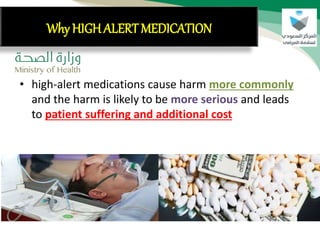
• high-alert medications cause harm more commonly
and the harm is likely to be more serious and leads
to patient suffering and additional cost
Why HIGHALERT MEDICATION
COMMON RISK FACTORS
• Poorly written medication orders.
• Incorrect dilution procedures.
• Confusion between IM, IV, intrathecal, preparations.
• Confusion between strengths of the same medications.
• Wrong infusion rate.
• Look alike or sound alike product and similar packaging.
COMMON RISK FACTORS
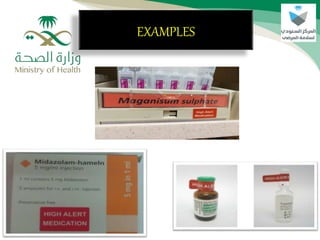
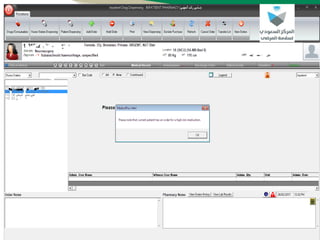
EXAMPLE:EXAMPLES
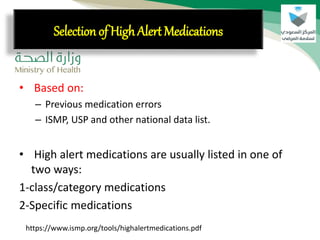
• Based on:
– Previous medication errors
– ISMP, USP and other national data list.
• High alert medications are usually listed in one of
two ways:
1-class/category medications
2-Specific medications
Selection of High Alert Medications
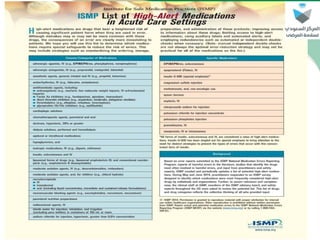
https://www.ismp.org/tools/highalertmedications.pdf
• Classes/Categories of High Alert Medications Examples:
• Antithrombotic agents (anticoagulants), including warfarin,
low molecular weight heparin, IV unfractionated heparin
• Chemotherapeutic agents, parenteral and oral
• Epidural or intrathecal medications
• Hypoglycemics, oral
• Narcotics/opiates, IV, transdermal, and oral (including
liquid concentrates, immediate and sustained-release
formulations)
• Radiocontrast agents, IV
Classes/Categories of Medications
• Special Medication Examples
• Insulin, subcutaneous and IV
• Magnesium sulfate injection
• Potassium chloride for injection concentrate
• Sodium chloride for injection, hypertonic (greater
than 0.9% concentration)
Specific medications
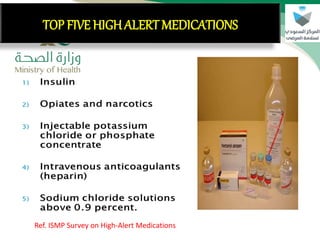
COMMON RISK FACTORSTOP FIVE HIGHALERT MEDICATIONS
Ref. ISMP Survey on High-Alert Medications
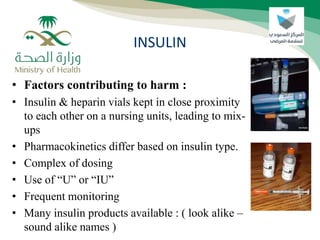
• Factors contributing to harm :
• Insulin & heparin vials kept in close proximity
to each other on a nursing units, leading to mix-
ups
• Pharmacokinetics differ based on insulin type.
• Complex of dosing
• Use of “U” or “IU”
• Frequent monitoring
• Many insulin products available : ( look alike –
sound alike names )
INSULIN
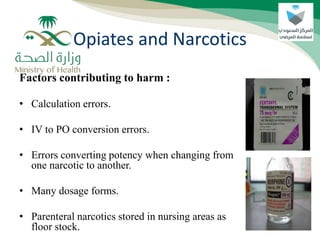
Factors contributing to harm :
• Calculation errors.
• IV to PO conversion errors.
• Errors converting potency when changing from
one narcotic to another.
• Many dosage forms.
• Parenteral narcotics stored in nursing areas as
floor stock.
Opiates and Narcotics
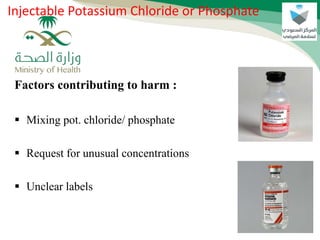
Factors contributing to harm :
 Mixing pot. chloride/ phosphate
 Request for unusual concentrations
 Unclear labels
Injectable Potassium Chloride or Phosphate
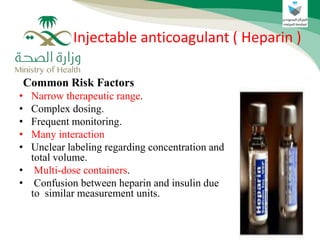
Common Risk Factors
• Narrow therapeutic range.
• Complex dosing.
• Frequent monitoring.
• Many interaction
• Unclear labeling regarding concentration and
total volume.
• Multi-dose containers.
• Confusion between heparin and insulin due
to similar measurement units.
Injectable anticoagulant ( Heparin )
• Storing sodium chloride solutions above 0.9
percent on nursing units.
• Large number of concentrations/formulations
available.
• No double check system in place.
Sodium chloride solution above 0.9%
STRATEGIES TO AVOID ERRORS
INVOLVING HIGH ALERT MEDICATION
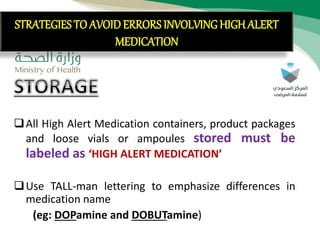
All High Alert Medication containers, product packages
and loose vials or ampoules stored must be
labeled as ‘HIGH ALERT MEDICATION’
Use TALL-man lettering to emphasize differences in
medication name
(eg: DOPamine and DOBUTamine)
STRATEGIES TO AVOID ERRORS INVOLVING HIGH ALERT
MEDICATION
CON’T:
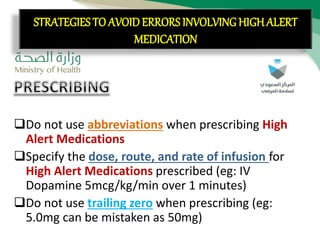
Do not use abbreviations when prescribing High
Alert Medications
Specify the dose, route, and rate of infusion for
High Alert Medications prescribed (eg: IV
Dopamine 5mcg/kg/min over 1 minutes)
Do not use trailing zero when prescribing (eg:
5.0mg can be mistaken as 50mg)
STRATEGIES TO AVOID ERRORS INVOLVING HIGH ALERT
MEDICATION
CON’T:
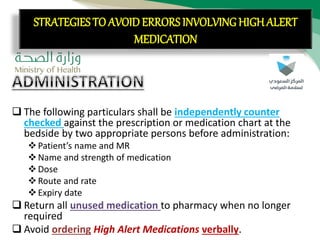
 The following particulars shall be independently counter
checked against the prescription or medication chart at the
bedside by two appropriate persons before administration:
Patient’s name and MR
Name and strength of medication
Dose
Route and rate
Expiry date
 Return all unused medication to pharmacy when no longer
required
 Avoid ordering High Alert Medications verbally.
STRATEGIES TO AVOID ERRORS INVOLVING HIGH ALERT
MEDICATION
CON’T:
All personal shall be trained prior to handling
of High Alert Medication .
STRATEGIES TO AVOID ERRORS INVOLVING HIGH ALERT
MEDICATION
CON’T:
Closely monitor vital signs, laboratory data,
patient’s response before and after
administration of medication
STRATEGIES TO AVOID ERRORS INVOLVING HIGH ALERT
MEDICATION
CON’T:
References or dilution guide should be made
available in the wards
Monitor adverse drug reaction and
medication errors related to High Alert
Medications
STRATEGIES TO AVOID ERRORS INVOLVING HIGH ALERT
MEDICATION
• Remove or minimize high alert medications from
clinical areas, where possible.
• Using "U" instead of "Units" in physician orders
for heparin and insulin is not accepted.
• Verbal and Telephone orders should be kept to
minimum when prescribing high alert
medications.
Take Home Message
• The organization should establish a checklist
that is used for the independent verification.
• Checklist items should include concentration
calculations, infusion pump , rates, and
correct line attachments.
• The prepared solution is labeled with a HIGH
RISK WARNING label prior to administration.
24
• Ideally, removal of concentrated electrolyte
solutions from all nursing units is
accomplished, and these solutions are only
stored in specialized pharmacy preparation
areas or in a locked area.
• Potassium vials, if stored in a specialized
patient care area, must be labeled individually
with a visible florescent warning label that
states MUST BE DILUTED.
25
• 1. Reduce or eliminate the possibility of errors
• 2.Make errors visible
• 3. Minimize the consequences of errors
Three principles may be used to safeguard the
use of high-alert medications:
26
2
03   high alert medications

03 high alert medications

  • 1.
  • 2.
    High-alert medications aredrugs that bear a heightened risk of causing significant patient harm when they are used in error. DEFINITIONOF High-Alert Medications HIGH ALERT MEDICATION Purpose This term "High-Alert Medications" has been assigned to these medications to draw attention to their potential danger.
  • 3.
    • high-alert medicationscause harm more commonly and the harm is likely to be more serious and leads to patient suffering and additional cost Why HIGHALERT MEDICATION
  • 4.
    COMMON RISK FACTORS •Poorly written medication orders. • Incorrect dilution procedures. • Confusion between IM, IV, intrathecal, preparations. • Confusion between strengths of the same medications. • Wrong infusion rate. • Look alike or sound alike product and similar packaging. COMMON RISK FACTORS
  • 5.
  • 7.
    • Based on: –Previous medication errors – ISMP, USP and other national data list. • High alert medications are usually listed in one of two ways: 1-class/category medications 2-Specific medications Selection of High Alert Medications https://www.ismp.org/tools/highalertmedications.pdf
  • 9.
    • Classes/Categories ofHigh Alert Medications Examples: • Antithrombotic agents (anticoagulants), including warfarin, low molecular weight heparin, IV unfractionated heparin • Chemotherapeutic agents, parenteral and oral • Epidural or intrathecal medications • Hypoglycemics, oral • Narcotics/opiates, IV, transdermal, and oral (including liquid concentrates, immediate and sustained-release formulations) • Radiocontrast agents, IV Classes/Categories of Medications
  • 10.
    • Special MedicationExamples • Insulin, subcutaneous and IV • Magnesium sulfate injection • Potassium chloride for injection concentrate • Sodium chloride for injection, hypertonic (greater than 0.9% concentration) Specific medications
  • 11.
    COMMON RISK FACTORSTOPFIVE HIGHALERT MEDICATIONS Ref. ISMP Survey on High-Alert Medications
  • 12.
    • Factors contributingto harm : • Insulin & heparin vials kept in close proximity to each other on a nursing units, leading to mix- ups • Pharmacokinetics differ based on insulin type. • Complex of dosing • Use of “U” or “IU” • Frequent monitoring • Many insulin products available : ( look alike – sound alike names ) INSULIN
  • 13.
    Factors contributing toharm : • Calculation errors. • IV to PO conversion errors. • Errors converting potency when changing from one narcotic to another. • Many dosage forms. • Parenteral narcotics stored in nursing areas as floor stock. Opiates and Narcotics
  • 14.
    Factors contributing toharm :  Mixing pot. chloride/ phosphate  Request for unusual concentrations  Unclear labels Injectable Potassium Chloride or Phosphate
  • 15.
    Common Risk Factors •Narrow therapeutic range. • Complex dosing. • Frequent monitoring. • Many interaction • Unclear labeling regarding concentration and total volume. • Multi-dose containers. • Confusion between heparin and insulin due to similar measurement units. Injectable anticoagulant ( Heparin )
  • 16.
    • Storing sodiumchloride solutions above 0.9 percent on nursing units. • Large number of concentrations/formulations available. • No double check system in place. Sodium chloride solution above 0.9%
  • 17.
    STRATEGIES TO AVOIDERRORS INVOLVING HIGH ALERT MEDICATION All High Alert Medication containers, product packages and loose vials or ampoules stored must be labeled as ‘HIGH ALERT MEDICATION’ Use TALL-man lettering to emphasize differences in medication name (eg: DOPamine and DOBUTamine) STRATEGIES TO AVOID ERRORS INVOLVING HIGH ALERT MEDICATION
  • 18.
    CON’T: Do not useabbreviations when prescribing High Alert Medications Specify the dose, route, and rate of infusion for High Alert Medications prescribed (eg: IV Dopamine 5mcg/kg/min over 1 minutes) Do not use trailing zero when prescribing (eg: 5.0mg can be mistaken as 50mg) STRATEGIES TO AVOID ERRORS INVOLVING HIGH ALERT MEDICATION
  • 19.
    CON’T:  The followingparticulars shall be independently counter checked against the prescription or medication chart at the bedside by two appropriate persons before administration: Patient’s name and MR Name and strength of medication Dose Route and rate Expiry date  Return all unused medication to pharmacy when no longer required  Avoid ordering High Alert Medications verbally. STRATEGIES TO AVOID ERRORS INVOLVING HIGH ALERT MEDICATION
  • 20.
    CON’T: All personal shallbe trained prior to handling of High Alert Medication . STRATEGIES TO AVOID ERRORS INVOLVING HIGH ALERT MEDICATION
  • 21.
    CON’T: Closely monitor vitalsigns, laboratory data, patient’s response before and after administration of medication STRATEGIES TO AVOID ERRORS INVOLVING HIGH ALERT MEDICATION
  • 22.
    CON’T: References or dilutionguide should be made available in the wards Monitor adverse drug reaction and medication errors related to High Alert Medications STRATEGIES TO AVOID ERRORS INVOLVING HIGH ALERT MEDICATION
  • 23.
    • Remove orminimize high alert medications from clinical areas, where possible. • Using "U" instead of "Units" in physician orders for heparin and insulin is not accepted. • Verbal and Telephone orders should be kept to minimum when prescribing high alert medications. Take Home Message
  • 24.
    • The organizationshould establish a checklist that is used for the independent verification. • Checklist items should include concentration calculations, infusion pump , rates, and correct line attachments. • The prepared solution is labeled with a HIGH RISK WARNING label prior to administration. 24
  • 25.
    • Ideally, removalof concentrated electrolyte solutions from all nursing units is accomplished, and these solutions are only stored in specialized pharmacy preparation areas or in a locked area. • Potassium vials, if stored in a specialized patient care area, must be labeled individually with a visible florescent warning label that states MUST BE DILUTED. 25
  • 26.
    • 1. Reduceor eliminate the possibility of errors • 2.Make errors visible • 3. Minimize the consequences of errors Three principles may be used to safeguard the use of high-alert medications: 26 2

Editor's Notes

  • #5 COMMON RISK FACTORS THAT ASSOCIATED WITH HIGH ALERT MEDICATION that lead to ME
  • #8 nstitute for Safe Medication Practices (ISMP) and the United States Pharmacopeia (USP),
  • #14 Adverse effet : - Respiratory depression - Confusion - Lethargy The different between hydromorphone and morphine.?????
  • #15 Adverse effect : 1- Muscular or respiratory paralysis. 2- Mental confusion. 3- Hypotension. 4- Cardiac arrhythmia. 5- Heart block.
  • #16 Many interaction : – Other prescription medication. – OTC medications. – Herbal products. – Food.
  • #27 Three principles may be used to safeguard the use of high-alert medications: 1. Reduce or eliminate the possibility of error (for example, reducing the number of high-alert medications stocked by the hospital; reducing the available concentrations and volumes; and removing high-alert drugs from clinical areas). 2.Make errors visible (for example, having two individuals independently check infusion pump settings for high-alert drugs is one way to make errors visible and thus caught before reaching the patient). 3. Minimize the consequences of errors(for example, fatal errors have occurred when the contents of 50mL vials of 2% lidocaine were injected instead of mannitol, which has a similar appearance – had lidocaine 2% been only available in the clinical area in a 10mL vial, if administered erroneously in place of another drug in a 10ml vial, the amount of lidocaine injected would likely not have been fatal).