PHARMACOLOGY
MADE SIMPLE FOR
NURSING STUDENTS
-BY RACHEL VIJAYA
(Registered Nurse)
Introduction and Sources of
Drugs
ļ‚— Historical Aspects
Pharmacology is the science that deals with the study of drugs and their
interactions with the living system.
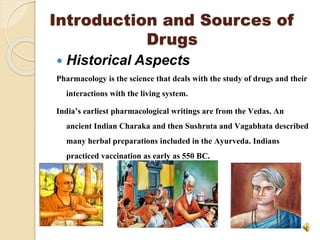
India’s earliest pharmacological writings are from the Vedas. An
ancient Indian Charaka and then Sushruta and Vagabhata described
many herbal preparations included in the Ayurveda. Indians
practiced vaccination as early as 550 BC.
Cont…
Various other traditional systems of medicine were practiced in
different parts of the world – like Homeopathy, Unani, Siddha and
Allopathy.
The basic reason for the failure of many systems is that man’s concepts
about diseases were incorrect and baseless in those days.
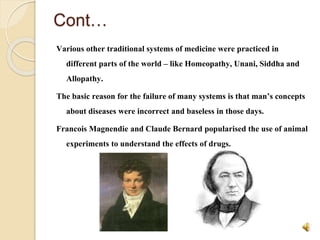
Francois Magnendie and Claude Bernard popularised the use of animal
experiments to understand the effects of drugs.
Cont…
The last century has seen a rapid growth of the subject with several new
drugs, new concepts and techniques being introduced. We now know
much more about receptors and molecular mechanisms of action of
many drugs. Several diseases which were considered incurable and
fatal, can now be completely cured with just a few tablets.
IMPORTANT DEFINITIONS
ļ‚— Drug – ā€œA drug is any substance or product that is
used or intended to be used to modify or explore
physiological systems or pathological states for the
benefit of the recipient.ā€ – WHO definition
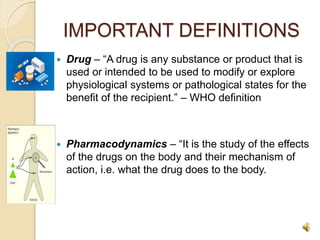
ļ‚— Pharmacodynamics – ā€œIt is the study of the effects
of the drugs on the body and their mechanism of
action, i.e. what the drug does to the body.
Cont…
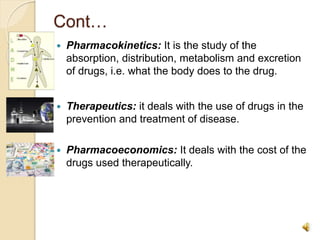
ļ‚— Pharmacokinetics: It is the study of the
absorption, distribution, metabolism and excretion
of drugs, i.e. what the body does to the drug.
ļ‚— Therapeutics: it deals with the use of drugs in the
prevention and treatment of disease.
ļ‚— Pharmacoeconomics: It deals with the cost of the
drugs used therapeutically.
Cont….
ļ‚— Pharmacogenomics: It deals with the use of
genetic information in selecting drugs for a person.
ļ‚— Pharmacoepidemiology: It is the study of both
useful and harmful effects of drugs on large
number of people.
ļ‚— Pharmacovigilence: it deals with the
epidemiological study of adverse drug effects.
ļ‚— Toxicology: It deals with adverse effects of drugs
and also study of poisons.
Cont….
ļ‚— Chemotherapy: It is the use of chemicals for the
treatment of infections. The term now includes the
use of chemical compounds to treat malignancies.
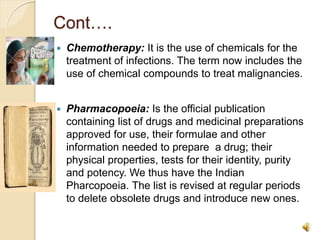
ļ‚— Pharmacopoeia: Is the official publication
containing list of drugs and medicinal preparations
approved for use, their formulae and other
information needed to prepare a drug; their
physical properties, tests for their identity, purity
and potency. We thus have the Indian
Pharcopoeia. The list is revised at regular periods
to delete obsolete drugs and introduce new ones.
Cont…
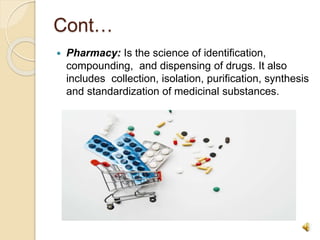
ļ‚— Pharmacy: Is the science of identification,
compounding, and dispensing of drugs. It also
includes collection, isolation, purification, synthesis
and standardization of medicinal substances.
SOURCES OF DRUGS
The sources of drugs can be Natural or Synthetic.
NATURAL SOURCES
1. PLANTS - e.g. Atropine, Morphine, Quinine and Digoxin
2. ANIMALS – e.g. Insulin, Heparin, Gonadotrophins and
Antitoxic sera.
3.MINERALS – e.g. Magnesium Sulphate, Iron, Sulphur and
Radioactive isotopes.
4. MICROORAGNISMS– e.g. Pencillin, Cephalosporins,
Tetracyclines and other antibiotics.
5.HUMAN – e.g. Immunoglobulins from blood, Growth hormone
from anterior pitutary and Chorionic Gonadotrophins from the
urine of pregnant women.
Cont…
ļ‚— SYNTHETIC DRUGS: e.g. Quinalones,
Omeprazole, Neostigmine, Sulfonamides.
CELL CULTURE - Urokinase from human kidney cells
RECOMBINANT DNA TECHNOLOGY – e.g. Human Insulin,
Erythropoietin
HYBIDOMA TECHNIQUE – e.g. Monoclonal antibodies
Important Questions
1. Discuss the history of drugs (5marks)
2. Sources of drugs (5marks)
3. Define Drug, Pharmacodynamics,
Pharmacokinetics (3marks)
Pharmacology Made Simple For Nursing Students

Pharmacology Made Simple For Nursing Students

  • 1.
    PHARMACOLOGY MADE SIMPLE FOR NURSINGSTUDENTS -BY RACHEL VIJAYA (Registered Nurse)
  • 2.
    Introduction and Sourcesof Drugs ļ‚— Historical Aspects Pharmacology is the science that deals with the study of drugs and their interactions with the living system. India’s earliest pharmacological writings are from the Vedas. An ancient Indian Charaka and then Sushruta and Vagabhata described many herbal preparations included in the Ayurveda. Indians practiced vaccination as early as 550 BC.
  • 3.
    Cont… Various other traditionalsystems of medicine were practiced in different parts of the world – like Homeopathy, Unani, Siddha and Allopathy. The basic reason for the failure of many systems is that man’s concepts about diseases were incorrect and baseless in those days. Francois Magnendie and Claude Bernard popularised the use of animal experiments to understand the effects of drugs.
  • 4.
    Cont… The last centuryhas seen a rapid growth of the subject with several new drugs, new concepts and techniques being introduced. We now know much more about receptors and molecular mechanisms of action of many drugs. Several diseases which were considered incurable and fatal, can now be completely cured with just a few tablets.
  • 5.
    IMPORTANT DEFINITIONS ļ‚— Drug– ā€œA drug is any substance or product that is used or intended to be used to modify or explore physiological systems or pathological states for the benefit of the recipient.ā€ – WHO definition ļ‚— Pharmacodynamics – ā€œIt is the study of the effects of the drugs on the body and their mechanism of action, i.e. what the drug does to the body.
  • 6.
    Cont… ļ‚— Pharmacokinetics: Itis the study of the absorption, distribution, metabolism and excretion of drugs, i.e. what the body does to the drug. ļ‚— Therapeutics: it deals with the use of drugs in the prevention and treatment of disease. ļ‚— Pharmacoeconomics: It deals with the cost of the drugs used therapeutically.
  • 7.
    Cont…. ļ‚— Pharmacogenomics: Itdeals with the use of genetic information in selecting drugs for a person. ļ‚— Pharmacoepidemiology: It is the study of both useful and harmful effects of drugs on large number of people. ļ‚— Pharmacovigilence: it deals with the epidemiological study of adverse drug effects. ļ‚— Toxicology: It deals with adverse effects of drugs and also study of poisons.
  • 8.
    Cont…. ļ‚— Chemotherapy: Itis the use of chemicals for the treatment of infections. The term now includes the use of chemical compounds to treat malignancies. ļ‚— Pharmacopoeia: Is the official publication containing list of drugs and medicinal preparations approved for use, their formulae and other information needed to prepare a drug; their physical properties, tests for their identity, purity and potency. We thus have the Indian Pharcopoeia. The list is revised at regular periods to delete obsolete drugs and introduce new ones.
  • 9.
    Cont… ļ‚— Pharmacy: Isthe science of identification, compounding, and dispensing of drugs. It also includes collection, isolation, purification, synthesis and standardization of medicinal substances.
  • 10.
    SOURCES OF DRUGS Thesources of drugs can be Natural or Synthetic. NATURAL SOURCES 1. PLANTS - e.g. Atropine, Morphine, Quinine and Digoxin 2. ANIMALS – e.g. Insulin, Heparin, Gonadotrophins and Antitoxic sera. 3.MINERALS – e.g. Magnesium Sulphate, Iron, Sulphur and Radioactive isotopes. 4. MICROORAGNISMS– e.g. Pencillin, Cephalosporins, Tetracyclines and other antibiotics. 5.HUMAN – e.g. Immunoglobulins from blood, Growth hormone from anterior pitutary and Chorionic Gonadotrophins from the urine of pregnant women.
  • 11.
    Cont… ļ‚— SYNTHETIC DRUGS:e.g. Quinalones, Omeprazole, Neostigmine, Sulfonamides. CELL CULTURE - Urokinase from human kidney cells RECOMBINANT DNA TECHNOLOGY – e.g. Human Insulin, Erythropoietin HYBIDOMA TECHNIQUE – e.g. Monoclonal antibodies
  • 12.
    Important Questions 1. Discussthe history of drugs (5marks) 2. Sources of drugs (5marks) 3. Define Drug, Pharmacodynamics, Pharmacokinetics (3marks)