
SAGAR SAVALE 1
Pharmacognostic classification
Classification of Natural Products:
The most important natural sources of drugs are (higher plants, microbes & animals
and marine organisms. Some useful products are obtained from minerals that are both
organic and inorganic in nature.
To follow the study of the individual drugs, one must adopt some particular sequence
of arrangement and this is referred to a system of classification of drugs. A method of
classification should be:
A) Simple, B) Easy to use, C) Free from confusion & ambiguities.
Because of their wide distribution, each arrangement of classification has its own
merits and demerits, but for the purpose of study the drugs are classified in the
following different ways:
1- Alphabetical classification.
2- Morphological classification
3- Taxonomic classification
4- Pharmacological classification
5- Chemical classification
6- Chemo - taxonomical classification
SAGAR SAVALE 2
1- Alphabetical Classification :
Alphabetical classification is the simplest way of classification of any
disconnected items. Crude drugs are arranged in alphabetical order of their Latin
and English names (Common names) or sometimes local
Some of the pharmacopoeias, dictionaries and reference books which classify
crude drugs according to this system are as follows:
1- Indian Pharmacopoeia.
2- United States = & National Formulary
3- British pharmaceutical Codex
4- European Pharmacopoeia
2- Morphological Classification :
In this system the drugs are arranged according to the morphological or external
characters of the plant parts nor does animal part i.e. (which part of the plant is
used as a drug e.g. (leaves, roots, stems, etc)
The drugs which obtained from the dried parts of the plants & containing cellular
tissues are called as ( Organized Drugs ) e.g. ( Rhizomes , barks , leaves , fruits ,
entire plants , hairs ,& fibers ) .
The drugs which are prepared from plants by some intermediate physical processes
such as ( incision , drying or extraction with a solvent and not containing any cellular
plant tissues are called as ( unorganized drugs ) such as ( Aloe juice , opium latex
, agar , gambir , gelatin , tragacanth , benzoin , honey , beeswax , lemon grass oil
..Etc.).
SAGAR SAVALE 3
Organized Drugs:
Woods – Quassia, Sandalwood, Red Sandalwood.
Leaves – Digitalis, Eucalyptus, Mint, Senna, Spearmint, Squill, Coca,
Hyoscyamus, Belladonna, and Tea.
Barks – Cascara, Cassia, Cinchona, Wild cherry.
Flowering parts – Clove, Pyrethrum, Saffron, Santonica, Chamomile.
Fruits – Anise , Bitter orange peel , Capsicum , Caraway , Cardamom , Colocynth
, Coriander , Cumin , Dill , Fennel , Lemon peel , Senna pod , Star anise ,
Tamarind .
Seeds – Bitter almond, Black Mustard, Cardamom, Colchicum, Linseed, Nux
vomica, Psyllium, White mustard.
Roots & Rhizomes – Aconite , Colchicum corm , Garlic , Gentian , Ginger ,
Ginsing , Glycyrrhiza , Podophyllum , Rauwolfia , Rhubarb , Turmeric , Valerian ,
Squill .
Plants & Herbs – Ergot, Ephedra, Yeast, Vince, Datura.
Hair & Fibers- Cotton, Hemp, Jute, Silk, Flax.
UN - Organized Drugs
Dried latex – Opium, Papain.
Dried Juice – Aloe, Kino.
Dried extracts – Agar, Black catechu, Pale catechu, Pectin.
Waxes – Beeswax, Spermaceti, Carnauba wax.
Gums – Acacia, Guar gum, Indian gum,
Resins – Asafetida, Benzoic, Colophony, Mastic, Coal tar, Tar, Tolo balsam,
Storax, sandarac.
SAGAR SAVALE 4
Volatile oil – Turpentine , Anise , Coriander , Peppermint , Rosemary ,
Sandalwood , Cinnamon , Lemon, Caraway , Dill , Clove , Eucalyptus , Nutmeg ,
Camphor .
Fixed oils & Fats – A rachis , Castor , Coconut , Cotton seed , Linseed , Olive ,
Sesame , Almond , Theobroma , Cod – liver , Halibut liver , Kokum butter .
Animal Products – Bees wax , Cod – liver oil , Gelatin , Halibot liver oil , Honey ,
Shark liver oil , Shellac , Spermaceti wax , Wool fat , Musk , Lactose .
Fossil organism & Minerals – Bentonite, Kaolin, Kiesslguhr, Talc.
3- Taxonomical Classification :
Taxonomical classification is purely a botanical classification, it’s based on
principles of natural relationship & evolutionary developments.
They are grouped in (Kingdom, Phyllum, Order, Family, and Genus &
Species). As all the entire plants are not used as drugs, parts of plant is used as
a drug. For example, Cinnamon bark. This it is of no significance from
identification point of view to put plants in a taxonomic order. Table (1) give
the account of main characters of various taxon that contribute crude drugs
while as Table (2) gives the taxonomical classification of some drugs.
4- Pharmacological Classification:
SAGAR SAVALE 5
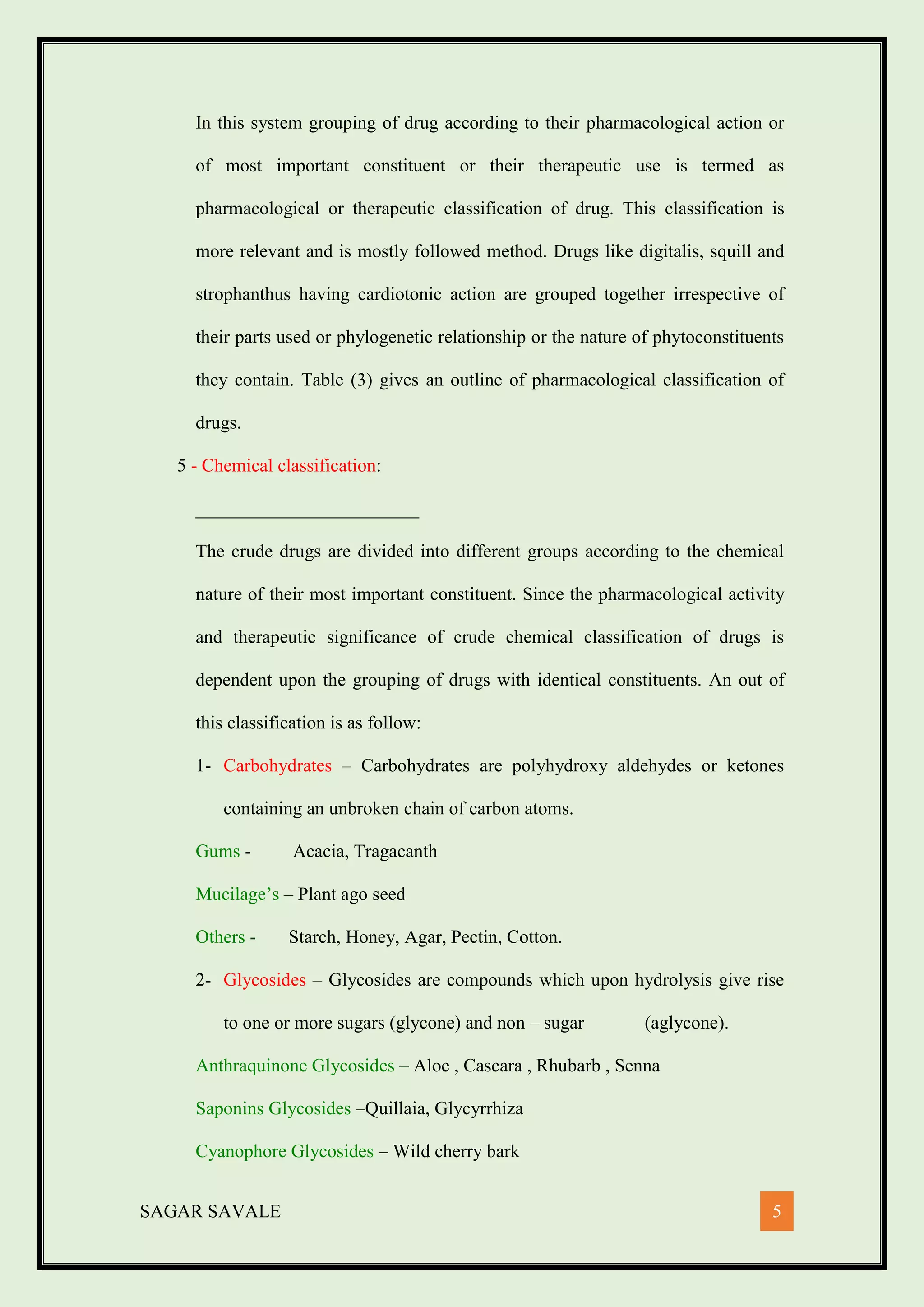
In this system grouping of drug according to their pharmacological action or
of most important constituent or their therapeutic use is termed as
pharmacological or therapeutic classification of drug. This classification is
more relevant and is mostly followed method. Drugs like digitalis, squill and
strophanthus having cardiotonic action are grouped together irrespective of
their parts used or phylogenetic relationship or the nature of phytoconstituents
they contain. Table (3) gives an outline of pharmacological classification of
drugs.
5 - Chemical classification:
________________________
The crude drugs are divided into different groups according to the chemical
nature of their most important constituent. Since the pharmacological activity
and therapeutic significance of crude chemical classification of drugs is
dependent upon the grouping of drugs with identical constituents. An out of
this classification is as follow:
1- Carbohydrates – Carbohydrates are polyhydroxy aldehydes or ketones
containing an unbroken chain of carbon atoms.
Gums - Acacia, Tragacanth
Mucilage’s – Plant ago seed
Others - Starch, Honey, Agar, Pectin, Cotton.
2- Glycosides – Glycosides are compounds which upon hydrolysis give rise
to one or more sugars (glycone) and non – sugar (aglycone).
Anthraquinone Glycosides – Aloe , Cascara , Rhubarb , Senna
Saponins Glycosides –Quillaia, Glycyrrhiza
Cyanophore Glycosides – Wild cherry bark
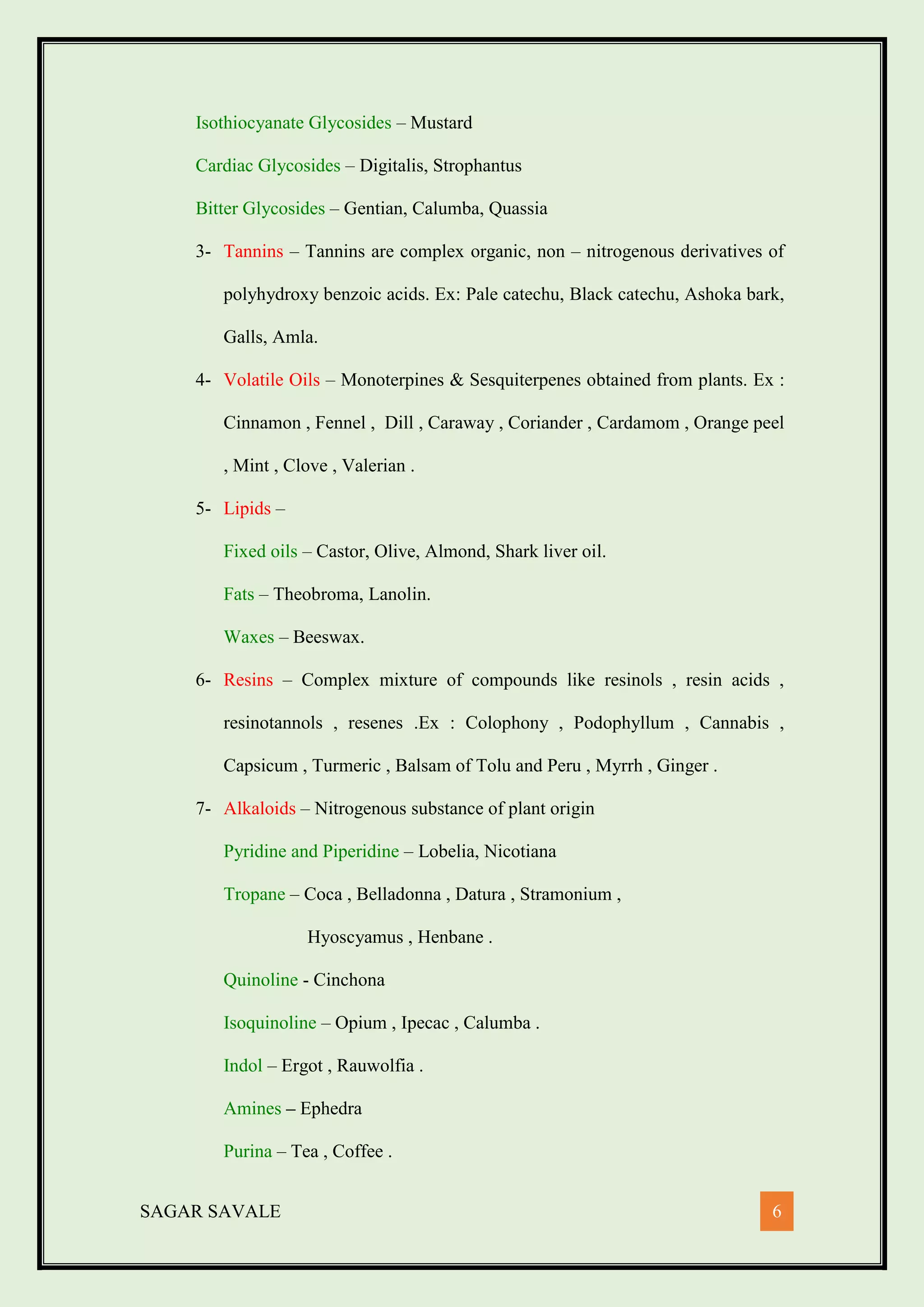
SAGAR SAVALE 6
Isothiocyanate Glycosides – Mustard
Cardiac Glycosides – Digitalis, Strophantus
Bitter Glycosides – Gentian, Calumba, Quassia
3- Tannins – Tannins are complex organic, non – nitrogenous derivatives of
polyhydroxy benzoic acids. Ex: Pale catechu, Black catechu, Ashoka bark,
Galls, Amla.
4- Volatile Oils – Monoterpines & Sesquiterpenes obtained from plants. Ex :
Cinnamon , Fennel , Dill , Caraway , Coriander , Cardamom , Orange peel
, Mint , Clove , Valerian .
5- Lipids –
Fixed oils – Castor, Olive, Almond, Shark liver oil.
Fats – Theobroma, Lanolin.
Waxes – Beeswax.
6- Resins – Complex mixture of compounds like resinols , resin acids ,
resinotannols , resenes .Ex : Colophony , Podophyllum , Cannabis ,
Capsicum , Turmeric , Balsam of Tolu and Peru , Myrrh , Ginger .
7- Alkaloids – Nitrogenous substance of plant origin
Pyridine and Piperidine – Lobelia, Nicotiana
Tropane – Coca , Belladonna , Datura , Stramonium ,
Hyoscyamus , Henbane .
Quinoline - Cinchona
Isoquinoline – Opium , Ipecac , Calumba .
Indol – Ergot , Rauwolfia .
Amines – Ephedra
Purina – Tea , Coffee .
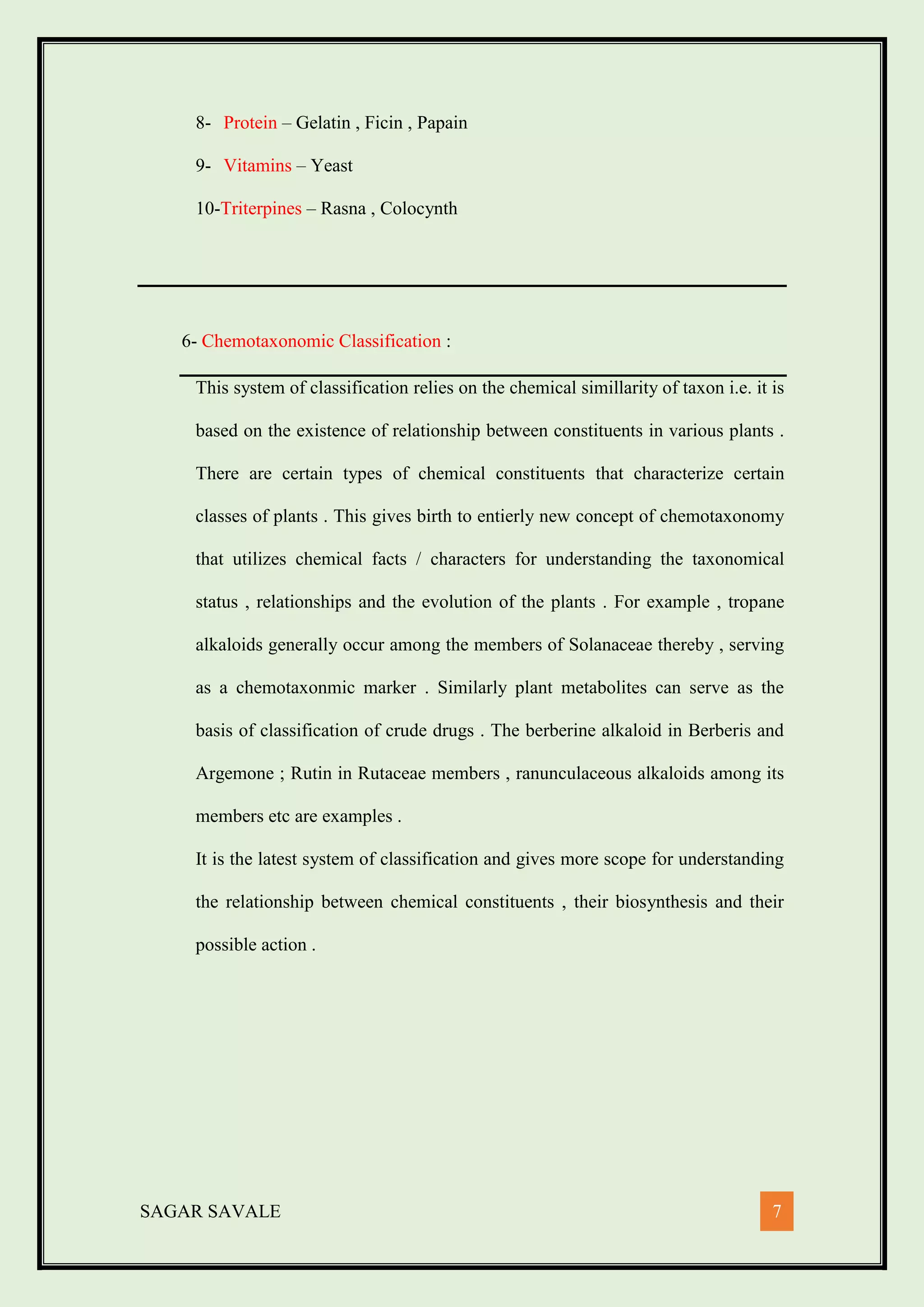
SAGAR SAVALE 7
8- Protein – Gelatin , Ficin , Papain
9- Vitamins – Yeast
10-Triterpines – Rasna , Colocynth
6- Chemotaxonomic Classification :
This system of classification relies on the chemical simillarity of taxon i.e. it is
based on the existence of relationship between constituents in various plants .
There are certain types of chemical constituents that characterize certain
classes of plants . This gives birth to entierly new concept of chemotaxonomy
that utilizes chemical facts / characters for understanding the taxonomical
status , relationships and the evolution of the plants . For example , tropane
alkaloids generally occur among the members of Solanaceae thereby , serving
as a chemotaxonmic marker . Similarly plant metabolites can serve as the
basis of classification of crude drugs . The berberine alkaloid in Berberis and
Argemone ; Rutin in Rutaceae members , ranunculaceous alkaloids among its
members etc are examples .
It is the latest system of classification and gives more scope for understanding
the relationship between chemical constituents , their biosynthesis and their
possible action .
SAGAR SAVALE 8

Pharmacognostic classification

  • 1.
    SAGAR SAVALE 1 Pharmacognosticclassification Classification of Natural Products: The most important natural sources of drugs are (higher plants, microbes & animals and marine organisms. Some useful products are obtained from minerals that are both organic and inorganic in nature. To follow the study of the individual drugs, one must adopt some particular sequence of arrangement and this is referred to a system of classification of drugs. A method of classification should be: A) Simple, B) Easy to use, C) Free from confusion & ambiguities. Because of their wide distribution, each arrangement of classification has its own merits and demerits, but for the purpose of study the drugs are classified in the following different ways: 1- Alphabetical classification. 2- Morphological classification 3- Taxonomic classification 4- Pharmacological classification 5- Chemical classification 6- Chemo - taxonomical classification
  • 2.
    SAGAR SAVALE 2 1-Alphabetical Classification : Alphabetical classification is the simplest way of classification of any disconnected items. Crude drugs are arranged in alphabetical order of their Latin and English names (Common names) or sometimes local Some of the pharmacopoeias, dictionaries and reference books which classify crude drugs according to this system are as follows: 1- Indian Pharmacopoeia. 2- United States = & National Formulary 3- British pharmaceutical Codex 4- European Pharmacopoeia 2- Morphological Classification : In this system the drugs are arranged according to the morphological or external characters of the plant parts nor does animal part i.e. (which part of the plant is used as a drug e.g. (leaves, roots, stems, etc) The drugs which obtained from the dried parts of the plants & containing cellular tissues are called as ( Organized Drugs ) e.g. ( Rhizomes , barks , leaves , fruits , entire plants , hairs ,& fibers ) . The drugs which are prepared from plants by some intermediate physical processes such as ( incision , drying or extraction with a solvent and not containing any cellular plant tissues are called as ( unorganized drugs ) such as ( Aloe juice , opium latex , agar , gambir , gelatin , tragacanth , benzoin , honey , beeswax , lemon grass oil ..Etc.).
  • 3.
    SAGAR SAVALE 3 OrganizedDrugs: Woods – Quassia, Sandalwood, Red Sandalwood. Leaves – Digitalis, Eucalyptus, Mint, Senna, Spearmint, Squill, Coca, Hyoscyamus, Belladonna, and Tea. Barks – Cascara, Cassia, Cinchona, Wild cherry. Flowering parts – Clove, Pyrethrum, Saffron, Santonica, Chamomile. Fruits – Anise , Bitter orange peel , Capsicum , Caraway , Cardamom , Colocynth , Coriander , Cumin , Dill , Fennel , Lemon peel , Senna pod , Star anise , Tamarind . Seeds – Bitter almond, Black Mustard, Cardamom, Colchicum, Linseed, Nux vomica, Psyllium, White mustard. Roots & Rhizomes – Aconite , Colchicum corm , Garlic , Gentian , Ginger , Ginsing , Glycyrrhiza , Podophyllum , Rauwolfia , Rhubarb , Turmeric , Valerian , Squill . Plants & Herbs – Ergot, Ephedra, Yeast, Vince, Datura. Hair & Fibers- Cotton, Hemp, Jute, Silk, Flax. UN - Organized Drugs Dried latex – Opium, Papain. Dried Juice – Aloe, Kino. Dried extracts – Agar, Black catechu, Pale catechu, Pectin. Waxes – Beeswax, Spermaceti, Carnauba wax. Gums – Acacia, Guar gum, Indian gum, Resins – Asafetida, Benzoic, Colophony, Mastic, Coal tar, Tar, Tolo balsam, Storax, sandarac.
  • 4.
    SAGAR SAVALE 4 Volatileoil – Turpentine , Anise , Coriander , Peppermint , Rosemary , Sandalwood , Cinnamon , Lemon, Caraway , Dill , Clove , Eucalyptus , Nutmeg , Camphor . Fixed oils & Fats – A rachis , Castor , Coconut , Cotton seed , Linseed , Olive , Sesame , Almond , Theobroma , Cod – liver , Halibut liver , Kokum butter . Animal Products – Bees wax , Cod – liver oil , Gelatin , Halibot liver oil , Honey , Shark liver oil , Shellac , Spermaceti wax , Wool fat , Musk , Lactose . Fossil organism & Minerals – Bentonite, Kaolin, Kiesslguhr, Talc. 3- Taxonomical Classification : Taxonomical classification is purely a botanical classification, it’s based on principles of natural relationship & evolutionary developments. They are grouped in (Kingdom, Phyllum, Order, Family, and Genus & Species). As all the entire plants are not used as drugs, parts of plant is used as a drug. For example, Cinnamon bark. This it is of no significance from identification point of view to put plants in a taxonomic order. Table (1) give the account of main characters of various taxon that contribute crude drugs while as Table (2) gives the taxonomical classification of some drugs. 4- Pharmacological Classification:
  • 5.
    SAGAR SAVALE 5 Inthis system grouping of drug according to their pharmacological action or of most important constituent or their therapeutic use is termed as pharmacological or therapeutic classification of drug. This classification is more relevant and is mostly followed method. Drugs like digitalis, squill and strophanthus having cardiotonic action are grouped together irrespective of their parts used or phylogenetic relationship or the nature of phytoconstituents they contain. Table (3) gives an outline of pharmacological classification of drugs. 5 - Chemical classification: ________________________ The crude drugs are divided into different groups according to the chemical nature of their most important constituent. Since the pharmacological activity and therapeutic significance of crude chemical classification of drugs is dependent upon the grouping of drugs with identical constituents. An out of this classification is as follow: 1- Carbohydrates – Carbohydrates are polyhydroxy aldehydes or ketones containing an unbroken chain of carbon atoms. Gums - Acacia, Tragacanth Mucilage’s – Plant ago seed Others - Starch, Honey, Agar, Pectin, Cotton. 2- Glycosides – Glycosides are compounds which upon hydrolysis give rise to one or more sugars (glycone) and non – sugar (aglycone). Anthraquinone Glycosides – Aloe , Cascara , Rhubarb , Senna Saponins Glycosides –Quillaia, Glycyrrhiza Cyanophore Glycosides – Wild cherry bark
  • 6.
    SAGAR SAVALE 6 IsothiocyanateGlycosides – Mustard Cardiac Glycosides – Digitalis, Strophantus Bitter Glycosides – Gentian, Calumba, Quassia 3- Tannins – Tannins are complex organic, non – nitrogenous derivatives of polyhydroxy benzoic acids. Ex: Pale catechu, Black catechu, Ashoka bark, Galls, Amla. 4- Volatile Oils – Monoterpines & Sesquiterpenes obtained from plants. Ex : Cinnamon , Fennel , Dill , Caraway , Coriander , Cardamom , Orange peel , Mint , Clove , Valerian . 5- Lipids – Fixed oils – Castor, Olive, Almond, Shark liver oil. Fats – Theobroma, Lanolin. Waxes – Beeswax. 6- Resins – Complex mixture of compounds like resinols , resin acids , resinotannols , resenes .Ex : Colophony , Podophyllum , Cannabis , Capsicum , Turmeric , Balsam of Tolu and Peru , Myrrh , Ginger . 7- Alkaloids – Nitrogenous substance of plant origin Pyridine and Piperidine – Lobelia, Nicotiana Tropane – Coca , Belladonna , Datura , Stramonium , Hyoscyamus , Henbane . Quinoline - Cinchona Isoquinoline – Opium , Ipecac , Calumba . Indol – Ergot , Rauwolfia . Amines – Ephedra Purina – Tea , Coffee .
  • 7.
    SAGAR SAVALE 7 8-Protein – Gelatin , Ficin , Papain 9- Vitamins – Yeast 10-Triterpines – Rasna , Colocynth 6- Chemotaxonomic Classification : This system of classification relies on the chemical simillarity of taxon i.e. it is based on the existence of relationship between constituents in various plants . There are certain types of chemical constituents that characterize certain classes of plants . This gives birth to entierly new concept of chemotaxonomy that utilizes chemical facts / characters for understanding the taxonomical status , relationships and the evolution of the plants . For example , tropane alkaloids generally occur among the members of Solanaceae thereby , serving as a chemotaxonmic marker . Similarly plant metabolites can serve as the basis of classification of crude drugs . The berberine alkaloid in Berberis and Argemone ; Rutin in Rutaceae members , ranunculaceous alkaloids among its members etc are examples . It is the latest system of classification and gives more scope for understanding the relationship between chemical constituents , their biosynthesis and their possible action .
  • 8.